Function and Normativity — Why Biological Organisation Matters
What makes a biological process a function rather than merely something that happens? This article addresses a central question in the philosophy of biology by examining teleological, selected-effects, causal-role, and organisational accounts of biological function. It argues that biological functions are organisational contributions to viability-oriented organised persistence rather than externally assigned purposes, historically selected effects alone, or isolated mechanistic roles. From this organisational foundation, biological normativity emerges because organised persistence can succeed or fail across changing conditions. The article further shows how agency, evaluation, semiosis, adaptation, malfunction, ecological coupling, and diagnosis become intelligible as interdependent aspects of viability-oriented organised persistence. APS therefore provides a unified organisational framework that naturalises biological function, normativity, and biological significance without reductionism, vitalism, or externally imposed teleology.
Key Points
- Biological functions are organisational contributions to viability-oriented organised persistence rather than externally assigned purposes, historically selected effects alone, or isolated mechanistic roles.
- Biological normativity emerges because organised persistence can succeed or fail across changing conditions, establishing intrinsic standards of biological success and failure.
- Agency, evaluation, semiosis, adaptation, and malfunction become intelligible as organisational expressions of viability-oriented organised persistence.
- Functional organisation is realised through temporally organised, reconstructive organism–environment coupling extending across interacting spatial and temporal scales.
- APS provides a unified organisational framework that naturalises biological function, normativity, and biological significance without reductionism, vitalism, or externally imposed teleology.
Where this article fits: This article addresses the conceptual question of what biological function is (definition and justification). Its role is to naturalise function and normativity within contemporary philosophy of biology. It examines the principal philosophical accounts of function, explains why function is inherently normative, and shows how APS grounds both within viability-oriented biological organisation. Readers seeking to understand how functions operate within the wider APS architecture should continue with Function — How Living Systems Make Persistence Operational (organisation and operation).
Introduction
What makes a biological process a function rather than merely something that happens?
Few concepts have been more central—or more contested—in biology than biological function. Biologists routinely describe hearts as pumping blood, kidneys as filtering waste, leaves as capturing light, immune systems as defending organisms, and nervous systems as coordinating behaviour. Yet what distinguishes these activities as functions, rather than simply causal processes, has remained one of the enduring questions of the philosophy of biology.
Over the past century, several influential answers have been proposed. Some accounts explain function through evolutionary history, arguing that functions are the effects for which traits were selected. Others understand function as the causal contribution that a component makes within a larger system. More recent organisational approaches locate function within the self-maintaining organisation of living systems. Each of these perspectives captures an important aspect of biological explanation, yet none fully explains why biological functions are intrinsically related to the continued existence of the organisms that enact them.
APS argues that biological function becomes intelligible only when understood relative to viability-oriented organised persistence. A process is functional because it contributes to the ongoing organisation through which a living system actively maintains and re-establishes the conditions of its own persistence across changing conditions. Functions are therefore not externally assigned purposes, merely historical evolutionary effects, or isolated mechanistic roles. They are present-tense organisational contributions to the continuity of living organisation.
Understanding function in this way also explains why biological normativity emerges naturally. Because organised persistence can succeed or fail, some organisational contributions preserve viability while others undermine it. Functional organisation therefore establishes intrinsic distinctions between success and failure, maintenance and breakdown, adaptation and dysfunction. These distinctions are not imposed by external observers but emerge from the organisation of living systems themselves.
This account has consequences extending well beyond function alone. By grounding function in viability-oriented organised persistence, APS also explains how mechanisms acquire biological significance, how agency enacts functional organisation, how evaluation operationalises normativity, how semiosis emerges from biologically significant differences, how adaptation reorganises continuity-preserving activity, and why malfunction and diagnosis are objective features of living organisation rather than merely descriptive labels.
This article develops that organisational account of function and examines its implications for biological explanation more broadly. Throughout, APS argues that function is not an isolated biological concept but one expression of the viability-oriented organisation through which living systems actively sustain themselves across continual change.
Function Beyond Teleology
If biological functions are not externally assigned purposes, what makes them genuine functions?
Since the decline of classical teleology, biology has sought to explain function without appealing to externally imposed purposes or irreducible final causes. Yet abandoning classical teleology did not eliminate the concept of function. Instead, it raised a more fundamental question: what distinguishes a biological function from an ordinary causal process?
Different traditions have offered different answers. Selected-effects accounts explain functions through the evolutionary history of traits, whereas causal-role accounts understand functions as the contributions components make within larger systems. Organisational approaches locate function within the self-maintaining organisation of living systems. Each perspective captures an important aspect of biological explanation, yet each also leaves open the relationship between function and the present organisation of living systems.
APS argues that biological functions become intelligible only in relation to viability-oriented organised persistence. Functions are neither mystical purposes imposed upon living systems nor merely retrospective products of evolutionary history. Nor are they reducible to isolated mechanistic operations considered independently of the organisation to which they contribute.
Within APS, a biological function is:
an organisational contribution to viability-oriented organised persistence.
A process is functional insofar as it contributes to maintaining or re-establishing the organisation through which a living system preserves the conditions of its own persistence across changing conditions. Function is therefore a present-tense organisational property grounded in the ongoing activity of living systems, while evolutionary history explains how such organisations came to exist rather than what presently makes them functional.
APS therefore naturalises biological function without appealing to external purpose or reducing function to historical origin or mechanistic description alone. Function emerges from the organisation of living systems themselves.
Function and Organised Persistence
How do biological functions preserve living organisation through continual change?
Living systems are never static. Their components undergo continual material turnover, energetic fluctuation, developmental transformation, ecological perturbation, injury, repair, and adaptive reorganisation. Yet despite this continual change, living systems maintain their organisational continuity.
This raises an important biological question. If organisms are constantly changing, in what sense do their functions contribute to persistence rather than simply accompanying change?
APS argues that biological functions contribute directly to the maintenance and re-establishment of organised persistence. A process is functional because it helps preserve the organisational conditions through which a living system remains viable across changing circumstances.
This can be seen across many domains of biological organisation. Metabolism functions because it sustains energetic continuity. Repair functions because it reconstructs degraded organisation. Immune activity functions because it preserves viable persistence under perturbation. Perception functions because it modulates activity relative to conditions that affect continued viability.
These examples illustrate a common organisational principle. Biological functions are not defined by the particular mechanisms they employ but by their contribution to maintaining and re-establishing the organised persistence of the living system. Function therefore concerns organisational contribution rather than isolated mechanical operation.
Living systems persist because different functional relations make different contributions to continuity-preserving organisation. The asymmetries between continuity-supporting and continuity-undermining contributions provide the organisational basis from which biological normativity subsequently emerges.
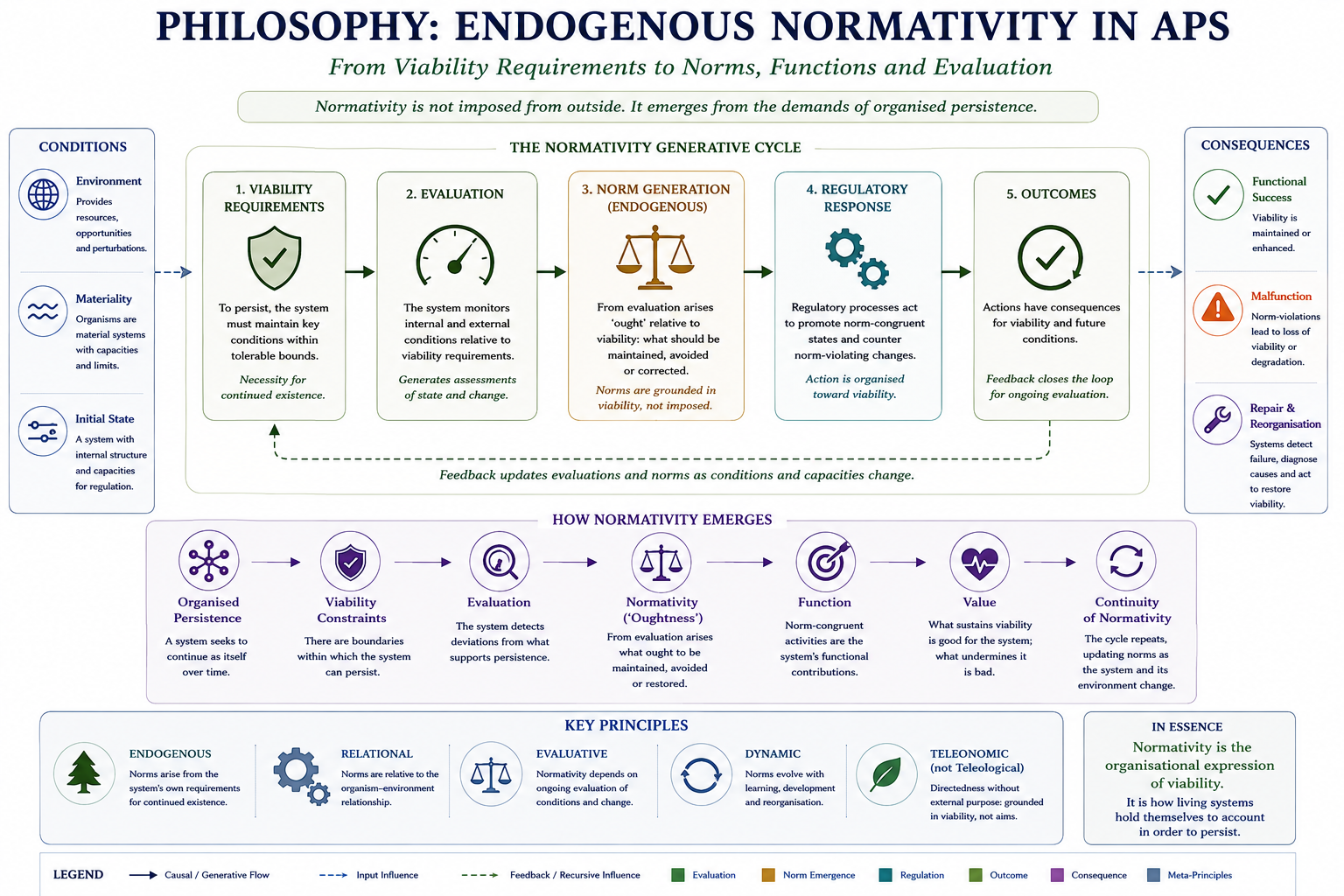
Endogenous Normativity in APS. Normativity emerges because organised persistence establishes real asymmetries between continuity-supporting and continuity-undermining organisational conditions.
Function and Mechanism
If mechanisms explain how biological processes occur, what makes some mechanisms biological functions?
Mechanistic explanation has become one of the defining achievements of modern biology. Metabolic pathways, gene regulatory networks, immune responses, developmental systems, neural circuits, and behavioural processes are all investigated by identifying the mechanisms through which they operate. These explanations reveal how biological activities are materially realised.
Yet an important philosophical question remains. If every biological process can be described mechanistically, what distinguishes those mechanisms that constitute biological functions from those that are merely causal events?
APS argues that mechanistic explanation is indispensable but not explanatorily self-sufficient. Mechanisms explain how biological processes occur. They do not by themselves explain why particular mechanisms contribute to the continued organisation of a living system.
Within APS, mechanisms become biologically functional because they participate in viability-oriented organised persistence. A metabolic pathway, neural circuit, immune response, developmental process, or behavioural pattern is biologically functional insofar as it contributes to maintaining or re-establishing the organisational conditions through which a living system persists across changing circumstances.
Mechanisms therefore acquire biological significance through their organisational roles within living systems. They contribute to viability maintenance, continuity regulation, repair, adaptive reorganisation, evaluation, semiosis, and other activities that preserve organised persistence.
APS therefore does not oppose mechanistic biology. Rather, it situates mechanistic explanation within a broader organisational account of living systems. Mechanisms explain how functional activities are realised, while organisational explanation clarifies why those mechanisms together constitute the viability-oriented persistence of a living organism.
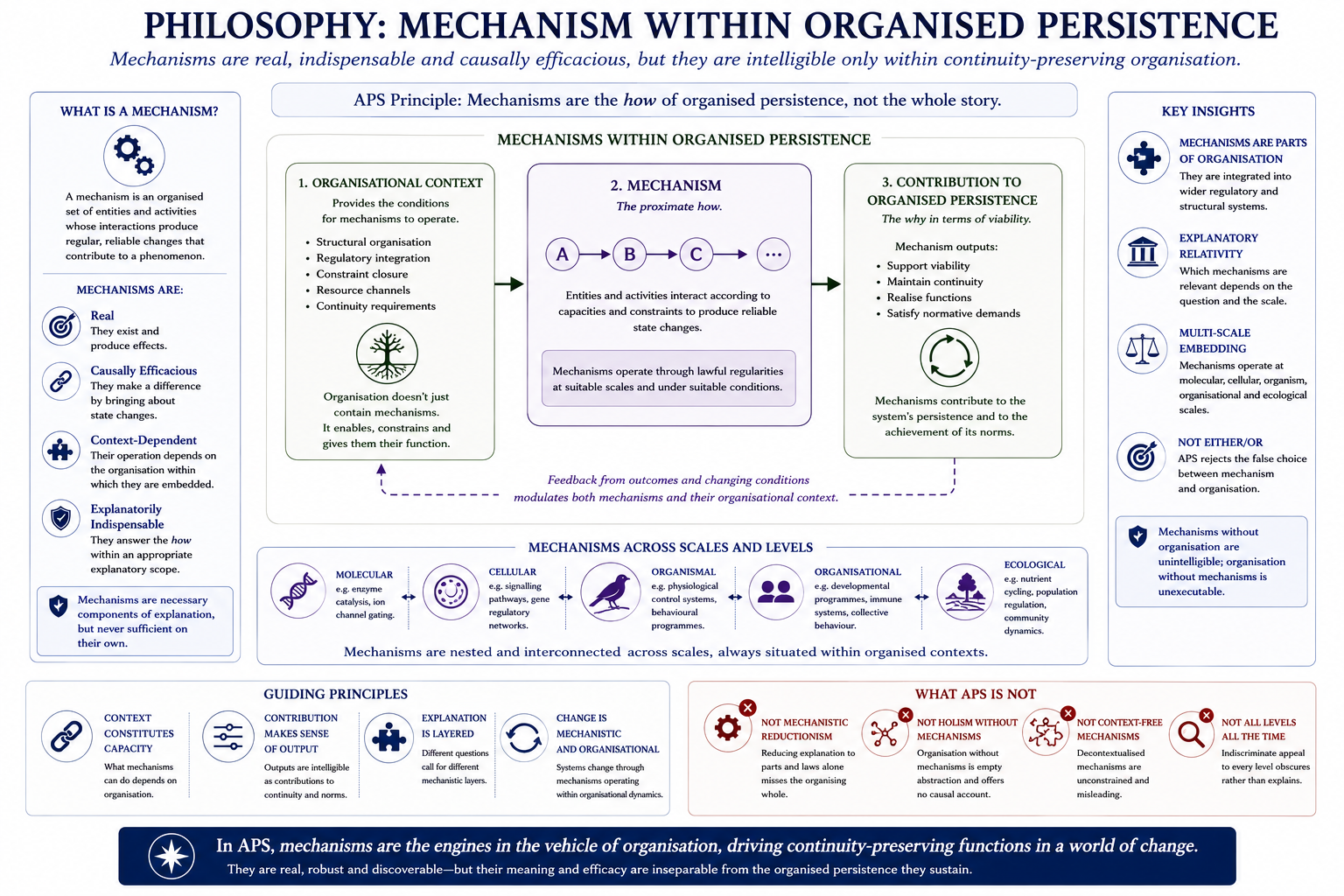
Mechanism Within Organised Persistence. Mechanisms become biologically intelligible through their contribution to continuity-preserving viability-oriented organisation.
Function and Temporal Organisation
Can a biological function be understood at a single moment in time?
Living systems exist in continual flux. Their components undergo ongoing material turnover, energetic exchange, developmental transformation, ecological interaction, and adaptive reorganisation. Yet despite this continual change, the functions through which living systems persist exhibit continuity across time rather than existing as isolated events.
This raises an important biological question. If living organisation is continuously changing, in what sense can biological functions remain the same?
APS argues that biological functions are inherently temporal. A process is functional not because of what it achieves at a single instant, but because of its contribution to maintaining or re-establishing viability-oriented organised persistence through time. Function therefore depends upon ongoing organisational continuity rather than static structural identity.
This temporal organisation is expressed through multiple, interacting processes, including continuity maintenance, developmental reconstruction, adaptive reorganisation, ecological coordination, and persistence-preserving regulation distributed across different timescales. Functional organisation therefore extends beyond individual events to encompass the dynamic organisation through which living systems preserve themselves across continual transformation.
Understanding function in this way explains why living systems can remain organisationally continuous despite continual material and environmental change. Biological functions are organised across time because the persistence they sustain is itself an ongoing organisational achievement.
Functions contribute to organised persistence by participating in temporally coordinated continuity-preserving organisation across changing conditions.
Normativity and Viability
Why do biological functions have standards of success and failure?
One of the distinctive features of biological functions is that they can succeed or fail. Hearts may pump effectively or inadequately, immune systems may preserve viability or permit disease, developmental processes may stabilise or become disrupted, and regulatory systems may maintain continuity or contribute to organisational collapse. Biological explanation therefore depends upon real distinctions between better and worse organisational outcomes.
This raises an important philosophical question. If biology does not appeal to externally imposed purposes or conscious evaluation, where do these standards of success and failure originate?
APS argues that biological normativity emerges directly from viability-oriented organised persistence. Living systems exist under conditions in which continuity may be maintained or lost, regulation may stabilise or degrade, organisation may persist or collapse, and viability may be preserved or undermined. These organisational asymmetries are not imposed by observers; they are intrinsic features of living organisation itself.
Normativity therefore does not depend upon conscious judgement, symbolic representation, external evaluation, or independently imposed standards. It arises because living systems are organised around the continual maintenance and re-establishment of the conditions required for their own persistence. Organisational states matter differently because they contribute differently to continued viability.
Understanding normativity in this way explains why biological functions possess genuine standards of success and failure without invoking external purposes or mental evaluation. Functional organisation is normative because the organisation of life itself establishes real asymmetries between continuity-preserving and continuity-undermining conditions.
Function and Biological Agency
How are biological functions actively maintained rather than merely possessed?
Biological functions are not static properties of living systems. They must be continually enacted, regulated, modified, and, when necessary, re-established if organised persistence is to continue. This raises an important question. If functions contribute to viability, what organises and sustains those contributions as conditions continually change?
APS answers this question through biological agency. Agency is the ongoing viability-oriented organisational activity through which living systems regulate and coordinate the processes that maintain their own persistence. Functions therefore do not simply exist within organisms; they are continually enacted through the active organisation of living systems.
This organisational activity extends across many domains of biological organisation, including metabolism, behaviour, development, ecological interaction, evaluation, semiosis, and organisational reconstruction. In each case, activity is continuously modulated relative to conditions affecting continued viability.
Agency therefore operationalises both function and normativity. Functional organisation is not passively present but continually regulated, reorganised, reinforced, compensated for, and reconstructed as living systems respond to changing internal and external conditions. Through this ongoing activity, agency preserves the organisational continuity upon which biological function depends.
Agency therefore integrates function, normativity, adaptation, evaluation, semiosis, and continuity-preserving organisation within one unified process of viability-oriented activity. It is through agency that functional organisation becomes an active and continuously maintained feature of living systems rather than a static property of biological structures.
Function and Evaluation
How do biological functions become operationally significant to living systems?
Biological functions do more than contribute to organised persistence. Living systems must also regulate those functions continuously in response to changing internal and external conditions. This raises an important question. If biological functions establish standards of success and failure, how are those standards translated into the ongoing regulation of living activity?
APS answers this question through biological evaluation. Evaluation is the principal operational expression of biological normativity. Through evaluation, living systems continually differentiate conditions that support continued viability from those that threaten it, thereby modulating activity relative to the requirements of organised persistence.
This evaluative organisation extends across all forms of life. Living systems continually distinguish favourable from unfavourable conditions, stabilising from destabilising activities, and continuity-supporting from continuity-threatening organisational relations. Evaluation therefore enables living systems to regulate their activity in ways that preserve or re-establish the conditions required for continued viability.
Evaluation does not require conscious reflection, symbolic representation, or deliberate judgement. Even the simplest organisms modulate their activity relative to conditions affecting persistence. Biological evaluation is therefore a fundamental organisational process through which agency enacts the normativity inherent in living organisation.
Without evaluation, living systems could not regulate persistence effectively across changing conditions. Evaluation operationalises biological normativity by continuously modulating activity in relation to viability-oriented organised persistence.
Function and Semiosis
How do biologically significant differences become meaningful to living systems?
Living systems continually encounter differences in their internal and external environments. Environmental signals, chemical gradients, mechanical interactions, and ecological conditions all vary through time. Yet only some of these differences influence the organisation of continued viability. This raises an important question. If evaluation distinguishes conditions that matter biologically, how do those differences become organised as meaningful aspects of a living system’s activity?
APS answers this question through semiosis. Semiosis is the organisational process through which biologically significant differences become integrated into the regulation of viability-oriented activity. Differences become meaningful because they contribute differently to the maintenance or disruption of organised persistence.
Meaning therefore does not originate in detached symbolic representation or abstract interpretation alone. It emerges from the organisation of living systems themselves. Environmental signals, chemical gradients, mechanical relations, and ecological cues acquire biological meaning because they influence the conditions under which organised persistence can be maintained or re-established.
Semiosis therefore depends upon function, normativity, agency, and biological evaluation. Function establishes organisational contributions to persistence. Normativity explains why those contributions matter. Agency actively regulates them. Evaluation differentiates conditions according to their significance for viability. Semiosis organises those biologically significant differences into coordinated activity directed towards continued persistence.
APS therefore understands semiosis not as the origin of biological meaning but as the organisational expression of evaluative significance within viability-oriented organised persistence.
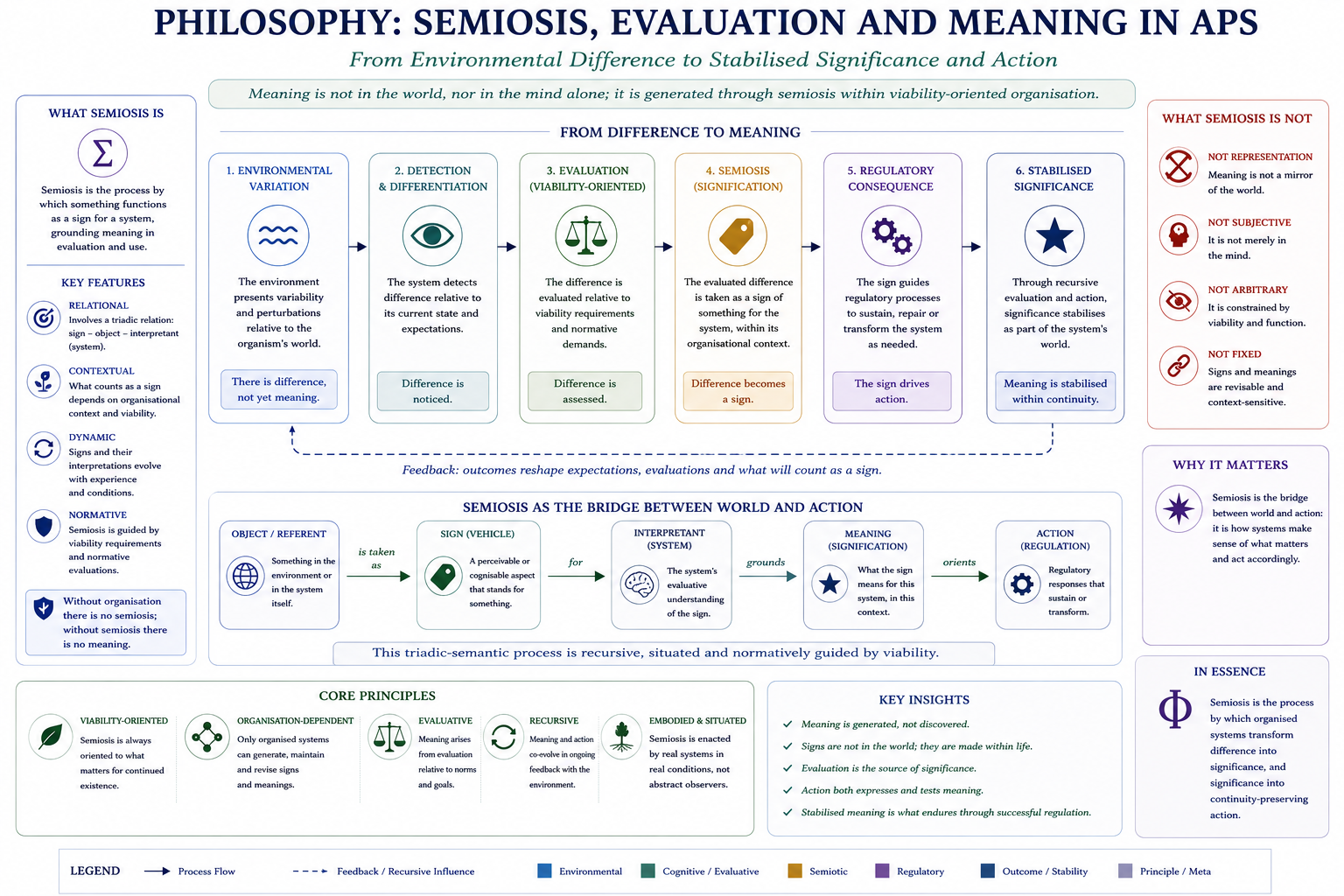
Semiosis and Evaluative Meaning. Differences become biologically meaningful because they matter differently relative to viability-oriented organised persistence.
Function, Malfunction, and Breakdown
How can biological functions fail while remaining biological functions?
One of the defining features of biological functions is that they can malfunction. Hearts may pump inadequately, regulatory systems may become unstable, developmental processes may be disrupted, and repair mechanisms may fail to restore organisational integrity. Yet these processes remain recognisably biological functions even when they no longer contribute effectively to continued viability.
This raises an important explanatory question. If biological functions are defined by their contribution to organised persistence, how can they retain their identity when those contributions become impaired?
APS argues that malfunction is an organisational phenomenon rather than merely an observer’s judgement. Biological functions are defined by their viability-oriented organisational role. Malfunction occurs when the organisation responsible for sustaining persistence no longer contributes adequately to that role, whether through degradation, disruption, or failure of coordination. The function remains identifiable because the organisational relation persists even though its effectiveness has been compromised.
Breakdown may therefore occur through failed repair, destabilised regulation, degraded coordination, disrupted development, or other failures of organisational integration. These failures reveal intrinsic distinctions between continuity-preserving and continuity-undermining organisational states, viable and non-viable trajectories, and effective and ineffective functional organisation.
Understanding malfunction in this way explains why biological normativity becomes especially apparent when organised persistence is threatened. Malfunction is not simply the absence of successful function or the projection of external evaluative standards. It is the organisational expression of disrupted viability within living systems themselves.
Function and Adaptation
How do biological functions remain continuous while living systems continually change?
Living systems exist in environments that are constantly changing. Internal organisation is continually modified through development, physiological regulation, ecological interaction, and responses to environmental variation. Yet despite this continual change, living systems preserve the functional organisation required for continued viability. This raises an important biological question. If biological functions are continuously reorganised, in what sense do they remain the same functions?
APS argues that biological functions are adaptive because they are organisational rather than structurally fixed. Living systems preserve continuity not by maintaining identical components or behaviours, but by continually reorganising the activity through which viability-oriented organised persistence is sustained.
This adaptive organisation is expressed through physiological compensation, behavioural flexibility, developmental plasticity, ecological responsiveness, and continuity-preserving reconstruction. As conditions change, functional relations may shift, compensate for degraded organisation, redistribute activity, or reorganise the conditions under which persistence can be maintained. Adaptation therefore preserves organisational continuity through ongoing reorganisation rather than through static structural constancy.
Understanding function in this way explains why biological organisation remains both stable and flexible. Functional continuity does not require organisational immobility. Instead, living systems preserve themselves by continually reconstructing the organisation through which viability is maintained across changing internal and external conditions.
Function and Ecological Coupling
Where are biological functions organised?
Biological functions are often described as properties of organisms alone. Yet living systems exist only through continual exchange with their environments. Metabolism depends upon environmental resources, behaviour is shaped by ecological conditions, development unfolds within environmental contexts, and regulation continually responds to external change. This raises an important biological question. Are biological functions entirely internal to organisms, or are they organised across organism–environment relations?
APS argues that biological functions emerge through organism–environment coupling. Living systems maintain viability not in isolation but through continuous organisational interactions with the conditions that support their persistence. Environmental relations therefore participate directly in the organisation through which living systems preserve themselves across time.
This coupled organisation is expressed through metabolic organisation, behavioural regulation, developmental continuity, ecological persistence, biological evaluation, semiosis, and adaptive reorganisation. These processes depend upon continual interactions between organisms and their environments rather than upon internally isolated mechanisms alone.
Understanding function in this way explains why organised persistence extends across organism–environment systems without dissolving the organism as the primary locus of biological agency. Environmental conditions contribute directly to the organisation of continued viability because they participate in the constraints through which living systems actively maintain themselves. Biological functions are therefore best understood as organisational achievements realised through ongoing ecological coupling.
Function Across Scale and Time
How are biological functions organised across different spatial and temporal scales?
Biological functions are realised through processes that extend across multiple spatial and temporal scales. Molecular interactions contribute to cellular organisation, cells sustain the persistence of organisms, organisms participate in ecological systems, and ecological conditions influence developmental and evolutionary trajectories. This raises an important biological question. If functional organisation spans these diverse domains, how should biology understand the relationship between them?
APS argues that biological functions are organised across interacting scales of biological organisation rather than being confined to isolated mechanisms or localised components. Organised persistence is maintained through coordinated relations extending across molecular, cellular, organismal, ecological, developmental, and evolutionary domains. Each contributes to the ongoing organisation through which viability is maintained.
These organisational relations remain interconnected across both space and time. Local processes occur under conditions shaped by wider organisational relations, while wider organisational continuity depends upon the continued activity of constituent processes. Biological explanation therefore requires understanding how organisational constraints are coordinated across interacting scales without replacing the causal contribution of local mechanisms.
Function cannot therefore be reduced to isolated mechanisms, single explanatory domains, or localised biological components alone. Biological functions are organised through continuity-preserving relations extending across interacting spatial and temporal scales, providing an integrated account of how living systems maintain viability across the full organisation of life.
Function and Diagnosis
How does an organisational understanding of function inform biological investigation?
A theory of biological function should do more than provide conceptual clarity. It should also help explain how living systems can be investigated, interpreted, and diagnosed. This raises an important practical question. If biological functions are organisational contributions to viability-oriented persistence, what follows for empirical biological investigation?
APS argues that function has direct diagnostic significance because organised persistence can be maintained, disrupted, compensated for, or restored in identifiable ways. Living systems may therefore be understood through patterns of continuity-preserving regulation, reconstructive organisation, adaptive compensation, biological evaluation, semiotic responsiveness, and coordinated viability-oriented activity. These organisational processes provide evidence of how living systems actively maintain themselves across changing conditions.
Diagnosis consequently involves more than identifying structural abnormalities or isolated mechanistic failures. It also requires recognising disruptions in the organisation through which continued viability is sustained. Functional degradation, impaired regulation, disrupted continuity, failures of organisational reconstruction, and degraded evaluative organisation each reveal different ways in which organised persistence may become compromised.
Understanding function in this way establishes an important bridge between APS’s explanatory architecture and empirical biological investigation. Rather than treating diagnosis as the identification of defective components alone, APS interprets diagnosis as the investigation of how organisational processes contribute to, or fail to contribute to, the maintenance and re-establishment of viability-oriented organised persistence.
Why Function and Normativity Matter
Why does resolving the problem of biological function matter?
The debate over biological function is not merely a question of terminology. How biology understands function shapes how it explains purposiveness, normativity, adaptation, malfunction, meaning, and the organisation of living systems more generally. A satisfactory account of function should therefore illuminate many of biology’s central conceptual questions rather than addressing function in isolation.
APS argues that understanding biological function as a viability-oriented organisational contribution to organised persistence provides precisely this broader explanatory framework. Because function is grounded in the ongoing maintenance and re-establishment of viability, it naturally explains why biological organisation exhibits genuine standards of success and failure, how purposiveness arises without external design or vitalism, and why living systems continuously regulate their own organisation across changing conditions.
This organisational perspective also clarifies how biological significance emerges through evaluation, how semiosis organises biologically meaningful differences, how adaptation preserves continuity through continual reconstruction, how mechanisms contribute to organised persistence, and why malfunction represents a genuine disruption of living organisation rather than merely an observer’s judgement.
Understanding function in this way therefore unifies a series of problems that have often been treated independently. Rather than requiring separate explanations for purposiveness, normativity, evaluation, semiosis, adaptation, malfunction, and biological meaning, APS shows how each follows from the organisation of viability-oriented persistence itself.
APS therefore naturalises biological significance through viability-oriented organised persistence, providing an integrated organisational account of function and normativity within living systems.
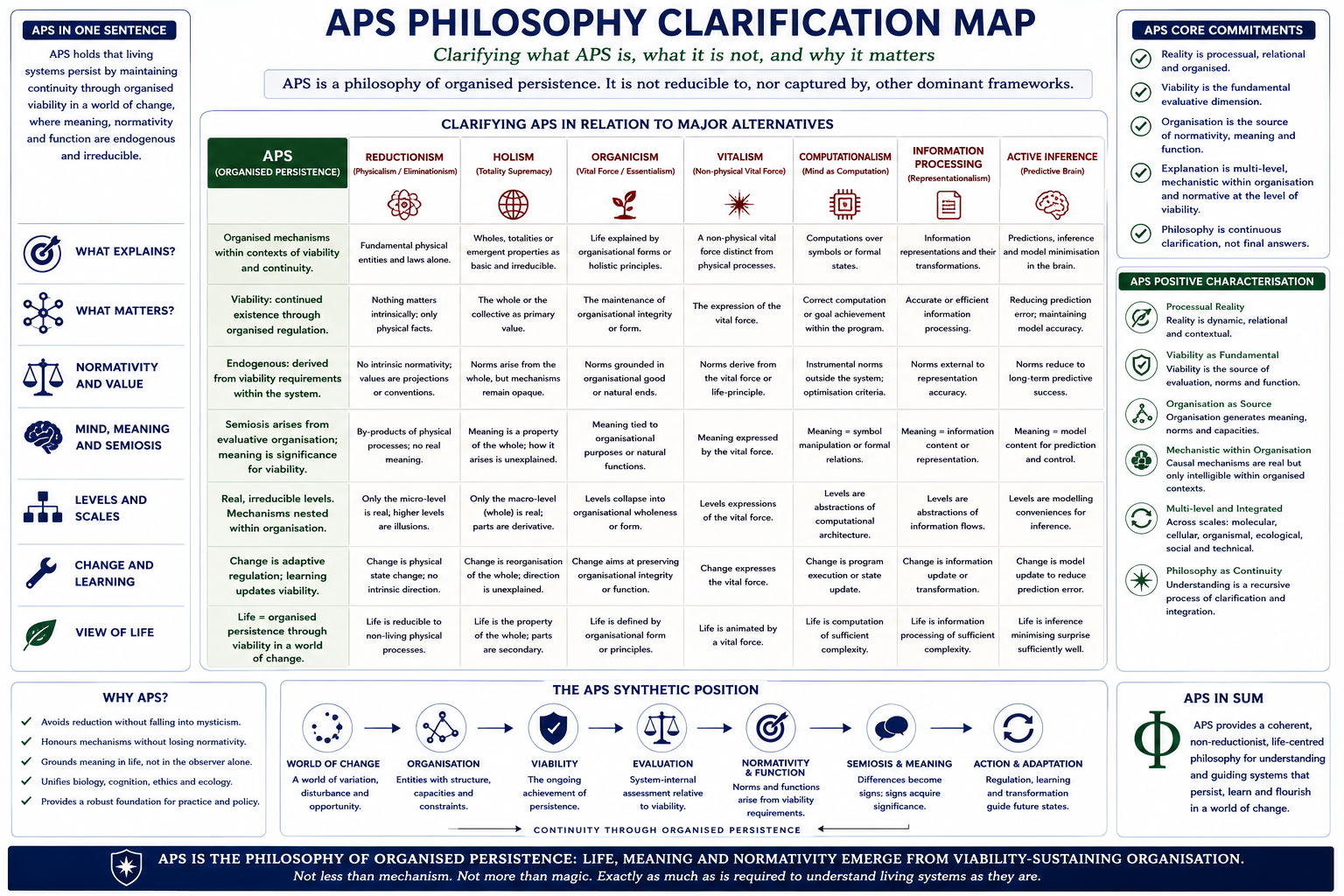
APS Clarification Map. APS naturalises normativity, function, semiosis, and meaning through viability-oriented organised persistence without reductionism, vitalism, or externally imposed teleology.
The question is therefore no longer simply what biological functions are, but what understanding biological function reveals about the organisation of life itself.
Conclusion
What makes a biological process a function rather than merely something that happens? This article has argued that biological functions are organisational contributions to viability-oriented organised persistence. A process is functional because it participates in the continual maintenance and re-establishment of the conditions through which a living system persists.
Understanding function in this way also explains why biological normativity is an intrinsic feature of life rather than an externally imposed standard. Living systems exist under conditions in which organised persistence can succeed or fail, continuity can be maintained or disrupted, and viability can be preserved or lost. These organisational asymmetries establish genuine standards of biological success and failure without appealing to external purposes, conscious judgement, or symbolic representation.
From this organisational foundation follow many of the phenomena that have traditionally required separate explanations. Agency enacts functional organisation, evaluation operationalises biological normativity, semiosis organises biologically significant differences, adaptation reconstructs continuity across changing conditions, and malfunction reveals disruptions in the organisation of viability. Biological function therefore provides a unifying explanatory framework through which these phenomena become intelligible as interdependent aspects of viability-oriented organised persistence.
APS consequently naturalises function and normativity by showing how biological significance arises through the organisation of life itself. Biological explanation is therefore directed not simply towards identifying mechanisms or describing evolutionary histories, but towards understanding how living systems actively maintain and re-establish the organisational conditions of their own persistence across time, across interacting organisational domains, and through continual engagement with their environments.
Key Point
Biological functions are organisational contributions to viability-oriented organised persistence. They matter because living systems continuously enact, regulate, and reconstruct the conditions through which their own persistence remains possible.
See Also
Related Articles
References
- (2007). Explaining the Brain: Mechanisms and the Mosaic Unity of Neuroscience. Oxford University Press. https://doi.org/10.1093/acprof:oso/9780199299317.001.0001
- (1975). Functional Analysis. The Journal of Philosophy, 72(20), 741–765 . https://doi.org/10.2307/2024640
- (2016). A Critical Overview of Biological Functions. Springer. https://doi.org/10.1007/978-3-319-32020-5
- (2019). What Biological Functions Are and Why They Matter. Cambridge University Press. https://doi.org/10.1017/9781108560764
- (1993). Functions: Consensus Without Unity. Pacific Philosophical Quarterly, 74(3), 196–208 . https://doi.org/10.1111/j.1468-0114.1993.tb00358.x
- (1984). Language, Thought, and Other Biological Categories: New Foundations for Realism. MIT Press.
- (2015). Biological Autonomy: A Philosophical and Theoretical Enquiry. Springer. https://doi.org/10.1007/978-94-017-9837-2
- (2017). What Makes Biological Organisation Teleological?. Synthese, 194(4), 1089–1114 . https://doi.org/10.1007/s11229-014-0594-z
- (2009). An Organizational Account of Biological Functions. The British Journal for the Philosophy of Science, 60(4), 813–841 . https://doi.org/10.1093/bjps/axp036
- (1991). Functions as Selected Effects: The Conceptual Analyst's Defense. Philosophy of Science, 58(2), 168–184 . https://doi.org/10.1086/289610
- (2018). Everything Flows: Towards a Processual Philosophy of Biology. Oxford University Press. https://doi.org/10.1093/oso/9780198779636.001.0001
- (2026). Agency as the Defining Activity of Life: A Viability-Oriented Framework Integrating Process and Scale. Biological Theory . https://doi.org/10.1007/s13752-026-00547-6
- (1973). Functions. The Philosophical Review, 82(2), 139–168 . https://doi.org/10.2307/2183766