Organism–Environment Coupling — Distributed Persistence Across Living Systems
This article develops an APS account of organism–environment coupling as a materially realised relation through which living systems and environmental conditions can affect one another in ways relevant to organised persistence. APS rejects both the treatment of organisms as explanatorily self-contained and the stronger claim that organism and environment universally form a single coupled system. Organism–environment relations may contribute constitutively to particular biological explananda, but coupling does not itself generate agency, significance, cognition, continuity, or multiscale organisation. Its explanatory relevance depends on the biological target, the material relations involved, the difference those relations make, and the spatial and temporal extent required to explain them.
Key Points
- Organism–environment coupling consists in materially realised relations between living systems and environmental conditions.
- Some organism–environment relations can be constitutively relevant to conditions of organised persistence.
- Coupling can support, reorganise, or undermine conditions relevant to viability; it is not intrinsically persistence-promoting.
- Biological agency can modulate organism–environment relations, but coupling does not generate agency.
- Organism–environment differences acquire biological significance through Biological Evaluation, not through coupling alone.
- Coupling, ecological embeddedness, responsiveness, significance, or semiosis do not by themselves establish cognition.
- Scale identifies the spatial and temporal extent required to explain materially relevant coupling relations; scales themselves do not couple.
- The explanatory contribution of coupling must be established relative to a specified explanandum and comparator.
Introduction
Where this article fits: Ecology as Organised Persistence Across Scales establishes how APS determines the spatial and temporal extent required for an ecological explanation, while Ecological Organisation and Organised Persistence examines the organisational significance of materially realised organism–environment relations. This article focuses more specifically on coupling itself: what organism–environment coupling consists in, how such relations can matter to organised persistence, and when their inclusion contributes to biological explanation. Coupling is a materially realised relation, not a fourth APS projection or a mechanism that integrates Agency, Process, and Scale.
Biological explanation often begins by distinguishing an organism from the environment in which it lives. That distinction is indispensable for many purposes, but it does not follow that the organismal boundary must also mark the boundary of every adequate explanation. Living systems continuously exchange matter and energy with their surroundings, encounter and respond to physical and biotic conditions, modify local environments, construct niches, and alter conditions that affect their own subsequent activity or that of other organisms. Environmental conditions, in turn, can alter physiology, development, behaviour, resource availability, exposure, and other features relevant to continued functioning.
Organism–environment coupling names these materially realised relations. Its importance lies neither in denying organismal individuality nor in replacing organisms with an undifferentiated organism–environment whole. The explanatory question is more precise: which relations connect a living system to environmental conditions, how are those relations materially implemented, and what difference do they make to the biological phenomenon under investigation?
APS therefore approaches coupling through a governing question:
What is coupled to what, through which materially realised relation, and what difference does that relation make to the biological explanandum?
Organism–Environment Coupling as a Material Relation
Organism–environment coupling is best understood as a class of materially realised relations rather than as an explanatory principle in its own right. Energetic and material exchange, resource acquisition, exposure to physical conditions, biotic interaction, environmental modification, niche construction, developmental dependence, signalling relations, and responses to perturbation can all instantiate forms of coupling. What gives these relations explanatory importance is not the general fact that an organism is connected to an environment, but the particular organisation through which one materially realised condition alters another.
An organism may, for example, change nutrient availability, soil structure, chemical composition, local temperature, habitat configuration, or patterns of resource distribution. Environmental conditions may alter metabolic activity, developmental trajectories, movement, physiological regulation, exposure to hazards, or opportunities for continued functioning. Such effects can be reciprocal without being symmetrical: the organism and environment need not make equivalent contributions, nor need their interaction benefit either party. Coupling can stabilise a relevant condition, reorganise it, or contribute to its disruption.
The concept therefore becomes explanatory only when its material basis is specified. To say that an organism and environment are coupled is a description of relation; to explain a biological phenomenon through coupling requires identifying what is related, how the relation is implemented, and why that relation matters to the target being explained. In this sense, organism–environment coupling is biologically real but does not constitute an independent causal power beyond the processes, constraints, exchanges, and interactions through which it is realised.
Beyond Strict Internal–External Separation
Recognising organism–environment coupling changes the role of the internal–external distinction without abolishing it. APS does not treat every environmental condition on which an organism depends as part of the organism itself. A living system remains a viability-oriented, constraint-closed organisation whose activities, constraints, and persistence can be distinguished from the wider conditions within which that organisation is realised. At the same time, some explananda cannot be adequately understood if materially relevant relations beyond the organismal boundary are excluded in advance.
This is particularly important where external conditions contribute constitutively to the phenomenon being explained. A developmental outcome, physiological state, behavioural possibility, or ecological relation may depend on environmental features that are not internal components of the organism yet nevertheless form part of the material conditions required for the phenomenon to occur. Their explanatory inclusion does not dissolve the organism–environment distinction; it shows that ontological boundary and explanatory boundary need not coincide.
The appropriate APS conclusion is therefore limited but consequential:
The organism boundary is not necessarily the explanatory boundary.
Where materially realised relations beyond the organism make a demonstrable difference to the target, they belong within the explanation. Where they do not, a more bounded account may be entirely adequate. Organism–environment coupling therefore challenges strict explanatory isolation without committing APS to relational holism or to the view that organism and environment universally constitute a single biological individual.
Coupling and Viability
The biological relevance of organism–environment coupling is most clearly understood in relation to viability. Coupling itself is not viability-oriented: that orientation belongs to living organisation and to the activity through which living systems maintain and re-establish the conditions of their own persistence. Environmental relations become viability-relevant when they alter conditions that make a difference to that organisation.
A nutrient supply may support metabolic continuity; temperature may alter physiological viability; predation may undermine persistence; microbial relations may support or disrupt developmental and metabolic organisation; and environmental modification by an organism may improve, worsen, or simply transform the conditions under which later activity occurs. The same formal category of coupling can therefore be associated with very different consequences. There is no general reason to assume that organism–environment interaction is persistence-promoting.
For this reason, APS should not describe viability as universally “co-produced” by organism and environment. The stronger and more precise claim is that conditions relevant to viability can depend partly upon materially realised organism–environment relations. Those relations may support persistence, reorganise the conditions under which persistence continues, or undermine them. Their significance must therefore be determined from the organisation and explanandum in question rather than inferred from the existence of coupling itself.
Coupling and Biological Significance
Organism–environment relations also help clarify how environmental differences can become biologically significant. Physical differences do not matter to a living system merely because they exist or because the organism is materially connected to them. Their significance depends upon how they are related to viability through the activity of the living organisation.
APS locates this transition in Biological Evaluation. Biological agency encounters differences whose consequences for organised persistence are not equivalent, and evaluative activity generates significance by differentiating among those conditions relative to viability. A chemical gradient, resource distribution, physical structure, predator cue, microbial condition, or environmental perturbation can therefore become significant when the activity of the living system differentiates it in relation to the maintenance or re-establishment of persistence.
The relation can be expressed schematically as:
organism–environment difference → Biological Evaluation → biological significance
Coupling provides the materially realised relation within which a relevant difference may occur; it does not itself generate significance. This distinction matters because otherwise the presence of an environmental relation could be mistaken for the existence of biological meaning. Not every environmental difference matters to every organism, and not every coupling relation enters evaluative organisation. Significance is relationally real, but it is generated through Biological Evaluation rather than supplied by the environment or by coupling as such.
Coupling and Biological Agency
The connection between coupling and agency follows from the same distinction. Biological agency is viability-oriented organisational activity. Because organisms act in materially realised environments, that activity can include the modulation of organism–environment relations: movement changes exposure to conditions, behaviour alters access to resources, physiological regulation modifies exchanges across boundaries, and niche construction can transform aspects of the environment encountered later by the same or other organisms.
These activities show why agency cannot be adequately understood as detached from material context. They do not, however, imply that coupling produces agency or that agency becomes spatially distributed into the environment whenever organismal activity has environmental consequences. The agentive activity remains the viability-oriented activity of living organisation; the organism–environment relation is one material domain through which that activity can operate.
Environmental conditions can constrain, enable, perturb, or otherwise alter the possibilities available to agency, and the material organisation of those conditions can therefore be indispensable to particular explanations of agentive activity. Yet the analytic distinction remains clear: Agency asks what living organisation does, whereas organism–environment coupling identifies relations through which some of that activity is materially realised.
Coupling and Development
Development provides an important case in which organism–environment relations can be constitutively significant without being universally explanatory. Nutritional conditions, temperature, microbial relations, physical environments, social interaction, ecological perturbations, and other environmental features can alter developmental trajectories. Where such relations make a difference to a developmental explanandum, they belong within the explanation rather than being treated merely as background context.
This dependence does not make development intrinsically or uniformly ecological. Some developmental questions can be answered through relatively bounded accounts of cellular, physiological, genetic, or other organismal processes; others require environmental relations that extend beyond the organismal boundary. What matters is not whether development “unfolds through coupling” in the abstract, but which material relations are necessary to explain the particular developmental phenomenon under investigation.
APS therefore treats ecological contribution to development as an empirical and explanatory question. The task is to identify the environmental conditions, exchanges, constraints, or interactions that make a difference to developmental organisation and then determine the spatial and temporal extent required to explain them. This preserves the importance of environmental scaffolding without turning it into a universal definition of development.
Coupling, Semiosis, and Cognition
Organism–environment coupling can also provide the material setting within which differences become significant and, in some systems, enter semiotic or cognitive organisation. A cue, gradient, chemical relation, structural feature, or behavioural indicator may matter because biological evaluation differentiates it relative to viability. In this qualified sense, organism–environment relations can contribute to the conditions under which semiosis occurs.
The existence of coupling does not, however, establish semiosis. Physical interaction alone is insufficient, and a relation becomes semiotically relevant only where differences participate in organised significance-bearing activity. The same caution applies more strongly to cognition. Ecological embeddedness, responsiveness, behavioural flexibility, biological significance, or temporal persistence cannot individually or collectively be treated as sufficient evidence that a system is cognitive.
APS locates cognition within a more specific organisational pathway:
Agency → Biological Evaluation → Significance → Integration → Cognition
Biological Evaluation generates significance; cognition requires the further integration of that significance across time. Biological agency becomes cognitive when integrated biological significance modulates activity across a temporal field of viability-relevant possibilities in ways not exhausted by immediate or fixed regulation. Organism–environment coupling may supply material conditions and differences that enter such organisation, but the relation itself does not constitute cognition.
This boundary is especially important because ecological responsiveness can be sophisticated without crossing the cognitive threshold. APS therefore recognises the importance of organism–environment relations to cognitive explananda while preserving a distinction between coupling, biological significance, semiosis, and cognition.
Coupling and Adaptation
Organism–environment relations can contribute to adaptive change, but the explanatory role of coupling depends on which sense of adaptation is at issue. Present-tense adaptive reorganisation concerns changes in activity through which living systems respond to altered conditions. Developmental plasticity concerns changes in phenotype that arise through development. Evolutionary adaptation concerns historically transformed populations or lineages. These phenomena may interact, but they are not interchangeable consequences of one general coupling process.
Environmental change can alter the circumstances under which organismal activity remains viable, while organisms can modify behaviour, physiology, development, or local environmental conditions in ways that transform those circumstances. Such relations may be central to explaining particular adaptive responses. Across generations, ecological conditions may also contribute to selection, inheritance, developmental context, or other features relevant to evolutionary adaptation.
The APS task is therefore to specify the target and the material relation rather than to claim that adaptation operates across multiple scales as a general property. Where a broader spatial or temporal extent is required, that requirement must follow from the relations that make a difference to the explanandum.
Coupling and Evolution
Evolutionary processes occur in lineages whose organisms are materially situated within environments, and ecological relations can therefore make an important contribution to evolutionary explanation. Organisms modify resource distributions, developmental environments, ecological interactions, and other persistence conditions, while evolutionary transformation can alter the capacities and activities through which organisms engage with those environments. The resulting historical reciprocity can matter greatly in particular evolutionary cases.
This does not make ecological and evolutionary continuity universally inseparable. The explanatory importance of organism–environment coupling depends on the evolutionary explanandum. Some questions require close attention to environmental modification, ecological interaction, or developmental conditions; others may be adequately addressed through a more bounded set of evolutionary relations. No general methodological rule should decide that question in advance.
APS therefore treats ecology and evolution as potentially connected explanatory domains rather than as necessarily fused ones. Ecological relations can contribute materially to evolutionary explananda, and evolutionary transformation can reorganise organism–environment relations. Whether both are required in a particular explanation must be established from the target.
Coupling and Explanatory Extent
Organism–environment relations are realised in space and through time, sometimes within relatively narrow boundaries and sometimes through relations that extend considerably beyond the immediate organism, locality, or moment. This material extension must be distinguished from the explanatory role assigned to Scale in APS.
Scale is the analytic projection concerned with where persistence is organised across spatial and temporal extents. It does not denote a hierarchy of interacting biological levels, and scales themselves do not couple. In an organism–environment explanation, the relevant sequence begins with the explanandum, identifies the materially realised relations that make a difference to it, and only then determines the spatial and temporal extent needed to include those relations.
The sequence can therefore be expressed as:
biological explanandum → materially relevant organism–environment relation → demonstrated explanatory difference → required spatial and temporal extent
Sometimes the relevant coupling relation will be adequately represented within a bounded explanatory domain. In other cases, additional environmental relations occurring farther away, over longer durations, or through historically extended interactions will be necessary. Broader explanatory extent is warranted only when those additional relations make a demonstrable difference to the target.
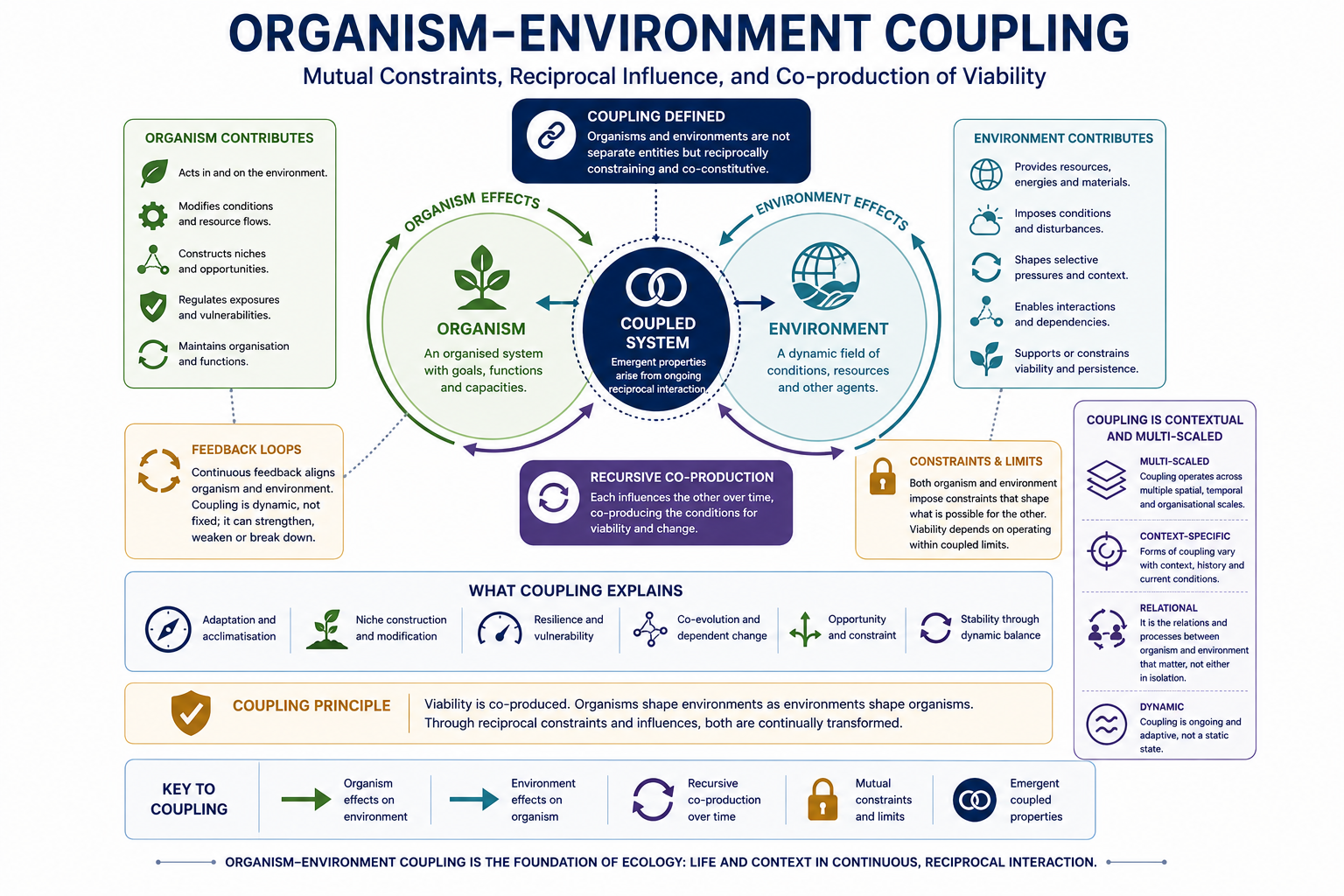
Organism–Environment Coupling and Explanatory Relevance. Organism–environment coupling consists in materially realised relations through which living systems and environmental conditions can affect one another. APS asks which of those relations make a difference to the specified biological explanandum and then identifies the spatial and temporal extent required to explain them. Coupling can support, reorganise, or undermine conditions relevant to persistence; broader explanatory extent is warranted only where additional materially realised relations make an explanatory difference to the target.
The resulting explanation may therefore remain bounded or require a broader, multiextent analysis. Neither outcome has priority in advance. A coupling relation may cross organismal or environmental boundaries; Scale identifies the extent needed to explain that relation but performs none of the coupling, coordination, constraint, or causal work itself.
Coupling and Constraint Organisation
Environmental relations frequently alter constraints relevant to biological persistence. Physical structure can restrict or enable movement, resource availability can constrain metabolic possibilities, temperature can alter physiological organisation, and biotic interactions can change the conditions under which organismal activity proceeds. Organisms can also modify some of these constraints through their own activity. In such cases, organism–environment coupling can be directly relevant to organisational explanation.
This relevance must nevertheless be distinguished from constraint closure. The fact that an organism depends upon an environmental condition, or that an external relation constrains its activity, does not establish that the environmental relation belongs to the constraint-closed organisation of the organism. Whether it does is a further organisational claim requiring evidence about the dependence and mutual maintenance of constraints, not merely evidence of ecological dependence.
The appropriate explanatory order is therefore to identify the material constraint, determine which biological process or condition it affects, and establish the resulting consequence for the explanandum. Scale can then identify the spatial and temporal extent required to represent those relations adequately. Organism–environment coupling can thus contribute to an explanation of constraint organisation without being described as automatically extending constraint closure beyond the organism.
Organism–Environment Coupling Within the APS Explanatory Grammar
APS approaches living organisation through Agency, Process, and Scale as analytic projections of one viability-oriented, constraint-closed organisation. They are not independent components, causal levels, or entities within the organism. Organism–environment coupling is likewise not an additional projection. It is a materially realised relation that can become relevant under different analytic perspectives depending on the explanatory target.
Agency asks what living organisation does. Where coupling matters, Agency can bring into focus viability-oriented activity through which a living system modulates relations with environmental conditions. Process asks how continuity is maintained despite change. In coupling explanations, this can require attention to exchanges, regulatory activities, constraints, interactions, and reorganisations through which persistence is maintained or re-established. Scale asks where persistence is organised across spatial and temporal extents; it identifies how far an explanation must extend to include the material organism–environment relations that matter to the explanandum.
No single coupling explanandum is required simply by virtue of being ecological to employ all three projections. Nor does the presence of organism–environment relations demonstrate that integration of Agency, Process, and Scale produces additional explanatory gain. Their relevance remains target-sensitive, and their explanatory contribution must be assessed rather than assumed.
Implications for Biological Explanation
The principal consequence of organism–environment coupling for biological explanation is therefore neither the replacement of organism-centred explanation nor the elevation of ecology into a universal explanatory framework. It is the more disciplined recognition that organismal boundaries should not determine explanatory boundaries in advance. Where environmental relations are materially constitutive of, or otherwise make a difference to, the target, they should be included; where they make no relevant difference, a more bounded account can remain sufficient.
This places a substantial burden on appeals to coupling. An adequate coupling explanation must identify the explanandum, specify the organism–environment relation involved, describe its material basis, establish the difference it makes to the target, and determine the spatial and temporal extent required to represent that relation. If APS is claimed to provide explanatory gain, the contribution must also be assessed against the strongest relevant comparator rather than inferred from the breadth or integrative character of the account.
Organism–environment coupling thus occupies an important but bounded position within APS. It provides a way of analysing materially realised relations that are easily obscured when organisms and environments are treated as explanatorily independent, while retaining organismal individuality, mechanistic specificity, and the possibility that a narrower explanation may sometimes be enough.
Conclusion
Organism–environment coupling is a materially realised feature of biological organisation. Living systems depend upon, respond to, and modify environmental conditions, and these relations can make an important difference to organised persistence. Some biological phenomena therefore cannot be adequately explained by considering an organism in isolation.
The significance of this conclusion lies in its precision. APS does not infer that organism and environment universally form one biological individual, that viability is jointly produced by a coupled system, or that coupling itself generates agency, significance, cognition, continuity, or multiscale organisation. Agency remains viability-oriented organisational activity; Biological Evaluation generates significance; cognition requires integrated biological significance organised across a temporally extended field of viability-relevant possibilities; and materially realised processes, interactions, and constraints perform the causal and organisational work. Scale identifies the extent across which those relations must be considered for the explanandum at hand.
Organism–environment coupling should therefore be understood neither as supplementary context nor as a universal explanatory principle. It is a material relation whose explanatory importance depends on what is being explained, how the relation is realised, and what difference its inclusion makes.
Coupling is a material relation; its explanatory significance is target-relative.
Explanatory Architecture
Central Question
When does a materially realised organism–environment relation contribute to explaining organised persistence, and how can that contribution be identified without treating coupling as a universal biological principle or as an interaction among scales?
Architectural Role
This article establishes the place of organism–environment coupling within APS ecological explanation. It identifies coupling as a materially realised relation through which living systems and environmental conditions can affect one another, while distinguishing that material relation from Agency, Process, Scale, Biological Evaluation, significance, cognition, and constraint closure. Its principal methodological contribution is to show that environmental relations should enter an explanation when they make a demonstrable difference to the explanandum, rather than because ecological extension or broader explanatory extent is assumed in advance.
Builds On
- Ecology as Organised Persistence Across Scales
- Ecological Organisation and Organised Persistence
- Biological Agency as the Activity of Self-Maintenance
- Constraint — How Organisation Becomes Persistence
- Temporal Organisation and Organised Persistence
- Persistence — Organised Continuity Through Time
Develops Into
- Organism–World Coupling — Why Agency Is Not Control
- Semiosis — How Differences Come to Matter in Living Systems
- Cognition — Where Does It Belong in Biology?
- Development as Organised Persistence
- Adaptation — How Living Systems Sustain Themselves Through Change
- Evolution as the Historical Transformation of Organised Persistence
Related Explanatory Questions
- When is an organism–environment relation constitutive of the explanandum rather than merely contextual?
- How can environmental conditions be viability-relevant without coupling itself becoming viability-oriented?
- How does Biological Evaluation transform organism–environment differences into biological significance?
- When do environmental relations belong within developmental, adaptive, cognitive, or evolutionary explanations?
- How does ecological dependence differ from participation in constraint closure?
- When does a coupling explanandum require broader spatial or temporal extent?
- What explanatory gain, if any, results from including organism–environment coupling relative to the strongest relevant comparator?
Position within APS
This is a Core article within the Ecological Organisation cluster. It sits between the general APS account of ecological organisation and more specific treatments of development, adaptation, semiosis, cognition, and evolution. Its role is not to make ecology a fourth explanatory projection, but to clarify how materially realised organism–environment relations can enter biological explanation under the target-sensitive analytic perspectives provided by Agency, Process, and Scale.
Corpus Significance
This article provides the principal APS account of organism–environment coupling as a material explanatory relation. It replaces earlier formulations in which coupling was treated as a continuity-producing mechanism operating across interacting scales with a more discriminating account centred on material relations, viability relevance, Biological Evaluation, and explanandum-relative explanatory extent. It also fixes a corpus-wide boundary: coupling can contribute constitutively to particular biological explanations without generating Agency, significance, cognition, constraint closure, or multiscale necessity, and any additional explanatory gain must be demonstrated rather than inferred from relational breadth.
Related Pathways
- Ecology as Organised Persistence Across Scales
- Biological Organisation
- Biological Agency as the Activity of Self-Maintenance
- Temporal Organisation and Organised Persistence
- Adaptation — How Living Systems Sustain Themselves Through Change
- Semiosis — How Differences Come to Matter in Living Systems
- Cognition — Where Does It Belong in Biology?
- Development as Organised Persistence
- Multiscale Evolution and Organised Persistence
See Also
Related Articles
References
- (2011). Incomplete Nature. W. W. Norton & Company.
- (1979). The Ecological Approach to Visual Perception. Houghton Mifflin.
- (1980). Autopoiesis and Cognition. D. Reidel Publishing Company.
- (2015). Biological Autonomy: A Philosophical and Theoretical Enquiry. Springer.
- (2018). Everything Flows: Towards a Processual Philosophy of Biology. Oxford University Press.
- (2003). Niche Construction: The Neglected Process in Evolution. Princeton University Press.
- (2026). Agency as the Defining Activity of Life: A Viability-Oriented Framework Integrating Process and Scale. Biological Theory . https://doi.org/10.1007/s13752-026-00547-6
- (2007). Mind in Life. Harvard University Press.
- (1991). The Embodied Mind. MIT Press.