Adaptation — How Living Systems Sustain Themselves Through Change
In the APS framework, adaptation is the continuity-preserving reorganisation through which viability-oriented systems sustain organised persistence under changing conditions. Adaptation is neither passive adjustment nor optimisation toward ideal states. Rather, it is an active organisational process through which living systems preserve viability across physiological, developmental, ecological, and evolutionary timescales. APS therefore treats adaptation as a central process linking persistence, viability, resilience, organism–environment coupling, natural selection, and long-term evolutionary transformation. Adaptation explains how living systems remain viable through change, while selection explains why some adaptive organisations persist historically more successfully than others.
Key Points
- Adaptation is continuity-preserving reorganisation within viability-oriented systems.
- Living systems persist through adaptive transformation rather than static endurance.
- Adaptation is not optimisation but the maintenance of viable continuity under changing conditions.
- Adaptation links persistence and natural selection by generating viability-preserving organisational change.
- Adaptation operates across interacting physiological, developmental, ecological, and evolutionary timescales.
- Resilience depends upon adaptive reorganisation preserving continuity through perturbation.
- APS explains adaptation as one of the principal processes through which organised persistence survives transformation.
Introduction
Where this article fits: Adaptation occupies a central position within the APS account of evolution. If persistence explains the continuity of living systems and natural selection explains the historical differential persistence of biological organisation, adaptation explains how viability-oriented systems remain capable of persistence under changing conditions. It therefore forms an essential bridge between ongoing biological continuity and long-term evolutionary transformation. For the broader temporal architecture underlying APS, see Persistence — Organised Continuity Through Time, Temporal Organisation and Organised Persistence, and Natural Selection and Organised Persistence.
Living systems exist in conditions that are never static. Their material components are continuously replaced, their environments fluctuate, their developmental trajectories transform over time, and their ecological relationships remain subject to ongoing change. Yet despite this continual transformation, living systems do not simply dissolve into instability. They preserve an organised continuity that allows them to remain viable across time.
The persistence of living systems therefore cannot be explained solely through stability. Biological continuity depends equally upon the capacity to reorganise activity in response to changing circumstances. Metabolic processes compensate for disturbance, physiological systems redistribute resources, behavioural activity adjusts to novel conditions, developmental pathways remain flexible, and ecological interactions shift as organisms encounter new opportunities and constraints. Through such processes, living systems preserve continuity not by resisting change but by remaining organised through change.
Adaptation refers to this capacity for continuity-preserving reorganisation. In conventional evolutionary accounts adaptation is often understood primarily through advantageous traits or improved fitness. APS does not reject these perspectives, but situates them within a broader organisational framework. Before adaptation can become visible as an evolutionary outcome, it exists as an ongoing biological process through which living systems maintain viability under changing conditions. Adaptation therefore belongs not only to evolutionary explanation but also to the explanation of physiology, development, ecology, resilience, and biological agency.
APS consequently approaches adaptation not as passive adjustment, static optimisation, or the accumulation of advantageous characteristics. Instead, adaptation is understood as the active reorganisation of viability-oriented organisation in ways that preserve continuity across perturbation, developmental transformation, ecological instability, and historical change.
Adaptation is the continuity-preserving reorganisation through which viability-oriented systems sustain organised persistence under changing conditions.
This definition places adaptation within the broader explanatory architecture of APS. Persistence identifies what is maintained across time. Viability identifies the conditions required for that continuity to remain possible. Adaptation explains how living systems reorganise themselves in ways that preserve those conditions when circumstances change. Natural selection then explains why some adaptive organisations persist historically more successfully than others. Together these concepts form a continuous explanatory trajectory linking moment-to-moment biological activity with long-term evolutionary transformation.
Adaptation therefore occupies a distinctive position within biological explanation. It is neither identical to persistence nor reducible to natural selection. Rather, it provides the organisational bridge between them. Living systems remain viable because they adapt, and evolutionary lineages of organised persistence transform because adaptive organisations are differentially preserved through time. Understanding adaptation is therefore essential for understanding how organised persistence survives transformation while remaining continuous across successive biological scales and timescales.
Adaptation is not merely something that happens to living systems. It is one of the principal ways in which biological agency is expressed. Viability-oriented systems continually reorganise activity relative to changing conditions affecting persistence. Adaptation therefore represents agency operating under conditions of environmental, developmental, physiological, and evolutionary change.
Adaptation as Continuity-Preserving Reorganisation
Adaptation is not separate from persistence but one of the principal processes through which persistence becomes possible. Living systems operate under conditions of material turnover, energetic instability, ecological fluctuation, developmental transformation, and environmental uncertainty. A system incapable of reorganising its activity under such conditions would rapidly lose the viability required for continued existence. Continuity therefore depends not only upon maintaining organisation but also upon the capacity to reorganise organisation when circumstances demand it.
This continuity-preserving reorganisation can take many forms. Physiological systems may compensate for disruption through regulatory adjustment. Behavioural systems may alter patterns of activity in response to changing circumstances. Developmental systems may redirect trajectories while preserving overall organisational coherence. Ecological relationships may shift as organisms modify their environments or respond to new ecological constraints. Across longer timescales, evolutionary processes may transform lineages of organised persistence while preserving broader patterns of biological continuity.
What unifies these diverse processes is not the specific mechanism involved but their contribution to viable persistence. Adaptive processes are adaptive because they help sustain organised continuity under changing conditions. They do not generate change for its own sake. Rather, they reorganise biological activity in ways that preserve the conditions necessary for persistence to continue.
Living systems therefore persist through adaptive continuity rather than static endurance. The capacity to survive change is not secondary to biological organisation. It is one of the defining characteristics of living systems themselves.
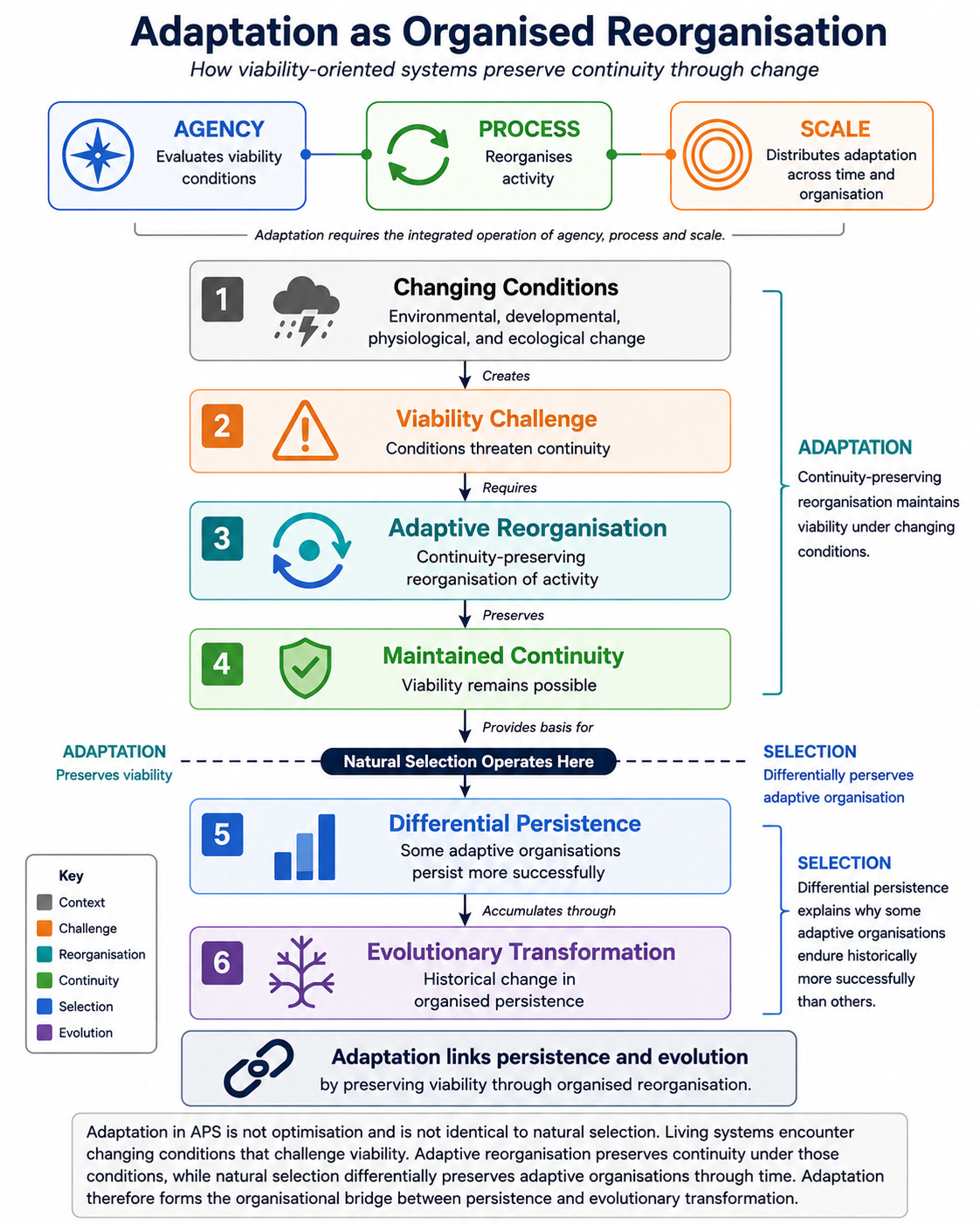
Adaptation links persistence and evolution by preserving viability through continuity-preserving reorganisation under changing conditions.
Variation and Adaptation
Adaptation and variation are closely related, yet they perform distinct roles within evolutionary continuity. Variation introduces novelty into biological organisation. Adaptation determines whether that novelty can be incorporated into viable persistence.
Variation arises because living systems are not perfectly invariant across time. Developmental processes, environmental influences, behavioural innovations, genetic changes, ecological interactions, and countless other sources of difference continually generate new organisational possibilities. Without variation, biological organisation could persist but could never transform. Evolutionary change therefore depends upon the continual production of novelty within ongoing continuity.
Novelty alone, however, does not guarantee persistence. Most changes contribute little to viability, while others may actively undermine it. Living systems must therefore continually reorganise activity in ways that preserve the conditions required for continued existence. Adaptation explains how this occurs. Adaptive processes determine whether new organisational possibilities can be integrated into viable persistence rather than disrupting the continuity upon which persistence depends.
From an APS perspective, variation and adaptation therefore occupy successive positions within a broader continuity architecture. Variation generates organisational possibilities. Adaptation evaluates those possibilities through their consequences for viability and reorganises biological activity accordingly. Novelty becomes biologically significant not merely because it appears, but because it can be incorporated into persistence-preserving organisation.
This relationship helps clarify why adaptation cannot be reduced to variation itself. Variation explains the emergence of difference. Adaptation explains the viability-oriented reorganisation through which some differences become integrated into ongoing biological continuity. Evolutionary transformation consequently depends upon both processes working together. Variation introduces the possibility of change, while adaptation determines whether change can contribute to the continuing persistence of living organisation.
Inheritance reproduces continuity across generations, variation introduces novelty into that continuity, and adaptation determines whether novelty can be incorporated into viable persistence. The adaptive organisations that emerge from this process become available for differential continuity and natural selection, allowing evolutionary transformation to proceed without breaking the continuity upon which persistence depends.
Adaptation Is Not Optimisation
Adaptation is frequently interpreted as a process of optimisation. Organisms are often described as becoming progressively better fitted to their environments, and adaptive change is frequently presented as movement toward increasingly efficient or ideal states. Although such language can be useful in limited contexts, APS regards it as an incomplete description of how living systems actually persist.
Living systems do not operate under ideal conditions. Every organism exists within a history of inherited constraints, developmental contingencies, energetic limitations, ecological uncertainties, and changing environmental circumstances. Biological organisation is therefore never constructed from first principles, nor does it move toward a universally optimal configuration. Instead, living systems must remain viable within the particular conditions they inherit and encounter.
From an APS perspective, adaptation is therefore not defined by perfection, maximal efficiency, or optimal design. The central question is not whether a system has reached the best possible state, but whether it remains capable of sustaining organised persistence. Adaptive reorganisation succeeds when viability is preserved and continuity remains possible. It fails when changing conditions undermine the organisation required for persistence.
This distinction is important because many biological systems persist despite being far from optimal. Organisms routinely survive through compensatory mechanisms, redundant pathways, developmental flexibility, behavioural modification, ecological buffering, and other forms of organisational redistribution. Such processes often preserve viability without producing ideal outcomes. Adaptation therefore concerns the maintenance of continuity under constraint rather than movement toward perfection.
APS consequently reframes adaptation as viability-preserving reorganisation rather than optimisation. Improvements in efficiency, performance, or fitness may emerge as important outcomes of adaptive processes, but they do not define adaptation itself. What defines adaptation is the preservation of organised continuity under changing conditions.
Adaptation and Temporal Organisation
Adaptation is inherently temporal because the conditions confronting living systems unfold through time. Organisms do not encounter isolated challenges that require isolated responses. Instead, they exist within continuously changing developmental, ecological, physiological, and evolutionary processes that must remain coordinated if viability is to be maintained.
For this reason, adaptation cannot be understood as a momentary event. Adaptive organisation emerges through ongoing processes of regulation, adjustment, compensation, and reorganisation that unfold across multiple interacting timescales. A physiological response that stabilises metabolic activity may occur within seconds or minutes, while developmental adjustments may emerge over months or years. Ecological adaptation may unfold across generations, and evolutionary adaptation may become visible only across much longer historical periods.
APS therefore treats adaptation as part of a broader architecture of temporal organisation. Present activity is continuously shaped by past organisational history while simultaneously influencing future possibilities for persistence. Adaptive processes contribute to continuity by coordinating biological activity across these temporal domains rather than operating within any single moment in isolation.
This temporal perspective also helps explain why adaptation appears in such diverse biological contexts. The same underlying principle of continuity-preserving reorganisation can be expressed through rapid physiological regulation, developmental plasticity, behavioural flexibility, ecological modification, or evolutionary transformation. These processes differ in duration and mechanism, yet each contributes to sustaining organised persistence through time.
Adaptation therefore links immediate regulation with long-term continuity. It connects present viability with future persistence and provides one of the principal mechanisms through which biological organisation remains coherent despite continual transformation.
Adaptation and Viability
Viability occupies a central place within the APS understanding of adaptation because living systems do not reorganise activity arbitrarily. Adaptive change occurs relative to circumstances that support or undermine continued persistence, making adaptation inherently oriented toward the preservation of viability.
Viability identifies the organisational requirements under which persistence remains possible. These requirements include energetic stability, physiological integrity, developmental coherence, ecological relationships, and the broader organisational structures that sustain living systems through time. When these requirements become threatened, adaptive reorganisation becomes necessary because continuity can no longer be maintained through existing patterns of activity alone.
Adaptation therefore functions as a mechanism through which viability is preserved under changing circumstances. Regulatory systems alter activity in response to disturbance, behavioural systems modify interactions with the environment, developmental systems adjust trajectories, and ecological systems reorganise patterns of coupling. Although these processes differ in form, they share a common orientation toward maintaining the conditions required for persistence.
This relationship explains why adaptation cannot be reduced to environmental adjustment alone. The significance of any adaptive process depends upon its contribution to viability rather than merely its responsiveness to change. A response becomes adaptive when it helps preserve the organisational conditions necessary for continued persistence. Change without viability-preserving consequences may be biologically significant, but it is not adaptive in the APS sense.
Adaptation and viability are therefore inseparable, but they perform different explanatory roles. Viability identifies the conditions under which organised persistence remains possible, whereas adaptation explains how living systems reorganise themselves when those conditions are challenged. Together they reveal that biological continuity is not maintained through static stability but through the ongoing preservation of the conditions required for persistence itself.
Adaptation and Normativity
Because adaptation is organised around viability, it also possesses an inherently normative dimension. Living systems do not interact with all conditions equally. Some conditions support persistence, while others threaten it. Some organisational trajectories contribute to viability, while others undermine it. Adaptive activity therefore depends upon distinctions that matter for the continued existence of the system itself.
APS locates the origin of biological normativity within this viability-oriented organisation. Normative distinctions emerge because living systems must continuously regulate activity relative to conditions affecting their persistence. The difference between beneficial and harmful, stabilising and destabilising, or viable and non-viable is not imposed externally upon biological systems. It arises from the organisation of living systems themselves.
Adaptation therefore involves more than mechanical responsiveness. Adaptive processes participate in the ongoing evaluation of conditions relative to viability and the reorganisation of activity in ways that preserve continuity. This evaluative dimension need not involve cognition, consciousness, or deliberate decision-making. It emerges wherever biological organisation regulates itself relative to the requirements of persistence.
Understanding adaptation in this way helps connect evolutionary explanation with broader APS themes concerning agency, evaluation, and normativity. Adaptive organisation reveals that living systems are not merely passive objects acted upon by external forces. They are viability-oriented systems whose activity is organised around the preservation of conditions required for continued existence.
Adaptation and Functional Reorganisation
Adaptation operates through the continual reorganisation of functional relationships within living systems. Biological functions are often described as if they were fixed properties attached permanently to particular structures. APS instead emphasises that functional organisation is dynamic and can be redistributed, compensated for, or reorganised while continuity is preserved.
This capacity for functional reorganisation is one reason why living systems exhibit remarkable flexibility under changing conditions. When existing pathways become disrupted, alternative pathways may compensate. When environmental conditions shift, behavioural or physiological activity may be reorganised. When developmental circumstances change, functional contributions may be redistributed across different components of the system. Persistence is maintained not because every function remains unchanged, but because the organisation of functional activity remains sufficiently coherent to sustain viability.
Adaptation therefore involves more than preserving existing functions. Because functions contribute to persistence through their place within an organised system, adaptive reorganisation often modifies how those contributions are distributed and coordinated. Biological systems may maintain continuity through compensation, substitution, innovation, or the redistribution of activity across components, provided that the resulting organisation remains viable.
From an APS perspective, function is therefore inseparable from organised persistence. Functions matter because they contribute to the maintenance of viability, and adaptation matters because it reorganises those contributions under changing conditions. Functional reorganisation thus provides one of the principal mechanisms through which continuity can survive transformation, allowing living systems to remain viable while preserving the organisational coherence required for longer-term evolutionary persistence.
Adaptation and Organism–Environment Coupling
Adaptation is inseparable from the relationship between organisms and their environments. Classical accounts often describe adaptation as a process through which organisms become fitted to external conditions, implicitly treating the environment as a fixed background against which adaptive change occurs. APS adopts a different perspective. Organisms and environments are not independent entities that interact only occasionally. They exist within ongoing relationships of mutual organisation through which the conditions of persistence are continuously produced and transformed.
Environmental conditions influence energetic availability, developmental possibilities, ecological opportunities, and the constraints under which living systems persist. Yet these conditions are not simply imposed upon biological systems from outside. Through metabolism, behaviour, niche construction, ecological engineering, and countless other forms of biological activity, living systems continually participate in shaping the very circumstances under which future adaptation occurs. Adaptation therefore emerges within an ongoing process of mutual organisation in which organism and environment co-constitute the conditions of persistence.
Adaptation therefore cannot be understood as passive adjustment to external circumstances. It emerges through ongoing processes of organism–environment coupling in which both sides of the relationship contribute to the maintenance of viability. The adaptive organisation of living systems is inseparable from the adaptive organisation of the ecological contexts within which those systems persist.
This perspective helps explain why adaptation often extends beyond the boundaries of individual organisms. Adaptive continuity may depend upon social organisation, ecological relationships, constructed niches, symbiotic interactions, or environmental modifications that contribute directly to viability. Adaptation is therefore not merely a property of isolated biological entities but an expression of organised persistence distributed across coupled biological systems.
Adaptation Across Scale and Time
Adaptation unfolds across multiple scales of biological organisation and across multiple timescales simultaneously. Although these dimensions are often studied separately, APS emphasises that they remain organisationally interconnected. Adaptive processes occurring at one scale frequently influence adaptive possibilities at others, creating a continuous architecture of persistence extending from immediate regulation to long-term evolutionary transformation.
At physiological scales, adaptation may involve rapid adjustments that preserve metabolic or regulatory stability. Developmental adaptation operates through modifications to organisational trajectories that unfold across the life of an organism. Behavioural adaptation contributes through flexible responses to changing circumstances, while ecological adaptation emerges through shifting patterns of interaction between organisms and their environments. Across generations, evolutionary adaptation transforms populations and lineages through historically accumulated changes in biological organisation.
These processes are not independent layers stacked upon one another. Physiological adaptation can influence developmental outcomes, developmental organisation can affect ecological relationships, ecological conditions can alter evolutionary trajectories, and evolutionary transformations can reshape future physiological possibilities. Adaptive continuity therefore emerges through interactions distributed across biological scales rather than through the operation of any single mechanism in isolation.
APS consequently rejects attempts to reduce adaptation to particular traits, isolated mechanisms, or single explanatory levels. Adaptation is better understood as a multiscale process through which viability-oriented organisation preserves continuity while remaining capable of transformation. Appreciating this distributed character of adaptation is essential for understanding how persistence can be maintained across both immediate and historical timescales.
Adaptation and Fitness
Adaptation and fitness are closely related concepts, yet they address different explanatory questions. Their distinction becomes clearer when viewed within the broader APS account of organised persistence.
Adaptation explains how viability-oriented systems preserve continuity under changing conditions. Through adaptive reorganisation, living systems modify physiological activity, developmental trajectories, behavioural patterns, ecological relationships, and other forms of organisation in ways that sustain the conditions required for persistence. Adaptation therefore concerns the maintenance of viability through continuity-preserving change.
Fitness addresses a different problem. Whereas adaptation explains how continuity is preserved, fitness explains why some viable organisations exhibit greater continuity than others. Fitness concerns differential continuity among biological variants. It identifies differences in the capacity of alternative forms of organisation to persist and reproduce across time.
This distinction is important because viability and differential continuity are not identical. A biological organisation may be adaptive in the sense that it successfully preserves viability under particular conditions while nevertheless exhibiting lower fitness than alternative viable organisations. Adaptation therefore does not guarantee maximal persistence relative to competitors. It ensures only that continuity remains possible. Fitness evaluates how successfully that continuity is maintained relative to other viable variants.
From an APS perspective, fitness consequently presupposes adaptation in much the same way that differential continuity presupposes continuity itself. Before variants can differ in their persistence, they must first remain viable. Adaptive organisation provides the continuity upon which fitness operates. Without adaptive capacities capable of preserving viability under changing conditions, there could be no enduring variants available for differential continuity to distinguish.
The relationship between variation, adaptation, fitness, and natural selection therefore forms a continuous explanatory sequence. Variation introduces organisational novelty. Adaptation determines whether that novelty can be incorporated into viable persistence. Fitness differentiates among viable variants according to their continuity through time. Natural selection then differentially stabilises those variants across generations. Each concept performs a distinct explanatory role, yet each depends upon the continuity established by the preceding stage.
Adaptation should therefore not be confused with fitness, nor treated as merely another name for evolutionary success. Adaptation explains how living systems remain viable through change. Fitness explains why some viable organisations persist more successfully than others. Together they connect the maintenance of continuity in the present with the differential continuity that shapes evolutionary transformation through time.
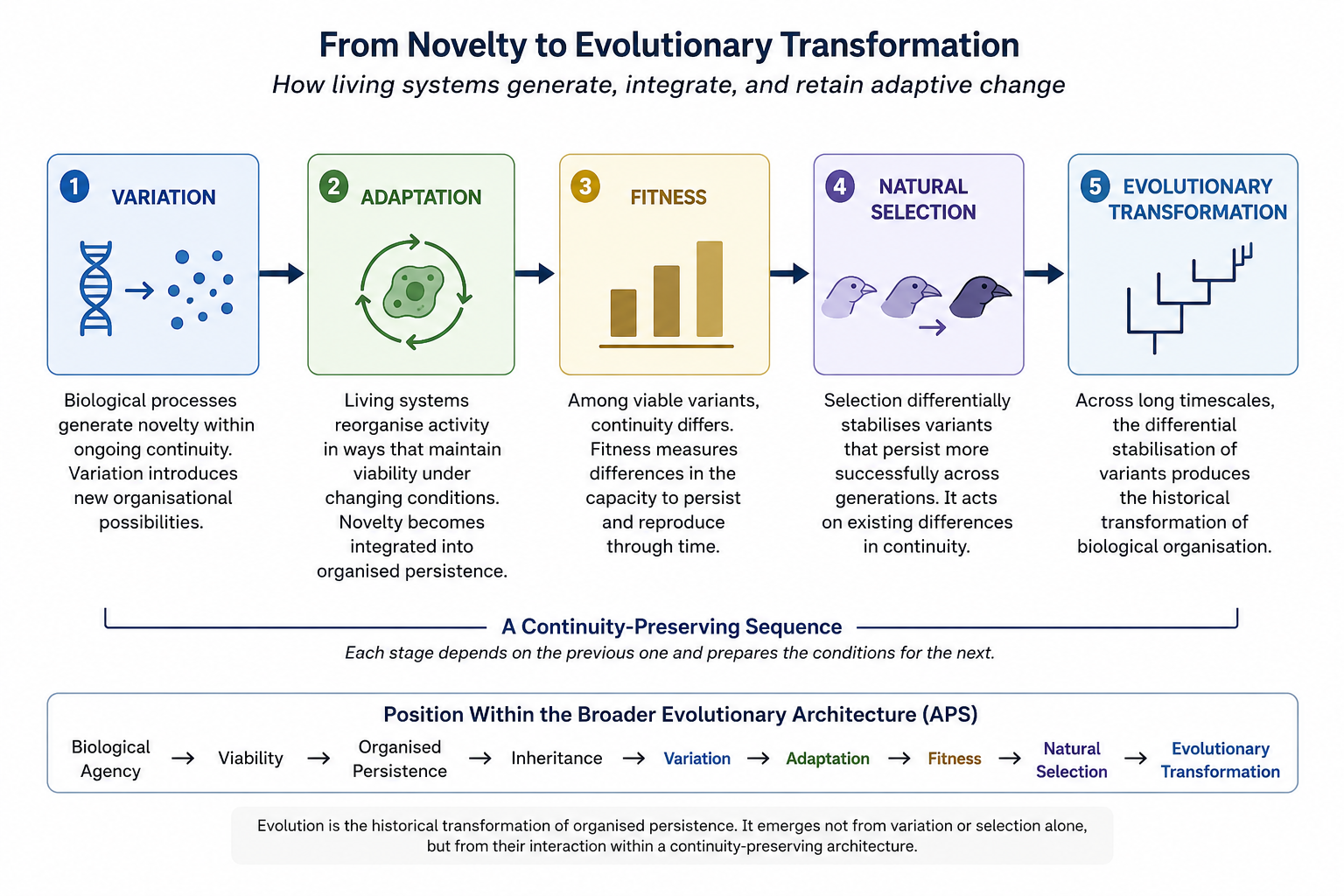
Evolutionary Concepts Visual. APS distinguishes variation, adaptation, fitness, and natural selection as successive explanatory moments within a continuity-preserving architecture. Variation introduces novelty, adaptation integrates novelty into viable persistence, fitness differentiates among viable variants, and natural selection differentially stabilises those variants across evolutionary time.
Adaptation and Natural Selection
Adaptation and natural selection are closely related, but they are not identical. In many evolutionary discussions the two concepts are treated almost interchangeably, creating the impression that adaptation is simply the outcome of selection. APS draws a sharper distinction because the explanatory roles of the two concepts differ.
Adaptation explains how living systems reorganise themselves in ways that preserve viability under changing conditions. Natural selection explains why some of these adaptive organisations persist historically more successfully than others. Adaptation concerns the generation and maintenance of continuity-preserving organisation, whereas selection concerns the differential persistence of organisational variants across time.
This distinction clarifies an important feature of biological explanation. Living systems must already possess adaptive capacities if they are to remain viable long enough for selection to operate upon them. Physiological regulation, developmental plasticity, behavioural flexibility, ecological modification, and other adaptive processes contribute directly to continuity before any long-term evolutionary consequences become visible. Selection does not create these organisational processes. Rather, it helps determine which forms of adaptive organisation become historically stabilised within evolving lineages.
APS therefore treats adaptation as conceptually prior to selection while recognising that the two processes remain deeply interconnected. Adaptation provides the mechanisms through which viability is preserved under changing conditions. Selection contributes to the historical retention, modification, and distribution of adaptive organisation across populations and evolutionary timescales.
Seen in this way, adaptation forms the organisational bridge between persistence and evolution. Living systems remain viable because they adapt, while evolutionary lineages transform because adaptive organisations are differentially preserved through time. Together, adaptation and selection explain how organised persistence both survives and changes across biological history.
Natural selection does not generate adaptation ex nihilo. Selection operates upon already existing adaptive organisation whose viability has already been established through continuity-preserving reorganisation.Selection therefore presupposes adaptation rather than replacing it.
Natural selection does not generate adaptation ex nihilo. Selection operates upon already existing adaptive organisation. Adaptive capacities preserve viability in the present, while selection influences which adaptive organisations become historically stabilised across generations.
Adaptation and Resilience
Adaptation contributes directly to resilience because resilience depends upon the capacity to preserve continuity under conditions of disturbance. Living systems continually encounter perturbations arising from environmental instability, developmental uncertainty, physiological disruption, ecological change, and countless other sources of variability. Persistence under such circumstances requires more than resistance. It requires the capacity to reorganise.
Resilience describes the successful maintenance or recovery of organised continuity when viability is challenged. Adaptation explains many of the processes through which such recovery becomes possible. Compensatory mechanisms, regulatory redistribution, behavioural flexibility, ecological buffering, and developmental reorganisation all contribute to preserving viability when existing organisational patterns become disrupted.
The relationship between adaptation and resilience is therefore complementary rather than identical. Adaptation refers to the continuity-preserving reorganisation itself, whereas resilience refers to the successful preservation or restoration of continuity achieved through that reorganisation. Adaptation provides the means through which resilience becomes possible.
This distinction is especially important within APS because it preserves the explanatory roles of both concepts. Adaptation identifies the organisational processes that respond to changing conditions, while resilience identifies the resulting capacity of the system to remain viable despite perturbation. Together they explain how organised persistence survives instability without requiring rigid stability or resistance to change.
Adaptation, Physiology, and Evolution
One of the most important contributions of adaptation within APS is its ability to connect physiological and evolutionary explanation. These domains are often treated separately because they operate across different timescales. Physiology is typically concerned with the maintenance of living systems in the present, whereas evolution is concerned with historical transformation across generations. Adaptation reveals the continuity linking these perspectives.
Physiological systems continuously reorganise activity in response to changing viability conditions. Metabolic regulation, behavioural modification, developmental plasticity, and ecological interaction all contribute to preserving continuity in the present. These adaptive processes sustain the viability required for persistence from moment to moment.
Across longer timescales, adaptive organisations may become historically stabilised, modified, or transformed through evolutionary processes. What appears as immediate continuity regulation at one temporal scale may contribute to long-term evolutionary trajectories at another. Evolution therefore does not stand apart from adaptation but emerges from the historical transformation of adaptive organisation distributed across generations.
Adaptation consequently links present continuity with historical continuity. It explains how physiological activity, developmental organisation, ecological interaction, and evolutionary transformation can be understood as different expressions of the same underlying process of viability-oriented persistence. This connection forms one of the central insights of the APS evolutionary framework.
Adaptation Within the APS Explanatory Grammar
APS situates adaptation within the broader explanatory grammar organised through agency, process, and scale. Adaptation cannot be understood adequately through any one of these dimensions in isolation because each illuminates a different aspect of how continuity is preserved under changing conditions.
Agency draws attention to the viability-oriented character of adaptive activity. Living systems do not simply undergo change; they reorganise activity relative to conditions that matter for their continued persistence. Process emphasises that adaptation unfolds through ongoing transformation rather than static structure. Scale reveals how adaptive organisation is distributed across interacting physiological, developmental, ecological, and evolutionary domains.
Viewed together, these dimensions provide a richer understanding of adaptation than accounts focused solely upon traits, mechanisms, or evolutionary outcomes. Agency explains why adaptive activity is directed toward viability, process explains how continuity is reorganised through change, and scale explains how these dynamics are distributed across biological organisation and time. Adaptation consequently emerges as a multiscale process of viability-oriented reorganisation through which organised persistence remains possible despite continual transformation.
Why Adaptation Matters in APS
Clarifying adaptation in organisational terms helps resolve several longstanding difficulties in biological explanation. It distinguishes adaptation from optimisation, explains why adaptive processes are inherently linked to viability, integrates development and ecology into evolutionary explanation, and clarifies the relationship between persistence and natural selection. It also helps explain why resilience, regulation, and organism–environment coupling are not peripheral topics but central components of biological organisation.
Most importantly, the APS account situates adaptation within a unified explanatory framework connecting physiology, development, ecology, evolution, agency, and normativity. Rather than treating adaptation as an isolated evolutionary phenomenon, APS presents it as one of the principal processes through which organised persistence remains viable across changing conditions and across time.
Conclusion
Living systems persist in a world characterised by continual transformation. Materials change, environments fluctuate, developmental trajectories unfold, ecological relationships shift, and evolutionary histories accumulate. Yet biological continuity remains possible. The explanation for this continuity cannot be found in stability alone. It depends upon the capacity of living systems to reorganise themselves in ways that preserve viability under changing conditions.
Adaptation is the name APS gives to this continuity-preserving reorganisation. It is not a movement toward perfection, nor merely a collection of advantageous traits. Rather, it is the ongoing process through which viability-oriented systems sustain organised persistence despite perturbation, uncertainty, and change. Through adaptation, living systems maintain the conditions required for their own continued existence while remaining capable of transformation across multiple scales and timescales.
Understanding adaptation in this way reveals why it occupies such a central position within biological explanation. It connects persistence with viability, links physiology with evolution, integrates development with ecology, and provides the organisational bridge through which natural selection becomes intelligible within a broader framework of organised persistence. Adaptation therefore stands as one of the principal processes through which life sustains continuity while remaining open to historical transformation.
Within the APS evolutionary framework, adaptation occupies the organisational centre of evolutionary continuity. Inheritance reproduces continuity across generations and sustains lineages of organised persistence. Variation introduces novelty into that continuity. Adaptation determines whether novelty can be incorporated into viable persistence. Fitness differentiates among viable variants according to their continuity through time, and natural selection differentially stabilises those differences across generations. Evolutionary transformation therefore emerges not from variation or selection alone but from the continual adaptive reorganisation of organised persistence across biological history.
Related Pathways
- Persistence — Organised Continuity Through Time
- Viability — The Organising Principle of Biological Persistence
- Temporal Organisation and Organised Persistence
- Physiology and Evolution in APS — Two Temporal Perspectives on the Same Biological Organisation
- Natural Selection and Organised Persistence
- Evolution as the Historical Transformation of Organised Persistence
- Ecology as Organised Persistence Across Scales
- Diagnosis as Continuity Analysis
- The Explanatory Geometry of Biology
Key Terms
adaptation · continuity · persistence · viability · resilience · physiology · development · ecology · natural selection · evolution · organism–environment coupling · temporal organisation · organised persistence
See Also
Related Articles
References
- (1999). Formal Darwinism, the Individual-as-Maximizing-Agent Analogy, and Bet-Hedging. Proceedings of the Royal Society B: Biological Sciences, 266, 799–803 . https://doi.org/10.1098/rspb.1999.0708
- (2000). The Triple Helix: Gene, Organism, and Environment. Harvard University Press.
- (1961). Cause and Effect in Biology. Science, 134, 1501–1506 . https://doi.org/10.1126/science.134.3489.1501
- (2012). A Theory of Biological Relativity: No Privileged Level of Causation. Interface Focus, 2, 55–64 . https://doi.org/10.1098/rsfs.2011.0067
- (2003). Niche Construction: The Neglected Process in Evolution. Princeton University Press.
- (2007). Do We Need an Extended Evolutionary Synthesis?. Evolution, 61, 2743–2749 . https://doi.org/10.1111/j.1558-5646.2007.00246.x