Evolution as the Historical Transformation of Organised Persistence
Evolution is commonly understood as change in gene frequencies within populations over time. While this formulation captures important statistical patterns, it does not fully explain what is changing, how continuity is preserved, or why evolutionary change is biologically meaningful. APS approaches evolution as the historical transformation of persistence-sustaining organisation across generations. Because living systems are agents whose activities sustain organised persistence through time, biological evolution presupposes the existence of continuity-producing living organisation and does not explain its original emergence. Agency, process, scale, development, inheritance, ecological continuity, and adaptation therefore constitute conditions for evolutionary transformation rather than products of it. Natural selection is understood not as the source of biological organisation, but as the differential stabilisation of already viable forms of persistence-sustaining organisation. Evolutionary explanation becomes the study of how living organisation is historically transformed across interacting developmental, ecological, organismal, and lineage scales.
Key Points
- Evolution is the historical transformation of organised persistence across generations.
- Evolution presupposes living systems already capable of viable continuity.
- Biological agency is prior to evolutionary transformation because living systems must already sustain themselves to evolve.
- Organised persistence is explanatorily prior to evolutionary transformation.
- Evolution transforms developmental, ecological, organismal, and lineage continuity systems.
- Natural selection differentially stabilises viable organised persistence.
- Adaptation reorganises persistence under changing conditions.
- Evolution is multiscale, temporal, developmental, ecological, and historical.
- APS explains evolutionary continuity as continuity-through-transformation rather than static replication.
- Biological evolution presupposes organised persistence and does not explain its original emergence.
Introduction
Where this article fits: This article develops the APS interpretation of evolution as the historical transformation of viability-oriented organised persistence across generations. Evolution is understood not merely as statistical change within populations, but as the long-term transformation of living organisation across developmental, ecological, organismal, and lineage scales. It provides the primary evolutionary anchor for understanding how agency, persistence, inheritance, adaptation, and natural selection fit together within the APS framework.
Living systems do not merely persist.
They transform historically.
Across generations, organisms diversify, developmental trajectories reorganise, ecological relationships shift, and new forms of biological organisation emerge. The living world is therefore characterised not only by continuity, but also by ongoing transformation. Evolution is the name given to this historical process.
Evolution is commonly defined as change in gene frequencies within populations over time. This formulation captures important statistical regularities and provides powerful tools for modelling evolutionary dynamics. Yet by itself it does not explain what is changing, how continuity is maintained despite transformation, or why evolutionary change is biologically meaningful. Gene frequencies do not evolve independently of living systems. They exist only within organisations already capable of sustaining viable continuity across time.
APS therefore approaches evolution from a different explanatory starting point. Biology explains how living systems sustain organised persistence through viability-oriented activity. Evolution explains how that persistence-sustaining organisation is historically transformed across generations. Before living systems can evolve, they must already be capable of maintaining themselves. They must preserve viability, regenerate continuity, and remain organised despite ongoing developmental and ecological change. Evolution does not create this basic capacity for persistence. Rather, it transforms the organisation through which persistence is achieved.
From the APS perspective, evolution is therefore:
the historical transformation of persistence-sustaining organisation across generations.
This formulation highlights the complementary relationship between biological and evolutionary explanation. Biology investigates how organised persistence is maintained in the present, while evolution investigates how organised persistence is transformed through historical time. The two therefore address different dimensions of the same underlying phenomenon.
Evolution does not explain the original emergence of organised persistence. It presupposes living systems already capable of sustaining viable continuity through development, adaptation, ecological interaction, and reproduction. The central question of evolutionary explanation therefore becomes how persistence-sustaining organisation is historically modified, diversified, stabilised, and transformed across time.
Agency, Process, and Evolutionary Transformation
APS begins from the proposition that living systems are biological agents. Organisms do not merely undergo change. They actively regulate physiology, behaviour, development, and environmental interaction in ways that contribute to the maintenance of their own viability. Agency in this sense does not imply conscious intention or deliberation. It refers to the viability-oriented activity through which living systems help sustain the conditions of their continued existence.
This point is fundamental for evolutionary explanation because evolution operates only upon systems already capable of such activity. Before evolutionary transformation can occur, living systems must already maintain themselves, reproduce themselves, and regulate their interactions with changing environments. Evolutionary processes therefore presuppose organisms that are actively engaged in sustaining continuity. Without agency, there would be no organised persistence available for historical transformation.
Agency is inseparable from process. Living systems are not static structures that occasionally change. They are ongoing processes through which biological organisation is continuously regenerated. Metabolism, development, repair, ecological interaction, reproduction, and behavioural regulation are all processual activities through which viability is maintained across time. The persistence of living systems therefore depends not upon preserving fixed structures but upon continuously reproducing organisational continuity despite material turnover and environmental change.
Because living systems are processual agents, their activities also become sources of evolutionary consequence. Behaviour modifies environments. Developmental activity influences the forms of variation that become available. Reproductive processes regenerate continuity while introducing opportunities for transformation. Ecological interactions alter the conditions under which viability can be maintained. Evolutionary change therefore emerges partly through the accumulated historical consequences of viability-oriented activity itself.
Evolution is also inherently multiscale. The continuity of living organisation depends upon interactions distributed across physiological, developmental, organismal, ecological, and historical scales. Processes occurring over seconds may influence developmental trajectories unfolding over years, while ecological and evolutionary transformations may emerge over generations or longer. Evolutionary explanation therefore cannot be confined to a single privileged scale because organised persistence itself is distributed across multiple interacting temporal and organisational domains.
Agency, process, and scale together establish the conditions under which organised persistence becomes possible. Biological agency sustains the viability-oriented activities through which continuity is maintained, while process and scale explain how that continuity is organised across time and across multiple domains of biological organisation. Organised persistence therefore becomes the central phenomenon linking biological and evolutionary explanation.
Evolution does not stand apart from these foundations. It acts upon persistence-sustaining organisation already capable of maintaining viable continuity. Biological agency sustains organised persistence in the present, while evolution transforms that organised persistence historically across generations. Evolution is therefore best understood as the long-term historical transformation of persistence-sustaining organisation rather than as change imposed upon otherwise passive biological material.
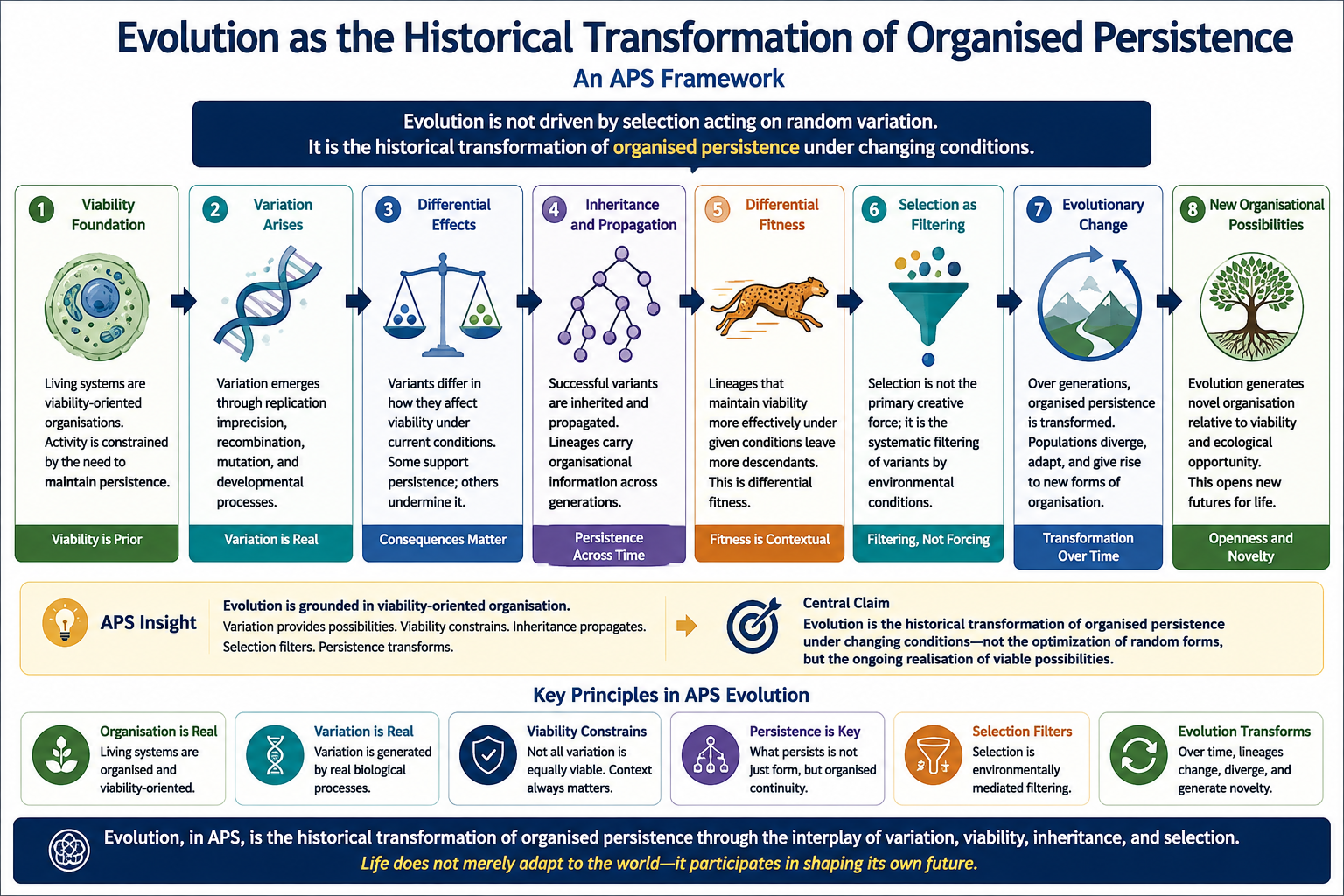
Primary Evolution Visual. APS interprets evolution as the historical transformation of viability-oriented organisation across variation, adaptation, inheritance, fitness, and natural selection. Selection does not create organised persistence; it differentially stabilises already viable forms of living organisation across generations.
Development and Evolutionary Transformation
Development is intrinsic to evolutionary continuity. Evolution does not act upon fixed structures that exist independently of developmental processes. Every organism must be constructed, maintained, repaired, and regenerated through development, and evolutionary transformation therefore necessarily involves changes in the developmental systems through which viable persistence is achieved.
Development contributes directly to evolutionary possibility because it shapes how living systems generate and respond to variation. Organisms do not emerge fully formed from inherited instructions. They arise through ongoing interactions among developmental processes, physiological activity, ecological conditions, and organism–environment relations. The forms of organisation available to evolution are therefore inseparable from the developmental systems through which organisms are continuously reconstructed.
Developmental plasticity is particularly important in this regard. Living systems often respond to changing circumstances by reorganising developmental trajectories, modifying behaviour, altering physiological activity, or exploiting new ecological opportunities. Such responses may preserve viability under novel conditions while simultaneously generating new possibilities for future evolutionary transformation. Development therefore contributes not only to continuity but also to evolutionary innovation.
Development also helps explain how continuity persists despite continual material and organisational change. Organisms are not replicated as static objects. Rather, each generation reconstructs viable organisation through developmental processes capable of regenerating continuity under changing circumstances. Evolutionary continuity therefore depends upon continuity-producing developmental systems that can preserve viability while remaining capable of transformation.
From an APS perspective, development and evolution are not separate explanatory domains connected only through inheritance. Development generates the living organisation that evolution transforms, while evolutionary processes reshape the developmental systems through which future continuity is achieved. The two therefore represent organisationally continuous dimensions of the same long-term process of historical persistence.
Variation and the Diversification of Persistence
Evolution depends upon variation because continuity cannot be historically transformed without the generation of difference. Variation introduces alternative forms of organisation, alternative developmental trajectories, alternative ecological relationships, and alternative ways of sustaining viability under changing conditions. Evolutionary transformation therefore depends upon the continual diversification of organised persistence.
APS accepts the importance of stochastic processes in generating variation while rejecting the idea that variation is merely unconstrained randomness imposed upon passive biological systems. Living systems actively participate in the production of variation through developmental plasticity, physiological modulation, behavioural activity, ecological interaction, and adaptive reorganisation. Variation therefore emerges within already ongoing systems of viability-oriented activity rather than appearing independently of them.
This distinction is important because not all differences are evolutionarily significant. Variation matters biologically when it affects the ways in which organised persistence can be achieved. Some forms of variation alter developmental trajectories. Others modify ecological relationships, behavioural capacities, reproductive organisation, or persistence-maintaining activities. The significance of variation therefore depends upon its consequences for continuity rather than upon difference alone.
Some variations contribute to the maintenance or extension of viable persistence. Others undermine continuity and disappear historically. Evolutionary diversification emerges through the ongoing generation, exploration, and differential persistence of these alternative organisational possibilities. Variation therefore contributes not merely to biological diversity but to the historical diversification of the ways living systems sustain themselves across time.
Evolution and the Transformation of Organisation
Evolution is not fundamentally the transformation of isolated traits. It is the historical transformation of systems capable of sustaining organised persistence.
Living systems maintain viability through networks of continuity-producing constraints distributed across physiology, development, behaviour, ecological interaction, and organism–environment coupling. These organisational relations make persistence possible by coordinating processes that would otherwise drift toward disintegration. Across generations, however, the organisation sustaining continuity may stabilise, diversify, reorganise, compensate for disruption, or collapse entirely.
What evolves is therefore not structure in abstraction, but the organisational capacities through which living systems sustain viability under changing developmental and ecological conditions. Evolution concerns the historical transformation of persistence-sustaining organisation itself. Living systems persist evolutionarily not despite transformation, but through it.
APS consequently approaches evolution organisationally rather than reductionistically or statistically alone.
Temporal Organisation and Evolutionary Continuity
Evolution is fundamentally temporal.
Evolutionary continuity does not emerge from static replication alone. It depends upon the ongoing regeneration of viable organisation across generations despite continuous transformation. Temporal organisation therefore becomes central to evolutionary explanation.
Living systems must preserve continuity through developmental change, reproduce organisational conditions across generations, coordinate processes unfolding across multiple temporal scales, and maintain viability despite environmental instability. Evolutionary continuity is therefore not the propagation of static sameness through time. It is the ongoing regeneration of organised continuity under changing historical conditions.
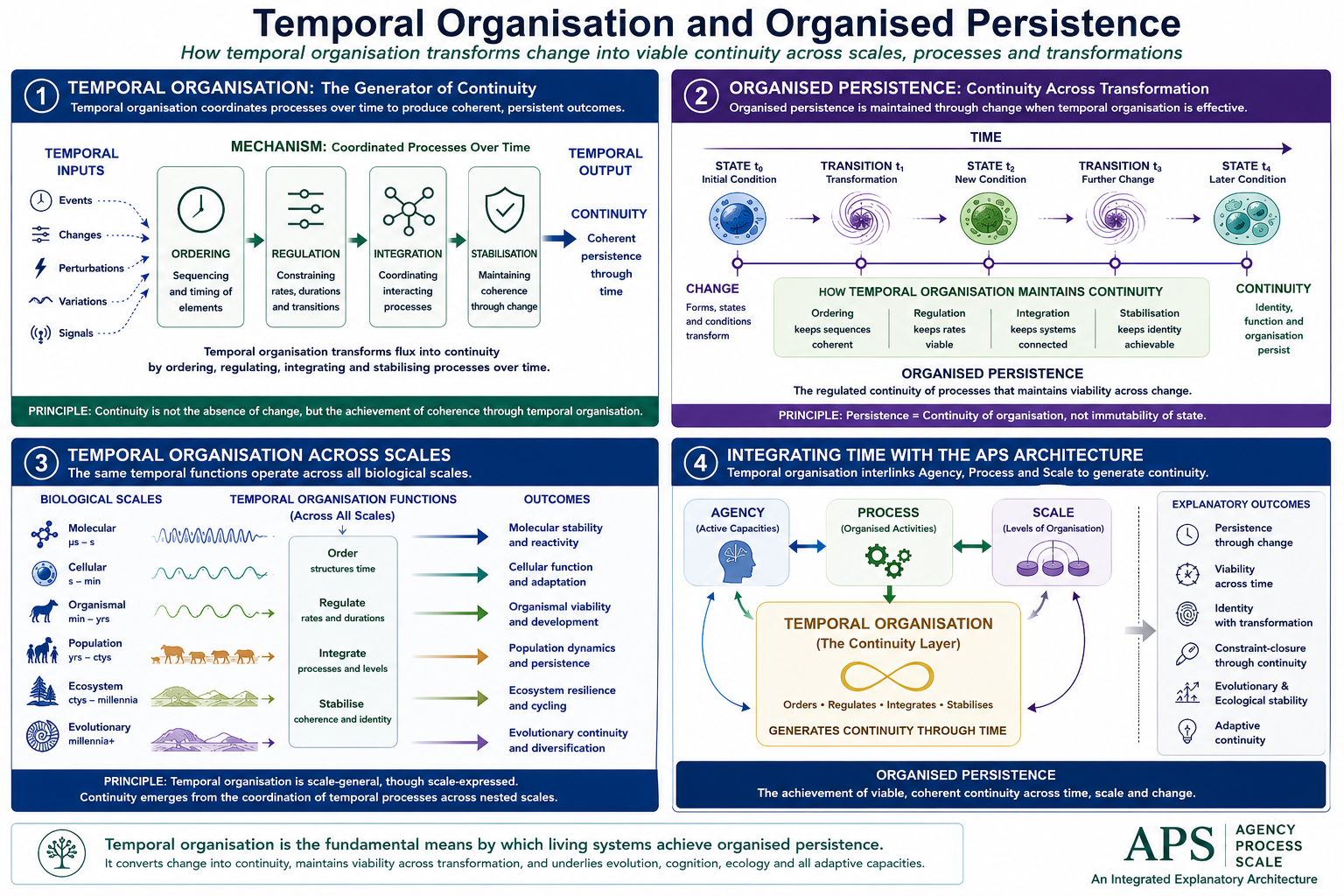
Temporal Organisation and Organised Persistence. Evolution preserves continuity not by preventing change, but by regenerating viable organisation through ongoing transformation across generations.
Adaptation and the Reorganisation of Viability
Variation alone does not explain evolutionary transformation. Differences become evolutionarily significant only insofar as they affect the ability of living systems to maintain viability under changing developmental and ecological conditions. This brings adaptation to the centre of evolutionary explanation.
Adaptation refers to the ongoing reorganisation of viability-oriented organisation in response to changing circumstances. Living systems continuously modify physiology, behaviour, development, ecological interaction, and persistence strategies in ways that contribute to continued viability despite perturbation, instability, and environmental uncertainty. Adaptation is therefore not simply a property organisms possess. It is an ongoing activity through which continuity is actively maintained.
This emphasis is important because adaptation is often treated primarily as an evolutionary outcome. APS instead highlights adaptation as a living process occurring continuously within the activities of organisms themselves. Organisms respond to challenges, compensate for disturbances, exploit opportunities, and reorganise their behaviour relative to changing conditions. Such adaptive activity contributes directly to the maintenance of organised persistence.
Evolution extends these adaptive processes historically across generations. Organisational configurations that remain sufficiently viable may become stabilised through inheritance and differential continuity, while configurations that fail to sustain persistence disappear. Evolutionary transformation therefore builds upon adaptive activity already occurring within living systems.
Adaptation and selection should consequently not be conflated. Adaptation concerns the active reorganisation of viability-oriented organisation. Selection concerns the differential stabilisation of organisational forms across historical time. The two processes interact continuously, but they are not identical. Adaptation generates and maintains viable continuity under changing conditions, while selection contributes to the historical persistence of some adaptive trajectories rather than others.
Evolution therefore builds upon adaptation without reducing to it. The historical transformation of life depends not only upon differences among organisms, but also upon the ongoing capacity of living systems to reorganise viability in ways that preserve continuity despite continual change.
Inheritance and Organisational Continuity
Evolution also depends upon inheritance. Without mechanisms capable of regenerating continuity across generations, historical transformation would leave no enduring trace. Evolution requires not only variation and adaptation, but also the capacity to preserve sufficient continuity for transformation to accumulate historically.
APS approaches inheritance more broadly than the transmission of genes alone. Living systems inherit the developmental, physiological, behavioural, ecological, and organisational conditions through which viable persistence can be reconstructed across generations. Inheritance therefore concerns the regeneration of continuity-producing organisation rather than the passive transfer of informational units in isolation.
This broader perspective becomes important because organisms do not inherit finished structures. Each generation must actively reconstruct viable organisation through developmental processes unfolding within ecological and historical contexts. What persists evolutionarily is therefore not a static package of inherited traits, but a continuity-producing organisation capable of being regenerated repeatedly despite ongoing transformation.
Developmental organisation, physiological coordination, behavioural tendencies, ecological relations, and persistence-maintaining activities all contribute to the continuity inherited across generations. Variation diversifies inherited organisation, adaptation reorganises it, and evolutionary transformation modifies it historically. Inheritance therefore serves as the continuity-producing bridge through which organised persistence extends across evolutionary time.
APS consequently approaches inheritance as the organised reconstitution of viable continuity. The significance of inheritance lies not merely in transmitting biological material, but in sustaining the historical continuity of living organisation despite continual developmental, ecological, and evolutionary change.
Lineages and Historical Continuity
The continuity established through inheritance becomes historically visible in lineages. A lineage is not simply a sequence of reproducing organisms. It is an ongoing continuity structure through which organised persistence is regenerated, transformed, and maintained across generations.
Lineages preserve continuity despite continual change. Organisms die, developmental trajectories differ, ecological conditions shift, and organisational arrangements are modified. Yet continuity persists because the underlying processes responsible for regenerating viable organisation continue through time. Evolution therefore operates not upon isolated organisms alone, but upon historically extended continuity structures linking generations together.
Understanding evolution in terms of lineage continuity helps clarify why evolutionary change is best understood as continuity-through-transformation. The persistence of a lineage does not require the preservation of static traits or fixed forms. Rather, it depends upon the ongoing regeneration of viability-oriented organisation under changing historical conditions. Evolutionary transformation therefore occurs within continuity rather than in opposition to it.
Fitness and Differential Continuity
Evolution also depends upon fitness, although APS approaches fitness somewhat differently from many traditional formulations. Fitness is often understood as reproductive success or contribution to future gene frequencies. While these measures capture important aspects of evolutionary outcomes, they do not by themselves explain why some forms of organisation persist historically while others disappear.
APS therefore approaches fitness as the historically situated continuity of viability-oriented organisation under particular developmental and ecological conditions. Fitness does not refer to abstract superiority, universal optimisation, or intrinsic biological value. It refers to the extent to which a form of organised persistence remains sufficiently viable to contribute to future continuity.
This perspective shifts attention away from idealised notions of competitive success and toward the practical problem of maintaining continuity under changing conditions. A biological organisation is evolutionarily successful not because it approximates some universal optimum, but because it remains capable of sustaining viability within the circumstances it encounters. Fitness therefore emerges from the relationship between living organisation and the conditions under which continuity must be maintained.
Fitness is consequently relational rather than absolute, historical rather than timeless, and organisational rather than reducible to isolated traits. Organisational arrangements that remain viable under specific ecological and developmental circumstances contribute to continuity, while those that fail to maintain viability do not. Fitness therefore contributes to the differential continuity through which evolutionary transformation unfolds across time.
From the APS perspective, this interpretation helps clarify why fitness cannot be reduced to reproductive success alone. Reproductive outcomes remain important because they contribute to historical continuity, but the deeper explanatory issue concerns the capacity of persistence-sustaining organisation to maintain viability across changing conditions and to contribute to future continuity. Fitness therefore reflects the differential continuity of organised persistence through time rather than merely the numerical success of isolated traits or genes.
Natural Selection and Differential Stabilisation
Natural selection is one of the most important processes within evolution, but it is not identical with evolution itself. Selection does not create organised persistence, nor does it explain the existence of living organisation itself. Rather, it operates upon living systems already capable of sustaining viable continuity through agency, development, inheritance, adaptation, and ecological interaction. From the APS perspective, natural selection is best understood as a process through which already viable forms of persistence-sustaining organisation are differentially stabilised across generations.
APS therefore approaches natural selection as:
the historical differential stabilisation of persistence-sustaining organisation across generations.
Selection operates because different forms of organisation vary in their capacity to maintain continuity under particular conditions. Some organisational arrangements remain sufficiently viable to persist historically, while others fail to sustain continuity and disappear. What becomes stabilised is therefore not simply isolated genes or traits considered in abstraction, but integrated forms of persistence-sustaining organisation distributed across multiple dimensions of biological life.
Natural selection consequently contributes to evolutionary transformation by differentially stabilising already viable forms of organised persistence. It helps explain why some organisational trajectories persist historically while others do not, but it does not explain the existence of organised persistence itself. Selection presupposes the living systems upon which it acts. Its explanatory role is therefore stabilising and transformative rather than creative in the strongest sense. Evolutionary change occurs because already viable forms of organisation differ in their capacity to maintain continuity under particular conditions, allowing some forms of persistence-sustaining organisation to become historically more stable than others.
Selection and the Origin of Life
At this point a natural question arises. If evolution presupposes organised persistence, did some form of selection contribute to the emergence of the first living systems?
APS does not deny that prebiotic chemical systems may have exhibited forms of differential persistence or selection-like dynamics. Long before the appearance of fully developed living systems, some chemical organisations may have persisted more effectively than others, accumulated more readily, or proved more stable under particular environmental conditions. Such processes may have contributed to the emergence of increasingly persistent forms of organisation.
However, APS distinguishes between prebiotic differential persistence and biological natural selection. Natural selection, in the evolutionary sense, requires systems already capable of maintaining continuity through reproduction, inheritance, and viable persistence across generations. Selection can only operate on entities that already possess some capacity to sustain and regenerate themselves through time.
This distinction is important because it clarifies the explanatory limits of selection. Selection may help stabilise particular forms of organisation once they exist, but it does not by itself explain the emergence of organised persistence. Before there can be differential survival, differential reproduction, or evolutionary adaptation, there must already be systems capable of maintaining continuity sufficiently for such differences to matter.
From the APS perspective, the origin of organised persistence and the evolutionary transformation of organised persistence are therefore related but distinct explanatory problems. Prebiotic selection-like processes may have contributed to the emergence of increasingly stable forms of organisation. Biological evolution begins only when organised persistence becomes capable of sustaining continuity across generations. Natural selection can then differentially stabilise viable forms of persistence-sustaining organisation, generating the evolutionary transformations observed throughout the history of life.
Evolution Across Biological Scale
Evolution unfolds across interacting biological scales. The continuity of living organisation depends simultaneously upon physiological regulation, developmental organisation, behavioural coordination, ecological interaction, and long-term historical persistence. Evolutionary transformation therefore emerges through relationships distributed across multiple scales rather than through change occurring at a single privileged scale of analysis.
Historically, evolutionary theory has often oscillated between attempts to locate a primary evolutionary unit and attempts to identify a privileged scale at which selection operates. APS approaches the problem differently. Living systems persist through organisational relations distributed across scales, and evolutionary transformation reflects changes in these distributed continuity structures rather than events occurring exclusively at any one biological scale.
Physiological processes contribute to organismal viability. Developmental systems generate continuity across generations. Behaviour modifies ecological conditions. Ecological organisation shapes opportunities for adaptation and persistence. Historical processes influence the trajectories along which lineages evolve. Evolutionary explanation therefore requires understanding how these scales interact rather than reducing one to another.
Scale is consequently not merely a way of describing biological organisation. It is a constitutive feature of how organised persistence operates. The viability of organisms depends upon relationships extending across multiple temporal and organisational domains, and evolutionary transformation reshapes these relationships historically. Evolution therefore becomes intelligible only when viewed as a multiscale process of organisational continuity and change.
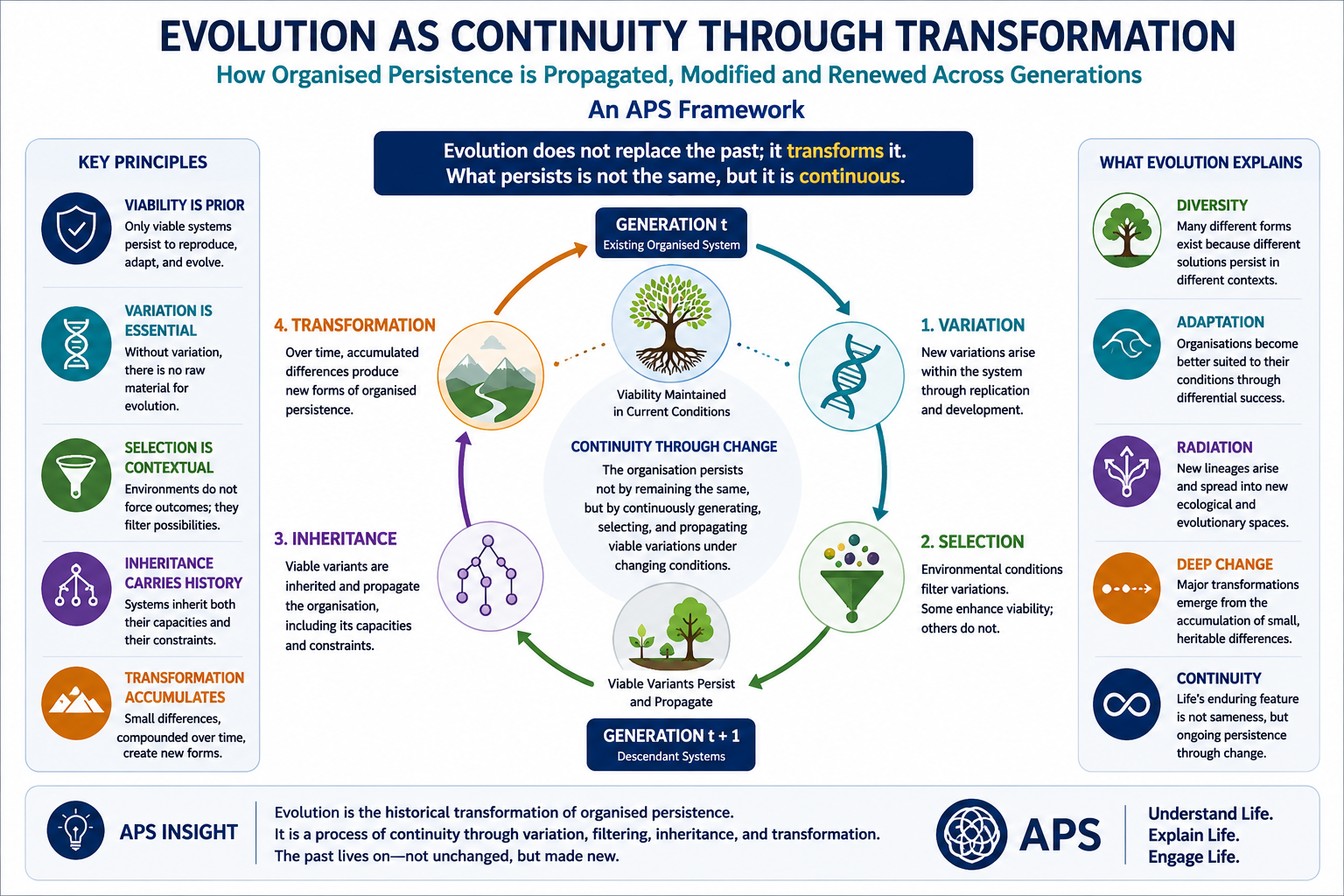
Evolution Continuity Visual. APS explains evolutionary continuity as the regeneration and transformation of viability-oriented organisation across generations through inheritance, variation, adaptation, ecological interaction, and the differential stabilisation of organised persistence under changing conditions.
Ecology and Historical Persistence
Evolution transforms ecological continuity systems historically, but ecological organisation also shapes the conditions under which evolutionary transformation occurs. Organisms modify environments through niche construction, behavioural activity, multispecies interaction, ecosystem engineering, and distributed persistence relations, while ecological conditions simultaneously influence developmental trajectories, adaptive possibilities, and viability itself.
This relationship is reciprocal rather than one-directional. Organisms are shaped by ecological conditions, but they also participate in shaping those conditions through their own activities. Ecological organisation is therefore neither a passive background nor an external force acting upon otherwise independent organisms. It forms part of the continuity-producing organisation through which living systems persist.
The significance of ecological organisation becomes especially clear when considering long-term evolutionary change. Ecological modifications may alter developmental opportunities, reshape adaptive pressures, influence patterns of inheritance, and transform the conditions under which future evolutionary trajectories unfold. Evolutionary transformation therefore occurs within historically changing ecological contexts that are themselves partly generated by living activity.
APS consequently rejects sharp separations between evolutionary explanation, ecological explanation, and developmental explanation. These represent different perspectives on interacting dimensions of organised persistence unfolding across historical time. Understanding evolutionary change therefore requires understanding how ecological continuity and biological continuity are mutually transformed.
Individuality and Evolution
Evolution transforms biological individuality as well as the organisms, populations, and ecological systems within which individuality is expressed. The forms through which biological continuity is organised are themselves historically variable. Developmental organisation, ecological coupling, reproductive organisation, agency, and persistence architectures may all be reorganised through evolutionary transformation.
This insight becomes particularly important once individuality is understood processually rather than statically. Biological individuals are not fixed objects persisting unchanged through time. They are continuity-producing organisations whose boundaries, interactions, and persistence strategies may themselves evolve. Evolution therefore transforms not only the characteristics of individuals but also the forms individuality can take.
APS distinguishes among organisms, biological agents, biological individuals, and processual individuals because each highlights a different aspect of organised persistence. Organisms identify living systems as integrated biological wholes. Biological agents emphasise viability-oriented activity. Biological individuals identify continuity-producing units capable of participating in evolutionary processes. Processual individuals highlight the dynamic and temporally extended nature of that continuity.
These distinctions are not merely conceptual refinements. They help clarify what evolutionary transformation acts upon and how continuity is maintained despite historical change. The organisational structures through which viable persistence becomes possible are themselves products of evolutionary history and may continue to change as evolutionary trajectories unfold. Evolution therefore transforms not only living systems, but the very forms through which biological continuity is organised.
Evolution, Agency, and Constraint Organisation
The historical transformation of organised persistence ultimately depends upon the transformation of continuity-producing constraints. Living systems maintain viability through networks of mutually sustaining constraints distributed across physiological, developmental, behavioural, reproductive, and ecological processes. These constraints do not merely limit activity. They organise activity by channeling biological processes in ways that contribute to the maintenance of continuity across time.
The persistence of living systems therefore depends upon more than the existence of particular structures or components. It depends upon the organisation of relationships through which biological activity remains viability-oriented. Metabolic processes support development, developmental processes support reproduction, behavioural processes support ecological interaction, and ecological relations help sustain the conditions under which continuity remains possible. Organised persistence emerges from these mutually reinforcing relations rather than from any single component acting independently.
Evolution transforms these continuity-producing organisations historically. Variation, adaptation, inheritance, ecological interaction, and differential stabilisation all contribute to changes in the constraint structures through which viability is maintained. Evolutionary transformation therefore involves more than the appearance of new traits or altered frequencies within populations. It involves the historical reorganisation of the networks of constraints through which living systems sustain themselves.
This perspective helps clarify why agency occupies such a central place within APS. Living systems are not merely shaped by constraint organisation. They actively participate in maintaining and modifying it. Through physiology, behaviour, development, reproduction, and environmental interaction, organisms continuously regulate the conditions upon which their own viability depends. Agency therefore contributes directly to the ongoing production and maintenance of organised persistence.
The evolutionary significance of agency extends beyond the activities of individual organisms. Behaviour alters ecological conditions. Development influences the forms of variation available to future generations. Organism–environment interactions reshape persistence conditions. Reproductive activities regenerate continuity while simultaneously creating opportunities for transformation. Evolutionary trajectories therefore emerge partly through the accumulated historical consequences of viability-oriented activity distributed across generations.
APS consequently rejects views of evolution that portray organisms as passive substrates shaped externally by selection alone. Selection remains important, but it operates upon systems already actively engaged in sustaining their own continuity. Evolutionary transformation therefore emerges through the interaction of agency, development, ecology, inheritance, adaptation, and differential stabilisation rather than through selection acting upon inert biological material.
Evolution can therefore be understood as the long-term historical transformation of agency-based organised persistence. Living systems continuously regenerate the conditions of their own continuity while simultaneously contributing to the historical processes through which those conditions are transformed. Evolution emerges from this ongoing interaction between viable agents, continuity-producing constraints, and the changing developmental and ecological contexts within which persistence occurs.
From the APS perspective, constraint organisation provides one of the principal mechanisms through which organised persistence is maintained across time. Living systems persist because networks of constraints regulate the flows of matter, energy, information, and activity required for viability. Evolutionary transformation therefore involves not merely changes in traits or components, but historical changes in the continuity-producing constraint organisations that sustain persistence. Evolution can thus be understood as the long-term transformation of the organisational structures through which living systems maintain viable continuity across generations.
Why Evolution Matters in APS
Clarifying evolution organisationally helps resolve several persistent difficulties within evolutionary explanation. Many longstanding debates arise because different explanatory traditions focus on different components of evolutionary systems while treating those components as explanatorily fundamental. Gene-centred accounts emphasise heredity, developmental approaches emphasise construction and plasticity, ecological approaches emphasise environmental relations, and selection-centred approaches emphasise differential reproductive outcomes. Each captures an important aspect of evolutionary organisation, yet none fully explains how these dimensions fit together.
APS approaches this problem by placing organised persistence at the centre of evolutionary explanation. Genes, developmental systems, ecological relations, behavioural activities, reproductive processes, and selection pressures all become intelligible as components of continuity-producing organisation. Evolutionary explanation therefore shifts from identifying a single privileged causal factor to understanding how different dimensions of biological organisation contribute to the maintenance and transformation of viability across time.
This perspective also clarifies why natural selection cannot be treated as the source of biological organisation. Selection explains differential persistence among already existing forms of organisation, but it presupposes systems capable of maintaining continuity in the first place. Living systems must already possess agency, developmental organisation, ecological integration, and continuity-producing constraints before selection can act upon them. Evolutionary explanation therefore requires understanding both the organisation that makes continuity possible and the processes through which continuity is transformed historically.
The APS account also helps illuminate the relationship between continuity and novelty. Evolution is often portrayed as a tension between stability and change, as though continuity and transformation were opposing forces. APS instead interprets novelty as emerging within systems already organised to preserve viability. Transformation occurs because continuity is maintained, not because continuity is abandoned. Evolutionary innovation therefore becomes compatible with organisational continuity rather than opposed to it.
This reconstruction further clarifies the relationships among development, ecology, inheritance, adaptation, and selection. These are not independent explanatory domains competing for priority. They are interacting dimensions of organised persistence that contribute in different ways to the historical transformation of living systems. Evolution becomes intelligible when these dimensions are understood together rather than treated as isolated explanatory alternatives.
Most importantly, APS helps explain why evolution remains fundamentally a biological phenomenon rather than merely a statistical one. Evolutionary patterns may be described mathematically, but the significance of those patterns derives from the living organisations through which viability is maintained and transformed. Evolution therefore concerns the historical dynamics of living systems rather than abstract changes considered independently of biological organisation.
This perspective also helps clarify the relationship between many concepts that are often treated separately within biology. Genes, development, inheritance, adaptation, ecology, fitness, and natural selection are not independent explanatory domains. Each contributes to understanding how organised persistence is maintained and how persistence-sustaining organisation is transformed through historical time. Evolution therefore provides a unifying framework through which diverse biological phenomena can be understood as interconnected dimensions of continuity and transformation.

From Novelty to Evolutionary Transformation. APS interprets evolution as a continuity-preserving sequence in which variation generates novelty, adaptation integrates novelty into viable persistence, fitness differentiates among viable variants, and natural selection differentially stabilises continuity across generations. Evolutionary transformation emerges from the interaction of these processes within the broader architecture of organised persistence.
Conclusion
Evolution is the historical transformation of persistence-sustaining organisation across generations.
Living systems are biological agents whose activities sustain the conditions of their own continued viability. Through development, ecological interaction, reproduction, adaptation, and inheritance, these agents generate forms of organised persistence capable of extending continuity across time. Evolution becomes possible because such continuity already exists.
The central task of evolutionary explanation is therefore not simply to explain change. It is to explain how continuity is maintained, regenerated, diversified, and transformed despite continual developmental, ecological, and organisational reorganisation. Living systems persist historically because they are capable of sustaining viability across changing circumstances, and evolution concerns the long-term transformation of the organisations through which that viability is achieved.
Agency asks what living systems do to sustain their own persistence (activity). Process asks how continuity is maintained despite continual material and organisational change (continuity). Scale asks where the relationships that support persistence are organised across developmental, ecological, organismal, and historical domains (organisation). Together these complementary perspectives explain how organised persistence is maintained, regenerated, and transformed through time, establishing the conditions under which evolution becomes possible.
In simplified form:
Agency = What do living systems do? Process = How is continuity maintained? Scale = Where is persistence organised?
Variation diversifies organised persistence. Adaptation reorganises it. Inheritance regenerates it across generations. Lineages extend it historically. Fitness contributes to differential continuity. Natural selection differentially stabilises viable forms of organisation under changing conditions. These processes do not operate independently. They interact continuously within the broader organisation of living systems and collectively contribute to the historical transformation of continuity-producing biological organisation.
APS therefore explains evolution as continuity-through-transformation. Evolution is not merely change in hereditary frequencies, nor simply the action of natural selection. It is the historical transformation of agency-based organised persistence across interacting developmental, ecological, organismal, and lineage scales. Through this transformation, living systems continuously regenerate and reorganise the conditions of their own continuity across the history of life.
Understanding evolution in this way helps reconnect many domains of biological explanation that are often treated separately. Development, ecology, inheritance, adaptation, individuality, agency, and selection become intelligible as interconnected dimensions of the same underlying phenomenon: the historical transformation of persistence-sustaining organisation. Evolution therefore becomes not merely a theory of biological change, but a theory of how living continuity itself is transformed across time.
From the APS perspective, the deepest significance of evolution lies in its relationship to organised persistence. Biological agency sustains the continuity of living systems in the present, while evolution transforms the organisation supporting that continuity across historical time. Evolution is therefore not simply change within populations, nor merely the accumulation of genetic differences across generations. It is the long-term historical transformation of persistence-sustaining organisation. Agency, process, and scale remain essential because they help explain how organised persistence is achieved and maintained, but these dimensions ultimately converge upon a common explanatory problem: how living systems sustain continuity despite ongoing transformation, and how the organisation making such continuity possible is itself transformed through evolutionary history.
See Also
Related Articles
References
- (1859). On the Origin of Species. John Murray.
- (1930). The Genetical Theory of Natural Selection. Clarendon Press.
- (2005). Evolution in Four Dimensions. MIT Press.
- (1982). The Growth of Biological Thought: Diversity, Evolution, and Inheritance. Harvard University Press.
- (2015). Biological Autonomy: A Philosophical and Theoretical Enquiry. Springer.
- (2018). Everything Flows: Towards a Processual Philosophy of Biology. Oxford University Press.
- (2003). Niche Construction. Princeton University Press.
- (2000). The Ontogeny of Information. Duke University Press.
- (2026). Agency as the Defining Activity of Life: A Viability-Oriented Framework Integrating Process and Scale. Biological Theory . https://doi.org/10.1007/s13752-026-00547-6
- (1957). The Strategy of the Genes. Allen & Unwin.
- (2003). Developmental Plasticity and Evolution. Oxford University Press.