Viability — The Organising Principle of Biological Persistence
Viability occupies a central organising position within the APS framework. Living systems do not merely survive but actively sustain, regulate, and reconstruct the conditions required for continued persistence across changing conditions. Agency maintains viability, viability enables organised persistence, and organised persistence provides the continuity through which living systems exist across time. This article develops viability as the organisational condition linking agency, persistence, function, normativity, process, scale, development, ecology, and evolution. Within APS, viability is understood not as passive survival or static maintenance but as the organised capacity to preserve continuity through continual transformation.
Key Points
- Viability is not mere survival but the organised maintenance and reconstruction of conditions required for continued persistence.
- Viability is the organisational condition maintained by biological agency.
- Viability enables organised persistence across changing conditions.
- Viability is enacted through temporally organised activity.
- Viability is distributed across biological scales and organisational contexts.
- Viability is achieved through ongoing organism–world coupling.
- Viability grounds biological function and normativity.
- Living systems persist through continual transformation rather than static stability.
Introduction
How do living systems remain alive despite continually changing conditions?
Organisms persist while undergoing material turnover, energetic exchange, developmental transformation, ecological interaction, environmental perturbation, injury, repair, and decay. Yet despite these continual sources of change, living systems maintain an organised continuity that allows them to remain recognisably themselves through time.
This continuity cannot be explained by static structure alone. Living systems must continuously sustain, regulate, repair, and reconstruct the conditions required for their own continued existence. These conditions are maintained not in isolation but through continual engagement with surrounding environments. Living systems remain viable through ongoing organism–world coupling that provides resources, presents challenges, and shapes the conditions under which continuity remains possible. The persistence of life therefore depends not merely upon organisation but upon the maintenance of conditions under which organisation can continue.
APS describes this condition as viability.
Viability is not simply the fact that a system remains alive. It is the organised capacity to preserve continuity across changing conditions through ongoing self-maintaining, reconstructive, and continuity-producing activity. Viability identifies the organisational condition that living systems must continuously sustain if persistence is to remain possible.
Within the APS framework, viability occupies a central organising position linking agency and organised persistence. Agency provides the viability-oriented activity through which living systems maintain themselves, while viability identifies the organisational condition that this activity preserves. Agency answers what living systems do; viability answers what must be maintained if organised continuity is to remain possible. The distinction is important. Agency identifies the activity through which living systems maintain themselves, whereas viability identifies the condition that this activity preserves. Agency answers what living systems do; viability answers what must be maintained if organised continuity is to remain possible. Organised persistence provides the continuity achieved through successful viability maintenance.
Agency maintains viability, viability enables organised persistence, and organised persistence provides the continuity through which living systems exist across time.
This relationship gives viability a foundational role within biological explanation. Function, normativity, development, ecology, cognition, and evolution all depend upon the capacity of living systems to preserve continuity despite continual transformation. Viability therefore serves as one of the key organising principles through which biological organisation becomes intelligible.
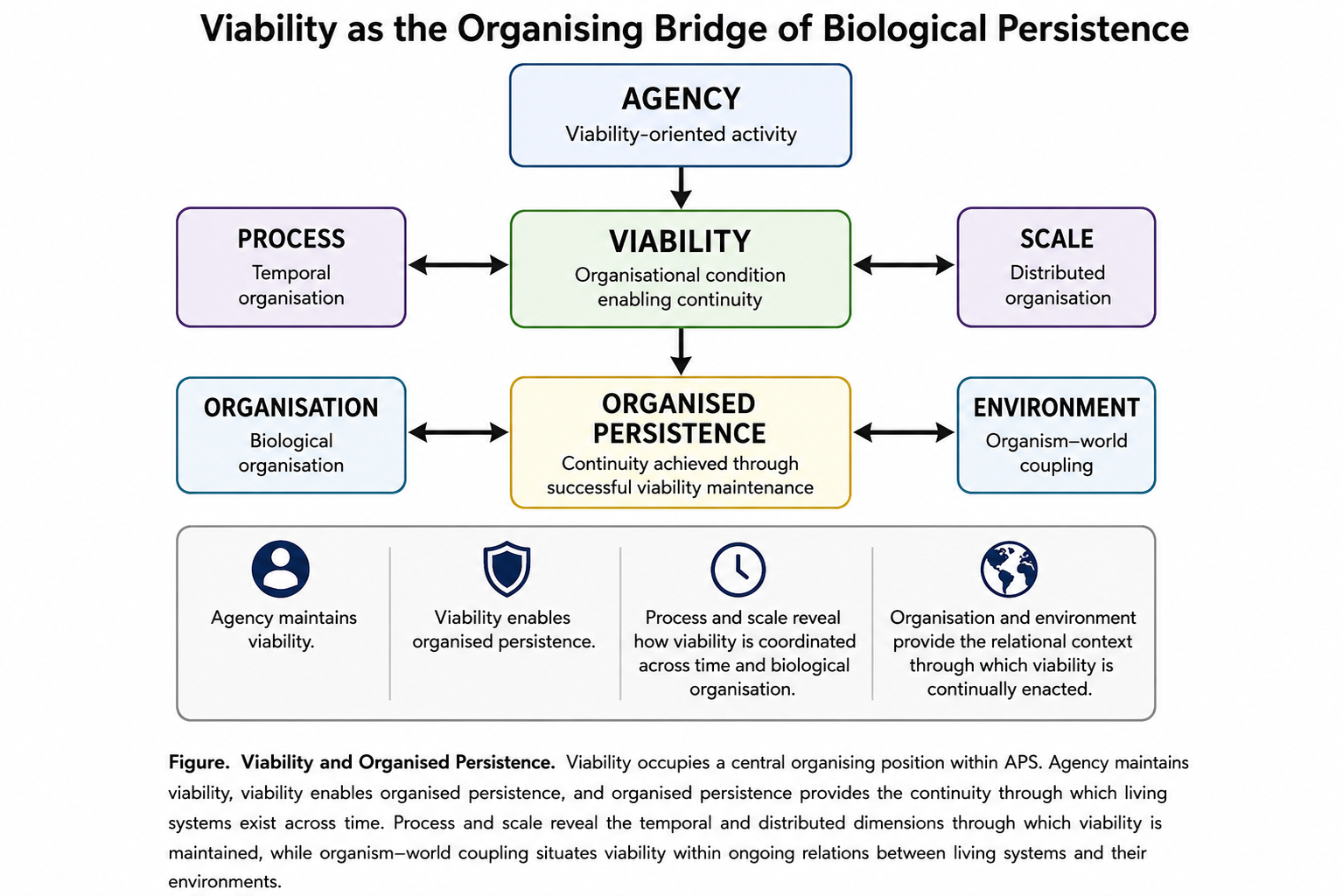
Viability and Organised Persistence. Viability occupies a central organising position within APS. Agency maintains viability, viability enables organised persistence, and organised persistence provides the continuity through which living systems exist across time. Process and scale reveal the temporal and distributed dimensions through which viability is maintained, while organism–world coupling situates viability within ongoing relations between living systems and their environments. Self-maintaining organisation and environmental relations together provide the context through which viability is continually enacted.
Viability Beyond Survival
Viability is often interpreted narrowly as survival.
APS rejects this reduction.
Survival describes an outcome.
Viability describes an organisational condition.
A system may remain extant temporarily while progressively losing the organisational capacities required for continued continuity. Conversely, viability may involve temporary instability, reorganisation, or transformation when such changes contribute to longer-term persistence.
Viability therefore concerns the maintenance and reconstruction of organised persistence rather than mere existence at a particular moment.
This distinction is essential because living systems are not static objects. They are dynamically maintained and continuously reconstructed organisations. Their continued existence depends not simply upon remaining present but upon preserving the organisational conditions that make future continuity possible.
Viability therefore introduces an important temporal dimension into biological explanation. What matters is not merely whether a system exists now, but whether it retains the capacity to continue existing as the kind of organised system that it is. Viability concerns continuity across time rather than occupancy of a momentary state.
Understanding viability in this way helps distinguish living systems from many non-living forms of persistence. A rock may survive environmental conditions without actively contributing to its own continuation. Living systems differ because they continuously participate in maintaining the conditions required for their own persistence. Viability therefore identifies an organisational condition rather than a simple outcome.
Viability as Organised Persistence
Living systems remain viable only by continuously regulating the conditions under which their organisation can persist.
This includes:
- maintaining metabolic organisation
- regulating internal conditions
- repairing damage
- adapting to perturbation
- reorganising activity
- coordinating processes across scales
- reconstructing degraded organisation
- integrating environmental relations
Viability therefore depends upon active organisation. Persistence is not passively possessed but continuously achieved through ongoing self-maintaining activity.
This is why viability occupies such a central position within APS. Agency provides the activity through which living systems maintain themselves. Viability identifies the organisational condition preserved through that activity. Organised persistence identifies the continuity achieved when viability is successfully maintained.
The relationship among these concepts forms one of the central continuity structures within APS:
Agency → Viability → Organised Persistence
These concepts are distinct but inseparable. Agency without viability would lack orientation. Viability without agency could not be actively maintained. Organised persistence without viability would lose the conditions required for continued continuity.
Viability therefore functions as the bridge linking biological activity to biological persistence. It explains how living systems transform ongoing self-maintaining activity into enduring organisational continuity.
Within APS, viability refers to the organised maintenance and reconstruction of persistence across time.
Viability and Temporal Organisation
Viability is inherently temporal.
A system cannot be viable merely at an isolated instant. It must sustain continuity across ongoing transformation. Living systems therefore persist not by remaining unchanged but by continuously reorganising themselves while preserving organisational coherence.
This temporal character distinguishes viability from static conceptions of biological organisation. Living systems are never materially identical from one moment to the next. Molecules are exchanged, cells are replaced, tissues are remodelled, ecological relations shift, and developmental states transform. Yet despite continual change, organisational continuity remains possible.
Viability therefore depends not merely upon maintenance but upon continuity-preserving reconstruction across time.
Within APS, this processual character of viability links it directly to Process as one of the framework’s foundational explanatory dimensions. Viability is not a state that living systems possess. It is a condition continually enacted through ongoing activity. The organisation supporting persistence must be continuously regenerated, regulated, repaired, and reconstructed if continuity is to remain possible.
Temporal organisation becomes essential because living systems must:
- coordinate processes unfolding at different rates
- regulate changing internal and external conditions
- preserve continuity despite material turnover
- reorganise under perturbation
- maintain persistence across environmental variation
- integrate developmental transformation with ongoing regulation
Viability therefore emerges through temporally organised activity rather than through static structure. Living systems remain viable because they continually produce the conditions under which future continuity remains possible.
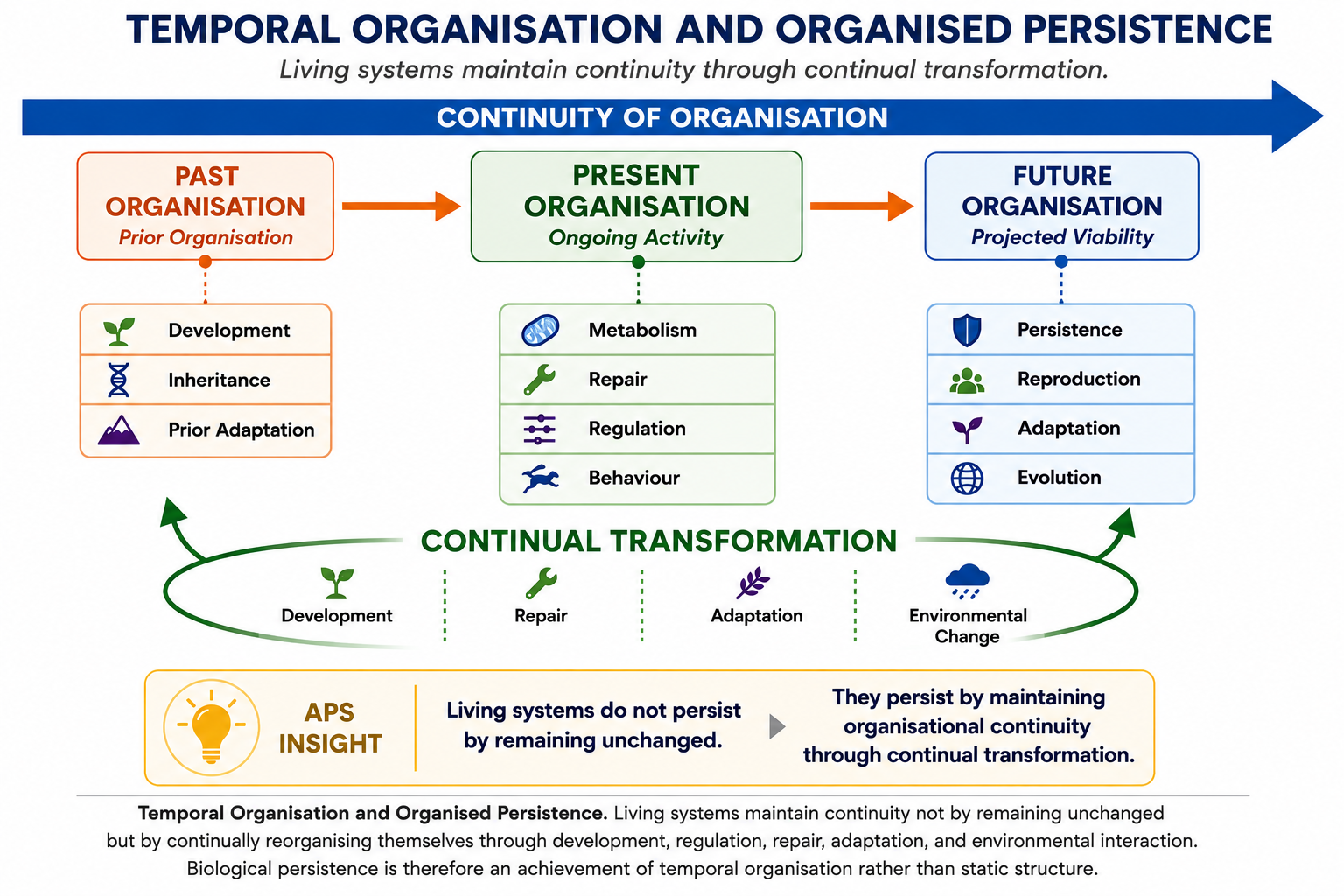
Temporal Organisation and Organised Persistence. Viability depends upon temporally organised activity that maintains continuity across changing conditions. Living systems persist by actively sustaining and reconstructing the conditions required for continued organisation.
Viability is therefore best understood not as a momentary property but as continuity-producing organisation enacted through time.
Viability and Constraint Closure
Constraint closure provides part of the organisational basis through which viability becomes possible.
Constraint-closed systems sustain the organisational conditions enabling their continued activity. Through networks of mutually supporting constraints, biological organisation acquires a degree of self-maintaining coherence that distinguishes living systems from many forms of non-living organisation.
However, closure alone is insufficient for viability.
A system may remain structurally integrated yet still fail to regulate perturbation, maintain adaptive organisation, reorganise under changing conditions, reconstruct degraded organisation, or preserve continuity through disruption.
APS therefore distinguishes between constraint closure and viability-oriented organisation.
Constraint closure describes an organisational architecture.
Viability describes an organisational condition.
Closure helps explain how biological organisation sustains itself. Viability explains why that organisation matters and how it remains capable of continued persistence across changing circumstances.
This distinction becomes particularly important when biological systems encounter novel conditions. Closure may preserve organisational coherence under familiar circumstances, yet viability requires the capacity to maintain continuity despite developmental transformation, ecological variation, injury, resource limitation, and environmental uncertainty.
Viability therefore introduces orientation into organisation. Biological activity becomes organised relative to the conditions required for continued persistence.
Constraint closure enables viability.
Viability extends beyond closure by linking organisational maintenance to continuity across time.
Viability and Normativity
Viability provides the foundation for biological normativity because persistence can succeed or fail.
Living systems exist under conditions where some states contribute to continuity while others undermine it. As a result, differences among biological states and processes acquire significance relative to the preservation of organised continuity.
Some conditions:
- support persistence
- stabilise organisation
- enhance adaptive capacity
- preserve continuity
while others:
- undermine organisation
- disrupt regulation
- degrade adaptive capacity
- threaten persistence
This asymmetry generates biological normativity.
Within APS, normativity is not externally imposed upon living systems. It emerges from the viability conditions of organised systems themselves. Activities matter because they influence the capacity of a system to continue existing as the organised system that it is.
Viability therefore provides the organisational basis from which biological evaluation becomes possible. A process may be beneficial, harmful, functional, dysfunctional, adaptive, or maladaptive because it affects the conditions supporting persistence.
This relationship also clarifies the connection between viability, function, and normativity. Functions contribute to viability. Normativity emerges because those contributions can succeed or fail. Viability therefore occupies a pivotal position linking biological organisation to biological significance.
The continuity architecture developed throughout APS can therefore be extended:
Agency → Viability → Function → Normativity
Agency maintains viability. Functions contribute to viability. Normativity emerges because viability can be enhanced or undermined.
Viability thus provides the organisational grounding from which biological meaning becomes intelligible.
Viability and Agency
The relationship between viability and agency has become increasingly important within the APS framework.
The Agency article established that agency is the defining activity through which living systems sustain themselves across time. Viability identifies the organisational condition that this activity preserves.
Agency maintains viability.
Viability gives agency orientation.
Organised persistence becomes possible through successful viability maintenance.
This relationship explains why agency cannot be reduced to behaviour, cognition, decision-making, or conscious intention. Agency appears wherever a living system actively contributes to preserving the conditions required for continued continuity.
Living systems do not merely undergo processes.
They regulate organisation relative to viability conditions.
Agency therefore includes:
- modulation of constraints
- regulation of activity
- adaptive reorganisation
- continuity-preserving behaviour
- repair and reconstruction
- maintenance of organism–environment relations
These activities matter because they influence viability.
Without viability, biological activity would lack organisational significance. Processes could occur, but there would be no basis for distinguishing activities that contribute to persistence from those that undermine it.
Viability therefore provides the orienting principle through which agency becomes biologically meaningful.
At the same time, viability depends upon agency because organisational conditions cannot be maintained passively. Living systems remain viable only through ongoing activity directed toward preserving continuity. Agency and viability therefore stand in a reciprocal relationship.
Agency maintains viability.
Viability orients agency.
Together they provide the bridge linking living activity to organised persistence.
This relationship forms one of the central explanatory structures within contemporary APS.
Viability Across Biological Domains
Viability appears throughout biology because the preservation of continuity is a universal requirement of living systems. Although viability is expressed differently across biological contexts, the underlying organisational principle remains the same: living systems must sustain the conditions required for continued persistence.
In physiology, viability concerns the maintenance of metabolic and regulatory organisation in real time. Organisms must coordinate countless interacting processes to preserve the conditions under which continued activity remains possible.
In development, viability concerns continuity through transformation. Developing organisms do not simply maintain existing organisation; they continually reconstruct and reorganise themselves while preserving developmental coherence. Viability therefore links persistence to ongoing developmental change.
In evolution, viability concerns the persistence and transformation of lineages across generations. Evolutionary processes modify biological organisation historically, yet those processes operate only because viable systems persist long enough to reproduce, vary, and undergo selection.
In ecology, viability concerns the maintenance of continuity through organism–world coupling. Living systems do not preserve themselves in isolation from their environments. They acquire resources, respond to changing conditions, modify ecological relationships, and participate in networks of interaction that influence the conditions under which persistence remains possible. Viability is therefore continually enacted through environmental engagement.
In cognition, viability concerns increasingly integrated and temporally extended forms of evaluative organisation. Cognitive systems contribute to persistence by enabling organisms to regulate activity relative to changing conditions across broader spatial and temporal scales.
These are not separate forms of explanation. They are different expressions of viability-oriented organised persistence enacted across distinct timescales, organisational contexts, and scales of biological organisation.
This perspective highlights another important feature of viability: it is distributed across Scale. Viability is not maintained at a single privileged level of organisation. Cellular processes contribute to organismal viability, organismal activities contribute to ecological viability, and ecological conditions influence the viability of individual organisms. Viability therefore emerges through coordinated organisation distributed across biological scales rather than through activity occurring at a single level.
Viability and Resilience
Viability does not require perfect stability.
Living systems are continuously exposed to perturbation, disruption, and change. Environmental conditions fluctuate, injuries occur, resources become limited, and organisational structures degrade through time. If viability depended upon maintaining a fixed state, living systems would be unable to persist under realistic biological conditions.
What matters instead is the capacity to preserve continuity despite disruption. This requirement introduces the importance of resilience within viability-oriented organisation.
Resilience refers to the capacity of a system to absorb disturbance, reorganise activity, reconstruct degraded organisation, and restore continuity-producing conditions. Resilience therefore contributes directly to viability because it allows persistence to continue even when established patterns of organisation are challenged.
Importantly, resilience should not be understood as simple resistance to change. Many biological systems remain viable precisely because they can change. Developmental plasticity, physiological flexibility, behavioural adaptation, and ecological responsiveness all represent forms of resilience through which continuity is preserved through reorganisation rather than through rigidity.
Viability therefore depends not upon avoiding change but upon regulating change in ways that preserve organised continuity.
This perspective further reinforces the processual character of viability. Persistence is not achieved through static stability. It is achieved through continuity-preserving reorganisation occurring across time.
Living systems remain viable because they can absorb disruption while continuing to generate the conditions required for future persistence.
Viability in APS
APS places viability at the centre of a broader explanatory architecture linking biological activity to organised persistence.
Agency identifies the activity through which living systems sustain themselves.
Viability identifies the organisational condition maintained by that activity.
Organised persistence identifies the continuity achieved through successful viability maintenance.
These relationships become intelligible through Process and Scale, the two explanatory dimensions that reveal how viability is maintained through time and coordinated across distributed biological organisation.
The resulting explanatory structure can be summarised as:
Agency = activity
Viability = organisational condition
Organised Persistence = explanatory target
Process = temporal organisation
Scale = distributed organisation
Together these dimensions explain how living systems maintain continuity across time. Agency supplies the activity through which continuity is pursued. Viability supplies the organisational condition that must be preserved. Process supplies the temporal organisation through which continuity is enacted. Scale supplies the distributed coordination through which viability is maintained. Organised persistence supplies the explanatory target that biology ultimately seeks to understand.
Agency explains how living systems actively participate in maintaining themselves, viability explains the conditions that must be preserved, organised persistence explains the continuity thereby achieved, process explains the temporal dynamics through which continuity is produced, and scale explains how viability is coordinated across distributed biological organisation.
This architecture allows diverse biological phenomena to be understood within a common framework. Development, physiology, ecology, evolution, cognition, function, normativity, adaptation, and resilience become intelligible as different expressions of viability-oriented organised persistence.
Viability therefore occupies a uniquely integrative position within APS. It connects biological activity to biological continuity and links the explanatory dimensions through which living organisation becomes intelligible.
Why Viability Matters
Clarifying viability helps resolve several persistent problems in biological explanation.
It explains why biological systems exhibit normativity. Activities matter because they affect the conditions required for continued persistence.
It explains how continuity remains possible despite continual material turnover and organisational change. Living systems persist because viability is actively maintained through ongoing reconstruction and regulation.
It explains why agency emerges within living organisation. Biological activity becomes meaningful because it is oriented toward preserving viability.
It explains how organisation remains coherent across scales despite continual transformation. Viability integrates distributed forms of organisation into continuity-producing systems.
It explains how developmental continuity remains possible through changing developmental states and how ecological engagement contributes to persistence through organism–world coupling.
It also helps explain how increasingly sophisticated forms of evaluation and cognition emerge within living systems. Cognitive organisation extends viability-oriented regulation across broader spatial, temporal, and organisational contexts.
More generally, viability provides a common explanatory language linking physiology, development, ecology, evolution, and cognition. Rather than treating these domains as isolated explanatory frameworks, APS understands them as different perspectives on the conditions through which organised persistence becomes possible.
Viability therefore represents one of the deepest organising principles within the APS framework.
Conclusion
Living systems do not merely survive.
They actively sustain, regulate, repair, and reconstruct the conditions required for continued persistence across changing circumstances.
APS describes this organisational condition as viability.
Viability is not passive survival, equilibrium, or static maintenance. It is the organised capacity of living systems to preserve continuity across continual transformation. Through viability, biological systems remain capable of sustaining themselves despite material turnover, developmental change, ecological interaction, perturbation, and environmental uncertainty.
Understanding viability clarifies why biological organisation exhibits function, normativity, resilience, adaptation, and agency. These phenomena derive their significance from their relationship to the conditions required for continued persistence.
Viability therefore occupies a central organising position within biological explanation.
Agency maintains viability.
Viability enables organised persistence.
Organised persistence provides the continuity through which living systems exist across time.
Through this relationship, living systems continuously sustain the organised continuity that makes life possible.
Viability is the organisational bridge through which living activity becomes enduring biological persistence.
See Also
Related Articles
References
- (2015). Biological Autonomy: A Philosophical and Theoretical Enquiry. Springer.
- (2023). Organization in Biology. Springer.
- (2018). Everything Flows: Towards a Processual Philosophy of Biology. Oxford University Press.
- (2026). Agency as the Defining Activity of Life: A Viability-Oriented Framework Integrating Process and Scale. Biological Theory . https://doi.org/10.1007/s13752-026-00547-6