What Is Life? — A Biological Question Revisited
Life remains one of biology's most fundamental yet persistently contested questions. Despite extraordinary advances across the biological sciences, no single account of life has achieved broad conceptual agreement. Competing approaches variously emphasise metabolism, reproduction, evolution, information, autonomy, autopoiesis, or organisational closure, each illuminating important aspects of living systems while leaving significant explanatory questions unresolved. This article examines why the question remains open and argues that the continuing debate reflects uncertainty concerning the organisational target of biological explanation. Rather than asking which properties distinguish living systems, the APS framework investigates the kind of organisation that makes those properties possible, proposing that life is best understood as viability-oriented, constraint-closed organisation sustained through organised persistence.
Key Points
- The question "What is life?" remains one of biology's central unresolved questions.
- Different approaches often explain different aspects of living systems rather than the same biological question.
- Trait-based definitions describe living systems but do not fully explain the organisation that unifies those traits.
- APS approaches life as an organisational rather than primarily classificatory problem.
- Life is interpreted as viability-oriented, constraint-closed organisation sustained through organised persistence.
- This interpretation provides a comparative explanatory framework that integrates rather than replaces existing biological approaches.
Where this article fits: The question What is life? occupies a special place within APS because it addresses the most fundamental question in biology. Before we can explain evolution, development, cognition, ecology, or behaviour, we must first understand what kind of organisation makes something alive. Several APS articles approach this question from different perspectives.
Agency as the Defining Activity of Life examines why living systems are active participants in their own persistence rather than passive objects shaped by external forces. Persistence — Organised Continuity Through Time explains why continuity is the central explanatory challenge of biology and why living systems must continually maintain themselves despite constant change. The Continuity Architecture of Life explores the major continuity architectures through which persistence is sustained across development, ecology, evolution, cognition, and social organisation.
This article occupies a different position. Its purpose is to answer the foundational question itself. Rather than asking how continuity is maintained or how agency operates, it asks what kind of organisation makes these phenomena possible in the first place. It therefore serves as one of the principal entry points into the APS framework.
Together, these articles form a conceptual sequence:
- What Is Life? — A Biological Question Revisited — What kind of organisation makes something alive?
- Agency as the Defining Activity of Life — Why living systems act to maintain themselves.
- Persistence — Organised Continuity Through Time — Why continuity is biology’s central explanatory challenge.
- The Continuity Architecture of Life — How continuity is maintained across the major domains of life.
Introduction - Why “What Is Life?” Remains an Open Question
At first sight, the question What is life? appears almost trivial. Living organisms seem immediately recognisable. Plants grow, animals move, microorganisms reproduce, and ecosystems display remarkable forms of organisation. Modern biology has mapped genomes, reconstructed evolutionary histories, revealed molecular mechanisms, and transformed our understanding of living systems across every level of biological investigation. Few scientific disciplines have achieved comparable explanatory success.
Yet despite these extraordinary advances, biology still lacks a universally accepted answer to one of its most fundamental questions: what is life?
This continuing uncertainty is not the result of insufficient empirical knowledge. Contemporary biology possesses an unprecedented understanding of metabolism, development, heredity, physiology, ecology, and evolution. The difficulty lies elsewhere. Knowledge of the many processes exhibited by living systems does not by itself explain what makes those processes expressions of a single biological phenomenon. Biology has become increasingly successful at explaining how living systems function while continuing to disagree about the nature of the organisation that makes them living.
The persistence of this question is reflected in the remarkable diversity of proposed definitions. Contemporary surveys of the field continue to document explanations centred on metabolism, replication, evolution, information, autonomy, autopoiesis, thermodynamics, artificial life, and viral biology, illustrating the continuing diversity of explanatory approaches (Zimmer, 2021; Nicholson, 2025). Some accounts emphasise metabolism, others reproduction, evolution, information, autonomy, autopoiesis, or organisational closure. More recent discussions increasingly treat life as a dynamic process rather than a static property or substance. Each perspective captures important aspects of living systems and has contributed significantly to biological understanding. Yet no single approach has achieved broad conceptual agreement, and debates concerning viruses, sterile organisms, artificial life, and other borderline cases continue to expose the limitations of many proposed definitions.
This continuing disagreement suggests that the problem is not simply the absence of a sufficiently comprehensive list of biological characteristics. Rather, different definitions frequently address different explanatory questions. Some identify properties commonly associated with living systems, others specify criteria for classification, while others seek to explain the distinctive organisation exhibited by organisms. These are related but not identical enterprises. Consequently, disagreements about the definition of life often arise because the underlying explanatory objective has not been clearly distinguished.
The APS framework approaches this issue by drawing an explicit distinction between recognising, defining, and explaining life. Observable characteristics such as metabolism, growth, regulation, reproduction, responsiveness, and evolution provide important evidence of living organisation and often assist in recognising living systems. A biological definition seeks to identify what qualifies a system as living. Biological explanation asks a deeper question: what kind of organisation makes these characteristic activities possible in the first place?
The central claim of this article is that the enduring debate over life reflects continuing uncertainty about that explanatory target. If biology seeks merely to classify living systems, then lists of defining characteristics may be sufficient. If, however, biology seeks to explain why those characteristics belong together as expressions of a single biological phenomenon, then the problem becomes organisational rather than merely classificatory.
This shift in emphasis does not reject existing biological knowledge. On the contrary, it seeks to understand why the many processes investigated throughout biology form a coherent domain of explanation. The question therefore becomes not simply Which properties distinguish living systems? but What kind of organisation makes those properties biologically meaningful?
The sections that follow examine the principal approaches that have been proposed in response to this question before developing the APS interpretation that life is most coherently understood as viability-oriented, constraint-closed organisation sustained through organised persistence.
From Definitions to Explanations: Major Approaches to Understanding Life
The enduring debate over the nature of life has generated a remarkable diversity of scientific and philosophical approaches. Although these perspectives frequently appear to compete with one another, they often begin from different explanatory objectives. Some seek criteria for recognising living systems, others identify the properties shared by organisms, while still others investigate the organisational principles through which living systems maintain themselves. Appreciating these different objectives is essential for understanding both the richness of the literature and the persistence of disagreement.
One of the earliest and most influential strategies has been to define life through characteristic biological properties. Lists commonly include metabolism, growth, reproduction, responsiveness to environmental change, homeostasis, and the capacity for evolution. Such approaches provide practical criteria for recognising many familiar organisms and have played an important role in biological education, taxonomy, and astrobiology. Their strength lies in identifying features that are widely associated with living systems.
However, property-based definitions encounter familiar difficulties. Individual characteristics often admit recognised exceptions. Sterile organisms remain alive despite lacking reproductive capacity, dormant organisms may exhibit little observable metabolism, and viruses satisfy some but not all commonly proposed criteria. Attempts to resolve these difficulties by extending the list of defining properties frequently shift rather than eliminate the underlying problem, because the question becomes not simply which properties should be included, but why these particular properties belong together as expressions of life.
Evolutionary approaches relocate the emphasis from individual organisms to populations capable of heritable variation and natural selection. From this perspective, the defining characteristic of life is participation in an evolutionary process through which adaptive complexity can accumulate over successive generations. This interpretation has proved especially influential in evolutionary biology and in discussions of the origin of life, where Darwinian evolution provides a powerful framework for explaining biological diversity and adaptation.
Yet evolutionary definitions also raise important questions. Individual organisms are alive whether or not they are currently reproducing, while the earliest stages in the emergence of life may have preceded fully developed Darwinian evolution. Moreover, evolution explains how living systems change historically rather than what distinguishes living organisation at any particular moment. These considerations suggest that evolutionary theory, although indispensable for explaining the historical transformation of life, may not by itself resolve the question of what life presently is.
A different family of approaches shifts attention from biological properties to biological organisation itself. Autopoietic theory characterises living systems as networks that continually produce and maintain the very organisation from which they are constituted. Closely related autonomy theories emphasise the self-maintaining organisation through which living systems preserve their own identity under changing environmental conditions. More recent work on constraint closure similarly argues that living organisation consists not simply in interacting processes but in networks of mutually sustaining constraints that maintain the conditions required for their own continued operation.
These organisational approaches have significantly deepened biological theory by moving beyond lists of defining characteristics toward explanations of how living systems achieve coherent organisation. They illuminate aspects of biological individuality, self-maintenance, and organisational continuity that are difficult to capture through property-based definitions alone. At the same time, differences remain concerning the precise character of organisational closure, the relationship between metabolism and autonomy, the role of evolutionary history, and the explanatory significance of organisational concepts themselves. Consequently, organisational biology has generated an increasingly sophisticated family of related perspectives rather than a single universally accepted account of life.
Taken together, these approaches demonstrate that contemporary biology possesses no shortage of explanations for particular aspects of living systems. Rather, it possesses multiple explanatory traditions that illuminate different dimensions of biological organisation. Property-based approaches clarify the observable characteristics of organisms. Evolutionary theory explains the historical transformation of living systems. Organisational theories investigate the conditions through which living systems maintain themselves as coherent entities. Each contributes substantially to biological understanding because each addresses a genuine explanatory problem.
The continuing diversity of these approaches therefore suggests that the central question may not be which definition of life is correct, but how these different explanatory achievements relate to one another. If each perspective captures an important aspect of living systems, then the remaining challenge is not simply to choose between them but to determine whether they can be understood within a broader organisational framework that clarifies their complementary explanatory roles.
It is at this point that APS enters the discussion. Rather than proposing another competing definition of life, The APS framework investigates whether the major explanatory traditions of biology become more coherent when interpreted as complementary perspectives on the organisation through which living systems maintain and re-establish the conditions of their own persistence. The following section develops this comparative explanatory perspective.
Although these approaches illuminate important aspects of living systems, they also reveal a deeper explanatory question. Rather than asking which characteristics distinguish life, biology may need to ask what kind of organisation those characteristics collectively express.
The Explanatory Shift: From Biological Characteristics to Biological Organisation
The preceding discussion suggests that the enduring diversity of definitions of life reflects more than disagreement over particular biological characteristics. It reflects differing assumptions about the explanatory objective itself. Property-based definitions, evolutionary accounts, and organisational theories each illuminate important aspects of living systems because they ask different, though related, questions. Recognising this distinction allows the discussion to move beyond the search for a single defining characteristic toward a more fundamental question concerning the organisation that unifies these diverse biological phenomena.
This shift in explanatory emphasis begins by distinguishing biological characteristics from biological organisation. Characteristics such as metabolism, growth, regulation, development, responsiveness, reproduction, and evolution are readily observable features of living systems. They provide valuable evidence that a system is alive and often serve as practical criteria for biological investigation. Yet the presence of these characteristics does not, by itself, explain why they occur together or why they exhibit the remarkable coherence that distinguishes living systems from other organised physical systems.
An explanatory account therefore requires more than a catalogue of biological properties. It must identify the organisational conditions under which those properties become intelligible as expressions of a single biological phenomenon. The explanatory challenge is not simply to recognise life once it is present, but to understand the mode of organisation through which living systems continually maintain and re-establish the conditions of their own persistence.
Viewed from this perspective, the principal traditions discussed in the previous section can be understood as addressing complementary dimensions of living organisation rather than competing answers to a single question. Property-based approaches identify characteristic manifestations of life. Evolutionary theory explains the historical transformation of living organisation through descent with modification and natural selection. Organisational approaches investigate the self-maintaining structures and processes through which organisms preserve their integrity under changing conditions. Each therefore contributes to understanding a genuine aspect of living systems while leaving open the broader question of how these explanatory achievements relate.
The APS framework begins with that broader question. Rather than asking which biological characteristic should define life, APS asks what kind of organisation makes the diverse phenomena investigated throughout biology intelligible as aspects of the same living system. This is an explanatory rather than classificatory shift. The objective is not to replace established biological theories with a new master theory, nor to reduce their distinctive explanatory contributions to a single principle. Instead, APS investigates whether these contributions become more coherent when interpreted as complementary perspectives on the organisation required for living systems to maintain themselves through continual change.
The significance of this shift is methodological. Biology has long explained mechanisms, developmental processes, ecological interactions, and evolutionary change with extraordinary success. APS does not question these achievements. Instead, it asks whether these explanations presuppose a common organisational target. If so, then biological explanation may be understood not simply as the accumulation of specialised accounts, but as a family of complementary explanatory perspectives directed toward the organisation that distinguishes living systems.
This change in explanatory priority also clarifies why debates concerning the definition of life have proved so persistent. If different investigators seek different explanatory targets, disagreement is not necessarily evidence that one approach is correct and the others mistaken. Rather, it may indicate that biology has been addressing several legitimate questions simultaneously without always distinguishing them explicitly. The apparent competition between definitions therefore often reflects differences in explanatory focus rather than straightforward conceptual incompatibility.
The organisational perspective adopted by APS consequently reframes the central question. Instead of asking which observable property, historical process, or organisational feature should define life, APS asks what organisation enables living systems to exhibit these phenomena as coordinated expressions of a continuing biological existence. The question is no longer primarily Which characteristics identify life? but What organisation makes those characteristics biologically coherent?
If biological explanation ultimately concerns the organisation of living systems rather than an inventory of defining characteristics, the remaining question becomes: what is the nature of that organisation?
Life as Viability-Oriented, Constraint-Closed Organisation
If biological explanation ultimately concerns the organisation of living systems rather than an inventory of defining characteristics, the next question concerns the nature of that organisation. The interpretation developed here answers that question by proposing that life is viability-oriented, constraint-closed organisation sustained through organised persistence.
The continuing diversity of definitions of life suggests that biology has not yet reached broad agreement concerning the organisation those definitions seek to characterise. Property-based, evolutionary, and organisational approaches each illuminate important dimensions of living systems, yet none alone has achieved broad conceptual agreement concerning what makes those dimensions aspects of a single biological phenomenon.
The interpretation developed here therefore proposes that life is most coherently understood not as a defining property, a particular process, or an historical outcome, but as a distinctive mode of biological organisation.
The central proposal developed in this article is that life is viability-oriented, constraint-closed organisation. This formulation does not introduce an additional defining characteristic alongside metabolism, reproduction, evolution, or information. Instead, it identifies the organisational context within which these and other biological phenomena become intelligible as coordinated expressions of living systems. The emphasis shifts from identifying the observable features of organisms to understanding the organisation through which they are generated, maintained, and continually re-established.
The first component of this interpretation is viability. Viability refers to the capacity of a living system to maintain and re-establish the organisational conditions required for its own persistence. It should not be understood as mere survival, reproductive success, or evolutionary fitness. Rather, viability is the ongoing organisational condition through which a living system maintains and re-establishes the organisational conditions through which the constraints necessary for persistence are sustained. necessary for its own persistence despite continual material exchange, environmental disturbance, developmental change, and internal reorganisation. Maintaining viability is therefore not an occasional achievement but the continuous organisational problem confronting every living system.
The second component is constraint closure. Organisational approaches to biology have shown that living systems are distinguished by networks of mutually dependent constraints that regulate the physical and chemical processes from which organisms are constituted. These constraints do not exist independently of the processes they regulate. Rather, they are continually generated, maintained, and renewed through the organisation they sustain. Constraint closure therefore characterises a mode of organisation in which the conditions required for continued biological activity are themselves products of that activity.
APS adopts this organisational insight while placing viability at its explanatory centre. Constraint closure describes an important organisational architecture of living systems, but APS investigates whether its biological significance lies in its orientation towards the continual maintenance and re-establishment of viability. The organisation of living systems is not merely self-maintaining in an abstract sense. It is organised around the continual maintenance and re-establishment of the conditions required for its own persistence. Viability therefore provides the normative orientation through which constraint-closed organisation becomes specifically biological.
This interpretation also clarifies the relationship between organisation and the biological characteristics discussed in earlier sections. Metabolism contributes to the continual renewal of organisational conditions. Development reorganises those conditions across the life history of the organism. Regulation preserves viable organisation in the face of internal and external perturbation. Reproduction extends organised persistence beyond the lifetime of individual organisms. Evolution explains the historical transformation of viability-oriented organisation across successive generations. None of these phenomena defines life in isolation. Rather, each contributes to understanding how viability-oriented, constraint-closed organisation is maintained, transformed, or extended.
Accordingly, within the APS framework, life is not treated as a property added to matter, nor as a particular mechanism operating within organisms. Life is understood as an distinctive mode of biological organisation through which material processes become organised around the continual maintenance and re-establishment of the conditions required for persistence. The unity of living systems therefore resides not in any single characteristic but in the organisation that integrates diverse biological activities into a coherent and persistent whole.
This organisational interpretation also explains why the major explanatory traditions considered in the previous section remain indispensable. Property-based approaches identify the characteristic manifestations of living organisation. Evolutionary biology explains its historical transformation. Organisational theories investigate its internal architecture. Each contributes genuine explanatory insight because each addresses a different dimension of the same organised biological phenomenon. Each contributes genuine explanatory insight because each investigates a different aspect of the same organised biological phenomenon. The APS framework clarifies how these explanatory achievements relate within a common organisational interpretation.
The interpretation developed here provides the foundation for the remainder of the APS framework. If life is viability-oriented, constraint-closed organisation, the central concepts of biology may be understood as complementary explanatory perspectives on that organisation. The next section develops this implication by examining why Agency, Process, and Scale should be understood as complementary explanatory perspectives through which the organisation of life becomes scientifically intelligible.
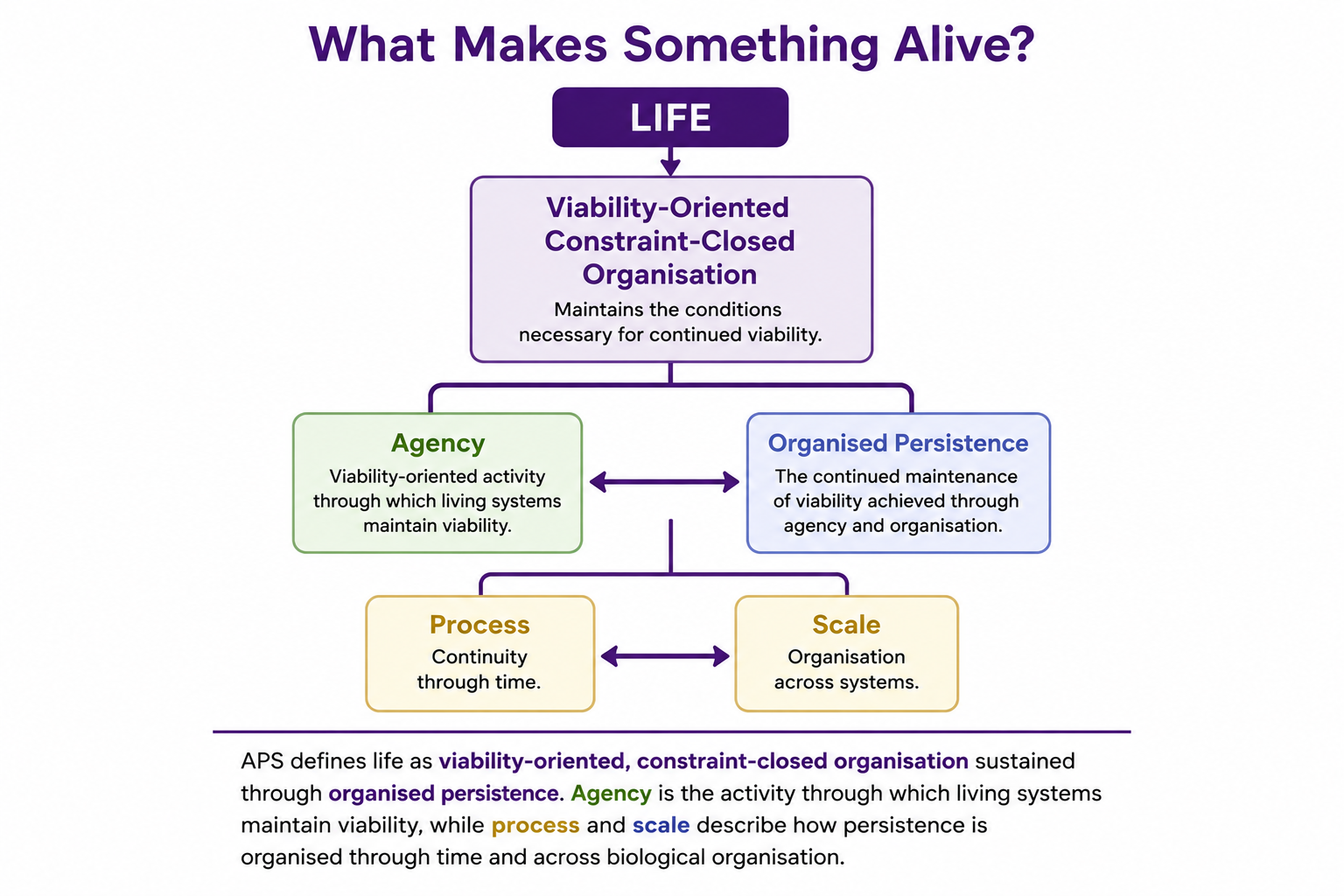
What Makes Something Alive? APS defines life as viability-oriented, constraint-closed organisation sustained through organised persistence. Agency is the activity through which living systems maintain viability, while process and scale describe how persistence is organised through time and across biological organisation.
APS does not define life by reference to life itself. Viability and constraint closure are introduced as organisational concepts whose conjunction identifies a distinctive mode of biological organisation. The claim is therefore an explanatory proposal rather than a circular definition.
Agency, Process, and Scale: Three Complementary Perspectives on Living Organisation
If life is understood as viability-oriented, constraint-closed organisation, the next question is how that organisation should be investigated scientifically. The preceding sections have argued that living systems cannot be adequately understood through isolated biological characteristics alone, but require explanation in terms of the organisation that unifies those characteristics. The APS framework addresses this explanatory task through three complementary perspectives: Agency, Process, and Scale. These are not independent theories of life, nor separate components of living systems. They are complementary perspectives through which the same organised biological phenomenon becomes scientifically intelligible.
Each perspective begins from a different explanatory question. Agency asks what living systems do to maintain and re-establish the conditions of their own persistence. Process asks how this organisation maintains continuity despite continual material and organisational change. Scale asks where organised persistence is realised across the spatial and temporal organisation of life. Although these questions differ, they are directed towards the same biological organisation and therefore produce complementary rather than competing explanations.
The perspective of Agency focuses upon the present-tense activity through which living organisation is enacted and sustained. Living systems do not simply undergo physical and chemical change; they continually regulate, repair, reorganise, and coordinate their own activities in ways that contribute to the maintenance of viability. Agency therefore refers neither to conscious intention nor to deliberative choice. It identifies the characteristic organisational activity through which living systems actively maintain and re-establish the conditions of their own persistence. Biological agency is the present-tense activity through which viability-oriented, constraint-closed organisation is enacted and sustained.
The perspective of Process addresses the continuity of that organisation through time. Living systems are characterised by continual material turnover, developmental transformation, physiological regulation, and environmental interaction. Despite this continual change, organisms maintain sufficient organisational continuity to remain the same living systems. Process therefore investigates how viability-oriented organisation persists through continual reorganisation rather than despite it. Biological continuity is not the preservation of unchanging structures but the ongoing maintenance and re-establishment of organised persistence.
The perspective of Scale considers the organisational domains across which persistence is realised. Living organisation is expressed within cells, organisms, ecological relationships, evolutionary lineages, and, in humans, forms of social organisation. These are not hierarchical levels that supersede one another, nor independent domains of explanation. They are different organisational contexts within which viability-oriented persistence is maintained, transformed, or coordinated. Scale therefore asks where organised persistence is realised and how explanatory priorities change across different organisational domains while remaining directed towards the same underlying biological organisation.
Taken together, these three perspectives provide a comparative explanatory methodology rather than an additional biological theory. Agency, Process, and Scale do not divide living systems into separate explanatory compartments. Instead, each perspective illuminates a different aspect of the organisation introduced in the previous section. Agency reveals the activity through which living organisation is continually enacted. Process explains the continuity of that organisation through change. Scale situates that continuity across the organisational domains within which persistence is realised. Their explanatory significance lies precisely in their complementarity.
This interpretation also clarifies the relationship between APS and established biological disciplines. Physiology, development, ecology, evolution, cognition, and behaviour investigate different dimensions of living systems because each addresses particular explanatory problems. APS does not seek to replace these disciplines or reduce them to a single explanatory principle. Rather, it provides a comparative methodology through which their distinctive explanatory achievements may be understood as complementary investigations of viability-oriented, constraint-closed organisation. Biological explanation therefore becomes progressively more coherent as these diverse perspectives are interpreted in relation to a common organisational target.
The Agency–Process–Scale framework thus completes the explanatory shift introduced in the preceding sections. Having moved from biological characteristics to biological organisation, APS now provides a structured methodology for investigating that organisation. The framework does not alter the empirical achievements of contemporary biology. Instead, it clarifies how those achievements relate through the organisation required for living systems to maintain and re-establish the conditions of their own persistence.
The remaining question is therefore not what life is, nor how it should be investigated, but what explanatory contribution this organisational perspective makes to biology itself. The following section examines how APS reframes central biological concepts by interpreting them as complementary perspectives on organised persistence rather than as isolated explanatory domains.
What APS Contributes to the Biology of Life
The preceding sections have argued that life is most coherently understood as viability-oriented, constraint-closed organisation and that Agency, Process, and Scale provide complementary perspectives for investigating that organisation. The remaining question concerns the scientific significance of this interpretation. If APS neither replaces established biological theories nor introduces a new empirical discipline, what contribution does it make to biological understanding?
The contribution of the APS framework lies in providing a comparative explanatory methodology through which the major concepts of biology can be understood in relation to a common organisational target. Rather than treating concepts such as function, development, evolution, ecology, cognition, and agency as largely independent explanatory domains, the APS framework examines how each contributes to an understanding of the organisation through which living systems maintain and re-establish the conditions of their own persistence. The contribution of APS therefore lies not in replacing existing explanations but in clarifying their organisational relationships.
This perspective becomes evident when considering the concept of biological function. Traditional discussions frequently distinguish between causal-role accounts, selected-effects theories, and organisational interpretations. APS does not seek to replace these analyses. Instead, it asks what function explains within living systems. From an APS perspective, biological function identifies the present-tense, viability-relative organisational contribution of a structure, process, or activity. Historical evolution may explain how a function arose, but the function presently consists in the contribution that the trait makes to maintaining viability-oriented organisation. Function therefore becomes an explanatory perspective on organised persistence rather than an isolated conceptual problem.
The same organisational interpretation clarifies development. Development is often understood as the sequence of changes through which an organism progresses from fertilisation to maturity. the APS interpretation retains this understanding while emphasising its organisational significance. Development concerns the continual reorganisation of living systems through changing forms while viability is maintained or re-established. The explanatory focus therefore shifts from developmental stages alone to the continuity of living organisation across the organism’s life history.
A similar relationship exists with evolution. Evolutionary theory explains the historical transformation of living systems through descent with modification, natural selection, and other evolutionary processes. APS neither modifies these explanations nor competes with them. Instead, it asks what persists through evolutionary transformation. From this perspective, evolution becomes the historical transformation of viability-oriented organisation across successive generations. Evolutionary biology explains how living organisation changes historically; APS clarifies the organisational target of that historical explanation.
The organisational perspective likewise illuminates ecology. Ecological investigation explains how organisms interact with one another and with their environments. APS interprets these interactions as organisational contexts within which viability is maintained, challenged, and re-established. Ecological relationships are therefore understood not merely as external influences acting upon organisms but as conditions within which organised persistence is continually realised.
The same pattern extends to cognition. APS does not identify cognition with life, nor does it treat all living systems as cognitive in the same sense. Instead, cognition is understood as a specialised organisational achievement that emerges within the broader organisation of life. Living systems must first maintain viability-oriented organisation before more complex forms of biological evaluation, integration, and cognition become possible. Cognition therefore presupposes life rather than defining it, while extending the organisational capacities through which persistence is regulated.
These examples illustrate a general feature of the APS methodology. Existing biological disciplines continue to address their established explanatory questions, yet their respective achievements become more coherent when interpreted in relation to the organisation that unites them. The APS framework therefore provides an explanatory grammar rather than an alternative empirical programme. It clarifies how different biological explanations relate without diminishing the autonomy or empirical success of the disciplines from which they arise.
This comparative perspective also has implications for theoretical biology. By identifying viability-oriented, constraint-closed organisation as the common organisational target of biological explanation, APS encourages explicit comparison between explanatory traditions that are often considered independently. Debates concerning function, individuality, development, evolution, agency, ecology, and cognition can therefore be understood not as isolated conceptual disputes but as complementary investigations of different aspects of organised persistence. In this way, APS seeks to strengthen theoretical integration while preserving the explanatory diversity that characterises contemporary biology.
The contribution of APS is therefore neither to redefine every biological concept nor to replace existing theories with a unified explanatory system. Its contribution is methodological. By interpreting the central concepts of biology as complementary explanatory perspectives on a common organisational phenomenon, APS provides a framework within which biological explanation becomes more coherent, more explicitly comparable, and more clearly directed towards the organisation that distinguishes living systems.
Implications for Biological Explanation
The interpretation developed throughout this article has implications that extend beyond the question of how life should be defined. If life is understood as viability-oriented, constraint-closed organisation, and if Agency, Process, and Scale provide complementary explanatory perspectives on that organisation, then biological explanation itself may be understood in a more explicitly organisational manner. The significance of APS therefore lies not only in its interpretation of life but also in the way it clarifies the relationship between the diverse explanatory practices of contemporary biology.
One implication concerns the explanatory unity of biological concepts. Modern biology employs a rich vocabulary that includes function, development, regulation, physiology, ecology, evolution, behaviour, cognition, and many other concepts. These have often been investigated within specialised disciplines, each with its own methods, explanatory priorities, and theoretical traditions. APS does not seek to dissolve these distinctions. Rather, it proposes that their explanatory achievements may be understood as complementary investigations of the organisation through which living systems maintain and re-establish the conditions of their own persistence. Conceptual diversity is therefore preserved while its organisational coherence becomes more explicit.
A second implication concerns the interpretation of theoretical disagreement. Debates over the nature of biological function, individuality, agency, organisation, or cognition are frequently presented as competing conceptual frameworks. The comparative methodology developed here suggests a different interpretation. Many such debates arise because different investigators address different explanatory questions or examine different organisational aspects of living systems. Recognising the organisational target of explanation makes it possible to distinguish genuine theoretical disagreement from differences in explanatory perspective. The objective is not to eliminate conceptual diversity but to understand how diverse explanatory traditions relate to one another.
The organisational perspective also has implications for interdisciplinary research. Contemporary biology increasingly integrates molecular biology, developmental biology, systems biology, evolutionary biology, ecology, neuroscience, and other specialised fields. APS does not prescribe how these disciplines should conduct their empirical investigations. Instead, it offers a common explanatory orientation through which their respective findings may be interpreted as contributions to understanding organised persistence. In this sense, APS functions as a comparative explanatory framework capable of relating specialised biological knowledge without reducing it to a single explanatory model.
This interpretation also clarifies the place of theoretical biology within the biological sciences. Theory is sometimes understood as secondary to empirical investigation or as concerned primarily with the comparison of competing models. APS suggests a broader role. Theoretical biology also investigates the conceptual organisation through which empirical explanations become scientifically intelligible. Clarifying the relationships among central biological concepts is therefore not an alternative to empirical research but an essential component of biological understanding itself. Organisational questions emerge from the success of empirical biology rather than from its inadequacy.
More generally, the perspective developed here encourages greater precision concerning the questions biological explanations are intended to answer. Explanations of mechanism, historical change, organisational continuity, ecological interaction, and cognitive regulation each possess their own legitimacy because they investigate different aspects of living organisation. Progress in theoretical biology may therefore depend not only upon increasingly sophisticated empirical evidence but also upon greater clarity concerning the explanatory targets of biological inquiry. APS contributes to this clarification by making those targets explicit and by relating them to a common organisational framework.
These implications should not be interpreted as establishing a final or exclusive account of life. The history of biology demonstrates that conceptual development accompanies empirical discovery, and future research will undoubtedly continue to refine our understanding of living systems. APS should therefore be understood as a research programme rather than a completed theory. Its central claim is methodological: biological explanation becomes more coherent when the diverse explanatory achievements of biology are interpreted in relation to viability-oriented, constraint-closed organisation and investigated through the complementary perspectives of Agency, Process, and Scale.
The question What is life? thus acquires a renewed significance. Rather than seeking a definitive list of defining characteristics, biology may increasingly be understood as investigating the organisation that makes those characteristics intelligible as coordinated expressions of living systems. The final section returns to this question and summarises the contribution that the APS framework makes to its continuing investigation.
Conclusion: Revisiting the Question What Is Life?
The question What is life? has accompanied biology throughout its history and continues to resist a universally accepted answer. This persistence should not be interpreted as evidence of scientific failure. Rather, it reflects the extraordinary complexity of the biological organisation that living systems exhibit and the diversity of explanatory questions through which that organisation has been investigated. Property-based definitions, evolutionary accounts, autopoietic and autonomy theories, and other organisational approaches have each contributed substantially to biological understanding because each has illuminated a genuine aspect of living systems.
This article has argued that the continuing diversity of these approaches reflects more than disagreement over definitions. It reflects differing assumptions concerning the explanatory target of biological inquiry. Some approaches seek criteria for recognising living systems, others identify defining characteristics, while others investigate the organisation through which living systems maintain and re-establish the conditions of their own persistence. These are distinct, though complementary, explanatory objectives. Recognising this distinction allows the long-standing debate concerning life to be interpreted not simply as a search for a better definition, but as an investigation into the organisation that unifies the diverse phenomena studied throughout biology.
APS approaches this investigation by proposing that life is most coherently understood as viability-oriented, constraint-closed organisation. This formulation is not intended as an additional defining characteristic or as a replacement for existing biological theories. Instead, it identifies the organisational phenomenon that the central concepts of biology investigate from different explanatory perspectives. Metabolism, development, regulation, function, ecology, evolution, cognition, and agency are thereby understood as complementary perspectives on the organisation through which living systems maintain and re-establish the conditions of their own persistence.
The Agency–Process–Scale framework extends this interpretation by providing a comparative explanatory methodology for investigating living organisation. Agency examines the present-tense activity through which viability-oriented organisation is enacted and sustained. Process investigates how that organisation maintains continuity despite continual change. Scale considers where organised persistence is realised across the spatial and temporal organisation of life. These perspectives are not alternative theories or independent levels of explanation. They are complementary analytic perspectives directed towards the same organised biological phenomenon.
The principal contribution of APS therefore lies in biological explanation rather than biological classification. APS does not seek to replace the explanatory achievements of contemporary biology, nor to reduce its conceptual diversity to a single organising principle. Instead, it provides an organisational framework within which the distinctive contributions of established biological disciplines may be understood as complementary investigations of a common explanatory target. In this sense, APS functions as a comparative explanatory methodology that seeks to increase the coherence, integration, and intelligibility of biological explanation while preserving the explanatory autonomy of the disciplines through which biological knowledge continues to advance.
Whether this organisational perspective ultimately proves scientifically valuable will depend not upon philosophical preference but upon its capacity to clarify biological concepts, stimulate productive research, and support the continuing development of theoretical biology. Like all scientific research programmes, APS must be evaluated through its explanatory fruitfulness, conceptual coherence, and ability to illuminate problems that remain incompletely understood.
The question What is life? is unlikely to disappear from biology because it concerns the organisation that makes every other biological question possible. APS does not claim to end that investigation. It proposes that the investigation becomes more coherent when life is understood as viability-oriented, constraint-closed organisation and when biological explanation is organised through the complementary perspectives of Agency, Process, and Scale.
Explanatory Architecture
Central question
This article asks what distinguishes living systems from every other organised system. It proposes that life is best understood as viability-oriented, constraint-closed organisation rather than as a collection of properties, substances, or mechanisms.
Architectural role
This article establishes the foundational concept upon which the APS framework is organised. It identifies the phenomenon that subsequent articles investigate from different explanatory perspectives.
Builds on
Naturalising Life What Is Biology Trying to Explain? What Is a Biological System?
Develops into
Biological Agency Organised Persistence Function Biological Evaluation Constraint Closure Process Scale Cognition Biological Explanation
Related explanatory questions
Readers may wish to continue with:
Why Does Biology Need Agency? Why APS Reframes Biology Organised Persistence What Is Biological Explanation? APS and Contemporary Theories
Position within APS
Within APS, life identifies the biological phenomenon requiring explanation. Agency investigates the viability-oriented organisational activity through which living organisation is enacted and sustained. Process investigates how that organisation maintains continuity despite continual change. Scale investigates where persistence is organised across spatial and temporal extents. Together these complementary explanatory perspectives investigate one viability-oriented, constraint-closed organisation.
Corpus Significance
What Is Life? is one of the principal conceptual foundations of the APS corpus. It establishes the framework’s canonical definition of life as viability-oriented, constraint-closed organisation and identifies the biological phenomenon that APS seeks to explain.
Subsequent APS articles investigate different aspects of the organisation established here, making this article the conceptual foundation for the framework’s wider explanatory architecture.
See Also
Related Articles
References
- (2022). Organization Needs Organization: Understanding Integrated Control in Living Organisms. Studies in History and Philosophy of Science, 93, 96–106 . https://doi.org/10.1016/j.shpsa.2022.03.005
- (2019). The Quest for a Universal Theory of Life: Searching for Life As We Don't Know It. Cambridge University Press. https://doi.org/10.1017/9781139046893
- (2002). Defining 'Life'. Origins of Life and Evolution of the Biosphere, 32(4), 387–393 . https://doi.org/10.1023/A:1020503324273
- (2005). Autopoiesis, Adaptivity, Teleology, Agency. Phenomenology and the Cognitive Sciences, 4(4), 429–452 . https://doi.org/10.1007/s11097-005-9002-y
- (2021). What Is Life?. Molecular Biology Reports, 48(8), 6223–6230 . https://doi.org/10.1007/s11033-021-06594-5
- (1980). Autopoiesis and Cognition: The Realization of the Living. D. Reidel Publishing Company.
- (2015). Biological Organisation as Closure of Constraints. Journal of Theoretical Biology, 372, 179–191 . https://doi.org/10.1016/j.jtbi.2015.02.029
- (2015). Biological Autonomy: A Philosophical and Theoretical Enquiry. Springer. https://doi.org/10.1007/978-94-017-9837-2
- (2009). An Organizational Account of Biological Functions. The British Journal for the Philosophy of Science, 60(4), 813–841 . https://doi.org/10.1093/bjps/axp036
- (2025). What Is Life? Revisited. Cambridge University Press. https://doi.org/10.1017/9781009127318
- (1991). Life Itself: A Comprehensive Inquiry into the Nature, Origin, and Fabrication of Life. Columbia University Press.
- (2004). Basic Autonomy as a Fundamental Step in the Synthesis of Life. Artificial Life, 10(3), 235–259 . https://doi.org/10.1162/1064546041255559
- (2004). A Universal Definition of Life: Autonomy and Open-Ended Evolution. Origins of Life and Evolution of the Biosphere, 34(3), 323–346 . https://doi.org/10.1023/B:ORIG.0000016440.53346.DC
- (1944). What Is Life? The Physical Aspect of the Living Cell. Cambridge University Press.
- (2026). Agency as the Defining Activity of Life: A Viability-Oriented Framework Integrating Process and Scale. Biological Theory . https://doi.org/10.1007/s13752-026-00547-6
- (2026). What Is Life? Definitions, Controversies, Ontological Perspectives, and Implications for Biology Education. BioScience . https://doi.org/10.1093/biosci/biag059
- (2021). Life's Edge: The Search for What It Means to Be Alive. Dutton.