The Continuity Architecture of Life
Living systems persist through multiple, mutually reinforcing forms of continuity. Development preserves continuity through transformation within lifetimes. Ecology preserves continuity through organism–environment coupling. Evolution preserves continuity through historical inheritance across generations. Cognition preserves continuity through evaluation, meaning, and responsiveness to biologically significant conditions. Social organisation preserves continuity through communication, culture, institutions, and coordinated activity. APS interprets these not as separate domains but as complementary continuity architectures that together sustain organised persistence. This article synthesises the major explanatory domains of APS and presents an integrated account of the organisational architecture through which life maintains continuity across scales, contexts, and timescales.
Where This Article Fits
APS approaches biology through the concept of organised persistence: the capacity of living systems to maintain continuity through ongoing change.
Several articles explore different aspects of this continuity framework. Persistence — Organised Continuity Through Time introduces organised persistence as the central explanatory target of biology and explains why living systems must maintain continuity despite continual transformation. This article examines the major continuity architectures through which organised persistence is maintained, showing how development, ecology, evolution, cognition, and social organisation each preserve continuity in distinct but complementary ways.
Readers interested in how continuity is organised within biological systems should continue to The Continuity Structure of Biological Organisation, which examines the organisational relationships that make continuity possible across process, scale, and constraint relations. Readers interested in the temporal foundations of continuity should see Temporal Organisation and Organised Persistence and Time and Biological Organisation, which explore how persistence depends upon the organisation of biological time.
Together, these articles provide a layered account of continuity within APS:
- Persistence — Organised Continuity Through Time — What organised persistence is and why it matters.
- The Continuity Architecture of Life — The major architectures through which continuity is maintained.
- The Continuity Structure of Biological Organisation — How continuity is organised within living systems.
- Temporal Organisation and Organised Persistence — How persistence depends upon temporal organisation.
- Time and Biological Organisation — The broader role of time in biological explanation.
The Continuity Architecture of Life
Life persists.
This simple observation lies at the centre of biology, yet it immediately presents a profound explanatory challenge. Living systems maintain continuity despite continual change. Organisms grow, develop, repair themselves, replace their components, adapt to shifting circumstances, reproduce, evolve, communicate, and participate in increasingly complex ecological and social worlds. Across all of this activity, continuity remains.
How is this possible?
Many biological theories have sought an answer in a single dominant process. Life has been explained through metabolism, reproduction, adaptation, evolution, information processing, development, cognition, self-organisation, or some combination of these. Each captures something important about living systems, yet none appears sufficient on its own. Development explains how organisms maintain continuity across a lifetime but not how continuity extends across generations. Evolution explains historical continuity but not how organisms remain viable from moment to moment. Cognition explains adaptive responsiveness but not the ecological conditions that make such responsiveness necessary, while social organisation explains cultural continuity but depends upon biological capacities that precede it.
APS approaches this challenge from a different perspective. Rather than searching for a single defining process, it begins with the observation that living systems persist through multiple forms of continuity operating simultaneously across different scales, contexts, and timescales. The central problem is therefore not identifying one privileged process but understanding how these different forms of continuity work together to sustain organised persistence.
The question is no longer which process explains life. The question becomes: what organisational architecture makes continuity possible?
This article develops the APS answer to that question. It argues that life persists through multiple interacting continuity architectures. Development preserves continuity through transformation, ecology through organism–environment coupling, evolution through historical inheritance and variation, cognition through evaluation and responsiveness to biologically significant conditions, and social organisation through communication, culture, institutions, and coordination. These architectures are not independent domains assembled after the fact. Together they constitute the organisational structure of life itself.
The Problem of Organised Persistence
Every living system confronts the same fundamental challenge: it must remain viable through time. Yet living systems do not persist by remaining unchanged. Cells divide, tissues remodel, organisms grow, physiological states fluctuate, behaviours change, and ecological conditions shift. Continuity therefore depends upon ongoing transformation rather than stasis.
This observation lies at the heart of APS. Organised persistence refers to the capacity of living systems to maintain continuity through ongoing transformation. Continuity is not produced by resisting change but emerges through the organisation of processes that continually preserve viability despite changing circumstances.
Once organised persistence is recognised as the central explanatory problem, a further question immediately follows: what kinds of organisation are required to sustain it?
The answer cannot be confined to any single biological process. Continuity must be maintained within organisms, between organisms and environments, across generations, through systems of evaluation and meaning, and increasingly through social and cultural forms of organisation. Each of these domains addresses a different aspect of the continuity problem. Together they reveal why life requires multiple continuity architectures rather than a single continuity mechanism.
Continuity Across Scales and Timescales
The need for multiple continuity architectures becomes apparent once we recognise the extraordinary range of scales across which life persists.
Consider a single organism. Its continuity must be maintained from moment to moment through physiological regulation while also being preserved across years or decades of development and transformation. Beyond the individual lifespan, continuity extends across generations through reproduction, inheritance, and evolution. For many organisms, continuity additionally depends upon ecological relationships that connect them to larger systems of resources, constraints, and environmental conditions. In social species, continuity may extend further still through communication, culture, institutions, and historical traditions.
These forms of continuity operate across very different timescales. Some occur over seconds, others unfold across years, and still others extend across millennia. Yet all contribute to the persistence of life.
The challenge is therefore not merely one of complexity but of organisation. Continuity must be maintained simultaneously across multiple dimensions of biological existence. A developmental perspective alone cannot explain ecological persistence, an ecological perspective alone cannot explain evolutionary continuity, an evolutionary perspective alone cannot explain meaning, evaluation, or cognition, and a cognitive perspective alone cannot explain cultural continuity. Each perspective illuminates an important aspect of life while leaving other aspects unexplained.
APS addresses this problem by treating these domains as continuity architectures. A continuity architecture is a structured organisation through which continuity is maintained under particular conditions and across particular scales. Different architectures solve different continuity problems: development addresses continuity through transformation, ecology through coupling, evolution through historical inheritance, cognition through evaluation, and social organisation through coordination.
Rather than competing with one another, these architectures complement one another. Each contributes to organised persistence in a distinct way, and together they provide a framework capable of explaining how life remains continuous despite operating across such diverse scales and timescales. Life is not explained by continuity at one scale alone. It persists because continuity is organised across many scales simultaneously.
From Processes to Architectures
This perspective requires a shift in how biological explanation is often framed. Many debates in biology and philosophy of biology have revolved around identifying the process that defines life. Different traditions have emphasised metabolism, reproduction, adaptation, development, information, cognition, or evolution. These discussions have generated important insights, yet they frequently assume that life must ultimately be explained through a single foundational process.
APS rejects this assumption. The problem is not that the proposed processes are unimportant; rather, each captures only part of a larger organisational reality. Development is indispensable, but development alone does not explain ecological dependence. Evolution is indispensable, but evolution alone does not explain how organisms remain viable between generations. Cognition is indispensable, but cognition alone cannot account for the developmental, ecological, and evolutionary conditions that make cognition possible.
Every major explanatory domain reveals an essential aspect of life while simultaneously pointing beyond itself. Instead of asking which process explains life, APS asks how different continuity-preserving processes become organised into a coherent architecture capable of sustaining viability across multiple scales and timescales.
The answer is not a single process but an organisational system. Life emerges through the integration of multiple continuity architectures, each solving a different aspect of the persistence problem while remaining connected to all the others.
The remainder of this article explores these architectures in turn before showing how they fit together within a unified account of organised persistence. The goal is not merely to describe development, ecology, evolution, cognition, and social organisation individually, but to understand how, together, they constitute the continuity architecture of life.
Development
The first continuity architecture concerns a problem faced by every organism from the beginning of its existence: how can continuity be maintained despite continual internal change?
Development provides the answer. Living systems do not persist by preserving fixed structures. They grow, differentiate, repair themselves, replace components, and undergo continual transformation throughout their lives. Yet despite these changes, continuity remains. An organism persists not because its material composition remains constant but because developmental organisation continually preserves viability across changing states.
Development therefore represents continuity through transformation. Its significance extends far beyond embryogenesis or growth. Developmental organisation encompasses the entire set of processes through which organisms maintain continuity while continually changing. Repair, regeneration, physiological adaptation, learning, and ageing all remain part of this broader developmental architecture because each contributes to the maintenance of viable organisation through time.
This continuity problem is fundamental because no other architecture can function without it. Ecology, cognition, evolution, and social organisation all depend upon organisms capable of maintaining continuity across time. Development therefore provides the organisational foundation upon which these further forms of continuity become possible.
At its core, the developmental architecture addresses the most immediate continuity problem of life: how an organism remains itself while continually becoming something different. The answer lies not in preserving a fixed state but in organising change in ways that sustain viability. Development therefore preserves continuity through transformation.
The Developmental Organisation of Life explores this architecture in detail.
Ecology
Development alone, however, cannot sustain continuity. No organism produces all of the conditions required for its own persistence. Resources must be acquired, environmental conditions must remain suitable, and relationships with other organisms must be negotiated. Continuity therefore depends upon more than internal organisation.
It depends upon ecology.
The ecological continuity architecture addresses how persistence is maintained through organism–environment coupling. Organisms remain viable because they participate in larger ecological organisations that provide the resources, opportunities, constraints, and conditions required for continuity. Persistence is therefore not solely an internal achievement but a relational one.
This insight transforms the role of ecology within biological explanation. The environment is not merely a backdrop against which life unfolds, nor is it simply an external influence acting upon otherwise self-contained organisms. Ecological organisation becomes part of the explanation of persistence itself.
Organisms persist through relationships. Niches, resources, constraints, resilience, ecosystems, and organism–environment coupling all contribute to continuity by organising the conditions under which viability can be maintained. The persistence of an organism is therefore inseparable from the persistence of the relationships upon which it depends.
Where development explains how continuity is maintained through internal transformation, ecology explains how continuity is maintained through relationships extending beyond the organism itself. Ecology therefore preserves continuity through coupling.
The Ecological Organisation of Life develops this continuity architecture in detail.
Evolution
Development preserves continuity within lives, and ecology preserves continuity through organism–environment relations. A further challenge nevertheless remains: how does continuity extend beyond individual lifetimes?
Evolution addresses this problem.
The continuity of life does not begin anew with each generation. Organisational achievements accumulated through previous histories contribute to future possibilities. Adaptations, developmental capacities, ecological relationships, behavioural tendencies, and biological innovations all reflect continuity extending across generations.
Evolution provides the architecture through which this historical continuity becomes possible. Inheritance preserves continuity, variation introduces novelty, selection influences which forms of organisation contribute successfully to future persistence, and innovation expands the possibilities available to life. Together these processes allow continuity to accumulate historically while remaining open to transformation.
This dual achievement is crucial. Without inheritance, continuity would disappear. Without variation, continuity could not adapt. Without selection, continuity could not remain responsive to changing circumstances. Evolution succeeds because it preserves continuity while simultaneously allowing change.
The living world observed today is therefore not merely a collection of contemporary organisms. It is the current expression of continuity extending across billions of years of evolutionary history. Every organism carries traces of earlier solutions to the problem of persistence while contributing to future possibilities for biological organisation.
Evolution therefore preserves continuity through historical transformation. It provides the architecture through which life becomes historical.
The Evolutionary Organisation of Life explores this architecture in detail.
Cognition
Development, ecology, and evolution explain how continuity persists across bodies, environments, and generations. Yet living systems confront another challenge. They inhabit worlds in which some conditions matter more than others. Resources differ from toxins, opportunities differ from threats, and successful actions differ from unsuccessful ones. Continuity therefore depends not only upon maintaining organisation but also upon responding appropriately to circumstances affecting viability.
Cognition addresses this problem.
The cognitive continuity architecture emerges from evaluation. Living systems distinguish among conditions according to their consequences for persistence, and from this foundation arise meaning, semiosis, information, representation, intelligence, and, in some lineages, consciousness. Cognition is therefore not an isolated addition to biological organisation but a further means by which continuity is maintained under changing conditions.
The cognitive domain transforms the relationship between organism and world. The environment is no longer encountered merely as a collection of physical conditions but becomes structured according to biological significance. Living systems increasingly navigate worlds organised around opportunities, dangers, constraints, and possibilities that matter for continuity.
Cognition therefore represents continuity through evaluation. It provides the organisational capacities through which living systems become responsive to significance and capable of adjusting their activities in ways that support persistence. Although this architecture depends upon development, ecology, and evolution, it contributes something distinctive: the ability to navigate viability-relevant worlds through increasingly flexible and adaptive forms of responsiveness.
The Cognitive Organisation of Life explores this architecture in detail.
Social Organisation
The emergence of cognition creates possibilities that extend beyond individual organisms. Communication becomes possible, meanings can be shared, knowledge can be transmitted, and activities can be coordinated across groups. Continuity can therefore become distributed among interacting individuals rather than remaining confined to single organisms.
This development gives rise to the social continuity architecture.
Social organisation addresses how continuity is maintained through coordination. Communication aligns activities, norms stabilise expectations, symbols preserve meaning, culture accumulates organisational resources, and institutions extend continuity across populations and historical periods. Technology further amplifies continuity by allowing organisational achievements to persist across larger scales and longer timescales.
The significance of this architecture is profound. Continuity is no longer confined to individual organisms or even biological inheritance alone. Organisational resources can persist through cultural transmission, social learning, institutions, and historical traditions. Knowledge can accumulate, practices can endure, and collective achievements can remain available long after the individuals who first created them have disappeared.
Social organisation therefore represents continuity through coordination. It extends organised persistence into forms that are simultaneously biological, cultural, historical, and technological. Although this architecture reaches its most elaborate expression in human societies, its roots extend much more broadly through the social organisation of life.
The Social Organisation of Life explores this architecture in detail.
The significance of these five architectures lies not merely in their individual contributions to persistence. Their deeper importance becomes visible only when we recognise that none operates in isolation. Development depends upon ecology, ecology shapes cognition, cognition contributes to social organisation, and evolution influences all four. Each continuity architecture addresses a distinct aspect of organised persistence while remaining inseparable from the others.
The question therefore becomes:
How do these architectures fit together?
It is this question that reveals the full continuity architecture of life.
No Architecture Operates Alone
The five continuity architectures introduced in the previous sections provide distinct solutions to different continuity problems. Development preserves continuity through transformation, ecology through coupling, evolution through historical transformation, cognition through evaluation, and social organisation through coordination. Yet their significance does not lie solely in their individual contributions.
The deeper insight of APS is that none of these architectures operates independently. Development depends upon ecology because organisms cannot grow, repair, or maintain themselves without continuity-supporting environments. Ecological organisation depends upon development because organism–environment relationships can only be sustained by living systems capable of maintaining their own continuity. Evolution depends upon development because inherited organisation must be realised through developmental processes before it can contribute to future continuity. Cognition depends upon ecological significance because evaluation requires environments structured by opportunities, constraints, and consequences for viability. Social organisation depends upon cognition because communication, meaning, coordination, and culture all presuppose systems capable of evaluating and responding to significance.
These dependencies extend in every direction. Ecological relationships shape developmental possibilities, development influences evolutionary trajectories, evolution transforms ecological organisation, social systems alter selective environments, and cognition reshapes ecological interactions. The continuity architectures therefore form an integrated network rather than a collection of separate domains.
This observation explains why biological explanation often becomes fragmented when these domains are treated in isolation. Each architecture reveals an important aspect of continuity, yet none is sufficient on its own. Life persists because continuity is maintained simultaneously across multiple dimensions of organisation.
The continuity architectures are therefore best understood as complementary rather than competing explanations. Each addresses a different aspect of the same underlying problem: how viability can be maintained through time.
The Architecture of Organised Persistence
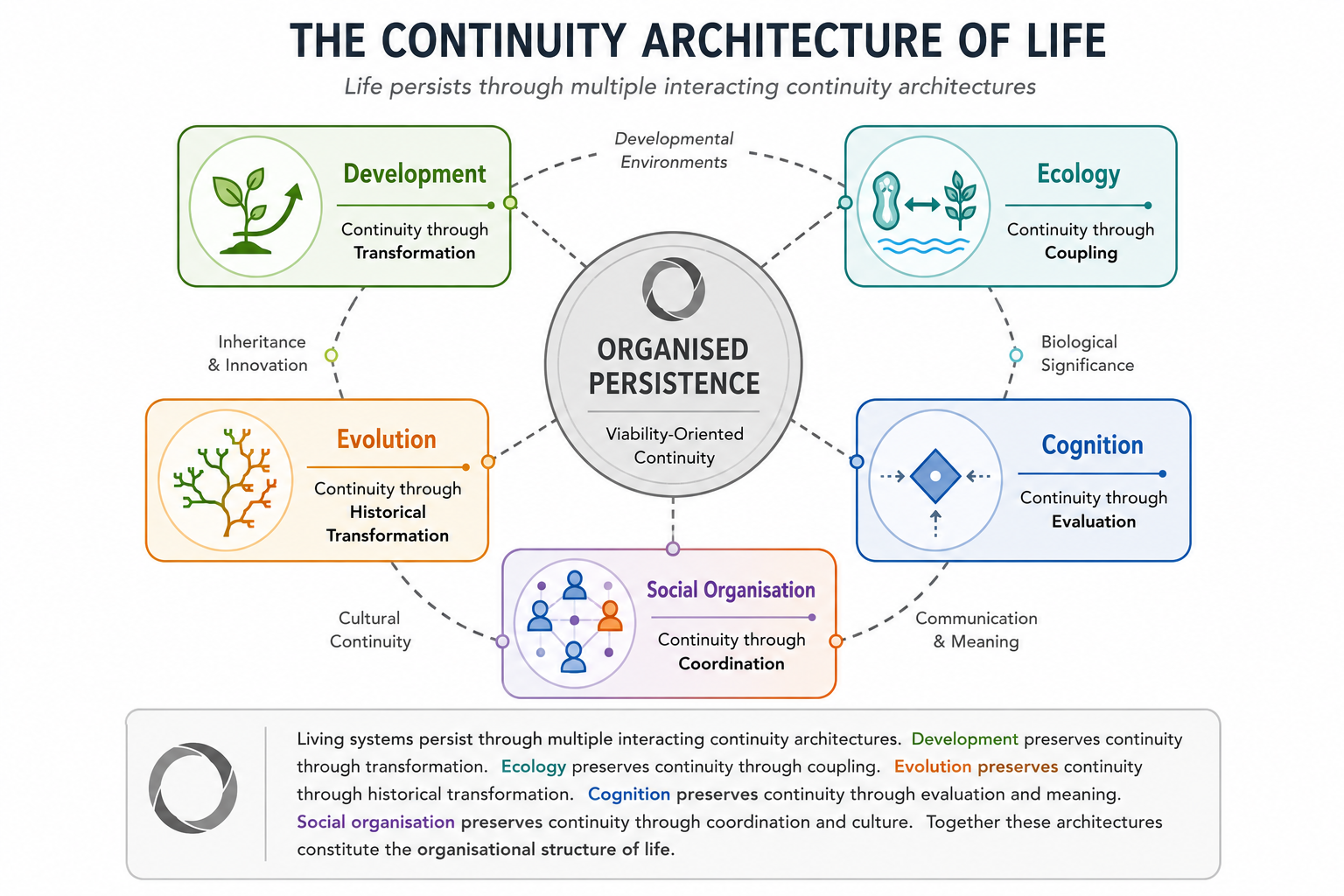
The Continuity Architecture of Life. Development, ecology, evolution, cognition, and social organisation each address distinct continuity problems. Together they contribute to organised persistence by maintaining continuity across different scales, contexts, and timescales.
The relationship among the continuity architectures can now be visualised more clearly.
The central element is organised persistence. This is not a controlling mechanism, a privileged level of organisation, or a hidden process governing the rest of life. Rather, it is the common continuity principle expressed through all five architectures. Development, ecology, evolution, cognition, and social organisation each contribute to organised persistence in different ways, but none occupies a privileged position within the architecture as a whole.
This absence of hierarchy is important. The figure is not a flowchart, a causal sequence, or a depiction of one continuity architecture producing the others. Instead, it represents a system of mutual dependence through which continuity is maintained across different scales and timescales simultaneously.
The connecting relationships are therefore as important as the architectures themselves. Developmental organisation depends upon ecological conditions, ecological organisation influences cognition, cognition contributes to social continuity, social organisation reshapes evolutionary possibilities, and evolution provides the historical context within which development unfolds. The architecture forms a continuity web rather than a continuity chain.
This distinction captures one of the central themes of APS. Life is not organised around a single privileged process. It is organised through the integration of multiple continuity-preserving systems whose interactions collectively sustain viability. The continuity architecture of life is therefore neither linear nor hierarchical. It is relational.
Why Life Is Organisational
The recognition that continuity depends upon multiple interacting architectures leads directly to one of the central philosophical claims of APS: life is fundamentally organisational.
This statement should not be misunderstood. APS does not deny the importance of mechanisms, molecules, genes, physiology, behaviour, ecosystems, or evolutionary processes. All remain indispensable to biological explanation. The point is that none of these elements becomes biologically meaningful in isolation. Their significance derives from the roles they play within continuity-preserving organisations.
The same principle applies at larger scales. Development is not merely a collection of processes, ecology is not merely a collection of interactions, evolution is not merely a collection of historical changes, cognition is not merely a collection of informational events, and social organisation is not merely a collection of behaviours. Each becomes intelligible because it contributes to organised persistence.
This perspective helps explain why attempts to reduce life to a single defining process repeatedly encounter difficulties. Every proposed process captures part of the organisational architecture while leaving other aspects unexplained. Biological reality continually exceeds such reductions because continuity itself is organised across multiple domains simultaneously.
APS therefore replaces the search for a single defining process with a search for organisational integration. The central explanatory question becomes:
How are continuity-preserving processes organised so that viability remains possible?
The answer lies in the continuity architecture itself. Life is not one process. Life is the organisation of many continuity-preserving processes into a coherent and viable whole.
The Continuity Architecture of Life
The continuity architectures can now be viewed together. Development preserves continuity within lives, ecology preserves continuity through organism–environment relations, evolution preserves continuity across generations, cognition preserves continuity through significance and evaluation, and social organisation preserves continuity through communication, culture, and coordination.
Each architecture solves a distinct continuity problem, but together they solve the larger problem of organised persistence. This integration represents the central synthesis of APS.
The living world is not best understood as a collection of separate domains studied independently, nor is it best understood through a single master process operating beneath biological diversity. Instead, life emerges as an organisational achievement realised through multiple interacting continuity architectures.
The significance of this synthesis extends beyond any individual biological discipline. Developmental biology, ecology, evolutionary theory, cognitive science, and social biology each investigate genuine aspects of living systems. APS provides a framework for understanding why these domains belong together. They are not merely neighbouring fields of inquiry but complementary perspectives on the organisation of continuity itself.
This insight reveals a deeper unity underlying biological explanation. The continuity architectures differ in their mechanisms, scales, histories, and subject matter, yet all address variations of the same question: how does continuity remain possible despite change?
Development answers through transformation.
Ecology answers through coupling.
Evolution answers through historical transformation.
Cognition answers through evaluation.
Social organisation answers through coordination.
Together these answers form the continuity architecture of life.
Conclusion
Living systems persist through multiple interacting continuity architectures. Development preserves continuity through transformation, ecology through coupling, evolution through historical inheritance and variation, cognition through evaluation, meaning, and responsiveness, and social organisation through communication, culture, institutions, and coordination.
APS interprets these architectures not as separate domains but as complementary components of a larger organisational system. Each contributes to organised persistence in a distinct way, and together they sustain viability across scales ranging from moment-to-moment physiological regulation to evolutionary and cultural continuity extending across generations.
The result is a different way of understanding life. Life is not defined by any single process, explained by any single mechanism, or reducible to any single scale of organisation. Life persists because continuity itself is organised.
Organised persistence is the explanatory target of biology. The continuity architectures described in this article explain how that persistence is maintained across the multiple domains through which life exists. The continuity architecture of life is the organisational structure through which that persistence becomes possible.
Where to Go Next
- The Developmental Organisation of Life
- The Ecological Organisation of Life
- The Evolutionary Organisation of Life
- The Cognitive Organisation of Life
- The Social Organisation of Life
- The Core Structure of APS
- How APS Explains Life
- APS as a Viability-Oriented Framework
Together these articles explore the major continuity architectures through which living systems maintain viability-oriented organised persistence across scales, contexts, and timescales.
See Also
Related Articles
References
- (2023). Synergistic Selection. World Scientific.
- (2011). Incomplete Nature. W. W. Norton.
- (2009). Darwinian Populations and Natural Selection. Oxford University Press.
- (2015). Biological Autonomy. Princeton University Press.
- (2023). Biological Functions: A Persistence-Based Approach. Cambridge University Press.
- (2018). Everything Flows: Towards a Processual Philosophy of Biology. Oxford University Press.
- (2013). Niche Construction: The Neglected Process in Evolution. Princeton University Press.
- (2026). Autonomy and Development: Distinguishing Teleological Development from Teleological Physiology. PhilSci Archive .
- (2026). Agency as the Defining Activity of Life: A Viability-Oriented Framework Integrating Process and Scale. Biological Theory . https://doi.org/10.1007/s13752-026-00547-6
- (2012). The Evolved Apprentice. MIT Press.
- (2003). Developmental Plasticity and Evolution. Oxford University Press.