The Cognitive Organisation of Life
Cognition belongs within biological organisation without being identical with life or biological agency. APS defines cognition as the organisation of biological significance across time. This article examines what cognitive organisation contributes once cognitive attribution has been independently warranted. Biological Agency, Biological Evaluation, Significance and Integration provide pre-cognitive foundations, while cognition arises where significance is organised across time in ways that can modulate present activity relative to viability-relevant circumstances and possibilities beyond what immediate or fixed regulation alone explains. Cognitive organisation need not be restricted to nervous systems, but neither non-neural complexity nor adaptive regulation establishes cognition by itself. Semiosis, information and representation may contribute to particular cognitive phenomena without constituting universal stages of cognition. The article therefore situates cognition as a materially implemented form of living organisation that can contribute to organised persistence while remaining distinct from life, regulation, intelligence, consciousness and mind.
Key Points
- Cognition is the organisation of biological significance across time and is not identical with life, biological agency, regulation or adaptive responsiveness.
- Biological Agency, Biological Evaluation, Significance and Integration establish pre-cognitive conditions from which cognitive organisation may arise.
- Cognitive attribution requires explanatory warrant beyond immediate or fixed regulation; temporal extension, complexity or anticipation alone do not establish cognition.
- Cognitive organisation may be materially implemented without nervous systems, but non-neural organisation does not by itself warrant cognitive attribution.
- Semiosis, information and representation may serve explanatory roles in particular cognitive phenomena without constituting universal stages between life and cognition.
Where This Article Fits
This article explains how cognition, once warranted, participates in the organisation of living activity. It does not identify cognition with life, biological agency, Biological Evaluation, Significance, regulation, adaptation, anticipation, or temporal extension. These capacities establish biological conditions from which cognition may arise, but they do not by themselves establish cognition.
The preceding APS synthesis, Cognition — From Life to Mind: Continuity Without Mentalism, establishes the broader explanatory relation among Life, Biological Agency, Biological Evaluation, Significance, Integration, Cognition, and Mind. The present article takes that architecture as given and asks a narrower question: what does cognitive organisation contribute within the ongoing activity of a living agent once cognitive attribution has been independently warranted?
APS defines cognition as the organisation of biological significance across time. This article develops the organisational consequences of that definition without attempting to determine the minimal cognitive threshold in particular organisms. That task belongs principally to the Minimal Cognition work.
1. Cognition Within Living Organisation
Cognition belongs within biology, but it does not follow automatically from being alive.
This distinction is easy to blur because living systems already possess many capacities that resemble features commonly associated with cognition. They regulate themselves, discriminate among changing conditions, retain effects of previous interactions, alter their activity in relation to circumstances, and maintain organisation despite disturbance. These capacities are biologically significant, and some are necessary for cognition to arise. Yet none is sufficient merely by being present.
APS therefore begins from biological organisation without treating biological organisation as universally cognitive. Life is viability-oriented, constraint-closed organisation, and biological agency is viability-oriented organisational activity. Living systems continually maintain and re-establish the conditions under which their organisation can persist. In doing so, they encounter circumstances that differ in their consequences for continued functioning (Spencer 2026; Moreno and Mossio 2015).
Through Biological Evaluation, such viability-relative differences acquire Significance. Some conditions support continued functioning, some require compensatory activity, and others undermine persistence. This gives living activity a normative organisation without requiring cognition as its starting point. Organisational and autonomy approaches likewise show how adaptivity and self-maintaining activity can be understood before cognitive status has been settled (Di Paolo 2005; Moreno and Mossio 2015).
Biological Evaluation and Significance are therefore pre-cognitive in the relevant sense. They establish what matters for an agent without determining that what matters is cognitively organised.
The question of cognition begins only after these foundations have been distinguished.
The relevant issue is not merely whether a system responds to what matters, but how what matters is organised within activity. A living system may respond effectively through fixed regulatory relations, tightly coupled feedback, developmental organisation, or other forms of viability-sensitive control. Such processes may be sophisticated without thereby settling whether cognition is present (Di Paolo 2005; Corcoran et al. 2020).
Cognitive explanation becomes relevant only where the organisation of biological significance contributes something that such accounts do not already explain.
Cognition is therefore neither an additional substance layered onto life nor another name for adaptive living organisation. It is a particular organisation realised within biological agency.
2. From Biological Significance to Cognitive Organisation
Within APS:
Cognition is the organisation of biological significance across time.
This definition places biological significance at the centre of cognitive explanation while preserving a distinction between possessing significance and cognitively organising it.
Biological Evaluation generates significance because viability-relevant circumstances are not equivalent for a living agent. A nutrient, a damaging condition, a potential refuge, or a physiologically consequential internal state can matter because of its relation to the organisation and continued functioning of that agent. Significance is therefore relationally real: it depends neither on conscious interpretation nor on an external observer assigning importance.
Cognition adds a further organisational requirement. Biological significance must become integrated across time in ways that influence present activity. The system’s organisation must relate present conditions to retained effects, changing contexts, or viability-relevant possibilities such that its current activity cannot be adequately explained only through immediate perturbation or fixed regulation.
This is why temporal extension alone is insufficient. Biological organisation is inherently historical. Regulatory systems may retain state, developmental processes may depend upon previous conditions, and anticipatory regulation may exploit regularities without thereby becoming cognitive. The scientific problem is therefore not simply whether the past affects the present or whether activity is future-relevant, but whether significance is organised across a temporal field in a way that changes the agent’s relation to viability-relevant possibilities. The distinction between biological regulation and richer forms of counterfactual cognition is independently recognised as a substantive explanatory problem (Corcoran et al. 2020).
The current APS provisional boundary proposal states:
Biological agency becomes cognitive when integrated biological significance modulates activity across a temporal field of viability-relevant possibilities in ways not exhausted by immediate or fixed regulation.
This is a provisional boundary proposal, not a replacement for the canonical definition of cognition. It specifies a candidate condition under which cognitive explanation may become necessary while leaving open the empirical question of whether particular systems satisfy it.
The article therefore does not derive cognition from Biological Evaluation. It asks how significance generated within living agency becomes organised in ways that alter the explanatory structure of the system’s activity.
3. What Cognitive Organisation Adds
If cognition is to be explanatorily useful, it must do more than rename biological responsiveness.
Living systems already display extensive forms of sensitivity, regulation and adaptation. A system may respond differently under different conditions because feedback relations have changed, because developmental history has modified regulatory parameters, or because materially implemented constraints now produce different outcomes. These processes may be highly complex without requiring cognitive explanation.
The wider problem of identifying what warrants specifically cognitive attribution rather than merely redescribing sophisticated behaviour or organisation is a longstanding one (Adams and Garrison 2013).
Within APS, cognitive organisation becomes relevant where present activity depends upon the integrated significance of conditions across time in ways that alter the agent’s relation to materially available alternatives. Such alternatives need not be explicitly represented, consciously entertained, or internally simulated. What matters is that differing possibilities are reflected in the organisation of activity and that those differences have viability-relevant consequences.
This introduces an organisational selectivity deeper than simple stimulus discrimination. The same immediate condition may lead to different activity because retained history, present state, context, or anticipated consequences alter what that condition signifies for the agent. Conversely, different immediate conditions may participate in similar activity because they occupy comparable positions within an integrated field of biological significance.
The explanatory importance of cognition therefore lies neither merely in flexibility nor merely in complexity. Many non-cognitive regulatory processes are flexible, and complex organisation is not automatically cognitive. The relevant difference concerns the way significance is integrated and deployed across time.
Cognitive organisation can consequently change the relation between present activity and the conditions to which that activity is responsive. What matters now may depend upon what happened before, upon the agent’s present organisation, upon context, and upon consequences associated with materially available possibilities.
Where such relations are explanatorily indispensable, cognition becomes a serious biological hypothesis rather than a descriptive embellishment.
This also makes cognitive explanation empirically vulnerable. If the phenomenon can be adequately accounted for through immediate coupling, fixed regulation, or established non-cognitive organisation, then cognitive vocabulary adds no explanatory gain merely by being available.
4. Cognition Beyond Immediate Regulation
The distinction between cognition and regulation is not a distinction between simple and complex systems.
Regulation may be temporally extended, adaptive and highly organised. Homeostatic systems preserve variables across changing conditions; developmental processes retain effects of earlier states; physiological systems can adjust in anticipation of recurrent demands. None of these properties alone warrants cognitive attribution.
The relevant comparison asks whether immediate or fixed regulatory organisation is sufficient for the specified explanandum.
Corcoran et al. (2020), for example, distinguish allostatic agents from counterfactual cognisers rather than treating prospective regulation itself as sufficient for cognition. Their analysis does not supply the APS criterion, but it demonstrates why the transition from sophisticated regulation to cognition requires independent explanation.
Suppose a system behaves differently under superficially similar present conditions because previous interactions have altered its current organisation. That difference may still be explained through a modified regulatory state. If, however, present activity depends upon the integration of several viability-relevant relations across time, and relevant interventions show structured sensitivity to differing possibilities and consequences that cannot be exhausted by a fixed response relation, cognitive explanation becomes a substantive candidate.
The contrast is therefore one of explanatory dependency, not vocabulary.
APS should not infer cognition because a phenomenon appears purposeful, flexible, anticipatory, information-sensitive, or adaptive. Each description can apply outside the cognitive domain. Cognitive attribution instead requires that organising biological significance across time explains dependencies that an adequate non-cognitive account does not.
This makes comparison indispensable. Cognitive explanation must be assessed against the strongest available alternative account of the same phenomenon. The continuing debate over a genuine mark of the cognitive illustrates why cognitive terminology alone cannot settle the issue (Adams and Garrison 2013).
If the comparator already explains the relevant dependency, cognition contributes nothing merely by restating it. If cognitive organisation identifies dependencies that the comparator leaves unexplained, an identifiable explanatory gain becomes possible.
The governing question is therefore:
What feature of the organism’s activity requires cognitive organisation for its explanation?
Without that question, cognition risks becoming a label for biological sophistication rather than an explanatory category.
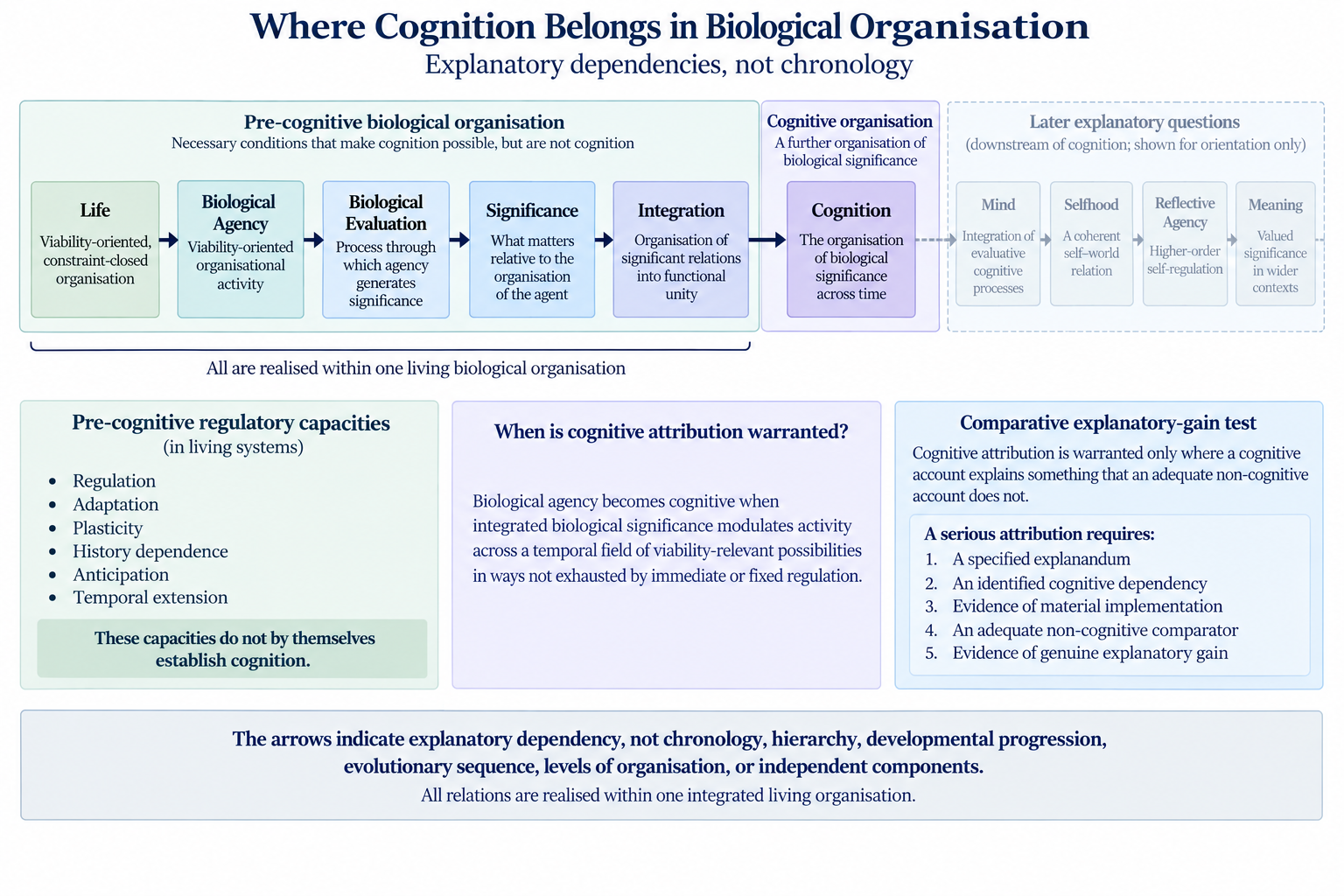
Cognitive Organisation Within Living Agency. Cognition integrates biological significance across time so that retained conditions, present circumstances, and viability-relevant possibilities can modulate present activity. Cognitive organisation is materially implemented within living agency, but regulation, temporal extension, complexity, or non-neural organisation alone do not establish cognition.
5. Material Implementation Without Neural Exclusivity
Nothing in this account makes nervous systems constitutive of cognition.
Neural organisation provides powerful means of integrating biological significance across time, but it does not follow that every cognitive process must be neural or that cognition should be defined by mechanisms characteristic of animal nervous systems. Biological and basal-cognition research has increasingly extended serious cognitive inquiry beyond conventional brain-centred models (Baluška and Levin 2016; Lyon et al. 2021).
Whether a particular non-neural system is cognitive nevertheless remains an empirical and explanatory question concerning the organisation realised in that system.
This protects two distinctions simultaneously.
First, absence of a nervous system is not sufficient reason to reject cognitive attribution. If materially implemented organisation performs the relevant integrative and temporal work, non-neural cognition remains possible.
Second, non-neural complexity is not sufficient reason to infer cognition. Cells, tissues, plants, microbial systems and other living organisations may display regulation, retained effects of prior conditions, communication, plasticity or coordinated activity without those properties necessarily satisfying a cognitive criterion.
The target is therefore neither neural machinery nor behavioural resemblance to humans. It is the organisation through which biological significance becomes integrated across time and influences present activity relative to viability-relevant possibilities.
Different organisms may realise relevant organisation through different material processes. Neural circuitry, biochemical networks, physiological states, morphological organisation, distributed signalling and organism–environment coupling may contribute in different combinations. APS does not require these to instantiate a single mechanism. It requires proposed cognitive organisation to be materially realised rather than inferred from abstract description.
This is also where Agency, Process and Scale perform their analytic function. They are not independent components or levels of cognition. They are analytic projections of one viability-oriented, constraint-closed organisation: what the living agent does, how continuity is maintained despite change, and where persistence is organised across spatial and temporal extents.
6. Semiosis, Information and Representation as Possible Cognitive Resources
The legacy architecture of this article treated Semiosis, Information and Representation as successive stages through which cognition developed. APS no longer requires that sequence.
Each concept may become explanatorily useful in particular cognitive phenomena, but none should be made constitutive simply because cognitive organisation is present.
A cognitive system may exploit sign relations, but the presence of reliable signalling or cue-sensitive organisation does not by itself establish cognition. Semiosis therefore requires its own explanatory warrant rather than functioning as a mandatory bridge from Biological Evaluation to Cognition.
The same caution applies to Information. Informational descriptions may be useful where particular differences constrain, guide, or distinguish biologically relevant possibilities, but information should not be treated as evidence for cognition merely because a system is sensitive to differences. The question remains what explanatory work informational vocabulary performs in the case under investigation.
Representation requires a still more specific warrant. Cognitive organisation need not begin with detached internal models. Some cognitive phenomena may be realised through embodied dispositions, retained physiological organisation, distributed control, or ongoing organism–environment relations.
This makes APS representation-neutral rather than anti-representational.
Representation may become explanatorily useful where phenomena involve content-specific error, guidance concerning absent conditions, recombination, symbolic organisation, decoupling, or other properties for which representational structure performs identifiable explanatory work. The broader philosophical literature likewise cautions against treating representational attribution as automatic merely because a system can be described in representational language (Ramsey 2007).
The methodological principle is therefore:
Semiosis, Information and Representation should be introduced when they explain something the phenomenon requires, not because they are presumed stages on a universal cognitive pathway.
This preserves their potential importance while preventing them from becoming compulsory intermediates between life and cognition.
7. Cognitive Diversity Without Hierarchy
Once cognition is separated from universal living regulation, diversity within the cognitive domain can be investigated without arranging organisms on a ladder.
Some cognitive systems may operate across relatively narrow temporal fields and restricted sets of viability-relevant possibilities. Others may integrate extensive retained experience, multiple sensory relations, social information, symbolic organisation, or long temporal horizons. These differences matter, but they do not establish a single ranking from primitive to advanced cognition.
Biological approaches to cognition have helped widen the comparative field beyond familiar nervous-system and human-centred examples (Baluška and Levin 2016; Lyon et al. 2021). APS accepts that widened field while retaining the requirement that cognitive attribution itself be independently warranted.
Different organisms confront different ecological, developmental and organisational problems. Their cognitive capacities should therefore be assessed in relation to the forms of activity those capacities organise rather than according to their proximity to human cognition.
A bacterium, plant, invertebrate, vertebrate or human need not first be located on a universal cognitive scale before meaningful comparison can begin. Comparison instead asks what organisation is materially realised, what explanandum is at stake, and what alternative explanation is available.
Nor does describing one organisation as more extensive in one respect imply overall cognitive superiority. A system may integrate significance across longer temporal spans while exhibiting relatively restricted behavioural possibilities. Another may display substantial behavioural flexibility within a narrower ecological domain. Human symbolic cognition introduces distinctive capacities for language, cultural transmission and reflective deliberation, but those capacities do not define cognition as such.
The same restraint applies to Intelligence and Consciousness. Cognition is not defined by intelligence, and cognitive attribution does not require consciousness. Both may become important explanatory subjects in their own right without functioning as endpoints of a universal cognitive progression.
Cognitive diversity is therefore best investigated through differences in organisation, implementation and explanatory function rather than hierarchical rank.
8. Cognition and Organised Persistence
The title The Cognitive Organisation of Life can now be understood precisely.
It does not mean that life is cognitively organised by definition. Nor does it mean that cognition is required for every living system to persist.
Life does not require cognition; cognition presupposes life.
The title refers instead to the way cognition, where present, becomes incorporated into the ongoing organisation through which living agents maintain and re-establish the conditions of their persistence.
Cognition can matter because an agent’s viability is not always secured through response to present disturbances alone. In changing circumstances, effective activity may depend upon the integration of retained conditions, present context and viability-relevant possibilities across time. Where such integration is required to explain activity, cognition can contribute to organised persistence by changing how biological significance is deployed.
This contribution should not be exaggerated into a universal biological principle. Many organisms, and many processes within cognitive organisms, may persist through non-cognitive regulation. Cognitive organisation is one possible organisation of biological agency, not the definition of life.
Nor should cognition be treated as an independent causal layer acting upon biological mechanisms. Cognitive organisation is materially implemented within the same living organisation whose activity is being explained. Wider spatial or temporal relations alter local activity only insofar as materially implemented constraints change the relevant local conditions.
The explanatory contribution of cognition therefore lies neither in replacing mechanism nor in invoking a higher level of causation. It lies in identifying dependencies that become visible when biological significance is considered across the temporal organisation of the agent’s activity.
APS’s published Agency–Process–Scale framework already places biological agency within viability-oriented organisation while treating process and scale as complementary explanatory perspectives rather than independent causes (Spencer 2026). The present account extends that organisational commitment into the cognitive domain.
Cognition can therefore remain fully biological while retaining explanatory distinctiveness.
The relation can be stated compactly:
Biological agency generates significance; cognition organises significance across time; and where that organisation alters present activity relative to viability-relevant possibilities, cognition can contribute to organised persistence.
That is the cognitive organisation of life.
Explanatory Architecture
Central Question
How does cognition, once independently warranted, become organised within living activity, and what explanatory work does cognitive organisation perform beyond immediate or fixed regulation?
Architectural Role
This article is the Core APS account of cognitive organisation within living systems. It does not establish where cognition first begins or derive cognition directly from life. Instead, it explains what changes explanatorily once biological significance is organised across time in ways that modulate present activity relative to viability-relevant circumstances and possibilities.
Biological Agency, Biological Evaluation, Significance and Integration are treated as pre-cognitive foundations. Cognition is a further organisation realised within living agency rather than a universal property of life.
Builds On
- Life
- Viability
- Biological Agency
- Normativity
- Biological Evaluation
- Significance
- Integration
- Cognition
Develops Into
- comparative analysis of cognitive organisation
- cognitive attribution
- non-neural cognition
- materially implemented cognitive organisation
- Mind
- Selfhood
- Reflective Agency
Related Explanatory Questions
- What does cognitive organisation add beyond viability-sensitive regulation?
- Why is temporal extension alone insufficient for cognition?
- How does integrated biological significance modulate present activity?
- What distinguishes cognitive organisation from immediate or fixed regulation?
- Can cognition be materially implemented without nervous systems?
- Why does non-neural organisation not by itself establish cognition?
- When do Semiosis, Information or Representation contribute explanatory work?
- Why is Representation not constitutive of cognition?
- How should cognitive diversity be compared without hierarchy?
- When does cognitive attribution provide explanatory gain over an adequate non-cognitive comparator?
- How can cognition contribute to organised persistence without being necessary for life?
- How does cognition prepare the organisational conditions from which Mind may develop?
Position within APS
This is a Core article within the Cognition and Mind cluster. Its principal predecessor is Cognition — From Life to Mind: Continuity Without Mentalism, which establishes the continuity, dependence and non-identity relations connecting Life, Agency, Cognition and Mind.
Within APS, cognition is the organisation of biological significance across time. The article uses but does not redefine this canonical definition. The current provisional boundary proposal is more specific: biological agency becomes cognitive when integrated biological significance modulates activity across a temporal field of viability-relevant possibilities in ways not exhausted by immediate or fixed regulation. This remains a provisional criterion rather than a second canonical definition.
The relevant dependency is:
Life → Biological Agency → Biological Evaluation → Significance → Integration → Cognition
This sequence identifies explanatory dependency rather than hierarchy, chronology, or independent components. The article begins from Cognition within that architecture and examines its organisation within living activity.
Agency, Process, and Scale remain analytic projections of one viability-oriented, constraint-closed organisation. Where cognition is attributed, its organisation must be materially implemented and its explanatory contribution assessed relative to a specified explanandum and adequate comparator.
Corpus Significance
This article provides the principal Core account of what cognition does within living organisation once cognitive attribution has been warranted. It therefore separates the organisational study of cognition from both the upstream question of how cognition becomes possible and the downstream question of how cognitive processes become further integrated into Mind.
It also supplies an architectural control for discussions of non-neural cognition, Representation, cognitive diversity, Intelligence and Consciousness by preventing any of these from becoming automatic definitions or universal stages of cognition.
See Also
Related Articles
References
- (2013). The Mark of the Cognitive. Minds and Machines, 23(3), 339–352 . https://doi.org/10.1007/s11023-012-9291-1
- (2016). On Having No Head: Cognition throughout Biological Systems. Frontiers in Psychology, 7 . https://doi.org/10.3389/fpsyg.2016.00902
- (2020). From Allostatic Agents to Counterfactual Cognisers: Active Inference, Biological Regulation, and the Origins of Cognition. Biology & Philosophy, 35(3) . https://doi.org/10.1007/s10539-020-09746-2
- (2005). Autopoiesis, Adaptivity, Teleology, Agency. Phenomenology and the Cognitive Sciences, 4(4), 429–452 . https://doi.org/10.1007/s11097-005-9002-y
- (2021). Reframing Cognition: Getting Down to Biological Basics. Philosophical Transactions of the Royal Society B, 376(1820) . https://doi.org/10.1098/rstb.2019.0750
- (2015). Biological Autonomy: A Philosophical and Theoretical Enquiry. Springer. https://doi.org/10.1007/978-94-017-9837-2
- (2007). Representation Reconsidered. Cambridge University Press. https://doi.org/10.1017/CBO9780511597954
- (2026). Agency as the Defining Activity of Life: A Viability-Oriented Framework Integrating Process and Scale. Biological Theory . https://doi.org/10.1007/s13752-026-00547-6