Meaning in Biology — An APS Clarification
Meaning is often invoked in biology when organisms respond to signals, interpret environmental differences, regulate activity, communicate, or behave in ways sensitive to context. APS distinguishes these phenomena from biological significance itself. Biological evaluation generates significance: differences become relationally real for living systems because they bear differently upon viability. Significance is therefore not yet meaning. Integration and cognition can organise biological significance across time and across viability-relevant possibilities, while semiosis, information, and representation identify further relations that must not be conflated with one another. This article clarifies the biological conditions relevant to the emergence of meaning without attributing meaning wherever biological significance occurs.
Introduction
Meaning presents a difficult problem for biology because the word is used across very different explanatory contexts. It can refer to linguistic semantics, symbolic reference, intentional content, interpretation, environmental significance, signalling, representation, or the importance that something has for a living system. Treating all of these uses as instances of a single biological phenomenon risks collapsing distinctions that explanation requires.
APS approaches this problem by beginning with living organisation rather than with language or symbolic representation. Living systems encounter conditions that differ in how they bear upon their viability. Their activity can maintain, restore, modify, or undermine the conditions of continued functioning. These differences are not merely distinctions imposed by an observer; they become relationally real through the organisation of biological activity.
APS calls the process through which agency generates this significance Biological Evaluation. Biological significance is therefore a relationally real product of biological evaluation. A nutrient gradient, damaging condition, developmental cue, physiological deviation, or environmental change can matter to a living system because its consequences differ relative to the system’s viability.
This establishes an important biological foundation for the study of meaning, but it does not establish that significance and meaning are identical. Biological significance is not meaning. The fact that something matters to a living system does not by itself show that the system interprets that significance in the richer sense required for meaning.
The task of this article is therefore one of clarification. It asks how biological significance, semiosis, information, representation, cognition, and meaning should be related without collapsing them into one another or arranging them into an automatic sequence. Its purpose is not to establish a universal threshold for meaning, but to identify the biological organisation from which increasingly rich forms of interpretation can become possible.
Where This Article Fits
This article clarifies the boundary between biological significance and meaning within APS. Its primary purpose is to prevent the fact that conditions matter biologically from being treated as sufficient evidence that meaning is already present.
The preceding APS architecture establishes that biological agency is viability-oriented organisational activity and that Biological Evaluation is the process through which agency generates significance. Significance therefore belongs directly to the organisation of living activity. Cognition introduces a further organisational development: the organisation of biological significance across time and across viability-relevant possibilities in ways not exhausted by immediate or fixed regulation.
The present article occupies the conceptual space between those foundations and the broader account developed in What Is Meaning?. It asks when biological talk of meaning becomes warranted and how meaning should be distinguished from neighbouring concepts such as significance, semiosis, information, representation, and cognition. What Is Meaning? owns the broader positive account of meaning within the later cognition–mind–selfhood–reflective-agency architecture.
This article should therefore not be read as claiming that all living systems possess meaning merely because they evaluate viability-relevant differences. It establishes the biological conditions from which meaning can develop while preserving the distinction between what matters biologically and what becomes meaningfully interpreted.
Biological Significance Is Not Meaning
The distinction between significance and meaning is fundamental to the APS account.
Living systems are organised in ways that make some differences consequential for their continued functioning. A change in nutrient availability can alter metabolic possibilities; tissue damage can initiate repair; a physiological deviation can trigger compensatory regulation; and an environmental condition can alter the viability of an organism’s activity. Such differences matter because they bear differently upon living organisation.
APS calls this biological significance. Significance does not require language, reflective awareness, conceptual interpretation, or symbolic representation. It arises relationally because a viability-oriented living system is organised such that different conditions have different consequences for its persistence.
Meaning requires greater caution. If every biologically significant difference were defined as meaningful, meaning would become nearly coextensive with biological agency itself. The distinction between a condition mattering to a system and a system organising that significance in an interpretive way would disappear.
APS therefore resists that collapse. Biological evaluation can generate significance without establishing meaning. Significance provides material from which meaning may develop, but the transition requires further organisation.
This distinction allows APS to naturalise biological significance without prematurely attributing interpretive capacities to all living systems.
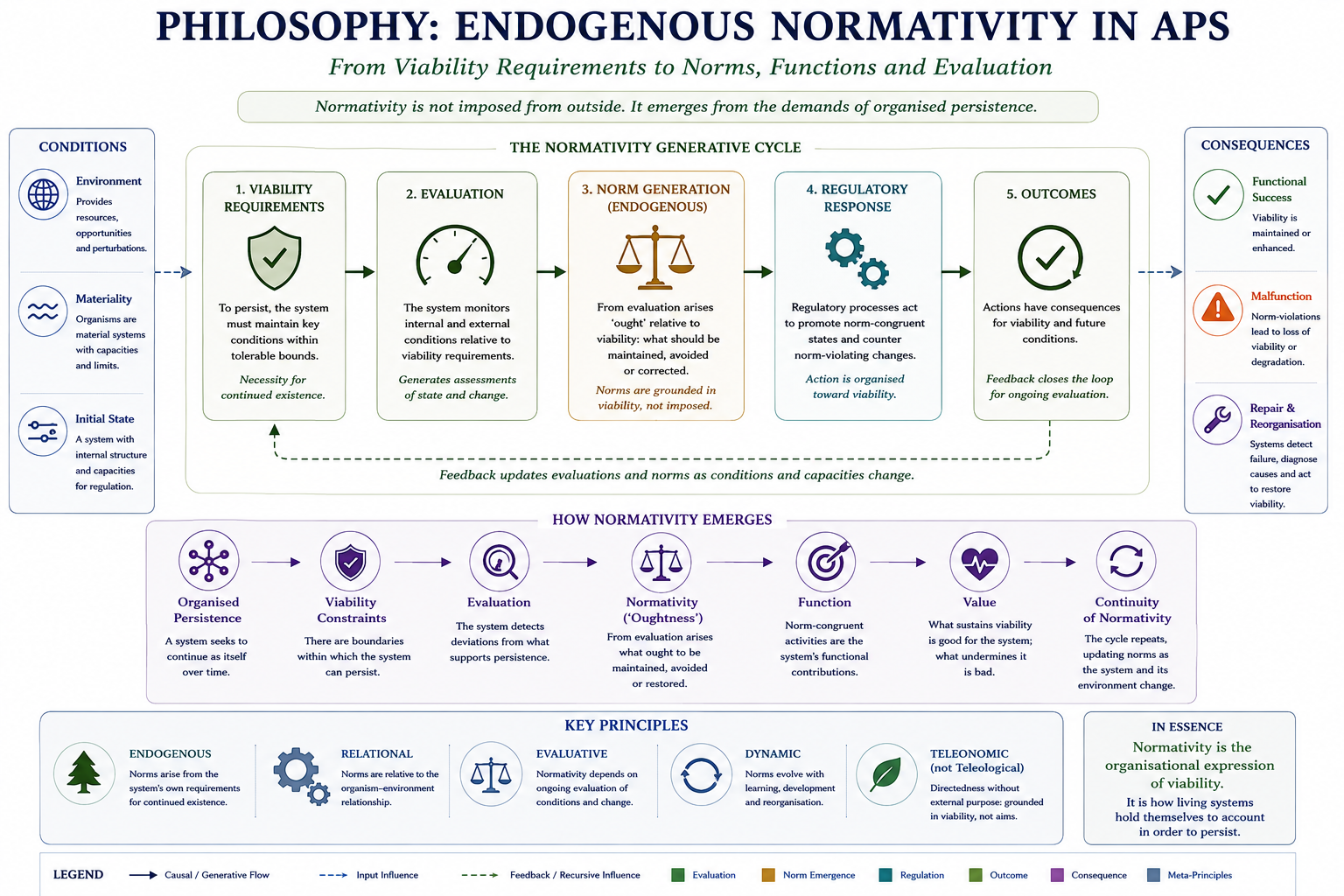
Biological Significance Within Evaluative Organisation. Viability-oriented organisation establishes real asymmetries among conditions affecting living systems. Biological evaluation generates significance from these viability-relative differences. This provides a biological foundation from which meaning may develop, but significance should not itself be identified with meaning.
Meaning Without Language?
Rejecting the identification of significance with meaning does not require identifying meaning exclusively with language.
Human linguistic meaning represents one highly developed form of interpretation, but language need not exhaust the category. Non-linguistic organisms can exhibit context-sensitive behaviour, temporal integration, learning, memory, anticipation, discrimination, and other capacities that may justify investigation in cognitive or interpretive terms.
The relevant question is therefore not whether meaning requires words. It is what organisation is required before biological significance is being interpreted rather than merely generated and acted upon through immediate or fixed regulation.
This question cannot be settled by observing differential responsiveness alone. Bacteria, plants, immune systems, developmental systems, and non-neural organisms can all respond differentially to biologically significant conditions. Such responsiveness demonstrates biological evaluation where the relevant viability relations are established, but it does not by itself establish cognition, representation, or meaning.
The biological study of meaning must therefore avoid two opposite errors. One is to reserve meaning exclusively for human language and reflective thought. The other is to attribute meaning wherever living systems respond differently to conditions that matter to them.
APS seeks a position between these extremes by distinguishing biological significance from the progressively richer organisation through which significance can be integrated, interpreted, represented, or reflectively understood.
Meaning and Semiosis
Semiosis provides an important comparison because biological sign relations are often described as meaningful. Biosemiotic approaches have emphasised that living systems are not merely exposed to physical differences but participate in organised relations in which one condition can function as a sign in relation to another.
APS can recognise the importance of such relations without making semiosis synonymous with meaning. A sign relation can participate in the organisation of biological significance, while the explanatory question remains what the relation does within the living system and what interpretive organisation, if any, it supports.
Semiosis should therefore not be treated as an automatic intermediate stage through which evaluation becomes meaning. Nor should it be assumed that every instance of biological evaluation is semiotic. The relevant relations must be identified in the system being investigated.
Where semiosis is present, it may provide an important organisational resource through which significance is coordinated, stabilised, transmitted, or integrated. Whether that organisation warrants the attribution of meaning depends upon what additional interpretive capacities are involved.
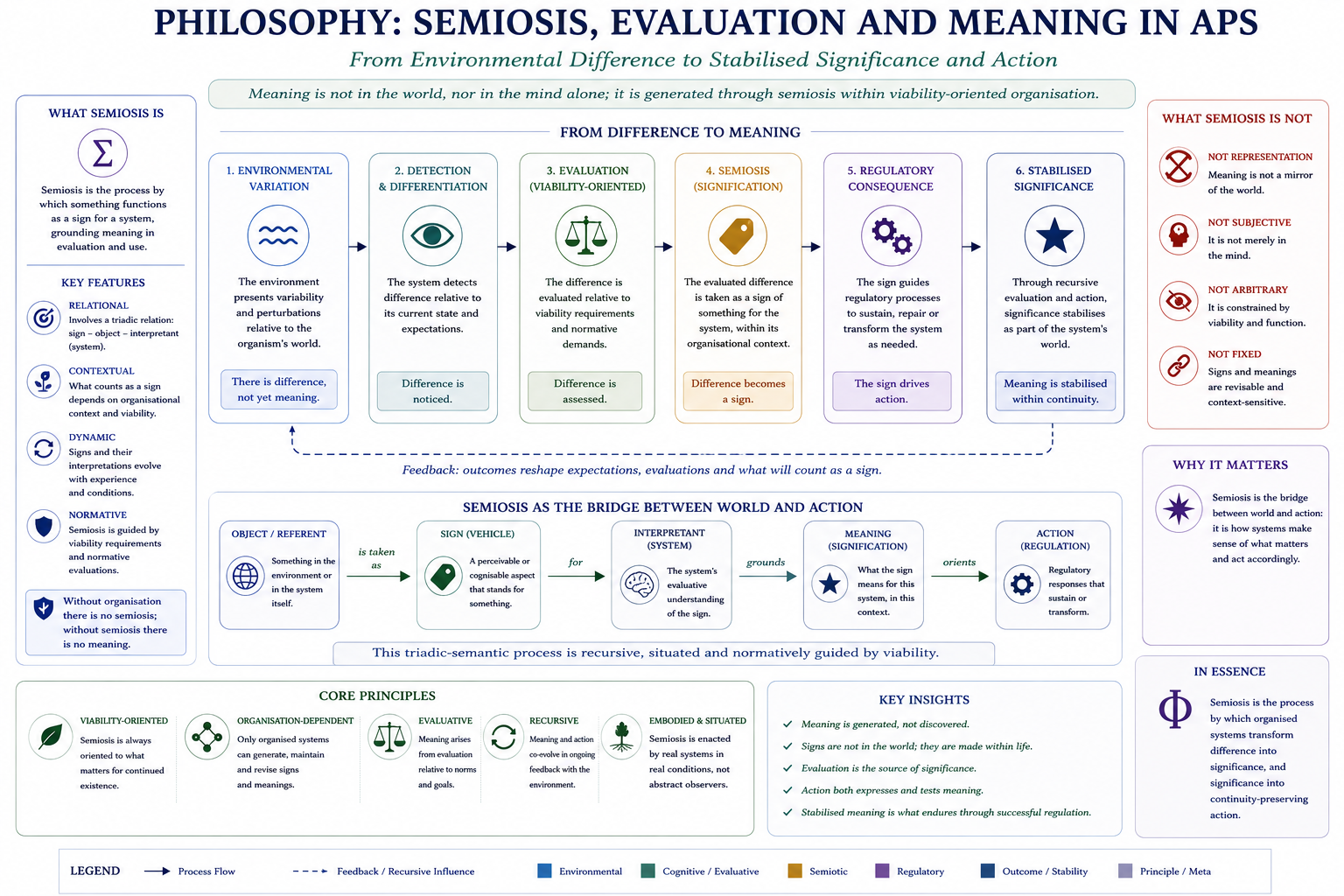
Semiosis and Biological Significance. Semiotic relations can organise biologically significant differences within living activity. APS treats such relations as potentially important to the development of meaning without assuming that semiosis, significance, and meaning are interchangeable.
Meaning and Information
Information is another concept that must be distinguished carefully from meaning.
Statistical information, informational correlation, biological signalling, genetic information, semantic information, and representational content do not all identify the same phenomenon. A biological system can contain reliable correlations or transmit signals without those relations necessarily constituting meaning in the interpretive sense.
APS therefore does not propose a universal sequence in which meaning must precede information or information must precede meaning. The relation depends upon what kind of information is being discussed and what explanatory target is at issue.
Shannon or statistical information can be specified without biological meaning. Biological information talk may concern correlations, coding relations, signalling systems, causal dependencies, or functional organisation. Some of these relations can become biologically significant because they participate in viability-oriented activity. Richer informational relations may also become integrated into cognitive and representational organisation.
The crucial APS distinction is that information and significance are not identical. A difference can carry statistical information without mattering to a living system, while a biologically significant condition matters because of its relation to viability. Meaning introduces a further interpretive question that cannot be settled merely by establishing either informational correlation or biological significance.
The detailed distinctions among these uses are developed in Information in Biology — An APS Clarification. Their relevance here is methodological: meaning should not be reduced to information, but neither should information be placed automatically before or after meaning in a universal explanatory sequence.
Meaning and Representation
Representation raises a related but distinct problem.
Some theories of cognition explain meaning through internal representations that stand for features of the organism, environment, possible actions, or future states. Such approaches can be powerful where there is evidence that biological organisation supports representational functions.
APS does not deny representation, but neither does it assume representation wherever biologically significant differences guide activity. Differential response, regulation, signalling, and even sophisticated behavioural coordination need not automatically establish that a system represents what it responds to.
Representation becomes a substantive explanatory possibility where organisation supports capacities such as counterfactual discrimination, temporal projection, flexible modelling, context-sensitive substitution, or other forms of activity in which something functions in relation to possibilities not exhausted by the immediately present condition.
Whether a particular system meets an appropriate representational criterion is an empirical and conceptual question. Representation should therefore be attributed where it improves explanation of the relevant organisation, not simply because the system processes information or responds adaptively.
Meaning and representation consequently need not stand in a simple linear order. Some forms of meaning may involve representation, while other forms of interpretive organisation may not require representation in the same sense. APS leaves that relation open to analysis rather than deciding it through architecture alone.
The dedicated article Representation — When and Whether It Arises in Biological Systems develops this question directly.
Meaning and Cognition
Cognition provides a more important boundary because APS explicitly distinguishes biological agency from cognitive organisation.
Life does not require cognition; cognition presupposes life. Biological agency already evaluates viability-relevant conditions and thereby generates significance. Cognition develops when that significance becomes organised across time and across a field of possibilities in ways not exhausted by immediate or fixed regulation.
In compact form, APS treats cognition as the organisation of biological significance across time.
More diagnostically:
Biological agency becomes cognitive when integrated biological significance modulates activity across a temporal field of viability-relevant possibilities in ways not exhausted by immediate or fixed regulation.
This distinction prevents cognition from being attributed wherever biological significance is present. It also prevents cognition from being defined in terms of pre-existing meaning. Cognition organises significance; it does not require APS to assume that significance has already become meaning.
Cognition is nevertheless highly relevant to the development of meaning. Temporal integration, context sensitivity, memory, anticipation, counterfactual organisation, and flexible modulation can allow significance to be related across possibilities rather than merely acted upon in an immediate regulatory relation. Such capacities provide increasingly strong grounds for speaking of interpretation.
APS therefore treats cognition as an important organisational development in the pathway toward meaning without defining meaning as cognition itself. Cognition can organise what matters across time; meaning concerns how significance becomes interpretively organised within increasingly integrated self–world relations.
This is one reason the broader positive account of meaning belongs downstream of cognition rather than at the point where biological evaluation first generates significance.
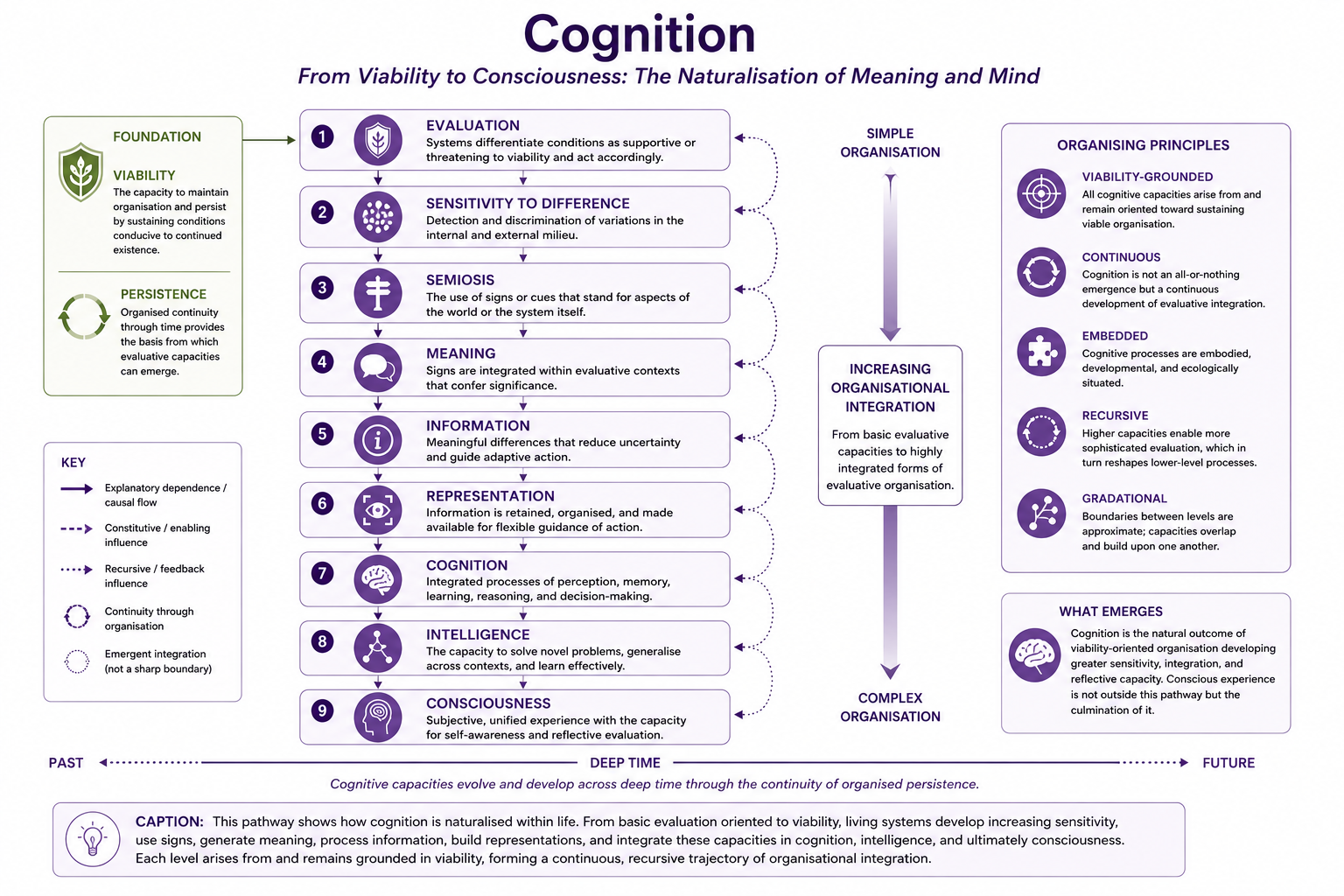
From Significance Toward Cognition. Biological evaluation generates significance. Cognition develops when integrated biological significance modulates activity across time and across viability-relevant possibilities in ways not exhausted by immediate or fixed regulation. This provides increasingly rich organisational conditions for interpretation without identifying significance itself with meaning.
From Cognition Toward Meaning
Cognition does not complete the APS account of meaning. Cognitive organisation can integrate significance across time, but increasingly rich forms of meaning also depend upon how such significance is organised within coherent relations between a system and its world.
APS uses Mind for integrated evaluative cognitive processes that maintain a coherent self–world relation. Selfhood concerns continuity across change within that organisation. Reflective Agency introduces the capacity for increasingly explicit engagement with possibilities, reasons, values, purposes, and interpretations.
These distinctions matter because the word meaning ranges from minimal interpretive organisation to the reflective, personal, social, symbolic, and existential meanings characteristic of human life. APS should not assume that all these forms appear together or that one threshold settles every legitimate use of the term.
The broader architecture therefore identifies an explanatory pathway rather than a hierarchy or universal chronology:
Life → Agency → Biological Evaluation → Significance → Integration → Cognition → Mind → Selfhood → Reflective Agency → Meaning
The arrows indicate explanatory dependencies within APS. They do not imply that biology consists of separate levels, that every biological lineage passes through a fixed sequence, or that later forms replace earlier organisation. Each later distinction depends upon organisational capacities established by preceding ones while introducing explanatory questions of its own.
Meaning belongs toward the interpretive end of this architecture because APS reserves the term for organisation that does more than register viability-relative significance. Exactly how meaning should be characterised across cognitive, reflective, social, symbolic, and existential contexts is the task of What Is Meaning?.
Meaning Across Spatial and Temporal Extents
Meaning should not be represented as a substance or property distributed through a hierarchy of biological scales. The relevant question is where the organisation supporting significance, cognition, interpretation, or representation is materially implemented.
APS uses Scale to identify where persistence and explanatory dependencies are organised across spatial and temporal extents. A meaningful or potentially meaningful relation may depend upon processes extending through molecular, cellular, physiological, behavioural, environmental, or social organisation, but these descriptions do not establish separate levels of meaning.
Which spatial and temporal extents matter depends upon the explanandum. A cognitive discrimination may depend upon cellular and organismal processes; a communicative practice may depend upon relations among organisms and their social environment; reflective meaning may depend upon temporally extended memory, selfhood, cultural practices, and symbolic resources.
Wider extent does not itself imply richer meaning, and local implementation does not imply explanatory sufficiency. The task is to identify the materially realised constraints and relations that make a difference to the interpretive organisation being explained.
Process is equally important because meaning, where present, is enacted and maintained through activity across time. APS therefore investigates meaning through organisation rather than assigning it to a fixed spatial location or hierarchical level.
Meaning Within APS Explanatory Architecture
The distinctions developed here allow meaning to be situated within APS without converting neighbouring concepts into a single linear sequence.
Life is viability-oriented, constraint-closed organisation. Biological agency is the viability-oriented organisational activity through which that organisation is enacted and sustained. Biological Evaluation is the process through which agency generates significance. Significance is therefore relationally real because conditions differ in how they bear upon viability.
From this foundation, further forms of organisation become possible. Semiotic relations may organise signs within biological activity. Informational relations may describe correlations, codes, signals, or other dependencies. Integration can organise significance into functional unity. Cognition can organise biological significance across time and across viability-relevant possibilities. Representation may arise where appropriate organisational criteria are met. Mind, selfhood, and reflective agency introduce further forms of integrated self–world organisation.
These concepts should not be treated as interchangeable or as steps in an automatic causal ladder. Their relations are explanatory and must be established for the phenomenon under investigation.
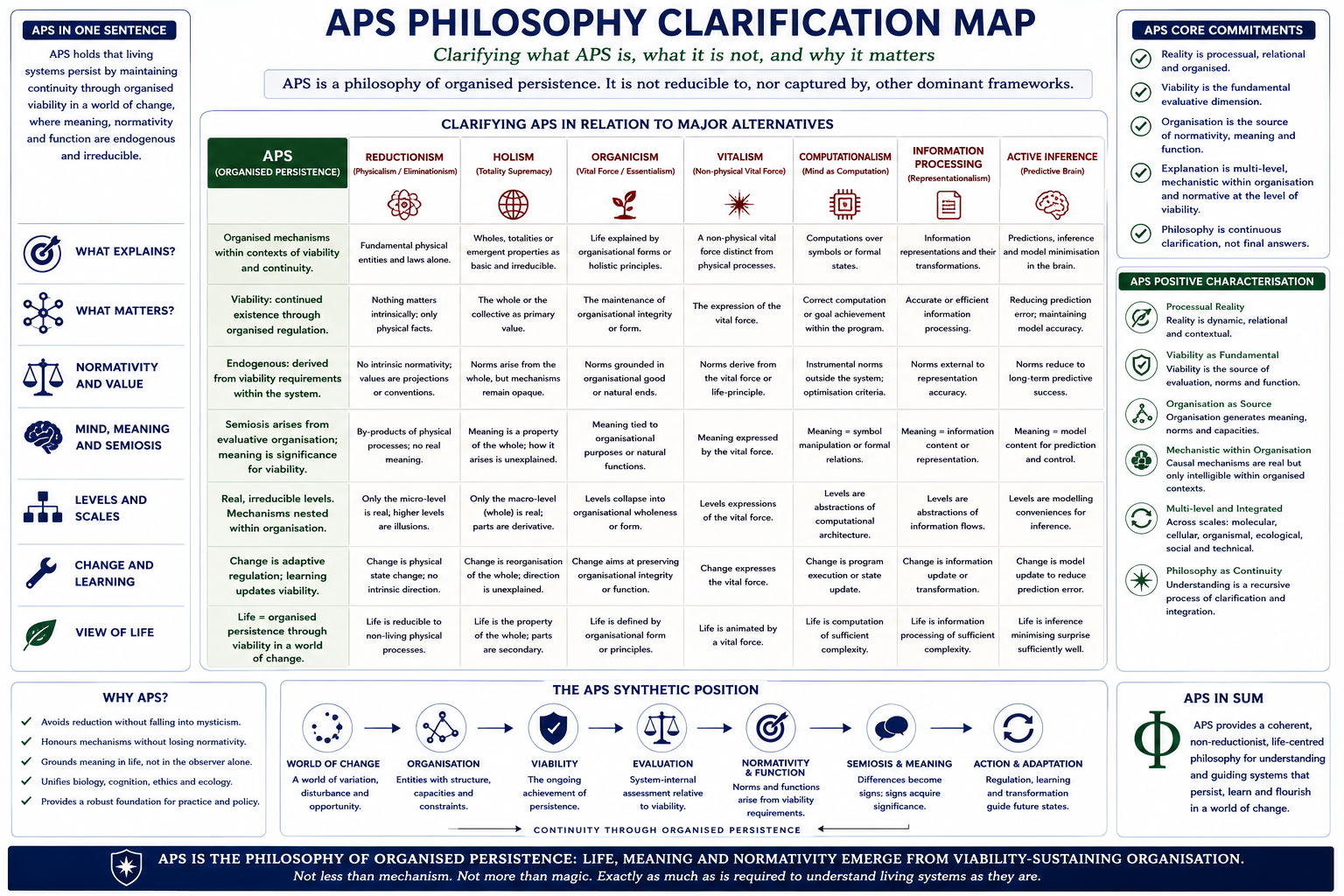
APS Clarification Map. APS distinguishes biological significance, semiosis, information, representation, cognition, and meaning rather than treating them as interchangeable. Their explanatory relations must be established through the organisation of living systems and the particular explanandum under investigation.
The resulting architecture does not define meaning simply as the endpoint of a formula. It establishes constraints upon explanation. Meaning cannot be inferred merely from information, differential response, biological significance, semiosis, or representation. Nor should its presence be denied merely because language or reflective consciousness is absent.
The scientific and philosophical task is to determine what form of interpretive organisation is actually present.
Why the Distinction Matters
Distinguishing significance from meaning resolves several recurrent ambiguities in biology and cognitive science.
First, it allows APS to say that conditions genuinely matter to living systems without inflating every viability-relevant relation into interpretation. Biological significance remains real even where meaning has not been established.
Second, it protects the boundary between agency and cognition. Living systems need not be cognitive merely because their activity is viability-sensitive. Cognition requires additional temporal and counterfactual organisation of significance.
Third, it prevents information from doing explanatory work that depends upon significance or interpretation. Statistical information, signalling, biological significance, representation, and semantic content can then be investigated separately before their relations are assessed.
Fourth, it permits semiosis to be studied without deciding in advance that every sign relation constitutes meaning in the same sense.
Finally, the distinction makes claims about meaning assessable. Instead of asking only whether a system responds appropriately to biologically relevant differences, inquiry can ask what organisation integrates those differences, how they are related across time and possibilities, whether representational or semiotic relations are involved, and what evidence supports an interpretive rather than merely regulatory description.
The result is a more conservative attribution of meaning, but also a more biologically substantive one.
Meaning and Organised Persistence
Meaning remains grounded in living organisation even though it should not be identified with organised persistence.
Living systems provide the viability-relative organisation through which differences first acquire biological significance. Without such organisation there is no APS basis for biological evaluation and therefore no biological significance in the relevant sense.
Organised persistence consequently supplies part of the biological background from which increasingly sophisticated forms of integration and interpretation can develop. It explains why differences can matter to a living system, while later organisation determines what is done with that significance across time, possibilities, self–world relations, and reflective activity.
This distinction is important. A nutrient gradient may be biologically significant because it bears upon metabolic viability. A stress condition may matter because it threatens continued functioning. A developmental cue may alter viable trajectories. None of these facts alone establishes that the system interprets the condition as meaningful.
Meaning becomes an additional explanatory question concerning how significance is organised rather than another name for the viability relation itself.
APS therefore grounds the possibility of biological meaning in living organisation without making meaning coextensive with life.
Relation to Comparative Explanatory Approaches
These distinctions also affect how APS should compare itself with informational, computational, representational, enactive, semiotic, or active-inference approaches.
APS should not argue that another framework fails simply because it begins from information, prediction, representation, semiosis, or formal dynamics rather than from APS terminology. Different frameworks may address different explananda, and similar words may perform different explanatory roles.
The appropriate comparison is target-relative. If two approaches both attempt to explain how biological significance arises, how cognition organises significance, or how meaning becomes possible, their respective dependency claims can be compared. If their targets differ, conceptual difference alone does not establish competition or explanatory gain.
The same control applies to the Free Energy Principle. Its formal resources for modelling adaptive self-organisation, inference, and organism–environment relations should not be classified merely as informational description to which APS supplies biological meaning. Whether APS and FEP explain the same target, identify different dependencies, or provide complementary, competing, redundant, or independent explanations must be determined by target-matched assessment.
These issues are developed further in APS and Contemporary Explanatory Approaches and APS and the Free Energy Principle: Organisation, Formalism, and Explanatory Comparison.
Conclusion
Biological meaning should neither be restricted automatically to language nor attributed wherever a living system responds to conditions that matter to it.
APS begins with a more fundamental relation. Life is viability-oriented, constraint-closed organisation. Biological agency enacts that organisation, and Biological Evaluation is the process through which agency generates significance. Conditions thereby become relationally significant because they bear differently upon viability.
Significance is not yet meaning.
That distinction allows APS to recognise genuine biological normativity without attributing interpretation prematurely. Semiosis, information, integration, cognition, and representation can each contribute additional forms of organisation, but none should simply be identified with meaning or placed into an automatic universal sequence.
Cognition is especially important because it organises biological significance across time. As significance becomes integrated across viability-relevant possibilities, and as cognitive organisation develops into increasingly coherent self–world relations, the biological conditions for richer interpretation become progressively more substantial. Mind, selfhood, and reflective agency can extend these capacities further into forms of meaning involving interpretation, values, purposes, symbols, and human understanding.
The contribution of this article is therefore deliberately bounded. It does not provide the complete APS theory of meaning. It clarifies the biological foundations and conceptual boundaries required before that theory can be developed.
The central distinction is simple but consequential:
Biological significance identifies what matters to a living system; meaning concerns the interpretive organisation of what matters.
The broader APS account of that interpretive organisation is developed in What Is Meaning?.
Key Point
Biological Evaluation generates significance, not meaning. Meaning becomes an additional explanatory question when biological significance is organised in ways that support interpretation. Distinguishing these concepts preserves the reality of biological significance while preventing meaning, cognition, representation, and semiosis from being attributed merely because viability-relevant differences affect living activity.
Explanatory Architecture
Central Question
When is biological talk of meaning warranted, and how should meaning be distinguished from biological significance, semiosis, information, representation, and cognition?
Architectural Role
This Clarification article establishes the boundary between biological significance and meaning within APS. Biological Evaluation generates significance because conditions bear differently upon the viability of living organisation. The article argues that this relation does not by itself establish meaning and examines the additional organisational questions raised by semiosis, information, integration, cognition, representation, mind, and reflective agency.
Preceding Explanatory Dependencies
These concepts and articles establish the explanatory resources presupposed by this article. They identify dependencies within the APS corpus rather than chronological order, hierarchy, or levels of organisation.
- Viability
- Function
- Normativity
- Biological Agency
- Biological Evaluation
- Biological Significance
- Integration
- Organised Persistence
Subsequent Explanatory Developments
The distinctions established here are developed, tested, or extended in:
- Semiosis — How Differences Come to Matter in Living Systems
- Information in Biology — An APS Clarification
- Representation — When and Whether It Arises in Biological Systems
- Cognition — Where Does It Belong in Biology?
- Mind
- Selfhood
- Reflective Agency
- What Is Meaning?
- APS and Contemporary Explanatory Approaches
- APS and the Free Energy Principle: Organisation, Formalism, and Explanatory Comparison
Related Explanatory Questions
- How does biological significance differ from meaning?
- What does Biological Evaluation generate?
- When does semiosis support interpretation rather than merely biological significance?
- How does biological information differ from biological significance?
- What organisational conditions warrant representational explanation?
- When does biological agency become cognitive?
- How does cognition organise biological significance across time?
- What additional organisation is required for meaning?
- How do mind, selfhood, and reflective agency transform the organisation of significance?
- How should biological meaning be distinguished from linguistic, symbolic, social, and existential meaning?
Position Within APS
This article clarifies the transition from biological significance toward meaning without collapsing the two. It preserves Biological Evaluation as the process through which agency generates significance, locates cognition in the organisation of biological significance across time, and leaves the positive account of meaning to the later cognition–mind–selfhood–reflective-agency architecture. Its role is therefore to establish the conceptual boundary required for APS to naturalise significance while avoiding premature attribution of meaning to living systems merely because viability-relevant differences matter to them.
See Also
Related Articles
References
- (2008). Biosemiotics: A New Understanding of Life. Springer.
- (2011). Incomplete Nature. W. W. Norton & Company.
- (2015). Biological Autonomy: A Philosophical and Theoretical Enquiry. Springer.
- (1931). Collected Papers of Charles Sanders Peirce. Harvard University Press.
- (2026). Agency as the Defining Activity of Life. Biological Theory . https://doi.org/10.1007/s13752-026-00547-6
- (2007). Mind in Life. Harvard University Press.
- (1991). The Embodied Mind. MIT Press.
- (2010). A Foray into the Worlds of Animals and Humans. University of Minnesota Press.