Introduction
Every mature scientific framework eventually reaches a point where individual concepts are no longer the primary source of explanatory interest. New ideas have been introduced, relationships among them have been clarified, and a growing body of work has accumulated around a common set of concerns. At this stage a deeper question begins to emerge:
Why do these concepts belong together?
APS has now reached this point.
The framework contains discussions of life, viability, persistence, continuity, development, adaptation, ecology, evolution, cognition, mind, selfhood, meaning, diagnosis, resilience, repair, normativity, agency, process, and scale. Each concept plays an important role. Yet APS is not simply a collection of biological topics gathered under a common label, nor is it a catalogue of independent theoretical claims.
It is an explanatory architecture.
The purpose of this article is to explain that architecture.
What Is APS? introduces the central intuition underlying the framework. How APS Explains Life describes the framework’s basic explanatory orientation. Understanding APS surveys its major conceptual domains. This article addresses a different question:
Why does the framework possess the structure that it does?
The answer begins with a simple biological observation.
Living systems persist.
Yet they do not persist by remaining unchanged. They grow, develop, repair, adapt, learn, age, reproduce, and continually interact with changing environments. Their continuity depends not upon stability but upon the successful organisation of change itself.
APS begins with this phenomenon.
Everything else in the framework emerges from the attempt to understand how such continuity remains possible.
Foundations
The Fundamental Problem of Life
Biological explanation is often organised around particular domains. Development explains transformation. Ecology explains organism–environment relations. Evolution explains historical change. Cognition explains adaptive responsiveness. Physiology explains functional regulation. Diagnosis explains disruption, recovery, and failure.
Each domain appears to address a different aspect of life.
APS agrees that these domains are genuinely distinct. However, it also asks why they repeatedly converge upon similar organisational themes. Why do concepts such as adaptation, repair, resilience, cognition, evaluation, and development recur throughout biology despite their apparent diversity? What underlying problem makes these different forms of organisation necessary?
APS proposes that these phenomena emerge because living systems face a common challenge:
The maintenance of viable continuity through time.
This challenge provides the architectural centre of the framework.
Development matters because continuity must survive transformation. Adaptation matters because continuity must remain possible under changing conditions. Repair matters because continuity must recover from disruption. Resilience matters because continuity must withstand perturbation. Ecology matters because continuity depends upon environmental relations. Evolution matters because continuity extends across generations. Cognition matters because living systems must respond differentially to conditions affecting continuity.
Viewed separately, these domains can appear unrelated. Viewed through the lens of organised persistence, they reveal different aspects of the same explanatory problem.
APS therefore begins not with a particular biological mechanism or level of organisation but with a question:
How do living systems maintain viable continuity despite continual transformation?
The remainder of the framework unfolds from the attempt to answer that question.
Viability and Organised Persistence
The central organising concept of APS is viability-oriented organised persistence.
This idea is easy to misunderstand because persistence is often associated with permanence, stability, or resistance to change. Living systems persist differently. An organism remains recognisably itself despite continual transformation. Development alters its structure, learning modifies its behaviour, repair reorganises damaged tissues, ecological interactions reshape opportunities and constraints, and evolution transforms populations across generations.
Change is not an interruption of biological existence. It is its normal condition.
The explanatory challenge therefore becomes understanding how continuity remains possible despite continual transformation.
APS addresses this challenge through the concept of organised persistence. Organised persistence refers to the active maintenance of viable continuity across time. Persistence is not mere duration. It is the continual regeneration of the organisational conditions required for continued existence.
This distinction changes how living systems are understood. Organisms are not best described as objects that happen to undergo change. They are continuity-preserving organisations whose persistence depends upon the successful organisation of change itself.
Yet persistence alone is not enough.
Many non-living systems persist. What distinguishes living persistence is that continuity must remain compatible with continued existence. Resources must be obtained, damage must be repaired, development must remain coordinated, environmental relations must remain sufficiently supportive, and activity must remain responsive to changing conditions.
This requirement introduces viability.
Viability identifies the conditions under which persistence succeeds or fails. Living systems do not merely continue through time. They continue under organisational constraints that determine whether continuity remains possible. Some conditions support persistence. Others undermine it. Some transformations contribute to continued existence. Others threaten it.
Persistence therefore acquires biological significance because continuity is not guaranteed. Living systems exist under circumstances where persistence can succeed or fail.
Within APS, viability provides the organisational context for propositions about normativity, regulation, adaptation, repair, resilience, and evaluation. These propositions have differing evidential statuses and are not collectively validated by their place in the framework.
Together, these concepts specify the central explanatory problem addressed by APS. Life is viability-oriented, constraint-closed organisation. Organised persistence identifies the problem of how that organisation maintains and re-establishes the conditions of its continuity despite change.
This is a principal explanatory target of APS and the organising target of its general account of living organisation. It does not follow that every biological inquiry must take organised persistence as its target.
Everything that follows in the framework emerges from this foundation.
Constraint Closure and Organisational Continuity
If viability-oriented organised persistence is the phenomenon APS seeks to explain, a further question immediately arises:
How is continuity maintained despite continual transformation?
APS addresses this question through the concept of constraint closure.
Living systems are organised through networks of constraints that regulate biological activity. These constraints channel processes, stabilise organisation, and contribute to continuity across time. Yet the constraints themselves are not fixed. They are continually regenerated through the activities of the system. The organisation that sustains continuity is simultaneously sustained by continuity-preserving activity.
Constraint closure therefore helps explain how organised persistence remains possible despite continual material turnover and organisational change. It provides an account of the reciprocal organisation through which living systems maintain themselves through time.
Constraint closure is integral to the APS definition of life, but it is not a separate explanatory centre. APS does not define life as constraint closure alone, nor does it derive the entire architecture from closure alone. Rather, closure matters within APS because it contributes to the maintenance of viable continuity.
Constraint closure is therefore integral to the APS account of living organisation, but it should not be understood as a separate level beneath organised persistence or as something derived from it. APS defines life as viability-oriented, constraint-closed organisation. Organised persistence identifies how the continuity of that organisation becomes an explanatory problem through time.
The relationship is therefore organisational rather than hierarchical. Constraint closure helps specify how living organisation maintains and regenerates conditions required for its persistence, while organised persistence directs attention to the continuity of that organisation despite material and organisational change.
Constraint closure is therefore best understood as one important organisational solution to the broader challenge of maintaining viable continuity through time.
This ordering helps clarify why APS investigates development, adaptation, repair, resilience, cognition, ecology, evolution, and social organisation within one conceptual architecture. Their inclusion organises inquiry; it does not establish that they share one demonstrated substantive explanation. Closure helps formulate continuity maintenance within APS, while the architecture organises questions arising from persistence.
At this point a deeper question becomes unavoidable: What kind of organisation actively maintains continuity relative to viability?
The answer leads to the analytic architecture through which APS organises inquiry into this problem.
Explanatory Architecture
The Agency–Process–Scale Analytic Interface
APS organises its general account of living organisation through three complementary analytic projections:
- Agency
- Process
- Scale
Agency, Process, and Scale are complementary analytic projections of one viability-oriented, constraint-closed organisation.
They are not three components from which living systems are constructed, three independent causes, three domains of reality, or three hierarchical levels. Nor does APS propose that every legitimate biological explanation must employ them.
Instead, each projection directs attention to a different explanatory question concerning the same integrated living organisation:
- Agency concerns what living systems do.
- Process concerns how continuity is maintained despite change.
- Scale concerns where persistence is organised across spatial and temporal extents.
The distinctions are analytic; the organisation and activities they disclose are biologically real.
Together these relations constitute the Agency–Process–Scale analytic interface through which APS structures inquiry into living organisation and organised persistence. This is a bounded analytic architecture, not a demonstrated general Explanatory Grammar for biology.
This analytic interface belongs specifically to APS. Its organisational usefulness does not establish that Agency, Process, and Scale are obligatory categories of biological explanation generally or that they provide additional substantive explanatory gain. Particular biological questions may be adequately addressed through mechanistic, evolutionary, developmental, ecological, mathematical, informational, or other explanatory approaches.
The current claim is bounded: when living organisation itself is the explanatory target, Agency, Process, and Scale provide complementary, target-sensitive ways of organising investigation of how living systems maintain and re-establish the conditions of their persistence. Whether this organisation adds substantive explanatory capacity requires target-matched comparison; it is not established by the architecture alone.
Why Agency, Process, and Scale Are Analytic Projections
The terminology matters because Agency, Process, and Scale can easily be mistaken for three things that exist independently within living systems. APS does not make that claim.
A living system does not contain Agency, Process, and Scale as separable components. Nor are they distinct causal forces or levels whose combination produces life. They identify complementary ways of investigating one integrated biological organisation.
APS therefore describes them as analytic projections.
Analytic indicates that the distinction is made for purposes of investigation and explanation. Living organisation can be examined by asking what the system does, how its continuity is maintained through change, and where that persistence is organised across spatial and temporal extents.
Projection indicates that these questions are directed toward the same organisation. Each brings particular relations into explanatory focus without implying that the biological organisation itself is divided into corresponding independent parts.
The term is deliberately preferred to several plausible alternatives.
Components would suggest that Agency, Process, and Scale are separable constituents from which living organisation is assembled. They are not.
Levels would suggest a hierarchical organisation in which one projection occupies a position above or below another. APS rejects this interpretation.
Dimensions can be useful informally, but may suggest independently constituted axes whose combination defines biological reality.
Categories would make the distinction primarily classificatory and would understate its explanatory role.
Perspectives captures part of the intended meaning but can suggest that Agency, Process, and Scale are optional viewpoints imposed by an observer. APS makes a stronger claim: the distinctions are analytical, but they disclose real features and relations of living organisation.
“Analytic projection” therefore preserves two commitments simultaneously:
The distinctions are analytic; the organisation they disclose is biologically real.
Agency, Process, and Scale consequently belong together without being independent things. Agency concerns the viability-oriented organisational activity of living systems. Process concerns the dynamic organisation through which continuity is maintained despite change. Scale concerns the spatial and temporal extents across which persistence is organised.
Their relationship is therefore neither additive nor hierarchical. They are complementary analytic projections of one viability-oriented, constraint-closed organisation.
This terminology also establishes an important limit on APS. Because Agency, Process, and Scale form an analytic interface through which APS investigates living organisation, it does not follow that every biological explanation must be reconstructed through them or that all three are equally useful for every target. Their relevance depends upon the explanatory target, and any claim that this interface provides a preferable account requires target-matched comparative demonstration rather than assertion.
Agency — What Living Systems Do
Agency concerns what living systems do.
The compact APS definition is:
Biological Agency is viability-oriented organisational activity.
Within the APS account, living systems contribute actively to maintaining and re-establishing conditions required for their persistence. This definition is a current APS commitment; its stronger constitutive application to all life has not been comparatively demonstrated. Cells regulate metabolism, organisms acquire resources, physiological systems maintain organisation, repair responds to damage, and activity can be reorganised as circumstances change.
Agency in this sense does not require intelligence, consciousness, intention, planning, representation, or reflective thought. These capacities may occur in some living systems, but they are not constitutive of biological agency.
Agency is therefore not an additional property layered onto otherwise complete biological organisation. It identifies the viability-oriented activity through which that organisation is enacted and sustained.
As an analytic projection within APS, Agency brings this active character of living organisation into explanatory focus.
Process — How Continuity Is Maintained Despite Change
Process concerns how continuity is maintained despite change.
Living organisation exists through ongoing activity rather than static structure. Metabolism, development, repair, adaptation, learning, reproduction, and ecological interaction unfold through time while continually altering the material and relational conditions of persistence.
APS therefore treats organisation as activity rather than as a snapshot of structure.
Persistence does not require the absence of transformation. Living systems persist through organised transformation: components are replaced, relations change, damage is repaired, developmental states succeed one another, and activity is reorganised while sufficient continuity is maintained.
Process is therefore not merely temporal succession. It identifies the dynamic organisation through which living systems maintain and re-establish continuity despite change.
As an analytic projection within APS, Process brings this temporal and transformational character of living organisation into explanatory focus.
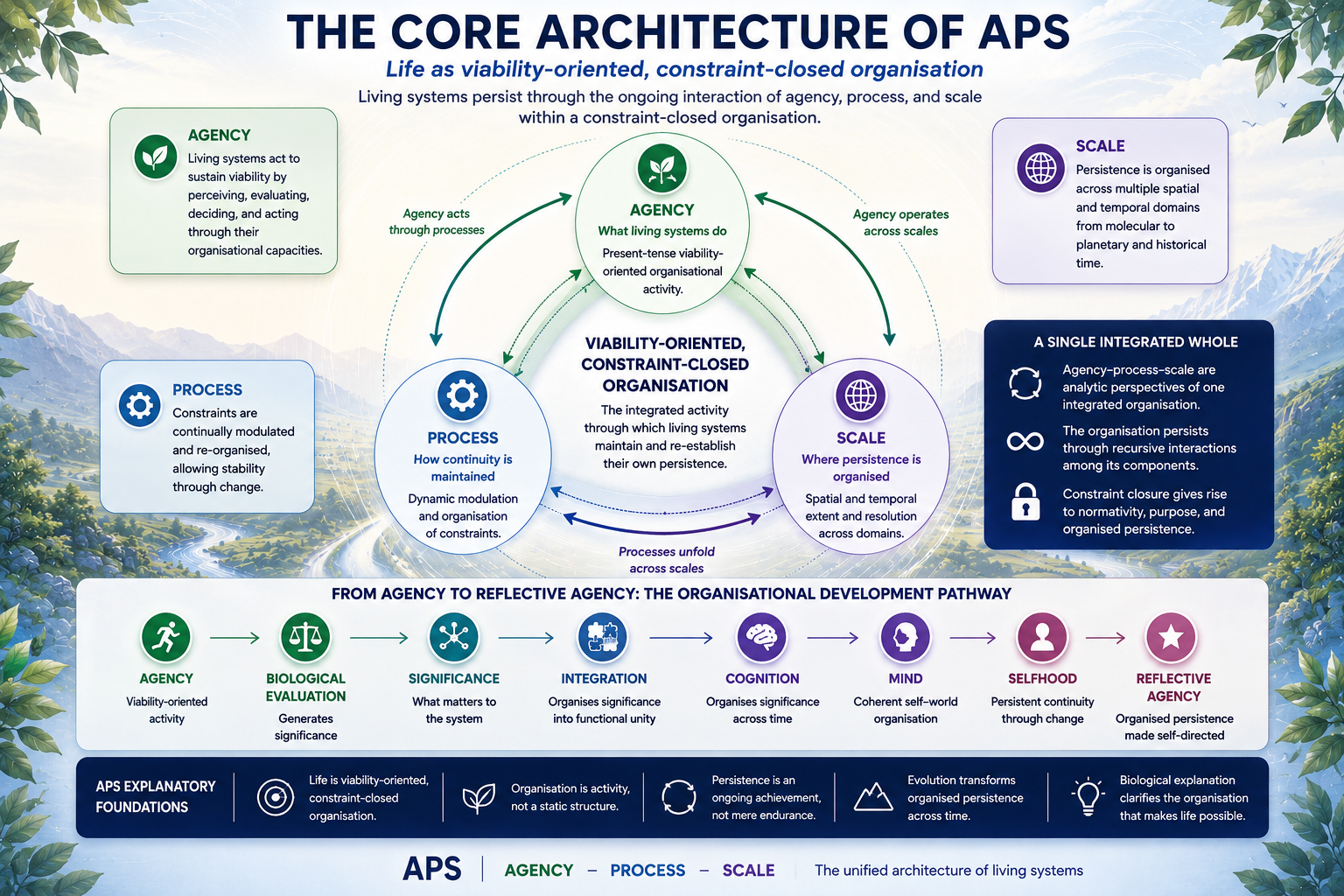
The Core Architecture of APS. Agency, process, and scale are analytic projections on a single viability-oriented, constraint-closed organisation. Together they explain what living systems do, how organised continuity is maintained through change, and where persistence is organised across spatial and temporal extents. The wider pathway represents proposed Dependency Hypotheses relating biological evaluation, significance, integration, cognition, mind, selfhood, and reflective agency to this living organisation.
APS formulates cross-scale influence in terms of materially implemented constraints that alter the conditions under which constituent processes occur. Scale has current analytic utility in directing attention to these relations, but APS-specific additional substantive gain or novel cross-scale causation has not been demonstrated. Wider organisational relations do not supersede local causation; they modify the organisational context within which local causal processes operate.
Scale — Where Persistence Is Organised
Scale concerns where persistence is organised across spatial and temporal extents.
Living organisation is not confined to a single spatial or temporal extent. Molecular interactions, cellular organisation, physiological regulation, organismal activity, developmental trajectories, ecological relations, and evolutionary histories occur across different extents while remaining materially related.
APS therefore does not treat Scale as a hierarchy of biological levels. Nor does a wider scale constitute a separate causal agency acting upon processes at a smaller scale.
Cross-scale influence is materially implemented. Organisational relations at wider extents alter the conditions and constraints under which more local processes occur, while local processes materially contribute to the organisation sustained across wider extents. No scale possesses intrinsic causal or explanatory priority merely by virtue of its extent.
Scale consequently identifies neither size alone nor a hierarchy of biological reality. It directs attention to the spatial and temporal organisation of persistence and to the materially implemented relations connecting processes across those extents.
As an analytic projection within APS, Scale brings this spatial and temporal organisation of persistence into explanatory focus.
Why These Concepts Belong Together
Agency, Process, and Scale belong together because they disclose complementary aspects of one living organisation.
Their relationship is not sequential. Agency does not produce Process, Process does not produce Scale, and the three do not combine to produce life. Nor does APS infer their biological reality from the coherence of the conceptual scheme.
Instead, APS begins with viability-oriented, constraint-closed organisation and asks complementary questions about it.
What does this organisation do in maintaining and re-establishing conditions of persistence? Agency.
How is its continuity maintained despite continual material and organisational change? Process.
Where is that persistence organised across spatial and temporal extents? Scale.
The three projections therefore belong together because the same living organisation is simultaneously active, processual, and organised across spatial and temporal extent.
Their distinctions are analytic. Their referent is one biologically real organisation.
This is why APS treats Agency, Process, and Scale as a structured analytic interface rather than as three independent parts of an APS ontology.
The Agency–Process–Scale Analytic Interface
The relationship can be summarised compactly:
- Agency — what living systems do.
- Process — how continuity is maintained despite change.
- Scale — where persistence is organised across spatial and temporal extents.
Agency, Process, and Scale are complementary analytic projections of one viability-oriented, constraint-closed organisation.
Together they constitute the target-sensitive analytic interface through which APS structures inquiry into living organisation and organised persistence.
This interface identifies how APS analyses living organisation. Its clarity and coherence are analytic and implementation virtues; they do not by themselves establish substantive biological truth or explanatory gain. The framework also proposes relationships among its wider concepts. These are represented in the APS dependency architecture as Dependency Hypotheses requiring independent assessment.
The APS Dependency Architecture
APS contains a series of proposed relationships extending from living organisation through biological evaluation, significance, integration, cognition, mind, selfhood, reflective agency, and meaning.
These relationships constitute the APS dependency architecture.
The architecture should not be read as establishing the relationships merely by placing concepts in sequence. Each connection represents a Dependency Hypothesis: a proposed relationship whose relata, material basis, alternatives, evidential support, limitations, and failure conditions must be independently specified and assessed.
The architecture therefore functions as a structured research programme rather than as evidence for its own claims.
Its principal pathway is represented as:
Life → Agency → Biological Evaluation → Significance → Integration → Cognition → Mind → Selfhood → Reflective Agency → Meaning
The arrows identify proposed dependencies. They do not by themselves establish causation, chronology, hierarchy, reduction, or evidential warrant.
In the sections that follow, terms such as depends upon, enables, generates, and creates the conditions for should be understood as statements of APS Dependency Hypotheses unless the relevant relationship has been independently established. Their position within the architecture does not itself provide evidential warrant.
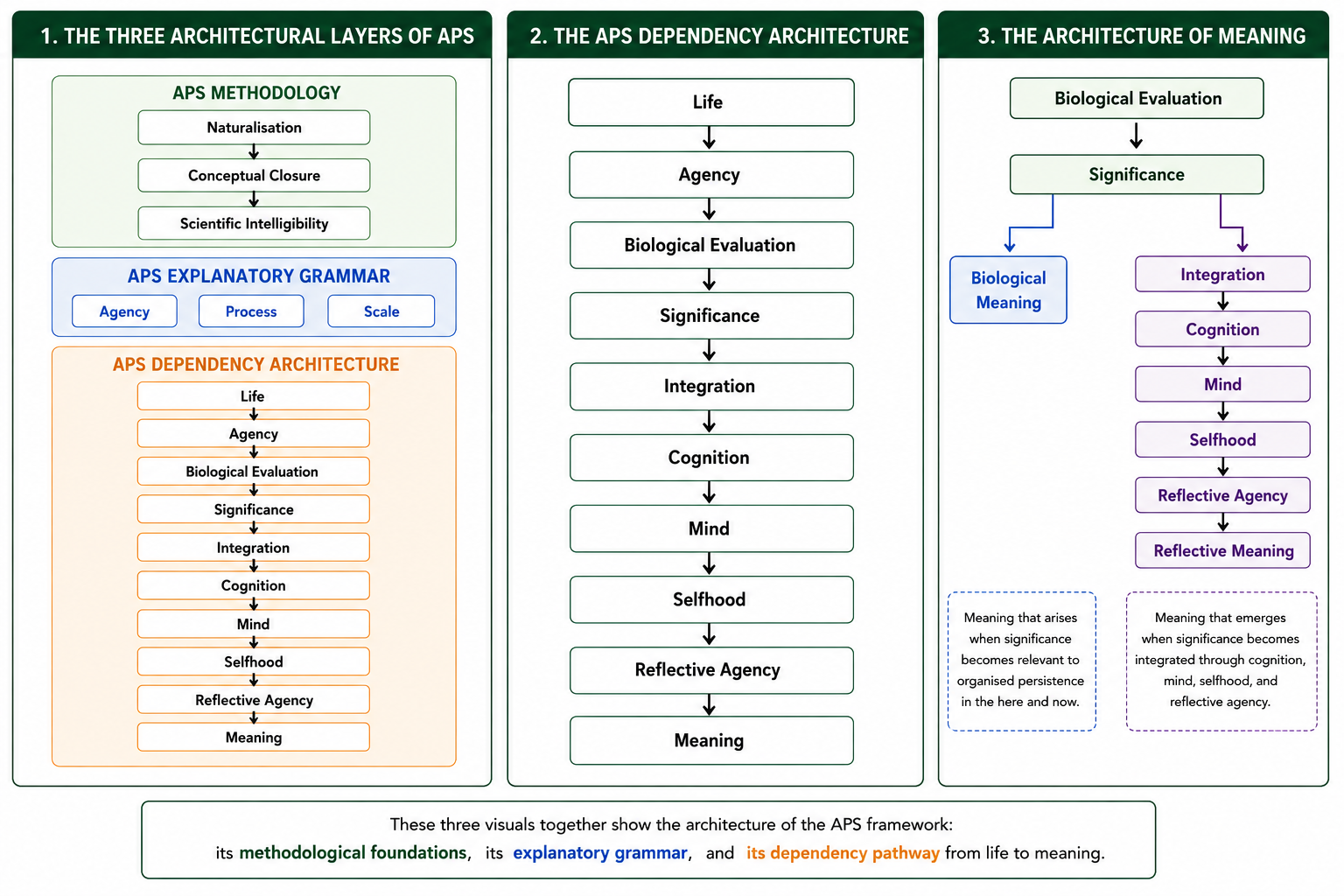
The Overall Architecture of APS. The framework is presented through three complementary layers: an independent methodological foundation concerned with explanatory assessment; an Agency–Process–Scale analytic interface; and a dependency architecture proposing relations among life, agency, biological evaluation, significance, integration, cognition, mind, selfhood, reflective agency, and meaning. The diagram organises these proposals; it does not validate their individual dependencies.
Yet the framework contains concepts that extend beyond viability, persistence, Agency, Process, and Scale. APS also includes Biological Evaluation, Significance, Integration, Cognition, Mind, Selfhood, Reflective Agency, and Meaning. These concepts are not independent additions to the framework, nor do they represent separate explanatory domains layered onto an otherwise complete account of life.
APS proposes relationships among these concepts through a dependency architecture.
The dependency architecture represents a structured series of Dependency Hypotheses concerning the organisational relationships through which APS investigates the pathway from life to increasingly complex forms of biological organisation and, ultimately, meaning.
The sequence should not be read as establishing those relationships merely by placing the concepts in an ordered architecture. Each connection identifies a proposed dependency whose relata, material basis, alternatives, evidential support, limitations, and failure conditions must be independently specified and assessed. The sequence does not by itself establish causation, chronology, hierarchy, reduction, or developmental progression.
The architecture begins with life as viability-oriented, constraint-closed organisation. From that starting point, APS proposes a series of relationships connecting Agency, Biological Evaluation, Significance, Integration, Cognition, Mind, Selfhood, Reflective Agency, and Meaning.
These relationships are represented as:
Life → Agency → Biological Evaluation → Significance → Integration → Cognition → Mind → Selfhood → Reflective Agency → Meaning
The arrows represent Dependency Hypotheses. They identify relationships proposed by APS for investigation; their position within the architecture does not itself provide evidential warrant for them.
The framework can therefore investigate a pathway from life to meaning while retaining its biological foundations and keeping each proposed transition open to independent assessment.
The remainder of this section explains the proposed relationships in turn.
From Agency to Meaning
The Agency–Process–Scale interface supplies the analytic projections through which APS investigates living organisation. The dependency architecture proposes a series of relationships through which APS investigates increasingly sophisticated forms of biological organisation.
The concepts that follow are therefore connected through a structured series of Dependency Hypotheses. Their sequence expresses the relationships proposed by APS; it does not by itself establish that those dependencies obtain.
The pathway can be summarised as:
Life → Agency → Biological Evaluation → Significance → Integration → Cognition → Mind → Selfhood → Reflective Agency → Meaning
Each arrow represents a Dependency Hypothesis requiring independent specification and assessment.
For readability, the sections below sometimes state these proposed relations directly—for example, that one form of organisation enables, generates, or depends upon another. Such formulations state APS Dependency Hypotheses; they do not indicate that the relationship has been established by its place in the architecture.
The remainder of this section explains the proposed relationships in turn.
Biological Evaluation
Agency regulates continuity relative to viability. Yet viability introduces an unavoidable asymmetry into biological organisation.
Some conditions contribute to persistence. Others undermine it. Some opportunities support continuity. Others threaten it. Some environmental changes require response. Others are largely irrelevant.
Living systems therefore do not encounter all conditions equally. They distinguish among them. APS refers to this organisational capacity as biological evaluation.
Biological evaluation is the process through which living systems distinguish conditions according to their significance for viability, functioning, and organised persistence. Evaluation does not require conscious judgement, symbolic reasoning, or reflective thought. It emerges whenever organisational activity becomes differentially responsive to conditions affecting continuity.
Within the APS dependency architecture, evaluation marks a proposed transition. Biological Evaluation remains a conditional, untested APS proposition rather than a comparator-validated result.
Living systems no longer merely regulate continuity: they regulate continuity relative to distinctions that matter.
APS proposes that Agency enables Biological Evaluation and that viability-relative asymmetry supplies its organisational basis. This dependency remains open to independent specification and testing.
Significance
Evaluation alone is not sufficient. The distinction of conditions according to viability immediately introduces another phenomenon. Some conditions now matter.
APS refers to this organisational consequence as significance.
Significance explains how differences become relevant to a living system. A condition is significant when it bears upon viability-oriented organised persistence. Significance is therefore not imposed from outside the system, nor is it a purely subjective interpretation. It emerges through the relationship between living organisation and the conditions affecting its continued existence.
Significance answers a question that evaluation alone cannot answer:
What exactly is it that living systems distinguish?
They distinguish conditions that matter. APS proposes that significance emerges from Biological Evaluation: Biological Evaluation generates significance. This dependency is conditional and untested, and its statement here does not establish residual explanatory gain.
Within the APS architecture, this proposed transition supplies a route for investigating cognition, mind, selfhood, and meaning. It does not establish those later dependencies or make the sequence foundationally indispensable.
Integration
Significance explains what matters. Yet significance does not exist as isolated fragments.
Living systems must coordinate multiple sources of significance simultaneously. Information from different domains must be brought into functional relation. Activities must be organised relative to one another. Short-term and long-term concerns must remain sufficiently coherent to support continued viability.
APS refers to this organisational requirement as integration. Integration explains how significance becomes organised into functional unity.
Without integration, significance remains fragmented. With integration, multiple forms of significance become coordinated within a coherent organisational system. Integration therefore performs a crucial architectural role.
APS proposes that Biological Evaluation generates significance and that Integration organises significance. Both are dependency formulations requiring independent evidential assessment.
The transition from significance to cognition becomes possible because significance no longer exists merely as isolated distinctions. It becomes organised within increasingly coherent patterns of activity.
Cognition
APS hypothesises that, once significance becomes integrated, it can become organised across time. Within this open research pathway, APS understands cognition as the organisation of biological significance across time. The relevant cognition discriminator remains a testable hypothesis, not a demonstrated general result.
This formulation differs from approaches that restrict cognition to brains, nervous systems, symbolic reasoning, or conscious thought. APS begins from the more fundamental organisational problem confronting living systems:
How can significance remain available to guide continuity under changing conditions?
Cognition addresses this problem by allowing significance to persist, accumulate, and influence future activity. Memory, anticipation, learning, adaptive responsiveness, and context-sensitive regulation all emerge through increasingly sophisticated forms of cognitive organisation.
Cognition therefore extends significance beyond the immediate present.
-
Biological evaluation generates significance.
-
Integration organises significance.
-
Cognition organises significance across time.
The architecture now begins to approach questions traditionally associated with mind.
Mind
Within the APS pathway, cognition allows significance to remain organised through time and mind marks a proposed further organisational achievement.
APS understands mind as the integrated organisation of evaluative cognitive processes through which an agent maintains a coherent relationship with itself and its world.
Mind therefore does not replace cognition. It builds upon it.
Cognition explains the temporal organisation of significance. Mind explains the coherent organisation of significance within an ongoing self–world relationship.
This distinction is important.
Many forms of cognition may remain relatively local, task-specific, or distributed. Mind refers to the emergence of a more coherent organisational perspective through which significance becomes integrated into an enduring pattern of engagement with the world.
APS proposes that mind establishes coherent self–world organisation.
Selfhood
Coherent self–world organisation introduces a further challenge.
How is such organisation maintained through continual transformation?
Living systems develop, learn, adapt, age, and reorganise themselves. Yet many retain a recognisable continuity despite these changes.
APS addresses this phenomenon through the concept of selfhood. Selfhood refers to the persistence of coherent self–world organisation through time. If mind explains coherence, selfhood explains continuity.
The distinction mirrors a recurring theme throughout APS.
Continuity does not require stasis. Persistence occurs through transformation.
Selfhood therefore represents the stabilisation of coherent self–world organisation across changing circumstances and timescales.
APS proposes that mind establishes coherence and that selfhood sustains coherence through change. This dependency remains open to independent assessment.
Reflective Agency
Within the APS pathway, selfhood is proposed to create conditions for another transition: agency can become directed toward itself.
APS refers to this capacity as reflective agency.
Reflective agency emerges when agents become capable of evaluating, interpreting, and reorganising aspects of their own activity. The significance structures guiding behaviour become available for examination, modification, and deliberate redirection.
Reflective agency therefore introduces a new form of organisational flexibility.
Agency no longer operates solely in relation to external conditions. It can also become concerned with its own organisation, commitments, goals, values, and patterns of activity.
The architecture thus becomes increasingly recursive. Agency regulates continuity. Reflective agency regulates the regulation of continuity.
This transition prepares the way for meaning in its fullest sense.
Meaning
Meaning represents the culmination of the Matter-to-Mind pathway within APS.
Throughout the preceding sections, significance has been progressively organised, integrated, stabilised, and transformed. What began as distinctions relevant to viability has become increasingly coherent, temporally organised, self-related, and reflective.
APS proposes that meaning emerges through this process.
APS understands meaning as organised significance.
This formulation preserves continuity with the earlier stages of the architecture while recognising the distinctive organisational achievements of later stages. Meaning does not appear suddenly at the reflective level, nor is it entirely absent from simpler forms of life. Its roots are already present wherever significance affects organised persistence.
Yet meaning becomes increasingly sophisticated as significance becomes integrated through cognition, mind, selfhood, and reflective agency. Meaning therefore occupies a distinctive position within APS.
It is both rooted in biological organisation and capable of becoming reflective, interpretive, symbolic, ethical, cultural, and existential.
The architecture reaches its culmination here because meaning represents the most highly organised form of significance within the framework.
The sequence is intended to investigate a pathway from agency to meaning without introducing a separate explanatory system. APS proposes that the pathway can be related to viability-oriented organised persistence; the relationship is not established by conceptual continuity alone.
APS therefore investigates meaning without departing from biology, asking whether increasingly sophisticated forms of organisation can be shown to emerge within the biological world. This remains a research programme rather than a demonstrated collective result.
Meaning, Value, and Ethics
Meaning is not the end of the APS architecture. It is a major organisational achievement within the Matter-to-Mind pathway, but it also creates the conditions under which new forms of evaluative organisation become possible.
Once significance becomes organised as meaning, some meanings acquire relative stability within agency and become values. In human societies, values become increasingly organised through communication, culture, institutions, and collective life. This gives rise to shared evaluation, social norms, moral evaluation, morality, and ethics.
APS therefore proposes a second major architecture related to the Matter-to-Mind pathway. The Evaluation-to-Ethics Architecture investigates how what matters might become progressively organised into value, social normativity, moral concern, and reflective ethical inquiry.
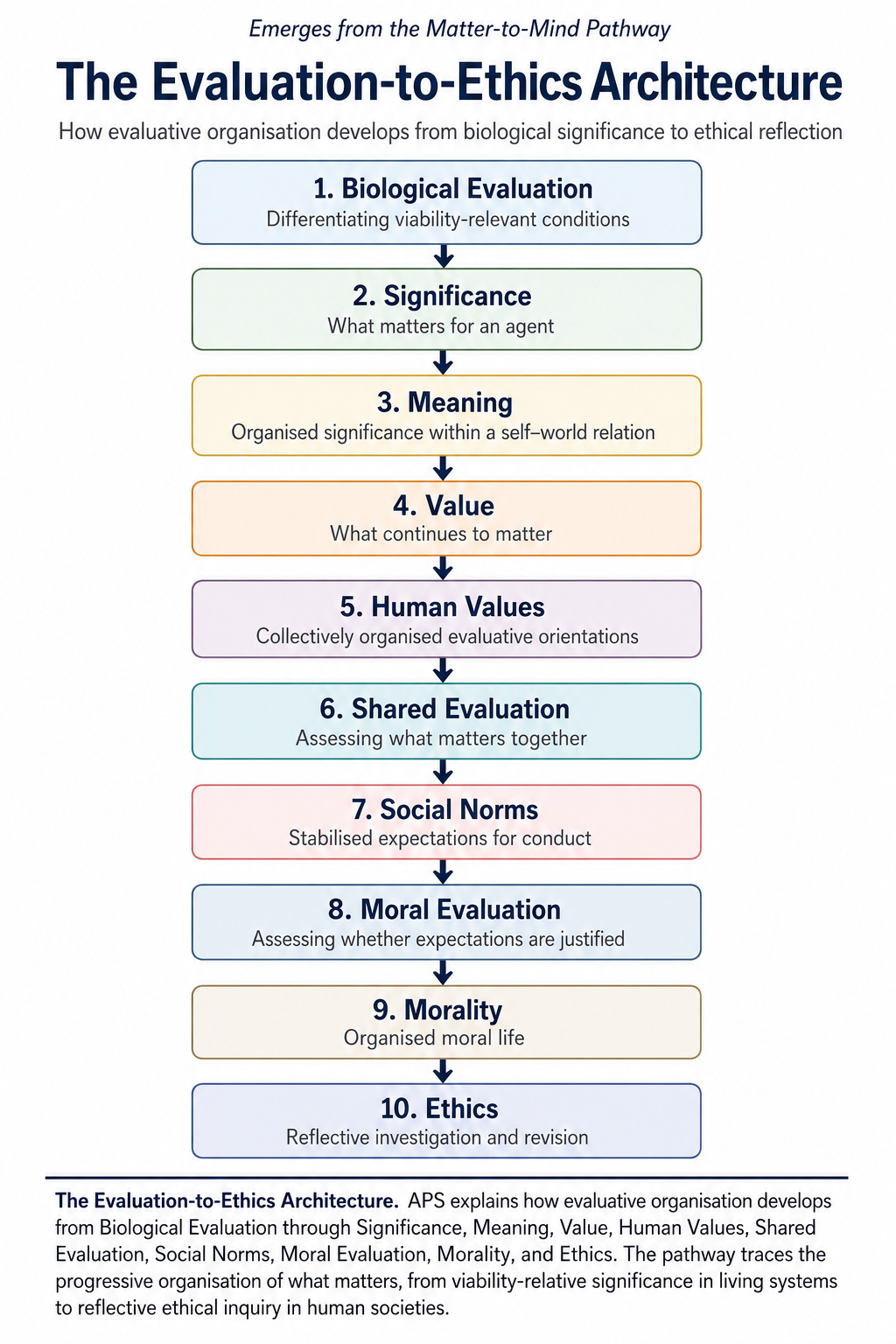
Together, the Matter-to-Mind pathway and the Evaluation-to-Ethics pathway constitute two major proposed organisational trajectories within APS. Their scope and coherence do not establish the individual dependencies.
The Evaluation-to-Ethics Architecture. APS proposes a pathway through which evaluative organisation may develop from Biological Evaluation through Significance, Meaning, Value, Human Values, Shared Evaluation, Social Norms, Moral Evaluation, Morality, and Ethics. The pathway traces a proposed progressive organisation of what matters, from viability-relative significance in living systems to reflective ethical inquiry in human societies.
The Evaluation-to-Ethics Architecture does not replace the Agency–Process–Scale perspective or the Matter-to-Mind pathway. Rather, it follows one aspect of living organisation—evaluation—through increasingly complex proposed forms of organisation. The result is a proposed trajectory linking biological significance to forms of human social and ethical life. Each dependency requires separate assessment, and biological viability does not by itself establish moral legitimacy.
Meaning and Extension
The dependency architecture provisionally culminates in meaning. APS also investigates whether related organisational questions can illuminate development, ecology, evolution, resilience, and social organisation. Understanding these proposed extensions requires clarifying the architecture of meaning itself.
The Architecture of Meaning
The APS dependency architecture culminates in meaning. Yet meaning remains one of the most easily misunderstood concepts within the framework.
Many discussions of meaning begin with human concerns such as language, symbolism, purpose, value, identity, culture, or existential reflection. These are undoubtedly important forms of meaning, but APS argues that they do not represent the beginning of the story. They represent highly developed expressions of organisational processes whose roots extend much deeper into biological life.
APS therefore approaches meaning from the opposite direction. Rather than beginning with symbolic thought and asking how meaning enters biology, it begins with living organisation and asks how increasingly sophisticated forms of meaning emerge within the biological world.
This approach requires a distinction between two related but different forms of meaning: biological meaning and reflective meaning.
These are not separate kinds of reality. They occupy different positions within the same organisational architecture.
Understanding their relationship helps clarify how APS connects life, cognition, mind, selfhood, and meaning without reducing one to the other.
Biological Meaning
Meaning begins long before reflective thought.
The roots of meaning emerge wherever significance influences the organisation of persistence.
Living systems continuously distinguish conditions according to their consequences for viability. Nutrient gradients, toxins, opportunities, threats, environmental changes, physiological conditions, and ecological relationships all acquire significance because they affect the possibility of continued existence.
Significance therefore introduces the earliest form of meaning within the architecture. This does not imply consciousness, symbolic representation, or interpretation. It simply means that conditions have consequences that matter to the organisation of persistence.
APS refers to this organisational phenomenon as biological meaning.
Biological meaning arises whenever significance becomes incorporated into the regulation of viability-oriented activity. The world is no longer organisationally neutral. Some conditions matter because they contribute to persistence. Others matter because they threaten it.
Meaning therefore begins wherever significance becomes functionally relevant to organised continuity.
This formulation allows APS to speak meaningfully about biological organisation without projecting human mental categories onto simpler forms of life. Biological meaning does not require minds. It requires significance.
Meaning begins because significance matters.
Reflective Meaning
Biological meaning provides the foundation for more sophisticated forms of meaning, but it does not exhaust them. As significance becomes increasingly integrated through cognition, mind, selfhood, and reflective agency, it becomes available for interpretation, deliberation, evaluation, and revision.
Meaning can now become a topic of concern in its own right.
Living systems capable of reflective agency can ask questions about goals, values, commitments, identities, purposes, futures, responsibilities, and possibilities. Significance becomes organised not merely through biological regulation but through interpretation and self-direction.
APS refers to this organisational achievement as reflective meaning.
Reflective meaning remains continuous with biological meaning because it emerges from the same underlying architecture. Yet it introduces forms of organisation unavailable to simpler systems.
Meaning can now be:
- interpreted;
- communicated;
- negotiated;
- revised;
- symbolically represented;
- culturally transmitted;
- ethically evaluated;
- existentially questioned.
Reflective meaning therefore represents not the abandonment of biological organisation but one of its most sophisticated expressions.
The pathway from biological meaning to reflective meaning is not a transition from biology to something non-biological. It is a transition from simpler to more integrated forms of significance.
Meaning and Significance
The distinction between significance and meaning plays a central role within APS. The two concepts are closely related but not identical.
Significance explains what matters.
Meaning explains how what matters becomes organised.
This distinction helps resolve several recurring confusions.
Biological evaluation generates significance because living systems distinguish conditions according to viability. Significance therefore emerges whenever conditions become relevant to organised persistence.
Meaning emerges when significance becomes organised within increasingly coherent patterns of activity.
The relationship can be summarised as follows:
Significance and Meaning
Significance = What Matters
Meaning = Organised Significance
This formulation captures both continuity and difference.
Meaning depends upon significance. Without significance, nothing matters.
Without meaning, significance remains insufficiently organised to support the more sophisticated forms of cognition, mind, selfhood, and reflective agency characteristic of complex living systems.
The distinction also clarifies why meaning occupies two positions within the broader architecture. Its roots appear early because significance already introduces biological meaning.
Its fullest expression appears later because reflective meaning requires cognition, mind, selfhood, and reflective agency.
Meaning therefore possesses both biological depth and reflective sophistication.
Extending the Architecture
The APS dependency architecture proposes how increasingly sophisticated forms of organisation may be related to viability-oriented organised persistence. APS also investigates the relevance of this architecture to other biological and social targets.
Development, ecology, evolution, diagnosis, resilience, and social organisation all address different expressions of the same underlying challenge: maintaining viable continuity through change.
These domains can therefore be investigated as extension domains of APS where their explanatory questions bear upon living organisation and organised persistence. Their inclusion does not imply that their specialist explanations must be reconstructed through APS or that they instantiate the same explanatory architecture in every respect.
Development
Development is often understood as the process through which organisms change across their life histories. APS agrees with this characterisation but places it within a broader architectural context.
Development addresses continuity through transformation.
Organisms do not persist despite developmental change. They persist through it. Growth, differentiation, maturation, regeneration, learning, and ageing all reorganise continuity while maintaining sufficient organisational coherence to sustain viability.
Development therefore illustrates one of the central themes of APS: continuity does not require stasis.
Persistence is achieved through organised transformation.
Within the broader architecture, development can be understood as the progressive reorganisation of significance, activity, and organisation across time.
Ecology
No living system persists in isolation. Continuity depends upon ongoing relationships with environmental conditions, resources, opportunities, constraints, and other organisms.
Ecology therefore extends the architecture outward. If agency regulates continuity, ecological relationships help determine the conditions under which continuity remains possible.
Significance, cognition, behaviour, adaptation, and development are all shaped by ecological circumstances. Organisms and environments continually influence one another through reciprocal processes of organisation and change.
Ecology therefore reveals continuity as relational.
Persistence depends not only upon internal organisation but also upon the broader networks within which that organisation is embedded.
Evolution
Development explains continuity within lifetimes. Evolution explains continuity across generations. From an APS perspective, evolution concerns the historical transformation of viability-oriented organisation.
Organisms inherit organisational solutions from previous generations, modify those solutions through variation and adaptation, and contribute to the emergence of new forms of continuity.
Evolution therefore extends organised persistence into historical time.
Within APS, inheritance, adaptation, diversification, and transformation can be examined as historical changes in the organisation of persistence. This is an integrative formulation, not a claim that the same principles have demonstrated additional explanatory power across targets.
Evolution reveals continuity as historical.
APS distinguishes between organisational change and organisational transition.
Many changes occur within an existing organisation of persistence. Regulation, adaptation, repair, and developmental modification may alter the state of a living system while preserving the organisation through which viability is maintained.
Organisational transitions involve a different kind of change. They occur when relations among constraints are reorganised such that a new and relatively stable regime of viability-oriented activity becomes possible.
APS formulates evolution as the historical transformation of viability-oriented, persistence-sustaining organisation, including transitions through which new forms of living organisation emerge and stabilise. This formulation remains current, but the tested developmental/evolutionary target showed no additional explanatory gain; that local null does not establish framework-wide failure.
Diagnosis and Resilience
The importance of continuity becomes especially visible when continuity is threatened. Injury, disease, dysfunction, environmental disruption, and organisational failure expose the conditions upon which persistence depends. Diagnosis therefore concerns the identification of disruptions affecting viable continuity. Resilience concerns the capacity to recover, reorganise, and restore continuity under changing conditions.
Both concepts illuminate organisational requirements that often remain hidden when systems function normally.
APS consequently uses diagnosis and resilience as possible analytic windows onto organised persistence. Their usefulness for particular targets must be established independently and does not amount to validated APS-specific diagnostics.
Social Organisation
APS proposes extensions beyond individual organisms.
Human social systems represent highly integrated forms of organised continuity distributed across individuals, institutions, practices, technologies, traditions, and symbolic systems.
Social organisation therefore extends agency, significance, cognition, and meaning into collective domains.
Cultural practices preserve continuity across generations. Institutions coordinate activity across populations. Knowledge systems stabilise significance. Norms and values guide collective behaviour. Shared meanings organise large-scale forms of cooperation.
The continuity challenges addressed by individual organisms reappear at broader scales in increasingly complex forms.
APS investigates whether social organisation can be related to selected organisational themes developed for living systems while preserving the distinct explanatory, historical, and normative requirements of collective life. This is a proposed extension, not a demonstrated reduction of social organisation to biological persistence.
APS as a Research Program
Extension Domains
Development can be examined as continuity through transformation; ecology as continuity through relation; evolution as continuity through history; diagnosis and resilience as continuity under disruption; and social organisation as continuity through collective coordination. Together these domains illustrate the breadth of questions that APS seeks to organise.
What begins as an attempt to understand viable continuity within living systems becomes a research programme asking where development, ecology, evolution, cognition, mind, meaning, resilience, and social organisation can be related to organised persistence—and where target differences or evidence set limits on that integration.
Why the Framework Has This Shape
At first encounter, APS can appear to contain an unusually diverse collection of concepts. Life, viability, persistence, agency, process, scale, evaluation, significance, cognition, mind, selfhood, meaning, development, ecology, evolution, resilience, and social organisation are often treated as distinct subjects within biology and philosophy.
The purpose of this article has been to show that their relationship is neither accidental nor merely thematic.
APS possesses the structure that it does because living systems face a recurring organisational challenge: the maintenance of viable continuity through continual transformation.
This challenge provides the organising problem from which APS proposes a series of further relationships.
Within the APS dependency architecture, continuity is related to viability; viability to regulation and agency; agency to biological evaluation; evaluation to significance; significance to integration; integration to cognition; cognition to mind; mind to selfhood; selfhood to reflective agency; and reflective agency to increasingly sophisticated forms of meaning.
These proposed relationships can be summarised as:
Life → Agency → Biological Evaluation → Significance → Integration → Cognition → Mind → Selfhood → Reflective Agency → Meaning
The sequence expresses the architecture of the APS research programme. It does not establish the individual dependencies merely through their conceptual ordering. Each connection remains a Dependency Hypothesis answerable to evidence, alternatives, limitations, and failure conditions.
What initially appears to be a collection of separate concepts can therefore be investigated as a structured set of proposed organisational relationships. APS does not begin with cognition and work backwards toward biology, nor does it begin with meaning and attempt to reduce it to simpler components. It begins with living organisation and investigates whether increasingly sophisticated forms of organisation can be related to that biological foundation through the proposed dependencies.
This is why the framework possesses the shape that it does. Its architecture expresses a research programme organised around the problem of living organisation rather than a sequence whose truth follows from its conceptual coherence.
Biological Explanation in APS
APS does not claim universal explanatory authority over biology.
Different biological questions may require different kinds of explanation. Mechanistic, evolutionary, developmental, physiological, ecological, mathematical, informational, cognitive, and other approaches may provide adequate and preferable explanations of particular phenomena without being reconstructed through APS.
APS makes living organisation, and the maintenance of that organisation despite change, explicit explanatory targets. Organised persistence has current explanandum-organising and integrative utility for continuity-through-change questions, but general additional substantive explanatory gain has not been demonstrated.
This gives APS a potentially broad field of application when living organisation is the target, without making it foundationally indispensable or claiming authority over specialist explanations. Relevance and gain remain target-sensitive.
APS may therefore investigate how findings and explanations from different biological domains bear upon the general problem of living organisation while preserving their independent explanatory contributions. Development, physiology, ecology, evolution, cognition, behaviour, and other domains retain their own explanatory targets, methods, evidence, and standards of adequacy.
Where relationships among these domains contribute to explaining living organisation, APS provides an analytic interface for organising inquiry into them. Comparative assessment is supplied by the independent comparative explanatory methodology, which can be applied to APS and other frameworks; it is neither substantive evidence for APS biology nor a uniquely APS invention. Integration is not assumed to be preferable in every case, and the inclusion of additional domains or relationships does not by itself constitute explanatory improvement.
APS therefore occupies a synthetic position without requiring synthesis to replace analysis or specialist explanation. Its purpose is not to reduce, absorb, or supersede established biological explanations, but to investigate whether and how their explanatory contributions can be related when living organisation or organised persistence is the target.
Whether APS provides additional substantive explanatory capacity for living organisation cannot be inferred from its breadth, coherence, integration, or conceptual architecture. It remains an open target-specific question requiring comparison with the strongest relevant alternatives.
APS and the Transition from Life to Mind
One of the most enduring questions in science and philosophy concerns how mind emerges within the natural world. Different traditions have approached this problem in different ways. Dualist approaches treat mind and matter as fundamentally distinct forms of reality. Reductive physicalist approaches seek to explain mental phenomena entirely in terms of underlying physical processes. Panpsychist approaches attempt to resolve the problem by locating mind-like properties at the foundations of reality itself. More recently, organisational and enactive approaches have explored the possibility that mind emerges through the distinctive forms of organisation characteristic of living systems.
APS belongs most closely to this latter tradition. Rather than treating mind as a separate substance or reducing it to a collection of physical components, the framework approaches the transition from life to mind as a problem of organisational development. The central question is not how non-living matter suddenly acquires mentality, but how increasingly sophisticated forms of organisation emerge from the challenge of maintaining viable continuity through time.
Within APS, mind is not treated as an isolated phenomenon. It is situated within a proposed dependency architecture linking life, evaluation, significance, cognition, mind, selfhood, reflective agency, meaning, value, morality, and ethics. The framework therefore investigates mind as part of a possible continuous organisational pathway rather than assuming that continuity has already been demonstrated.
This position places APS alongside work in theoretical biology, enactivism, embodied cognition, and organisational approaches to mind that investigates continuity between life and cognition. APS contributes to this discussion by proposing a more explicit dependency architecture through which increasingly sophisticated forms of organisation might be related to viability-oriented organised persistence. The proposal remains open to dependency-specific testing.
APS does not claim a final solution to subjective experience. Questions concerning consciousness, awareness, and first-person experience remain among the most difficult problems in contemporary science and philosophy. The framework’s proposal is more limited and more specific. APS investigates a possible biological-organisational pathway toward awareness by identifying candidate relations among agency, evaluation, significance, integration, cognition, mind, selfhood, and meaning. It does not claim that this pathway has been collectively demonstrated.
Readers interested in this question in greater depth should continue to How Did Matter Become Aware of Itself?, which explores the relationship between life, cognition, mind, and awareness as one of the central long-term research programmes of APS.
Navigating the APS Framework
The APS framework can be approached from many directions.
Some readers begin with questions about life. Others begin with agency, cognition, evolution, meaning, or mind. The architecture developed throughout this article provides a guide for navigating these different entry points.
The framework can be explored through four broad pathways.
Foundations
These articles present the biological starting points of APS and introduce the central concepts of viability-oriented organised persistence.
Core Topics
- What Is Life?
- Biological Agency
- Agency
- Process
- Scale
- The Biological Imperative
- Organised Persistence
Central Question
How is viable continuity possible?
Significance and Cognition
These articles explore how living systems distinguish, organise, and respond to conditions affecting persistence.
Core Topics
- Biological Evaluation
- Significance
- Integration
- Cognition
- Functional Equivalence
Central Question
How does significance become organised?
Mind and Selfhood
These articles examine increasingly integrated forms of significance and self–world organisation.
Core Topics
- Mind
- Selfhood
- Reflective Agency
- Awareness
- Human Agency
Central Question
How does organised significance become coherent self–world organisation?
Meaning, Values, and Ethics
Core Topics:
- Biological Meaning
- Meaning
- Value
- Human Values
- Shared Evaluation
- Social Norms
- Moral Evaluation
- Morality
- Ethics
Central Question:
How does organised significance become value, morality, and ethical reflection?
Reader Pathway
Foundations ↓ Evaluation & Significance ↓ Cognition ↓ Mind & Selfhood ↓ Meaning, Values, and Ethics
Readers may enter the framework at any point, but the architecture described throughout this article provides the conceptual map through which the relationships among these domains become visible.
Conclusion
APS begins from the problem of living organisation.
Living systems persist, but they do not do so by remaining unchanged. Their components, relations, activities, environments, and histories continually change while organisation sufficient for continued viability is maintained or re-established.
APS addresses this problem through its account of life as viability-oriented, constraint-closed organisation and through the concept of organised persistence.
Agency, Process, and Scale provide three complementary analytic projections of that organisation. Agency concerns what living systems do. Process concerns how continuity is maintained despite change. Scale concerns where persistence is organised across spatial and temporal extents. Together they constitute the Agency–Process–Scale analytic interface used within APS.
The distinctions are analytic; the organisation they disclose is biologically real.
From this starting point APS develops a wider research architecture containing Dependency Hypotheses concerning biological evaluation, significance, integration, cognition, mind, selfhood, reflective agency, meaning, value, morality, ethics, and other forms of biological and social organisation. The coherence of that architecture does not itself establish those dependencies; each remains answerable to evidence, alternatives, limitations, and failure conditions.
APS therefore makes a bounded claim. It proposes an organisational account of life and a target-sensitive analytic architecture for investigating living organisation. Its strongest demonstrated contribution is the bounded analytic and methodological organisation of explanatory inquiry. It is not claimed to be foundationally indispensable, the preferred explanation of every biological phenomenon, or a requirement that specialist explanations be reconstructed through APS.
Whether APS provides additional substantive explanatory capacity for living organisation remains an open, target-specific question requiring comparison with the strongest relevant alternatives addressing the same target.
Where to Go Next
Readers wishing to continue exploring the framework may find the following progression useful.
Foundations
- What Is Life?
- What Is Biological Agency?
- The Biological Imperative
- Agency, Process, and Scale
Significance and Cognition
- What Is Biological Evaluation?
- What Is Significance?
- What Is Integration?
- What Is Cognition?
Mind and Selfhood
- What Is Mind?
- What Is Selfhood?
- What Is Reflective Agency?
Meaning and Values
- What Is Biological Meaning?
- What Is the Meaning of Life?
- Where Do Human Values Come From?
- Morality and Biological Organisation
Architecture and Orientation
- What Is APS?
- How APS Explains Life
- APS Architecture Map
- How APS Concepts Fit Together