Diagnosis as Continuity Analysis
This article develops an APS account of diagnosis as the analysis of continuity, perturbation, compensation, resilience, and reorganisation within viability-oriented systems. Diagnosis is not treated merely as the identification of isolated defects or symptoms, but as the investigation of how temporally organised persistence succeeds, destabilises, compensates, recovers, or fails across interacting biological processes and scales. APS therefore reconstructs diagnosis around continuity analysis within dynamically organised living systems.
Key Points
- Diagnosis concerns continuity analysis within viability-oriented organised persistence.
- Biological dysfunction is disruption within persistence-maintaining organisation.
- Diagnosis must analyse perturbation, compensation, resilience, and recovery across interacting scales and timescales.
- Pathology cannot always be reduced to isolated local defects.
- Ecological, developmental, physiological, behavioural, and evolutionary continuity all contribute to diagnosis.
- APS reconstructs diagnosis as the analysis of continuity destabilisation and reorganisation within living systems.
Diagnosis as Continuity Analysis
Where this article fits: This article develops the diagnostic implications of APS. Diagnosis is treated not as the isolated detection of defects within static systems, but as the analysis of continuity, perturbation, resilience, compensation, and reorganisation within temporally organised viability-oriented living systems. For the broader temporal architecture underlying APS, see Temporal Organisation and Organised Persistence, Persistence — Organised Continuity Through Time, and Adaptation — How Living Systems Sustain Themselves Through Change.
Diagnosis is often understood as the identification of:
- malfunction;
- pathology;
- abnormality;
- or defective components.
Within many conventional frameworks:
- symptoms are isolated;
- mechanisms are localised;
- and diagnosis becomes the classification of discrete abnormalities within otherwise stable systems.
APS reconstructs diagnosis more fundamentally.
Living systems are not static assemblies of parts.
They are dynamically organised systems sustaining viable continuity across time.
Diagnosis therefore concerns:
the analysis of continuity, perturbation, compensation, resilience, destabilisation, and reorganisation within persistence-maintaining systems.
This changes the meaning of biological dysfunction itself.
A failure matters biologically not merely because a component deviates from statistical normality, but because organised continuity becomes disrupted.
Diagnosis and Organised Persistence
Living systems persist through ongoing coordination across:
- metabolism;
- regulation;
- development;
- ecological interaction;
- behavioural organisation;
- semiosis;
- adaptation;
- and continuity-producing organisation.
Diagnosis therefore concerns the integrity of persistence-maintaining continuity.
APS consequently approaches diagnosis as:
continuity analysis within viability-oriented organised persistence.
This means diagnosis investigates:
- how continuity is maintained;
- where continuity destabilises;
- how systems compensate;
- how resilience reorganises continuity;
- and whether viable persistence can recover successfully under perturbation.
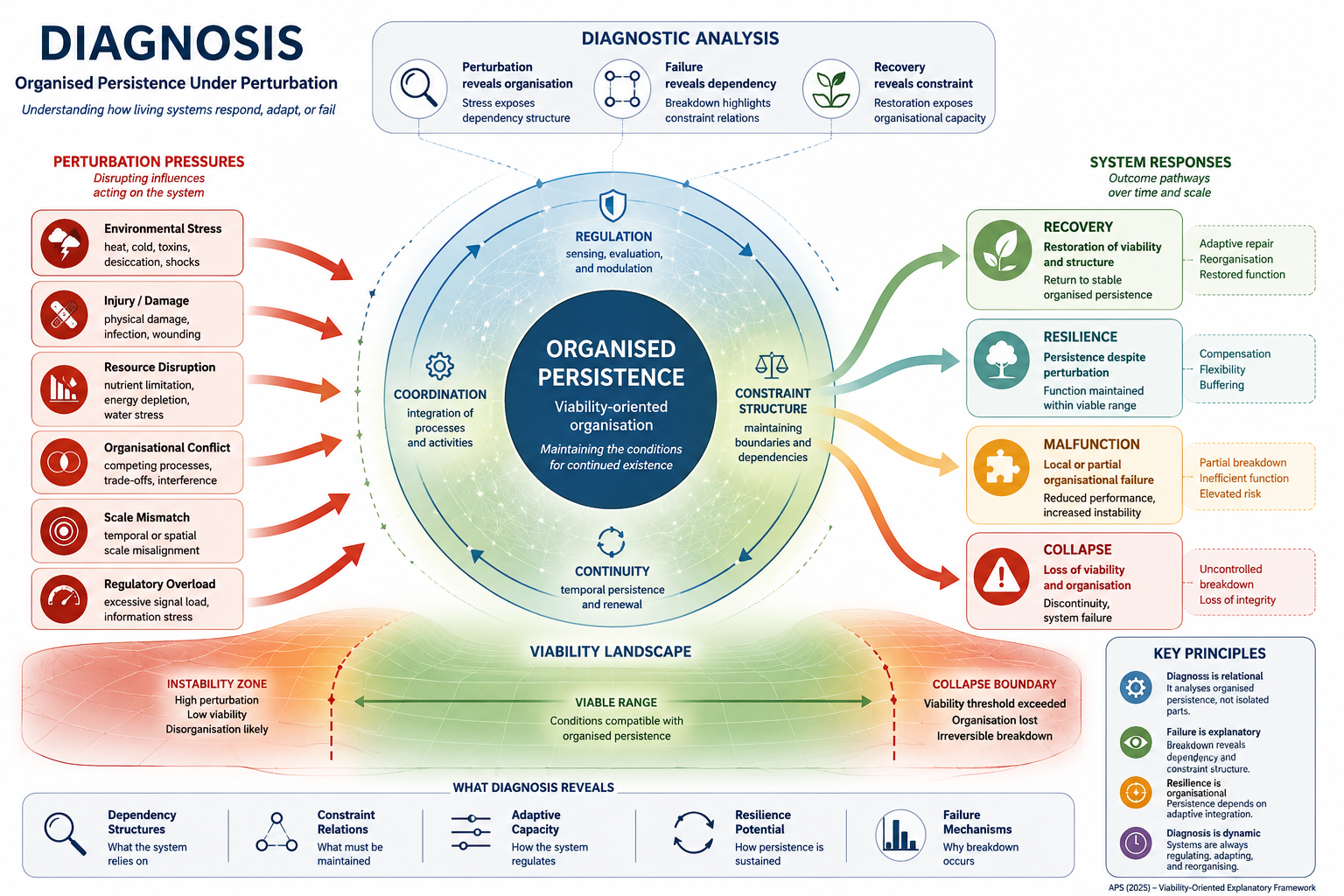
Primary Diagnosis Visual. APS interprets diagnosis as the analysis of continuity, perturbation, resilience, malfunction, and reorganisation within viability-oriented systems. Biological dysfunction becomes intelligible through disruptions to persistence-maintaining organisation distributed across multiple interacting scales and processes.
Diagnosis therefore extends beyond:
- isolated symptoms;
- local defects;
- or static pathological classification.
It concerns the organisational dynamics through which living systems sustain, destabilise, compensate, recover, or fail to sustain viable continuity across time.
Perturbation Reveals Organisation
Stable systems often conceal organisational dependency.
Perturbation reveals it.
Disruption may expose:
- hidden regulatory dependencies;
- ecological vulnerabilities;
- developmental constraints;
- adaptive limits;
- continuity fragilities;
- and resilience capacities.
Diagnosis therefore becomes possible because organised persistence possesses structure.
Systems fail in patterned ways precisely because persistence depends upon coordinated continuity across interacting organisational domains.
APS consequently treats perturbation not as accidental noise, but as diagnostically revealing.
Diagnosis and Viability
Diagnosis is intrinsically viability-oriented.
Biological disturbances matter because they influence:
- persistence;
- regulation;
- adaptation;
- development;
- ecological coordination;
- and continuity across time.
A condition becomes biologically significant when it threatens the continuity of viable organisation.
APS therefore rejects purely statistical definitions of pathology.
Normality cannot be understood solely as population frequency.
Instead:
- dysfunction;
- resilience;
- compensation;
- and recovery
must all be interpreted relative to viable continuity.
Diagnosis consequently concerns:
the continuity conditions required for organised biological persistence.
Malfunction as Continuity Destabilisation
APS interprets malfunction organisationally rather than mechanically alone.
A malfunction is not simply:
- a broken part;
- a defective mechanism;
- or a local structural abnormality.
It is a disruption within continuity-maintaining organisation.
Malfunction may involve:
- failed regulation;
- disrupted ecological coupling;
- impaired developmental coordination;
- adaptive collapse;
- semiosic breakdown;
- resilience failure;
- or continuity destabilisation across interacting scales.
This means dysfunction may emerge:
- systemically;
- developmentally;
- ecologically;
- behaviourally;
- cognitively;
- or evolutionarily.
Diagnosis therefore cannot always be reduced to local mechanistic failure.
It must analyse how continuity structures destabilise across interacting organisational domains.
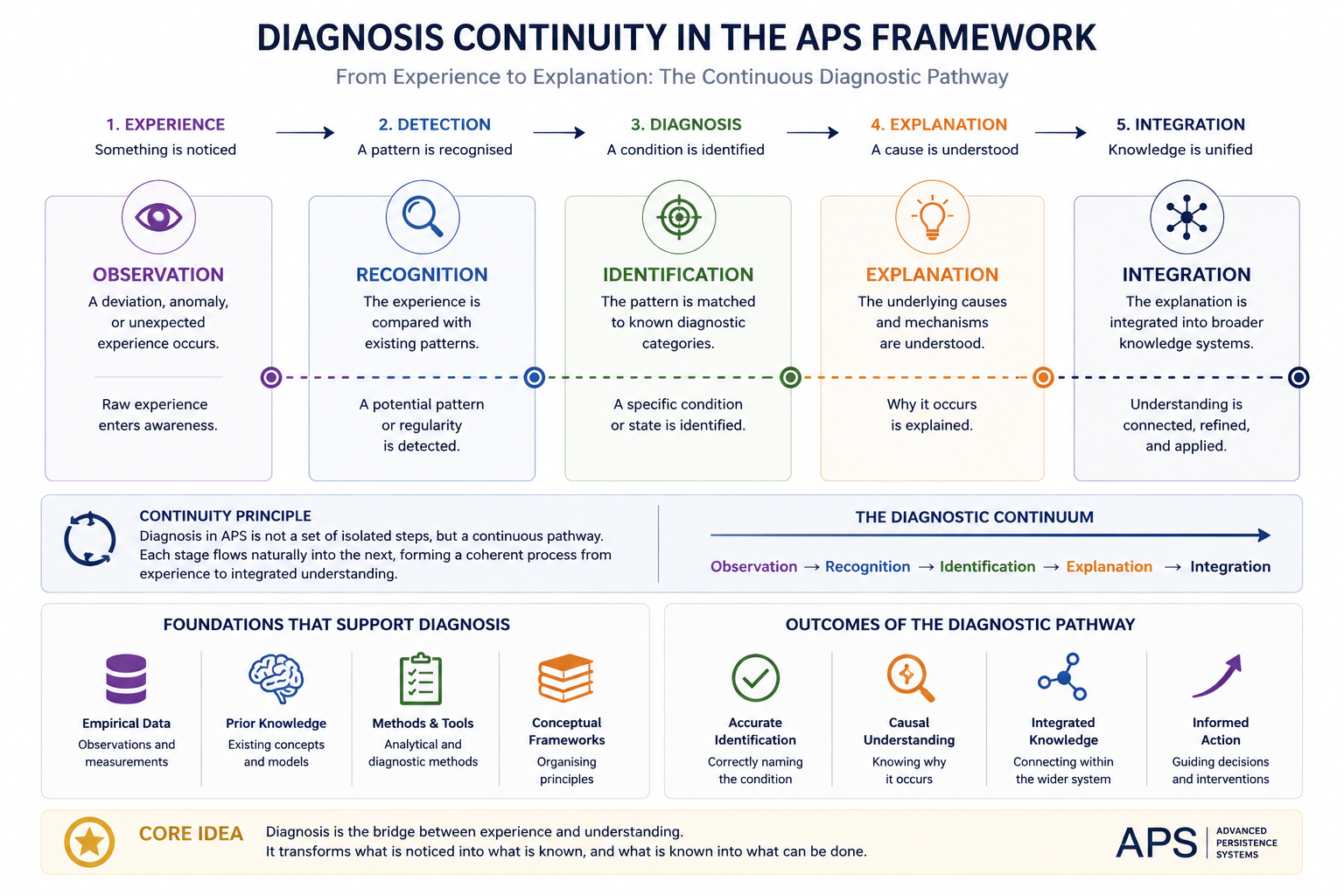
Diagnosis Continuity Visual. APS explains diagnosis through the analysis of how viable continuity is preserved, destabilised, compensated, reorganised, or lost across interacting temporal and organisational scales.
Diagnosis therefore concerns not merely identifying abnormalities, but analysing whether organised continuity can remain viable under perturbation and transformation.
Diagnosis Across Scale and Time
Diagnostic organisation is multiscalar and temporal.
Disruption at one scale may propagate across others.
For example:
- molecular disruption may alter developmental continuity;
- ecological instability may reorganise physiology;
- behavioural dysregulation may affect metabolic coordination;
- and developmental disruption may influence long-term evolutionary trajectories.
Diagnosis therefore cannot remain confined to isolated mechanisms at single moments.
Persistence is distributed across:
- physiological organisation;
- developmental trajectories;
- behavioural systems;
- ecological coupling;
- and historical continuity.
Diagnostic explanation must therefore analyse continuity across interacting temporal and organisational domains simultaneously.
Diagnosis and Ecology
Diagnosis is ecologically situated.
Living systems persist only through ongoing organism–environment coupling.
Environmental disruption may therefore generate:
- developmental instability;
- metabolic stress;
- behavioural dysregulation;
- ecological collapse;
- resilience failure;
- or adaptive destabilisation.
APS consequently rejects strongly internalist diagnostic models detached from ecological continuity.
Many dysfunctions emerge not from isolated internal defects alone, but from disrupted continuity across organism–environment systems.
Diagnosis therefore includes:
- ecological context;
- environmental perturbation;
- resource instability;
- social organisation;
- and distributed persistence conditions.
Diagnosis and Resilience
Diagnosis also concerns resilience.
Living systems continuously reorganise continuity under changing conditions.
They:
- compensate;
- redistribute constraints;
- reorganise regulation;
- and restore persistence-maintaining organisation under perturbation.
Resilience therefore becomes diagnostically central.
A system may remain viable despite disruption because continuity reorganises successfully.
Diagnosis must therefore distinguish:
- temporary perturbation;
- adaptive compensation;
- chronic instability;
- resilience failure;
- and irreversible continuity collapse.
APS consequently treats resilience as:
- continuity-preserving reorganisation within viability-oriented systems.
Diagnosis therefore concerns whether continuity can remain viable through perturbation, compensation, and adaptive transformation.
Diagnosis and Development
Developmental organisation shapes diagnostic possibility.
Disruptions may emerge through:
- developmental timing;
- ecological interaction;
- nutritional instability;
- social organisation;
- behavioural history;
- or continuity disruption across developmental trajectories.
Diagnosis therefore cannot always be reduced to fixed structural abnormality.
Many dysfunctions involve altered developmental continuity distributed across time.
APS consequently approaches diagnosis historically as well as mechanistically.
Present dysfunction may reflect:
- developmental continuity;
- accumulated compensation;
- ecological destabilisation;
- historical perturbation;
- or disrupted adaptive organisation.
Diagnosis therefore frequently concerns the analysis of altered temporal trajectories rather than isolated present abnormalities alone.
Diagnosis and Semiosis
Living systems continuously evaluate meaningful environmental differences relative to viability.
Diagnosis therefore also possesses a semiosic dimension.
Symptoms, signals, biomarkers, behavioural changes, and ecological indicators
function as meaningful organisational differences within persistence-maintaining systems.
APS consequently interprets diagnosis partly as:
the interpretation of continuity-relevant biological signs.
Diagnostic meaning emerges because living systems are organised around viability-oriented continuity.
Diagnosis and evolution
Diagnostic organisation is historically shaped.
evolution contributes to:
- vulnerability structures;
- adaptive capacities;
- developmental constraints;
- regulatory organisation;
- ecological dependence;
- and continuity trade-offs.
Many dysfunctions therefore reflect compromises embedded within historical persistence strategies.
Diagnosis consequently requires evolutionary context as well as immediate mechanistic analysis.
APS therefore situates diagnosis within:
- developmental continuity;
- ecological continuity;
- evolutionary continuity;
- and temporally organised persistence simultaneously.
Diagnosis Within the APS Explanatory Grammar
APS situates diagnosis within the broader explanatory grammar organised through:
- agency;
- process;
- and scale.
Diagnosis therefore cannot be reduced adequately to:
- isolated mechanistic description;
- statistical classification;
- or purely local dysfunction analysis.
Instead, diagnosis concerns:
- continuity;
- perturbation;
- resilience;
- adaptive reorganisation;
- ecological coupling;
- developmental trajectory;
- viability;
- and persistence-maintaining organisation
distributed across scale and time.
Diagnosis therefore becomes:
the analysis of continuity destabilisation and reorganisation within organised living systems.
Implications for Biological Explanation
Reframing diagnosis organisationally has several important consequences.
It:
- integrates diagnosis with ecology, development, adaptation, and evolution;
- situates pathology within continuity analysis;
- explains resilience as continuity-preserving reorganisation;
- strengthens multiscale biological explanation;
- integrates diagnosis into temporally organised persistence;
- and weakens purely reductionistic models of dysfunction.
APS therefore approaches diagnosis not as the identification of isolated defects within static systems, but as the analysis of continuity within dynamically organised viability-oriented persistence.
Conclusion
APS reconstructs diagnosis around continuity analysis within viability-oriented organised persistence.
Living systems persist through dynamically organised continuity distributed across:
- metabolism;
- development;
- ecological coupling;
- behavioural organisation;
- semiosis;
- adaptation;
- and resilience.
Diagnosis therefore concerns:
- how continuity is sustained;
- where it destabilises;
- how systems compensate;
- whether resilience can reorganise continuity;
- and whether viable persistence can recover successfully under perturbation.
Biological dysfunction is therefore not merely local mechanical failure.
It is disruption within continuity-maintaining organisation.
Diagnosis consequently becomes:
the analysis of continuity destabilisation, compensation, resilience, and reorganisation within dynamically organised living systems.
APS therefore transforms diagnosis from:
- static defect identification
into:
- the analysis of continuity, perturbation, resilience, and organised persistence across time.
Related Pathways
- Persistence — Organised Continuity Through Time
- Viability — The Organising Principle of Biological Persistence
- Temporal Organisation and Organised Persistence
- Adaptation — How Living Systems Sustain Themselves Through Change
- Ecology as Organised Persistence Across Scales
- evolution as the Historical Transformation of Organised Persistence
- How to Diagnose a Biological System
- Malfunction
Key Terms
diagnosis · continuity · perturbation · resilience · malfunction · viability · persistence · adaptation · temporality · organisation · ecological coupling
See Also
Related Articles
References
- (1991). The Normal and the Pathological. Zone Books.
- (1932). The Wisdom of the Body. W. W. Norton.
- (2011). Incomplete Nature. W. W. Norton.
- (1977). The Need for a New Medical Model. Science, 196(4286), 129–136 .
- (2015). Biological Autonomy. Springer.
- (2019). Everything Flows. Oxford University Press.