Persistence — Organised Continuity Through Time
Persistence is one of the deepest organising concepts in APS because living systems remain continuous despite ongoing material, developmental, ecological, and evolutionary change. APS explains persistence not as static endurance but as organised continuity actively maintained through viability-oriented organisation. This article shows how persistence emerges through the coordinated activity of agency, viability, organisation, process, and scale, and why organised persistence provides one of the central explanatory concerns of biology.
Key Points
- Persistence in living systems is organised continuity across transformation rather than static endurance.
- Living systems persist through viability-oriented organisation that actively maintains continuity across changing conditions.
- Agency contributes to persistence by regulating and reorganising conditions required for continued viability.
- Persistence depends upon temporal organisation, developmental coordination, repair, resilience, and adaptive reorganisation.
- Biological identity is grounded in organisational continuity rather than material sameness.
- Persistence generates biological normativity because continuity can succeed or fail.
- Organised persistence links development, physiology, ecology, cognition, and evolution within a unified explanatory framework.
- APS treats organised persistence as one of the central explanatory concerns of biology.
Persistence — Organised Continuity Through Time
Introduction
How can living systems remain themselves while continuously changing?
Every living organism undergoes constant transformation. Molecules are replaced, cells turn over, tissues remodel, developmental processes reorganise structure and function, ecological conditions shift, and evolutionary change transforms populations across generations. Yet despite this continual transformation, living systems remain recognisably continuous across time.
This continuity cannot be explained through material permanence. Organisms do not persist because they remain physically identical. Much of the material composing a living system is temporary, exchanged continually through metabolism, growth, repair, and interaction with the environment. Nor can persistence be explained through static structure alone, because biological organisation itself changes throughout development, ageing, adaptation, and ecological interaction.
The persistence of living systems therefore presents a fundamental biological problem. How can continuity be maintained when the very systems exhibiting that continuity are constantly changing?
APS approaches this question by rejecting the assumption that persistence means endurance without transformation. Living systems do not persist because change is absent. They persist because continuity is actively maintained through ongoing change. Persistence is therefore not a passive condition but an organisational achievement continuously enacted across time.
Within APS, persistence refers to the organised continuity of viability-oriented organisation across ongoing transformation. Persistence is not static endurance, equilibrium, or mere survival. It is the continuity produced when living systems actively maintain the conditions required for their own continued existence despite developmental, physiological, ecological, and evolutionary change.
Persistence therefore occupies a central position within biological explanation. Agency explains the activity through which living systems act. Viability explains the orientation of that activity. Organisation explains how activity is coordinated. Persistence explains the continuity that such activity, orientation, and organisation collectively sustain. Understanding persistence therefore helps explain how living systems remain continuous despite the continual transformations that characterise life itself.
Why Persistence Is a Biological Problem
At first glance persistence appears unremarkable. Organisms exist today and continue to exist tomorrow. Yet this apparent continuity conceals one of the deepest explanatory problems in biology.
Living systems are not static entities. Every organism exists within a continuous stream of material exchange, energetic transformation, developmental reorganisation, and environmental interaction. Cells die and are replaced. Molecular components are continually synthesised and degraded. Physiological states fluctuate. Behaviour changes in response to circumstances. Development reorganises structure across the life cycle. Ecological interactions continually reshape the conditions under which organisms live.
If persistence depended upon material permanence, living systems would cease to exist almost immediately. If persistence depended upon structural immobility, development and adaptation would undermine continuity rather than support it. Biological persistence therefore requires a different explanation.
The problem becomes even clearer when persistence is considered across longer timescales. Development transforms embryos into adults. Ageing alters physiological organisation. Ecological change continually modifies organism–environment relations. Evolution transforms lineages across generations. Yet continuity remains visible across each of these transformations.
Persistence therefore cannot be understood as resistance to change. The remarkable feature of living systems is not that they avoid transformation but that they remain continuous through transformation. Continuity itself becomes the phenomenon requiring explanation.
APS approaches persistence as an organisational problem rather than a material one. The central question is not how particular structures remain unchanged, but how continuity is maintained despite continual reorganisation. Persistence therefore directs attention toward the processes through which continuity is actively produced and sustained.
Persistence Beyond Static Endurance
Persistence is frequently interpreted as permanence, stability, equilibrium, or resistance to disruption. Such interpretations arise naturally because many non-living systems persist through relative structural stability. Mountains endure. Crystals remain intact. Engineered structures can survive for long periods without significant reorganisation.
Living systems differ fundamentally from these forms of persistence.
An organism does not persist by remaining unchanged. It persists while continually transforming. Growth alters organisation. Development reorganises function. Repair replaces damaged structures. Adaptation modifies behaviour and physiology. Ecological interactions reshape the conditions under which continuity must be maintained. Change is not an exception to biological persistence. It is one of its defining characteristics.
This distinction reveals why persistence cannot be reduced to endurance alone. Endurance describes continued existence. Biological persistence explains how continued existence remains possible despite continual transformation. The explanatory challenge therefore concerns continuity rather than mere duration.
APS rejects the notion that persistence should be understood as the preservation of fixed states. Living systems do not maintain continuity by preventing change. Instead, they regulate change in ways that preserve organisational coherence. Transformation becomes compatible with continuity because organisation is maintained across changing conditions.
Persistence therefore occurs through change rather than despite it. Development, repair, adaptation, ecological interaction, and evolutionary transformation are not threats to persistence in principle. They are among the processes through which persistence is enacted and sustained.
This perspective shifts biological explanation away from static entities and toward continuity-producing organisation. The question is no longer how living systems remain unchanged. The question becomes how continuity remains possible while change continually occurs.
Organised Persistence
APS describes biological persistence as organised continuity actively maintained across time.
Persistence is therefore not merely the fact that a system continues to exist. Many non-living systems persist in this minimal sense. Biological persistence differs because continuity depends upon ongoing organisational activity that continually regenerates the conditions required for continued existence.
Living systems must regulate internal processes, coordinate developmental activity, repair disruption, respond to perturbation, adapt to changing circumstances, and maintain viability despite continual transformation. Continuity emerges from the successful coordination of these activities rather than from the preservation of static structures.
Organised persistence therefore refers to the continuity achieved when biological organisation continually maintains itself across changing conditions. Organisation does not simply support persistence. Organisation is the means through which persistence becomes possible. Continuity is not imposed upon living systems from outside. It is generated through the ongoing activity of the systems themselves.
This perspective helps explain why persistence occupies such a central position within APS. Agency contributes to persistence by regulating activity. Viability provides the orientation guiding that regulation. Organisation coordinates the relations through which activity becomes effective. Persistence describes the continuity that these processes collectively sustain.
Organised persistence therefore functions as more than a description of biological continuity. It provides a unifying explanatory concept linking agency, viability, organisation, development, ecology, cognition, and evolution. Each of these domains concerns, in different ways, the maintenance, disruption, reorganisation, or transformation of continuity across time.
From this perspective, biology becomes intelligible not primarily as the study of structures, mechanisms, or behaviours considered in isolation, but as the study of organised persistence. Living systems remain continuous because continuity is continually produced through viability-oriented organisation operating across changing conditions and multiple timescales.
Persistence, Viability, and Organisation
Persistence does not occur automatically. Continuity must be actively maintained, and this maintenance depends upon the coordinated relationship between viability, organisation, and persistence itself.
APS distinguishes these concepts while recognising their deep interdependence. Viability concerns the conditions required for continued existence. Organisation concerns the structured relations through which biological activity is coordinated. Persistence concerns the continuity achieved when viability-oriented organisation successfully maintains itself across time. None of these concepts can be fully understood in isolation because each depends upon the others.
Persistence without viability would be an empty concept. A system might continue to exist while progressively losing the conditions required for continued biological activity. Biological persistence therefore differs from mere endurance because continuity must remain oriented toward the preservation and regeneration of viability. Living systems persist only insofar as they maintain the conditions that allow continued existence to remain possible.
Viability alone is likewise insufficient. Viability specifies what must be maintained but does not explain how maintenance occurs. The conditions supporting continued existence can only be preserved through organised activity capable of regulating, coordinating, repairing, and adapting biological processes. Organisation therefore provides the means through which viability becomes operational.
Persistence emerges from the successful integration of these relationships. Living systems persist because viability-oriented organisation continually regenerates the conditions required for continued continuity. Persistence is therefore neither a separate property nor a final outcome imposed upon biological systems. It is the ongoing achievement produced when organisation remains successfully oriented toward viability across time.
This relationship also clarifies why persistence occupies such a central position within APS. Agency explains the activity through which living systems regulate themselves. Viability explains why that activity matters. Organisation explains how activity becomes coordinated and effective. Persistence explains the continuity that such activity ultimately sustains. Persistence therefore provides one of the principal explanatory bridges linking the major concepts of the APS framework.
Persistence and Biological Identity
Questions of biological identity have traditionally been among the most challenging problems in biology and philosophy. How can an organism remain the same individual when almost every aspect of its material composition changes over time?
APS approaches this question through persistence rather than substance.
If identity depended upon material sameness, living systems would constantly lose their identity. Cells divide and die. Molecules are continually replaced. Physiological states fluctuate. Development reorganises structure and function throughout life. Yet organisms remain recognisably continuous despite these transformations.
The persistence of identity therefore cannot depend upon the persistence of matter. Instead, it depends upon the persistence of organised continuity.
Biological identity emerges when continuity is maintained across change. An organism remains itself not because its material components remain fixed, but because its viability-oriented organisation remains sufficiently continuous across ongoing transformation. Continuity therefore becomes organisational rather than material.
This perspective helps explain why development does not destroy identity. An embryo and an adult differ profoundly in structure, function, behaviour, and ecological relation. Yet both belong to a single continuous developmental process. The persistence of identity arises because organisational continuity is maintained across developmental transformation rather than because developmental states remain unchanged.
The same principle applies across repair, regeneration, adaptation, and ageing. Biological systems continuously reorganise themselves while remaining recognisably continuous. Identity therefore becomes a consequence of organised persistence rather than a property attached to static structures.
Within APS, persistence provides the explanatory foundation through which biological identity becomes intelligible. Identity is not something preserved in addition to continuity. Identity is the expression of continuity successfully maintained across time.
Persistence and Agency
Agency contributes directly to persistence because continuity requires ongoing regulation.
Living systems do not simply undergo change. They actively modulate their relations with themselves and their environments in ways that influence whether continuity is preserved, disrupted, strengthened, or restored. Agency therefore provides one of the principal mechanisms through which organised persistence is maintained.
APS defines agency as viability-oriented activity through which living systems sustain, modulate, and recreate the conditions required for their own continued existence. Persistence provides the continuity that such activity serves. Without persistence, agency would lack biological significance. Without agency, persistence could not be actively maintained.
This reciprocal relationship reveals why agency occupies such a central position within biological organisation. Organisms continually adjust behaviour, physiology, development, and ecological interaction in ways that contribute to continued viability. These adjustments are not arbitrary. They are oriented toward preserving the conditions under which continuity remains possible.
Repair provides a clear example. When biological organisation is disrupted, living systems frequently initiate activities that restore continuity-producing organisation. Similar principles operate during immune responses, developmental compensation, ecological adjustment, behavioural flexibility, and adaptive reorganisation. In each case, agency contributes to persistence by helping maintain or regenerate the conditions required for continued viability.
Agency therefore should not be understood as an activity occurring alongside persistence. Agency is one of the principal means through which persistence is enacted. Persistence provides continuity across time, while agency supplies the viability-oriented activity through which that continuity can be maintained despite continual challenge and transformation.
Persistence Across Process and Scale
Persistence is inherently distributed across both process and scale.
No living system persists at a single moment. Persistence can only be understood across temporal sequences extending through development, physiology, behaviour, ecological interaction, ageing, and evolutionary change. Continuity therefore exists not within isolated states but across organised processes unfolding through time.
This temporal character explains why process occupies such an important position within APS. Living systems persist because continuity is continually regenerated through coordinated activity. Metabolism, development, repair, regulation, reproduction, adaptation, and ecological interaction all contribute to persistence by maintaining continuity-producing organisation across changing circumstances.
Persistence is equally distributed across scale. No single component of a living system can account for continuity on its own. Persistence emerges through relations extending across molecules, cells, tissues, organs, organisms, ecological systems, and evolutionary lineages. Continuity therefore depends upon coordinated organisation spanning multiple scales simultaneously.
The persistence of an organism, for example, depends upon physiological regulation occurring within tissues and organs, developmental organisation coordinating growth and repair, behavioural activity regulating environmental interaction, and ecological conditions supporting continued viability. Each scale contributes to continuity while simultaneously depending upon relations extending beyond itself.
APS therefore rejects attempts to locate persistence at any single privileged level of organisation. Continuity emerges from coordinated activity distributed across multiple scales and sustained through interconnected processes operating over different timescales.
Persistence is consequently neither localised nor static. It is a distributed organisational achievement continually enacted through the interaction of process and scale.
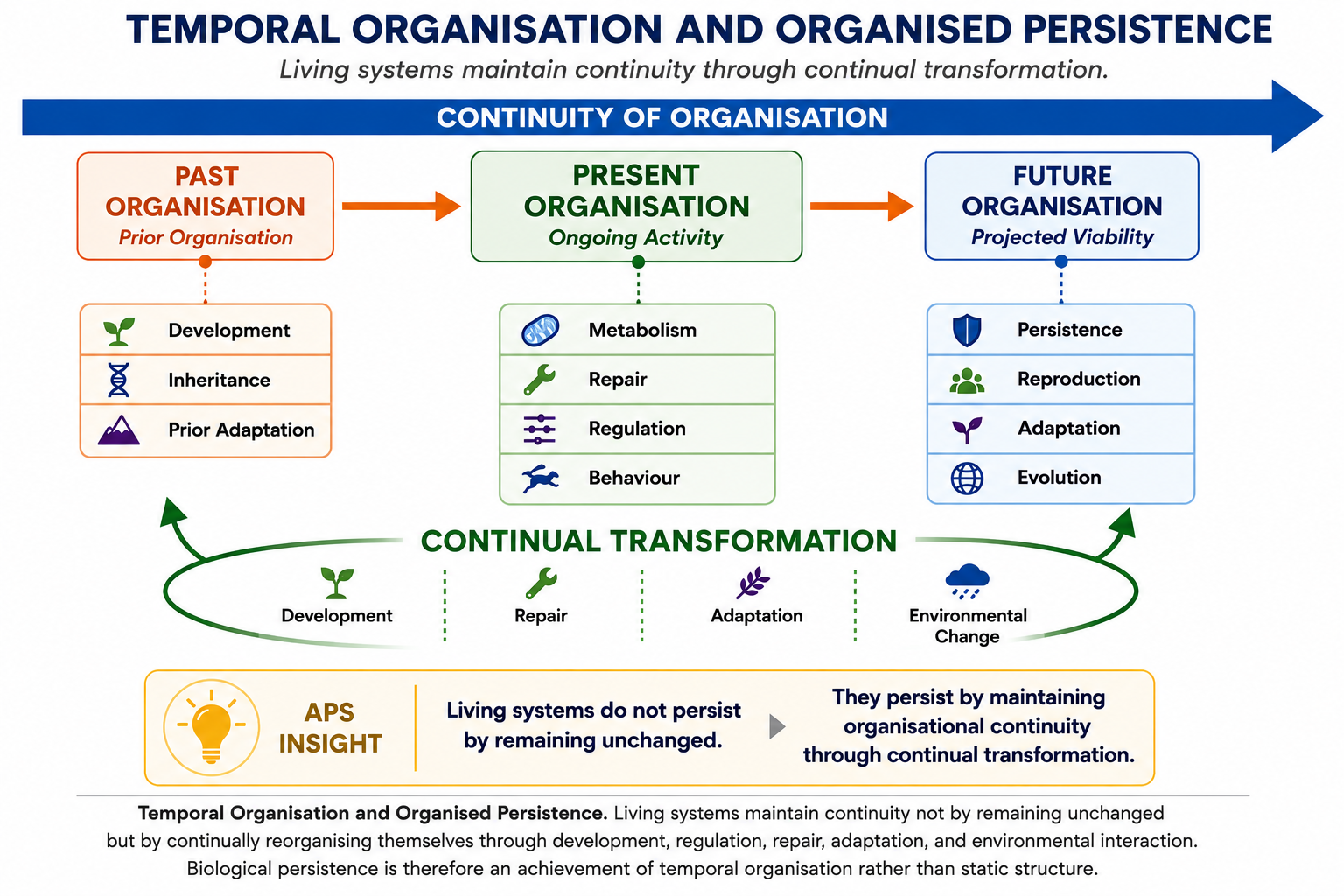
Temporal Organisation and Organised Persistence. Living systems persist not by remaining unchanged, but by maintaining organised continuity across ongoing transformation. Persistence emerges through the coordination of viability-oriented organisation across multiple processes, timescales, and scales of biological organisation.
Persistence Across Biological Domains
Persistence appears throughout biology because continuity must be maintained wherever living organisation exists. Although the specific forms persistence takes differ across biological contexts, the underlying explanatory principle remains the same. Living systems continually sustain organised continuity despite ongoing transformation.
In physiology, persistence concerns the maintenance of metabolic, regulatory, and functional organisation across time. Physiological processes continually compensate for disturbance, repair disruption, and coordinate activity in ways that preserve viability despite fluctuating internal and external conditions. Physiological continuity therefore represents one expression of organised persistence.
In development, persistence concerns continuity across transformation. Organisms do not merely maintain existing organisation. They continually reorganise themselves through growth, differentiation, maturation, repair, regeneration, and ageing. Development therefore demonstrates particularly clearly that continuity does not require stasis. Organisms remain continuous precisely because organised transformation preserves continuity across changing developmental states.
In ecology, persistence concerns the maintenance of continuity through organism–environment relations. Living systems do not persist independently of their environments. Continuity depends upon ongoing exchanges of matter, energy, information, opportunity, and constraint. Ecological persistence therefore emerges through coupled organisational relations extending beyond the boundaries of individual organisms.
In evolution, persistence concerns continuity across generations. Lineages remain continuous despite continual variation, adaptation, and transformation. Evolution therefore reveals persistence operating at longer temporal scales, where continuity is maintained not through the preservation of fixed forms but through the continuity of evolving biological organisation.
In cognition, persistence concerns increasingly integrated forms of evaluative continuity. Organisms continually regulate behaviour relative to conditions affecting viability. More complex cognitive systems extend this continuity across broader temporal horizons, integrating memory, anticipation, learning, and adaptive flexibility into the ongoing maintenance of viability-oriented organisation.
These domains do not represent separate forms of persistence. Rather, they reveal how organised continuity appears under different biological conditions and across different scales of organisation. Persistence therefore provides a unifying explanatory concept linking diverse areas of biological inquiry within a common framework.
Persistence and Resilience
Persistence does not imply the absence of disruption. Living systems exist within environments characterised by uncertainty, fluctuation, disturbance, and change. Continuity therefore depends not upon perfect stability but upon the capacity to respond effectively when organisation is challenged.
This capacity is commonly described as resilience. Within APS, resilience refers to the ability of living systems to absorb perturbation, reorganise activity, restore continuity-producing organisation, and maintain viability despite disruption. Resilience therefore contributes directly to organised persistence.
The significance of resilience becomes apparent whenever biological systems encounter conditions that threaten continuity. Injury, disease, environmental change, developmental disturbance, and ecological instability all create circumstances in which persistence could fail. Yet living systems frequently respond through repair, compensation, adaptation, and reorganisation that restore continuity despite disruption.
Resilience should therefore not be understood merely as resistance. A resilient system does not simply withstand change. It reorganises in ways that preserve continuity while accommodating new conditions. Persistence is maintained because biological organisation remains sufficiently flexible to regenerate itself when challenged.
This perspective highlights one of the central insights of APS. Living systems persist not because they avoid disruption, but because they possess organisational capacities enabling continuity to be restored when disruption occurs. Resilience therefore reveals persistence as an active organisational achievement rather than a passive state.
Perturbation often makes persistence visible because challenges reveal the organisational processes responsible for maintaining continuity. Repair, compensation, adaptation, and recovery expose the underlying mechanisms through which living systems preserve viability despite disturbance. Resilience therefore provides a powerful window into the organisational foundations of persistence itself.
Why Organised Persistence Matters
Persistence occupies a uniquely important position within biological explanation because continuity underlies nearly every phenomenon biology seeks to understand.
Questions concerning development, physiology, behaviour, ecology, cognition, ageing, adaptation, and evolution all involve continuity in one form or another. Each asks how living systems maintain themselves, transform themselves, or remain continuous despite changing conditions. Persistence therefore operates not at the periphery of biological explanation but near its centre.
APS places organised persistence at the heart of biological intelligibility because continuity provides the context within which other biological concepts acquire meaning. Agency matters because it contributes to continuity. Viability matters because it defines the conditions under which continuity remains possible. Organisation matters because it coordinates the relations through which continuity is maintained. Development, adaptation, resilience, and evolution matter because they shape how continuity is preserved, reorganised, or transformed.
This perspective shifts biological explanation away from static entities and toward dynamic continuity-producing organisation. Rather than asking only what biological systems are, APS asks how biological systems remain continuous despite continual transformation. Persistence therefore becomes one of the deepest organising principles available for understanding living systems.
The concept also provides a bridge across traditional disciplinary boundaries. Physiologists investigate continuity within organisms. Developmental biologists investigate continuity across transformation. Ecologists investigate continuity through environmental relations. Evolutionary biologists investigate continuity across generations. Cognitive scientists investigate continuity in adaptive regulation and evaluation. Organised persistence reveals these apparently distinct concerns as variations of a common explanatory problem.
Persistence therefore functions not merely as a topic within biology but as an integrating concept capable of linking multiple domains within a unified explanatory framework.
Conclusion
Living systems do not persist because they remain unchanged.
They persist because organised continuity is continually maintained across ongoing transformation.
This continuity cannot be explained through material permanence, structural immobility, or resistance to change. Living systems remain continuous despite continual turnover, development, repair, adaptation, ecological interaction, ageing, and evolutionary transformation. The persistence of life therefore requires explanation.
APS approaches this challenge through the concept of organised persistence. Persistence is understood not as static endurance but as the continuity produced when viability-oriented organisation actively maintains itself across time. Agency contributes the activity through which continuity is sustained. Viability provides the orientation guiding that activity. Organisation coordinates the relations through which continuity becomes possible. Persistence describes the continuity these processes collectively achieve.
From this perspective, persistence becomes one of the deepest organising concepts in biology. It explains how living systems remain themselves despite continual change, why biological identity is organisational rather than material, how resilience restores continuity under perturbation, and why development, ecology, cognition, and evolution can be understood as different expressions of organised continuity across time.
Living systems persist not because change is absent, but because continuity is continually regenerated through viability-oriented organisation. Organised persistence therefore provides one of the central explanatory concerns of biology and one of the most powerful unifying concepts within the APS framework.
Related Pathways
- Agency as the Defining Activity of Life
- Viability — The Organising Principle of Biological Persistence
- Temporal Organisation and Organised Persistence
- The Developmental Organisation of Life
- Developmental Temporality
- Ageing and Organisational Persistence
Key Terms
persistence · organised persistence · continuity · viability · biological organisation · agency · temporal organisation · development · resilience · adaptation · repair · ageing · ecology · evolution
Explanatory Architecture
Central Question
How do living systems maintain organised continuity through continual material, physiological, developmental, ecological, and evolutionary transformation?
Architectural Role
This Anchor article establishes persistence as organised continuity actively maintained through change. It explains why biological persistence cannot be understood as static endurance, material permanence, equilibrium, or mere survival, and shows how agency, viability, organisation, process, and scale jointly clarify the continuity of living systems across time.
The article also establishes organised persistence as one of the principal explanatory concerns of biology. Development, physiology, repair, resilience, ecology, cognition, ageing, and evolution are interpreted as distinct investigations of how living organisation is maintained, restored, reorganised, or historically transformed.
Preceding Explanatory Dependencies
These concepts and articles establish the explanatory foundations presupposed by this article. They identify explanatory dependencies within APS rather than chronological stages, hierarchical levels, or a compulsory reading order.
- What Is Life? A Biological Question Revisited
- Agency as the Defining Activity of Life
- Biological Agency as the Activity of Self-Maintenance
- Viability — The Organising Principle of Biological Persistence
- Biological Organisation
- Constraint Closure — What It Does and Does Not Do
- Process — The Dynamics of Living Organisation
- Scale — How Life Is Coordinated Across Space and Time
Subsequent Explanatory Developments
The explanatory architecture established here is developed, extended, or applied in the following articles and explanatory domains.
- Temporal Organisation and Organised Persistence
- Agency and Organised Persistence
- Biological Explanation — What Needs to Be Explained
- Biological Explanation and Organised Persistence
- The Developmental Organisation of Life
- Developmental Temporality
- Ageing and Organisational Persistence
- Scale, Time, and Persistence
- Physiology and Evolution in APS
- Organisational Realism in Biology
- APS and Contemporary Theories
- APS and the Free Energy Principle: Complementary Explanatory Frameworks in Theoretical Biology
Related Explanatory Questions
- How can biological identity remain continuous despite material turnover?
- Why is persistence an organisational achievement rather than passive endurance?
- How do agency and viability contribute to continuity?
- How are development, repair, resilience, and adaptation related to persistence?
- How is continuity organised across spatial and temporal extents?
- How does organismal persistence relate to lineage continuity and evolutionary transformation?
- How do formal accounts of stability and self-maintenance relate to organised persistence?
Position Within APS
Persistence identifies the continuity sustained through viability-oriented living organisation. Agency explains the present-tense activity through which that continuity is maintained and re-established. Process clarifies how continuity is enacted through continual transformation. Scale clarifies where persistence is organised across spatial and temporal extents.
Organised persistence is therefore not a fourth component alongside Agency, Process, and Scale. It is the continuing biological phenomenon whose organisation becomes intelligible through those three analytic projections. The article consequently connects APS’s definition of life with its accounts of biological identity, development, resilience, cognition, ecology, evolution, and explanation.
Position Within the APS Corpus
This Anchor article is the canonical APS treatment of persistence as organised continuity through time. Together with What Is Life? A Biological Question Revisited, Agency as the Defining Activity of Life, and Viability — The Organising Principle of Biological Persistence, it forms part of the principal conceptual foundation of APS.
It also functions as a major corpus hub. It provides the central conceptual connection between the foundational account of living organisation and later articles concerning temporal organisation, development, repair, resilience, ageing, biological identity, cognition, ecology, evolutionary continuity, and biological explanation.
Within the Comparative Biology programme, this article supplies the APS account of persistence against which formal and organisational frameworks can be compared. It therefore provides a principal conceptual entry point to APS and the Free Energy Principle: Complementary Explanatory Frameworks in Theoretical Biology, where organised persistence is compared with formal accounts of stability, inference, and self-maintenance.
See Also
Related Articles
References
- (2011). Incomplete Nature: How Mind Emerged from Matter. W. W. Norton.
- (2015). Biological Autonomy: A Philosophical and Theoretical Enquiry. Springer.
- (2023). Organization in Biology. Springer.
- (2018). Everything Flows: Towards a Processual Philosophy of Biology. Oxford University Press.
- (2026). Agency as the Defining Activity of Life: A Viability-Oriented Framework Integrating Process and Scale. Biological Theory . https://doi.org/10.1007/s13752-026-00547-6