Biological Organisation — How Living Systems Sustain Themselves
Biological organisation is a central target of explanation within APS. Living systems persist despite continual material, functional, developmental, and environmental change because their organisation is actively maintained and re-established. APS characterises living organisation as viability-oriented and constraint-closed, and analyses it through the complementary, target-sensitive analytic projections of Agency, Process, and Scale. This perspective does not replace established biological explanations or reduce biological organisation to a single component, mechanism, or scale. It identifies an organisational target to which different explanatory approaches may contribute.
Key Points
- Biological organisation is treated within APS as a target of explanation rather than as a replacement for established biological explanations.
- APS characterises living organisation as viability-oriented and constraint-closed; constraint closure is part of the canonical APS account of Life rather than a universally required form of biological explanation.
- Agency, Process, and Scale are complementary, target-sensitive analytic projections of one biologically real organisation rather than independent causes, entities, or hierarchical levels.
- Relations across spatial and temporal extents require materially implemented interactions, conditions, constraints, or dependencies; differences of scale alone do not establish causal coupling.
- Biological organisation provides a common explanatory target to which molecular, mechanistic, physiological, developmental, ecological, evolutionary, and other biological approaches may contribute.
Where this article fits
This article treats biological organisation as a target of explanation rather than as a replacement for established biological explanations. Within APS, Agency, Process, and Scale provide complementary, target-sensitive analytic projections of the same living organisation.
1. The Problem of Biological Continuity
Living systems persist despite continual change.
Their molecular constituents turn over. Cellular structures are repaired and replaced. Physiological conditions fluctuate. Development transforms form and function. Organisms alter their relations with surrounding environments. Yet through such changes, living systems can maintain continuity of organisation.
This creates a distinctive explanatory problem. Biological continuity cannot always be identified with the persistence of unchanged material structures.
Molecular, biochemical, physiological, structural, developmental, and other biological explanations identify materially specified features and processes through which living systems function. The organisational question does not compete with these explanations. It asks how the relevant activities, structures, constraints, and dependencies are related in ways that allow living organisation to remain continuous despite change.
APS refers to this continuity as organised persistence.
Organised persistence is the continuity of living organisation through change. It is the continuity requiring explanation, not an independent mechanism or activity that produces persistence.
2. Biological Organisation as a Target of Explanation
Biological organisation should not be identified merely with the arrangement of biological parts.
Living systems consist of materially realised structures and processes, but organisation concerns the relations through which those structures and processes contribute to the continued functioning of the system.
These relations include dependencies among activities, structures, constraints, and conditions. Their explanatory relevance depends on the biological target under investigation.
Appealing to organisation cannot substitute for specifying the material activities through which it is realised.
Organisation has explanatory value when it identifies such relations, not when it merely redescribes a system as an integrated whole.
Constraint closure is an important part of the APS account of living organisation. It identifies networks in which constraints involved in maintaining biological activity depend, directly or indirectly, upon other processes and constraints within the organisation whose continuation they help sustain.
Constraint closure does not by itself exhaust the APS account of living organisation. APS also asks how the relevant organisation is enacted through viability-oriented activity, how continuity is maintained despite change, and across what spatial and temporal extents persistence is organised.
3. Viability, Regulation, and the Organisation of Persistence
Within APS, living organisation is analysed relative to viability.
Viability concerns the conditions under which living organisation can continue to function. Changes in internal or external conditions can therefore differ in their consequences for continued functioning. Some remain compatible with persistence; others impair or destroy the organisation on which continued functioning depends.
Within the APS analysis, this asymmetry provides the limited sense of biological normativity required here. Conditions matter biologically insofar as they differ in their consequences for the viability of the organisation concerned.
This does not imply conscious evaluation, intention, preference, or judgement.
Living systems can regulate, repair, reorganise, acquire resources, modify relations with their environments, and otherwise respond to changing conditions in ways relevant to continued functioning. These activities may contribute to maintaining or re-establishing the organisation required for persistence.
APS characterises the living organisation at issue as viability-oriented, constraint-closed organisation.
Organised persistence identifies the continuity of that organisation through change. It does not identify an additional mechanism or causal force.
The organisation relevant to persistence is therefore not a static arrangement. Within APS, it is understood through materially realised activities and dependencies through which conditions relevant to continued functioning can be maintained and re-established.
4. Agency, Process, and Scale as Analytic Projections
APS analyses living organisation through three complementary, target-sensitive analytic projections.
Agency concerns what living systems do.
Biological agency is viability-oriented organisational activity. Regulation, repair, behaviour, physiological adjustment, resource acquisition, and environmental modification may express biological agency without individually defining it. Within APS, agency is not an additional capacity attached to an otherwise complete living system; it identifies the activity through which viability-oriented living organisation is enacted and sustained.
Agency does not require intention, consciousness, deliberation, symbolic representation, or cognition.
Process concerns how continuity is maintained despite change.
Living organisation persists through ongoing material, physiological, developmental, and environmental transformation. Process directs attention to the dynamics through which organisational continuity is maintained or re-established rather than treating persistence as static stability.
Scale concerns where persistence is organised across spatial and temporal extents.
The relevant extent depends on the explanatory target. Scale does not divide biological reality into hierarchical levels, nor does it assign intrinsic explanatory priority to molecular, cellular, organismal, ecological, or longer temporal descriptions.
Where relations across different extents are explanatorily relevant, they must be materially implemented through identifiable interactions, conditions, constraints, or dependencies. Differences of scale alone do not establish causal coupling.
Agency, Process, and Scale are therefore complementary, target-sensitive analytic projections of one living organisation. They are not stages, independent causes, components, hierarchical levels, or ontological domains.
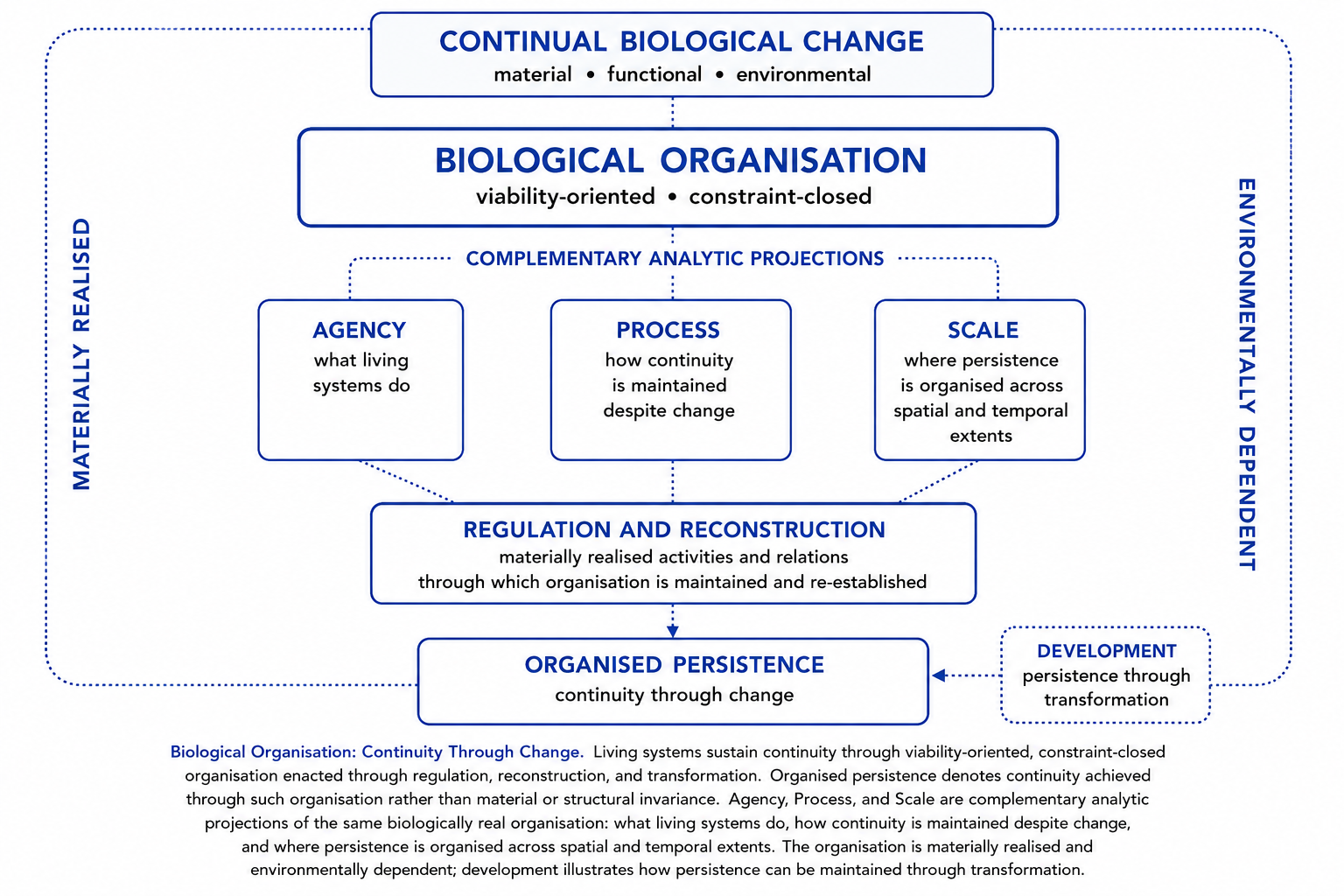
Biological Organisation: Continuity Through Change. Living systems sustain continuity through viability-oriented, constraint-closed organisation enacted through materially realised regulation, reconstruction, and transformation. Organised persistence denotes the continuity of living organisation through change rather than material or structural invariance. Agency, Process, and Scale are complementary, target-sensitive analytic projections of the same biologically real organisation: what living systems do, how continuity is maintained despite change, and where persistence is organised across spatial and temporal extents. The organisation is materially realised and environmentally dependent; development illustrates how persistence can be maintained through transformation.
5. Persistence Through Developmental Transformation
Development makes the problem of organised persistence especially clear.
A developing organism can undergo substantial changes in size, morphology, physiology, behaviour, and relations among tissues and organs while remaining continuous as the same developing living organisation.
Continuity therefore need not require structural invariance.
Development can involve the regulated production, removal, replacement, and reorganisation of structures. What the analysis tracks as continuing is an organised relation among activities, constraints, and conditions through which the developing system remains viable while changing.
APS can analyse this through Agency, Process, and Scale.
Agency concerns the viability-oriented activities through which development is enacted. Process concerns how continuity is maintained through developmental transformation. Scale concerns which spatial and temporal extents are relevant to the developmental explanandum.
These do not provide three separate explanations. They are complementary analytic projections of the same developing organisation.
Development does not independently establish the APS account. Established developmental explanations retain their mechanisms, evidence, and explanatory targets. Development instead provides a clear case in which the explanatory problem of continuity through transformation can be examined.
6. Organisation in an Environment and Across Scale
Living organisation is materially realised and environmentally dependent.
Organisms depend upon exchanges of matter and energy and upon environmental conditions compatible with continued functioning. They can also modify those conditions through their own activity.
Dependence on an environment does not erase the distinction between the organisation of the living system and the wider systems with which it interacts.
Coupling alone does not establish constraint closure, and dependence alone does not establish biological agency or normativity.
Likewise, relations extending across spatial or temporal extents should not be represented as causal traffic between abstract biological levels.
Where wider organisation alters local activity, the relation must be materially implemented through identifiable conditions, interactions, constraints, or dependencies. Local activity contributes to wider organisation through similarly material relations.
Scale therefore identifies where persistence is organised for the explanatory target at issue. It does not introduce a hierarchy in which wider scales automatically control smaller ones or possess greater explanatory importance.
7. Biological Organisation as a Target of Explanation
Treating biological organisation as a target does not imply that every biological question is fundamentally organisational.
Different questions require different explanatory resources.
A molecular mechanism may adequately explain one target. Physiological organisation may be relevant to another. Developmental history, ecological relations, or evolutionary history may be required for others.
Mechanistic and organisational explanations therefore need not compete. A mechanism can form part of an organisational explanation where the target requires specification of the wider dependencies under which the mechanism operates. Conversely, no additional organisational account is required merely because a mechanism can be redescribed as belonging to a larger system.
No spatial or temporal scale is automatically privileged.
The organisational perspective becomes particularly relevant where identifying relations among activities, structures, constraints, and conditions makes an explanatory difference to the target.
Whether it provides additional explanatory gain must be assessed relative to that target and to the strongest established explanation available for it.
Within APS, what is tracked as persisting is neither matter alone nor an abstract pattern detached from material realisation. It is the continuity of materially realised living organisation through change.
APS characterises Life as:
Life is viability-oriented, constraint-closed organisation.
Organised persistence identifies the continuity of that living organisation through change.
Explanatory Architecture
Central Question
How do living systems maintain biological continuity despite continual material, functional, developmental, and environmental change, and what kind of organisation makes that persistence possible?
Architectural Role
This Core article establishes biological organisation as a central explanatory target within APS.
It presents the APS account of living organisation as viability-oriented and constraint-closed and relates that account to organised persistence and the target-sensitive analytic projections of Agency, Process, and Scale.
Its purpose is not to replace molecular, mechanistic, physiological, developmental, ecological, evolutionary, or other biological explanations. It identifies an organisational target to which such explanations may contribute where relevant to the explanandum.
Preceding Explanatory Dependencies
These concepts and articles establish APS conceptual dependencies presupposed by this article:
-
Life — viability-oriented, constraint-closed organisation.
-
Biological Agency — viability-oriented organisational activity.
-
Viability — conditions relevant to the continued functioning of living organisation.
-
Constraint Closure — the organisational relation through which mutually dependent constraints contribute to maintaining the organisation within which they operate.
-
Process — the analytic projection concerned with how continuity is maintained despite change.
-
Scale — the analytic projection concerned with where persistence is organised across spatial and temporal extents.
-
Organised Persistence — continuity of living organisation through change.
These dependencies do not constitute a hierarchy, chronology, sequence of biological levels, or set of independent causes.
Subsequent Explanatory Developments
The organisational architecture developed here supports subsequent APS investigations of:
-
biological function;
-
normativity and biological evaluation;
-
development and developmental continuity;
-
adaptation and evolutionary transformation;
-
cognition and later organisational capacities;
-
biological explanation across different spatial and temporal extents.
These later developments do not follow automatically from the present article and require their own explanatory and evidential assessment.
Related Explanatory Questions
-
How does biological organisation differ from biological structure?
-
How does constraint closure contribute to the APS account of living organisation?
-
How does viability help APS distinguish biologically consequential changes from organisational dependence alone?
-
How can biological continuity persist despite material turnover and developmental transformation?
-
When do relations across spatial or temporal extents contribute to explanation?
-
When does an organisational analysis provide explanatory gain beyond the strongest established explanation for the same target?
Position Within APS
Biological Organisation occupies a central position within the conceptual foundations of APS because it provides a common explanatory target for Life, Agency, Process, Scale, Viability, Constraint Closure, and Organised Persistence.
Agency, Process, and Scale are complementary, target-sensitive analytic projections of this living organisation rather than independent causes, components, or levels.
The article therefore functions as an integrative Core object within APS while leaving the explanatory adequacy of particular biological accounts to be established relative to their specific targets, evidence, and strongest available comparators.