Levels vs Scale — Why Biological Organisation Is Not Hierarchical
Biology frequently describes living systems through hierarchical levels, from molecules and cells to organisms, populations, and ecosystems. Such representations can be useful for classification, investigation, and communication, but their usefulness does not establish that biological organisation itself consists of discrete causal or ontological levels. APS distinguishes these descriptive partitions from Scale. Scale is the analytic projection concerned with where persistence is organised across spatial and temporal extents. It does not replace levels with another biological hierarchy, nor does it imply that living systems must always be explained across multiple scales. The explanatory task is to identify the materially realised processes, constraints, interactions, and dependencies relevant to a biological target and to determine the spatial and temporal extent across which they must be considered.
Key Points
- Hierarchical levels can be useful descriptive and investigative abstractions without constituting the organisation they describe.
- Scale is the analytic projection concerned with where persistence is organised across spatial and temporal extents.
- Levels and Scale answer different explanatory questions; APS does not simply replace one with the other.
- Biological agency is viability-oriented organisational activity and need not be assumed to reside at, or require explanation across, any predetermined scale.
- Spatial and temporal extent becomes explanatorily relevant when materially realised relations across that extent make a difference to the biological target.
- Wider or more extensive explanations are not automatically better explanations.
The Limits of Hierarchical Thinking
Where this article fits.
This article distinguishes hierarchical descriptions of biological phenomena from Scale as an APS analytic projection. It does not argue that biological levels must be abandoned. Instead, it asks what level-based representations can legitimately provide, where they become explanatorily misleading, and how Scale addresses a different question: where the persistence relevant to a biological explanandum is organised across spatial and temporal extents. Readers interested in the broader philosophical implications of hierarchy should also see Why APS Is Not Hierarchical.
Biology has long used hierarchical representations to organise phenomena. Textbooks commonly distinguish molecules, cells, tissues, organs, organisms, populations, and ecosystems, while specialised disciplines often concentrate on particular regions of this descriptive organisation. Such distinctions can be scientifically useful. They support classification, communication, experimental design, and the practical division of complex research problems.
The difficulty begins when the usefulness of these representations is taken to establish the organisation of biological reality itself. A molecular, cellular, physiological, organismal, or ecological description identifies a domain of investigation; it does not by itself establish that the biological system consists of discrete causal or ontological layers.
Living organisation is materially realised through relations among processes, structures, constraints, and environmental conditions. Some of those relations may be relatively local. Others may extend over wider spatial or temporal extents. Whether a particular partition captures what matters depends on the explanandum.
APS therefore does not reject hierarchical descriptions merely because they are hierarchical. It rejects the inference that a useful descriptive partition automatically supplies the organisation or causal structure required for explanation.
What Levels Can — and Cannot — Explain
Level language can perform several legitimate scientific functions. It can distinguish objects of study, identify useful resolutions, organise experimental techniques, and indicate where particular processes are conventionally investigated. Molecular biology and physiology, for example, may focus on different material relations without thereby describing separate biological realities.
Problems arise when the boundaries of these investigative domains are treated as causal boundaries. Describing one process as molecular and another as physiological does not establish that causal influence must travel upward or downward between levels. Nor does the fact that two processes are described at different levels establish that relations between them are required for a particular explanation.
Where organisation extending beyond a local boundary alters local activity, the explanatory task is to identify the materially implemented interactions, constraints, and conditions through which that alteration occurs. A wider spatial or temporal extent does not itself cause a local event.
The same caution applies to claims about explanatory completeness. A molecular explanation is not incomplete merely because it is molecular, and an organismal or ecological explanation is not superior merely because it covers a wider domain. A relatively local explanation may be sufficient for one target, while another target may require relations extending beyond that locality.
Levels therefore neither succeed nor fail in the abstract. Their explanatory adequacy depends on what is being explained and on whether the organisation relevant to that target is captured by the chosen description.
Scale and Organised Persistence
APS uses Scale for a different analytic purpose.
Scale is the analytic projection concerned with where persistence is organised across spatial and temporal extents.
Scale therefore does not designate a position in a hierarchy. Nor does it identify a biological domain, a causal force, or a set of interacting layers. It asks about explanatory extent.
A living process is materially realised somewhere and unfolds over some duration. The spatial and temporal relations relevant to explaining that process, however, cannot be determined simply from its physical size, its conventional disciplinary classification, or an assumption that more extensive organisation must always be included.
For some explananda, a relatively restricted material organisation may be sufficient. For others, explanation may require relations involving cellular organisation, physiology, behaviour, environmental conditions, development, inheritance, or historical transformation. What justifies the additional extent is not the existence of another “scale” but the explanatory difference made by the materially realised relations found there.
This distinction is central to APS. Spatial organisation may itself be constitutive of biological organisation: position, configuration, boundaries, orientation, interaction, and other material relations can make a difference to what a biological system is able to do. Scale, by contrast, is explanatory. It identifies the spatial and temporal extent across which the organisation relevant to the explanandum must be considered.
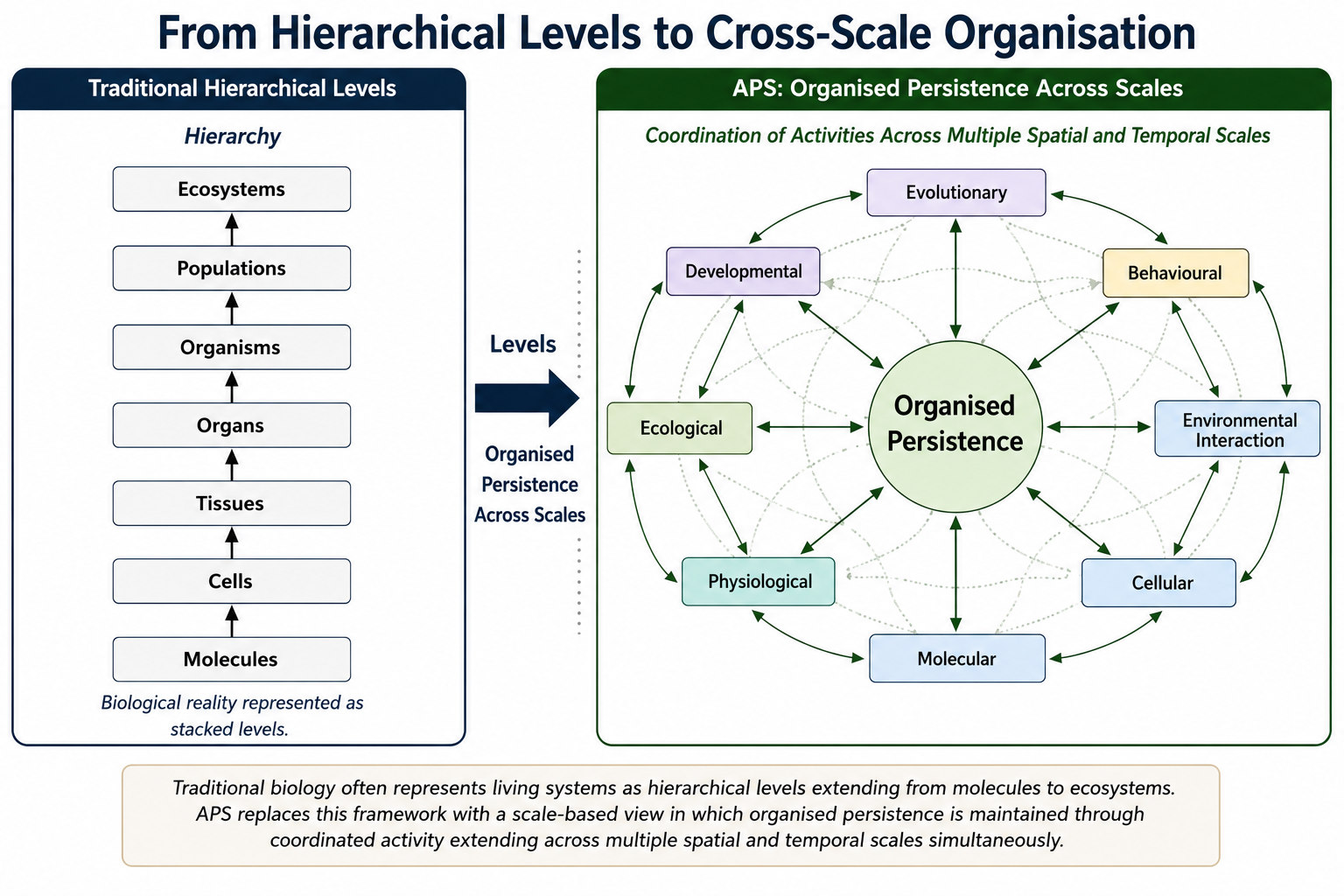
From Levels Representation to APS Scale Analysis. Conventional level representations remain useful descriptive and investigative tools. APS Scale analysis asks a different question: where is the persistence relevant to a biological explanandum organised across spatial and temporal extents? Scale is an analytic projection, not an additional causal level or hierarchy.
Agency and Explanatory Extent
The distinction between levels and Scale matters for biological agency, but it does not establish that agency is necessarily multiscale.
In APS, biological agency is viability-oriented organisational activity. Agency concerns what living systems do. It should not be identified automatically with a gene, molecular network, nervous system, brain, behavioural mechanism, or any other component merely because that component contributes to the activity being explained.
At the same time, rejecting a privileged component does not entail that every explanation of agency must extend across multiple spatial and temporal extents. The required extent must be established from the organisation relevant to the explanandum.
A bacterium moving in relation to a nutrient gradient, a plant modifying growth under changing conditions, and an animal altering behaviour in response to danger depend on materially realised processes and constraints. Different explanatory targets may require different portions of that organisation to be included. The question is not how many scales agency occupies, but which organisational relations make an explanatory difference to the viability-oriented activity under investigation.
Agency is therefore neither assigned to a privileged level nor constituted by Scale. Scale helps specify where the persistence relevant to explaining the activity is organised.
Material Causation Across Explanatory Extents
Hierarchical language often encourages descriptions of biological causation as bottom-up or top-down. Such language can sometimes function as shorthand, but it can also obscure the material relations through which biological effects occur.
APS does not solve this problem by replacing directional causation between levels with “cross-scale causation” or “cross-scale coordination.” Scales do not cause, coordinate, constrain, or integrate biological activity.
Where a physiological condition alters molecular activity, explanation should identify the materially implemented conditions, interactions, or constraints through which that alteration occurs. Where behaviour changes environmental conditions that subsequently affect the organism, the relevant causal relations are the organism’s activities, the altered environmental conditions, and the mechanisms through which those conditions matter to subsequent activity. Where developmental organisation changes future possibilities, explanation should identify the material organisation that produces and constrains those possibilities.
The spatial or temporal extent across which these relations occur may be important. But difference of extent is not itself a causal relation.
This distinction also sharpens the assessment of reductionist and more extensive explanations. Molecular mechanisms may sometimes explain the target adequately. In other cases, their operation depends on organisational conditions that must also be represented. Conversely, adding organismal, ecological, developmental, or historical context does not automatically improve an explanation.
The relevant question is always whether the additional materially realised relations make an explanatory difference to the target.
Temporal Extent and Scale
Scale includes temporal as well as spatial extent. This does not mean that time is a separate causal dimension supplied by Scale. It means that the organisation relevant to biological persistence may have to be identified over different durations.
Physiological regulation can involve processes occurring over seconds, minutes, or hours. Development involves organised transformation over longer periods. Inheritance concerns relations across reproductive sequences and generations. Evolution concerns the historical transformation of living organisation across populations and lineages.
These phenomena should not simply be collapsed into different temporal scales of one process. They have different explananda and may require different explanatory relations. Their connection within APS lies in the question of organised persistence and transformation, not in an assumption that all of them must be integrated into every biological explanation.
Temporal extent therefore has to be established in relation to the target. A short-duration process may be explained without reconstructing developmental or evolutionary history. Other explananda may depend essentially on developmental sequence, inherited organisation, or historical transformation.
Scale asks which temporal extent is required. It does not make the widest temporal account the most adequate one.
The Organism as Viability-Oriented Organisation
Organisms illustrate why descriptive level and explanatory organisation should be distinguished.
An organism can be classified as one level within a conventional biological hierarchy. But that classification does not explain how the organism maintains itself. Its persistence depends on materially realised organisation: metabolic activity, cellular processes, physiological regulation, repair, behaviour, environmental relations, and other processes and constraints relevant to its continued functioning.
These relations need not be redescribed as activities occurring at interacting scales. What matters is how they are organised and which of them are required to explain the target under investigation.
APS treats the organism as a particularly important locus of viability-oriented organisation because organismal activity provides a central case in which the conditions of persistence are actively maintained and re-established. This does not make every biological explanation organism-wide, nor does it imply that all biological processes derive their significance from occupying positions within an organismal hierarchy.
For any particular explanandum, Scale asks how far spatially and temporally the relevant organisation must be traced. The answer may be relatively local, organism-wide, environmentally extended, developmentally extended, or historically extended depending on the dependencies that actually make an explanatory difference.
Biological Explanation and Scale
The distinction between levels and Scale changes how explanatory scope should be assessed.
A level label tells us something about how a phenomenon has been partitioned for investigation. Scale asks a different question: across what spatial and temporal extent must the relevant organisation be identified to explain the target?
The resulting explanatory sequence is:
Biological explanandum → materially relevant organisation → required spatial and temporal extent
Neither question can be answered adequately by assuming in advance that biological explanation should be molecular, organismal, ecological, or multiscale. The required explanatory extent is target-sensitive.
Mechanistic investigations remain indispensable where mechanisms explain the relevant organisation. Physiological, developmental, ecological, and evolutionary investigations likewise address relations that may be required for their respective explananda. APS does not unify these domains by declaring them manifestations of a universally multiscale organisation. It provides a comparative explanatory question that can be asked across them: what organisation must be represented, and across what extent, for the explanation to account for the target?
This also places a constraint on claims of explanatory gain. Adding a wider spatial context, a longer temporal history, or further organisational relations does not by itself make an explanation better.
A more spatially or temporally extensive explanation is warranted only when those additional relations make an explanatory difference to the target.
Scale therefore provides no presumption in favour of maximal explanatory breadth. Its role is diagnostic: to clarify the extent required by the explanandum.
Levels and Scale Answer Different Questions
APS does not replace levels with Scale.
Level descriptions can remain useful for classification, communication, experimental practice, and the organisation of scientific disciplines. Molecular, cellular, physiological, organismal, ecological, and evolutionary descriptions may identify legitimate domains of investigation.
Scale is not another way of naming those domains. Calling one process molecular and another ecological does not by itself establish two APS scales, and moving between disciplinary domains does not automatically constitute Scale analysis.
Scale becomes relevant when explanation asks where the persistence pertinent to the target is organised across spatial and temporal extents. Sometimes that question may track familiar level distinctions. Sometimes it may cut across them. Sometimes a conventional level description may already delimit the relevant organisation adequately.
The distinction is therefore methodological rather than competitive. Levels provide useful representations and partitions. Scale identifies explanatory extent.
Treating them as different questions avoids two opposite errors: reifying descriptive levels as independent layers of biological reality, and replacing them with an equally reified picture of interacting scales.
Scale Reframed
The mature APS conception of Scale begins with living organisation rather than with a predetermined hierarchy of biological domains.
Living organisation is materially realised. Its processes, constraints, boundaries, interactions, and dependencies occupy space and unfold through time. Biological explanation must determine which of those relations are relevant to the explanandum.
Scale is the analytic projection through which APS asks where that relevant persistence is organised across spatial and temporal extents.
This conception neither denies the usefulness of levels nor treats Scale as a deeper biological structure. It also does not imply that biological organisation is always multiscale, that agency is necessarily multiscale, or that explanations become better as their spatial and temporal scope increases.
Instead, Scale imposes a discipline on explanatory scope. It requires the extent of an explanation to be justified by the organisation relevant to the target.
Biological organisation therefore need not be understood as a hierarchy merely because hierarchical representations are useful. Nor need it be redescribed as a system of interacting scales. What matters is the materially realised organisation through which living systems persist, and the spatial and temporal extent across which that organisation must be identified for the particular explanatory task.
Key Point. Hierarchical levels can be useful ways of representing and investigating biological phenomena, but they should not automatically be treated as the causal or ontological organisation of living systems. APS does not replace levels with interacting scales. Scale is the analytic projection concerned with where persistence is organised across spatial and temporal extents, and the extent required for explanation must be established from the materially realised organisation relevant to the explanandum.
Explanatory Architecture
Central Question
What is the relationship between biological levels and Scale, and what does each contribute to biological explanation?
Architectural Role
This article clarifies the distinction between hierarchical level descriptions and Scale within APS. It explains why useful descriptive or investigative partitions should not automatically be treated as the causal or ontological organisation of living systems, while establishing Scale as the analytic projection concerned with where persistence is organised across spatial and temporal extents.
Builds On
- Biological Organisation
- Organised Persistence
- Scale
- Process
- Biological Agency
Develops Into
- Why APS Is Not Hierarchical
- Scale, Time, and Persistence
- Biological Explanation
- Reductionism in Biology
- Evolutionary Explanation
- Ecological Explanation
Related Explanatory Questions
- When are hierarchical levels useful in biological explanation?
- When does a descriptive level become mistaken for biological organisation itself?
- How does Scale differ from a biological level or domain?
- What determines the spatial and temporal extent required for an explanation?
- When do relations extending beyond a local boundary make an explanatory difference?
- Why is a wider or more multiscale explanation not automatically a better explanation?
Position within APS
This is a Clarification article within the Conceptual Foundations cluster. It distinguishes two forms of explanatory organisation that can otherwise be conflated: the use of levels as descriptive or investigative partitions and the use of Scale as an analytic projection within APS. It therefore protects the APS architecture from treating Scale as either a hierarchy of biological domains or a replacement ontology of interacting scales.
Corpus Significance
This article provides a principal clarification of the Scale projection within the APS corpus. It establishes that APS does not replace biological levels with interacting scales, while preserving the legitimate descriptive and investigative uses of level-based representations. Together with the canonical Scale glossary and Scale, Time, and Persistence, it establishes the methodological basis for determining explanatory extent across later discussions of agency, causation, reductionism, evolution, ecology, and comparative biological explanation.
See Also
Related Articles
References
- (2007). Explaining the Brain: Mechanisms and the Mosaic Unity of Neuroscience. Oxford University Press. https://doi.org/10.1093/acprof:oso/9780199299317.001.0001
- (1985). Unfinished Synthesis: Biological Hierarchies and Modern Evolutionary Thought. Oxford University Press.
- (2026). The importance of spatial structure in biology. European Journal for Philosophy of Science, 16(3) . https://doi.org/10.1007/s13194-026-00760-x
- (2018). Everything Flows: Towards a Processual Philosophy of Biology. Oxford University Press. https://doi.org/10.1093/oso/9780198779636.001.0001
- (2012). A Theory of Biological Relativity: No Privileged Level of Causation. Interface Focus, 2(1), 55–64 . https://doi.org/10.1098/rsfs.2011.0067
- (1985). Evolving Hierarchical Systems: Their Structure and Representation. Columbia University Press. https://doi.org/10.7312/salt91068
- (1962). The Architecture of Complexity. Proceedings of the American Philosophical Society, 106(6), 467–482 .
- (2026). Agency as the Defining Activity of Life: A Viability-Oriented Framework Integrating Process and Scale. Biological Theory . https://doi.org/10.1007/s13752-026-00547-6
- (1974). Reductive Explanation: A Functional Account. PSA: Proceedings of the Biennial Meeting of the Philosophy of Science Association, 1974, 671–710 . https://doi.org/10.1086/psaprocbienmeetp.1974.495833