Why APS Is Not Hierarchical
Biology is often described through hierarchical levels extending from molecules to ecosystems. Such representations can be useful for investigation, modelling, communication, and teaching, and some can track materially real part–whole or nested relations. Neither fact establishes that living organisation forms a universal hierarchy of discrete causal or explanatory levels. APS therefore does not replace hierarchy with interacting scales. It asks which materially realised processes, constraints, interactions, structures, and organisational relations are relevant to the explanandum. Scale then identifies the spatial and temporal extent across which the persistence relevant to that explanandum is organised. APS thus replaces the presumption of hierarchical ontology with analysis of organisation, while retaining hierarchical descriptions where they serve a legitimate explanatory purpose.
Key Points
- Hierarchical descriptions can be useful without constituting a universal ontology of biological organisation.
- Biology contains materially real part–whole, nested, and organisational relations; APS does not deny them.
- APS does not replace hierarchical levels with interacting scales.
- Materially realised processes, constraints, interactions, structures, and organisational relations perform biological causal work.
- Scale identifies the spatial and temporal extent across which persistence relevant to an explanandum is organised.
- Terms such as top-down and bottom-up causation should be resolved into the material relations they abbreviate.
- Biological agency is viability-oriented organisational activity, not a property located at a privileged hierarchical level.
- Explanatory domains need not correspond to ontological levels.
- The spatial and temporal extent required for explanation is target-dependent.
The Appeal of Hierarchy in Biology
Where this article fits.
This article explains why APS does not treat hierarchical representation as a general ontology of life. Hierarchical descriptions can be useful, and some can track materially real biological structures and part–whole relations, without establishing a universal ordering of causal or explanatory authority. Levels vs Scale — Why Biological Organisation Is Not Hierarchical develops the complementary distinction between materially realised biological organisation and Scale as the analytic projection concerned with where persistence is organised across spatial and temporal extents.
Introduction
Biology is often described in hierarchical terms. Textbooks routinely organise living systems into levels extending from molecules and cells through tissues, organs, organisms, populations, and ecosystems. This language is familiar, intuitively appealing, and frequently useful for teaching and research. Hierarchical descriptions can simplify complex phenomena, distinguish different objects of investigation, and organise explanations at different resolutions.
Some of these descriptions also track materially real biological relations. Cells can be components of tissues, organs can contain differentiated tissues, and organisms can participate in populations and ecological systems. APS does not deny such containment, nesting, composition, or part–whole organisation.
A further inference, however, does not automatically follow. The existence of useful hierarchical representations or materially real nested relations does not establish that biology as a whole is organised into discrete tiers possessing fixed causal or explanatory authority. A representation can order biological phenomena without that ordering constituting a universal ontology of life.
APS therefore distinguishes hierarchical representation from material biological organisation. It does not replace a hierarchy of levels with a hierarchy or network of interacting scales. Instead, explanation should identify the materially realised processes, constraints, interactions, structures, and organisational relations relevant to the explanandum. Scale has a different role: it identifies the spatial and temporal extent across which the persistence relevant to that explanandum is organised.
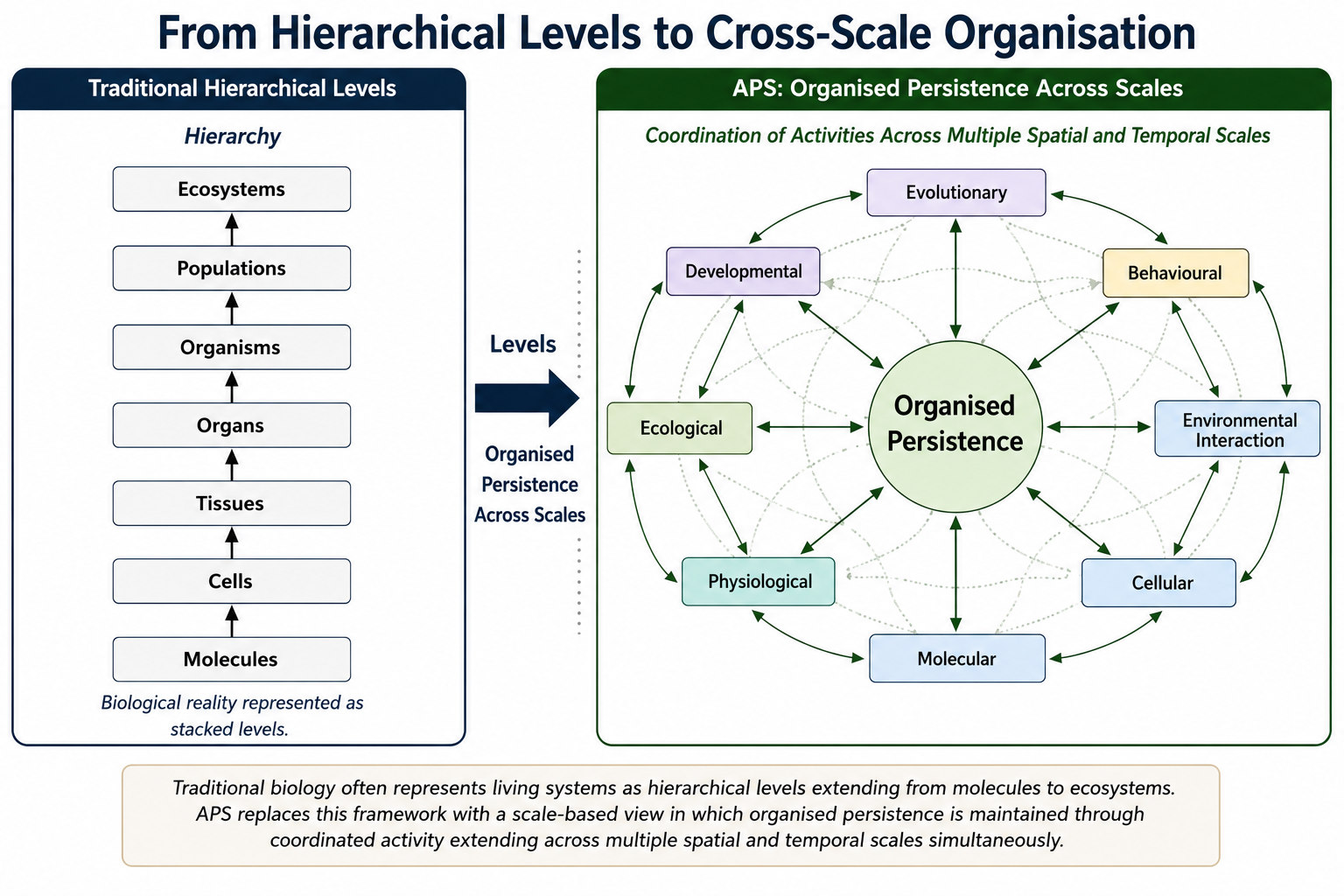
From Hierarchical Representation to APS Scale Analysis. Hierarchical levels can provide useful representations of biological phenomena, but they should not automatically be treated as the causal or ontological organisation of living systems. APS identifies the materially realised organisation relevant to the explanandum and uses Scale to determine the spatial and temporal extent required for its explanation.
Hierarchy as an Epistemic Convenience
Scientific investigation necessarily simplifies biological complexity. Researchers partition systems into components, mechanisms, domains, and scales in order to describe, investigate, model, and communicate particular phenomena. Hierarchical representations can be especially useful because they provide manageable ways of organising such distinctions.
The epistemic use of levels must nevertheless be distinguished from the empirical question of what those levels track. Some level descriptions function primarily as conveniences of investigation. Others correspond to materially important structures, boundaries, containment relations, or compositional organisation. A description may combine both functions.
APS therefore does not treat levels simply as fictions or arbitrary constructions. The relevant question is what explanatory work a particular level description performs and which features of biological organisation it successfully represents.
Problems arise when the representational ordering itself is assumed to establish a universal ordering within biological reality. Molecular biology, physiology, developmental biology, ecology, evolutionary biology, and other domains organise inquiry around different questions and phenomena. Their disciplinary boundaries do not by themselves demonstrate corresponding strata in nature.
The distinction is therefore not between unreal levels and real organisation. It is between a representational device and the material organisation that the device may, with varying success, describe. APS asks that the two not be conflated.
Why Ontological Hierarchy Is Misleading
Treating hierarchy as a universal ontology can introduce several assumptions that biological explanation does not warrant.
The first is discreteness. Convenient partitions can make biological organisation appear to consist of sharply separated tiers. Yet whether a particular boundary is biologically significant must be established from the processes, structures, constraints, and relations relevant to the explanandum.
The second is fixed causal authority. A hierarchical representation can encourage the assumption that causal importance follows position: lower levels supply fundamental mechanisms while higher levels exert control, or conversely higher levels are treated as explanatorily primary because they organise lower-level activity. Neither priority follows merely from hierarchical position.
The third is causation between levels. Expressions such as top-down and bottom-up causation can be useful shorthand, but levels themselves do not act upon one another. Causal explanation must identify the materially implemented processes, interactions, constraints, and conditions through which an effect occurs.
The fourth is universal explanatory ordering. A biological phenomenon need not possess one predetermined level at which its correct explanation resides. Some explananda can be adequately addressed within relatively bounded domains. Others require relations extending beyond an initially selected boundary. Which is appropriate must be established for the target.
APS therefore rejects the automatic reification of hierarchical representation into causal or explanatory ontology. It does not infer from this that all biological phenomena require wide-ranging explanations or that hierarchy should be replaced by interacting scales. It asks instead what material organisation explains the phenomenon and how far across space and time that explanation must extend.
The ontological significance of treating Agency, Process, and Scale as analytic projections rather than components of reality is developed in How Does Scientific Explanation Reach Reality?.
Explanatory Perspective and Organisational Domains
Rejecting a universal hierarchy does not require rejecting explanatory diversity. Biology investigates living organisation through many explanatory approaches, and those approaches can address genuinely different explananda.
Physiology may ask how particular regulatory organisation contributes to viability. Developmental biology may ask how biological organisation is established and transformed through an organism’s history. Ecology may investigate organism–environment relations. Evolutionary biology may explain historical transformations across generations. Cognitive biology may address forms of organisation appropriate to cognition.
These questions can concern the same organism, overlapping biological organisation, or materially connected processes without thereby constituting different ontological levels. The plurality belongs partly to what investigators seek to explain and partly to the organisation relevant to those explanations.
APS therefore preserves explanatory pluralism without turning disciplinary or explanatory domains into strata of reality. Different explanations need not describe different worlds, but neither must they share one identical explanandum. Their relationships must be established through the biological organisation and explanatory targets involved.
This distinction is important because explanatory perspectives are analytic while the processes, structures, constraints, and relations they investigate are materially real. The existence of several legitimate perspectives on biological organisation therefore establishes neither hierarchy nor explanatory equivalence.
Organisational Domains Are Not Levels
Development, physiology, ecology, cognition, and evolution are often discussed as distinct biological domains. These distinctions can be scientifically valuable, but a domain of inquiry should not automatically be interpreted as an ontological level.
A developmental process is materially realised through biological activities and relations occurring through time; it does not acquire its causal role by occupying a developmental level. Ecological explanation investigates materially realised organism–environment relations rather than an ecological stratum acting upon lower strata. Cognitive explanation concerns appropriate forms of biological organisation and activity rather than a cognitive tier added above otherwise passive biological mechanisms.
The same biological process can also be relevant to more than one explanatory domain. A physiological change can alter behaviour; behaviour can modify environmental conditions; developmental organisation can affect later physiological capacities; ecological conditions can alter processes relevant to evolutionary outcomes. These are material relations among biological processes and conditions, not exchanges among explanatory domains.
APS therefore treats organisational domains as ways of distinguishing explanatory questions and relevant biological organisation. Their boundaries can overlap because the material relations under investigation can overlap. That does not make the domains ontological levels, nor does it imply that all domains reduce to one undifferentiated explanatory perspective.
Constraint Relations Without Hierarchical Control
Hierarchical descriptions can encourage metaphors of command and control. Higher levels may be described as directing lower levels, while lower levels are described as providing the mechanisms from which higher-level activity is constructed. Such language can sometimes summarise real dependencies, but the hierarchical vocabulary does not itself identify the biological relations performing the work.
APS instead asks which materially realised constraints, processes, interactions, and conditions alter the range of possible activity within the system. A constraint does not exercise control because it occupies a higher level. Its explanatory role depends on how it is materially implemented within biological organisation.
Physiological regulation, for example, can alter conditions under which cellular activity occurs, while cellular processes can contribute materially to maintaining physiological organisation. Organisms can modify environmental conditions that subsequently alter circumstances relevant to their viability. Developmental organisation can constrain later possibilities through structures and relations produced earlier in development.
Such reciprocity does not require causation between levels or scales. It consists in identifiable material relations whose organisation can be investigated directly.
Constraint closure provides an important example. In a constraint-closed organisation, relevant constraints participate in maintaining conditions through which the organisation responsible for their own maintenance persists. This does not describe commands passing downward through a hierarchy or causal influence passing between scales. It describes materially realised organisational dependencies.
APS therefore does not replace hierarchical control with another universal architecture of reciprocal or cross-scale control. It asks what constrains what, how the constraint is materially implemented, and how that relation contributes to the persistence relevant to the explanandum.
Agency and Causation Without Hierarchy
Hierarchical language can also obscure the distinction between causal relations and the representations used to organise them. Terms such as top-down and bottom-up causation often identify a contrast in spatial extent, composition, or explanatory focus, but the causal work must still be assigned to materially realised processes, constraints, interactions, and conditions.
A wider spatial or temporal extent does not itself cause a local event. Where organisation extending beyond a local boundary alters local activity, explanation should identify the materially implemented constraints, interactions, and conditions through which that alteration occurs.
Molecular processes can contribute to physiological organisation. Physiological conditions can alter the circumstances under which molecular processes occur. Behaviour can modify environmental conditions, and those conditions can subsequently alter possibilities for behaviour. Nothing in these examples requires one level or scale to act upon another. The relevant causal relations are material.
Scale enters only as an analytic question about explanatory extent. If understanding a causal relation requires following materially relevant organisation beyond an initially selected spatial or temporal boundary, the explanation should widen accordingly. If the bounded explanation is sufficient, no wider extent is required.
The same distinction clarifies biological agency. Biological agency is viability-oriented organisational activity. It is not a property added at a privileged position in a biological hierarchy, nor does it arise simply because a system occupies a sufficiently high level of complexity.
The explanatory question is how living organisation acts in ways oriented to maintaining or re-establishing conditions of viability. Which material processes and relations must be included in that explanation depends on the case. Agency therefore does not require a hierarchical location or distribution across scales.
APS consequently rejects both privileged-level agency and causation between reified levels. Agency belongs to the analysis of viability-oriented organisational activity; causal explanation belongs to the materially implemented relations through which biological effects occur.
Translating Standard Biological Language
APS does not require biologists to abandon familiar hierarchical terminology. Terms such as levels of organisation, higher-level control, top-down causation, and bottom-up processes are deeply embedded in biological practice and can function effectively as shorthand.
The problem arises when the shorthand is allowed to substitute for an account of the material relations involved. APS therefore treats hierarchical terminology as an invitation to explanatory clarification rather than as vocabulary requiring one-to-one replacement.
| Conventional expression | APS asks |
|---|---|
| level of organisation | What materially realised organisation does this level distinguish, and what explanatory purpose does the distinction serve? |
| top-down causation | Which materially implemented constraints, interactions, or conditions alter the local activity? |
| bottom-up causation | Which component processes and interactions contribute to the explanandum? |
| higher-level control | What material regulatory or constraint relations perform the controlling work? |
| emergence from lower levels | Which organisational relations explain the property or activity not captured by the narrower description? |
| hierarchical organisation | Does the hierarchy track materially relevant part–whole relations, serve primarily as a representation, or combine both? |
| cross-level influence | What material relation connects the phenomena being described, and across what spatial or temporal extent must it be explained? |
APS therefore translates hierarchical language by recovering the material and explanatory relations it abbreviates, not by replacing the word level with scale.
This approach preserves the practical value of established biological terminology while making its explanatory commitments explicit. A hierarchical description can remain useful when it accurately serves the question being asked. What APS resists is the unexamined inference from that usefulness to a universal architecture of biological reality.
Summary
Hierarchy remains a useful representational strategy in biology. It helps organise complexity, distinguish objects of investigation, support modelling, and communicate relationships among biological phenomena. Some hierarchical descriptions also track materially real containment, compositional, nested, or part–whole relations.
Neither fact establishes that living organisation forms a universal hierarchy of discrete causal or explanatory levels.
APS distinguishes the organisation of explanation from the material organisation being explained. It asks which processes, constraints, interactions, structures, boundaries, and organisational relations are relevant to the explanandum. It then uses Scale to ask where the persistence relevant to that explanandum is organised across spatial and temporal extents.
This means APS does not replace hierarchy with interacting scales. Nor does it assume that every explanation must extend widely across biological organisation. A bounded explanation may be sufficient for one target, while another may require relations extending across a broader spatial or temporal extent. The appropriate extent must be established from the explanatory difference those additional relations make.
The same principle applies to causal language. Levels and scales do not perform biological work. Materially realised processes, constraints, interactions, and conditions do. Hierarchical terms such as top-down and bottom-up can remain useful shorthand when the underlying causal relations are made explicit.
APS therefore replaces the presumption of hierarchical ontology with analysis of organisation. Hierarchical representations are assessed by what biological relations they track, what explanatory purpose they serve, and whether the explanandum requires an explanation extending beyond their boundaries.
Key Point. APS does not reject hierarchy as a descriptive or representational convenience, nor does it deny materially real nested and part–whole organisation. It rejects the automatic treatment of hierarchical representation as a universal causal or explanatory ontology. Biological explanation should identify the materially realised organisation relevant to the explanandum, while Scale identifies the spatial and temporal extent required for its explanation.
Explanatory Architecture
Central Question
Why should useful hierarchical representations not automatically be treated as the causal or ontological organisation of living systems?
Architectural Role
This article is a conceptual-foundations clarification distinguishing hierarchical representation, materially realised biological organisation, and APS Scale. Its role is to prevent the rejection of hierarchical ontology from being replaced by an interacting-scales ontology.
Builds On
This article builds on Life as viability-oriented, constraint-closed organisation; Biological Agency as viability-oriented organisational activity; Process; Scale; Constraint Closure; organised persistence; and the distinction between levels and Scale developed in Levels vs Scale — Why Biological Organisation Is Not Hierarchical.
These dependencies do not imply that every explanation requires all APS projections.
Develops Into
This clarification supports more precise interpretation of level language, analysis of causal claims spanning different spatial or temporal extents, and target-sensitive use of Scale. It also provides a methodological basis for later evolutionary, ecological, organism–environment, and other applications in which the required explanatory extent must be established rather than assumed.
Related Explanatory Questions
Relevant questions include when a hierarchical representation tracks materially real part–whole organisation; when it functions primarily as an epistemic convenience; what material relations are abbreviated by top-down or bottom-up language; when explanation requires a wider spatial or temporal extent; when a bounded explanation is sufficient; and whether different disciplinary domains correspond to different explananda rather than biological levels.
Position within APS
Agency, Process, and Scale are analytic projections of one viability-oriented, constraint-closed organisation. They are not ontological levels or independently acting causes. Agency concerns what living systems do; Process concerns how continuity is maintained despite change; Scale concerns where persistence is organised across spatial and temporal extents.
Scale therefore does not replace hierarchy as the structure of biological reality. It identifies where the persistence relevant to an explanandum is organised and thereby helps determine the spatial and temporal extent required for explanation.
Corpus Significance
This article prevents APS’s rejection of hierarchy from becoming an interacting-scales ontology. It establishes an organisation-first account in which hierarchical representations are assessed according to what materially realised relations they track and what explanatory purpose they serve.
Its central correction is therefore methodological rather than terminological:
APS does not replace hierarchy with scale; it replaces the presumption of hierarchical ontology with analysis of organisation.
See Also
Related Articles
References
- (2018). Everything Flows. Oxford University Press.
- (2015). Biological Autonomy. Springer.
- (2016). Dance to the Tune of Life. Cambridge University Press.
- (1991). Life Itself. Columbia University Press.
- (1962). The Architecture of Complexity. Proceedings of the American Philosophical Society, 106(6), 467–482 .
- (2026). Agency as the Defining Activity of Life: A Viability-Oriented Framework Integrating Process and Scale. Biological Theory . https://doi.org/https://doi.org/10.1007/s13752-026-00547-6
- (2007). Re-Engineering Philosophy for Limited Beings. Harvard University Press.