Cognition — Where Does It Belong in Biology?
Cognition belongs within biological organisation without being identical with life, biological agency, regulation, intelligence, representation, prediction, consciousness, or mind. APS defines cognition as the organisation of biological significance across time. Biological Agency, Biological Evaluation, Significance, and Integration provide pre-cognitive explanatory dependencies, but none by itself establishes cognition. Cognitive attribution becomes warranted only where integrated biological significance modulates activity across a temporal field of viability-relevant possibilities in ways not exhausted by immediate or fixed regulation. This article establishes the canonical architectural position of cognition within APS while leaving the lower biological boundary of cognition open to comparative empirical testing.
Key Points
- Cognition is the organisation of biological significance across time.
- Life does not require cognition; cognition presupposes life.
- Biological Agency, Biological Evaluation, Significance, and Integration are pre-cognitive explanatory dependencies rather than stages that automatically produce cognition.
- Regulation, temporal extension, complexity, memory-like effects, anticipation, and adaptive flexibility do not individually establish cognition.
- Cognitive attribution requires materially implemented explanatory dependencies that are not exhausted by an adequate non-cognitive account.
Where This Article Fits
How Did Cognition Become a Biological Problem? explains how changing explanatory traditions produced the contemporary cognition–regulation boundary problem, while The Cognitive Organisation of Life examines what cognitive organisation contributes once cognition has been independently warranted. The Minimal Cognition work addresses the more difficult empirical question of where the lower boundary of cognition should be drawn. The present article occupies the architectural position between these projects by asking where cognition belongs within biology, what it depends upon, and what distinguishes its explanatory position from life, biological agency, evaluation, significance, integration, and regulation.
APS defines cognition as the organisation of biological significance across time. This definition locates cognition within living organisation without making all living organisation cognitive. The purpose of this article is therefore to establish the explanatory place of cognition within APS while leaving disputed attribution to comparative empirical investigation.
Introduction — Where Does Cognition Belong?
Cognition has often occupied an unstable position within biology. At one extreme, it is treated as so deeply continuous with adaptive living activity that life and cognition approach equivalence; at the other, cognition is restricted to organisms possessing nervous systems, complex behaviour, representation, intelligence, or consciousness. Between these positions lie proposals identifying cognition with information processing, learning, prediction, memory, behavioural flexibility, or other capacities associated with sophisticated biological regulation. Each approach identifies phenomena that may matter to cognitive explanation, but none by itself establishes where cognition belongs.
APS begins from a different question. Rather than asking first whether a particular mechanism, organism, or behaviour should be labelled cognitive, it asks where cognition fits within the organisation of living systems and what explanatory dependencies must be present before cognitive attribution becomes warranted. The starting point is therefore not cognition but life: Life is viability-oriented, constraint-closed organisation, while Biological Agency is viability-oriented organisational activity. Living systems maintain and re-establish the conditions of their persistence through ongoing activity under changing circumstances (Spencer 2026), and such activity already involves regulation, selective responsiveness, adaptivity, history dependence, and organisation across time. None of those capacities, merely by occurring in a living system, establishes cognition.
This establishes an important asymmetry within APS: Life does not require cognition; cognition presupposes life. Cognition is therefore biological without being biologically foundational. Its position depends upon a set of pre-cognitive explanatory relations:
Life → Biological Agency → Biological Evaluation → Significance → Integration → Cognition
This sequence expresses explanatory dependency rather than chronology, ontogeny, evolutionary progression, hierarchy, levels of organisation, or a succession of independent biological components. The central claim of this article is accordingly that cognition belongs within living organisation as a specialised organisation of biological significance across time. Biological Agency, Biological Evaluation, Significance, and Integration establish conditions from which cognition may arise, but none constitutes cognition by itself. Cognitive attribution becomes warranted only where organising biological significance across time identifies explanatory dependencies not exhausted by an adequate non-cognitive account of the same phenomenon. In this way, cognition can be placed firmly within biology while its lower boundary remains empirically open.
Cognition Is Biological but Not Foundational
Locating cognition within biology first requires distinguishing it from life itself. Living systems already possess forms of organisation that can appear cognitive when described loosely: they detect and respond to environmental change, regulate internal conditions, alter their activity after perturbation, preserve effects of previous states, coordinate processes over time, and act differently under conditions that differ in their consequences for continued functioning. These capacities are far from trivial, but they belong to the organised activity through which living systems persist and cannot be assumed to be cognitive simply because they are sophisticated.
The organisation required for life establishes a biological domain in which conditions matter relative to continued functioning. Organisms do not merely undergo physical change; their activity contributes, successfully or unsuccessfully, to maintaining and re-establishing conditions compatible with their continued organisation. Adaptivity and autonomy approaches have independently emphasised this viability-sensitive character of living organisation without requiring cognition as their starting point (Di Paolo 2005; Moreno and Mossio 2015). The important consequence is that viability sensitivity, selective responsiveness, and adaptive regulation cannot themselves serve as sufficient criteria for cognition.
APS therefore rejects two opposing reductions. The first effectively reduces life to cognition by treating the selective and adaptive character of living activity as sufficient to make living systems cognitive. This fails to preserve the possibility that regulation, evaluation, normativity, and adaptive organisation can occur before the question of cognition has been settled. The second reduction confines cognition to specialised neural machinery, so that cognition enters biology only when nervous systems provide mechanisms of sufficient complexity. APS does not accept this restriction as definitional either. Neural systems provide powerful means of organising activity across time, but neural implementation is not part of the APS definition of cognition.
Cognition consequently belongs between these extremes. It is neither the basis of life nor a domain detached from living organisation, but a particular form of organisation realised within biological agency.
The APS Definition of Cognition
Within APS:
Cognition is the organisation of biological significance across time.
The definition requires careful interpretation because neither significance nor temporal extension is, by itself, sufficient for cognition. All living organisation is historical in some sense: regulatory systems retain state, development depends upon prior conditions, physiological organisation can be path dependent, and anticipatory regulation can exploit regularities across time. Likewise, conditions already differ in their consequences for viability before cognitive organisation has been established. Biological significance therefore need not be cognitive merely because it matters to a living system, just as a biological process need not be cognitive merely because its present organisation depends upon its past.
The definition instead identifies the explanandum distinctive to cognition: the organisation of what matters biologically across temporal relations. Cognition is consequently downstream from Significance without Significance itself becoming cognitive. This distinction also separates the canonical definition from the stronger question of attribution. The definition specifies what cognition is supposed to be when present; it does not determine, by conceptual stipulation, when a particular biological system crosses the relevant explanatory boundary.
That second question requires a separate and empirically vulnerable proposal. The current APS boundary proposal is:
Biological agency becomes cognitive when integrated biological significance modulates activity across a temporal field of viability-relevant possibilities in ways not exhausted by immediate or fixed regulation.
This is not a second definition of cognition but a provisional discriminator intended to make cognitive attribution testable rather than automatic. Maintaining the distinction between definition and discriminator is essential, because otherwise APS would risk deriving cognitive attribution directly from its own conceptual architecture. The architecture establishes where cognition belongs and what it presupposes; it does not establish in advance which biological systems are cognitive.
The Explanatory Dependencies of Cognition
The placement of cognition within APS is best understood through explanatory dependency:
Life → Biological Agency → Biological Evaluation → Significance → Integration → Cognition
Each term identifies something presupposed by the explanatory role of the term that follows. Life provides the viability-oriented organisation within which biological agency is possible, while Biological Agency provides the ongoing organisational activity through which living systems maintain and re-establish the conditions of persistence. Biological Evaluation generates significance by differentiating conditions according to their viability-relevant consequences, and Significance identifies what matters relative to the organisation of the agent. Integration then organises significant relations into functional unity, providing the pre-cognitive organisation upon which cognition depends. Cognition concerns the organisation of this integrated biological significance across time.
These relations should not be interpreted as a ladder leading from simple to complex life, nor do they imply that organisms pass through a succession of discrete stages before becoming cognitive. They are analytic dependencies within a single organised biological reality. A particular organism may realise these dependencies through many interacting mechanisms, and the explanatory architecture does not prescribe those mechanisms in advance. Its role is instead to specify what must already be available conceptually before cognitive explanation can be introduced without circularity.
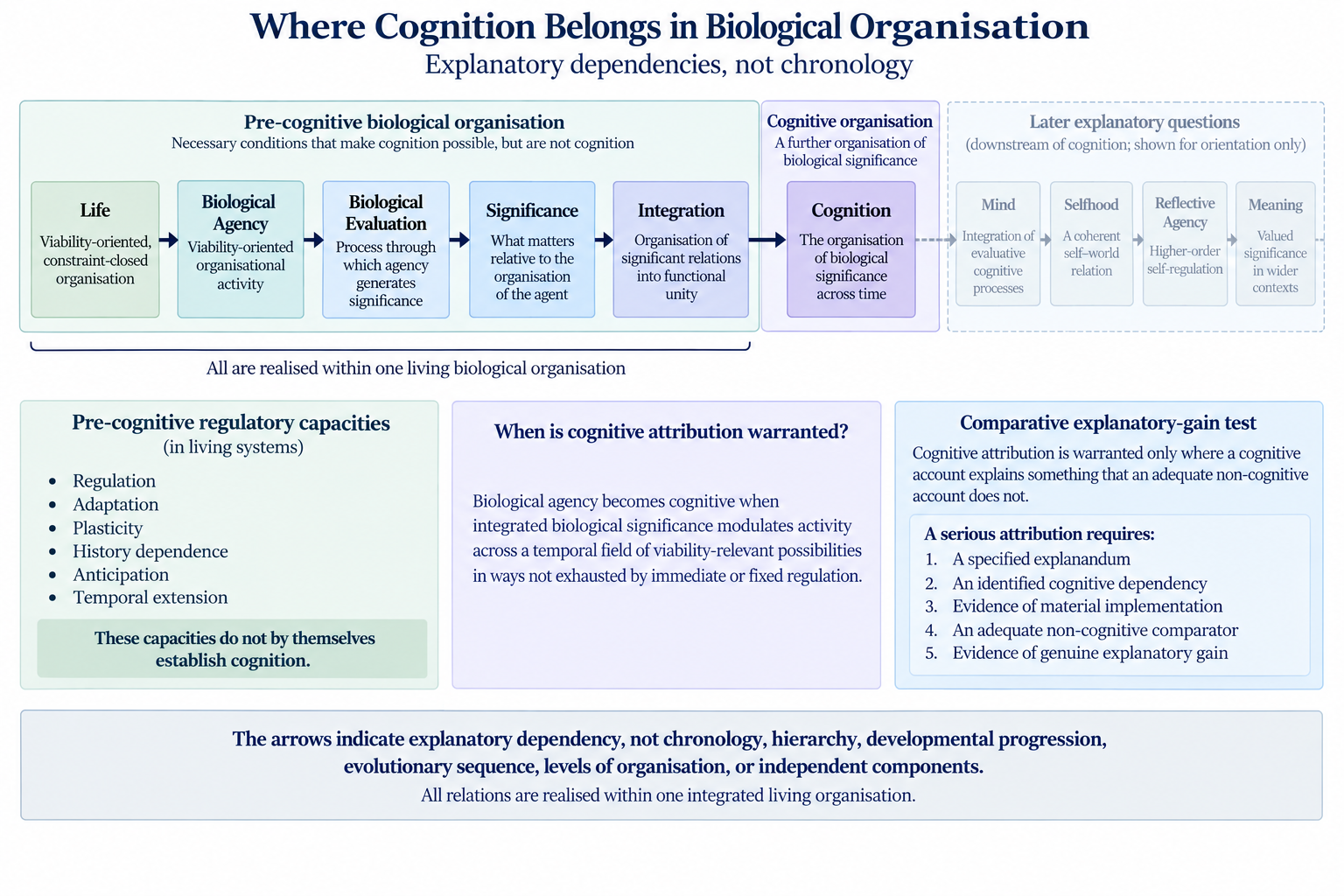
Where Cognition Belongs in Biological Organisation. Cognition depends upon Life, Biological Agency, Biological Evaluation, Significance, and Integration without being identical with any of them. The arrows express explanatory dependency rather than chronology, hierarchy, developmental progression, evolutionary sequence, levels of organisation, or independent components. Cognitive attribution requires materially implemented explanatory dependencies that provide genuine explanatory gain over an adequate non-cognitive account.
Biological Agency, Evaluation, and Significance Before Cognition
Biological Agency is viability-oriented organisational activity, and such activity is already selective because conditions are not equivalent for a living system. Some contribute to continued functioning, others interfere with it, and still others alter which forms of activity remain viable. APS describes the process through which agency differentiates these conditions as Biological Evaluation: Biological Evaluation is the process through which agency generates significance.
Evaluation therefore precedes cognition explanatorily. This does not mean that organisms first perform one process and subsequently acquire another as a discrete developmental stage. Rather, cognition cannot explain how biological relevance first appears, because significance must already be available for cognitive organisation. A living system may regulate differently in the presence of nutrients, toxins, damage, resource scarcity, temperature change, or competing physiological demands, and these differences can be real and viability-relative without requiring cognitive attribution.
Significance is therefore both pre-cognitive and relationally real. A condition matters biologically because of its relation to the organisation and persistence of the agent, rather than because an external observer assigns importance to it. This avoids making significance dependent upon cognition, representation, or interpretation while also avoiding its reduction to an observer’s description of physical effects. Biological significance arises within viability-oriented organisation itself; cognition subsequently organises such significance across time.
Why Integration Is Necessary but Not Sufficient
Significance alone does not establish cognition because living systems encounter multiple viability-relevant relations whose consequences must be coordinated within ongoing activity. APS refers to the organisation of such relations into functional unity as Integration. Integration is necessary to the cognition architecture because cognition does not concern isolated significant events; it concerns significance organised within a wider functional pattern capable of modulating activity across time.
Integration nevertheless remains pre-cognitive because living organisation is integrative throughout biology. Metabolic processes are coordinated, development integrates signals and constraints, physiological systems combine multiple inputs, regulatory networks retain prior state, and organisms coordinate competing requirements under changing conditions. None of these processes becomes cognitive merely by becoming more integrated. If increasing integration were itself sufficient, complexity would effectively become a hidden threshold at which sufficiently elaborate organisation automatically turned into cognition.
APS rejects that inference. Integration establishes that significant relations can be organised together, but cognition requires a further explanatory condition concerning how integrated significance operates across a temporal field of viability-relevant possibilities. Integration is therefore a necessary dependency of cognition without being a sufficient mark of the cognitive.
Cognition and Biological Regulation
The most important neighbouring category for cognition is not Meaning but regulation. Living systems regulate continually, and regulation can be complex, context-sensitive, history-dependent, anticipatory, plastic, distributed, and adaptive. It can incorporate feedback, preserve prior effects, coordinate multiple variables, and alter future response tendencies. Because none of these properties alone establishes cognition, the boundary between cognition and regulation cannot be drawn simply by contrasting sophisticated activity with simple reaction.
A contrast between reaction and cognition is inadequate because non-cognitive regulation need not be immediate or rigid, while a contrast between fixed and flexible behaviour fails because regulatory systems can themselves be flexible. Present versus future orientation is equally insufficient, since anticipatory regulation may exploit recurrent structure without requiring cognitive organisation. Corcoran, Pezzulo, and Hohwy (2020), for example, distinguish allostatic regulation from stronger counterfactual cognition. Their account is not identical to the APS proposal, but it demonstrates why prospective organisation alone does not settle cognitive status. Similarly, debates over the mark of the cognitive show that sophisticated biological activity cannot simply be redescribed as cognition without an independent discriminator (Adams and Garrison 2013).
APS therefore treats regulation as the strongest immediate comparator. The relevant question is not merely whether an activity can be described in cognitive terms, but whether cognitive organisation is required to explain a dependency that an adequate regulatory account does not already explain. This comparative requirement provides the central methodological discipline for cognitive attribution within the reconstructed Anchor.
The Temporal Organisation of Biological Significance
Time is indispensable to the APS definition of cognition, but biological temporality must be distinguished from cognition rather than treated as evidence sufficient to establish it. Three forms of temporal dependence are especially important: history dependence, temporally extended regulation, and cognitive temporal organisation.
History dependence occurs whenever a biological system’s present state depends upon its previous states. Temporally extended regulation goes further in the sense that previous conditions, retained physiological states, developmental trajectories, or recurrent environmental patterns may influence present regulatory activity. Neither relation is necessarily cognitive. Cognitive temporal organisation becomes a distinct explanatory possibility where integrated biological significance modulates present activity relative to a temporal field of viability-relevant possibilities in a way not exhausted by immediate or fixed regulation.
The difference is therefore not simply one of duration, nor can it be established by the presence of memory or anticipation alone. A system may preserve traces of previous conditions without those traces functioning as cognitive organisation, just as it may regulate prospectively because recurrent conditions have shaped its present organisation. What matters is the explanatory dependency: whether present activity depends upon the integration of significance across viability-relevant possibilities in a way that the strongest non-cognitive model cannot adequately explain.
APS accordingly treats temporality as necessary to cognition but not as a shortcut to cognitive attribution. The relevant evidence must establish what temporal organisation contributes to the phenomenon being explained rather than merely demonstrating that past or future conditions are involved.
What Does Not by Itself Establish Cognition?
A range of properties commonly associated with cognition may provide relevant evidence without individually establishing cognitive organisation. Complexity, for example, cannot serve as a sufficient criterion because non-cognitive biological organisation can itself be extremely complex, while adaptive success may be achieved through regulatory organisation without requiring cognition. Behavioural flexibility likewise does not settle the issue, since flexible responses can arise through plasticity, state-dependent dynamics, and other forms of regulation.
The same caution applies to temporal phenomena. Memory-like effects show that prior states influence present organisation, but they do not by themselves establish that those effects are cognitively organised. Anticipation demonstrates sensitivity to future-relevant conditions, yet prospective regulation may exploit recurrent biological or environmental structure without cognition. Learning-like change can similarly alter response after experience while leaving open the organisation through which that change is produced.
Nor can cognition be established simply by shifting to informational or representational vocabularies. Information processing can describe many physical and biological dependencies, while signalling may involve reliable sensitivity to biologically relevant conditions without cognitive organisation. Representation does not establish cognition merely because representational vocabulary can be applied, and prediction does not establish it merely because activity is future-relevant. The presence or absence of a nervous system is likewise insufficient: absence of neural organisation does not establish cognition, while possession of a nervous system does not make every process within an organism cognitive.
These exclusions are not intended to make cognition inaccessible or to deny that such properties can contribute to cognitive explanation. Their purpose is to prevent biological sophistication from becoming synonymous with cognition. Any of these features may become evidentially important when they help establish the relevant cognitive dependency, but none substitutes for demonstrating that dependency.
Cognition Beyond Nervous Systems
Nothing in the APS definition makes nervous systems constitutive of cognition. This matters because contemporary biological approaches have broadened serious cognitive investigation beyond familiar human and vertebrate cases (Baluška and Levin 2016; Lyon et al. 2021). Such work is scientifically valuable because it prevents the mechanisms characteristic of one lineage from being mistaken for the universal definition of cognition. At the same time, widening the legitimate field of cognitive inquiry does not warrant widening cognitive attribution automatically.
APS therefore distinguishes the methodological claim that non-neural systems are legitimate candidates for cognitive investigation from the empirical claim that a particular non-neural system is cognitive. The former does not entail the latter. Neural systems provide powerful mechanisms for retaining, integrating, transforming, and coordinating significance across time, while non-neural systems may realise relevant organisation through other mechanisms. Whether they do so in a cognitively explanatory sense remains a case-specific question.
Melkikh and Sukhoverkhov (2026) extend the investigation of basal cognition into the internal organisation of organisms, interpreting molecular recognition, intracellular transport and distributed immune responses through endosemiosis and cognitive terminology. Their account illustrates why non-neural biological processes deserve serious investigation, while also exposing the difficulty of distinguishing sophisticated regulation from cognition. Within APS, molecular recognition, signalling and distributed coordination do not themselves establish cognitive organisation. Cognitive attribution requires evidence that integrated biological significance operates across viability-relevant temporal possibilities in ways that an adequate non-cognitive regulatory account cannot explain. The authors’ further proposals concerning quantum control are not required by the APS account.
The resulting position is implementation-neutral without being attribution-neutral. A proposed instance of cognitive organisation must still be materially realised, causally relevant to the specified phenomenon, and explanatorily distinguishable from an adequate non-cognitive comparator. Removing nervous systems from the definition of cognition therefore expands the possible implementation space without relaxing the evidential requirements for cognitive attribution.
Cognition, Representation, Prediction, and Intelligence
Cognition has often been identified with capacities that occur prominently in familiar cognitive systems, including representation, prediction, and intelligence. APS treats these capacities as possible contributors to particular cognitive explanations rather than as universal constituents of cognition.
Representation
APS is representation-neutral rather than anti-representational. Representational explanation may be warranted where content-specific error, decoupling, symbolic structure, recombination, guidance concerning absent conditions, or related phenomena require representational organisation. Representation should not, however, be inferred simply because an organism behaves flexibly or because cognitive vocabulary is being used. Ramsey (2007) provides an important general caution against promiscuous representational attribution. Representation is therefore a possible explanatory resource within cognition, not its universal foundation.
Prediction
Prediction may likewise perform important explanatory work in some cognitive systems, particularly where organisms organise activity relative to expected or possible future circumstances. Future relevance alone, however, does not establish cognitive prediction because prospective regulation can itself be non-cognitive. Predictive organisation should therefore be invoked where it identifies an explanatory dependency that contributes to the phenomenon under investigation, rather than being used as a generic synonym for adaptation, anticipation, or future-oriented regulation.
Intelligence
Cognition is also not equivalent to Intelligence. Intelligence may involve specialised problem solving, flexible planning, abstraction, strategic behaviour, symbolic organisation, or other sophisticated capacities, and these may depend upon cognitive organisation. They do not, however, define cognition. Maintaining these distinctions allows cognition to remain biologically general without becoming explanatorily indiscriminate, while permitting representation, prediction, and intelligence to perform more specific explanatory roles where the evidence requires them.
Cognition Across Process and Scale
Cognition should not be located at a privileged biological level, because APS treats Agency, Process, and Scale as complementary analytic projections of one viability-oriented, constraint-closed living organisation. They are analytic projections rather than components of reality. Cognition is therefore not an additional component alongside Agency, Process, and Scale, nor does its explanation require the introduction of a separate cognitive level.
Applied to cognition, Agency asks what the living system is doing when cognitive organisation contributes to its activity. Process asks how that organisation maintains relevant continuity despite changing conditions. Scale asks where the dependencies involved in cognitive organisation are materially organised across spatial and temporal extents. These perspectives allow cognition to be investigated without either localising it by definition or appealing vaguely to distributed organisation.
A cognitive explanation may require relations extending across cellular, physiological, neural, behavioural, environmental, developmental, or other spatial and temporal domains, but wider spatial or temporal organisation does not override local causation. Cross-scale influence must be materially implemented: wider organisation matters where constraints operating across those extents alter the local conditions under which activity occurs. Cognition is therefore neither a higher-level cause nor a separate layer placed over biological mechanism. It consists in an organisation of materially implemented dependencies within the living system being explained.
Cognition and Mind
Cognition and Mind are closely related within APS but should not be treated as interchangeable. Cognition is the organisation of biological significance across time, whereas Mind concerns a further integration of evaluative cognitive processes through which an agent maintains a coherent self–world relation. Cognition is therefore required for Mind within the current APS architecture, but cognitive organisation need not itself constitute Mind.
This distinction prevents minded organisation from being read back into the definition of cognition. A system need not possess a coherent minded perspective merely because cognitive organisation is warranted, and Mind should not be used retrospectively to determine whether cognition is present. The cognition question concerns how biological significance is organised across time; the Mind question concerns how cognitive organisation becomes integrated into a coherent ongoing relation between agent and world. The two explanatory problems are continuous without being identical.
The same restraint applies to the concepts that follow Mind within the wider APS architecture. Selfhood, Reflective Agency, and Meaning belong to later explanatory questions in the cognition-and-mind corpus and should not be inserted as prerequisites for cognition. Their dependence upon prior cognitive organisation does not alter the pre-cognitive dependencies through which cognition itself is located.
Where Cognition Belongs
The central question can now be answered directly. Cognition belongs within living organisation: it is neither an external mental domain imposed upon biological mechanism nor the defining property of life. It is not identical with biological agency, Biological Evaluation, Significance, Integration, Regulation, Adaptation, Intelligence, Representation, Prediction, Consciousness, or Mind, even though its explanation depends upon or may intersect with several of these phenomena.
Cognition depends upon Biological Agency because it is realised within living activity; it depends upon Biological Evaluation because it organises relations that already matter biologically; it depends upon Significance because it does not create biological relevance from nothing; and it depends upon Integration because significant relations must participate in coherent functional organisation before their organisation across time can perform the role attributed to cognition. Its distinction from non-cognitive regulation lies in the further claim that integrated biological significance is organised across a temporal field of viability-relevant possibilities in ways not exhausted by immediate or fixed regulation.
This is the distinctive position of cognition within APS. It is neither foundational nor biologically exceptional, but a specialised form of organisation within life whose attribution requires more than the presence of the biological capacities upon which it depends.
The Boundary Remains Empirical
Nothing in the APS architecture determines automatically which organisms or processes are cognitive. The architecture specifies a candidate explanatory dependency, but conceptual coherence does not turn that dependency into an empirical conclusion. Cognitive attribution must therefore be warranted by evidence rather than derived from the fact that the relevant concepts can be arranged into a coherent APS architecture.
At minimum, a serious cognitive attribution requires:
- a specified explanandum;
- an identified cognitive dependency;
- evidence of material implementation;
- an adequate non-cognitive comparator;
- evidence that the cognitive account explains something the comparator does not.
These requirements follow the broader APS comparative methodology, according to which explanatory claims are target-relative and comparator-relative. A cognitive account should not be judged superior merely because it uses richer vocabulary or provides a conceptually attractive description. If the relevant phenomenon is already adequately explained through established regulation, coupling, developmental organisation, physiological adjustment, or another non-cognitive dependency, introducing cognition produces no explanatory gain merely by redescribing the same process.
Conversely, where cognitive organisation identifies a materially implemented dependency that the strongest relevant non-cognitive alternative leaves unexplained, cognitive attribution becomes an empirical explanatory possibility. This is why the reconstructed Anchor does not decide the Minimal Cognition problem. Its function is to establish the architecture within which that problem can be tested, leaving disputed cases to ask what feature of an organism’s activity actually requires cognitive organisation for its explanation. A useful cognition concept must therefore remain capable of failing when an adequate non-cognitive account does the explanatory work.
Explanatory Architecture
1. Central Question
Where does cognition belong within biological organisation, and what distinguishes cognitive explanation from accounts in terms of life, agency, evaluation, significance, integration, and regulation alone?
2. Architectural Role
This article is the principal APS Anchor for the biological placement of cognition. It establishes cognition as a specialised organisation realised within living agency without identifying cognition with life itself. It defines cognition as the organisation of biological significance across time, identifies its pre-cognitive explanatory dependencies, distinguishes it from neighbouring biological and cognitive categories, and establishes why cognitive attribution requires comparative empirical warrant. It does not determine the lower biological threshold of cognition in particular organisms.
3. Builds On
The article builds on Life as viability-oriented, constraint-closed organisation; Biological Agency as viability-oriented organisational activity; Biological Evaluation as the process through which agency generates significance; Significance as relationally real biological relevance; Integration as the organisation of significant relations into functional unity; and the APS comparative methodology in which explanatory claims are relative to a specified explanandum and adequate comparator.
The central dependency is:
Life → Biological Agency → Biological Evaluation → Significance → Integration → Cognition
This expresses explanatory dependency rather than chronology, hierarchy, developmental sequence, evolutionary progression, or independent components.
4. Develops Into
The architecture established here develops into The Cognitive Organisation of Life, which asks what cognition contributes once cognitive attribution is independently warranted, and into Minimal Cognition, which tests where the lower cognition–regulation boundary should be drawn. It also provides a foundation for investigations of non-neural cognition and for the downstream APS questions concerning Mind, Selfhood, Reflective Agency, and Meaning. These subsequent questions depend upon cognition without redefining its canonical place within living organisation.
5. Related Explanatory Questions
The article connects to the questions of how cognition became a biological problem; what distinguishes cognition from sophisticated biological regulation; why temporal extension is insufficient by itself; how biological significance is integrated across time; whether cognition can be materially implemented without nervous systems; when Representation, Information, Semiosis, or Prediction perform genuine explanatory work; what cognitive organisation contributes to organised persistence; how cognition differs from Intelligence and Consciousness; how cognition provides conditions from which Mind may arise; and what evidence would justify cognitive explanation over an adequate non-cognitive comparator.
6. Position within APS
Agency, Process, and Scale remain complementary analytic projections of one viability-oriented, constraint-closed organisation, and cognition does not constitute a fourth APS component. Within the Agency projection, cognition concerns a specialised organisation of viability-oriented activity. Within Process, it concerns the maintenance and transformation of biologically significant relations across time. Within Scale, it concerns where the relevant materially implemented dependencies are organised across spatial and temporal extents. Cognitive attribution must therefore remain materially grounded and explanatorily specific.
7. Corpus Significance
Cognition — Where Does It Belong in Biology? establishes the canonical architectural position of cognition within the APS corpus by separating three questions that can otherwise be conflated: why cognition became a biological problem, where cognition belongs within living organisation, and where the empirical boundary between cognition and non-cognitive regulation should be drawn.
The historical question belongs principally to How Did Cognition Become a Biological Problem?, while the organisational consequences of warranted cognition belong principally to The Cognitive Organisation of Life. The detailed boundary test belongs principally to Minimal Cognition. The present Anchor connects these projects by establishing the conceptual and methodological architecture they require. Its governing constraint is therefore that APS can specify what cognition would have to explain without assuming in advance where cognition begins.
Conclusion
Cognition belongs within biology, but not at biology’s foundation. Living systems already possess viability-oriented organisation, biological agency, evaluation, significance, integration, regulation, and temporal continuity before cognitive attribution has been established. Cognition becomes explanatorily distinctive where biological significance is organised across time in a way that contributes to present activity relative to viability-relevant possibilities beyond what an adequate account of immediate or fixed regulation explains.
This position preserves a genuine pre-cognitive biological domain while preventing cognition from being identified automatically with complexity, adaptive success, memory, anticipation, information processing, representation, intelligence, prediction, nervous systems, or their absence. Cognition is the organisation of biological significance across time, but whether a particular living system satisfies the conditions for cognitive attribution remains an empirical question.
APS therefore answers the architectural question without pre-empting the boundary question. Cognition belongs within biological organisation as a specialised organisation of living agency—dependent upon Biological Evaluation, Significance, and Integration, materially implemented across relevant spatial and temporal extents, and distinguishable from non-cognitive regulation only where cognitive explanation demonstrates genuine explanatory work. That is where cognition belongs in biology.
See Also
Related Articles
References
- (2013). The Mark of the Cognitive. Minds and Machines, 23(3), 339–352 . https://doi.org/10.1007/s11023-012-9291-1
- (2016). On Having No Head: Cognition throughout Biological Systems. Frontiers in Psychology, 7 . https://doi.org/10.3389/fpsyg.2016.00902
- (2020). From Allostatic Agents to Counterfactual Cognisers: Active Inference, Biological Regulation, and the Origins of Cognition. Biology & Philosophy, 35(3) . https://doi.org/10.1007/s10539-020-09746-2
- (2005). Autopoiesis, Adaptivity, Teleology, Agency. Phenomenology and the Cognitive Sciences, 4(4), 429–452 . https://doi.org/10.1007/s11097-005-9002-y
- (2021). Reframing Cognition: Getting Down to Biological Basics. Philosophical Transactions of the Royal Society B, 376(1820) . https://doi.org/10.1098/rstb.2019.0750
- (2026). Intelligence From Within: Exploring Endosemiosis, Recognition, Goal-directedness and Crowd Wisdom Inside the Organism. Biosemiotics . https://doi.org/10.1007/s12304-026-09665-x
- (2015). Biological Autonomy: A Philosophical and Theoretical Enquiry. Springer. https://doi.org/10.1007/978-94-017-9837-2
- (2007). Representation Reconsidered. Cambridge University Press. https://doi.org/10.1017/CBO9780511597954
- (2026). Agency as the Defining Activity of Life: A Viability-Oriented Framework Integrating Process and Scale. Biological Theory . https://doi.org/10.1007/s13752-026-00547-6