From Life to Explanation — The Explanatory Architecture of APS
APS moves from an account of life as viability-oriented, constraint-closed organisation to a target-sensitive architecture for explanatory inquiry. Agency, Process, and Scale organise questions about living organisation without determining biological explanations in advance. This article distinguishes explanatory architecture from biological warrant and shows how APS-guided inquiry must proceed through specified explananda, materially grounded dependencies, evidence, and—where explanatory gain is claimed— comparison with the strongest relevant alternative.
Key Points
- APS moves from its account of living organisation to an explanatory architecture, not directly to completed biological explanations.
- Agency, Process, and Scale are complementary, target-sensitive analytic projections; the explanandum determines their relevance.
- APS architecture can identify relationships worth investigating, but biological dependencies require material specification and evidence.
- Organised Persistence can integrate questions concerning continuity through change without functioning as an additional causal force.
- Integration, coherence, and redescription do not by themselves establish explanatory gain; gain is target-relative and comparator-relative.
- APS becomes a research programme when architectural proposals generate specific investigations capable of positive, null, adverse, or narrowing outcomes.
Introduction - What This Article Does
The Agency–Process–Scale framework begins with a particular account of life. It treats living systems as viability-oriented, constraint-closed organisations whose continued existence depends on maintaining the conditions of their own persistence. From that starting point, APS develops an explanatory architecture organised around three complementary analytic projections: Agency, Process, and Scale.
That move needs to be made carefully. A definition of life does not by itself explain particular biological phenomena. Nor does the APS architecture determine in advance which variables, mechanisms, dependencies, spatial extents, or temporal relations matter in any particular case. Moving from an account of living organisation to biological explanation therefore requires additional steps.
APS can organise inquiry by relating a specified biological explanandum to the activity sustaining viability, the processes through which that activity occurs, and the spatial and temporal extents across which persistence is organised. These are not three independent causes of biological phenomena. They are analytic projections of one living organisation, and their relevance depends on the explanatory problem.
The distinction between organising explanation and providing biological warrant is fundamental. APS can help specify what is being asked, expose relationships that merit investigation, and connect otherwise separated explanatory questions. Whether those relationships actually obtain in a biological system is a further matter. That requires evidence.
Where This Article Fits
This article occupies the transition between the conceptual foundations of APS and its comparative methodology of explanation.
What Is APS? introduces the framework and its basic commitments. The foundational articles examine life, biological organisation, Agency, Process, Scale, and Organised Persistence in greater detail. This article asks the next question: if those commitments are provisionally adopted, what follows for explanatory inquiry?*
The answer is not that APS supplies completed explanations in advance. Its architecture helps move from an account of living organisation towards specified explanatory questions and candidate biological dependencies. The methodology articles then take over, asking how such claims should be tested, compared with existing explanations, and assessed for explanatory gain.
From an Account of Life to an Explanatory Problem
APS defines life as viability-oriented, constraint-closed organisation.
Within APS, this identifies the kind of organisation from which explanatory inquiry begins. Living systems persist only while organised activities continue to maintain, repair, regulate, reproduce, or re-establish conditions compatible with continued existence.
This starting point has important affinities with organisational approaches to biology, particularly work on biological autonomy and closure of constraints (Moreno and Mossio 2015; Montévil and Mossio 2015). These traditions provide independent scientific and philosophical context for treating living systems as organised and self-maintaining rather than as static collections of components. They do not, however, independently establish the complete APS account of life or its explanatory architecture.
Living systems are materially realised. Their components interact through particular causal structures and biological processes. Molecular, mechanistic, physiological, developmental, ecological, evolutionary, and other domain-specific explanations therefore retain their own explanatory roles. APS does not replace them. It asks whether particular explanatory questions can sometimes be related more explicitly to the organised persistence of the living system being investigated.
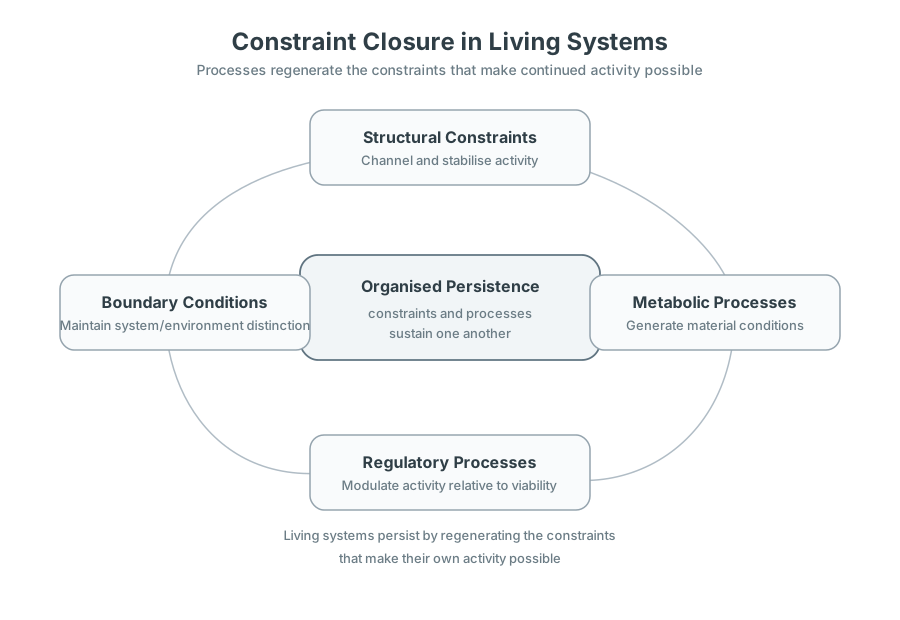
Constraint Closure in Living Systems. Constraint closure describes reciprocal organisation in which living processes maintain constraints that contribute to the continuation of organised activity. In APS, this provides part of the organisational starting point for explanatory inquiry; it does not by itself determine an adequate biological explanation.
Why Living Organisation Places Demands on Explanation
Once life is treated as organised persistence rather than material constancy, APS asks how inquiry into such an organisation should be structured.
Living systems remain organised while undergoing continual change. Components turn over, physiological states fluctuate, development transforms the organism, environments change, and lineages persist through reproduction and inheritance. An explanatory architecture concerned with such systems must therefore be capable of asking about activity, transformation, and the spatial and temporal organisation of persistence.
Within APS, Agency, Process, and Scale provide those complementary perspectives. This is an architectural proposal, not a claim that every biological explanation must take the same form.
The distinction is important. APS’s account of life motivates explanatory questions; it does not determine their answers.
Agency, Process, and Scale as Analytic Projections
Agency concerns the viability-oriented activity through which living organisation sustains conditions of persistence.
Process concerns how organised biological change occurs.
Scale concerns where persistence is organised across spatial and temporal extents.
These are complementary analytic projections of one organisation. They are not components into which an organism can be decomposed, stages through which explanation must proceed, hierarchical levels, or independent causal powers.
A particular explanandum may foreground one projection, require two, or require relations involving all three. Their relevance must be established for the explanatory target rather than assumed from the APS architecture itself.
This is the first boundary between architecture and biological explanation: APS supplies questions and distinctions; biological investigation determines which are relevant and what answers they receive.
For the detailed APS treatment of spatial and temporal extent, see Scale — How Life Is Coordinated Across Space and Time.
An Explanatory Architecture, Not an Explanatory Grammar
APS therefore does not provide a universal explanatory grammar into which every biological phenomenon must be fitted.
Its architecture performs a more limited function. It helps ask whether a specified phenomenon is adequately understood in relation to viability-oriented activity, biological change, and the spatial and temporal organisation of persistence.
That distinction protects explanatory plurality. A molecular mechanism does not become incomplete merely because it can be redescribed in APS terminology. A physiological explanation need not invoke every APS projection. An evolutionary explanation does not become an APS explanation simply because persistence across generations can be identified.
The explanatory target comes first.
Only after that target has been specified can APS ask which projections, relationships, and dependencies are relevant to explaining it.
From Architecture to Domain-Specific Explananda
An APS investigation should therefore begin by specifying the explanandum rather than by searching for Agency, Process, and Scale.
The target might concern maintenance of a physiological variable, regeneration after injury, developmental stability, behavioural adjustment, persistence under environmental change, or another biological phenomenon. Different explananda legitimately require different explanatory resources.
Once the target is clear, APS can ask more discriminating questions. Which activities make a viability-relevant difference to the phenomenon? Through what processes is the relevant change produced or maintained? Across which spatial and temporal extents is the organisation required for the phenomenon realised?
These questions can organise investigation without predetermining its outcome.
The sequence is therefore:
specified explanandum → relevant analytic projection(s) → candidate explanatory relationships
rather than:
Agency → Process → Scale → explanation.
Relations, Dependencies, and Material Organisation
An explanatory architecture can identify relationships worth investigating. It cannot establish those relationships merely by representing them.
Suppose an APS analysis suggests that a biological phenomenon depends upon interactions extending across cellular, tissue, organismal, or temporal extents. That suggestion becomes biologically explanatory only when the relevant relations can be specified materially.
What interacts with what? Through which processes? Under what conditions? Over what timescale? What would be expected to change if the proposed dependency were altered? Contemporary causal and mechanistic approaches already provide powerful resources for addressing questions of this kind (Machamer, Darden, and Craver 2000; Woodward 2003).
APS does not replace those resources. Its possible contribution is to help identify dependencies that matter because of their relation to the organised persistence of the system under investigation.
The same restriction applies across the three projections. Calling an activity viability-oriented identifies its APS significance but does not specify its material mechanism. Identifying a process does not establish its contribution to persistence. Likewise, the occurrence of phenomena at different scales does not establish causal coupling between them.
Scale itself does not coordinate or cause biological activity. Such work is performed by materially realised interactions, constraints, and processes.
The explanatory sequence must therefore proceed beyond architecture:
candidate relationship → specified biological dependency → material implementation → evidence.
Continuity Across Biological Time and Scale
A concept linking the APS account of life to this explanatory architecture is Organised Persistence.
Living systems persist through change. Their material constituents turn over, their states fluctuate, and their developmental and environmental circumstances alter. Persistence therefore does not ordinarily mean preservation of an identical material state. It concerns continuity of living organisation through change.
Within APS, Organised Persistence helps organise questions about what is maintained, restored, transformed, or reproduced; through which processes this occurs; and across which spatial and temporal extents the relevant organisation persists.
This gives the concept an explanandum-organising and integrative role. It does not make Organised Persistence an additional causal entity, nor does it establish that explanations formulated through it are superior to mechanistic, physiological, developmental, ecological, or evolutionary explanations.
Its value must instead be assessed in relation to particular explanatory targets.
For the fuller treatment, see Persistence — Organised Continuity Through Time.
Architecture Does Not Guarantee Explanation
This boundary becomes especially important when APS moves from conceptual architecture to empirical investigation.
A proposed dependency must be supported by evidence appropriate to the kind of relation being claimed. Causal, mechanistic, organisational, developmental, historical, and other dependencies need not require identical forms of evidence.
Perturbation can provide evidence about a proposed dependency when the intervention and resulting change bear appropriately on that dependency. Such evidence must still be interpreted relative to the claim, experimental design, and relevant alternatives.
This logic is not uniquely APS. The possible APS contribution lies in helping identify which dependencies merit explicit investigation because of their relation to organised persistence.
But a successful APS redescription is not yet a successful APS explanation.
If APS reorganises established knowledge without revealing a relevant dependency, resolving an explanatory difficulty, generating a useful discrimination, or otherwise changing what can be explained, its contribution may be conceptual, integrative, methodological, or heuristic rather than substantively explanatory.
Those are legitimate contributions. They should not be confused with explanatory gain.
From Explanatory Architecture to Comparative Method
Biology is explanatorily plural. Different fields address different questions using different methods and explanatory resources, and relations among those explanations need not be simple (Marchionni 2008; Gijsbers 2016).
APS can investigate whether explanations directed at different aspects of living systems can be related through their bearing on organised persistence. Such integration can be scientifically useful, but integration is not automatically explanatory gain.
Showing that APS can describe or organise a phenomenon is therefore insufficient. Where additional explanatory capacity is claimed, the relevant question becomes comparative:
What does the APS-guided account contribute relative to the strongest relevant alternative addressing the same explanatory target?
Target matching comes first. Approaches directed at different explananda should not be ranked as though they answered the same question, and a weak or obsolete comparator cannot establish a meaningful advantage.
The detailed comparison procedure belongs to How Should Scientific Explanations Be Compared?. The important point here is architectural: APS explanation becomes a comparative question once explanatory gain is claimed.
APS as a Research Programme
The transition from life to explanation therefore changes the scientific role of APS.
A framework can remain principally conceptual if it organises ideas. A research programme must expose those ideas to investigation.
For APS, the resulting sequence is:
living organisation → specified explanandum → relevant Agency–Process–Scale projection(s) → proposed dependency → material implementation → evidence → strongest relevant comparator where required → bounded result
Not every investigation will require every projection. Not every proposed dependency will survive testing. Not every comparison will reveal explanatory gain.
Negative and null findings are therefore informative. They can show where APS contributes clarification or integration without additional explanatory capacity, where an established explanation is already sufficient, where a proposed dependency lacks support, or where an APS claim requires restriction or revision.
The scientific standing of APS cannot be established simply by extending its vocabulary into additional areas of biology. It depends upon the cumulative results of controlled investigations.
For the methodology of framework testing, see How Should a New Scientific Framework Be Tested?.
What Would Count as Explanatory Gain?
APS treats explanatory gain as target-relative and comparator-relative.
Conceptual clarification, integration, methodological guidance, and heuristic organisation can all be genuine scientific contributions. None automatically establishes substantive explanatory superiority.
For a specified target, stronger explanatory gain would require showing that an APS-guided analysis adds relevant explanatory capacity relative to an appropriately strong alternative—for example by identifying and supporting a dependency required for the target that the comparator does not capture.
A null result is equally legitimate. If the strongest comparator already explains the target and APS contributes only redescription, no additional explanatory gain has been demonstrated for that target.
Neither result should automatically be generalised to the framework as a whole.
The full criteria are developed in What Counts as Explanatory Gain?, while What Happens When APS Is Tested Against Its Strongest Comparators? shows how proposition-specific comparison can produce different outcomes.
A Bounded Example: Cognition
Cognition illustrates the transition from architecture to biological warrant particularly clearly.
Within APS, cognition is not synonymous with life, biological agency, or regulation. The framework proposes a more specific boundary involving the integration of biological significance across a temporal field of viability-relevant possibilities.
The important point here is methodological rather than a full account of cognition. APS architecture can formulate a candidate distinction. Biological cases must then establish whether the proposed dependencies are materially realised and whether an adequate non-cognitive explanation is sufficient.
Cognition therefore exemplifies the larger sequence:
architectural distinction → biological application → discriminating evidence → comparative assessment.
The substantive cognition architecture and its empirical boundary are treated in Cognition — Where Does It Belong in Biology?.
See Also
Related Articles
References
- (2016). Explanatory Pluralism and the (Dis)Unity of Science: The Argument from Incompatible Counterfactual Consequences. Frontiers in Psychiatry, 7 . https://doi.org/10.3389/fpsyt.2016.00032
- (2000). Thinking About Mechanisms. Philosophy of Science, 67(1), 1–25 . https://doi.org/10.1086/392759
- (2008). Explanatory Pluralism and Complementarity: From Autonomy to Integration. Philosophy of the Social Sciences, 38(3), 314–333 . https://doi.org/10.1177/0048393108319399
- (2015). Biological Organisation as Closure of Constraints. Journal of Theoretical Biology, 372, 179–191 . https://doi.org/10.1016/j.jtbi.2015.02.029
- (2015). Biological Autonomy: A Philosophical and Theoretical Enquiry. Springer. https://doi.org/10.1007/978-94-017-9837-2
- (2003). Making Things Happen: A Theory of Causal Explanation. Oxford University Press. https://doi.org/10.1093/0195155270.001.0001