Scale, Time, and Persistence — Why Life Exists Only Through Organised Continuity
This article explains how temporal continuity and Scale contribute to the APS account of organised persistence. Living systems persist through materially realised organisation that is continually maintained and re-established through change. That organisation extends across spatial and temporal extents appropriate to the biological processes being explained. Time makes the continuity of living organisation explicit; Scale identifies where that persistence is organised across spatial and temporal extents. Neither is an independently acting cause or component of life. Together they provide complementary explanatory perspectives on the organised continuity through which living systems persist.
Key Points
- Living systems persist through organised continuity rather than material constancy.
- Persistence is an ongoing organisational achievement enacted through time.
- Materially realised biological organisation can extend across different spatial and temporal extents.
- Scale is the analytic projection concerned with where persistence is organised across spatial and temporal extents.
- Scale does not coordinate, integrate, or cause biological persistence; living organisation performs the relevant causal and coordinative work.
- Temporal continuity and Scale provide complementary explanatory perspectives on one living organisation rather than co-constitutive components of persistence.
- The spatial and temporal extent relevant to an explanation must be established from the biological explanandum rather than assumed in advance.
Scale, Time, and Persistence — Why Life Exists Only Through Organised Continuity
Where this article fits: This Synthesis article brings together organised persistence, temporal continuity, and the APS analytic projection of Scale. It does not redefine Scale or treat time and Scale as additional components of living organisation. The Core Scale article establishes Scale as the analytic projection concerned with where persistence is organised across spatial and temporal extents. The present article asks how that explanatory perspective contributes to understanding living systems whose organisation continues through material and temporal change.
Persistence as Organised Continuity
Living systems exist through continuity, but biological continuity does not mean remaining materially unchanged. Cells replace components, molecules are synthesised and degraded, structures are repaired and remodelled, and physiological conditions fluctuate as organisms develop, act, and respond to changing environments. The material composition of a living system can therefore change substantially while its organisation continues.
APS describes the explanatory problem posed by this continuity as organised persistence. Persistence is neither simply the continued presence of matter nor passive resistance to change. It is the continuing maintenance and re-establishment of the organisation through which a living system remains viable despite ongoing material transformation. The central explanatory question is therefore not merely what remains unchanged, but how living organisation is maintained and re-established through change. This places continuity itself among the principal targets of biological explanation.
Time as Organised Continuity
Living organisation is necessarily enacted through time. A static description can identify structures, components, concentrations, boundaries, or relations at a particular moment, and such descriptions may be indispensable, but living organisation cannot be exhausted by a succession of static states. Metabolic activity continues, constraints are maintained or regenerated, damage is repaired, and regulatory relations modify activity as conditions change. Development likewise transforms organisation while preserving sufficient continuity for the developing system to remain viable.
Time matters, then, because persistence is temporally extended activity, not because time acts as an independent biological cause. It is the organism’s materially realised activity that maintains and re-establishes its organisation through time. Temporal analysis makes this continuity and transformation explicit without turning time itself into the source of biological organisation.
Scale and the Extent of Organised Persistence
Temporal continuity alone does not determine where the organisation relevant to persistence is realised. Depending upon the explanandum, biological explanation may require molecular interactions within a local cellular region, relations distributed across tissues and organs, organism-wide regulation, organism–environment coupling, or processes extending over developmental or evolutionary durations. APS addresses this question of explanatory extent through Scale.
Scale is the analytic projection concerned with where persistence is organised across spatial and temporal extents.
Scale does not coordinate the processes through which persistence is maintained, nor does it integrate molecular, cellular, physiological, developmental, ecological, or evolutionary processes into a biological whole. Living organisation performs the relevant causal and coordinative work. Where integration occurs, it must be materially realised through actual biological relations—interactions, constraints, structures, boundaries, regulatory processes, environmental conditions, or other dependencies established in the biological case. Scale identifies the spatial and temporal extent over which those relations must be followed when they matter to the explanandum. In this way, an explanatory perspective is kept distinct from the biological mechanisms and relations being explained.
Spatial Organisation and Explanatory Scale
Spatial organisation can itself contribute materially to biological organisation. Hermida and Ladyman (2026) emphasise that position, configuration, shape, orientation, directionality, boundaries, and physical relations among biological parts can be constitutively important to biological phenomena. APS accepts the importance of such spatial organisation without identifying it with Scale.
A membrane boundary can materially constrain interaction, the location of a signalling component can affect what it does, tissue geometry can alter physiological possibilities, and the spatial arrangement of cells can contribute directly to development or function. These are properties and relations of the materially realised organisation itself. Scale asks a different question: across what spatial and temporal extents must that organisation be identified in order to explain the persistence-relevant phenomenon under investigation?
Material spatial organisation and explanatory Scale are therefore related but distinct. Spatial organisation belongs to the biological organisation being explained; Scale identifies the analytic perspective from which the relevant extent of that organisation becomes explicit.
Persistence Across Differing Extents
Living systems depend upon activities whose characteristic spatial and temporal extents differ substantially. Molecular interactions may occur rapidly and locally, cellular organisation may be maintained across longer durations and larger spatial regions, and physiological regulation may depend upon relations distributed throughout an organism. Development extends organised transformation across substantial portions of a lifetime, while organism–environment relations may persist or recur over still different durations and spatial extents.
These differences imply neither a hierarchy of increasingly important biological levels nor processes belonging to independently acting scales. They show instead that the organisation relevant to a biological explanation may have to be traced across different extents. A local account can be sufficient when the explanandum is local and the relevant dependencies are adequately captured within that boundary. A more extended account becomes necessary only when the explanandum depends upon organisation that the local description does not adequately represent.
Scale is therefore target-sensitive. The widest explanation is not automatically the best explanation. The relevant extent is determined by the organisation required to explain the biological target.
Viability Through Time
Organised persistence is viability-relative. A living system does not merely undergo change; its organisation maintains and re-establishes conditions under which continued functioning remains possible. Biological continuity therefore differs from the persistence of an inert structure. A rock can remain physically present without actively maintaining the conditions of its own existence, whereas a living system continually participates in maintaining the organisation upon which its continued activity depends.
Within APS:
Life is viability-oriented, constraint-closed organisation.
This organisation consists in the ongoing modulation of constraints through which a system actively maintains and re-establishes the conditions of its own persistence. Persistence concerns the continuation of this organisation through time, while Scale asks where that persistence-relevant organisation is realised. Neither viability nor persistence is thereby distributed automatically across every domain connected to a living system. Claims about viability, agency, normativity, or persistence must remain indexed to the organisation for which the relevant relations are established.
Persistence as Organisational Achievement
The persistence of a living system is an achievement of organisation rather than the conservation of a fixed material state, a point that becomes particularly clear under perturbation. A living system can be displaced from an existing condition and nevertheless continue because its organisation modifies activity, repairs damage, restores constraints, reorganises relations, or establishes a new viable trajectory. Continuity can therefore be maintained through substantial transformation rather than through the preservation of an invariant state.
Homeorhesis captures an important aspect of this phenomenon by describing persistence in terms of an organised trajectory rather than repeated return to a fixed condition. APS places this insight within the broader problem of organised persistence. The explanatory target is not an abstract trajectory by itself but the materially realised organisation through which viable continuity is maintained despite transformation. Temporal analysis makes continuity through change explicit; Scale identifies the spatial and temporal extent across which the relevant organisation must be followed.
Scale, Time, and Biological Significance
The relationship between Scale and time also matters when biological activity acquires significance for the living system. A change matters biologically because of its relation to viability, and the same environmental event can therefore have different consequences depending upon the organisation of the system, its current condition, its history, and the temporal possibilities opened or closed by that event. Biological significance need not, for this reason, be confined to an instantaneous local interaction.
In organisms capable of integrating biological significance across time, present activity can be modulated in relation to temporally extended viability-relevant possibilities. This does not mean that Scale produces significance or cognition, nor does temporal extension by itself establish cognition. Scale instead helps delimit where the materially realised organisation relevant to the explanandum must be located. The explanatory requirements for agency, biological evaluation, cognition, and other organisational capacities must then be established independently rather than inferred merely from spatial or temporal extension.
Developmental, Ecological, and Evolutionary Continuity
Developmental, ecological, and evolutionary phenomena introduce explanatory targets extending beyond many immediate physiological processes. Development concerns organised transformation through an individual lifetime, ecological explanation can require organism–environment relations extending beyond organismal boundaries, and evolution concerns historical transformation across generations. These phenomena should not be collapsed into a single multiscale causal process, because their explananda and characteristic temporal extents differ and the biological organisation relevant to each must be established independently.
APS therefore does not infer that an ecological system or evolutionary lineage possesses the same viability-oriented organisation as an organism merely because organismal persistence depends upon environmental or historical relations. Nor does the existence of long-duration processes establish a wider agent encompassing the organisms involved. Scale instead asks:
Where is the organisation relevant to this particular explanandum realised, and across what spatial and temporal extents must it be followed?
This question allows developmental, ecological, and evolutionary relations to enter explanation where they are materially relevant without transferring organismal properties to wider domains without evidence.
Multiscale Temporality
Biological processes occur over markedly different temporal durations and spatial extents, and representing those differences can be useful when it clarifies the organisation relevant to an explanandum. Such representations should not, however, be interpreted as depicting independently acting biological scales, nor should arrows among domains be taken to mean that Scale itself mediates causal influence. The causal relations remain materially realised biological relations; Scale identifies their relevant explanatory extent.
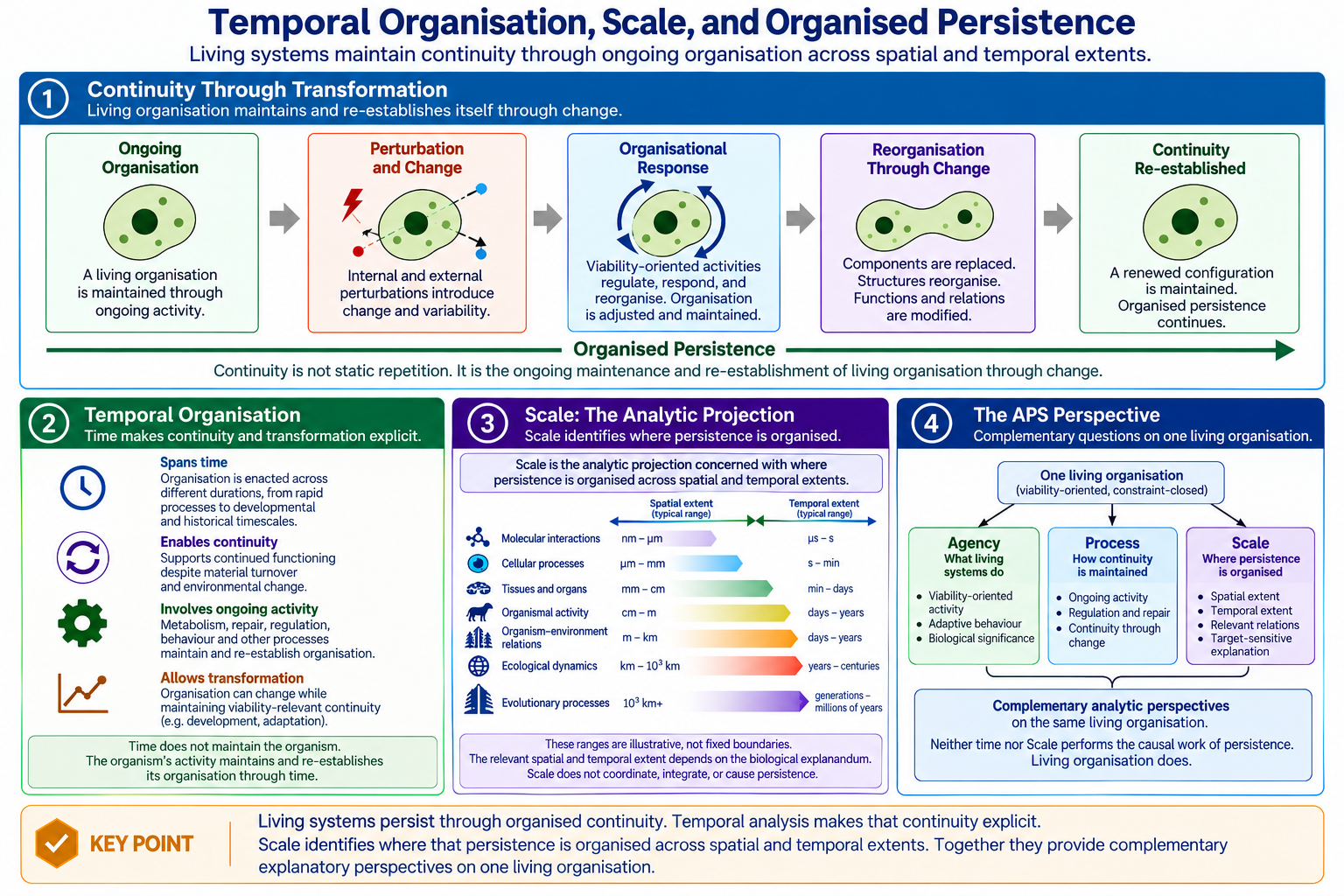
Temporal Organisation, Scale, and Organised Persistence.
Living systems maintain and re-establish their organisation through change. Temporal analysis makes this continuity explicit, while Scale identifies where persistence is organised across spatial and temporal extents. Agency, Process, and Scale provide complementary analytic perspectives on one viability-oriented, constraint-closed organisation rather than independently acting causes or levels.
Scale, Time, and the APS Triad
The relation between Scale, time, and persistence becomes clearest within the APS explanatory architecture. APS distinguishes three analytic projections:
- Agency concerns what living systems do.
- Process concerns how continuity is maintained despite change.
- Scale concerns where persistence is organised across spatial and temporal extents.
These projections concern one viability-oriented, constraint-closed organisation. They are not three components whose interaction produces persistence, nor does Scale integrate Agency and Process across biological domains. Rather, the projections give different explanatory priority to different questions about the same materially realised living organisation. Agency foregrounds viability-oriented organisational activity, Process foregrounds continuity through change, and Scale foregrounds the spatial and temporal extent across which that persistence is organised.
Organised persistence is therefore not an emergent product of an Agency–Process–Scale interaction. It is the continuity of the living organisation that these analytic projections allow biology to investigate from complementary explanatory perspectives.
Implications for Biological Explanation
Bringing Scale and temporal continuity together has several consequences for biological explanation. Biological persistence cannot be understood simply as material endurance because the relevant organisation is continually enacted and re-established, and the spatial and temporal boundaries of an explanation cannot always be assumed in advance. Those boundaries must instead be established from the explanandum and from the materially realised dependencies relevant to it.
Extending an explanation across more domains likewise does not automatically increase explanatory adequacy. A local explanation may be sufficient, while a more extended explanation is warranted only where additional relations make an explanatory difference to the target. For the same reason, spatial structure and spatial extent must not be conflated. Material spatial organisation can contribute causally or constitutively to biological phenomena; Scale identifies the explanatory extent across which such organisation is relevant.
Finally, differences among spatial and temporal extents do not establish a hierarchy of biological causation. Where wider organisation affects local activity, explanation must identify the materially implemented constraints and relations through which local conditions are altered. A wider domain does not supersede local causation merely by being wider.
Explanatory Architecture
Central Question
How does materially realised living organisation maintain continuity through time, and across what spatial and temporal extents must that organisation be identified to explain its persistence?
Architectural Role
This Synthesis article connects organised persistence with temporal continuity and the APS projection of Scale. It does not establish Scale as an additional biological mechanism or treat time and Scale as co-constitutive components of living organisation. Temporal analysis concerns the continuity and transformation through which organisation persists, while Scale concerns where that persistence is organised across spatial and temporal extents. The biological organisation itself performs the causal, regulatory, and coordinative work.
Dependency on the Core Scale Article
The meaning of Scale used here is governed by the Core Scale article:
Scale is the analytic projection concerned with where persistence is organised across spatial and temporal extents.
Accordingly, this Synthesis article does not use Scale to denote an ontological level, a causal domain, a coordinating mechanism, a spatial structure, or an independently acting dimension of life. Material organisation can extend across multiple spatial and temporal extents without Scale itself becoming a material component of that organisation.
Spatial-Organisation Comparator
Hermida and Ladyman (2026) provide a contemporary account of the biological importance of materially realised spatial structure. Their analysis helps clarify why position, configuration, boundary, orientation, and physical interaction can matter directly to biological organisation, but APS Scale should not be substituted for those material relations. Where spatial organisation itself explains the target, describing its extent in APS Scale terms does not by itself constitute additional explanatory gain. Any stronger APS contribution requires target-matched comparison.
Position Within APS
The article therefore synthesises three closely connected questions without collapsing them:
What persists?
Viability-oriented, constraint-closed organisation.
How does it persist?
Through ongoing organisational activity that maintains and re-establishes continuity despite change.
Where is that persistence organised?
Across the spatial and temporal extents established by the organisation relevant to the explanandum.
Agency, Process, and Scale make different aspects of this single explanatory architecture explicit.
Conclusion
Life exists through organised continuity. Living systems persist not because their material components remain unchanged, but because their organisation is continually enacted, maintained, modified, and re-established through time. That organisation is materially realised through processes, structures, constraints, boundaries, interactions, and environmental relations whose relevant spatial and temporal extents differ with the biological explanandum.
Time makes the continuity and transformation of living organisation explicit, while Scale makes its relevant extent explicit. Neither performs the causal work of persistence; living organisation does. APS therefore does not explain persistence as the product of interacting scales or as the outcome of independently acting Agency, Process, and Scale components. It explains one viability-oriented, constraint-closed organisation through complementary analytic projections.
Life persists through organised continuity; Process asks how that continuity is maintained despite change, and Scale asks where that persistence is organised across spatial and temporal extents.
See Also
Related Articles
References
- (2026). The Importance of Spatial Structure in Biology. European Journal for Philosophy of Science, 16(3) . https://doi.org/10.1007/s13194-026-00760-x
- (2015). Biological Autonomy: A Philosophical and Theoretical Enquiry. Springer.
- (2023). Organization in Biology. Springer.
- (2018). Everything Flows: Towards a Processual Philosophy of Biology. Oxford University Press.