APS as Philosophy — A Viability-Oriented Reconstruction of Biological Intelligibility
This article presents the Agency–Process–Scale (APS) framework as a philosophical reconstruction of biological intelligibility grounded in viability-oriented organised persistence sustained across time. APS is developed not merely as a conceptual vocabulary for biology, but as an explanatory grammar specifying the organisational conditions under which living systems regulate continuity, adapt to perturbation, generate normativity, sustain purposive organisation, produce semiosis and meaning, and maintain viable persistence through ongoing transformation across interacting scales and timescales.
Key Points
- APS reconstructs biological explanation around viability-oriented organised persistence.
- Living systems remain viable through dynamically regulated continuity rather than static stability.
- Constraint closure explains how living systems continuously regenerate the conditions of their own persistence.
- Normativity, purposiveness, evaluation, and meaning emerge intrinsically from viability-oriented organisation.
- Mechanisms are indispensable but biologically intelligible only within organised persistence.
- Semiosis and meaning emerge through evaluative organisation rather than abstract symbol manipulation.
- Agency, process, and scale function as co-constitutive dimensions of organised continuity.
- APS operates as an explanatory grammar for biology rather than a single explanatory principle.
- The framework integrates insights from process philosophy, autonomy theory, enactivism, systems theory, mechanistic biology, and biosemiotics within a continuity-oriented organisational architecture.
Where This Article Fits: This article examines APS as a philosophical project. Its purpose is not to explain the biological architecture of the framework but to consider what follows when APS is viewed as a systematic attempt to understand reality, knowledge, explanation, meaning, and the place of life within the natural world. Readers seeking APS’s philosophy of biology should consult The Philosophical Foundations of APS. That article develops APS’s account of life, agency, organised persistence, biological explanation, and its relationship to contemporary philosophy of biology. The present article addresses a broader question: whether APS provides a distinctive philosophical perspective extending beyond biology itself. The two articles therefore serve complementary purposes. The Philosophical Foundations of APS explains the biological and explanatory foundations of the framework. APS as Philosophy explores the wider philosophical implications of those foundations and considers how APS relates to larger questions concerning reality, knowledge, meaning, value, and human understanding.
Philosophy Returns Through Biology
Modern biology is one of humanity’s greatest intellectual achievements. Over the course of several centuries, living systems were transformed from objects of speculation, theological interpretation, and natural history into objects of increasingly rigorous scientific investigation. Evolutionary theory explained adaptation without invoking external design. Physiology revealed the mechanisms underlying regulation and metabolism. Genetics illuminated the inheritance of biological organisation. Molecular biology exposed the biochemical foundations of life. Ecology revealed the relational structures linking organisms and environments. Across a remarkable range of domains, biology demonstrated that living systems could be investigated scientifically without abandoning explanatory depth.
Yet the very success of biology generated an unexpected consequence. As biological explanation became increasingly sophisticated, it also became increasingly dependent upon concepts whose deeper significance remained difficult to articulate. The empirical achievements of the life sciences did not eliminate conceptual questions. In many cases, they made those questions more visible.
Biologists routinely speak of function, adaptation, regulation, organisation, information, signalling, cognition, meaning, resilience, malfunction, agency, and normativity. Organisms are described as maintaining themselves, responding to challenges, preserving viability, repairing damage, coordinating activity, evaluating conditions, and pursuing continuity under changing circumstances. Biological explanations continually distinguish between activities that contribute to persistence and activities that undermine it. Such distinctions are not optional features of biological discourse. They are woven deeply into the explanatory practices of the discipline.
Yet the conceptual status of these ideas remains contested. How can biological systems possess functions without externally imposed purposes? How can normativity emerge within a fully naturalistic world? How can organisation become explanatorily significant without invoking vitalistic forces? How can meaning and semiosis arise within systems composed entirely of physical processes? How can living systems be understood as agents without implying consciousness, intentionality, or psychological subjectivity? The more successful biology became as a science, the more urgently such questions demanded clarification.
The philosophical challenge therefore changed. The problem was no longer whether living systems could be explained scientifically. Biology had already demonstrated that they could. The deeper question became how the conceptual foundations of biological explanation themselves should be understood. Why do explanatory concepts such as function, adaptation, regulation, persistence, viability, and organisation appear repeatedly across otherwise diverse biological domains? What makes these concepts indispensable? What kind of world must living systems inhabit for such forms of explanation to make sense?
APS begins from this challenge. It does not approach philosophy as an external critique imposed upon biology from outside, nor does it treat biology as a collection of examples awaiting philosophical interpretation. Instead, APS argues that biology generates philosophical questions through its own explanatory successes. The conceptual problems addressed by philosophy of biology are not imposed upon the life sciences from elsewhere. They emerge from biology’s own attempts to understand living systems.
In this sense, philosophy returns through biology. The task is not to replace scientific explanation with metaphysical speculation, nor to subordinate empirical investigation to abstract theory. The task is to clarify the organisational conditions that make biological explanation possible in the first place. APS approaches this task by asking what must be true of living organisation for concepts such as agency, function, normativity, meaning, adaptation, and persistence to become intelligible within a naturalistic account of life.
Where this article fits: This article presents APS as a philosophical reconstruction of biological intelligibility. It builds upon the framework introduced in What Is APS?, How APS Explains Life, Understanding APS, and APS as a Viability-Oriented Framework, and asks a deeper question: What kind of organisation must exist for biological explanation itself to become possible?
Why Biology Requires Philosophy
The relationship between biology and philosophy is frequently misunderstood. Philosophy is often portrayed as something science eventually leaves behind. On this view, conceptual questions exist only temporarily, occupying explanatory gaps that disappear as empirical knowledge advances. As mechanisms become better understood, philosophy is expected to retreat. APS argues that the history of biology suggests the opposite pattern.
Scientific success often generates new philosophical questions precisely because it reveals the conceptual commitments embedded within explanation. The more effectively a science explains its subject matter, the more clearly its underlying explanatory architecture becomes visible. Biology provides a particularly striking example of this phenomenon because its explanatory achievements repeatedly expose concepts whose significance cannot be reduced to the empirical discoveries that first brought them to attention.
Evolutionary theory offers an important illustration. Darwinian and post-Darwinian biology explained adaptation without appealing to external design, yet the success of evolutionary explanation did not eliminate questions concerning function, purposiveness, and biological normativity. On the contrary, the explanatory power of evolutionary theory made such questions more pressing. If organisms are not designed from outside, why does biological explanation continue to rely upon concepts that appear purpose-like? Why do functions remain indispensable within biological reasoning?
A similar pattern appears within molecular biology. The extraordinary success of mechanistic explanation revealed molecular pathways, regulatory networks, and biochemical interactions with unprecedented precision. Yet increasing mechanistic detail did not remove questions concerning organisation, biological individuality, developmental coordination, or system-level continuity. Instead, it highlighted the need to understand how mechanisms participate within larger organisational wholes.
The same dynamic can be observed across neuroscience, systems biology, ecology, developmental biology, and cognition research. As explanatory knowledge expands, biology repeatedly encounters questions concerning agency, meaning, evaluation, organisation, resilience, identity, and continuity. These concepts are not remnants of a pre-scientific worldview waiting to be discarded. They persist because they perform indispensable explanatory work. Biology continues to rely upon them because living systems exhibit forms of organisation that cannot be adequately characterised without them.
This observation reveals an important distinction. Empirical investigation discovers how living systems operate. Philosophy asks why the forms of explanation employed by biology take the shape that they do. These enterprises are different, but they are not opposed. Scientific investigation and conceptual clarification address different aspects of the same explanatory project. Biology investigates living systems; philosophy seeks to understand the conceptual architecture through which those systems become intelligible.
APS therefore treats philosophy not as a rival to biology but as a continuation of biology’s own explanatory ambitions. Its goal is not to prescribe what biology ought to discover. Its goal is to clarify why biological explanation repeatedly returns to concepts such as function, organisation, persistence, adaptation, regulation, cognition, and viability. Rather than treating these concepts as isolated explanatory tools, APS asks what unifies them and why they appear together across such a wide range of biological domains.
The answer proposed by APS is that these concepts converge upon a common organisational reality. Living systems must maintain themselves through time despite continual transformation, uncertainty, and perturbation. The conceptual vocabulary of biology reflects this challenge. Agency, function, normativity, adaptation, meaning, and regulation all become intelligible because they emerge within systems organised around the preservation of viable continuity. Philosophy becomes necessary not because biology has failed to explain life, but because understanding the success of biological explanation requires understanding the organisational conditions that make such explanation possible.
From Biological Framework to Philosophical Reconstruction
APS is often first encountered as a biological framework. Its initial claims concern living systems, not philosophy. Organisms are understood as viability-oriented forms of organised persistence sustained across time. Agency, process, and scale function as the primary dimensions through which living continuity becomes intelligible. Development, ecology, evolution, cognition, diagnosis, and social organisation become domains through which that continuity is maintained, transformed, challenged, and renewed. At this stage, APS appears to be offering a theoretical account of biological organisation.
Yet as the framework develops, a deeper implication gradually emerges. The concepts introduced by APS do not merely describe living systems. They identify the organisational conditions under which living systems become intelligible as living systems at all. The framework therefore begins to operate simultaneously in two ways. It describes biological reality while also clarifying the conditions that make biological explanation possible.
This transition is significant because philosophy of biology has often treated ontology and explanation as distinct projects. One asks what living systems are. The other asks how they should be explained. APS argues that these questions are more closely related than is often recognised. The organisational conditions that make life possible are also the organisational conditions that make biological explanation possible. The explanatory vocabulary of biology emerges because living systems possess particular forms of organisation. To understand why biology explains as it does therefore requires understanding the nature of the phenomena being explained.
Consider continuity. To say that living systems persist through organised continuity is not merely to describe a biological fact. It is to identify the explanatory condition that makes biological identity intelligible despite continual material turnover. Organisms remain recognisably the same systems while their constituents are replaced, their structures reorganise, and their relationships change. Biological explanation repeatedly returns to continuity because continuity is one of the central phenomena that biology seeks to understand.
The same logic applies to viability. To describe living systems as viability-oriented is not merely to characterise their behaviour. It is to explain why biological explanation continually invokes concepts such as success and failure, function and malfunction, adaptation and breakdown. Viability introduces distinctions that matter to the continued persistence of the system. These distinctions provide the foundation from which biological normativity becomes intelligible. Biology does not arbitrarily employ normative concepts. It does so because living systems are organised around the maintenance of viable continuity.
Process occupies a similarly important position. APS treats living systems as fundamentally processual, but not because change itself is philosophically fashionable. The significance of process lies in its explanatory necessity. Biological identity cannot be understood through static composition alone because living systems persist through ongoing activity. Metabolism, development, regulation, repair, learning, adaptation, and reproduction are not events occurring to an otherwise stable entity. They are constitutive of the entity’s continued existence. The processual character of life therefore reflects an explanatory reality rather than a terminological preference.
Scale introduces a further philosophical consequence. Biological continuity is never maintained at a single scale of organisation. Organisms persist through interactions linking molecular, cellular, physiological, behavioural, ecological, developmental, and evolutionary processes. No single scale possesses explanatory privilege. Biological intelligibility therefore requires understanding how continuity is distributed across interacting organisational relations. APS treats scale not merely as a problem of complexity but as a condition of biological explanation itself.
Viewed individually, these claims appear biological. Viewed collectively, they reveal something deeper. They specify the organisational architecture through which biological phenomena become intelligible. The framework therefore undergoes a gradual transformation. What initially appears to be a theory about living systems increasingly becomes a reconstruction of the conditions under which living systems can be understood.
APS consequently asks a different question from many traditional biological theories. It does not ask only:
What are living systems?
It also asks:
What organisational conditions must exist for living systems to become biologically intelligible?
This shift marks the transition from biological framework to philosophical reconstruction. Biology remains the starting point, but the framework increasingly concerns the organisational conditions that make biological explanation possible. Ontology and explanation converge because both ultimately depend upon the same continuity-preserving forms of organisation.
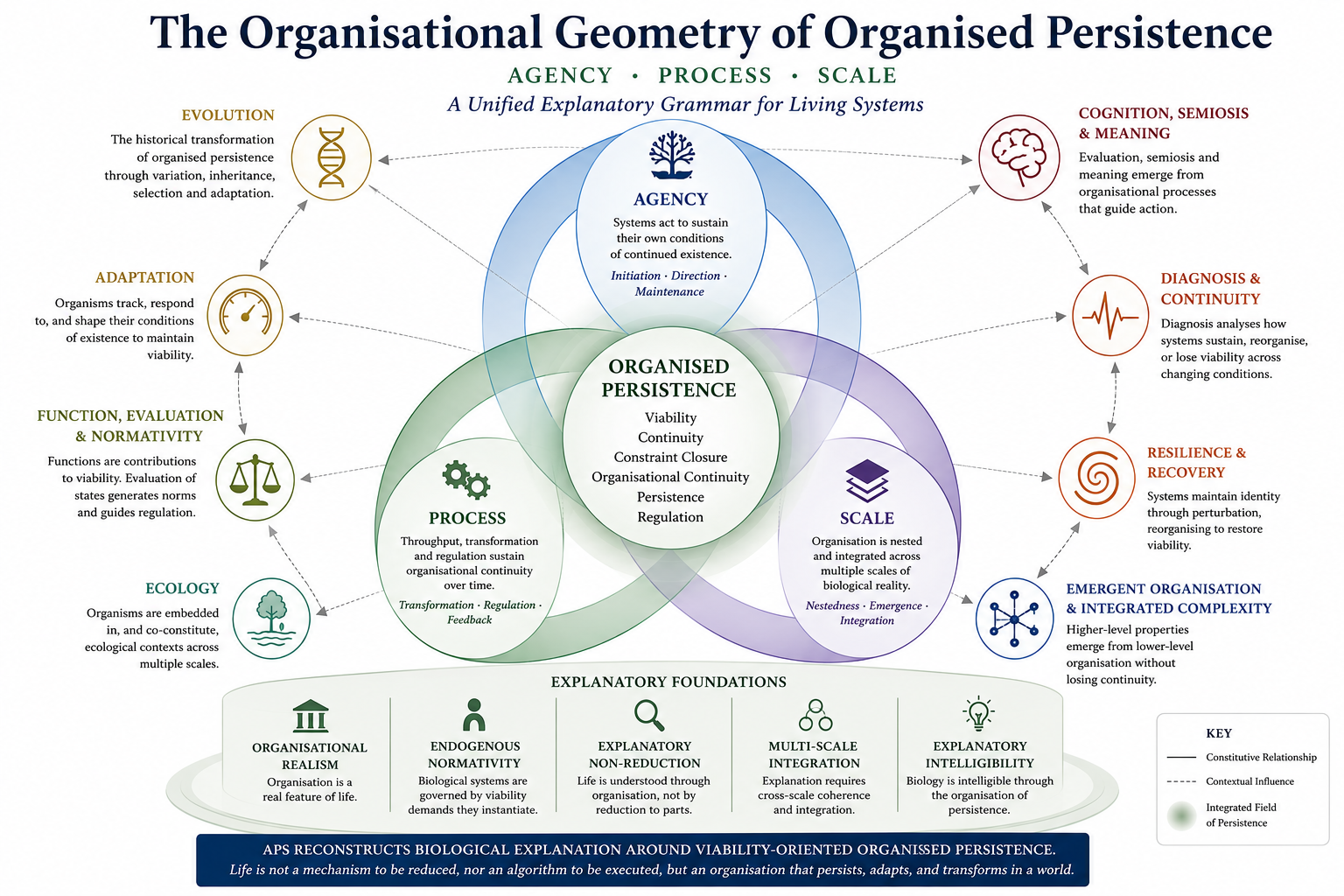
The Organisational Geometry of Organised Persistence. APS reconstructs biological intelligibility around viability-oriented organised persistence sustained through continuity, regulation, evaluation, semiosis, and transformation across interacting scales.
Explanatory Grammar and Biological Intelligibility
One of the most distinctive features of APS is its claim that biology possesses an explanatory grammar. The phrase does not refer to terminology alone. Nor does it refer merely to a collection of recurring concepts. Instead, it refers to the organisational structure that makes certain forms of explanation coherent and others unintelligible. Just as a linguistic grammar constrains how words can be combined into meaningful sentences, an explanatory grammar constrains how concepts can be combined into meaningful explanations.
Biology possesses such a grammar whether it is explicitly recognised or not. Biological explanations repeatedly invoke concepts such as organisation, function, adaptation, regulation, development, persistence, viability, and evolution. These concepts do not appear together by historical accident. They recur because they illuminate different aspects of the same underlying organisational reality. APS therefore asks why these concepts belong together and what their systematic relationship reveals about living systems.
Traditional approaches often begin with biological entities. Organisms are decomposed into organs, tissues, cells, molecules, genes, and mechanisms. This analytical strategy has produced enormous scientific success and remains indispensable. APS does not reject analytical investigation. Indeed, without analysis there could be no rigorous biological science. Yet analysis alone cannot explain why biological components matter in the particular ways that they do.
Whether we examine genes, physiological mechanisms, behavioural responses, or developmental processes, their biological significance derives not from their existence in isolation but from the roles they play within continuity-preserving organisation. Genes matter because they contribute to organised continuity, physiological mechanisms because they support viability, behavioural responses because they influence persistence, and developmental processes because they sustain continuity through transformation.
The explanatory significance of biological entities therefore depends upon organisational relations that extend beyond the entities themselves.
This observation changes the focus of explanation. Instead of beginning exclusively with components and asking how larger systems emerge from them, APS begins with the organisational conditions that make biological significance possible. The central question becomes:
What must be true of living organisation for biological systems to become intelligible as living systems?
From this perspective, biological explanation is simultaneously analytic and synthetic. Analysis identifies components, mechanisms, pathways, and structures. Synthesis reveals the continuity-preserving relations through which those components acquire biological meaning. Neither mode of explanation is sufficient on its own. Analysis without synthesis fragments biological reality into disconnected parts. Synthesis without analysis loses empirical precision. Biological intelligibility depends upon their integration.
APS proposes that agency, process, and scale function as the foundational dimensions through which this integration occurs. Agency concerns the viability-oriented activities through which living systems maintain continuity. Process concerns the temporally organised transformations through which those activities are sustained and renewed. Scale concerns the distributed organisational relations across which those activities and transformations occur. Although analytically distinguishable, these dimensions are not independent explanatory modules. Each illuminates a different aspect of the same underlying phenomenon: viability-oriented organised persistence.
As the framework develops, additional concepts become incorporated into this architecture. Viability specifies the conditions under which persistence succeeds or fails. Constraint closure explains how continuity is continually regenerated. Evaluation explains why conditions acquire biological significance. Semiosis explains how differences become meaningful. Cognition emerges through increasingly integrated forms of evaluative organisation. Evolution explains the historical transformation of organised persistence across generations. What initially appears to be a diverse collection of biological concepts gradually reveals itself as a coherent explanatory structure.
The philosophical significance of this development is profound. APS does not merely propose a new vocabulary for biology. It offers an account of why biological explanation possesses the structure that it does. The explanatory grammar of biology emerges because living systems are organised around the maintenance of viable continuity through time. Concepts such as function, adaptation, regulation, cognition, development, and evolution remain indispensable because they describe different aspects of this continuity-preserving organisation.
Biological intelligibility therefore arises not from isolated mechanisms, entities, or processes considered independently, but from the organised relations through which living systems sustain themselves despite continual transformation. APS functions as an explanatory grammar because it makes these relations explicit. It seeks to reveal the organisational architecture that biological explanation has long presupposed and thereby explain why the life sciences repeatedly return to the same conceptual themes across otherwise diverse domains of inquiry.
Continuity, Perturbation, and Organised Persistence
The explanatory grammar developed by APS ultimately converges upon a deceptively simple observation: living systems persist. At first glance this may appear unremarkable. Many things persist. Rocks persist. Mountains persist. Rivers persist. Planets persist. Yet the persistence characteristic of living systems differs fundamentally from the persistence associated with most non-living entities. The challenge posed by life is not simply that organisms continue to exist. The challenge is that they continue to exist while continually changing.
An organism does not remain alive by remaining the same. Cells are replaced. Tissues are renewed. Physiological states fluctuate. Development reorganises bodily structures. Behaviour adapts to changing conditions. Ecological relationships shift. Evolution transforms populations across generations. At every scale of organisation, change is ubiquitous. Yet despite this continual transformation, continuity remains. The organism persists as an identifiable living system.
This phenomenon occupies a central place within APS because it reveals something profound about biological reality. The primary explanatory challenge is not merely understanding change. Change is everywhere in nature. Nor is it merely understanding stability. Stable systems are common. The distinctive challenge presented by life is understanding continuity through change. How can a system remain itself while continually transforming the very processes through which it exists?
APS argues that much of biology can be understood as a response to this question. The diverse domains of biological inquiry repeatedly return to different aspects of the same underlying phenomenon. Development investigates how continuity is maintained through growth and transformation. Physiology investigates how continuity is maintained through metabolic activity and regulation. Ecology investigates how continuity is maintained through organism–environment relations. Evolution investigates how continuity extends across generations despite continual variation and change. Cognition investigates how continuity is maintained through adaptive responsiveness to uncertain conditions. Diagnosis investigates continuity under conditions of disruption, breakdown, and recovery.
These domains often appear distinct because they focus upon different mechanisms, different scales, and different timescales. APS argues, however, that they are united by a common explanatory concern. Each investigates a continuity architecture through which organised persistence becomes possible. What varies across domains is not the underlying problem but the particular organisational strategies through which continuity is achieved.
For this reason APS treats organised persistence as more than a descriptive concept. It functions as an explanatory centre. Organised persistence refers to the maintenance of viable continuity despite continual transformation. It identifies the phenomenon that biology repeatedly encounters whenever it studies adaptation, development, regulation, resilience, cognition, evolution, or social organisation. These domains are not connected because they share a single mechanism. They are connected because they reveal different expressions of the same continuity-preserving organisational logic.
This perspective also carries important philosophical consequences. Identity can no longer be understood as simple material sameness. A living system persists despite replacing much of its material composition. Nor can biological organisation be understood solely through static structure. Structures matter because they contribute to continuity, not because they remain permanently unchanged. The explanatory focus therefore shifts away from permanence and toward the organised maintenance of continuity through ongoing transformation.
The ontology implied by biology consequently differs from the ontology often associated with inert physical objects. Living systems exist as organised continuities rather than static collections of constituents. Their reality consists not merely in what they are made of but in the continuity-preserving organisation through which they remain viable across time. APS therefore treats organised persistence not as one biological phenomenon among many, but as the phenomenon that helps unify biological explanation itself.
Perturbation and the Visibility of Organisation
If organised persistence occupies the centre of biological intelligibility, an important methodological question immediately follows. How does such organisation become visible? Much of the continuity-preserving activity characteristic of living systems operates routinely and unobtrusively. Under stable conditions, organisational relationships often disappear into the background of ordinary functioning. APS argues that one of the most reliable ways to reveal these relationships is through perturbation.
A perturbation is any disruption that challenges the continuity of a system. The significance of perturbation extends far beyond experimental manipulation. Living systems continually encounter changing environmental conditions, injury, resource fluctuations, developmental disturbances, ecological instability, and other forms of challenge. Such disruptions place continuity under pressure and thereby expose the organisational capacities through which continuity is maintained.
Under stable conditions, the existence of a repair system may be difficult to appreciate because nothing appears to require repair. The significance of resilience may remain hidden because no disruption has occurred. Regulatory capacities may appear trivial because environmental conditions remain favourable. Yet when continuity is threatened, these organisational relationships become visible. Damage reveals repair. Stress reveals adaptation. Instability reveals regulation. Disturbance reveals resilience. What previously appeared ordinary suddenly becomes explanatorily significant.
APS therefore formulates a central methodological principle:
Perturbation reveals organisation.
The importance of this principle lies not merely in its usefulness for scientific investigation but in its philosophical implications. Perturbations reveal what a system must do in order to remain itself. They expose the dependencies upon which continuity relies and thereby illuminate the organisational conditions that ordinary functioning often conceals. A system’s response to challenge frequently reveals more about its organisation than routine operation alone.
This insight helps explain why APS places such emphasis upon malfunction, breakdown, disruption, failure, recovery, and repair. These phenomena are not marginal exceptions to normal biological functioning. They are windows into the organisational architecture that makes functioning possible. A damaged tissue reveals capacities for regeneration. A disrupted developmental pathway reveals underlying regulatory organisation. Ecological disturbance reveals patterns of resilience and dependence. Cognitive uncertainty reveals evaluative structures guiding adaptive behaviour.
The philosophical significance of perturbation is therefore inseparable from the philosophy of biological identity. To understand what a living system is, one must often observe what happens when the conditions supporting its continuity are challenged. Perturbations reveal not merely what a system does but what it must preserve in order to continue existing as the kind of system that it is.
APS consequently treats empirical investigation and philosophical clarification as deeply interconnected. Questions concerning continuity, organisation, normativity, and identity are not addressed through abstract speculation detached from biological practice. They are approached through the study of living systems confronting real challenges. Philosophical understanding emerges from biological investigation because the organisational conditions that make life possible become visible precisely when continuity is placed under pressure.
Constraint Closure, Agency, and Viability
Among the most influential developments in contemporary theoretical biology has been the recognition that living systems exhibit distinctive forms of organisational closure. Autonomy theory, organisational approaches, and related traditions have emphasised that organisms do not merely contain constraints; they continually generate and maintain the very constraints upon which their continued existence depends. APS incorporates this insight while situating it within a broader framework centred upon viability-oriented organised persistence.
Living systems are saturated with constraints. Membranes channel molecular interactions. Regulatory pathways constrain physiological activity. Developmental processes constrain trajectories of growth and differentiation. Ecological relationships constrain the conditions under which organisms can survive. These constraints are not obstacles imposed upon living systems from outside. They are organisational structures that make biological activity possible.
What makes living organisation distinctive is that many of these constraints are themselves products of the system’s activity. Cells maintain membranes that help sustain cellular organisation. Organisms regulate physiological processes that preserve the conditions required for continued regulation. Development generates structures that support further development. The organisation that channels activity is simultaneously regenerated by the activity it channels. APS refers to this reciprocal relationship as constraint closure.
Constraint closure helps explain one of biology’s most persistent puzzles: how continuity can survive continual material turnover. Molecules are replaced. Cells are renewed. Tissues are reorganised. Yet organisational continuity remains because the system continually reproduces the constraints required for its own persistence. Closure therefore provides an important account of how continuity-preserving organisation can remain stable despite ongoing change.
APS nevertheless differs from some organisational theories in the explanatory status it assigns to closure. Constraint closure is indispensable, but it is not treated as the ultimate explanatory principle. APS argues that closure becomes biologically significant because of its relationship to viability. Closure matters because it contributes to the maintenance of viable continuity. The explanatory centre therefore remains viability-oriented organised persistence rather than closure alone.
The relationship can be expressed schematically:
viability
↓
organised persistence
↓
constraint closure
This ordering is philosophically important. APS does not begin with a particular organisational mechanism and derive life from it. Instead, it begins with the problem of maintaining viable continuity through time. Constraint closure emerges as one of the organisational strategies through which that problem is addressed. Closure contributes to persistence because it helps regenerate the conditions required for continued viability.
This shift in explanatory emphasis has important consequences for understanding agency. Living systems are not merely constrained systems. They actively participate in the maintenance of their own continuity. Their activities are organised relative to conditions affecting viability. They regulate, respond, repair, adapt, and reorganise in ways that contribute to persistence. Agency emerges because living systems are not passive occupants of organisational structures; they are active participants in the maintenance of those structures.
APS therefore treats agency as a consequence of viability-oriented organisation rather than as an additional property imposed upon living systems. Organisms do not first exist and then acquire agency. The activities through which they maintain viable continuity are already forms of agency. Agency emerges wherever living systems actively contribute to the preservation of the conditions required for their continued existence.
This conclusion carries significant philosophical implications. Agency need not be grounded in consciousness, intentionality, deliberation, or representation. These may emerge in particular forms of life, but they are not the foundation of biological agency itself. The deeper foundation lies in the active maintenance of viability. Agency becomes intelligible because living systems participate in the preservation of their own continuity.
APS thus incorporates insights from autonomy theory while situating them within a broader account of organised persistence. Constraint closure explains how continuity can be regenerated. Viability explains why that regeneration matters. Agency explains how living systems participate in its maintenance. Together these concepts reveal a continuity-preserving architecture that links organisation, activity, and persistence within a unified account of biological intelligibility.
Process Philosophy and Organisational Constraint
APS shares important affinities with process-oriented traditions in philosophy, but it also departs from them in significant ways. The relationship is best understood not as one of simple agreement or disagreement, but as an attempt to preserve the most important insights of process thought while integrating them within a broader organisational account of living systems.
Much of Western philosophy has been shaped by the assumption that enduring entities are the primary constituents of reality. Processes are then understood as changes occurring to those entities. Biological systems often challenge this picture. Organisms do not simply possess processes; they persist through processes. Metabolism, development, regulation, repair, adaptation, reproduction, and ecological interaction are not secondary features attached to an independently existing object. They are constitutive of the organism’s continued existence. Remove these activities and the organism ceases to exist as the kind of system it was.
This observation has led many philosophers of biology to adopt increasingly process-oriented accounts of life. Organisms appear less like static things and more like organised flows of activity. Biological identity seems to depend upon continuity of organisation rather than continuity of material composition. Living systems therefore appear to exemplify many of the central insights associated with process philosophy.
APS agrees with this diagnosis. Living systems cannot be adequately understood through a static ontology. Biological reality is intrinsically temporal. Organisms exist through ongoing activity rather than through passive persistence. The continuity characteristic of life is achieved through continual transformation. In this respect, APS stands firmly within the processual turn that has become increasingly influential within contemporary philosophy of biology.
Yet APS also argues that process alone is insufficient. The existence of a process does not by itself explain the distinctive character of living organisation. Many non-living systems are highly dynamic. Rivers flow. Flames burn. Storms circulate. Whirlwinds persist for a time through ongoing activity. Process, therefore, cannot by itself distinguish life from non-life.
The decisive question is not whether activity occurs, but how that activity is organised. Living systems differ from many other dynamic systems because their processes contribute to the maintenance of viability-oriented continuity. Their activities are not merely ongoing; they are organised relative to conditions affecting persistence. Metabolism contributes to continued viability. Regulation contributes to continuity under changing conditions. Development contributes to continuity through transformation. Repair contributes to continuity following disruption. Biological processes participate within an organisational architecture directed toward the preservation of viable persistence.
This is where APS departs from stronger versions of process philosophy. Some process-oriented approaches risk treating organisation as a secondary consequence of dynamic activity. APS reverses the emphasis. Processes matter biologically because of their place within organised persistence. Activity becomes biologically intelligible through its contribution to continuity-preserving organisation.
The result is neither a substance ontology nor a pure process ontology. APS proposes a form of organisational processualism in which continuity emerges through the organised coordination of processes relative to viability. Living systems are not static entities. Nor are they unstructured flows. They are organised processes whose activities continually regenerate the conditions required for their own persistence.
This synthesis helps explain why concepts such as regulation, development, adaptation, resilience, and organisation remain indispensable within biology. The biological world is not merely dynamic. It is dynamically organised. Process philosophy captures the importance of continual transformation. Organisational approaches capture the importance of continuity-preserving structure. APS integrates these insights within a unified account of viability-oriented organised persistence.
The philosophical significance of this synthesis extends beyond biology. It suggests that living systems occupy a distinctive ontological position in which continuity and change are not opposing principles but mutually dependent aspects of the same organisational reality. Organisms persist because they change, and they change in ways that preserve persistence. APS therefore reframes the traditional opposition between permanence and becoming. The central phenomenon is neither static stability nor unrestricted flux, but organised continuity through transformation.
Normativity, Evaluation, and Organised Meaning
Few topics in philosophy of biology have generated more sustained debate than biological normativity. Living systems appear to distinguish between conditions that support persistence and conditions that threaten it. Some activities function successfully. Others malfunction. Some environmental conditions are favourable. Others are harmful. Some outcomes contribute to viability. Others undermine it. Biological explanation routinely relies upon such distinctions, yet their status within a naturalistic worldview has often remained controversial.
The difficulty arises because normativity appears to involve standards. To describe something as functioning properly seems to imply a distinction between what ought to occur and what ought not to occur. Many philosophers have therefore worried that biological normativity introduces evaluative concepts into a world supposedly governed only by causal processes. The challenge has been to explain how such distinctions can emerge naturally without appealing to external purposes, intrinsic values, or teleological principles imposed from outside the system.
APS approaches this problem through viability-oriented organisation. For a living system, conditions are not equivalent. Differences matter because some contribute to continued persistence while others threaten it. The distinction between success and failure therefore emerges from the organisational requirements of viability itself. Normativity does not appear because living systems possess access to transcendent standards. It appears because living systems must continually maintain the conditions required for their continued existence.
From this perspective, biological functions become intelligible as contributions to organised continuity. A function succeeds when it contributes to viability-oriented persistence. A malfunction occurs when that contribution is disrupted, diminished, or lost. Adaptations matter because they support continuity under changing conditions. Breakdowns matter because they threaten continuity. Normative distinctions therefore emerge from the relationship between activity and persistence rather than from externally imposed purposes.
The same logic extends naturally to evaluation. Living systems do not encounter the world as a collection of neutral differences. They encounter conditions that vary in their significance for viability. Nutrients differ from toxins. Opportunities differ from hazards. Signals differ from irrelevant fluctuations. Living systems must therefore distinguish among environmental conditions in ways that reflect their consequences for persistence.
Evaluation emerges because viability requires differential responsiveness. Organisms cannot remain indifferent to the conditions affecting their continued existence. They must respond selectively to differences that matter. The capacity to evaluate is therefore not an optional addition to biological organisation. It follows directly from the requirements of viable persistence.
Once evaluation becomes established, increasingly sophisticated forms of organisation become possible. Differences can acquire significance. Signals can guide behaviour. Organisms can coordinate activity relative to changing circumstances. Semiosis emerges when differences become meaningful within continuity-preserving organisation. Meaning emerges when signs participate in evaluative processes contributing to viability. Cognition emerges through increasingly integrated forms of evaluative activity capable of guiding adaptive action across a widening range of conditions.
APS therefore links normativity, evaluation, semiosis, meaning, and cognition within a single explanatory architecture. These phenomena are often treated separately within philosophy of biology, cognitive science, and biosemiotics. APS argues that they become intelligible when viewed as progressively elaborated expressions of viability-oriented organisation.
The explanatory sequence can be represented schematically:
viability ↓ evaluation ↓ normativity ↓ semiosis ↓ meaning ↓ cognition
This sequence does not imply a rigid developmental hierarchy. Rather, it identifies a set of organisational dependencies. Evaluation becomes possible because viability creates differences that matter. Normativity emerges because evaluation distinguishes conditions according to their consequences for persistence. Semiosis emerges because evaluated differences can function as signs. Meaning emerges because signs participate in continuity-preserving organisation. Cognition emerges through increasingly integrated forms of meaningful evaluative activity.
One of the most important philosophical consequences of this framework is that it naturalises concepts often regarded as problematic without trivialising them. Normativity is neither reduced away nor treated as mysterious. Meaning is neither dismissed as an illusion nor detached from biological reality. Agency does not require metaphysical special pleading. Each emerges from the organisational requirements imposed by viability-oriented persistence.
Function and Purpose
APS distinguishes function from purpose. Functions describe how components, activities, or organisational structures contribute to viability-oriented persistence, whereas purposes describe the continuity-preserving conditions that viability-oriented activity seeks to maintain. Functions therefore concern contributions to persistence; purposes concern the persistence-supporting outcomes toward which biological organisation is directed. The two are closely related, but they are not identical. A function contributes to the achievement of a purpose, while a purpose provides the organisational context within which functions become biologically intelligible.
Teleology, Teleonomy, and Biological Organisation
Many of the phenomena traditionally discussed under the headings of teleology and teleonomy can be understood within APS as consequences of viability-oriented organisation. Living systems exhibit genuinely purposive organisation because their activities are organised around the maintenance of continuity under changing conditions. APS therefore rejects appeals to external design, intrinsic final causes, or future states acting as causes in the present. At the same time, it rejects the view that biological purposiveness is merely apparent or metaphorical. Purpose in living systems is real, but it does not depend upon conscious intention, deliberation, or representation. In this respect APS aligns most closely with teleonomic interpretations of life while seeking to explain why purposive organisation emerges in the first place: it arises because viability-oriented systems must continually preserve the conditions of their own persistence.
Purpose in APS is therefore neither an illusion nor a consequence of minds. It emerges from viability-oriented organised persistence itself.
Goal-Directedness and Organised Persistence
APS similarly interprets biological goal-directedness as an emergent consequence of viability-oriented organised persistence. Living systems behave in ways that are directed toward particular outcomes because some outcomes support continued viability while others threaten it. Goal-directedness therefore does not require conscious intention, representation, or external purpose. It emerges because viability-oriented systems must continually regulate their activities relative to conditions affecting their own continuity. The apparent goals of living systems are thus neither metaphysical mysteries nor explanatory fictions; they are expressions of the organisational requirements of persistence itself.
Philosophy therefore returns to biology at precisely the point where biology confronts questions of significance, value, meaning, and purpose. APS argues that these questions are not external additions to biological explanation. They arise because living systems exist as organised continuities whose persistence depends upon differential responsiveness to the conditions of their own existence. Understanding normativity, meaning, and cognition therefore becomes part of understanding life itself.
The result is a philosophical account that remains fully naturalistic while preserving the explanatory richness required by biology. Rather than importing value, meaning, or purpose into nature from outside, APS shows how these phenomena emerge within living organisation. Biological intelligibility expands because the concepts biology already employs become understandable as consequences of viability-oriented organised persistence.
Normativity is not imported into nature. It emerges within living organisation.
APS Among Contemporary Frameworks
One of the strengths of APS is that it emerges within a rich and productive landscape of contemporary theoretical biology rather than in opposition to it. Over the past several decades, numerous frameworks have sought to clarify the conceptual foundations of life, each illuminating important aspects of biological organisation. Autopoietic theories emphasised self-production and organisational closure. Enactivist approaches explored the relationships linking embodiment, action, and cognition. Autonomy theories investigated the self-maintaining character of living systems. Systems biology highlighted relational organisation and distributed causation. Developmental systems approaches emphasised the distributed and context-sensitive nature of development. Process-oriented philosophies challenged static conceptions of biological identity and organisation.
APS shares important concerns with all of these traditions. It agrees that biological explanation cannot be reduced to isolated components. It agrees that organisation matters. It agrees that development, ecology, embodiment, and process are indispensable to understanding life. It agrees that living systems must be understood through their ongoing activities rather than through static descriptions alone. In many respects, APS can be viewed as participating in a broader movement within biology and philosophy that seeks to move beyond overly reductionist conceptions of living systems.
Yet APS differs from these frameworks in the way it organises its explanatory priorities. Many influential approaches begin with a particular biological phenomenon and elevate it to explanatory centrality. Autopoiesis begins with self-production. Enactivism begins with embodied cognition and sense-making. Autonomy theory begins with organisational closure. Systems approaches often begin with relational organisation. Process philosophies begin with becoming, activity, and transformation. Each framework identifies a genuine and important feature of living systems, but each also risks organising biological explanation around a single explanatory centre.
APS adopts a different strategy. Rather than beginning with a particular mechanism, process, or organisational principle, it begins with the broader problem of viability-oriented organised persistence. The central question is not which process defines life, but how continuity is maintained despite continual transformation. This starting point allows APS to incorporate insights from multiple traditions while situating them within a wider explanatory architecture.
Viewed from this perspective, many influential theoretical frameworks can be understood as illuminating different dimensions of organised persistence. Autopoiesis reveals the importance of self-producing organisation. Autonomy theory reveals the importance of closure and self-maintenance. Enactivism reveals the role of evaluative engagement with the environment. Systems approaches reveal distributed relational organisation. Process philosophies reveal the centrality of continual transformation. APS does not reject these insights. Instead, it asks how they contribute to the maintenance of viable continuity through time.
This shift in perspective has important integrative consequences. Constraint closure becomes significant because it helps sustain persistence. Development becomes significant because continuity must survive transformation. Ecology becomes significant because continuity depends upon organism–environment relations. Cognition becomes significant because living systems evaluate conditions affecting persistence. Evolution becomes significant because continuity extends beyond individual lifetimes into historical lineages. Each domain becomes intelligible as part of a broader continuity architecture rather than as an independent explanatory centre.
APS therefore functions less as a competing orthodoxy and more as an integrative framework. Its ambition is not to replace existing approaches but to clarify the organisational logic that links many of their most important insights. Different frameworks often appear to disagree because they emphasise different aspects of living organisation. APS suggests that many of these disagreements become more tractable once they are understood as addressing different dimensions of the same continuity-preserving phenomenon.
This integrative role is philosophically significant because it allows APS to avoid a recurring tendency within theoretical biology: the search for a single defining principle of life. Living systems are too organisationally rich to be adequately captured by any one concept in isolation. Self-production, autonomy, process, cognition, development, and evolution all matter. APS seeks to explain why they matter by showing how each contributes to the maintenance of viable persistence.
The result is a framework that is simultaneously synthetic and pluralistic. It preserves the insights of multiple traditions while situating them within a shared explanatory architecture. APS does not seek to win a competition among theories of life. It seeks to reveal the organisational conditions that make many of those theories meaningful in the first place.
Empirical Tractability and Philosophical Naturalism
A persistent concern within philosophy of biology is whether philosophical concepts can remain scientifically meaningful. Concepts such as agency, normativity, purpose, meaning, organisation, and cognition often appear indispensable to biological explanation, yet they are sometimes viewed with suspicion because they seem difficult to operationalise empirically. Philosophical discourse can therefore drift away from scientific practice, while scientific practice can become reluctant to engage with concepts that appear philosophically controversial.
APS attempts to avoid this separation by grounding philosophical concepts in organisational phenomena that are observable, investigable, and empirically tractable. The framework does not introduce agency, normativity, or meaning as speculative additions to biology. It identifies them because they emerge repeatedly within biological explanation itself. Philosophical clarification begins from biological practice rather than being imposed upon it.
Agency becomes visible through the active regulation of continuity. Organisms alter behaviour, reorganise activity, repair damage, and respond adaptively to changing conditions. Normativity becomes visible through distinctions between successful and unsuccessful functioning. Persistence becomes visible through continuity maintained despite disruption and transformation. Meaning becomes visible through semiosis and evaluative responsiveness. Resilience becomes visible through recovery following perturbation. In each case, the philosophical concept is anchored to phenomena that can be investigated empirically.
This grounding gives APS a distinctive form of philosophical naturalism. The framework neither seeks to eliminate philosophical concepts nor to insulate them from scientific scrutiny. Instead, it argues that many philosophical questions arise because living systems exhibit organisational properties that possess both empirical and conceptual significance. Understanding such properties requires empirical investigation and conceptual clarification working together rather than in opposition.
The importance of this position becomes apparent when considering how biological explanation actually proceeds. Biologists routinely investigate function, regulation, adaptation, signalling, cognition, resilience, and development. These concepts are not external philosophical inventions imposed upon biological practice. They are embedded within the explanatory structure of the discipline itself. APS therefore asks not whether such concepts should be used, but why they are necessary and what organisational realities they reveal.
This approach avoids two common extremes. On one side lies reductionism, which attempts to eliminate biological concepts by explaining them entirely in terms of component interactions considered in isolation from wider organisational relations. On the other side lies a form of conceptual exceptionalism that treats biological concepts as resistant to empirical investigation. APS rejects both strategies. Biological concepts retain their explanatory significance precisely because they refer to organisational phenomena that are real, observable, and scientifically tractable.
The framework therefore promotes a reciprocal relationship between philosophy and science. Empirical investigation reveals continuity-preserving organisation. Philosophical clarification explains why such organisation matters conceptually. Scientific discoveries enrich philosophical understanding, while philosophical analysis clarifies the explanatory significance of scientific discoveries. Neither enterprise is reducible to the other, yet each contributes to a deeper understanding of living systems.
This relationship is particularly important because many of the central phenomena studied by APS occupy the intersection between empirical observation and conceptual interpretation. Viability can be investigated empirically. Persistence can be investigated empirically. Development, adaptation, resilience, repair, cognition, and ecological organisation can all be investigated empirically. Yet understanding why these phenomena possess explanatory significance requires philosophical reflection upon the organisational conditions they reveal.
APS therefore advances a form of philosophical naturalism that remains closely aligned with scientific practice. Philosophy does not stand outside biology judging it from a distance. Nor does biology render philosophy obsolete. Instead, both become parts of a common project aimed at understanding the organisational conditions through which living systems remain viable, adaptive, and intelligible.
Biological Reality as Organised Persistence
The deepest philosophical claim advanced by APS concerns the nature of biological reality itself. Throughout the history of biology, explanations have often focused upon identifying the components from which living systems are constructed. Genes, proteins, cells, tissues, organs, mechanisms, and pathways have all contributed enormously to biological understanding. APS fully acknowledges the importance of these achievements. Without them, contemporary biology would be impossible.
Yet identifying components does not by itself explain what is most distinctive about life. Living systems are not unique because they contain a particular molecule, structure, or mechanism. No single constituent can explain why organisms remain viable through continual transformation, why biological organisation persists despite material turnover, or why living systems exhibit agency, normativity, adaptation, and meaning. These phenomena emerge from organisation rather than from any individual component considered in isolation.
APS therefore argues that biological reality possesses a fundamentally organisational character. Living systems are best understood not as collections of parts but as continuity-preserving organisations sustained across time. Components matter because they participate in this organisation. Mechanisms matter because they contribute to its maintenance. Structures matter because they support continuity. The explanatory significance of biological entities derives from their place within organised persistence.
This claim carries important ontological implications. Organisms cannot be identified solely by their material composition because that composition is continually changing. Nor can they be identified solely by static structure because biological structures themselves are continually reorganised. Biological identity instead depends upon continuity-preserving organisation. A living system remains the system that it is because its organisational continuity survives ongoing transformation.
The philosophical significance of this conclusion extends beyond questions of identity. It provides a unifying perspective on many of the themes developed throughout APS. Process-oriented approaches emphasise continual transformation. Organisational approaches emphasise relational structure. Normative approaches emphasise distinctions between success and failure. Cognitive approaches emphasise evaluation, meaning, and responsiveness. Evolutionary approaches emphasise historical continuity across generations. APS integrates these insights by showing how each illuminates a different dimension of organised persistence.
The resulting position is neither reductionist nor mystical. APS does not deny the importance of physical processes, mechanisms, or material constituents. Nor does it invoke hidden forces or non-natural principles. Instead, it argues that living systems possess forms of organisation that are both real and explanatorily significant. Biological reality is organisational because the phenomena biology seeks to explain are organisational phenomena.
This conclusion naturally aligns APS with a broader commitment to organisational realism. The structures, relations, and continuity architectures identified by biology are not merely useful descriptive tools. They correspond to genuine features of the living world. Organisms are organised continuities. Developmental systems are organised continuities. Ecological systems are organised continuities. Evolutionary lineages are organised continuities. Biological explanation succeeds because it increasingly reveals the organisational realities through which such continuities are maintained.
The philosophical project of APS therefore culminates in a distinctive conception of biological reality. Living systems exist as viability-oriented organised persistence sustained across time. Their identity, agency, normativity, adaptability, and intelligibility emerge from this organisational condition. To understand life is therefore to understand the continuity-preserving architectures through which living systems remain possible.
Conclusion
APS begins with biology. It begins with organisms that develop, regulate, adapt, repair, learn, reproduce, and maintain viability despite continual change. It begins with the phenomena that biologists investigate every day and with the explanatory concepts that repeatedly appear across the life sciences. At first glance, these concepts may seem diverse: function, organisation, adaptation, cognition, meaning, agency, resilience, development, and evolution. Yet the central argument of APS is that they are connected because they arise from a common organisational reality.
The philosophical significance of APS emerges by following biological explanation to its conceptual foundations. The framework argues that living systems become intelligible through viability-oriented organised persistence sustained across time. From this foundation, a broader explanatory architecture unfolds. Agency reflects the active maintenance of continuity. Process reflects the temporal organisation of continuity. Scale reflects the distributed organisation of continuity across interacting relations. Development, ecology, cognition, diagnosis, social organisation, and evolution become continuity architectures through which persistence is maintained despite ongoing transformation.
Viewed in this way, many longstanding philosophical problems acquire a new form. Function becomes intelligible because living systems must preserve viability. Normativity becomes intelligible because some conditions support persistence while others threaten it. Meaning becomes intelligible because living systems evaluate differences according to their significance for continuity. Agency becomes intelligible because organisms actively participate in the maintenance of their own existence. Organisation becomes intelligible because continuity depends upon relational structures that survive continual material change.
The philosophical project of APS therefore does not begin by imposing abstract concepts upon biology. It begins by asking what biological explanation itself presupposes. Why do concepts such as function, regulation, adaptation, cognition, and persistence remain indispensable? Why do biological explanations repeatedly return to continuity, viability, and organisation? APS argues that these recurring themes reveal something fundamental about the nature of living systems and about the conditions under which they become intelligible.
In this sense, philosophy returns through biology. Not because scientific explanation has failed, nor because biology requires supplementation from outside, but because the success of biology reveals deeper organisational questions that demand clarification. The more biology uncovers about living systems, the more visible the conceptual architecture of biological explanation becomes.
APS approaches that architecture through continuity, viability, organisation, and persistence. It proposes that living systems are not best understood as collections of components, isolated mechanisms, or static structures. They are organised continuities that maintain themselves through continual transformation. Their reality is organisational. Their persistence is active. Their intelligibility depends upon understanding the conditions through which viable continuity becomes possible.
The result is a philosophical reconstruction grounded in biology itself. APS does not add philosophy to biology. It reconstructs the organisational conditions under which biological explanation becomes possible. Life becomes intelligible as viability-oriented organised persistence sustained through continuity across time, and biological explanation becomes intelligible because it reflects that underlying organisational reality.
Philosophy returns through biology because life itself is organised in ways that make philosophical questions unavoidable.
Continue Reading
Readers interested in the philosophical foundations of APS may continue with:
- Organisational Realism in Biology
- The Explanatory Geometry of Biology
- Reductionism in Biology — An APS Clarification
- Emergence in Biology — An APS Clarification
- Holism in Biology — An APS Clarification
- Organicism in Biology — An APS Clarification
- Why Life Is Not Computation
- Why Life Is Not Intelligence
- Function and Normativity — Why Biological Organisation Matters
Readers seeking the broader framework context may continue with:
- What Is APS?
- How APS Explains Life
- Understanding APS
- APS as a Viability-Oriented Framework
- The Core Structure of APS
Together these articles show how APS develops a unified biological and philosophical account of life organised around viability-oriented organised persistence sustained across time.
See Also
Related Articles
References
- (-350). Physics; Parts of Animals.
- (1865). An Introduction to the Study of Experimental Medicine. Dover.
- (2019). Teleonomy and the Proximate–Ultimate Distinction Revisited. Biological Journal of the Linnean Society, 127(4), 912–916 . https://doi.org/10.1093/biolinnean/blz087
- (2023). Evolution “On Purpose”: Teleonomy in Living Systems. MIT Press.
- (2011). Incomplete Nature. W. W. Norton & Company.
- (2016). A Critical Overview of Biological Functions. Springer.
- (2009). Darwinian Populations and Natural Selection. Oxford University Press.
- (1966). The Phenomenon of Life. Harper & Row.
- (1790). Critique of Judgment. Macmillan.
- (1993). The Origins of Order. Oxford University Press.
- (1974). Teleological and Teleonomic: A New Analysis. Boston Studies in the Philosophy of Science, 14, 91–117 .
- (1984). Language, Thought, and Other Biological Categories. MIT Press.
- (1971). Chance and Necessity. Alfred A. Knopf.
- (2015). Biological Autonomy: A Philosophical and Theoretical Enquiry. Springer.
- (2023). Biological Functions and Functional Analysis. Cambridge University Press.
- (2019). Everything Flows: Towards a Processual Philosophy of Biology. Oxford University Press.
- (1958). Adaptation, Natural Selection, and Behavior. Yale University Press.
- (1991). Life Itself. Columbia University Press.
- (2007). Mind in Life: Biology, Phenomenology, and the Sciences of Mind. Harvard University Press.
- (1979). Principles of Biological Autonomy. North Holland.
- (1968). General System Theory. George Braziller.
- (1973). Functions. The Philosophical Review, 82, 139–168 . https://doi.org/10.2307/2183766