Why Philosophy of Biology Matters
Philosophy of biology examines the conceptual foundations, explanatory structures, and ontological assumptions underlying biological science. Biology repeatedly generates philosophical problems because living systems maintain viability-oriented organisation through continual material and structural change. This organised persistence raises questions concerning function, agency, normativity, teleology, individuality, cognition, and meaning that cannot be settled by empirical description alone. This article explains why such questions continually reappear within biological explanation and situates APS as a comparative explanatory methodology within the broader landscape of contemporary philosophy of biology and theoretical biology.
Key Points
- Biology generates philosophical problems because living systems exhibit organised persistence.
- Biological explanation repeatedly invokes organisation, normativity, function, and purposiveness.
- Whether organisational analysis adds to mechanistic or other established explanations must be assessed comparatively.
- Teleology and teleonomy reappear because organisms regulate activity relative to viability.
- APS defines life as viability-oriented, constraint-closed organisation.
- Agency, Process, and Scale are analytic projections of that one organisation.
- Philosophy of biology emerges from the explanatory structure of biology itself.
Introduction
Biology is an empirical science, but its explanatory problems are not exhausted by empirical observation. Research into organisms, genes, evolution, physiology, ecology, and behaviour repeatedly raises questions about the concepts through which biological phenomena are identified and explained. What is life? What distinguishes living from non-living systems? What is biological function? What makes something an organism? Why do living systems appear purposive? What is adaptation? What is cognition? Why do agency, normativity, organisation, meaning, and teleology continually reappear within biological explanation? Questions of this kind have long made biology a central subject of philosophical inquiry (Hull 1974; Godfrey-Smith 2014).
They arise not because biological science has failed to produce successful empirical explanations, but because empirical success does not by itself settle what those explanations presuppose, what their central concepts mean, or how different explanatory approaches relate. Philosophy of biology examines these conceptual foundations, explanatory structures, and ontological commitments. It asks not only how biological processes occur, but what counts as an adequate biological explanation and what forms of organisation make living systems biologically intelligible.
A central reason these questions persist is that living systems maintain continuity despite continual change. Organisms replace material components, alter their structure, undergo development, respond to their surroundings, reproduce, and participate in evolutionary change while sustaining forms of organisation through which continued functioning remains possible. APS describes this continuity of living organisation through ongoing material and structural transformation as organised persistence. Organised persistence is therefore something biological explanation must account for; it is not itself the definition of life.
What Is Philosophy of Biology?
Philosophy of biology is concerned with the conceptual, explanatory, and ontological foundations of biological science (Hull 1974; Godfrey-Smith 2014). Its questions range from the nature of life, function, adaptation, information, individuality, cognition, teleology, and biological organisation to broader issues concerning reduction, emergence, explanation, and the relation of biology to physics and chemistry.
Such questions are unusually persistent because biology studies systems that maintain and regulate themselves while undergoing continual change. Living systems develop, reproduce, adapt, evolve, and remain coupled to changing environments. Their material composition is not fixed, yet their organisation exhibits forms of continuity. Their activities can succeed or fail relative to conditions required for continued functioning, and biological explanation therefore repeatedly invokes distinctions such as functional and dysfunctional, adaptive and maladaptive, regulated and dysregulated.
These features do not make biology independent of physics or chemistry. They do, however, generate explanatory questions concerning organisation, history, function, and normativity that are characteristically biological (Mayr 1982; Dupré 1993; Godfrey-Smith 2014). Philosophy of biology investigates how these questions should be formulated and what kinds of explanatory resources are needed to address them.
The field therefore does more than comment on biological discoveries from outside biology. It examines concepts already operating within biological practice. When biologists describe a structure as functional, a response as adaptive, an organism as an individual, or a regulatory process as maintaining a viable condition, they are already relying upon distinctions whose meaning and explanatory role can be philosophically examined.
Why Biology Generates Philosophical Problems
Biology occupies a distinctive explanatory position because living systems combine causal and dynamical processes with organisation oriented toward continued functioning. Physical systems exhibit causation, interaction, transformation, and temporal change. Living systems exhibit these as well, but their activities are also organised in ways that maintain boundaries, coordinate processes, repair disruption, regulate internal conditions, develop, reproduce, and respond adaptively to changing circumstances.
These features generate recurring questions about function, purposiveness, individuality, normativity, identity, and persistence. A heart can function well or badly. A regulatory process can maintain viability or fail to do so. A developmental trajectory can remain within viable bounds or depart from them. An organism can continue through substantial material turnover while retaining organisational continuity. Such distinctions are not adequately characterised merely by listing the components involved; they concern how those components and processes are organised in relation to the continued functioning of the living system.
Mechanistic explanation remains indispensable to understanding how biological activities are materially realised. The philosophical issue is not whether mechanisms matter, but whether every biologically relevant explanandum is exhausted by identifying mechanisms. For some questions, a mechanistic account may be sufficient. For others, an organisational analysis may identify dependencies or relations that the relevant mechanistic account does not make explicit. Whether that provides additional explanation cannot be assumed in advance; it must be determined relative to the explanandum and the established comparator.
This comparative restraint matters because philosophy of biology is concerned not merely with generating alternative descriptions, but with understanding explanatory contribution. An organisational vocabulary does not gain explanatory force simply because it redescribes mechanisms in different terms. The relevant question is whether it clarifies dependencies, conditions, or relations required for the phenomenon being explained.
Philosophy therefore returns within biology not because empirical biology is incomplete in some general sense, but because successful biological inquiry repeatedly generates questions about what its explanations explain, how different explanatory modes relate, and what organisational conditions biological concepts presuppose.
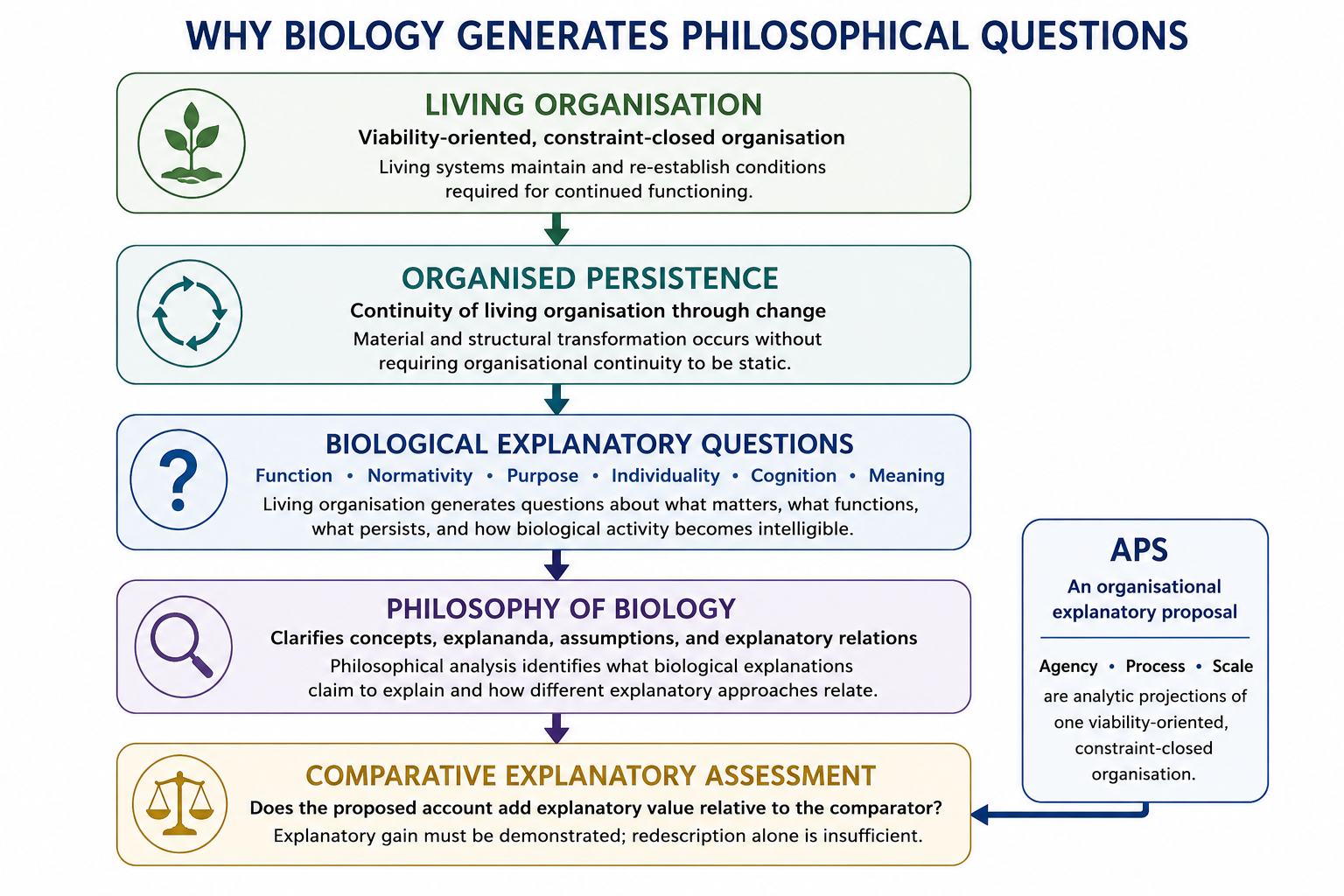
Why biology generates philosophical questions. Living systems exhibit viability-oriented, constraint-closed organisation whose continuity through material and structural change constitutes organised persistence. This generates recurring explanatory questions concerning function, normativity, purpose, individuality, cognition, and meaning. Philosophy of biology clarifies these questions and the relations among proposed explanations. APS supplies one organisational account, whose explanatory contribution remains subject to comparative assessment.
Organised Persistence and Biological Explanation
APS proposes that life is viability-oriented, constraint-closed organisation. This definition identifies living systems not by a particular substance, molecule, structure, or isolated process, but by an organisation through which the conditions required for continued functioning are maintained and re-established.
Constraint closure is central to this account because the constraints that regulate biological processes are themselves generated, maintained, or renewed through the organisation they help sustain (Moreno and Mossio 2015). Viability is distinct from constraint closure. It concerns the asymmetry between conditions that permit continued organisation and those that lead toward loss of functioning or breakdown. The two concepts therefore answer different questions: constraint closure concerns how the conditions of continued organisation are mutually maintained, whereas viability distinguishes the conditions under which that organisation can continue.
Living organisation is never materially static. Organisms maintain boundaries, coordinate metabolism, repair damage, respond to environmental change, reorganise during development, and reproduce while undergoing continuous material turnover. Organised persistence names the continuity of this organisation through such change. It is therefore neither an additional component of life nor a result produced by Agency, Process, and Scale. It is the persistence of living organisation across ongoing transformation.
Once living systems are understood in this way, biologically consequential asymmetries become unavoidable. Some conditions sustain organisation while others undermine it. Some activities contribute to continued functioning while others do not. Regulatory outcomes can therefore differ in relation to the viability of the system itself.
APS interprets these differences as the basis of biological normativity. Normativity does not require conscious judgement or external evaluation. It arises from viability-relative asymmetry within living organisation: conditions and activities differ in their consequences for the system’s continued organisation. Organised persistence is what is sustained through these relations; it is not the independent source from which normativity emerges.
This distinction is important because it prevents several APS concepts from collapsing into one another. Life identifies the form of organisation under consideration. Viability identifies the relevant asymmetry among conditions. Constraint closure concerns how conditions of continued organisation are mutually maintained. Organised persistence identifies the continuity of that organisation through change. Each concept therefore performs a different explanatory function within the same biological organisation.
A Brief Historical Overview
Questions concerning life, organisation, purpose, and biological explanation have a long history. Aristotle already treated living beings as forms of organised activity whose parts and processes could not be understood solely through material composition. Modern biology transformed these questions rather than eliminating them. Evolutionary theory, genetics, physiology, developmental biology, molecular biology, ecology, systems theory, and theoretical biology progressively altered what could be explained empirically while simultaneously creating new questions about the kinds of explanation appropriate to living systems (Mayr 1982).
Twentieth-century biology often placed strong emphasis on genes, molecular mechanisms, reduction, and informational explanation. These approaches generated major explanatory successes. At the same time, other traditions continued to emphasise process, development, organisation, autonomy, ecology, emergence, and systems dynamics (Dupré 1993; Nicholson and Dupré 2018; Moreno and Mossio 2015).
These traditions need not be arranged as mutually exclusive alternatives. Their explanatory contributions depend upon the phenomena and questions to which they are applied. Molecular mechanisms may explain the production of a particular cellular outcome, developmental accounts may explain how structures arise through time, evolutionary accounts may explain historical transformation, and organisational accounts may ask how processes and constraints are related to conditions required for continued functioning.
Philosophy of biology became increasingly important as the field in which such explanatory differences could be examined explicitly. Its task is not simply to choose among biological traditions, but to clarify their concepts, assumptions, explananda, and relations.
Teleology, Teleonomy, and Biological Normativity
Few problems illustrate the persistence of philosophical questions within biology more clearly than purposiveness. Living systems routinely behave in ways that can be described as directed toward outcomes: wounds heal, organisms regulate temperature and metabolism, developmental processes converge on organised forms, and behaviour changes in response to conditions relevant to survival and reproduction. Such descriptions easily invite the language of goals and purposes.
Classical teleology interpreted purposive organisation through final causes or intrinsic ends. Modern biology largely rejected teleological explanations where they appeared to invoke external design, metaphysical purpose, or causation by future states. The problem, however, did not disappear when these explanations were rejected. Biology still required ways of describing the organised, goal-directed character of many living processes.
The concept of teleonomy emerged as one response. Pittendrigh, Mayr, Monod, and later commentators used teleonomic language to distinguish biologically organised goal-directedness from metaphysical or future-directed teleology, commonly relating such organisation to evolutionary history and inherited biological organisation (Pittendrigh 1958; Mayr 1982; Monod 1971; Corning 2019). Contemporary discussion continues to examine how far teleonomy can naturalise purposive biological language and how it relates to function, adaptation, organisation, and evolutionary explanation (Corning et al. 2023).
Evolutionary history is indispensable to explaining why many traits and capacities exist, but historical selection and present organisation answer different questions. Explaining how a regulatory system arose does not by itself settle how that system presently organises activity in relation to conditions required for continued functioning. APS addresses this present-tense question organisationally without treating historical explanation as dispensable.
Within APS, purpose does not require intention, foresight, external design, or future-directed causation. It refers to viability-oriented organisation: biological activity is organised in relation to conditions bearing upon continued functioning. This formulation does not compete with evolutionary explanations of how such organisation arose. It identifies a distinct present-tense relation within the living system.
Normativity follows from the same viability-relative structure. Because some conditions support continued organisation while others impair or terminate it, biological outcomes are not equivalent for the living system. Function and dysfunction, successful and failed regulation, and adaptive and maladaptive outcomes acquire significance through these viability-relative differences.
Organised persistence is consequently the continuity sustained through this organisation, not the source from which normativity or purposiveness independently arises. The philosophical importance of teleology and teleonomy lies precisely here: they reveal how biological explanation repeatedly encounters organised relations to viability even after metaphysical purpose has been excluded.
Mechanism and Organisation
Mechanistic explanation is indispensable to biology. Molecular interactions, physiological processes, developmental pathways, and regulatory dynamics are often understood by identifying the entities, activities, and causal organisation through which particular biological outcomes are produced. Nothing in APS requires these explanatory achievements to be displaced.
The philosophical question concerns what a specified mechanism explains and whether the explanandum extends beyond the production of the immediate outcome. A mechanism may explain how a regulatory response occurs, for example, while a further question concerns how that response contributes to maintaining or re-establishing conditions required for continued functioning. The distinction is not between an inadequate mechanistic explanation and a superior organisational one. It is between explanatory questions that may require different relations to be made explicit.
APS therefore approaches mechanism and organisation comparatively. For a specified biological explanandum, it asks whether attention to the organisation of viability-relevant dependencies contributes explanatory information not already supplied by the established account. Sometimes it may. In other cases, the established mechanistic explanation may already capture the relevant dependencies, or organisational terminology may simply redescribe what is already known. Redescription alone does not constitute explanatory gain.
This comparative approach also avoids treating mechanism and organisation as different causal levels. Biological organisation is materially implemented through the processes and constraints that constitute living activity. Where processes occurring across different spatial or temporal extents influence local biological activity, that influence must itself be materially realised through constraints that alter local conditions. Wider-scale organisation does not supersede local causation.
Mechanistic and organisational explanations can therefore be complementary without being automatically complementary in every case. Their relation must be established by asking what each explains, which dependencies each identifies, and whether their explanatory contributions genuinely differ.
Evolution and Historical Organisation
Evolution transformed biological explanation by establishing that present biological organisation has a history. Organisms cannot be understood solely through their present structure because traits, developmental systems, regulatory capacities, and organism–environment relations have themselves been transformed across generations (Mayr 1982).
APS accepts the explanatory importance of established evolutionary accounts. Population-genetic, phylogenetic, ecological, developmental, and other evolutionary approaches explain different aspects of biological change, and an organisational description does not replace those explanations simply by redescribing their outcomes.
APS instead asks whether evolutionary change can also be illuminated by examining the historical transformation of the organisation through which living systems persist. On this interpretation, evolution concerns not only changes in particular traits or their frequencies but changes in the forms and conditions under which living organisation is maintained across generations. Developmental organisation, ecological relations, adaptive capacities, and lineage continuity can thereby become relevant to understanding how organised persistence itself changes historically.
This is an APS interpretation of evolutionary organisation, not a replacement definition of evolution. Its explanatory value must be assessed relative to the phenomenon under investigation and to the evolutionary explanations already available. Where it identifies dependencies or continuities that those explanations leave unresolved, it may contribute additional understanding. Where it merely restates established evolutionary relations in APS terminology, it does not.
The philosophical significance of evolution is therefore broader than any single explanatory framework. Evolution brings history into the constitution of biological explanation and raises continuing questions about how historical transformation relates to present organisation. APS addresses one part of that problem by examining how viability-oriented organisation changes while biological continuity is maintained across generations.
Cognition, Meaning, and Life
Biology increasingly intersects with philosophy of mind and cognitive science as questions concerning cognition, information, representation, meaning, intelligence, and consciousness are extended beyond their traditional human and animal contexts. These developments raise a fundamental biological question: what must living organisation be capable of before its activity should count as cognitive rather than merely regulatory?
APS approaches this problem organisationally. Living systems continually encounter conditions that differ in their consequences for viability. Biological agency is the viability-oriented organisational activity through which such systems maintain and re-establish conditions required for their persistence. Within this activity, biological evaluation generates significance as conditions acquire relevance in relation to continued functioning.
Cognition requires more than this basic evaluative organisation. APS therefore does not infer cognition from life itself, nor does it treat every instance of regulation, responsiveness, or adaptive activity as cognitive. The relevant question is how biological significance becomes organised in ways that extend beyond immediate or fixed regulation and support activity across temporally structured possibilities.
This places cognition within the investigation of living organisation without collapsing cognition into life. Meaning, semiosis, evaluation, and cognition can be investigated in relation to viability-oriented organisation and organised persistence while retaining the distinctions required to determine where cognition begins. Life does not require cognition; cognition presupposes life.
The philosophical importance of this relation is considerable. Questions traditionally associated with mind can then be approached through the biological organisation from which increasingly complex forms of evaluation and significance arise, without assuming that the explanation of biological organisation by itself resolves consciousness or subjective experience.
Why Conceptual Clarification Matters
Philosophy of biology matters because biological science depends upon concepts as well as observations. Terms such as life, function, adaptation, agency, cognition, information, organisation, individuality, and purpose do not merely label independently given objects. They help determine what phenomena are distinguished, what questions are asked, and what counts as an explanation.
Conceptual ambiguity can therefore become explanatory ambiguity. If function is alternately treated as historical effect, present contribution, or observer-assigned usefulness, apparently competing explanations may be addressing different questions. If organisation means sometimes spatial arrangement, sometimes causal interaction, and sometimes the maintenance of viability-relevant dependencies, explanatory claims may appear to agree while referring to different relations. Similar difficulties arise when agency is equated with intention, normativity with conscious judgement, or persistence with mere continued existence.
Philosophical clarification helps expose these differences. It can distinguish explananda, identify assumptions, clarify the relations among explanatory approaches, and show where disagreement is substantive rather than terminological. It can also reveal when a proposed explanation adds no new dependency and therefore amounts primarily to redescription.
This does not place philosophy above empirical biology. Conceptual analysis cannot determine biological facts independently of evidence, and philosophical coherence cannot substitute for empirical adequacy. The relationship is reciprocal: biological findings constrain philosophical interpretation, while conceptual clarification helps determine what those findings are being asked to explain.
For APS, this relationship is especially important because its central concepts are intended to perform distinct explanatory functions. Life, viability, constraint closure, agency, process, scale, and organised persistence cannot be allowed to collapse into interchangeable descriptions. Their value depends upon whether the distinctions they introduce clarify biological organisation and contribute to explanation.
APS Within Philosophy of Biology
APS belongs within the broader landscape of philosophy of biology and theoretical biology because it addresses longstanding questions concerning life, organisation, function, normativity, purpose, cognition, persistence, and explanation. It does not do so by proposing that established biological approaches should be replaced by a single alternative theory.
Its canonical starting point is that life is viability-oriented, constraint-closed organisation. This organisation consists in the ongoing modulation of constraints through which a living system maintains and re-establishes conditions required for its own persistence. Organised persistence describes the continuity of this living organisation through material and structural change.
Agency, Process, and Scale are complementary analytic projections of that one organisation rather than independent components, causes, levels, or interacting domains. Agency concerns what living systems do. Process concerns how continuity is maintained despite change. Scale concerns where persistence is organised across spatial and temporal extents. The distinctions are analytic; the organisation and activities they disclose are biologically real.
Adaptation, evolution, normativity, semiosis, and cognition should therefore not be placed alongside Agency, Process, and Scale as additional APS dimensions. They are biological phenomena whose organisation can be investigated through these analytic projections where doing so clarifies the explanandum.
APS is developed as a comparative explanatory methodology for biology, but comparative explanatory methodology must also be distinguished from the particular APS account subjected to it. The comparative method requires explanatory proposals to be assessed against specified explananda and relevant established comparators. APS cannot determine the outcome of that comparison merely by supplying its own vocabulary or ontology.
This imposes an important discipline on APS itself. An organisational formulation provides explanatory gain only when it identifies relevant dependencies, distinctions, or relations that contribute beyond what the comparator already explains. A reformulation that merely redescribes established findings in terms of viability, organisation, agency, process, or scale does not thereby improve the explanation.
APS can therefore be understood as an organisational proposal operating within a wider philosophical and methodological inquiry into biological explanation. Its contribution is not secured by explanatory priority but by comparative performance.
Conclusion
Philosophy of biology matters because the explanatory success of biological science does not eliminate questions about the concepts, relations, and forms of organisation through which living phenomena become intelligible. Living systems undergo continual material, structural, developmental, ecological, and evolutionary change while maintaining and re-establishing conditions required for continued functioning. Their continuity through such transformation is organised persistence.
This feature of life generates recurring questions concerning function, normativity, purposiveness, agency, individuality, cognition, and meaning. Such questions cannot be settled simply by declaring biology irreducible to physics or by assuming that organisational explanation must supplement every mechanistic account. They require careful specification of what is being explained and of the relations upon which the explanation depends.
APS approaches these problems from the proposition that life is viability-oriented, constraint-closed organisation. Agency, Process, and Scale are analytic projections of that one organisation: Agency concerns what living systems do, Process concerns how continuity is maintained despite change, and Scale concerns where persistence is organised across spatial and temporal extents. Organised persistence names the continuity of living organisation through transformation rather than an additional component or independent explanatory principle.
This organisational account does not acquire explanatory priority merely by being expressed in APS terms. Mechanistic, evolutionary, developmental, ecological, and other established explanations retain their explanatory achievements. APS must demonstrate any additional contribution relative to specified explananda and comparators, and redescription alone does not constitute explanatory gain.
Philosophy of biology therefore matters to APS for a precise reason. It clarifies the questions that biological explanation generates, the concepts through which those questions are expressed, and the standards by which proposed answers can be distinguished. APS offers one systematic organisational response to those questions, while comparative assessment determines what that response actually explains.
Life persists, evolution transforms that persistence, and biological explanation clarifies the organisation that makes both possible.
Explanatory Architecture
Central Question
Why does biological inquiry repeatedly generate philosophical questions concerning life, organisation, persistence, function, normativity, purpose, individuality, cognition, meaning, and explanation?
Architectural Role
This article provides the philosophical orientation for APS by explaining why conceptual, explanatory, and ontological questions arise from biological inquiry itself. It establishes why biological organisation is legitimately a subject of philosophical as well as empirical investigation without treating APS’s philosophical commitments as evidence of explanatory success.
Preceding Explanatory Dependencies
The article builds on the recognition that biological explanation concerns living systems whose organisation is maintained through continual material and structural change. It therefore presupposes the distinction between viability-oriented, constraint-closed organisation and the organised persistence of that organisation through change.
Subsequent Explanatory Developments
The questions identified here develop into more specific APS investigations of biological reality, organisation, function, normativity, purpose, agency, cognition, and explanation. APS as Philosophy examines the philosophical implications of APS’s organisational commitments, while comparative explanatory methodology establishes how explanatory proposals are assessed against specified explananda and established comparators.
Related Explanatory Questions
- How should biological organisation be understood?
- What distinguishes description from explanation?
- How should function, normativity, and purpose be naturalised?
- What makes an organisational account explanatorily informative rather than merely redescriptive?
- How should alternative or complementary biological explanations be compared?
Position Within APS
This article explains why the philosophical questions arise. It does not establish APS as their preferred solution. APS supplies an organisational account centred on viability-oriented, constraint-closed organisation, but that account remains subject to comparative explanatory assessment. The article therefore connects the philosophical foundations of APS with its explanatory methodology while preserving the distinction between philosophical orientation, substantive APS proposals, and the comparative assessment of their explanatory contribution.
See Also
Related Articles
References
- (2019). Teleonomy and the Proximate–Ultimate Distinction Revisited. Biological Journal of the Linnean Society, 127(4), 912–916 . https://doi.org/10.1093/biolinnean/blz087
- (2023). Evolution "On Purpose": Teleonomy in Living Systems. MIT Press. https://doi.org/10.7551/mitpress/14642.001.0001
- (1993). The Disorder of Things: Metaphysical Foundations of the Disunity of Science. Harvard University Press.
- (2014). Philosophy of Biology. Princeton University Press.
- (1974). Philosophy of Biological Science. Prentice-Hall.
- (1982). The Growth of Biological Thought: Diversity, Evolution, and Inheritance. Belknap Press of Harvard University Press.
- (1971). Chance and Necessity: An Essay on the Natural Philosophy of Modern Biology. Alfred A. Knopf.
- (2015). Biological Autonomy: A Philosophical and Theoretical Enquiry. Springer. https://doi.org/10.1007/978-94-017-9837-2
- (2018). Everything Flows: Towards a Processual Philosophy of Biology. Oxford University Press. https://doi.org/10.1093/oso/9780198779636.001.0001
- (1958). Adaptation, Natural Selection, and Behavior. Yale University Press.