Organisational Realism in Biology
This article develops the organisational-realist commitment associated with APS's biological account. It examines whether materially implemented organisational relations, constraints, dependencies, and activities should be treated as real features of living systems rather than merely as observer-imposed descriptions. APS defines Life as viability-oriented, constraint-closed organisation and treats organised persistence as the continuity of that organisation through material and structural change. Organisational realism is therefore a philosophical commitment concerning the reality tracked by organisational explanation, not evidence that an APS explanation is automatically superior to an established biological account.
Where this article fits: This article examines one specific philosophical commitment associated with APS: the claim that biological organisation can be treated as a materially realised feature of living systems rather than merely as an observer-imposed description. The broader philosophical commitments and implications of APS are examined in APS as Philosophy — A Philosophical Reconstruction of Biological Intelligibility. Organisational realism does not determine the standards of biological explanation. APS remains a comparative explanatory methodology, and particular APS proposals must establish their contribution relative to specified explananda and relevant comparators.
Organisational Realism in Biology
Biology routinely investigates living systems through concepts such as function, regulation, adaptation, agency, development, signalling, cognition, and organisation. These concepts raise an ontological question as well as an explanatory one: when biological inquiry identifies an organisational relation, is it tracking something materially realised in the living system, or merely imposing a useful pattern upon underlying physical processes?
APS develops an organisational-realist answer to that question. Its claim is not that organisation constitutes an additional substance or causal force beyond the physical processes through which living systems exist. Rather, materially implemented relations, dependencies, constraints, and activities may themselves be real features of biological systems. Organisation, on this view, concerns how such material processes are related in the ongoing activity of a living system.
The central claim of organisational realism is therefore deliberately limited:
Biological organisation is not merely a useful description of living systems. Materially implemented organisational relations can be real features of living systems themselves.
Within APS, this claim begins from the canonical biological account:
Life is viability-oriented, constraint-closed organisation.
Organised persistence has a different and more restricted role. It denotes the continuity of living organisation through ongoing material and structural transformation. Living systems can remain organisationally continuous while components are replaced, structures change, and activities are reorganised. This continuity does not define Life and is not the underlying source from which biological agency, normativity, function, cognition, or explanation arise.
Organisational realism is consequently a philosophical commitment concerning what biological organisational claims may refer to. It does not establish, merely by being realist, that an APS account explains a phenomenon better than an established mechanistic, developmental, evolutionary, ecological, or other explanation. Where APS proposes that a particular organisational relation contributes additional understanding, that contribution must be established relative to the explanandum and the relevant comparator. Redescription in organisational vocabulary is not by itself explanatory gain.
The Problem of Biological Reality
The question of biological reality arises because successful biological inquiry often depends upon relations that are not captured simply by listing the material components present in a system. Regulation, development, repair, signalling, functional contribution, and organism–environment interaction concern not only what components exist but what those components do in relation to one another and to the continuing activity of the system.
This does not imply that component analysis or mechanistic explanation is deficient. Mechanistic accounts can provide substantive and sometimes sufficient explanations by identifying entities, activities, interactions, causal organisation, and the conditions under which biological phenomena occur (Craver 2007). Nor does organisational realism require a contrast between an allegedly superficial mechanism and a deeper organisational reality. Mechanisms themselves can be dynamically organised, environmentally embedded, and extended across spatial and temporal extents.
The realist question is instead whether some of the organisational dependencies identified by biology should be understood as features of the systems investigated rather than merely as conveniences of description. Scientific realism more generally asks how the success of scientific representation bears upon claims about the reality described by science, while allowing that models, concepts, and theories remain fallible and revisable (Psillos 1999). APS applies a bounded version of that question to living organisation.
Its proposal is that biological inquiry can sometimes identify materially implemented organisational dependencies that make a difference to how living systems function. A regulatory relation, a constraint, or a dependency among activities need not correspond to an additional entity in order to be real. Its reality can consist in the material relations through which particular activities constrain, enable, maintain, or alter other activities within the living system.
The explanatory importance of such relations can motivate an organisational-realist interpretation, but explanatory usefulness and ontological reality should not simply be equated. A successful explanatory representation may simplify, idealise, or abstract. Conversely, identifying a relation as organisational does not establish that it contributes beyond what a comparator already explains. Organisational realism therefore remains a philosophical interpretation of what certain successful biological explanations may be tracking, not a shortcut to demonstrating APS explanatory success.
Organisation as Materially Real Biological Organisation
APS does not oppose organisational reality to physical reality. Living systems are materially constituted, and biological activities occur through physical interactions. Organisational realism concerns the relations among those materially realised activities rather than a second kind of substance placed above or outside them.
A living system can therefore be analysed both in terms of its components and in terms of dependencies among the processes through which those components participate in continuing biological activity. Whether an organisational account is needed depends upon the explanandum. For some questions, identifying components, interactions, and mechanisms may be sufficient. For others, the explanandum may concern the relations through which particular activities contribute to maintaining or re-establishing conditions required for continued functioning.
These organisational relations are not made real simply because APS names them. Their proposed reality depends upon their material implementation and upon evidence that the relevant relations genuinely obtain in the system under investigation. Regulatory activity, constraint relations, repair, compensatory change, and organism–environment interaction can provide experimentally tractable cases in which changing one relation alters the conditions under which other biological activities occur.
Organised persistence is relevant here as an explanandum rather than an ontological foundation. Living systems undergo continual material and structural transformation while sometimes retaining organisational continuity. Asking how that continuity is maintained directs attention to the activities and dependencies through which conditions of viability are maintained or re-established. It does not imply that persistence itself acts as a cause or that all biological phenomena derive their significance from a single persistence-producing principle.
Processual approaches in philosophy of biology have likewise emphasised the importance of transformation and continuity in understanding living systems (Nicholson and Dupré 2018). APS’s organisational-realist proposal is more specific: where continuity depends upon materially implemented organisational relations, those relations may legitimately be treated as features of the biological system rather than merely as features of its description.
Organisation Is Not Mere Arrangement
Organisation should not be identified with static structure, complexity, interaction density, or visual order. Non-living systems can exhibit highly regular structures and complex dynamics. The APS claim concerns a more specific form of organisation: the materially implemented relations through which living activity is viability-oriented and constraint-closed.
The distinction matters because a description of arrangement alone does not establish the presence of living organisation. To identify an organisational relation in the relevant APS sense requires evidence about what the relation does within the system: what activities it constrains or enables, what dependencies are sustained, and how those relations bear upon conditions required for continued functioning.
Constraint closure provides an especially important example. Constraints are not immaterial controls standing outside physical processes. They are materially implemented conditions that modulate what processes can occur, while the continued presence or effectiveness of the relevant constraints depends upon processes that they themselves help constrain. The resulting organisation is relational and materially enacted (Moreno and Mossio 2015).
The claim that such organisation is real does not mean that every higher-order description identifies an autonomous causal entity. Nor does it imply that organisational language automatically improves upon mechanistic description. Organisational realism instead allows that relations among materially implemented activities and constraints can themselves be legitimate objects of empirical investigation where they make a relevant difference to the phenomenon being explained.
Continuity, Perturbation, and Dynamic Stability
Living systems do not maintain continuity by remaining materially unchanged. Components turn over, metabolic activity continues, development transforms structure, and environmental conditions vary. Organised persistence denotes the continuity of living organisation through such material and structural transformation.
This distinguishes persistence from permanence. What continues need not be an invariant material composition or fixed structure. Organisational continuity can instead depend upon ongoing activities that maintain or re-establish conditions required for continued functioning. The biological interest of this continuity lies precisely in the fact that it can persist through change.
The term dynamic stability can be useful in this context, provided it is not opposed too simply to equilibrium. Living systems may employ regulatory, metabolic, developmental, or behavioural processes that respond to changing conditions, but the relevant explanatory question is not whether change occurs. It is which materially implemented relations make a difference to maintaining or re-establishing viability under those conditions.
Perturbation can help investigate those relations. Altering a component, environmental condition, constraint, or regulatory interaction may reveal dependencies that are difficult to distinguish during relatively undisturbed functioning. Recovery, compensation, reorganisation, impairment, and failure can thereby provide contrasts from which organisational relations may be inferred.
Perturbation is nevertheless an investigative strategy rather than a privileged route to biological reality. Some organisational relations can be established without disruptive intervention, and perturbation by itself does not show that an APS interpretation is correct. The resulting evidence must support the specific organisational claim being made and, where explanatory contribution is at issue, must be assessed against the relevant comparator.
Viability and Constraint Closure
APS defines Life as viability-oriented, constraint-closed organisation. Viability orientation and constraint closure identify related but distinct features of this organisation. Viability orientation concerns the way living activity bears upon conditions required for continued functioning. Constraint closure concerns the mutually dependent organisation of materially implemented constraints through which relevant biological processes are modulated and sustained.
Viability does not function as an external goal imposed upon the system. Living systems occupy conditions under which continued functioning is possible, impaired, restored, or lost. Those differences generate a biologically significant asymmetry: some conditions support continued organisation while others undermine it. APS grounds biological normativity in this viability-relative asymmetry, rather than in observer judgement or in organised persistence treated as an independent explanatory principle.
Constraint closure likewise should not be understood as independence from an environment. Living systems depend upon matter, energy, environmental conditions, and interactions beyond their boundaries. Closure concerns the organisation of constraints involved in maintaining living activity, not energetic or material closure. In autonomy-based accounts, this form of mutual dependence among constraints has been used to characterise an important feature of biological organisation (Moreno and Mossio 2015).
Within APS, constraint closure is not presented as a stage that follows viability, nor as something generated by organised persistence. Together, viability orientation and constraint closure specify the organisation constitutive of Life. Organised persistence then names the continuity of that organisation where it is maintained through ongoing transformation.
This formulation also prevents biological normativity from being inferred merely from survival or persistence. The relevant asymmetry concerns conditions relative to the viability of the organisation in question. A state, activity, or environmental change may support, impair, or make no relevant difference to continued functioning. Establishing those relations is an empirical matter.
Where activities and constraints extend across different spatial or temporal extents, their influence should likewise be understood materially. A process occurring over a wider extent does not exert a special higher-level force upon a local process. It can alter local conditions through implemented constraints, material interactions, boundary conditions, resource distributions, signalling relations, or other physical dependencies. Scale in APS concerns where persistence is organised across spatial and temporal extents, not a hierarchy of causal levels.
Agency, Process, and Scale can therefore be used analytically without dividing the living system into separate domains. They are projections of the same viability-oriented, constraint-closed organisation: Agency concerns what the living system does; Process concerns how organisational continuity is maintained despite change; Scale concerns where that persistence is organised across spatial and temporal extents. Their analytical usefulness does not establish explanatory gain in advance. Where an APS account invokes them, their contribution must still be demonstrated relative to the explanandum and the relevant established explanation.
Agency as Organisational Regulation
Within APS, biological agency concerns what living systems do as viability-oriented, constraint-closed organisations. Agency is therefore not an additional property that emerges once viability, constraint closure, or organised persistence has already been established. It is an analytic projection of the living organisation itself, directed toward the activities through which the system acts under conditions relevant to its continued functioning.
This account does not require consciousness, deliberation, representation, or explicit intention. A living system may alter its activity in relation to changing conditions through materially implemented regulatory processes without possessing any of those capacities. The relevant question is whether the activity belongs to the organisation through which the system maintains or re-establishes conditions of viability.
Agency should consequently be distinguished from mere causal activity. Physical systems produce effects, and many non-living systems respond dynamically to environmental change. Biological agency, in the APS sense, concerns activity organised relative to the viability of the living system. This does not make agency an independent causal force. The activity is realised through the same material processes, constraints, and interactions investigated by biological science.
This distinction also limits the ontological conclusion that can be drawn from APS terminology. Calling an activity agential does not establish that the proposed organisation is present, nor does it demonstrate that an agential description explains more than an established mechanistic or regulatory account. Where APS proposes biological agency as explanatorily relevant, the relevant dependencies must be identified and their contribution assessed against the explanandum and comparator.
Agency is therefore compatible with organisational realism without being generated by it. Organisational realism concerns whether the materially implemented relations identified in an organisational account are real features of the system. Agency concerns one way of analysing that organisation: the viability-oriented activity of the living system.
Normativity and Evaluation
Biological organisation exhibits asymmetries that matter relative to continued functioning. Some changes maintain or restore conditions of viability; others impair them; still others may make no relevant difference. APS grounds biological normativity in this viability-relative asymmetry.
Normativity is therefore neither imposed by an observer nor generated by organised persistence as an independent principle. The relevant difference arises because a living organisation can continue only within conditions compatible with its viability. A perturbation, internal state, environmental condition, or activity can consequently be evaluated according to its relation to the continued functioning of the organisation concerned.
This does not imply moral value, conscious judgement, or explicit preference. It identifies a biological asymmetry grounded in the organisation of the system. Whether a particular condition is beneficial, detrimental, or neutral in the relevant sense depends upon its material consequences for viability and must be established empirically.
Biological Evaluation is the process through which agency generates significance. In the minimal APS sense, a difference becomes significant where viability-oriented activity is differentially organised in relation to it. Evaluation is therefore associated with agency rather than inserted as an additional ontological layer between viability and normativity.
This relationship should not be converted into a necessary sequence from viability through evaluation to semiosis, meaning, and cognition. More elaborate forms of significance may depend upon additional organisational capacities. Cognition in particular requires more than immediate viability-sensitive regulation or basic evaluation. Organisational realism does not erase those distinctions simply by treating the relevant biological relations as real.
Function as Organisational Contribution
Biological function provides a particularly important test case for organisational realism because functional claims concern what some activity or structure contributes within a living system. APS treats function as present-tense viability-relative organisational contribution.
A component or activity has an APS function where its present activity contributes to the viability-oriented organisation of the system in which it operates. This formulation makes function relational: the relevant contribution cannot be specified solely by identifying a component or describing what it happens to do in isolation. The contribution is defined relative to an organisation and to the conditions of viability to which the activity bears.
This does not imply that evolutionary accounts of function are mistaken or dispensable. Evolutionary history can explain why a trait exists, how it was selected, or why particular capacities have been retained. Nor does APS require that every legitimate biological use of function be replaced by an organisational account. The question is instead what explanatory target a functional attribution addresses.
Organisational realism adds a philosophical interpretation to the APS proposal. If a functional contribution depends upon materially realised relations among activities, constraints, and viability conditions, those relations need not be regarded merely as conveniences of description. They may be real features of the system. But the realist interpretation does not itself demonstrate that the APS account provides greater explanatory value than an evolutionary, mechanistic, or other functional explanation.
Mechanism and Organisational Explanation
Organisational realism does not require an opposition between mechanism and organisation. Mechanistic explanation can identify entities, activities, interactions, causal organisation, regulatory relations, and environmental dependencies through which biological phenomena occur. Such explanations may be sufficient for particular explananda.
APS asks a further question only where it is relevant: whether specifying relations to viability-oriented, constraint-closed organisation identifies dependencies that contribute to explaining the same phenomenon. The answer cannot be settled in advance. In some cases an APS account may identify an additional dependency; in others it may clarify a relation already represented by the comparator; in still others it may amount only to redescription or add no relevant explanatory information.
Organisation should therefore not be pictured as a larger explanatory container within which mechanisms become biologically meaningful. Nor should mechanism be equated with reduction to smaller parts. A mechanism can itself involve organisation across extended spatial and temporal conditions, feedback, environmental interaction, and regulatory dependencies.
The philosophical issue is correspondingly narrower. If a mechanistic investigation identifies materially realised organisational relations, organisational realism permits those relations to be treated as features of the biological system. If APS proposes additional organisational dependencies, their explanatory contribution remains subject to comparative assessment.
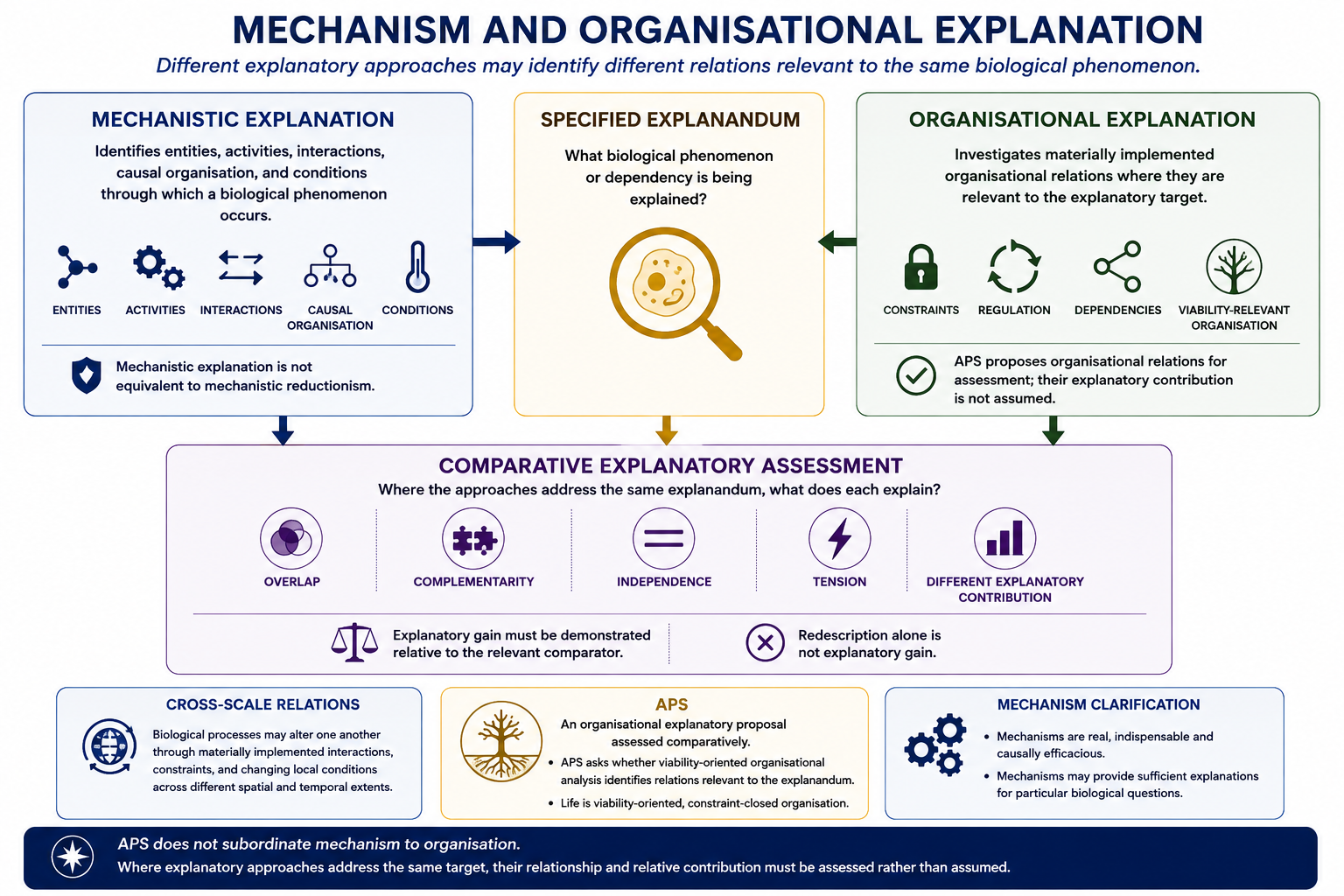
Mechanism and organisational explanation. Mechanistic and organisational explanations may identify different relations relevant to a biological explanandum. APS does not subordinate mechanism to organisation: where explanatory approaches address the same target, their relationship and relative contribution must be assessed rather than assumed. Organisational redescription alone does not establish explanatory gain.
Multiple Realization and Biological Identity
Living systems undergo substantial material transformation. Molecules are replaced, cells divide and die, tissues remodel, developmental processes alter structure, and patterns of activity change through time. These transformations make biological identity difficult to identify with permanence of material composition.
Organisational realism provides one way of interpreting continuity through such change. Where a living system remains organisationally continuous despite material turnover, the relations through which that continuity is maintained may themselves be biologically real. Organised persistence names this continuity of living organisation through material and structural transformation.
This does not make organised persistence the primary explanatory basis of biological identity. Different questions about identity may depend upon different criteria, including developmental history, lineage, structure, functional organisation, ecological relations, or other biological considerations. APS contributes a specific question: whether continuity of viability-oriented, constraint-closed organisation is relevant to the identity claim being investigated.
Multiple realization strengthens the importance of distinguishing organisation from particular material composition without establishing that organisation is independent of material implementation. Similar organisational relations may sometimes be realised through differing material arrangements, but every actual biological organisation remains materially enacted. Organisational realism is therefore compatible with material variation precisely because the realist commitment concerns materially implemented relations rather than an abstract pattern detached from its realization.
Process-oriented accounts of biology have emphasised related problems of identity and continuity in systems undergoing persistent transformation (Nicholson and Dupré 2018). APS retains that insight while restricting organised persistence to the continuity of living organisation rather than treating persistence as an ontological substance or the universal basis of biological identity.
Reductionism, Holism, and Organisational Realism
The contrast between reductionism and holism can obscure more than it clarifies if it is treated as a choice between real components and real wholes. Organisational realism does not require such a choice.
Components are materially real, and analysis of their activities can provide powerful biological explanations. Organisational relations can also be materially real where they are implemented through dependencies among components, constraints, processes, and environmental conditions. Recognising those relations does not require treating a whole as an additional causal entity standing over its parts.
APS therefore does not claim that analytical explanations must be completed by synthesis, or that organisational explanation subsumes mechanistic, developmental, ecological, evolutionary, systems, or process approaches. Different approaches may address different explananda or identify different dependencies relevant to the same explanandum. Their contributions have to be compared rather than assigned an explanatory hierarchy in advance.
This is also why organisational realism should not be equated with holism. A realist claim about organisation concerns particular materially implemented relations. It does not imply that wholes are always explanatorily prior to parts, that every biological phenomenon requires whole-system explanation, or that local mechanisms lack autonomous explanatory value.
The appropriate contrast is therefore not between reduction and an APS synthesis. It is between alternative explanatory claims about a specified phenomenon and the evidence bearing upon the dependencies each identifies. Organisational realism makes it possible to take organisational dependencies seriously within that comparison without predetermining its outcome.
Organisational Realism and Scientific Realism
Organisational realism can be understood as a bounded realist commitment within the philosophy of biology. It does not require APS to settle the general philosophical dispute between scientific realism and its alternatives.
Scientific realism concerns, among other things, how the success of scientific theories and explanations bears upon belief in the entities, structures, or relations they posit (Psillos 1999). Biological organisation raises a specific version of that issue because many biological explanations depend upon relations such as regulation, functional contribution, constraint, signalling, and coordinated activity.
APS proposes that where such organisational relations are materially implemented and empirically supported, they need not be treated merely as artefacts of explanatory language. They may be features of the systems being investigated. Evidence for such a claim can include intervention upon the relevant relations, perturbation of constraints, altered regulatory dependencies, and other observations showing that changing an organisational relation makes a relevant difference to the biological phenomenon.
The inference remains defeasible. Scientific models idealise; explanatory concepts can succeed without mapping reality in a simple one-to-one fashion; and competing descriptions may identify different real dependencies. Organisational realism therefore does not follow automatically from the usefulness of organisational vocabulary.
This modest form of realism is sufficient for the article’s purpose. APS can maintain that living organisation is scientifically investigable and materially real without turning that commitment into a general metaphysical doctrine or treating it as proof that APS explanations possess automatic priority.
Biological Reality and Organisational Continuity
The realist commitment developed here concerns living organisation rather than organised persistence considered independently. Life is viability-oriented, constraint-closed organisation. That organisation is materially implemented through biological activities, constraints, dependencies, and interactions.
Organised persistence describes what happens when that living organisation maintains or re-establishes continuity through material and structural transformation. It is therefore an important explanatory target for APS, but not the definition of Life, the source of biological organisation, or the universal ground from which agency, normativity, function, semiosis, cognition, or purpose derives.
This distinction matters for biological realism. If organisational continuity survives substantial turnover of material components, that provides reason to investigate which relations are maintained and how they are materially realised. The resulting explanation may identify dependencies that are not evident from material inventory alone. Whether those dependencies add explanatory value in a particular case remains a comparative question.
Agency, Process, and Scale can assist this analysis without being converted into ontological divisions. Agency concerns what the living system does; Process concerns how organisational continuity is maintained despite change; Scale concerns where persistence is organised across spatial and temporal extents. They are analytic projections of one viability-oriented, constraint-closed organisation.
Organisational realism therefore concerns the reality that these analyses seek to track, not the automatic success of the analyses themselves.
Conclusion
Organisational realism in biology is the claim that materially implemented organisational relations can be real features of living systems rather than merely observer-imposed descriptions. APS has reason to adopt this commitment because its substantive biological account treats Life as viability-oriented, constraint-closed organisation and investigates the relations through which living activity is maintained, regulated, and reorganised.
This realist commitment should nevertheless remain bounded. Organisation is not an immaterial force or an additional substance. Organised persistence is not the ontological foundation of Life; it denotes continuity of living organisation through material and structural transformation. Agency, Process, and Scale are not separate levels or dimensions of biological reality but analytic projections of the same organisation.
The commitment also carries no automatic methodological privilege. Mechanistic, evolutionary, developmental, ecological, and other biological explanations retain their legitimate explanatory achievements. Where APS proposes that an organisational analysis identifies additional explanatory relations, that contribution must be established relative to a specified explanandum and relevant comparator. Redescription alone is not explanatory gain.
Organisational realism therefore says something important but limited about biological reality: biological inquiry can legitimately investigate materially implemented organisational relations as features of living systems. Whether a particular APS account successfully identifies such relations, and whether doing so improves explanation, remains an empirical and comparative question.
Explanatory Architecture
Central Question
When should biological organisation be treated as a real, materially implemented feature of living systems rather than merely as an observer-imposed description?
Architectural Role
This article develops the organisational-realist commitment associated with APS’s substantive account of living organisation. Its task is ontological and philosophical: to clarify what APS commits itself to when it treats viability-oriented, constraint-closed organisation and the materially implemented relations that constitute it as features of living systems.
That role is narrower than the role of APS as Philosophy. APS as Philosophy examines the wider philosophical commitments and implications of APS across biological reality, identity, normativity, function, purpose, agency, cognition, and explanation. The present article takes one of those commitments—organisational realism—and examines it in greater depth.
Organisational realism does not determine what counts as an adequate biological explanation and does not establish APS explanatory superiority. APS remains a comparative explanatory methodology, while its organisational account is a substantive explanatory proposal subject to that methodology.
Preceding Explanatory Dependencies
The article depends upon the canonical APS account:
Life is viability-oriented, constraint-closed organisation.
It also depends upon the distinction between that definition and organised persistence, which denotes the continuity of living organisation through material and structural transformation.
Its philosophical setting is provided by APS as Philosophy, which establishes the broader distinction between examining the implications of APS’s organisational commitments and demonstrating the explanatory contribution of particular APS proposals.
Subsequent Explanatory Developments
Organisational realism provides philosophical context for more specific APS discussions of biological identity, function, normativity, purpose, agency, evaluation, semiosis, cognition, mechanism, and continuity.
Those developments do not follow deductively from organisational realism. Each requires its own conceptual and evidential argument, and each APS explanatory proposal remains subject to comparative assessment where it addresses an explanandum also addressed by established biological explanations.
Related Explanatory Questions
The organisational-realist commitment raises further questions about which organisational relations are materially implemented, how their presence can be established empirically, how biological identity can persist through material transformation, how constraints alter the conditions under which local processes occur, and when organisational analysis contributes information not already supplied by a relevant comparator.
It also requires continued distinction between the reality of an organisational relation and the explanatory usefulness of a particular representation of that relation. A real biological dependency can be represented inadequately, while a useful model can idealise or abstract from aspects of the underlying organisation.
Position Within APS
APS is a comparative explanatory methodology for biology. Organisational realism is a philosophical commitment associated with the substantive organisational account that APS subjects to comparative assessment.
The commitment permits APS to treat materially implemented organisational relations, constraints, dependencies, and activities as potential features of biological reality. It does not determine the standards by which explanatory proposals are assessed, guarantee that an APS description identifies a real dependency, or establish that an APS explanation contributes more than an established comparator.
The resulting division of labour is therefore explicit: organisational realism concerns what APS’s biological account takes seriously as potentially real; comparative explanatory methodology determines what explanatory contribution a particular APS proposal actually makes.
See Also
Related Articles
References
- (2007). Explaining the Brain: Mechanisms and the Mosaic Unity of Neuroscience. Oxford University Press. https://doi.org/10.1093/acprof:oso/9780199299317.001.0001
- (2015). Biological Autonomy: A Philosophical and Theoretical Enquiry. Springer. https://doi.org/10.1007/978-94-017-9837-2
- (2018). Everything Flows: Towards a Processual Philosophy of Biology. Oxford University Press. https://doi.org/10.1093/oso/9780198779636.001.0001
- (1999). Scientific Realism: How Science Tracks Truth. Routledge.