APS and Contemporary Theories
This article situates APS in relation to major contemporary approaches in biology, cognition, systems theory, organisational biology, process philosophy, and theoretical biology. Rather than assuming that these frameworks are either competitors or complementary parts of a unified explanation, APS compares their explanatory targets, organising principles, explanatory priorities, conceptual architectures, domains of strength, and explanatory scope. APS defines life as viability-oriented, constraint-closed organisation and treats organised persistence as the explanatory problem of continuity through change. The article asks whether and how other explanatory traditions relate to APS when living organisation or organised persistence provides a genuinely shared target. Complementarity, integration, independence, competition, explanatory gain, and null results are possible outcomes of comparison rather than assumptions of the method.
Introduction: Why Compare Biological Theories?
Contemporary biology is remarkable not only for the breadth of its empirical achievements but also for the diversity of its explanatory traditions. Mechanistic biology explains how organised activities are generated through interacting components. Evolutionary biology explains how living systems are transformed across historical time. Developmental biology investigates the emergence of biological form and organisation, ecology examines organism–environment relations, systems biology analyses complex interactions, and organisational approaches explore the conditions under which living systems maintain themselves as integrated organisations. Each of these traditions has contributed profoundly to biological understanding, and together they have transformed the life sciences into one of the most successful scientific enterprises of the modern era.
Yet this extraordinary success has not eliminated deeper theoretical questions. On the contrary, it has made them increasingly explicit. As biological knowledge has expanded, so too has the number of successful explanatory frameworks available to interpret it. Rather than converging upon a single conceptual vocabulary, contemporary biology has developed a rich plurality of explanatory approaches, each illuminating different aspects of living systems. Diversity in biological theory is therefore not a sign of disciplinary weakness but a natural consequence of investigating organisms from multiple explanatory perspectives.
To compare these explanatory approaches systematically, this analysis uses the protocol established in the article Comparative Explanatory Methodology in Theoretical Biology. Research programmes are examined first in terms of their explanatory targets, organising principles, explanatory priorities, conceptual architectures, domains of strength, and explanatory scope. Only then are their relationships with APS assessed.
This diversity raises an important question. If different theoretical traditions successfully explain different aspects of living systems, how should their relationships be understood? Are they independent explanatory tools, do their targets overlap, or do they address related questions in ways that invite comparison? When frameworks disagree about concepts such as agency, function, information, organisation, cognition, or biological explanation, the disagreement may concern biological claims, explanatory targets, conceptual architecture, or some combination of these.
These questions have become increasingly significant within theoretical biology and the philosophy of biology. Many contemporary debates concern not only empirical findings but the conceptual architectures through which those findings are organised and explained. Mechanistic, evolutionary, organisational, ecological, informational, cognitive, and process-oriented approaches all provide substantive biological explanations, yet they may differ in what they make explicit, the relations they investigate, and the explanatory priorities they adopt.
Recognising this distinction changes the purpose of comparison. The aim is not to identify a single theory that replaces all others, nor to dissolve meaningful differences into unrestricted pluralism. Comparison instead clarifies the distinctive explanatory achievements of different traditions, the questions each addresses, and the relations among them where their targets overlap.
It is within this context that the Agency–Process–Scale (APS) framework should be understood. APS does not begin by asking which contemporary biological theory is universally correct. It makes living organisation an explicit explanatory target and asks how other explanatory traditions relate to that target when such a comparison is warranted.
Within APS:
Life is viability-oriented, constraint-closed organisation.
The related problem of organised persistence concerns how that organisation maintains and re-establishes continuity through change.
These commitments provide APS with a distinctive explanatory orientation, but they do not establish that other approaches are incomplete, subordinate, or dependent upon APS.
Accordingly, the purpose of this article is not to evaluate contemporary theories as competitors in a philosophical contest, nor to propose APS as a replacement for them. Its purpose is to examine how the principal explanatory traditions of contemporary biology contribute to understanding living systems and how their relationships can be assessed where living organisation or organised persistence provides a genuinely shared target.
The comparison does not assume in advance that these explanatory contributions are complementary, integrable, or improved by being situated within APS. Complementarity and integration are possible comparative outcomes. So are independence, overlap, competition, tension, redundancy, framework-favouring results, APS-favouring results, qualified results, and null results.
Where explanatory targets differ, no ranking follows merely from that difference. Where they coincide, comparative explanatory gain requires target-matched assessment against the strongest relevant alternative.
Why Biology Contains Many Successful Explanatory Frameworks
The diversity of contemporary biology is not an accident of intellectual history, nor does it indicate that biology lacks a coherent subject matter. It reflects the complexity of living systems and the variety of questions biological investigation seeks to answer.
Organisms develop, regulate activity, reproduce, evolve, interact with changing environments, exchange matter and energy, respond to signals, and maintain organisation despite continual material turnover. These phenomena can support multiple legitimate explanatory targets.
Major traditions have developed around different biological questions. Mechanistic approaches investigate how biological activities arise through organised causal relations. Evolutionary theory explains historical transformation. Developmental biology studies the production and modification of biological form. Ecology examines organism–environment relations. Systems biology investigates coordinated dynamics. Organisational approaches analyse self-maintenance and autonomy. Informational, semiotic, and cognitive approaches address further forms of biological organisation and activity.
These traditions have developed different concepts, methods, evidential standards, and explanatory strategies because they often ask different questions.
Their success should therefore not be interpreted as evidence that biology is theoretically fragmented. Explanatory diversity is often a consequence of scientific maturity. As empirical knowledge expands, new phenomena become available for investigation and increasingly specialised explanatory resources are developed to understand them.
Nor does explanatory success within one domain automatically determine the relationship to another domain. A mechanistic, evolutionary, ecological, organisational, computational, informational, or cognitive explanation may be entirely adequate for its target without answering every other biological question.
The existence of another question does not demonstrate an explanatory deficiency.
Conversely, apparently different frameworks may sometimes address overlapping targets. In such cases their relationship cannot be determined merely from disciplinary labels or conceptual vocabulary. They may prove complementary, independent, partially overlapping, competing, redundant, or differently successful.
The methodological challenge is therefore not to eliminate explanatory diversity or arrange biological theories in a fixed order. It is to determine which explanatory targets are being addressed and how different explanations relate when those targets genuinely overlap.
APS accepts this diversity as scientifically productive. It does not propose that mechanistic, evolutionary, ecological, organisational, cognitive, informational, or systems approaches should be replaced by a single overarching theory. Its comparative task is to make relationships among explanatory traditions assessable without prejudging their outcome.
Why Foundational Disagreements Persist
The success of multiple explanatory traditions does not eliminate deeper conceptual disagreement. Different research programmes can organise biological concepts differently even while drawing upon the same empirical findings.
Agency, function, information, organisation, normativity, cognition, adaptation, and biological explanation itself are interpreted differently across contemporary biology. These differences are not always merely terminological. They can concern explanatory targets, organising principles, evidential priorities, and the relations among concepts.
Agency provides one illustration. Some approaches emphasise adaptive behaviour, environmental interaction, or goal-directed activity. Others emphasise autonomy, self-maintenance, regulation, or cognition. These formulations may overlap, compete, or address different explananda. Their relationship cannot be settled simply by assigning one concept an earlier or more fundamental position.
Comparable diversity occurs in accounts of function, information, normativity, organisation, and cognition.
A mechanistic explanation may investigate causal organisation. An evolutionary explanation may investigate historical transformation. An ecological explanation may investigate organism–environment relations. An organisational explanation may investigate self-maintenance or autonomy. These explanatory questions need not be mutually exclusive, but neither are their relationships fixed in advance.
Theoretical disagreement therefore often concerns how biological explanation should be organised rather than whether a single body of empirical findings is accepted.
Comparison should consequently ask:
- What is the explanatory target?
- What relations does the framework propose?
- What evidence supports those relations?
- Does another framework address the same target?
- If so, what difference follows from adopting one explanatory architecture rather than another?
APS enters this landscape as one proposed comparative methodology. It does not settle foundational disagreements by assigning its own concepts prior status. Instead, it provides a framework for asking how different explanatory programmes relate when their targets overlap with living organisation or organised persistence.
The APS Question
The preceding discussion suggests that contemporary biological traditions differ not only in the phenomena they investigate but also in the explanatory questions they ask and the relations they treat as salient.
APS makes one particular explanatory target explicit:
living organisation.
Within APS:
Life is viability-oriented, constraint-closed organisation.
This formulation is a substantive APS commitment. It is not a conclusion that other explanatory traditions must accept before their own explanations can be considered adequate.
APS also identifies organised persistence as the explanatory problem of how living organisation maintains and re-establishes continuity through change.
These commitments motivate a comparative question:
When another explanatory framework addresses living organisation, biological continuity, or a related target, how does its explanation compare with the relations proposed by APS?
This differs from asking whether every biological explanation must ultimately be reconstructed through APS.
Mechanistic, evolutionary, ecological, informational, organisational, computational, cognitive, and other approaches may address targets for which an APS organisational analysis adds no explanatory value. In such cases their explanations may remain sufficient or preferable.
Where explanatory targets overlap, however, comparison becomes possible. The relevant task is then to specify the explanandum, identify the dependencies proposed by each approach, evaluate the evidence supporting them, and determine what—if anything—is gained by relating or contrasting the explanations.
APS therefore does not ask a causally, temporally, ontologically, or hierarchically prior question.
It asks a comparative methodological question:
How should explanations be compared when living organisation or organised persistence is genuinely among the targets under investigation?
That question preserves explanatory plurality while making relationships among explanatory traditions available for systematic assessment.
APS as a Comparative Explanatory Methodology
If the objective is to understand how different explanatory traditions relate, comparison cannot consist merely of listing similarities and differences among theories. It must identify their explanatory targets, organising principles, proposed dependencies, evidential commitments, characteristic strengths, and explanatory scope.
APS therefore approaches comparison as a methodological activity rather than as a competition among frameworks.
Successful biological theories may address different questions about the same living systems. Mechanistic approaches investigate causal organisation. Evolutionary approaches investigate historical transformation. Organisational approaches investigate self-maintenance and autonomy. Ecological, informational, cognitive, developmental, computational, and systems approaches bring other explanatory targets and methods into view.
No hierarchy follows simply from these differences.
Where targets differ, the frameworks may remain independently adequate. Where targets overlap, comparison can investigate whether their explanatory contributions are complementary, competing, redundant, partially overlapping, or otherwise related.
APS conducts such comparisons particularly where living organisation or organised persistence is relevant to the explanandum.
It employs three complementary analytic projections:
Agency concerns what living systems do.
Process concerns how continuity is maintained despite change.
Scale concerns where persistence is organised across spatial and temporal extents.
Agency, Process, and Scale are analytic projections of one viability-oriented, constraint-closed organisation. They are not independent components of reality, separate causal forces, dimensions, levels, a hierarchy, or causal stages.
Where agency itself must be specified:
Biological agency is viability-oriented organisational activity.
These projections provide APS with a way of organising its own investigation of living organisation. Their availability does not imply that every adequate biological explanation must use all three, or that another framework is incomplete because it employs a different explanatory architecture.
The purpose of comparative methodology is therefore not theoretical unification and not predetermined integration. Different explanatory traditions retain their own targets, concepts, methods, and evidential standards.
APS asks whether and how those contributions can be related where living organisation or organised persistence provides a relevant shared target.
Possible outcomes include complementarity, useful integration, overlap, independence, tension, competition, redundancy, framework-favouring results, APS-favouring results, qualified results, and null results.
APS does not determine these outcomes in advance.
Nor does its conceptual architecture establish any substantive Dependency Hypothesis merely by placing concepts in relation to one another. Proposed dependencies require specification and assessment.
The success of APS as a comparative methodology therefore depends not upon the breadth or coherence of its terminology but upon whether target-matched comparison produces genuine methodological or explanatory gain.
A Major Comparative Case: The Free Energy Principle
The Free Energy Principle (FEP) provides an important example of why theoretical frameworks should be compared through their explanatory targets rather than arranged in a predetermined hierarchy.
FEP and related active-inference approaches have developed powerful formal resources for analysing adaptive dynamics, prediction, action, regulation, and organism–environment relations under conditions of uncertainty. APS, by contrast, makes living organisation and organised persistence explicit explanatory targets.
These differences identify distinct explanatory orientations, but they do not determine the relationship between the frameworks.
APS defines life as viability-oriented, constraint-closed organisation and asks how such organisation maintains and re-establishes continuity through change. FEP approaches employ their own formal and theoretical resources to investigate the dynamics of adaptive systems. Neither difference establishes that one framework merely describes phenomena that the other explains.
Where FEP and APS address different explananda, their explanations may remain independent. Where they address overlapping questions concerning regulation, adaptive organisation, organism–environment relations, or biological continuity, their relationship requires target-matched comparison.
Such comparison may reveal overlap, complementarity, tension, redundancy, framework-specific advantages, or no significant explanatory gain from combining the approaches.
The relevant question is therefore not whether FEP should be incorporated into APS, or APS reconstructed through FEP, but what each approach contributes when the explanatory target is held constant.
This case illustrates the wider comparative principle governing this article:
differences in formalism, terminology, biological specificity, or conceptual architecture do not by themselves establish differences in explanatory adequacy.
Readers interested in the detailed comparison should consult:
APS and the Free Energy Principle: Complementary Explanatory Frameworks in Theoretical Biology.
Comparing Contemporary Biological Traditions
The following comparison identifies characteristic explanatory targets and the questions that arise when these traditions are compared with APS. The descriptions are deliberately schematic: each tradition contains substantial internal diversity, and no row establishes a fixed division of explanatory labour.
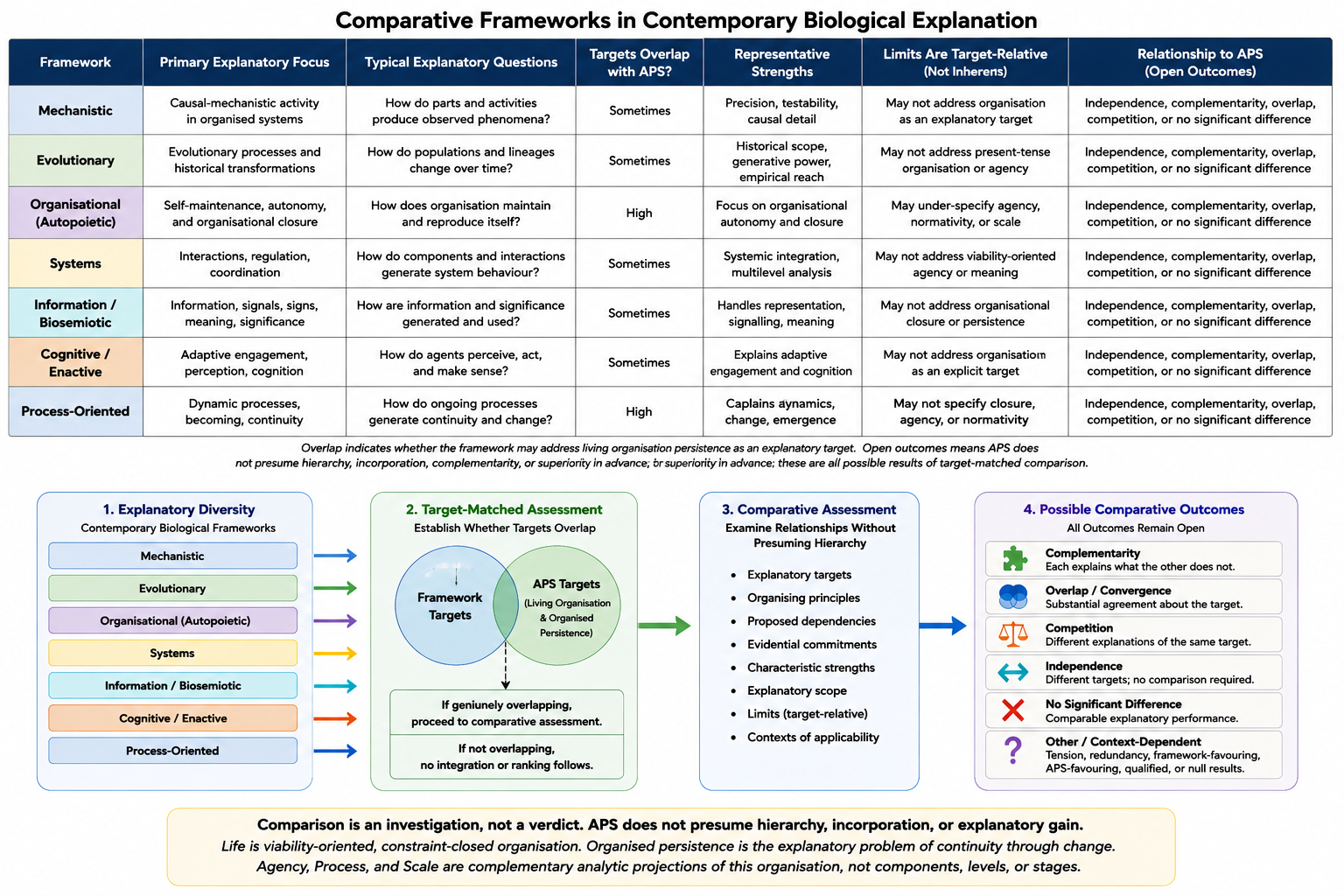
Mechanistic Biology
Mechanistic explanation is one of the central explanatory strategies of contemporary biology. It investigates how biological phenomena are produced through organised causal relations among entities, activities, structures, and processes.
Such explanations can be highly substantive. They may address not merely isolated components but organisation, regulation, feedback, coordination, development, and the causal architecture through which biological activities are generated and maintained.
APS therefore does not treat mechanism as a merely local or descriptive form of explanation.
Its relationship to mechanistic biology depends upon the explanatory target.
APS makes living organisation explicit through its account of viability-oriented, constraint-closed organisation and examines organised persistence through Agency, Process, and Scale. Mechanistic approaches possess their own resources for explaining biological organisation and activity.
Where a mechanistic explanation addresses a different target, no further APS explanation is required merely because APS uses a broader organisational vocabulary.
Where both approaches address the same phenomenon, however, comparison can ask whether APS identifies dependencies or contrasts that alter the explanation, whether the mechanistic account already captures them, or whether the approaches remain independently useful.
APS therefore does not assign mechanism the task of explaining how while reserving biological significance, organisation, or intelligibility for itself.
The relationship is an empirical and explanatory question to be assessed case by case.
Evolutionary Theory
Evolutionary theory explains the historical transformation of biological populations, lineages, traits, and forms of organisation. Natural selection, inheritance, variation, drift, developmental processes, niche construction, and other evolutionary processes provide powerful resources for understanding biological change through time.
APS addresses a different but potentially overlapping set of questions when it investigates living organisation and organised persistence.
This distinction does not establish that present organisation is explanatorily prior to evolutionary history, nor that evolutionary explanation is incomplete unless supplemented by APS. Historical and organisational explanations may address different targets, or they may intersect when questions concern the transformation, maintenance, or emergence of biological organisation.
Where such targets overlap, comparison should determine what each explanatory approach contributes.
APS may ask how viability-oriented, constraint-closed organisation is maintained and transformed across time. Evolutionary approaches may explain the historical processes through which particular forms of organisation arise and change. Whether these explanations are complementary, partially overlapping, independent, or in tension cannot be inferred merely from the distinction between present organisation and historical transformation.
Evolutionary explanation therefore remains indispensable within its domain, while the precise relationship between evolutionary explanation and APS organisational analysis remains a target-specific comparative question.
Organisational Biology
Organisational approaches have developed some of the most substantive contemporary accounts of living organisation. They investigate autonomy, self-maintenance, closure, regulation, biological function, and the mutually dependent relations through which living systems sustain themselves.
APS strongly converges with this emphasis on organisation while retaining its own substantive commitments.
APS defines life as viability-oriented, constraint-closed organisation and treats biological agency as viability-oriented organisational activity. Organised persistence identifies the related explanatory problem of how living organisation maintains and re-establishes continuity through change.
These formulations are not simply alternative names for organisational biology’s existing concepts. Nor does their difference establish that APS extends, completes, or improves organisational approaches.
The appropriate question is comparative.
Where organisational biology and APS address living organisation as a shared target, their accounts can be examined for similarities and differences in the relations they identify, the explanatory work assigned to closure, autonomy, viability, regulation, agency, function, and persistence, and the evidence supporting those relations.
Some differences may prove terminological. Others may reflect substantive explanatory commitments. Some may yield additional explanatory discrimination; others may not.
APS therefore treats organisational biology as a major substantive comparator rather than as a precursor to be incorporated into a broader APS framework.
Systems Biology and Systems Approaches
Systems approaches comprise a heterogeneous family of explanatory strategies concerned with interactions, feedback, regulation, dynamics, stability, networks, boundaries, coordination, and organisation.
Some systems approaches employ highly formal and cross-domain methods. Others address specifically biological forms of organisation and regulation. It would therefore be misleading to treat systems explanation as merely a mathematical description of complexity or as an abstract representation awaiting biological interpretation.
Systems approaches can provide substantive explanations of biological phenomena.
APS differs in making viability-oriented, constraint-closed organisation an explicit account of life and in examining organised persistence through Agency, Process, and Scale. That biological specificity is a feature of APS’s explanatory architecture, not by itself evidence of greater explanatory power.
Where systems approaches analyse phenomena such as feedback, regulation, coordination, stability, or organism–environment dynamics, their explanations may be sufficient for the question being asked.
Where a systems account and APS both address living organisation, comparison can instead ask whether the APS concepts identify explanatory dependencies or contrasts not already captured by the systems account, whether systems concepts provide resources absent from APS, or whether the approaches largely redescribe the same organisation.
No fixed division therefore assigns dynamics and regulation to systems theory while reserving biological organisation, normativity, or significance for APS.
Their relationship remains open to target-matched comparison.
Information and Biosemiotics
Informational and biosemiotic approaches address some of biology’s most important questions concerning signalling, communication, signs, interpretation, coding, biological differences, and the ways in which those differences acquire functional or organism-relative significance.
These approaches are heterogeneous. Information, semiosis, biological significance, and meaning should not be treated as interchangeable concepts, nor should informational or semiotic explanation be reduced to passive description.
APS approaches part of this conceptual territory through Biological Evaluation, defined as the process through which agency generates significance.
Within APS, biological significance concerns differences that matter relative to the viability of an organised living system. This is an APS account of significance; it does not establish that informational or biosemiotic approaches must be grounded in APS before their explanations become biological.
Where informational, semiotic, and APS accounts address different explananda, no hierarchy follows.
Where they address overlapping questions about biological significance, signalling, interpretation, or organism-relative differences, comparison can examine the relations each approach proposes and the explanatory consequences of those differences.
APS may propose Dependency Hypotheses concerning evaluation, significance, semiosis, and cognition. Their position within APS architecture does not establish them. They require independent specification and assessment.
The comparative question is therefore not what APS must add before information or signs become biologically meaningful. It is whether the competing or overlapping accounts explain the relevant biological target differently, and whether that difference produces demonstrable explanatory gain.
Cognitive and Enactive Biology
Cognitive and enactive approaches emphasise embodied activity, adaptive engagement, sense-making, organism–environment coupling, and the continuity between life and cognition. These traditions have provided substantive alternatives to accounts of cognition based exclusively on internal representation or computation.
APS shares important concerns with these approaches while retaining a more restrictive distinction between biological agency and cognition.
Within APS, biological agency is viability-oriented organisational activity. Cognition requires additional organisational capacities and should not be inferred merely from regulation, adaptive response, information processing, or organism–environment interaction.
This is an APS conceptual commitment, not a demonstration that enactive or cognitive approaches have drawn the boundary incorrectly.
APS also proposes relations among Biological Evaluation, significance, integration, and cognition. Where these relations function as Dependency Hypotheses, they require specification and assessment rather than being established by their position within APS architecture.
The resulting comparison should therefore not claim that living organisation simply precedes cognition in an explanatory hierarchy or that enactivist sense-making requires APS to provide its biological foundation.
Instead, comparison can ask how different approaches distinguish agency from cognition, how they understand sense-making and significance, what organisational capacities they associate with cognition, and what evidence discriminates among these accounts.
APS and cognitive or enactive approaches may overlap substantially. They may also differ over conceptual boundaries and explanatory priorities. Whether those differences yield explanatory gain for either approach remains an open comparative question.
Process Biology
Process-oriented approaches emphasise that organisms are not static things but dynamically maintained organisations constituted through continuing activity and change. This perspective has important affinities with APS.
APS likewise treats organisation as ongoing activity rather than a snapshot of structural relations. Its Process projection asks how continuity is maintained despite change, while organised persistence identifies the explanatory problem of how living organisation maintains and re-establishes continuity through time.
The convergence is substantial, but it does not establish equivalence.
Process approaches encompass a wider range of metaphysical, philosophical, and biological positions. APS makes more specific commitments concerning viability orientation, constraint closure, biological agency, and its Agency–Process–Scale analytic architecture.
Those differences do not by themselves establish that APS is more biologically complete or explanatorily powerful.
Nor should Process be treated as a component or level of living organisation. Within APS, Agency, Process, and Scale are complementary analytic projections of one viability-oriented, constraint-closed organisation.
Comparison should therefore ask what explanatory work follows from the different formulations. Process-oriented accounts may illuminate aspects of biological temporality and becoming without requiring reconstruction through APS, while APS may offer a particular method for investigating continuity through change.
Whether either formulation provides additional explanatory gain depends upon the target and evidence under comparison.
Why APS Is Not Another Competing Theory
The preceding comparisons show that contemporary theoretical biology contains a rich diversity of successful explanatory traditions. Mechanistic, evolutionary, organisational, systems, informational, cognitive, and process-oriented approaches investigate different or overlapping biological questions and have generated substantial empirical and conceptual achievements.
The purpose of comparison is not to identify a single winner among them.
APS is best understood here as a comparative explanatory methodology rather than as another specialist theory competing for universal explanatory authority. It does not introduce a new causal mechanism or require existing biological explanations to be reconstructed within APS.
Its distinctive task is to investigate relationships among explanatory traditions where their targets make comparison appropriate.
APS gives particular attention to cases in which living organisation or organised persistence is among the relevant explanatory targets. Within APS:
Life is viability-oriented, constraint-closed organisation.
Organised persistence concerns how that organisation maintains and re-establishes continuity through change.
These are substantive APS commitments. They do not establish that every other biological explanation depends upon APS or that living organisation is explanatorily prior to every other biological target.
APS therefore differs both from theoretical reduction and from unrestricted pluralism. It does not seek to reduce biology to one explanatory vocabulary, but neither does it assume that different explanatory traditions are permanently independent.
Where their targets differ, they may remain independently adequate. Where targets overlap, their relationship becomes a question for comparison.
Agency, Process, and Scale support this methodological task as complementary analytic projections of one viability-oriented, constraint-closed organisation. They are not additional variables, components, levels, dimensions, or stages through which other theories must pass.
APS’s contribution must therefore be assessed through what its comparative methodology actually achieves.
Target-matched comparison may reveal complementarity, useful integration, overlap, independence, tension, competition, redundancy, framework-favouring results, APS-favouring results, qualified results, or null results.
The methodological task is to make these relationships assessable rather than to declare them in advance.
Comparison Is Not Competition
APS compares explanatory traditions by examining their targets, organising principles, proposed dependencies, evidential strengths, explanatory scope, and possible relationships. Comparison does not presume hierarchy, incorporation, complementarity, or superiority.
Shared Organisational Themes Across Contemporary Biology
Contemporary biological theories often encounter related organisational questions even when their explanatory aims, methods, and conceptual commitments remain distinct.
Mechanistic approaches investigate organised causal activity. Evolutionary approaches investigate transformations of biological organisation through history. Organisational biology examines self-maintenance and autonomy. Systems approaches study interaction, regulation, and coordination. Informational and biosemiotic approaches address biological differences, signalling, signs, and significance. Cognitive and enactive approaches investigate adaptive engagement and cognition. Process approaches emphasise dynamic continuity and change.
The recurrence of organisational themes across these traditions is methodologically significant, but it should not be interpreted as evidence that contemporary biology is converging upon APS or any other single framework.
Shared questions are not shared theories.
Different research traditions may investigate overlapping aspects of living systems while retaining distinct explananda, methods, evidential standards, and theoretical commitments. Similar terminology likewise does not establish explanatory equivalence.
APS therefore does not claim that existing theories are incomplete because they have not adopted Agency, Process, or Scale. Nor does it claim that biology is implicitly moving towards an APS architecture.
Its more modest proposal is that recurring organisational questions create opportunities for disciplined comparison.
Where two approaches genuinely address a shared target, comparison can examine whether they identify the same dependencies, different dependencies, complementary relations, competing explanations, or no significant explanatory difference.
Where their targets do not overlap, no integration is required.
APS therefore treats the visibility of organisational themes as an invitation to comparison rather than as evidence for theoretical consolidation.
Shared Questions Are Not Shared Theories
Contemporary biological traditions may encounter related questions because they investigate the same living systems from different explanatory perspectives. This does not imply convergence on a single theory or make APS their common foundation. It creates possible targets for comparative assessment.
What APS Contributes
APS proposes a comparative explanatory methodology for investigating relationships among the diverse explanatory traditions of contemporary biology when their targets warrant comparison.
Its first proposed contribution is methodological. APS compares explanatory programmes through their explanatory targets, organising principles, proposed dependencies, evidential commitments, characteristic strengths, and explanatory scope.
This makes comparison itself explicit and assessable.
Second, APS uses Agency, Process, and Scale as complementary analytic projections through which its own account of living organisation can be examined.
Agency concerns what living systems do.
Process concerns how continuity is maintained despite change.
Scale concerns where persistence is organised across spatial and temporal extents.
These are analytic projections of one viability-oriented, constraint-closed organisation rather than independent components, dimensions, levels, hierarchy, or causal stages.
Third, APS distinguishes organised persistence from the historical processes through which living organisation is transformed. Organised persistence concerns continuity through change; development, reproduction, adaptation, and evolution raise additional historical and transformational questions. Their relationships may be materially important, but those relationships should be treated as assessable Dependency Hypotheses rather than consequences of conceptual ordering alone.
Fourth, APS offers a vocabulary for conducting comparison across disciplinary boundaries. This vocabulary does not replace the specialised concepts of molecular biology, physiology, development, ecology, evolution, systems biology, cognitive science, organisational biology, or other fields. Its value depends upon whether it helps clarify their relationships without obscuring their distinctive explanatory achievements.
Finally, APS proposes that the conceptual architecture of biological explanation itself can be a legitimate object of theoretical investigation. This proposal does not establish that APS has already rendered biology more coherent. It establishes a methodological question:
Does explicit comparison of explanatory architectures produce greater explanatory or methodological discrimination than would otherwise be available?
That question remains open to assessment.
APS should therefore be judged not by the authority of its terminology or by the breadth of its architecture, but by whether it generates clearer comparisons, identifies assessable dependencies, distinguishes genuine explanatory alternatives, and produces demonstrable methodological or explanatory gain.
A Methodological Contribution
APS proposes a comparative framework for investigating how explanatory traditions relate when their targets genuinely overlap with living organisation or organised persistence. Whether that framework provides methodological or explanatory gain must be demonstrated rather than assumed.
Conclusion
Contemporary biology derives much of its strength from explanatory diversity. Mechanistic, evolutionary, organisational, systems, informational, cognitive, ecological, developmental, computational, and process-oriented approaches investigate different or overlapping biological questions and have generated major explanatory achievements.
This diversity does not constitute theoretical disorder.
It creates a methodological problem: how should successful explanations be related when their targets overlap, and how should their differences be understood when they do not?
APS has been presented as one response to that problem.
It proposes a comparative explanatory methodology rather than a universal replacement theory. It makes living organisation an explicit target through the substantive APS claim that:
Life is viability-oriented, constraint-closed organisation.
It treats organised persistence as the explanatory problem of how that organisation maintains and re-establishes continuity through change.
Those commitments provide one framework for comparison. They do not establish that all other explanations are incomplete, that other approaches depend upon APS, or that APS possesses a privileged explanatory position.
The comparative task is instead to determine whether explanatory targets genuinely overlap and, where they do, what difference follows from the relations proposed by each framework.
APS therefore does not predetermine complementarity, integration, independence, competition, or superiority.
Its value depends upon demonstrated methodological or explanatory gain.
Whether APS ultimately proves useful will not be decided by new terminology, breadth of conceptual coverage, or claims to theoretical integration. It will depend upon whether the method clarifies explanatory targets, improves comparisons, identifies dependencies that can be assessed, distinguishes genuine alternatives, and generates understanding unavailable without the comparison.
APS should consequently be understood as an invitation to make the organisation of biological explanation itself more explicit and assessable.
It offers one methodology for that task—not a conclusion that the explanatory landscape of biology has already been unified.
The Aim of APS
APS does not seek to replace the major explanatory traditions of contemporary biology. It proposes a comparative methodology for investigating their relationships where explanatory targets genuinely overlap. Living organisation and organised persistence are important APS targets, but their relevance to another framework must be established in the comparison. Complementarity, integration, independence, overlap, competition, tension, redundancy, framework-favouring, APS-favouring, qualified, and null outcomes remain possible. The success of APS depends upon demonstrated methodological or explanatory gain.
The methodology introduced here is developed through detailed comparative studies of major contemporary frameworks. These include organisational biology, systems approaches, autonomy theory, the Free Energy Principle and active inference, the Extended Evolutionary Synthesis, mechanistic explanation, information processing, enactivism, computation, control theory, and related approaches.
These studies apply the same governing rule:
the gateway cannot decide a comparative result that the target-matched comparison has not established.
Explanatory Architecture
Central Question
How should the major explanatory traditions of contemporary biology be compared without assuming in advance that they are competing, complementary, hierarchical, or reducible to a common explanatory framework?
Architectural Role
This article establishes the methodological gateway to the APS comparative-theory programme.
It presents APS as a comparative explanatory methodology for examining explanatory targets, organising principles, proposed dependencies, conceptual architectures, evidential strengths, and explanatory scope.
APS makes living organisation and organised persistence explicit targets for its own comparative programme, but it does not assume that every biological framework addresses those targets or depends upon APS.
Where targets overlap, comparative relationships require target-matched assessment.
Preceding Explanatory Dependencies
This article draws upon:
- What Is APS?
- Agency as the Defining Activity of Life
- Organised Persistence
- Biological Explanation
- Agency
- Process
- Scale
- Comparative Explanatory Methodology in Theoretical Biology
Within APS:
Life is viability-oriented, constraint-closed organisation.
Biological agency is viability-oriented organisational activity.
Organised persistence concerns how living organisation maintains and re-establishes continuity through change.
Agency, Process, and Scale are complementary analytic projections of one viability-oriented, constraint-closed organisation.
These are conceptual commitments used by APS. Their position within the APS architecture does not establish causal, temporal, ontological, hierarchical, foundational, or comparative priority over alternative explanations.
Any substantive relation proposed between these concepts and the explanatory commitments of another framework remains a Dependency Hypothesis requiring specification and assessment.
Subsequent Explanatory Developments
The comparative methodology established here is applied and tested in articles including:
- Why Life Is Not Active Inference
- Why Life Is Not Information Processing
- Why Life Is Not a Machine
- Why Life Is Not Enactivism
- Why Life Is Not Autopoiesis
- APS and Autonomy Theory
- APS and Systems Theory
- Why Life Is Not Control Theory
- Why Life Is Not Computation
- APS and Organisational Biology
- APS and the Free Energy Principle
- APS and the Extended Evolutionary Synthesis
- related comparative studies
These articles should not make claims against a comparator stronger than target-matched assessment warrants.
Related Explanatory Questions
- When do two biological frameworks genuinely address the same explanatory target?
- How should frameworks be compared when their terminology differs but their explananda overlap?
- When does conceptual difference amount to substantive explanatory difference?
- When are explanatory contributions complementary, competing, redundant, independent, or otherwise related?
- How should Dependency Hypotheses be specified and assessed?
- What constitutes demonstrated methodological or explanatory gain?
- When is no additional APS explanation required?
Position Within APS
This article defines the methodological role of comparative analysis within APS.
APS is not presented here as a universal theory that subsumes specialist biological explanations. Its role is to make selected explanatory relationships assessable where living organisation, organised persistence, or another genuinely shared target permits comparison.
The framework’s biological commitments provide one participant in those comparisons, not the result of the comparison.
Corpus Significance
This Anchor article is the canonical gateway to the APS comparative-theory programme.
It establishes the standard that governs all downstream comparator articles:
represent the strongest warranted alternative, distinguish non-identity from inferiority, preserve multiple possible comparative outcomes, and require target-matched assessment before claiming explanatory gain.
The gateway therefore constrains downstream articles as well as introducing them. No individual comparator article should make a stronger claim against an alternative than this methodology permits, and the gateway itself must not announce a comparative conclusion before the relevant comparison has been made.
See Also
Related Articles
References
- (2013). The Constituents of Life. In K. Kampourakis (Ed.), The Philosophy of Biology: A Companion for Educators. Springer. https://doi.org/10.1007/978-94-007-6537-5_3
- (2015). Biological Autonomy: A Philosophical and Theoretical Enquiry. Springer.
- (2023). Organization in Biology. Springer.
- (2018). Everything Flows: Towards a Processual Philosophy of Biology. Oxford University Press.
- (2026). Bootstrapping Life-Inspired Machine Intelligence. arXiv.Preprint. https://arxiv.org/abs/2602.08079
- (2026). Agency as the Defining Activity of Life: A Viability-Oriented Framework Integrating Process and Scale. Biological Theory . https://doi.org/10.1007/s13752-026-00547-6
- (2015). Organisms, Agency, and Evolution. Cambridge University Press.