APS and the Extended Evolutionary Synthesis — Organisation, Evolution, and Explanatory Comparison
The Extended Evolutionary Synthesis (EES) broadens evolutionary explanation through development, plasticity, niche construction, ecological inheritance, and organism–environment interaction. APS addresses related questions through its account of viability-oriented, constraint-closed organisation and organised persistence. This article compares the two explanatory architectures without assuming that APS grounds, completes, or occupies a more fundamental explanatory domain than evolutionary theory. APS may investigate proposed dependencies between living organisation, reproduction, inheritance, variation, selection, and historical transformation, but their explanatory significance requires target-matched assessment rather than inference from APS architecture alone.
Key Points
- The Extended Evolutionary Synthesis broadens evolutionary explanation through development, plasticity, niche construction, ecological inheritance, and organism–environment interaction.
- APS and the EES overlap in their attention to organisms, development, environmental modification, and historical transformation.
- APS interprets evolution in relation to viability-oriented organisation and organised persistence.
- Organisational, historical, and evolutionary relations must be distinguished from claims of explanatory priority or foundational dependence.
- Proposed dependencies among persistence, reproduction, inheritance, variation, adaptation, and selection require evidential assessment rather than architectural assumption.
- Where APS and evolutionary approaches address the same explanatory target, comparative gain requires target-matched comparison.
Part of APS and Contemporary Explanatory Approaches
This article clarifies the relationship between the Extended Evolutionary Synthesis (EES) and APS. The EES and APS address overlapping questions concerning organismal activity, development, environmental relations, continuity, and evolutionary transformation. Their conceptual and explanatory differences create a comparative problem; they do not establish that APS grounds or completes evolutionary explanation.
The Extended Evolutionary Synthesis
The Extended Evolutionary Synthesis encompasses a set of approaches that expand evolutionary theory beyond the gene-centric framework of the Modern Synthesis. It incorporates processes such as developmental bias, phenotypic plasticity, niche construction, and ecological inheritance.
These approaches emphasise that organisms are not passive products of selection but active participants in shaping their evolutionary trajectories. Development influences variation, and organism–environment interaction modifies the conditions under which selection operates.
In this way, the EES broadens evolutionary explanation by situating genetic change within a wider set of developmental, ecological, and organism–environment processes.
Points of Convergence with APS
APS and the EES share several important commitments. Both resist strictly gene-centric accounts of evolution and emphasise the significance of organism–environment interaction, while recognising that development, regulation, and ecological context contribute to understanding how evolutionary processes unfold. The EES emphasis on niche construction and phenotypic plasticity also provides an important point of contact with the APS treatment of organisms as active participants in processes affecting the conditions of their persistence.
These convergences make the EES a natural point of comparison for APS. They establish overlapping explanatory concerns, however, rather than theoretical identity or a predetermined relation between the two frameworks.
Comparing Evolutionary and Organisational Explanatory Targets
APS and the EES overlap substantially in the biological phenomena they address, but they organise explanatory questions differently. The EES broadens evolutionary explanation by examining how development, inheritance, plasticity, niche construction, selection, and organism–environment relations contribute to evolutionary change.
APS investigates living organisation and organised persistence and asks how evolutionary processes bear upon the historical continuity and transformation of viability-oriented organisation.
This does not establish that APS asks a more fundamental question, nor that evolutionary theory merely presupposes conditions which APS alone explains. Claims that persistence, reproduction, inheritance, variation, or selection depend upon particular organisational relations should instead be treated as Dependency Hypotheses whose evidential and explanatory significance must be assessed.
The relevant comparative question is therefore whether APS and an evolutionary explanation address the same explanandum and, if so, whether the APS formulation changes explanatory discrimination, dependency disclosure, scope, evidence, or warranted understanding. Difference in conceptual architecture alone does not establish such gain.
APS: Organised Persistence and Evolutionary Transformation
APS proposes that life is viability-oriented, constraint-closed organisation and treats organised persistence as the problem of how that organisation maintains and re-establishes the conditions of its continuity despite change.
Applied to evolution, APS investigates possible dependencies among organised persistence, reproduction, inheritance, variation, environmental relations, and historical transformation. It may therefore ask how forms of living organisation are maintained, reconstructed, and transformed across generations.
Within APS, biological agency is viability-oriented organisational activity. Agency may include regulation, environmental modification, development, behaviour, reproduction, and other activities where these contribute to the maintenance or transformation of living organisation.
APS accordingly interprets evolution as the historical transformation of viability-oriented organisation. This is an APS explanatory framing, not a replacement for established evolutionary explanations of population change, selection, inheritance, adaptation, or diversification. Whether this reframing adds explanatory gain is a separate comparative question.
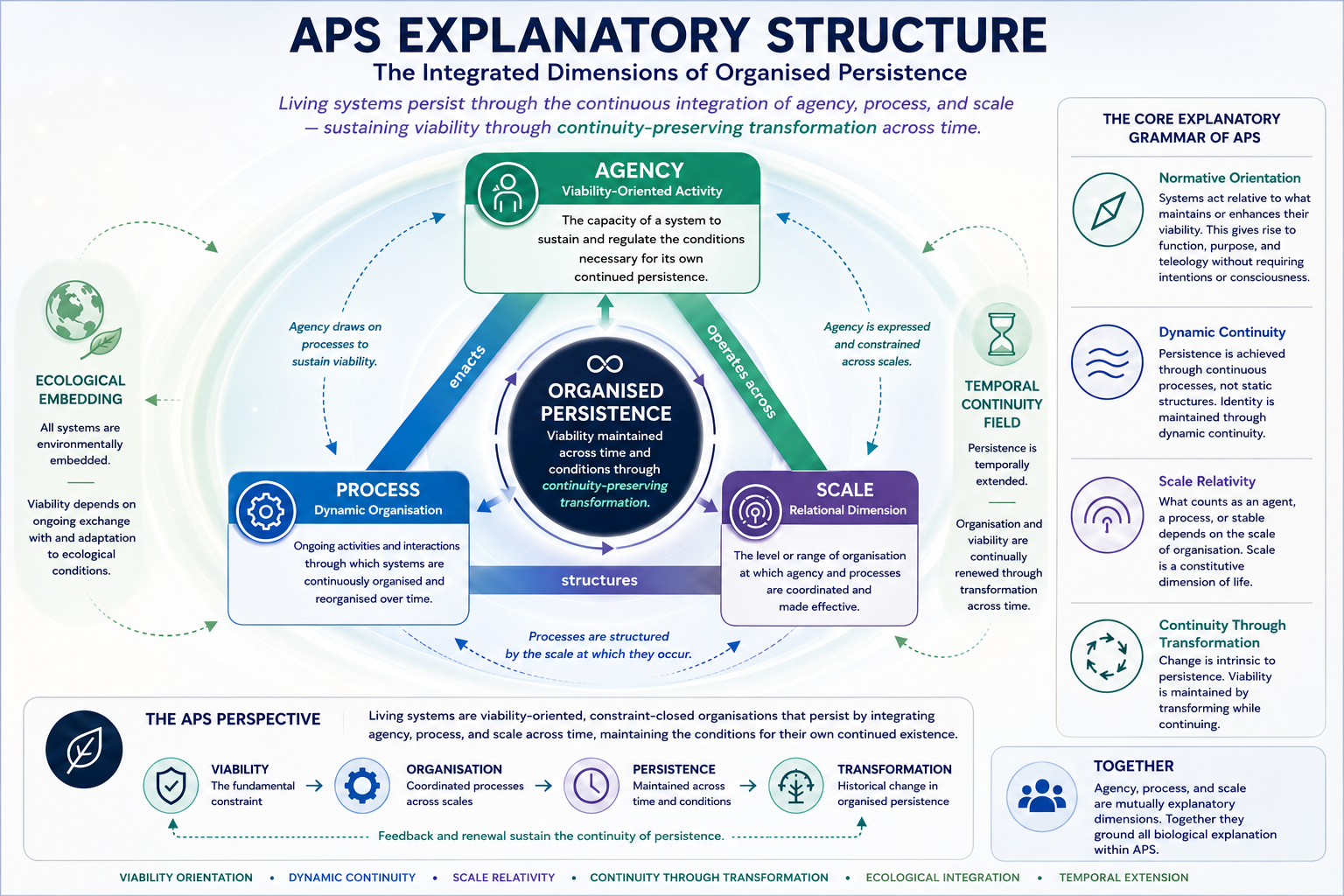
APS Explanatory Structure. Agency, Process, and Scale are complementary analytic projections of one viability-oriented, constraint-closed organisation. Applied to evolutionary questions, APS investigates what living systems do, how organisational continuity is maintained and transformed through time, and where persistence is organised across spatial and temporal extents. This architecture proposes questions for evolutionary comparison; it does not establish explanatory priority over evolutionary theory.
Organisms as Active Participants
The EES emphasises organismal activity through processes such as niche construction, developmental regulation, and environmental modification. These provide important points of comparison with APS, which treats biological agency as viability-oriented organisational activity.
APS can therefore investigate niche construction and related processes in relation to the activity through which organisms modify conditions relevant to persistence. This does not require reclassifying niche construction as merely an expression of APS agency or denying its role within evolutionary explanation.
Evolution, Adaptation, and Persistence
APS interprets adaptation and evolution in relation to living organisation, while evolutionary frameworks may characterise these phenomena through different explanatory units and processes. These formulations should be compared rather than hierarchically nested.
Within APS, adaptation may be investigated as the reorganisation of viability-oriented activity in relation to changing conditions, while evolution is interpreted as the historical transformation of viability-oriented organisation across generations. These formulations locate adaptation and evolution within the APS explanatory architecture; they do not replace established evolutionary definitions or establish that evolutionary explanations must be reconstructed through organised persistence.
Within APS, biological purpose refers to viability-oriented organisation without requiring externally imposed design or conscious intention.
APS may investigate proposed relations among inheritance, adaptation, fitness, selection, and lineage continuity as Dependency Hypotheses. Their exact form and explanatory contribution require biological and comparative assessment rather than following automatically from their position within APS architecture.
The Scope of the EES
The EES addresses evolutionary questions through an expanded range of developmental, ecological, hereditary, and organismal processes. APS makes living organisation itself an explicit explanatory target and asks how evolutionary processes bear upon organised persistence and historical transformation.
These differences in scope do not establish that the EES is explanatorily incomplete, that APS supplies its missing foundation, or that the two frameworks are necessarily complementary. Where their targets differ, each may remain adequate for its own question. Where their targets overlap, their relative explanatory contribution requires target-matched comparison.
Comparing the EES and APS
The EES and APS can be compared across several overlapping concerns: development, organismal activity, environmental modification, inheritance, adaptation, historical continuity, and evolutionary transformation.
APS brings these questions into relation with its account of viability-oriented organised persistence. The EES develops them within an explicitly evolutionary explanatory programme. Neither architecture is thereby contained within the other.
Their relationship may vary according to the explanatory target. Particular comparisons may reveal overlap, complementarity, independence, tension, redundancy, APS-favouring gain, evolutionary-framework-favouring gain, or a qualified result. Conceptual inclusion within APS does not establish integration or explanatory superiority.
Summary
The Extended Evolutionary Synthesis broadens evolutionary explanation through development, plasticity, niche construction, ecological inheritance, and organism–environment interaction.
APS addresses related questions through viability-oriented, constraint-closed organisation and organised persistence and interprets evolution as the historical transformation of living organisation.
These differences create opportunities for target-matched comparison but do not establish that APS grounds, completes, contains, or provides a more fundamental explanation than evolutionary theory.
Key Point
The EES and APS address overlapping questions concerning organisms, development, environmental interaction, continuity, and evolutionary transformation. APS interprets these questions through viability-oriented organised persistence, but difference in architecture does not establish explanatory priority. Where the two approaches address the same target, comparative explanatory gain must be demonstrated.
Explanatory Architecture
Central Question
How do APS and the Extended Evolutionary Synthesis converge and differ in their explanations of organismal activity, continuity, inheritance, adaptation, and evolutionary transformation, and what comparative significance follows when they address the same explanatory target?
Architectural Role
This comparative article examines APS alongside the Extended Evolutionary Synthesis without assuming explanatory hierarchy, grounding, subsumption, or complementarity. It distinguishes evolutionary explanation from APS’s organisational framing while identifying where proposed dependencies between organised persistence and evolutionary processes require explicit assessment.
Preceding Explanatory Dependencies
These concepts and articles provide the APS background used in this comparison. They identify relations within the APS corpus rather than established biological dependencies, hierarchy, or explanatory priority.
- What Is APS?
- APS and Contemporary Explanatory Approaches
- Organised Persistence
- Biological Agency
- Viability
- Constraint Closure
- Evolution as the Historical Transformation of Viability-Oriented Organisation
- Explanatory Priority Is Not Ontological Priority
Subsequent Explanatory Developments
The questions identified here are developed or applied in:
- Selection Revisited — What Does Selection Actually Act On?
- Organism–World Coupling: Agency, Not Control
- Architectural Dependency and Biological Explanation
- Why APS Reframes Biology
- Comparative Explanatory Methodology in Theoretical Biology
Related Explanatory Questions
- When do APS and evolutionary approaches address genuinely matched explanatory targets?
- How should organised persistence be related to reproduction, inheritance, variation, and selection?
- Which proposed relations are Dependency Hypotheses rather than established dependencies?
- Does APS’s organisational framing add explanatory gain beyond established evolutionary explanations?
- Under what conditions might APS and the EES be complementary, overlapping, independent, redundant, competing, or differentially explanatory?
Position Within APS
This article belongs to the APS Comparative Explanatory Approaches family. It examines evolutionary explanation without treating living organisation as automatically prior to historical explanation. APS retains its substantive account of viability-oriented organised persistence while leaving the comparative significance of that account to target-matched assessment against the strongest relevant evolutionary alternatives.
See Also
Related Articles
References
- (2016). The extended evolutionary synthesis. Annual Review of Ecology, evolution, and Systematics, 47, 1–28 . https://doi.org/10.1146/annurev-ecolsys-121415-032359
- (2015). The extended evolutionary synthesis: its structure, assumptions and predictions. Proceedings of the Royal Society B: Biological Sciences, 282(1813), 20151019 . https://doi.org/10.1098/rspb.2015.1019
- (2018). Everything Flows: Towards a Processual Philosophy of Biology. Oxford University Press.
- (2012). A theory of biological relativity: no privileged level of causation. Interface Focus, 2(1), 55–64 . https://doi.org/10.1098/rsfs.2011.0067
- (2003). Niche Construction: The Neglected Process in evolution. Princeton University Press.
- (2007). Do we need an extended evolutionary synthesis?. evolution, 61(12), 2743–2749 . https://doi.org/10.1111/j.1558-5646.2007.00246.x
- (2003). Developmental Plasticity and evolution. Oxford University Press.