APS can be approached through a few introductory questions. These pathways introduce the biological problem, what distinguishes living systems, and the structure of the framework.
Biology explains many things.
But what is biology itself trying to explain?
Evolution. Development. Function. Agency. Ecology. Biological organisation.
Each area of biology has its own questions, methods, and explanatory achievements. Together they raise a wider question: how do these different explanations relate?
Agency–Process–Scale (APS) investigates this question as a proposed integrative framework for theoretical biology. It seeks to clarify relationships among biological concepts without replacing established theories or presuming explanatory superiority.
Start Here
-
What Is Biology Trying to Explain?
Start HereBegin with biology’s central explanatory question and why it matters to the relationships among different biological explanations.
-
What Is a Biological System?
Start HereExplore what distinguishes living organisation and why the maintenance of viability matters.
-
What Is APS?
Start HereAn accessible introduction to agency, process and scale as complementary perspectives on living organisation.
For a wider guide to the website’s concepts, domains, and reading pathways, see Understanding APS: The Structure of the Framework .
What Is APS?
APS stands for Agency–Process–Scale. It investigates living systems through three complementary analytic projections, not three separate biological entities, independent causes, or hierarchical levels.
APS proposes that life is characterised by viability-oriented, constraint-closed organisation: living systems participate in sustaining the conditions that make their continued existence possible. This organisation is enacted through activity, unfolds through processes, and can be investigated across spatial, temporal, and organisational scales.
Organised Persistence
Living systems grow, develop, repair, reproduce, and respond to changing circumstances. Their persistence is therefore continuity maintained through change, not changeless endurance. APS investigates this organised persistence as a candidate comparative explanatory target where it is relevant to the biological question at hand. It does not assume that all biological phenomena share one explanation.
-
Agency
What do living systems do?
Biological agency is viability-oriented organisational activity: the present-tense activity through which living systems maintain and re-establish the conditions of their persistence.
-
Process
How is continuity maintained through change?
APS examines the processes through which biological organisation remains continuous amid material turnover, development, repair, environmental variation, ageing, and evolutionary transformation.
-
Scale
Where is persistence organised?
APS investigates where persistence is organised across spatial and temporal extents, and how materially implemented relations alter the causal contexts within which local biological activity occurs.
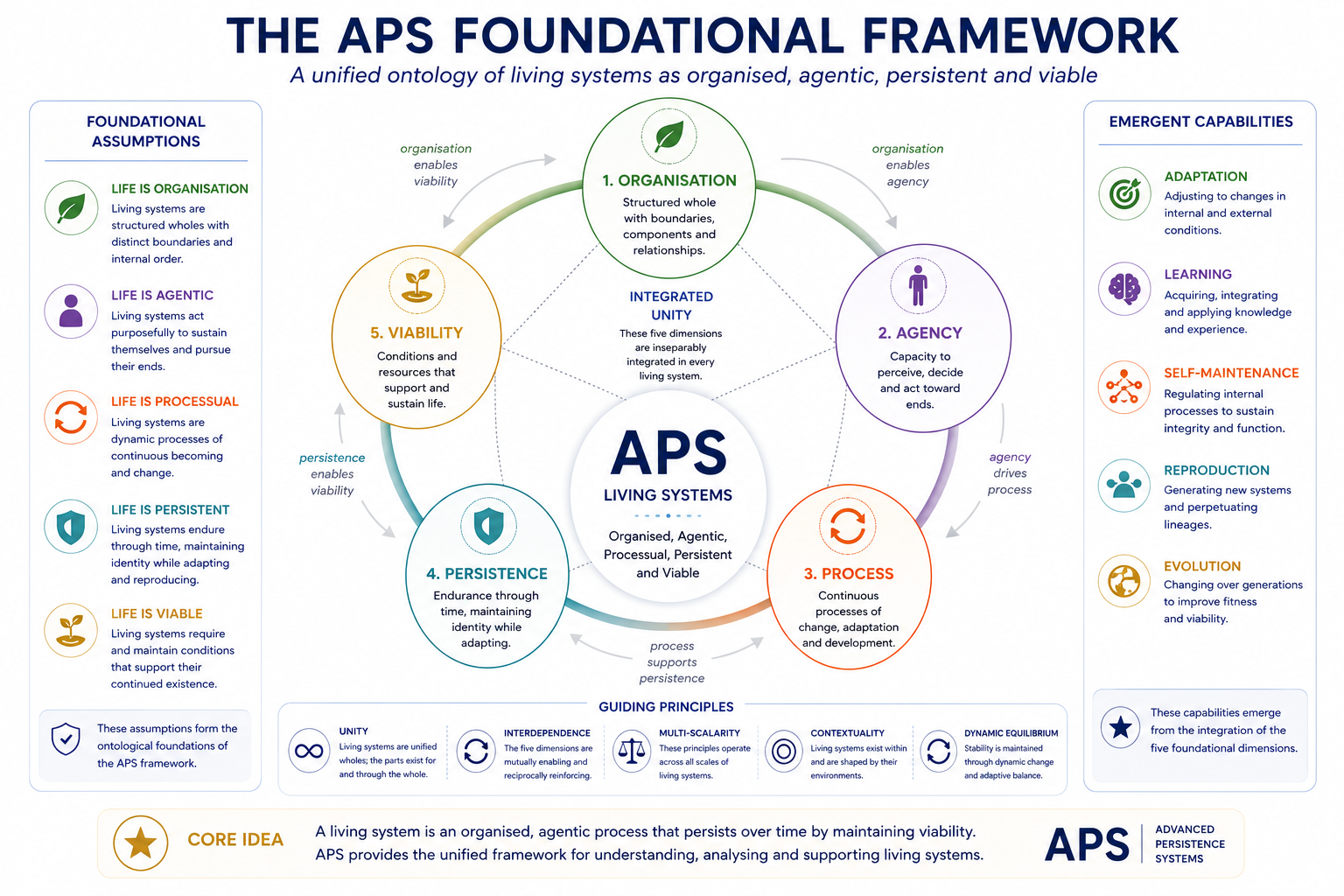
Open the diagram to view a larger version.
Further reading: The Core Structure of APS .
APS in Action
APS does not replace established biological explanations. It asks whether examining their relationships through living organisation, viability, and persistence can clarify particular questions. Three examples illustrate this approach.
-
Function
A familiar biological question
What does this trait, process, or structure do?APS also asks
How does it contribute to maintaining viability-oriented biological organisation?APS examines function as a present-tense, viability-relative organisational contribution, while distinguishing this from explanations of how the function arose.
-
Development
A familiar biological question
How does an organism develop?APS also asks
How is viable biological organisation reorganised across an individual life history?APS investigates continuity through developmental transformation without replacing the mechanisms that explain particular developmental processes.
-
Evolution
A familiar biological question
How do biological populations change across generations?APS also asks
How are forms of organised persistence historically transformed?APS examines how organised persistence relates to inheritance, variation and evolutionary change without displacing established evolutionary explanations.
These examples suggest possible connections; they do not establish that APS offers a better explanation. For additional examples involving agency and ecology, read Why APS Reframes Biology.
APS in Contemporary Biology
Modern biology succeeds through explanatory plurality. Mechanistic, evolutionary, developmental, ecological, informational, physiological, mathematical, and organisational approaches address different questions and achieve different kinds of understanding.
APS investigates whether important relationships among biological concepts and explanations can be made more precise, systematic, and assessable through a shared organisational perspective. Its proposed contribution may lie in conceptual clarification and cross-domain integration, not necessarily in discovering new biological principles.
This possibility remains a research question. APS distinguishes conceptual coherence from empirical adequacy, and clarification from demonstrated explanatory gain. A claim of comparative advantage must address the same explanatory target as the strongest relevant alternative and establish a difference beyond redescription or vocabulary.
APS is being investigated as a candidate general explanatory framework for biology. Research to date supports bounded architectural coherence and integration; it has not established framework-wide empirical adequacy or comparative explanatory superiority. The APS research programme records positive, qualified, null, and adverse findings rather than assuming its own success.
For comparison with other explanatory approaches, see APS and Contemporary Theories. The Methodology and Explanation Topic develops the criteria used to assess explanatory claims.
Explore APS
APS is organised into connected areas of inquiry. The Topics pages guide readers to their principal concepts, articles, and research questions. These domains are not stages in a hierarchy or parts of a universal causal sequence; relationships between them must be established for each explanatory question.
Biological Domains
-
Biological significance, evaluation, integration and the conditions under which biological activity may be cognitive.
-
Continuity, transformation, regeneration and repair across development.
-
Inheritance, variation, adaptation and historical change across generations.
-
Organism–environment relationships, ecological dependencies and viability across scales.
-
Coordination, collective activity and relationships among biological participants.
Foundations, Methods, and Further Reading
-
The principal concepts and architecture of APS.
-
How explanatory claims are specified, compared and tested.
-
Biological organisation, normativity and philosophical interpretation.
-
Evidence, diagnostic distinctions and empirical assessment.
-
The limits of biological concepts and comparisons with artificial systems.
Browse the full Articles directory, consult the Glossary, or use site search for more specialised material, including philosophical discussions and clarifications.