The APS Glossary as Conceptual Infrastructure
This article explains how the APS glossary functions as conceptual infrastructure. Canonical definitions, controlled terminology, documented conceptual relationships, and explicit revision procedures help maintain consistency across the APS corpus. This infrastructure supports pathway specification, explanatory practice, and domain-specific development without itself establishing biological dependencies, explanatory claims, or comparative explanatory gain.
Where This Article Fits
This article explains how the APS glossary functions as conceptual infrastructure within the APS framework. APS uses canonical definitions, controlled terminology, documented conceptual relationships, and explicit revision procedures to maintain consistency across its corpus. The glossary therefore serves a role that extends beyond providing isolated definitions. It supports consistent pathway specification, explanatory practice, and domain-specific development without itself establishing biological dependencies or explanatory claims. For the broader APS account of organised conceptual relationships, see APS as an Organised Conceptual System — Why Definitions Form a System.
Conceptual Infrastructure
A framework containing many related concepts requires ways of maintaining their meanings and distinctions across different contexts.
Without such controls, key terms can shift in meaning between articles, diagrams, glossary entries, and research programmes. Claims that appear to use the same concepts can then become difficult to compare, and revisions to one concept can produce unnoticed consequences elsewhere.
APS addresses this problem through a structured conceptual infrastructure centred on its glossary.
The glossary does more than provide short definitions. It records canonical formulations, preserves important distinctions, documents relationships among concepts, and provides stable reference points against which later revisions can be assessed.
APS therefore treats glossary entries as systematically related rather than as independent descriptions. This does not mean that every conceptual relationship is a biological dependency or that conceptual coherence establishes explanatory success. It means that changes to one canonical formulation can affect the interpretation of other parts of the framework.
The glossary functions as infrastructure because it helps make those relationships explicit and manageable across the APS corpus.
The Positive Contribution of Conceptual Infrastructure
The APS glossary contributes to biological understanding through the relationships among its definitions, not merely through the precision of individual terms. Its interconnected architecture makes conceptual commitments explicit, helps prevent ambiguity and conflation, and provides a common interpretive perspective across otherwise distinct biological domains.
This organisation has several positive functions. Stable definitions support consistent interpretation; documented relationships expose assumptions and dependencies to criticism; controlled distinctions preserve differences among explanatory targets; and revision procedures allow conceptual improvements to be assessed for their consequences throughout the framework. These features make APS a coherent and corrigible conceptual system rather than a collection of independent claims.
The potential intellectual value of this architecture lies in its capacity to improve biological intelligibility. By relating questions concerning agency, function, development, evolution, ecology, and cognition through a shared account of living organisation, APS offers a systematic perspective from which their connections and differences can be examined.
Such integration does not itself establish additional biological mechanisms, empirical dependencies, or comparative explanatory superiority. Its contribution is instead conceptual and interpretive: making biological relationships more explicit, coherent, and open to critical assessment. Whether particular applications improve understanding must be judged in relation to the questions and alternatives concerned.
Key Point
The APS glossary is not merely a mechanism for maintaining terminological consistency. Its interconnected, revision-open architecture is a potential resource for conceptual clarification, cross-domain integration, and biological understanding.
Why Scientific Frameworks Need Conceptual Infrastructure
Scientific inquiry depends upon clear and sufficiently stable concepts as well as empirical observations, models, theories, and explanations.
Terminological stability supports communication, comparison, criticism, and cumulative investigation. When the same term changes meaning without explicit control, apparent agreements or disagreements can become difficult to interpret.
Biology provides a useful but limited analogy through internationally maintained systems of nomenclature. Stable nomenclatural practices allow biological entities to be identified consistently across languages, communities, and generations. Nomenclature concerns naming rather than explanation, so the analogy should not be taken further than this: controlled terminology can support continuity in scientific communication while remaining open to governed revision.
APS applies that general organisational lesson to its own conceptual corpus.
The glossary stabilises APS terminology and records relationships among APS concepts. Definitions can be compared across articles, conceptual changes can be tracked, and revisions can be assessed for their consequences elsewhere in the framework.
This conceptual organisation does not replace empirical investigation or theoretical analysis. Nor does it establish the biological claims in which APS concepts are used.
The glossary is therefore a means of maintaining conceptual continuity across APS rather than a mechanism that generates biological explanation.
Conceptual Infrastructure and Biological Explanation
APS seeks to clarify the organisation that makes biological persistence and transformation intelligible.
Doing so requires concepts whose meanings remain sufficiently controlled for claims using them to be interpreted and compared.
The glossary contributes to this task by stabilising canonical formulations and clarifying distinctions among related concepts. A claim involving Life, Biological Agency, Process, Scale, Viability, Constraint Closure, or Organised Persistence can be assessed more clearly when those terms do not shift meaning from one context to another.
Conceptual infrastructure supports biological explanation by clarifying the concepts, distinctions, and relationships through which explanatory claims are formulated and assessed. It can also contribute to conceptual understanding by making relationships among biological questions more explicit and intelligible. This contribution should be distinguished from establishing the biological dependencies or causal mechanisms invoked in particular explanations.
A canonical definition does not establish that a biological system instantiates the defined organisation. A documented conceptual relationship does not establish a material dependency. And consistency among APS concepts does not demonstrate comparative explanatory gain.
Those conclusions require evidence, argument, and comparison appropriate to the explanandum.
The glossary’s narrower role is to help ensure that APS claims can be stated and interpreted consistently enough for those further assessments to occur.
Conceptual Infrastructure and APS Pathway Relations
APS uses pathways to display proposed relationships among concepts.
Examples include:
Life → Agency
and:
Life → Agency → Biological Evaluation → Significance
and:
Significance → Values → Shared Evaluation → Social Norms → Social Organisation
These pathways should not be read as temporal sequences, causal chains, developmental stages, hierarchical levels, or automatically established dependencies.
Following the APS account of Architectural Dependency, each arrow records a proposed dependency relation whose relata, relation type, material or argumentative basis, evidence, scope, alternatives, and failure conditions require separate assessment.
The glossary has an important but limited role in that assessment.
Before asking whether a proposed dependency is biologically supported, it must be reasonably clear what the concepts at either end of the arrow mean. If Life, Agency, Significance, Values, or Social Norms change meaning between uses, the dependency claim itself becomes difficult to specify.
Stable definitions therefore help make pathway claims explicit and comparable.
They do not establish those claims.
A conceptual relationship recorded within APS may explain why the framework places two concepts in relation. Whether a corresponding biological dependency exists is a separate question. Where explanatory gain is claimed, comparison with the strongest relevant established explanation is required as a further step.
Key Point
Conceptual infrastructure helps APS pathway claims to be specified consistently and assessed explicitly. It does not turn pathway arrows into evidence.
Conceptual Infrastructure and Explanatory Practice
Stable definitions are only one part of maintaining consistency across a framework.
APS also relies upon controlled distinctions among concepts and claim types. These distinctions help prevent different questions from being collapsed into one another.
For example, APS distinguishes between:
- conceptual relationships and material biological dependencies;
- dependency and causation;
- organisation and structure;
- persistence and continuity;
- significance and information;
- morality and ethics.
These distinctions are not merely matters of preferred vocabulary. They affect what a claim means, what evidence would be relevant to it, and what conclusions can legitimately follow.
The glossary contributes to APS explanatory practice by recording and stabilising such distinctions.
Together, these controlled concepts and distinctions contribute to an APS-specific explanatory grammar: a structured vocabulary and set of conceptual relationships through which APS explanations can be formulated, connected, compared, criticised, and revised. This grammar can improve conceptual clarity and support integration across biological domains without prescribing the concepts that all biological explanations must use or establishing the adequacy of particular APS claims.
Explanatory adequacy remains a property to be assessed in relation to particular explananda, evidence, alternatives, and established explanations.
Key Point
The glossary contributes to an APS-specific explanatory grammar that supports conceptual clarity, consistency, and integration without claiming to govern biological explanation generally.
Infrastructure, Scope, and Conceptual Economy
A useful glossary should be sufficiently comprehensive for its intended role without expanding whenever a new expression appears in the corpus.
APS therefore treats glossary development as a controlled editorial and conceptual process.
A concept may warrant canonical glossary status when it has a distinct APS usage, recurs across relevant parts of the corpus, requires a stable reference formulation, or needs to be distinguished explicitly from neighbouring concepts.
Conversely, a separate glossary entry may be unnecessary when an existing canonical concept already performs the required role or when a proposed term adds no sufficiently distinct conceptual function.
These considerations concern scope and conceptual economy.
They do not establish that the current glossary is formally minimal, that it contains every concept required for biological explanation, or that removal of any particular term would necessarily reduce explanatory capacity.
The appropriate question is narrower: does the concept have a sufficiently clear and distinct role within the APS corpus to justify controlled canonical treatment?
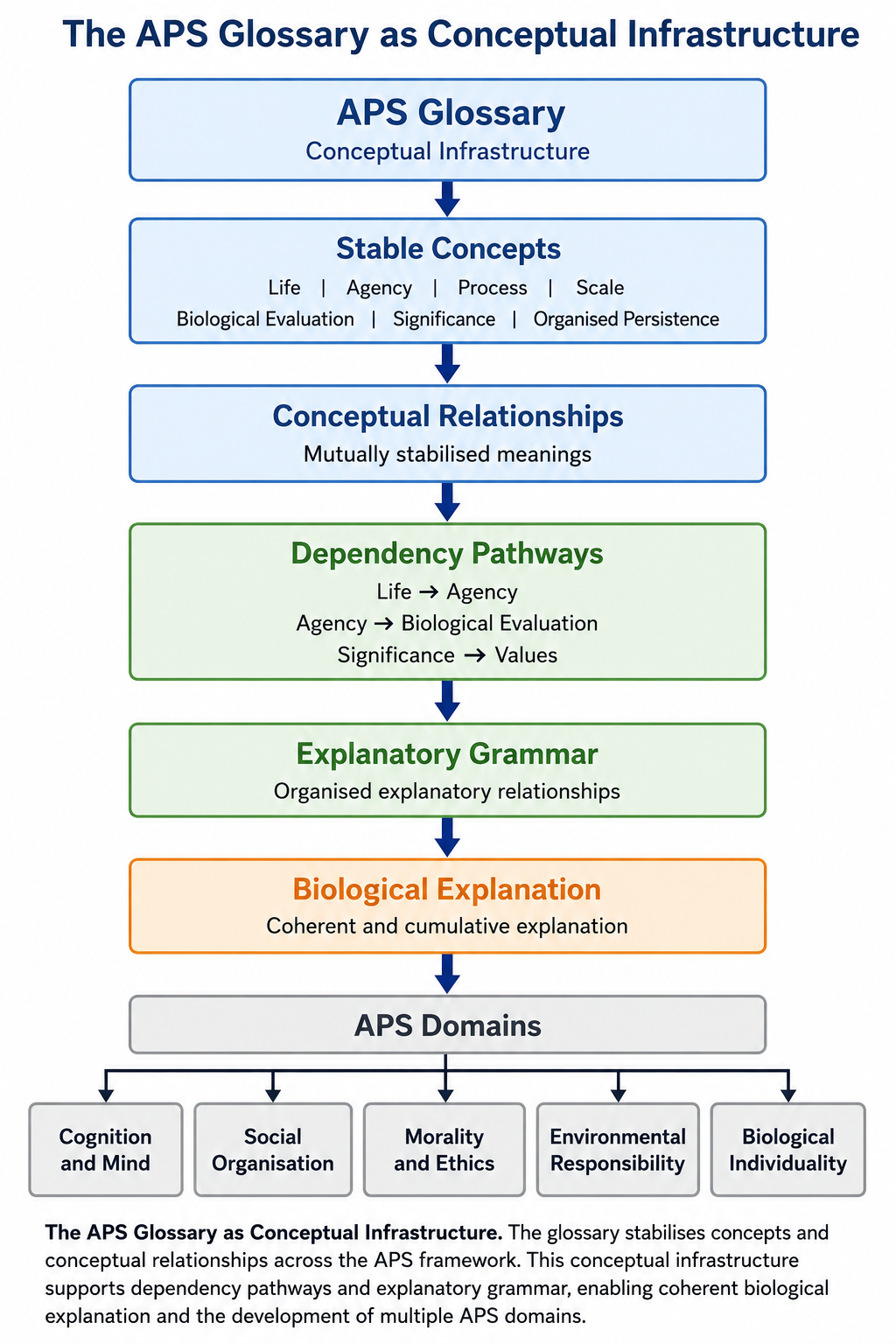
The APS Glossary as Conceptual Infrastructure. The glossary maintains canonical concepts, distinctions, and conceptual relationships across APS. This infrastructure supports consistency in pathway specification, explanatory practice, and domain-specific APS programmes without itself establishing biological dependencies or explanatory claims.
Organising the APS Glossary
The APS glossary is not organised as a simple list of independent terms.
Its concepts perform different roles within the conceptual organisation of the framework. Some recur across APS’s account of living organisation. Others help describe conceptual and methodological relationships. Still others are used principally within more specialised domain programmes.
These are organisational distinctions within the APS corpus. They do not establish different biological levels, degrees of reality, or explanatory priority.
For practical purposes, the glossary can therefore be considered in three broad groupings:
- core concepts;
- architectural concepts;
- domain concepts.
The boundaries among these groupings need not be absolute. Their purpose is to clarify how concepts are used within APS rather than to impose a hierarchy upon them.
Core Concepts
Core concepts express recurring canonical commitments used across multiple APS articles and domains.
Examples include:
- Life
- Agency
- Process
- Scale
- Biological Evaluation
- Significance
- Organised Persistence
These concepts do not all perform the same role.
Life identifies APS’s canonical formulation of living organisation. Agency, Process, and Scale are complementary, target-sensitive analytic projections of that organisation. Organised Persistence identifies continuity of living organisation through change. Biological Evaluation and Significance occur in APS’s account of how viability-relative differences acquire organisational significance.
Their inclusion here records their recurring roles within the APS corpus. It does not re-adjudicate their scientific status or establish dependency relations among them.
Core concepts are therefore not isolated primitives or members of a hierarchy. They participate in documented conceptual relationships whose interpretation depends upon the particular question and context in which they are used.
Architectural Concepts
Architectural concepts help APS describe and organise relationships among concepts, claims, and methods.
Examples include:
- Constraint
- Constraint Closure
- Organisation
- Function
- Normativity
- Architectural Dependency
These concepts differ substantially in biological and methodological role. Their grouping here is therefore organisational rather than ontological.
Some, such as Constraint Closure, participate directly in APS’s account of living organisation. Others, such as Architectural Dependency, concern how APS pathway claims are represented and assessed.
Canonical definitions provide stable reference points for these different uses while remaining open to explicit revision when required.
The nomenclature analogy remains limited here as elsewhere. Controlled revision can preserve continuity of terminology, but terminological stability does not establish the scientific adequacy of the claims expressed through those terms.
Architectural concepts therefore help make APS relationships and methodological distinctions explicit. Their presence in the glossary does not itself validate those relationships.
Domain Concepts
Domain concepts are used in more specialised APS programmes.
Examples include concepts associated with:
- Cognition and Mind
- Values and Social Organisation
- Morality and Ethics
- Environmental Responsibility
- Biological Individuality
These concepts draw upon other parts of the APS vocabulary while addressing questions specific to their domains.
Their inclusion in this classification does not imply that domain concepts are later stages, higher levels, or less fundamental forms of biological reality. Nor does it imply that the relevant domain claims follow automatically from the core glossary.
As APS develops, domain vocabularies may change more rapidly than heavily reused canonical terms. Their integration therefore requires attention to existing definitions, distinctions, and documented conceptual relationships.
Conceptual Organisation Rather Than Hierarchy
These groupings should not be interpreted as levels, hierarchies, or stages of explanation.
They identify different conceptual roles within the framework rather than different degrees of importance.
Core concepts, architectural concepts, and domain concepts remain interconnected through their use across APS articles, pathways, diagrams, and research programmes.
Those connections may be definitional, conceptual, methodological, or, where separately supported, biological. They should not all be treated as one undifferentiated kind of dependency.
The purpose of the classification is therefore organisational rather than hierarchical.
Conditions of Inclusion
Canonical glossary status requires explicit editorial and conceptual justification.
A candidate concept should normally satisfy considerations such as:
- it has a distinct and identifiable APS usage;
- a stable canonical definition would improve consistency across the corpus;
- its distinction from neighbouring concepts can be stated clearly;
- its relevant relationships to other APS concepts can be documented;
- it is not merely an unnecessary duplicate of an existing canonical term.
These are governance criteria rather than claims about conceptual necessity.
A concept need not be defined through every neighbouring concept, contribute to explaining another glossary entry, or occupy a dependency pathway in order to justify inclusion.
Likewise, the absence of a dependency relation does not make a concept isolated in a scientifically defective sense.
Where two entries prove duplicative, insufficiently distinct, or inconsistent, they may require clarification, merging, reclassification, or removal. Such decisions should be made through explicit review rather than inferred from a supposed requirement for conceptual closure.
These criteria help keep the glossary coherent and usable without treating its current organisation as a necessary or minimal conceptual system.
Canonical Definitions and Controlled Development
Conceptual infrastructure requires active maintenance.
APS therefore distinguishes between ordinary variation in usage and canonical definitions. Canonical definitions serve as stable reference points across the framework, allowing articles, diagrams, glossary entries, and research programmes to use recurring terms consistently.
Stability does not imply immobility.
Concepts may require refinement, clarification, or extension as the framework develops. APS therefore combines canonical reference formulations with explicit revision procedures intended to preserve continuity while making substantive changes visible.
These procedures include:
- canonical definitions;
- canonical lock dates;
- revision histories;
- glossary audits;
- conceptual audits;
- dependency audits.
Such controls allow conceptual changes to be evaluated in relation to the wider corpus rather than introduced silently or in isolation.
New concepts may be added when an identifiable conceptual need cannot be handled adequately by existing terminology, when the proposed distinction is sufficiently clear, and when its relationship to existing APS usage can be documented.
The relevant standard is not explanatory necessity in the abstract.
Development is instead guided by identifiable conceptual need, role clarity, consistency, and controlled integration.
In this way, APS seeks to combine conceptual stability with revision-open development.
Key Point
Conceptual infrastructure is maintained through controlled development rather than unrestricted expansion.
The Glossary as APS Infrastructure
The APS glossary functions as infrastructure for the framework rather than merely as a supplementary reference resource.
Its role extends beyond defining individual terms. By maintaining canonical formulations, preserving distinctions, documenting conceptual relationships, and recording controlled revisions, it supports continuity across the APS corpus.
This infrastructure operates in several related ways.
Conceptual Infrastructure
The glossary provides stable reference formulations for recurring APS concepts.
Definitions are not treated as isolated descriptions. Their documented relationships help maintain continuity across articles, diagrams, glossary entries, and research programmes.
This continuity is conceptual and editorial. It does not establish the truth of biological claims made using those concepts.
Pathway and Architectural Support
The glossary supports the specification and interpretation of APS pathways and other conceptual architectures.
Stable concepts make it easier to identify exactly what a pathway arrow is proposed to relate and to detect when a revision changes the meaning of one of its relata.
This support should not be confused with evidential support for the dependency itself.
A glossary definition can clarify what an APS pathway claims. It cannot determine whether the proposed relation is causal, constitutive, enabling, constraint-based, conceptual, mixed, or unsupported. Those questions require separate assessment.
Stable conceptual organisation therefore helps make APS pathway and architectural relations explicit and consistent.
Explanatory-Practice Support
The glossary also supports explanatory practice within APS by preserving distinctions relevant to how claims are formulated and interpreted.
A consistent distinction between organisation and structure, dependency and causation, or morality and ethics can prevent different explanatory questions from being conflated.
The glossary nevertheless remains infrastructure for explanatory practice rather than an explanation in its own right.
It does not determine whether a particular explanation is adequate, whether an APS formulation improves upon an established alternative, or whether a claimed biological dependency is supported.
Taken together, these functions make the glossary an important part of APS corpus governance and conceptual organisation.
Its coherence matters because APS repeatedly reuses the same concepts across different objects and research programmes. But that internal coherence must remain distinct from biological evidence and comparative explanatory success.
Key Point
The APS glossary functions as conceptual infrastructure, supports pathway and architectural specification, and helps maintain consistency in APS explanatory practice.
Conclusion
The APS glossary functions as conceptual infrastructure for the APS framework.
Its role extends beyond providing definitions. By maintaining canonical formulations, preserving distinctions, documenting conceptual relationships, and recording controlled revisions, it supports continuity across APS articles, diagrams, pathways, and research programmes.
That role should be stated precisely.
Stable conceptual infrastructure can make APS claims clearer, more consistent, and easier to compare. It can reveal when a revision to one concept affects other parts of the framework. It can help pathway relations to be specified without ambiguity and can support continuity as domain-specific programmes develop.
It does not establish biological dependencies.
It does not turn conceptual relationships into empirical evidence.
It does not supply a general explanatory grammar.
And conceptual coherence within APS does not by itself demonstrate explanatory gain over established biological explanations.
Those burdens remain with the relevant biological and comparative claims.
The glossary should therefore be understood neither as a simple dictionary nor as a foundation from which biological explanation automatically follows. It is an interconnected, revision-open conceptual system through which APS maintains precision, preserves important distinctions, makes conceptual relationships explicit, and supports the integration of explanatory questions across biological domains.
Its contribution is both infrastructural and interpretive. The glossary helps sustain a coherent conceptual architecture through which biological questions can be examined, connected, criticised, and refined. These are positive contributions to the organisation of biological understanding, although their usefulness in particular applications remains open to assessment.
The scientific standing of the claims expressed through that infrastructure must be established separately.
Explanatory Architecture
Central Question
How can APS maintain stable concepts, distinctions, and documented conceptual relationships across a developing and revision-open framework?
Architectural Role
This article establishes the APS glossary as conceptual infrastructure for the framework.
Its function is to maintain canonical formulations, preserve important distinctions, document conceptual relationships, and support consistency across APS articles, diagrams, pathways, and research programmes.
The glossary does not itself establish biological dependencies, explanatory adequacy, or comparative explanatory gain.
Preceding Conceptual Dependencies
This article presupposes the canonical APS concepts and scientific-status controls established elsewhere in the framework, including:
- Life;
- Biological Agency;
- Viability;
- Constraint Closure;
- Process;
- Scale;
- Organised Persistence;
- Biological Organisation;
- and Architectural Dependency.
Their inclusion here records their use within APS conceptual infrastructure. It does not re-adjudicate their scientific status.
Subsequent Use
The glossary supports:
- consistent specification of APS pathway relations;
- controlled use of recurring concepts across articles and diagrams;
- explicit recognition of conceptual revision;
- development of domain-specific APS vocabularies;
- and comparison of claims that would otherwise risk terminological drift.
These functions are infrastructural. Biological and comparative claims retain their own evidential burdens.
Methodological Limit
Conceptual coherence is not biological evidence.
A stable definition can clarify what APS claims. It cannot establish that a biological system instantiates the defined organisation, that a proposed dependency is materially realised, or that APS provides explanatory gain over the strongest established alternative.
Position Within APS
The APS glossary is neither a simple dictionary nor a universal explanatory grammar for biology. It contributes to an APS-specific explanatory grammar while maintaining the conceptual distinctions and revision procedures required for responsible explanatory practice.
It is a controlled conceptual resource through which APS maintains continuity, clarity, and revision discipline across its corpus.
Its contribution is conceptual and infrastructural; the scientific standing of claims expressed through that infrastructure must be established separately.