The Explanatory Geometry of Biology — How APS Organises Biological Explanation
This article explains how APS organises biological explanation around organised persistence as a principal explanatory target and Agency, Process, and Scale as complementary, target-sensitive analytic projections of living organisation. It distinguishes the analytic organisation of inquiry from demonstrated explanatory gain, preserves the plurality and independent adequacy of established biological explanations, and shows how APS can relate explanatory domains where their contributions bear upon the organisation and persistence of living systems.
What This Article Explains
Biology contains many forms of explanation. Molecular biology explains biochemical organisation, physiology explains functional regulation, development explains transformation across time, ecology explains organism–environment relations, evolution explains historical change, and cognition research investigates particular forms of biological evaluation and control.
These explanatory traditions have achieved substantial success. They also address different explananda with different methods, evidence, causal resources, and standards of adequacy. Their plurality is therefore not a defect that requires elimination.
APS asks a more specific methodological question:
How can these different explanatory practices be related when the explanandum concerns the organisation and persistence of living systems?
APS approaches that question by distinguishing an explanatory target from an analytic architecture. Organised persistence is a principal explanatory target within APS: the continuity of living organisation through change. Agency, Process, and Scale provide complementary, target-sensitive analytic projections through which APS investigates that target.
This does not make organised persistence the compulsory target of biological explanation generally, nor does it make Agency, Process, and Scale necessary dimensions of every adequate biological explanation. Established explanations may remain adequate for their own explananda without employing APS terminology or all three projections.
The explanatory geometry developed here therefore concerns how APS organises inquiry. Whether that organisation contributes additional explanation in a particular case is a further comparative question.
Where this article fits: How APS Explains Life introduces organised persistence and the Agency–Process–Scale architecture. This article develops the methodological structure through which APS relates those commitments to biological explanation. It does not establish a universal grammar for biology or replace the independently established explanatory practices of biological science.
Orientation Pathway
Readers new to APS will usually benefit from proceeding through the following sequence:
- What Is APS?
- How APS Explains Life — A Two-Step Guide
- Biological Explanation — What Needs to Be Explained?
- Biological Explanation and Organised Persistence
- The Explanatory Geometry of Biology — How APS Organises Biological Explanation
Explanatory Target and Analytic Architecture
Two questions need to be distinguished.
The first concerns the phenomenon to be explained. The second concerns the conceptual organisation through which an explanatory approach investigates that phenomenon.
Within APS, organised persistence is a principal explanatory target. Living organisation continues through continual material, structural, developmental, physiological, behavioural, and environmental change. APS asks how that continuity is maintained, re-established, or transformed.
Agency, Process, and Scale provide the corresponding analytic architecture:
- Agency concerns what living systems do as viability-oriented organisational activity.
- Process concerns how continuity is maintained, transformed, or re-established despite change.
- Scale concerns where persistence is organised across spatial and temporal extents relevant to the explanandum.
These are not independent causes, components, stages, levels, or ontological divisions. They are complementary, target-sensitive analytic projections of one viability-oriented, constraint-closed living organisation.
Nor are all three projections required in every explanation. A particular explanandum may make one or more projections especially relevant. Their function is to distinguish explanatory questions without dividing biological reality or predetermining what an adequate explanation must contain.
APS can therefore use an explanatory grammar in a bounded methodological sense: the conceptual relations through which the framework identifies questions and makes particular features salient. Such a grammar organises inquiry. It does not by itself demonstrate explanatory adequacy or additional explanatory gain.
Organisational Continuity Analysis
APS uses organisational continuity analysis where the explanandum concerns how living organisation persists through change.
This inquiry may involve mechanisms, causal relations, structures, functions, developmental processes, organism–environment relations, historical transformations, or other established explanatory resources. APS does not treat their significance as exhausted by their contribution to persistence. Rather, it asks how they bear upon organised persistence when that is the explanatory target.
A physiological explanation may foreground real-time regulation. A developmental explanation may foreground transformation across an individual lifetime. An evolutionary explanation may foreground historical change. An ecological explanation may foreground organism–environment relations. A molecular explanation may foreground biochemical interactions and mechanisms.
These explanations need not be reduced to one another or to APS. Where relevant, APS asks how their contributions bear upon the organisation and persistence of living systems.

APS Explanatory Geometry. Organised persistence is an explanatory target adopted within APS. Agency, Process, and Scale are complementary analytic projections through which that target can be investigated. Biological explanations remain plural; APS relates them, where relevant, by examining how their contributions bear upon the organisation and persistence of living systems.
The term geometry therefore refers to the organisation of explanatory relations within APS. Different questions can foreground different aspects of living organisation without requiring one explanatory perspective to supersede the others.
This geometry provides a way of asking how explanatory resources relate. It does not establish in advance that relating them produces additional explanatory gain.
Continuity, Perturbation, and Dynamic Stability
Living systems persist through change rather than by remaining materially unchanged.
Regulation, repair, development, adaptation, and other processes can contribute to maintaining or re-establishing living organisation under changing conditions. APS investigates such processes where they illuminate how continuity is maintained or transformed.

Temporal Organisation and Organised Persistence. Living systems maintain continuity not by remaining unchanged but by continually reorganising themselves through development, regulation, repair, adaptation, and environmental interaction. Biological persistence is therefore an achievement of temporal organisation rather than static structure.
Perturbation can be especially informative because dependencies that remain unobtrusive during ordinary functioning may become experimentally or diagnostically accessible when organisation is challenged.
Injury can expose dependencies involved in repair. Physiological stress can reveal compensatory relations. Developmental disturbance can expose regulatory dependencies. Environmental change can reveal conditions relevant to adaptation or continued viability.
Perturbation does not automatically validate an APS interpretation. Its explanatory value depends upon what the intervention reveals, the explanandum under investigation, and whether the resulting account contributes something beyond the strongest established explanation.
From Description to APS Explanatory Grammar
Description, diagnosis, and explanation perform different roles within inquiry.
Description identifies structures, processes, patterns, and relations. Diagnosis evaluates the condition or organisation of a system relative to a specified concern. Explanation addresses why or how the phenomenon under investigation occurs.
APS therefore distinguishes explanatory grammar from descriptive vocabulary.
Within APS, concepts such as function, regulation, adaptation, evaluation, semiosis, cognition, resilience, and repair acquire particular interpretations through their relations to living organisation. This conceptual organisation can clarify what APS asks about those phenomena without determining the adequacy of explanations developed elsewhere.
Function, for example, concerns present-tense viability-relative organisational contribution within APS. Biological evaluation concerns how agency generates significance. Cognition concerns the organisation of biological significance across time and requires capacities not exhausted by immediate or fixed regulation.
These concepts do not become explanatory merely by occupying a place in the APS architecture. Their explanatory contribution must be established relative to the relevant explanandum and evidence.
An APS explanatory grammar therefore organises what the framework asks and makes salient. Comparative assessment determines what the resulting explanation actually contributes.
Explanatory Dependency
APS begins its account with living organisation rather than using concepts derived from sophisticated cognition as prerequisites for explaining Life.
This establishes an explanatory dependency:
Life does not require cognition; cognition presupposes Life.
The point is not that biological explanation must proceed in a single direction. Nor does it establish a temporal or ontological hierarchy among explanatory domains.
Rather, APS resists treating representation, computation, inference, intelligence, or decision-making as concepts that must already be attributed to every living system before biological organisation can be explained.
Cognition, where present, must therefore be explained as a development within living organisation rather than assumed as a condition of Life itself.
Explanatory Priority and Ontological Priority
Biological explanations frequently foreground different entities, processes, relations, or spatial and temporal extents.
Gene-centred, organism-centred, developmental, physiological, ecological, and evolutionary explanations can therefore differ substantially in what they treat as explanatorily important.
APS does not infer from this plurality that one explanatory focus must constitute the ontological foundation of biology.
What becomes explanatorily central depends upon the explanandum, evidence, methods, and material relations under investigation. Explanatory priority is therefore target-relative and should not be confused with ontological priority.
Genes, organisms, developmental systems, populations, ecological relations, and evolutionary lineages can each be legitimate objects of biological explanation. Their explanatory significance need not be reduced to a single scale or organisational description.
APS contributes a cross-scale organisational perspective where materially implemented relations across spatial and temporal extents are relevant to the explanandum. Wider organisational relations do not supersede local causal processes; their effects must themselves be materially implemented in the conditions under which local activity occurs.
Cognition Within Living Organisation
APS locates cognition within, rather than prior to, living organisation.
Biological agency is viability-oriented organisational activity. Biological evaluation is the process through which agency generates significance. Cognition requires a further form of organisation in which integrated biological significance can modulate activity across a temporal field of viability-relevant possibilities in ways not exhausted by immediate or fixed regulation.
This preserves an important dependency without claiming that physiology, development, ecology, evolution, and cognition all operate according to one demonstrated explanatory principle.
Cognition can therefore be investigated in relation to the same living organisation addressed elsewhere in APS while retaining explananda, evidence, mechanisms, and diagnostic requirements specific to cognition.
The inclusion of cognition within APS consequently extends the range of phenomena to which the framework can be applied. It does not by itself establish additional explanatory gain or a universal explanatory grammar across biological domains.
Conceptual Constraint and Explanatory Coherence
APS concepts are not intended to function as an unrestricted vocabulary.
Agency, Process, Scale, viability, organised persistence, function, evaluation, cognition, and other concepts carry defined relations within the framework. These relations impose requirements of internal conceptual coherence. A use of Agency, for example, should remain compatible with biological agency as viability-oriented organisational activity; Scale should remain target-sensitive rather than becoming a hierarchy of causal levels.
This internal discipline is valuable because it constrains what counts as a coherent APS claim.
But conceptual constraint must not be confused with demonstrated explanatory power.
Foundational relations within a framework can make its claims more precise without showing that the framework explains a target better than an established comparator. Internal integration is therefore a condition of coherent APS analysis, not evidence by itself of additional explanatory gain.
The relevant scientific question remains comparative:
What does the APS account enable us to explain, discriminate, constrain, or infer that the strongest relevant comparator does not already enable us to do?
Where no such difference is demonstrated, APS may still provide non-trivial analytic organisation or redescription, but additional explanatory gain has not been established.
Making APS Claims Empirically Assessable
The explicit structure of APS allows its claims to be tested rather than protected by conceptual breadth.
For a specified explanandum, an APS analysis should identify which projection or projections are relevant, what material dependencies are proposed, what evidence bears upon them, and what explanatory operation is claimed.
The strongest relevant comparator must then be specified independently of the desired outcome.
Mechanistic, developmental, evolutionary, physiological, ecological, organisational, or other explanations may already recover the explanatory work at issue. If they do, reformulating that work in APS terminology does not constitute additional gain.
Perturbation can assist this assessment when intervention reveals dependencies relevant to the explanandum. Cross-scale analysis can assist where materially implemented relations across spatial and temporal extents matter. Neither strategy guarantees an APS-specific result.
Constraint closure remains an important commitment within the APS account of Life. It identifies reciprocal maintenance among constraints involved in living organisation. Closure considered abstractly, however, does not by itself establish Life, viability orientation, Agency, normativity, organised persistence, or additional explanatory gain.
The empirical task is therefore not to locate APS terminology in a biological system. It is to determine what explanatory consequence follows from the proposed organisational relation and whether that consequence survives comparison with established alternatives.
Explanatory Adequacy
Explanatory adequacy must be assessed relative to an explanandum.
Predictive success, causal identification, mechanistic detail, historical reconstruction, organisational description, and other achievements can each be relevant depending upon what is being explained. APS does not supply a single criterion that renders explanations biologically inadequate whenever they omit organised persistence or one of the A–P–S projections.
Within APS, an explanation of organised persistence can be assessed by asking whether it clarifies dependencies relevant to the maintenance, re-establishment, or transformation of living organisation.
But an established mechanistic, developmental, evolutionary, ecological, or other explanation is not incomplete merely because its explanandum differs or because it does not employ APS terminology.
Where APS claims additional explanatory gain, the standard is stronger. The candidate account must enable explanation, discrimination, constraint, or inference not already adequately supplied by the strongest relevant comparator.
The legitimate outcomes include positive gain, no additional gain, and unresolved comparison.
Explanatory adequacy within APS therefore concerns both fit to the specified target and disciplined comparison with what established explanations already accomplish.
Relating Biological Domains Without Reducing Them
APS can relate explanatory domains without claiming that they share a single established explanatory principle.
Physiology may explain real-time regulation and coordination. Development may explain transformation across an individual lifetime. Evolution may explain historical change, adaptation, and diversification. Ecology may explain organism–environment relations. Molecular and cellular biology may explain mechanisms and organisation at their respective spatial and temporal extents. Cognition research addresses capacities requiring their own diagnostic and evidential controls.
Where organised persistence is relevant to the explanandum, APS can ask how contributions from these domains bear upon continuity of living organisation.
This creates a possible analytic relation, not a demonstration that all domains are manifestations of one biological grammar.
Their independent explanatory achievements remain intact. Their inclusion within APS does not establish that every domain requires all three A–P–S projections, that their integration produces explanatory gain, or that APS supersedes their established explanatory resources.
Explanatory pluralism can therefore be preserved while APS investigates selected relations among domains.
Explanation and Biological Intelligibility
APS treats biological explanation as analysable without requiring biology to possess one universal explanatory architecture.
Within the framework, organised persistence supplies a recurring explanatory target where the question concerns continuity of living organisation through change. Agency, Process, and Scale provide complementary analytic projections through which that target can be investigated.
This architecture can organise explanatory attention. It can distinguish questions. It can reveal candidate relations for investigation. It can provide non-trivial integrative redescription and analytic organisation.
Those achievements must nevertheless be distinguished from additional comparator-relative explanatory gain.
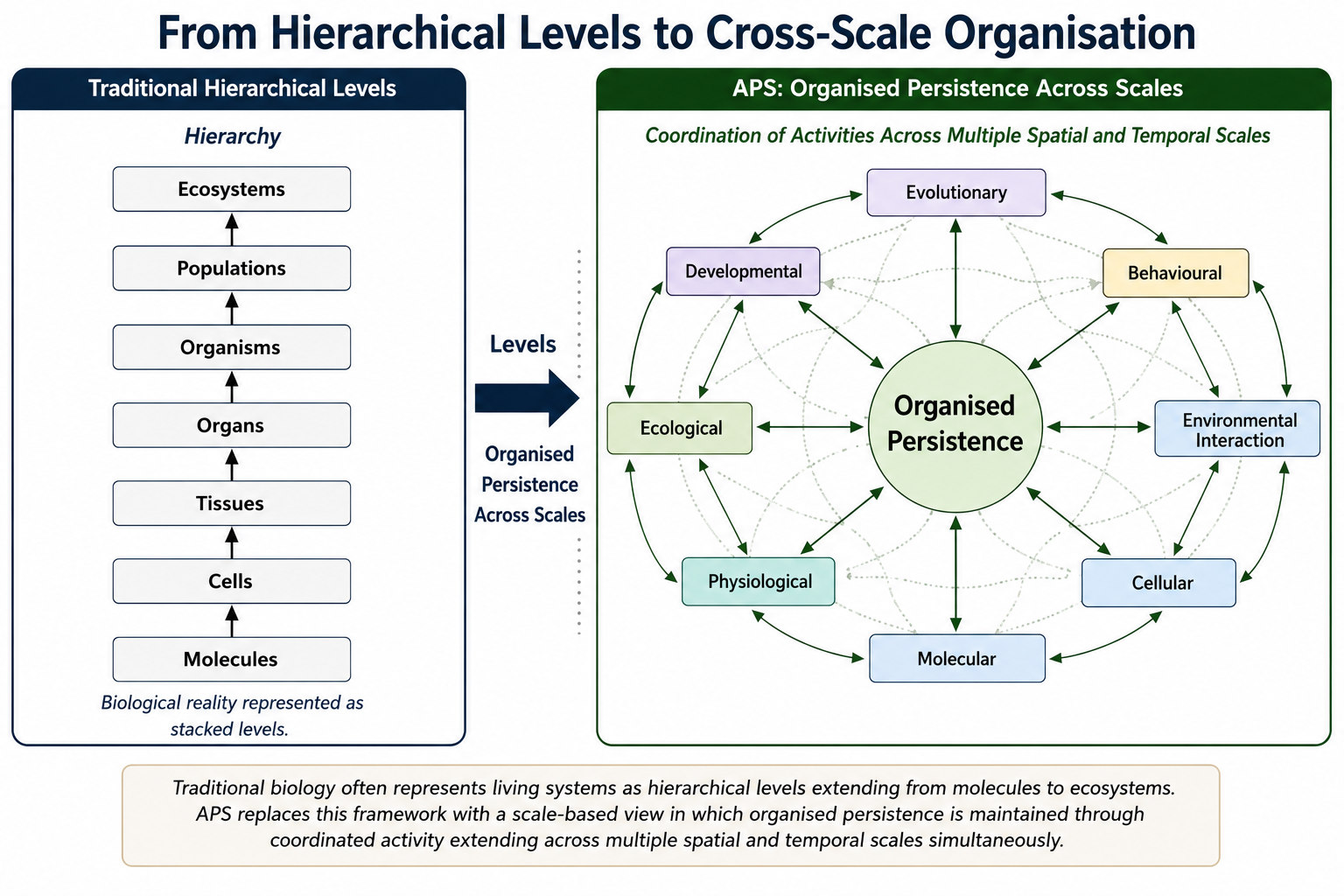
From Stacked Representation to Cross-Scale Organisational Analysis. Level-based representations can remain useful for many biological purposes. APS provides a different analytic perspective where the explanandum requires investigation of materially implemented activities and dependencies across relevant spatial and temporal extents. Cross-scale analysis does not imply that every explanandum spans multiple scales or that wider organisational relations replace local causation.
The broader philosophical implications of this explanatory structure are developed further in APS as Philosophy — A Viability-Oriented Account of Biological Reality.
Related Orientation Articles
- What Is APS?
- How APS Explains Life — A Two-Step Guide
- Understanding APS — The Structure of the Framework
- The Core Structure of APS — How the Framework Fits Together
- APS Architecture Map — Navigating the Framework
Conclusion
APS organises a particular inquiry into living organisation.
A principal explanatory target is organised persistence: the continuity of viability-oriented, constraint-closed living organisation through change. Agency, Process, and Scale provide complementary, target-sensitive analytic projections of that one organisation.
This architecture does not prescribe the necessary structure of biological explanation generally. Biological disciplines address different explananda, employ different evidence, and can provide adequate explanations without being reduced to APS.
The contribution of APS must therefore be assessed rather than assumed.
Its analytic architecture can organise questions, relate explanatory resources, and identify candidate dependencies. Whether those relations provide additional explanation depends upon the specified explanandum, the evidence, and comparison with the strongest relevant established explanation.
The explanatory geometry of APS is consequently best understood as a disciplined organisation of inquiry rather than a demonstrated universal grammar of biology. Its scientific value lies in what that organisation enables us to explain, discriminate, constrain, or infer in particular cases—and in allowing the answer, where warranted, to be no additional explanatory gain.
Explanatory Architecture
Central Question
How does APS organise biological explanation around organised persistence without treating Agency, Process, and Scale as independent causes, components, levels, or universally required explanatory dimensions?
Architectural Role
This article establishes the explanatory geometry of APS: organised persistence provides a principal APS explanatory target, while Agency, Process, and Scale provide complementary, target-sensitive analytic projections through which living organisation can be investigated. It explains how APS relates different explanatory questions and biological domains without requiring their reduction to a single explanatory form or treating integration itself as evidence of additional explanatory gain.
Builds On
-
What Is APS?
-
How APS Explains Life — A Two-Step Guide
-
Biological Explanation — What Needs to Be Explained?
-
Biological Explanation and Organised Persistence
-
The Core Structure of APS — How the Framework Fits Together
Develops Into
-
Explanatory Grammar
-
Explanatory Adequacy
-
Comparative Explanatory Methodology
-
Explanatory Gain
-
Strongest-Comparator Selection
-
Framework Testing
Related Explanatory Questions
-
What does APS mean by explanatory geometry?
-
How do Agency, Process, and Scale organise different questions about one living organisation?
-
When is organised persistence the relevant explanatory target?
-
How can biological explanations be related without reducing them to a single explanatory form?
-
How does target-relative Scale analysis differ from a hierarchy of biological levels?
-
When does APS provide analytic organisation without additional comparator-relative explanatory gain?
Position within APS
This is a Core article within the Methodology and Explanation cluster. It establishes how the Agency–Process–Scale architecture functions as an organisation of explanatory inquiry and connects the conceptual foundations of APS to its comparative explanatory methodology.
Corpus Significance
This article provides the principal account of explanatory geometry within the APS corpus. It establishes that Agency, Process, and Scale are analytic projections rather than components of reality and explains how they can organise inquiry around organised persistence while preserving explanatory pluralism and target-relative use. It also marks the boundary between analytic organisation and demonstrated explanatory gain: the coordination of Agency, Process, and Scale can provide non-trivial integrative redescription and analytic organisation, but additional explanatory gain must be established separately through evidence and comparison with the strongest relevant comparator.
See Also
Related Articles
References
- (2015). Biological Organisation as Closure of Constraints. Journal of Theoretical Biology, 372, 179–191 . https://doi.org/10.1016/j.jtbi.2015.02.029
- (2015). Biological Autonomy: A Philosophical and Theoretical Enquiry. Springer.
- (2018). Everything Flows: Towards a Processual Philosophy of Biology. Oxford University Press.
- (2026). Agency as the Defining Activity of Life: A Viability-Oriented Framework Integrating Process and Scale. Biological Theory . https://doi.org/10.1007/s13752-026-00547-6