Introduction
Within APS, life is characterised as:
viability-oriented, constraint-closed organisation.
APS investigates how such organisation maintains and re-establishes the conditions of its own persistence across change.
As the framework has developed, it has expanded into a series of interconnected research and explanatory pathways addressing persistence, development, adaptation, ecology, evolution, cognition, diagnosis, social organisation, and philosophy of biology. These pathways are not independent research programmes gathered under a common label. Within APS, they are connected by shared questions concerning continuity, viability, living organisation, and organised persistence.
This article functions as a conceptual map of that architecture. Its purpose is not to replace the individual articles that develop particular parts of the framework, but to help readers understand how the major pathways fit together and to identify useful routes through the site depending on their interests and background.
APS is therefore organised not as a collection of isolated topics, but as an integrative analytic framework connecting different questions and explanatory targets across multiple domains of biological inquiry.
Where this article fits: The Core Structure of APS provides the canonical account of the framework’s conceptual architecture. This article serves a complementary role. Its purpose is to make that architecture visible, helping readers navigate the major pathways, domains, and reading routes that emerge from the wider APS framework.
The Explanatory Centre of APS
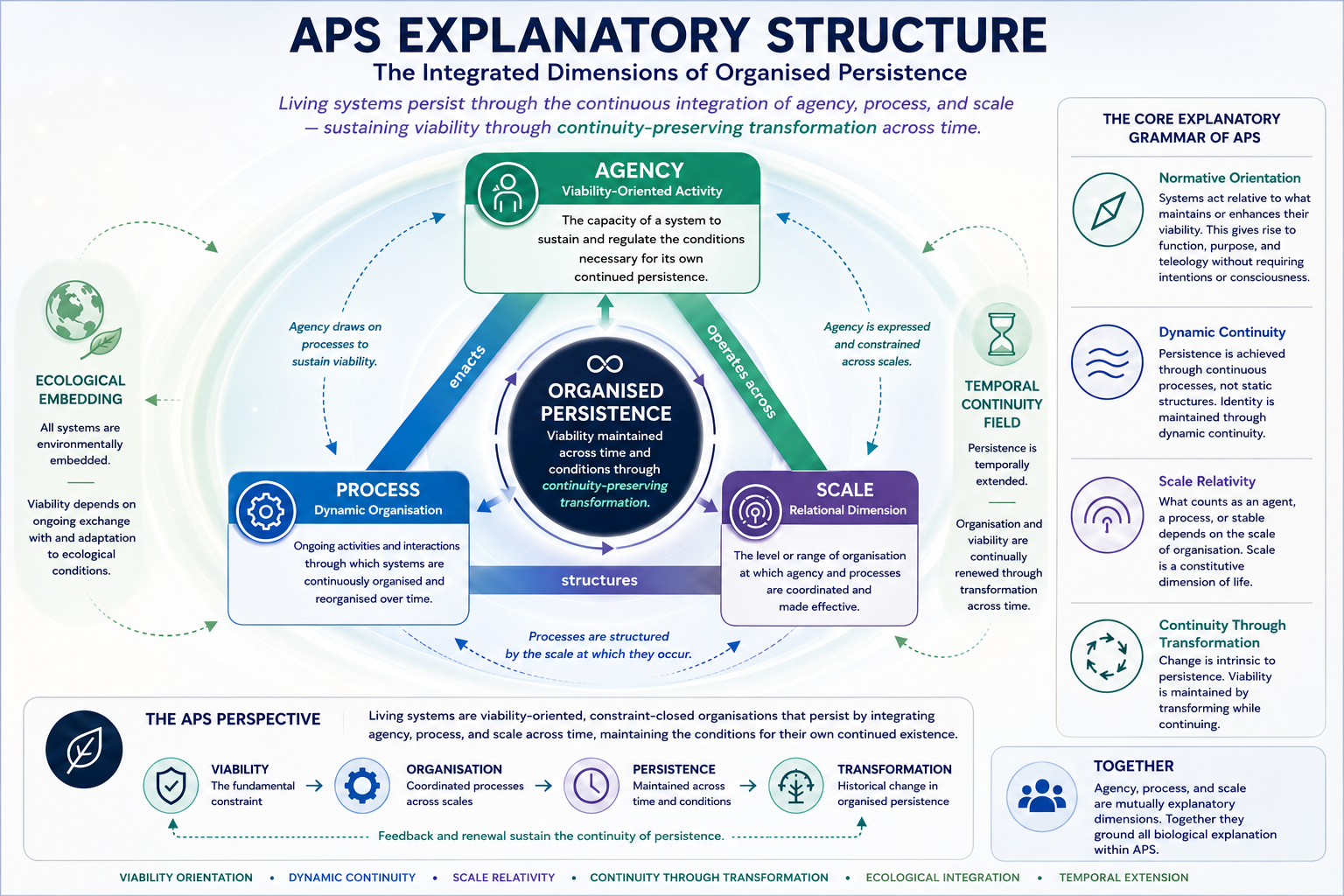
APS Explanatory Structure. Agency, Process, and Scale provide complementary analytic projections of one viability-oriented, constraint-closed living organisation. They distinguish explanatory questions without dividing biological reality into separate components or hierarchical levels.
Figure: The core analytic structure of APS. Agency, Process, and Scale are complementary, target-sensitive analytic projections of the same living organisation. They distinguish different explanatory questions without dividing biological reality into components, levels, stages, or independent causes.
At the centre of APS lies its account of living organisation. Living systems actively maintain and re-establish conditions relevant to their continued viability while undergoing material, structural, developmental, and environmental change.
APS characterises life as viability-oriented, constraint-closed organisation and treats organised persistence as a principal explanatory target: how living organisation maintains continuity through ongoing change.
APS investigates this organisation through three complementary analytic projections:
-
Agency — what living systems do: viability-oriented organisational activity;
-
Process — how continuity is maintained despite change through ongoing organisational activity;
-
Scale — where persistence is organised across the spatial and temporal extents and materially implemented relations relevant to the explanandum.
Agency, Process, and Scale are not separate explanatory modules, biological components, levels, stages, or independent causes. They are analytic projections of the same living organisation, distinguishing different explanatory questions without dividing biological reality.
Their relevance is target-relative. A particular biological explanandum may require one, two, or all three projections, and no projection has intrinsic causal or explanatory priority.
Readers new to APS should begin with the core orientation sequence outlined below.
Core Orientation Pathway
Recommended Starting Sequence
-
What Is APS?
-
Understanding APS — The Structure of the Framework
-
Naturalising Life
-
How APS Explains Life
-
The Core Structure of APS — How the Framework Fits Together
-
APS Architecture Map — Navigating the Framework
-
How APS Concepts Fit Together
Together these articles introduce the central analytic architecture of APS and provide routes into the wider framework.
APS at a Glance
The APS framework can be approached through several complementary architectural views. These include its methodological and analytic organisation, proposed dependency pathways linking biological and cognitive questions, and research architectures concerning significance and meaning.
These views do not have identical evidential status. Some express canonical APS commitments, some organise explanatory questions, and others represent proposed dependency relations requiring proposition-specific assessment.
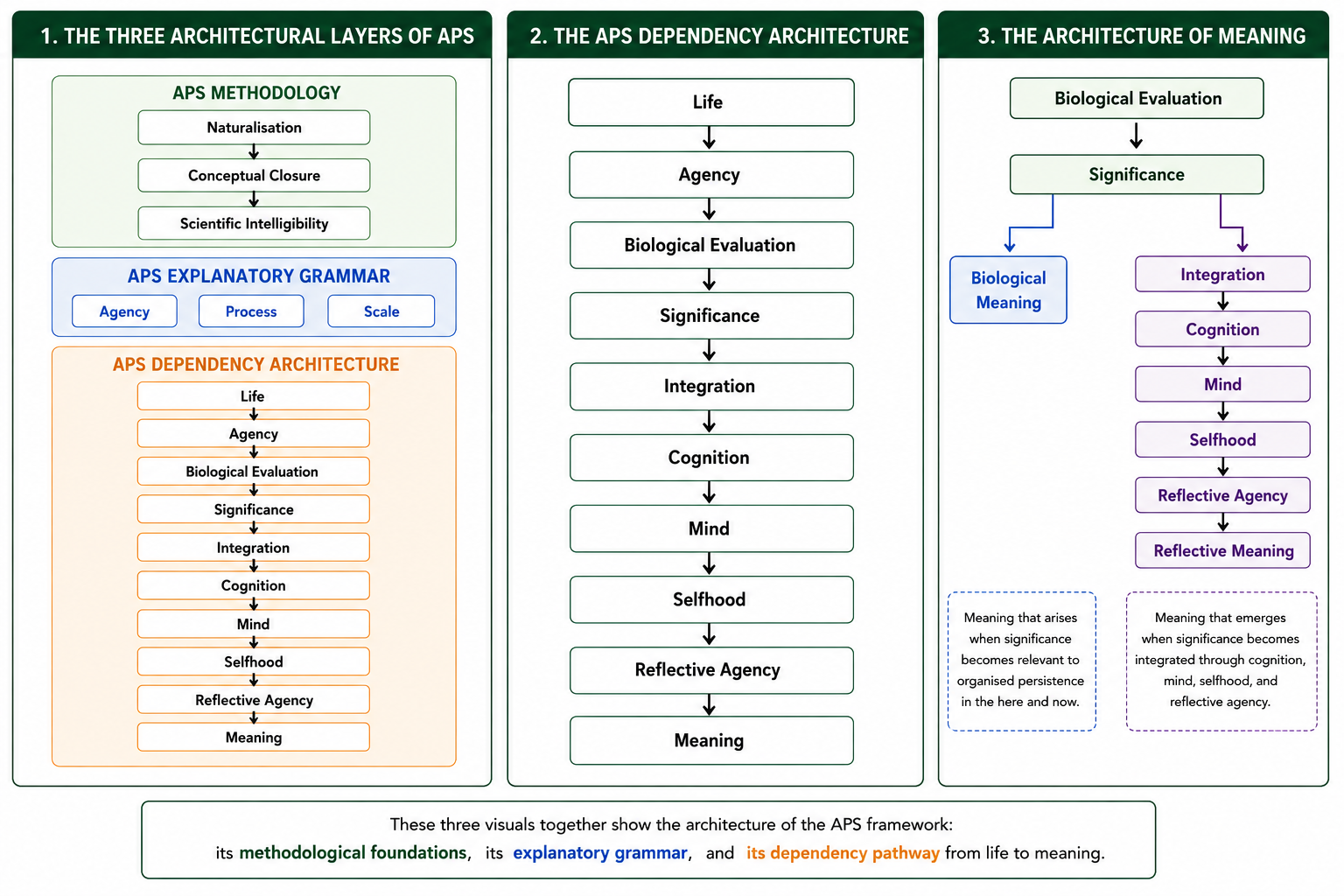
APS at a Glance. This diagram provides a historical architectural overview of several APS pathways. Its methodological, analytic, dependency, cognition, and meaning structures should not be read as having identical evidential status. In particular, proposed dependency pathways require proposition-specific assessment and do not by themselves establish causal or developmental succession.
The remainder of this map directs readers into the principal domains through which these questions are developed. Each pathway investigates a different aspect of living organisation while remaining connected to the wider APS framework.
Major Continuity Architectures of APS
The diagram below provides a structural overview of major pathways developed within APS.
These pathways investigate different explanatory targets using APS concepts concerned with viability, persistence, continuity, and living organisation. Agency, Process, and Scale are used where the relevant explanatory question calls for those projections; they are not universally or equally required categories of biological explanation.
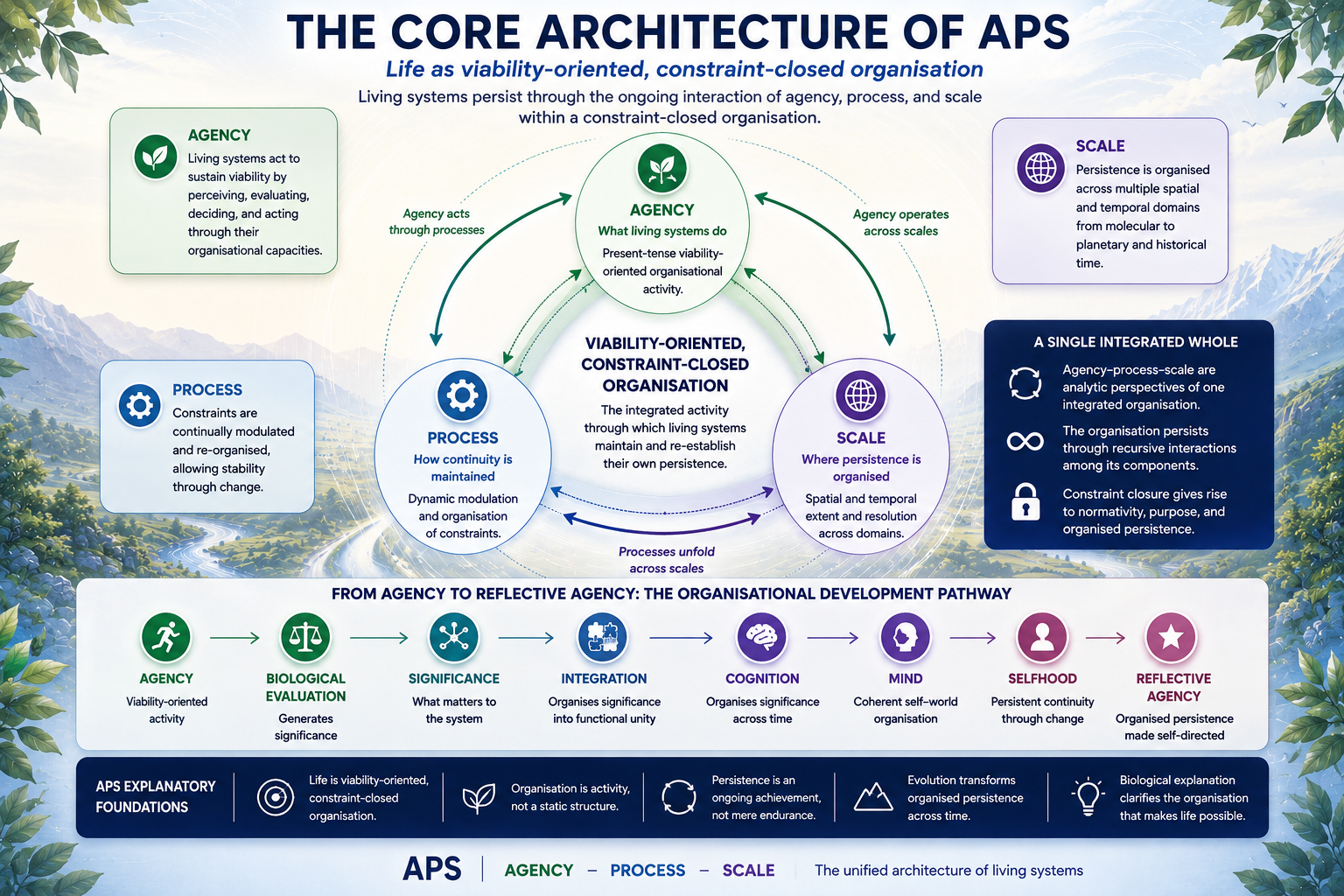
Figure: The core architecture of APS. Agency, Process, and Scale are complementary, target-sensitive analytic projections of living organisation. The diagram also identifies a proposed APS research pathway from biological agency toward increasingly integrated cognitive and reflective organisation; individual transitions within that pathway retain their proposition-specific evidential status.
1. Persistence and Temporal Organisation
One major pathway within APS develops the temporal organisation of biological persistence.
This pathway explores viability, continuity, adaptation, resilience, temporal organisation, and persistence across time and spatial extent. Within APS, organised persistence directs attention to how living systems maintain continuity through organised transformation rather than by remaining materially or structurally unchanged.
Key Articles
2. Development and Organised Continuity
A second major pathway examines how continuity can be investigated through developmental transformation.
Within APS, development provides an important domain for examining organised persistence because growth, repair, adaptation, ageing, and developmental plasticity involve continuing organisation under changing conditions.
Key Articles
The APS developmental pathway therefore asks how living organisation maintains or reconstructs viable continuity across developmental change. This is an APS explanatory framing rather than evidence that organised persistence provides additional explanatory gain for every developmental target.
3. Ecology, Adaptation, and Evolution
APS develops an integrative research pathway connecting questions in ecology, adaptation, and evolution.
Within this framework, ecological questions can be examined in relation to the spatial and temporal organisation of organism–environment persistence; adaptation in relation to the reorganisation of viable continuity under changing conditions; and evolution in relation to the historical transformation of organised persistence across generations.
These are APS formulations of the relevant explanatory targets. Their integration within a common framework does not by itself establish additional explanatory power over established ecological, developmental, or evolutionary explanations.
Key Articles
-
Adaptation — How Living Systems Sustain Themselves Through Change
-
Evolution as the Historical Transformation of Organised Persistence
-
Physiology and Evolution in APS — Two Temporal Perspectives on the Same Biological Organisation
Within APS, evolutionary questions are organised through a connected conceptual sequence:
viability
↓
persistence
↓
variation
↓
adaptation
↓
inheritance
↓
fitness
↓
natural selection
↓
evolution
This sequence is an APS integrative formulation rather than a claim that these concepts constitute a single causal chain or replace established evolutionary mechanisms and explanations. It organises questions concerning how living organisation capable of persistence is historically transformed through variation, inheritance, selection, and other evolutionary processes.
APS therefore resists reducing evolutionary explanation to any single explanatory factor. Its continuity-oriented formulation is intended to organise relations among biological organisation, development, ecology, inheritance, selection, and historical transformation without treating conceptual integration itself as evidence of comparator-relative explanatory superiority.
4. Cognition, Information, and Meaning
APS also develops a cognition-and-mind research pathway.
Within APS, information, meaning, representation, and cognition are investigated in relation to viability-oriented living organisation rather than assumed to be defining properties of life. The framework asks whether and under what conditions increasingly integrated organisation supports cognitive capacities that are not exhausted by immediate or fixed regulation.
Key Articles and Glossary Entries
Within APS, the principal cognition-and-mind research pathway is organised as:
Life
↓
Agency
↓
Biological Evaluation
↓
Significance
↓
Integration
↓
Cognition
↓
Mind
↓
Selfhood
↓
Reflective Agency
↓
Meaning
This pathway represents an APS research architecture rather than a demonstrated causal, developmental, or chronological sequence. Its transitions retain proposition-specific evidential status and require independent assessment. The concepts are not separate substances, modules, components, or hierarchical levels.
Within this architecture, Biological Evaluation is the process through which agency generates significance, while cognition concerns the organisation of biological significance across time. More diagnostically, biological agency becomes cognitive when integrated biological significance modulates activity across a temporal field of viability-relevant possibilities in ways not exhausted by immediate or fixed regulation.
A related research pathway examines possible relations among Biological Evaluation, Significance, Meaning, Value, Human Values, Shared Evaluation, Social Norms, Moral Evaluation, Morality, and Ethics.
The diagram below summarises this Evaluation-to-Ethics Architecture.
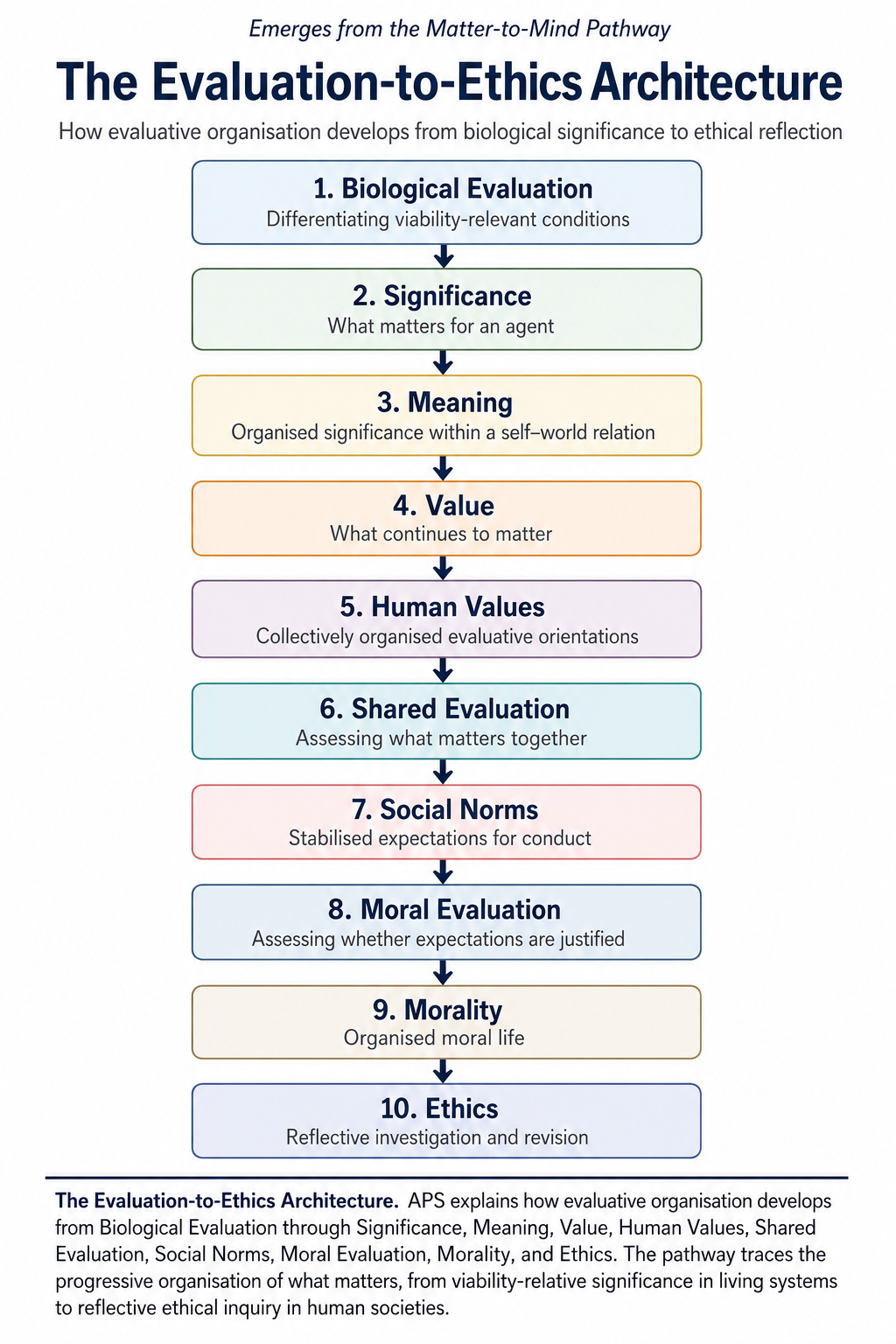
The Evaluation-to-Ethics Architecture. APS proposes this pathway as a research architecture connecting Biological Evaluation, Significance, Meaning, Value, Human Values, Shared Evaluation, Social Norms, Moral Evaluation, Morality, and Ethics. The arrows represent proposed dependencies rather than demonstrated causal or developmental succession. Individual transitions retain their proposition-specific evidential status, and biological viability, social persistence, consensus, or established norms do not by themselves establish moral legitimacy.
This architecture provides a research bridge between the cognition-and-mind and social-organisation domains. It asks how viability-relative biological significance may relate to increasingly integrated evaluative, cognitive, social, moral, and reflective organisation without treating those relations as a collectively demonstrated progression.
In particular, the transition from social norms to morality is not licensed by persistence, stability, consensus, power, or collective success alone. Moral evaluation introduces the separate question of whether established expectations and practices are justified.
5. Diagnosis, Resilience, and the Empirical Interface
APS also develops a diagnostic research pathway centred on perturbation, malfunction, continuity destabilisation, resilience, compensation, recovery, and breakdown.
Within APS, diagnosis can therefore be investigated as:
continuity analysis within viability-oriented organised persistence.
Key Articles
This pathway investigates whether perturbation, resilience, repair, compensation, and breakdown can disclose organisational dependencies relevant to biological continuity. Such diagnostic use remains an APS research proposal; conceptual usefulness does not by itself establish a validated APS-specific diagnostic capacity or additional empirical explanatory gain.
6. Social Organisation and Distributed Continuity
APS also extends its research programme to questions concerning social organisation.
This pathway investigates how communication, cooperation, institutions, culture, technology, and collective knowledge contribute to forms of continuity distributed across organisms, populations, institutions, and other materially realised social arrangements.
The extension does not require treating societies, institutions, cultures, or other large-scale systems as biological agents. Nor does Scale designate a higher biological level with intrinsic explanatory priority. Scale instead directs attention to the spatial and temporal extents and materially implemented relations relevant to a particular explanandum.
Key Articles
This pathway therefore explores how APS concepts concerning continuity, evaluation, and organisation may be extended into social inquiry while preserving the distinction between biological viability, social persistence, normative organisation, and moral legitimacy.
7. Philosophy of Biology and Comparative Frameworks
APS also positions itself in relation to broader traditions within philosophy and theoretical biology.
This pathway clarifies similarities and differences between APS and neighbouring approaches. Rather than presenting APS as an isolated or replacement theory, these articles situate it within ongoing debates concerning reductionism, emergence, autonomy, function, information, organisation, agency, and biological explanation.
Conceptual comparison can clarify explanatory targets, commitments, similarities, and differences, but such integration or comparison does not by itself demonstrate that APS is explanatorily superior to established alternatives. Claims of additional explanatory gain require target-matched comparative assessment.
Key Articles
Together these articles clarify how APS relates to systems theory, autonomy theory, organisational approaches, computational biology, information-processing frameworks, and other contemporary perspectives within theoretical biology.
Different Reading Pathways
Different readers often enter APS from different backgrounds and interests. The pathways below provide suggested routes through the framework depending on the questions readers wish to explore.
For Readers New to APS
Start with:
-
What Is APS?
-
Understanding APS
-
Naturalising Life
-
How APS Explains Life
-
The Core Structure of APS
For Readers Interested in Persistence and Temporality
Recommended pathway:
-
Persistence — Organised Continuity Through Time
-
Viability — The Organising Principle of Biological Persistence
-
Temporal Organisation and Organised Persistence
-
Scale, Time, and Persistence
-
Adaptation — How Living Systems Sustain Themselves Through Change
For Readers Interested in Development
Recommended pathway:
-
Development as Organised Persistence
-
Development and Biological Continuity
-
Developmental Stability Is Not Rigidity
-
The Developmental Organisation of Life
For Evolutionary Theorists
Recommended pathway:
-
Evolution as the Historical Transformation of Organised Persistence
-
Variation
-
Adaptation
-
Inheritance
-
Fitness
-
Natural Selection
-
Biological Individual
For Readers Interested in Cognition, Information, and Meaning
Recommended pathway:
- Biological Evaluation
- Biological Significance
- Cognition — Where Does It Belong in Biology?
- Information in Biology — An APS Clarification
- Semiosis — How Differences Come to Matter in Living Systems
- Representation — When and Whether It Arises in Biological Systems
- Meaning in Biology — An APS Clarification
- Mind, Selfhood, and Reflective Agency
For Readers Interested in Diagnosis and Empirical Application
Recommended pathway:
-
Diagnosis as Continuity Analysis
-
How to Diagnose a Biological System
-
Malfunction
-
Ecological Resilience
For Readers Interested in Social Organisation
Recommended pathway:
-
The Social Organisation of Life
-
Social Continuity and Organised Persistence
-
APS and Norms
-
Social Organisation and Distributed Persistence
For Philosophers of Biology
Recommended pathway:
-
APS as Philosophy
-
APS and Contemporary Explanatory Approaches
-
Why Philosophy of Biology Matters
-
Why APS Is Not Holism
-
Why APS Is Not Organicism
APS as an Organising Framework
APS is not intended to replace existing biological research programmes or established biological explanations. It provides an integrative analytic framework for investigating questions concerning living organisation, viability, continuity, and organised persistence while remaining compatible with independently established mechanistic, developmental, evolutionary, ecological, physiological, and other biological explanations.
Its principal demonstrated contribution at the present stage is bounded analytic and methodological organisation: clarifying explanatory targets, distinguishing questions, exposing dependencies for assessment, and connecting research pathways without treating conceptual integration itself as evidence of biological truth or explanatory superiority.
Within those limits, APS aims to provide:
-
an explicit organisational account of life within the framework;
-
a coherent analytic structure for investigating biological organisation;
-
ways of relating questions concerning mechanism, function, development, evolution, ecology, cognition, and diagnosis without collapsing their distinct explanatory targets;
-
and an integrative architecture through which claims about organised persistence can be formulated and subjected to further comparative and empirical assessment.
Agency, Process, and Scale provide complementary, target-sensitive analytic projections within this architecture. They are not universally necessary dimensions of biological explanation, and no projection has intrinsic causal or explanatory priority.
Organised persistence is a principal APS explanatory target rather than a fourth projection. It identifies the problem of how living organisation maintains continuity through material, structural, developmental, and environmental change. Whether APS provides additional explanatory gain for a particular organised-persistence target must be established by target-matched comparison rather than inferred from the coherence of the framework.
Comparative explanatory methodology remains independently applicable. Its standards can be used to assess APS, neighbouring frameworks, and established biological explanations alike; they do not constitute substantive evidence for APS biological claims.
How to Use This Map
Readers do not need to follow every pathway in sequence.
Some will arrive through questions about evolution. Others may be interested primarily in development, cognition, diagnosis, ecology, social organisation, or philosophy of biology. The purpose of the architecture map is therefore not to prescribe a single route through APS but to make the structure of the framework visible so that readers can identify pathways most relevant to their interests.
As the framework continues to develop, additional pathways may emerge and existing research pathways may be revised as their individual propositions are assessed.
Within APS, organised persistence remains a principal explanatory target.
Agency, Process, and Scale provide complementary analytic projections through which APS investigates living organisation where those projections are relevant to the explanandum.
The various domains of APS provide research contexts in which questions concerning continuity, organisation, maintenance, transformation, and extension can be investigated without assuming that every domain requires the same explanatory categories or that conceptual integration demonstrates explanatory superiority.
Key Point
APS is best understood as an integrative analytic framework connecting multiple research and explanatory pathways rather than as a collection of independent topics or a universal explanatory grammar for biology.
Persistence, development, ecology, evolution, cognition, diagnosis, social organisation, and philosophy of biology raise different explanatory questions. APS provides a structured way of relating those questions through its concern with living organisation and organised persistence while preserving their target differences, proposition-specific evidential status, and the independence of established biological explanations.
This architecture map is therefore a guide to the APS research programme: what its major pathways investigate, how they are related within the framework, and where claims require further empirical or comparative assessment.