Malfunction, Breakdown, and Death — Failure in Viability-Oriented Systems
APS treats malfunction, breakdown, and death as revealing relations to organised persistence within viability-oriented living systems. Malfunction is impaired functioning within an organisation that continues to persist; breakdown is erosion of the capacity through which that organisation maintains and re-establishes the conditions of its persistence; and death is collapse of the viability-oriented organisation through which the organism exists as that organism. Failure therefore provides a diagnostic window into biological organisation without replacing the mechanistic and empirical explanations required for particular cases.
Key Points
- Viability-orientation does not imply indefinite persistence.
- Biological vulnerability follows from the continuing activity required to sustain organised persistence.
- Malfunction is impaired functioning within a living organisation that continues to persist.
- Breakdown is erosion of the organisation's capacity to maintain and re-establish the conditions of its persistence.
- Death is collapse of the viability-oriented organisation through which the organism persists as that organism.
- Failure can reveal organisational dependencies that remain less visible during relatively stable functioning.
- Ageing provides a comparative test case for distinguishing damage-based, programmatic, cybernetic, and organisational explanations of biological deterioration.
- APS does not assume that organisational explanation provides greater explanatory adequacy than mechanistic or other competing accounts.
Introduction
Where This Article Fits
This article develops the APS account of organised persistence by asking what biological failure reveals about the organisation that living systems must continually maintain. It distinguishes malfunction within continuing organisation, progressive breakdown of the capacity for self-maintenance, and death as collapse of the living organisation itself.
The article therefore connects the foundational APS account of life and viability-oriented organisation with more specific analyses of perturbation, repair, resilience, adaptation, and biological diagnosis. Its purpose is not to provide a general theory of disease, ageing, or death, but to clarify the organisational relations that such explanations may need to address and against which competing explanations can be compared.
Living systems are viability-oriented forms of organisation whose continued existence depends upon ongoing activity that maintains and re-establishes the conditions of their own persistence. This orientation toward viability does not imply indefinite persistence. Living systems remain materially finite, environmentally exposed, and vulnerable to disruption, deterioration, and eventual death. Their capacity to persist is therefore not something they simply possess, but something continuously enacted through regulation, repair, compensation, and reorganisation.
This vulnerability is not incidental to life. A living system exists as that system only while the organisation supporting its persistence remains sufficiently intact. The possibility that this organisation can malfunction, deteriorate, or collapse consequently reveals something important about the kind of organisation life involves. APS therefore treats malfunction, breakdown, and death not as secondary anomalies imposed upon otherwise complete living systems, but as revealing possibilities inherent in viability-oriented organisation.
Why Failure Matters in Biology
Failure is pervasive in biology. Hearts fail, cells malfunction, organisms deteriorate, and regulatory systems collapse. Although these phenomena are familiar, their explanatory significance can easily be overlooked. Biological failure is distinctive because it occurs relative to an organisation whose continued persistence is itself at stake.
A rock may fracture and a machine may cease to operate, but neither thereby loses an internally grounded form of persistence-sensitive organisation. In living systems, by contrast, failure can threaten the continued existence of the system as that system. Some states and activities contribute to continued viability, while others impair or destroy it. Failure is therefore biologically meaningful because organised persistence provides an internally grounded reference against which differences in functioning can matter.
This is one way in which failure reveals biological normativity. The distinction between successful and unsuccessful functioning need not be imposed solely by an external observer. It can arise from materially realised differences in what particular states, activities, and conditions contribute to the continued organisation of the living system itself.
Viability and Vulnerability
APS defines life as viability-oriented, constraint-closed organisation. Such organisation depends upon continuing activity through which the conditions required for persistence are maintained and, where necessary, re-established. No biological system secures those conditions permanently. Living systems remain thermodynamically vulnerable, materially finite, environmentally exposed, and dependent upon ongoing regulation and repair.
Viability-orientation therefore does not mean permanent success or uninterrupted stability. It means that living activity is organised relative to conditions under which the system can continue functioning and persisting. Mortality does not contradict this organisation. Rather, it reveals that persistence must continually be achieved under conditions in which failure remains possible.
This distinction also prevents viability from being understood as a static property. A living system does not first possess viability and subsequently act to preserve it. Viability is sustained through the organisation of continuing activity, and vulnerability arises because that organisation can be impaired.
Malfunction: Local Failure Within Persistence
Malfunction occurs when a part, process, or activity fails relative to the organisation of a living system while the system itself continues to persist. Cardiac arrhythmia, enzyme misfolding, impaired sensory signalling, and disrupted regulation can all constitute malfunctions when they interfere with activities contributing to continued biological organisation without immediately destroying the organism as an organised whole.
The significance of malfunction is therefore relational. A heart malfunctions not merely because its activity differs from a statistical norm, but because effective circulation contributes to maintaining the organisation and viability of the organism. The relevant standard of success and failure is grounded in the contribution made within the living organisation.
Malfunction can consequently be local, partial, graded, and reversible. Repair, compensation, or adaptive reorganisation may restore adequate functioning because the wider organisation continues to maintain the conditions under which recovery remains possible. Malfunction therefore presupposes both biological function and continuing system identity: something can fail within the organism because the organism remains organised sufficiently for that failure to matter.
Breakdown: Erosion of Organisational Integrity
Breakdown is more extensive than malfunction. Whereas malfunction concerns impaired activity within a system that continues to maintain itself, breakdown concerns progressive erosion of the organisation through which that maintenance remains possible. Repair may become less effective, regulatory relations may destabilise, compensatory capacity may decline, and damage may accumulate faster than it can be contained or repaired. The system can continue functioning during this process while becoming progressively less capable of sustaining its own organised persistence.
This transition from local dysfunction toward systemic vulnerability occurs in many biological conditions, including chronic disease, progressive degeneration, ageing, and other forms of sustained deterioration. Such cases are especially informative because they show that biological failure need not consist in the instantaneous loss of a single indispensable component. It can instead arise through progressive alteration of relations that normally enable continuing regulation, compensation, and repair.
A recent preprint proposes ageing as a loss of goal-directed alignment among cellular collectives after developmental morphogenetic goals have been achieved (Pio-Lopez, Jawanda, and Levin 2026). Although formulated in terms of multiscale collective intelligence and cybernetic goal-directedness rather than APS organisation, the proposal provides a useful comparative case: it treats ageing as progressive failure of coordinated biological organisation rather than simply accumulated component damage. Whether this account provides explanatory gain over damage-based and programmatic theories—and whether an APS analysis adds anything further—remains an empirical and comparative question.
APS interprets breakdown more generally as erosion of the organisation through which continued persistence is maintained. Within the framework’s account of life, this can include deterioration in relations contributing to constraint closure: the mutually sustaining organisation through which the system maintains and re-establishes conditions of its own persistence becomes increasingly unstable. This does not imply that every case of deterioration has the same mechanism or that organisational description can replace detailed biological explanation. It identifies the explanatory problem to be investigated: which materially realised dependencies are failing, how their failure propagates through the organisation, and what difference this makes to the system’s capacity to continue.
Death: Collapse of Organised Persistence
Death is not simply an extreme instance of local malfunction, nor can it be identified without qualification with accumulated damage. It marks the collapse of the viability-oriented organisation through which the organism persists as that organism.
During deterioration, regulation, repair, compensation, and other biological activities may continue even as their effectiveness declines. At death, the organisation required for their integration into continued biological persistence is lost. Matter, structure, and residual physical or chemical activity may remain, but the organism no longer persists as a viability-oriented, constraint-closed system.
This distinction separates the biological processes leading toward death from what death signifies organisationally. Deterioration, pathology, and breakdown remain processes occurring within a living system. Death marks the loss of the organisation relative to which those processes constituted biological successes, impairments, or failures. In APS terms, it is therefore associated with collapse of constraint-closed organisation, loss of the organism’s internally grounded biological identity, and cessation of its biological agency.
Physical and chemical processes continue after death, but they are no longer organised as the persistence-maintaining activity of that organism. The matter remains and continues to transform; the living organisation does not.
Why Machines Do Not Die
Machines can malfunction and cease operating, sometimes in ways that superficially resemble biological breakdown. An engine can seize, a computer can crash, and a factory can cease production. Yet these failures differ from biological death because the continued existence of the machine is not maintained through internally grounded viability-oriented organisation.
A machine’s functions and standards of successful operation derive from purposes assigned through its design, construction, or use. Its continued operation may matter greatly to its users, but it does not thereby become a condition that matters internally to the machine’s own organisation in the biological sense. APS therefore distinguishes technical malfunction from biological malfunction and organisational collapse. The similarity of the vocabulary of failure does not establish equivalence between the organisations in which failure occurs.
Failure as a Diagnostic Window Into Life
Failure provides a particularly revealing diagnostic window into biological organisation because perturbation can expose dependencies that remain less visible during relatively stable functioning. For the broader APS account of diagnosis, perturbation, resilience, malfunction, recovery, and continuity impairment within living systems, see Diagnosis as Continuity Analysis, together with the glossary entries on Resilience and Malfunction.
The diagnostic question is not simply whether a system can be disrupted. It is whether the system regulates conditions relevant to its own persistence, whether damage impairs its continued organisation, whether it can reorganise activity under perturbation, and whether differences between successful and unsuccessful functioning can be grounded in their consequences for continued viability.
Living systems respond to disruption through materially realised self-maintaining activity. Their failures can therefore reveal the relations through which continued organisation is normally sustained. Perturbation may expose compensatory capacities, regulatory dependencies, limits of repair, and conditions under which recovery ceases to be possible. Failure is diagnostically useful not because disruption creates these organisational relations, but because it can make their contribution to persistence experimentally and explanatorily visible.
Continuity Without Equivalence
APS does not require a discontinuity between all living and non-living organisation. Non-living physical systems can stabilise patterns, regulate variables, recover from perturbations, and display complex dynamical behaviour. Such similarities are biologically important and should not be obscured by definitions designed merely to enforce categorical boundaries.
Continuity, however, does not establish equivalence. Living systems are distinguished within APS by viability-oriented, constraint-closed organisation: their persistence depends upon continuing activity through which conditions of that persistence are maintained. Consequently, impairment and collapse acquire an organisational significance that stability and disruption alone do not provide.
Malfunction, breakdown, and death can therefore be understood as graded relations to organised persistence. Malfunction concerns failure within an organisation that continues to persist; breakdown concerns erosion of the capacity through which that persistence is maintained; death concerns collapse of the living organisation itself. These distinctions are explanatory rather than merely terminological because they identify different relations between local activity, systemic organisation, and continued viability.
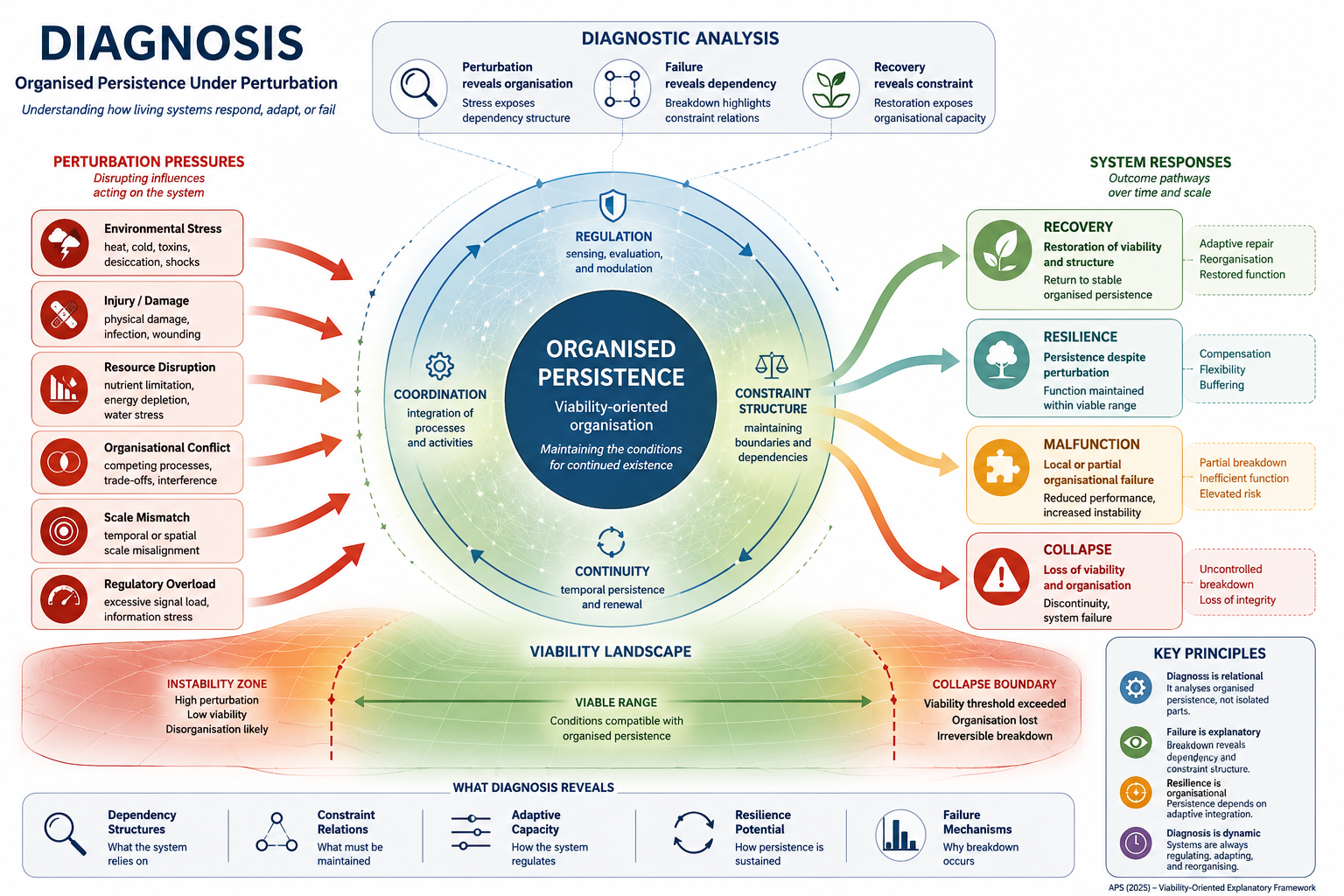
APS therefore approaches malfunction, deterioration, and death not as external interruptions imposed upon otherwise complete systems, but as intrinsic possibilities of viability-oriented organisation. Failure dynamics can reveal the conditions under which living systems sustain continuity, reorganise under perturbation, progressively lose compensatory capacity, or ultimately cease to maintain themselves as integrated biological organisations.
Why Mortality Does Not Contradict APS
Any apparent tension between viability-orientation and mortality disappears once persistence is understood as an organisational achievement rather than a guarantee of indefinite existence. APS does not claim that living systems persist forever. It claims that living activity is organised relative to conditions of continued persistence.
Mortality therefore does not refute viability-oriented organisation. It reveals its precarious character. Repair, regulation, adaptation, reproduction, and evolutionary change occur in systems for which continued organisation is neither automatic nor permanently secured. The possibility of failure is consequently integral to understanding why these activities matter biologically.
This does not mean that mortality itself must be regarded as an adaptive function or biological goal. The point is more limited: an organisation whose persistence depends upon continuing self-maintaining activity is necessarily an organisation for which loss of that capacity remains possible. Vulnerability follows from the character of organised persistence without implying that every particular cause or timing of death is organisationally prescribed.
Explanatory Architecture
Central Question
What do malfunction, breakdown, and death reveal about the organisation through which living systems maintain, lose, or cease organised persistence?
Architectural Role
This article clarifies biological failure by distinguishing three relations to continuing viability-oriented organisation. Malfunction is impaired functioning within an organisation that continues to persist. Breakdown is erosion of the organisation’s capacity to maintain and re-establish the conditions of its persistence. Death is collapse of the viability-oriented organisation through which the organism exists as that organism.
The distinction is organisational rather than a claim that three universally separable mechanisms underlie biological failure. Particular cases require mechanistic and empirical explanation. The architecture identifies what relation those mechanisms bear to the persistence of the living organisation.
Builds On
- Life as viability-oriented, constraint-closed organisation
- Biological Agency
- Organised Persistence
- Viability
- Biological Function
- Constraint Closure
- Perturbation and Resilience
Develops Into
- diagnosis as continuity analysis
- repair and recovery
- resilience and adaptation
- ageing and progressive deterioration
- empirical investigation of organisational failure
- analysis of the transition between continuing biological organisation and death
Related Explanatory Questions
- When does local malfunction become systemic breakdown?
- Which organisational dependencies make recovery possible?
- How can perturbation reveal relations contributing to organised persistence?
- When does declining repair or compensation indicate erosion of the system’s capacity to maintain itself?
- What distinguishes the processes leading to death from the collapse of living organisation itself?
- Do competing accounts of ageing and deterioration explain the same target, and what would constitute explanatory gain between them?
Position within APS
Failure is not an additional component of APS or a separate explanatory domain. It provides a diagnostic perspective on viability-oriented organisation by revealing what happens when activities and relations contributing to organised persistence are impaired, reorganised, restored, or lost.
Agency, Process, and Scale remain analytic projections of one viability-oriented, constraint-closed organisation. Agency concerns the activity through which living organisation is enacted; Process concerns how continuity is maintained despite change; and Scale concerns where persistence is organised across spatial and temporal extents. Malfunction, breakdown, and death can require attention to all three projections, but none acts as an independent causal level.
The explanatory task therefore remains case-relative. APS does not assume that an organisational description is superior to a molecular, physiological, cybernetic, evolutionary, or other account. It asks which materially realised relations are required to explain the specified form of failure and whether making those relations explicit provides explanatory content not already supplied by the relevant comparator.
Conclusion
Living systems persist only through continuing activity that maintains and re-establishes the conditions required for their organisation. Because those conditions are never permanently secured, vulnerability is intrinsic to living organisation rather than an accidental qualification added to it.
Malfunction, breakdown, and death identify different relations between failure and organised persistence. Malfunction occurs within a system that remains capable of maintaining itself. Breakdown involves progressive erosion of that capacity, potentially through declining regulation, repair, compensation, or other organisational dependencies. Death marks the collapse of the viability-oriented organisation through which the organism persisted as that organism.
These distinctions do not replace mechanistic explanation. On the contrary, they help specify what mechanisms of failure must explain. By examining how living systems respond to perturbation, compensate for impairment, recover organisation, progressively deteriorate, or cease to maintain themselves, biological failure can reveal relations that remain less visible during stable functioning.
Mortality therefore does not contradict viability-oriented organisation. It demonstrates that organised persistence is an achievement of continuing biological activity under conditions in which success is never guaranteed.
Key Point
Malfunction, breakdown, and death do not contradict viability-oriented organisation. They reveal different relations between biological failure and organised persistence: local impairment within continuing organisation, erosion of the capacity for self-maintenance, and eventual collapse of the living organisation itself.
See Also
Related Articles
References
- (1966). The Phenomenon of Life. Harper & Row.
- (2015). Biological Autonomy: A Philosophical and Theoretical Enquiry. Springer.
- (2018). Everything Flows: Towards a Processual Philosophy of Biology. Oxford University Press.
- (2026). Theories of Aging: From Damage and Programmed Theories to Goal-Directedness. Preprints.org. https://doi.org/10.20944/preprints202608.1219.v1
- (2007). Mind in Life. Harvard University Press.