How to Diagnose a Biological System — An APS Method
This article develops the methodological and empirical dimensions of APS diagnosis. APS diagnosis evaluates viability-oriented organisation through perturbation, regulation, evaluation, semiosis, and persistence-maintaining activity rather than through trait lists or static classification. Diagnosis in APS is explanatory, organisational, perturbational, and graded rather than merely classificatory.
How to Diagnose a Biological System — An APS Method
Where this article fits: This article develops the methodological and empirical dimensions of APS diagnosis. For the broader conceptual account of diagnosis as continuity, perturbation, resilience, malfunction, and organisational disruption, see Diagnosis as Continuity Analysis.
APS diagnosis begins from a foundational biological question:
How does a system sustain itself as a viable organisation across time?
Traditional diagnostic approaches often identify:
- traits;
- molecular markers;
- behavioural capacities;
- or structural properties.
APS reframes diagnosis organisationally.
A biological system is not identified merely by what it contains or what it appears to do, but by how its organisation contributes to the maintenance of its own persistence.
Diagnosis therefore becomes the evaluation of viability-oriented organised persistence through perturbation, regulation, evaluation, and organisational response.
From Classification to Organisational Explanation
Conventional biological diagnosis frequently operates classificatorily.
Systems are identified as living because they:
- metabolise;
- reproduce;
- grow;
- respond;
- evolve;
- or possess particular molecular structures.
Such criteria can be operationally useful.
However, they do not by themselves explain why these features matter biologically.
APS therefore shifts the diagnostic question:
- from “What traits are present?”
- to “How is organised persistence maintained?”
This transforms diagnosis:
- from static classification;
- into explanatory evaluation.
The goal is not merely to assign systems to categories, but to understand how viability-oriented organisation is sustained across time and scale.
What APS Diagnoses
APS evaluates whether a system:
- maintains the conditions of its own persistence;
- regulates itself relative to viability;
- reorganises under perturbation;
- and sustains organisational coherence across time.
The diagnostic target is therefore not:
- metabolism alone;
- adaptive behaviour alone;
- or information processing alone
but the organised activity through which a system continues to exist as a unified biological process.
Biological diagnosis consequently concerns:
- organisation;
- evaluation;
- regulation;
- persistence;
- endogenous activity;
- semiosis;
- and scale-coupled coordination.
Why Trait Lists Are Insufficient
Trait-list approaches remain limited because many non-living systems display life-like properties.
For example:
- crystals grow;
- fires spread;
- machines regulate;
- and artificial systems may optimise or adapt.
Yet such systems do not necessarily sustain themselves as viability-oriented organisations.
APS therefore asks a deeper diagnostic question:
Do these processes contribute to the system’s own organised persistence?
A trait becomes biologically meaningful only when embedded within an organisation actively contributing to the maintenance of viability across time.
Traits alone therefore do not diagnose life.
Organisation does.
Nor does optimisation, information processing, or adaptive performance alone diagnose biological organisation. Diagnostic significance depends upon whether such processes participate in endogenous viability-oriented persistence.
Perturbation as the Primary Diagnostic Method
APS diagnosis is fundamentally perturbational.
This is because organisation becomes most visible when it is challenged.
Under perturbation, systems may:
- degrade;
- remain externally stabilised;
- compensate;
- reorganise;
- or restore viable conditions.
These responses reveal whether the system actively contributes to maintaining its own persistence.
A living system does not merely undergo change.
It evaluates perturbation relative to viability conditions and modulates organisation accordingly.
Perturbation therefore provides a principled diagnostic method for evaluating:
- biological agency;
- organisational dependence;
- functional integration;
- endogenous regulation;
- and viability-oriented persistence.
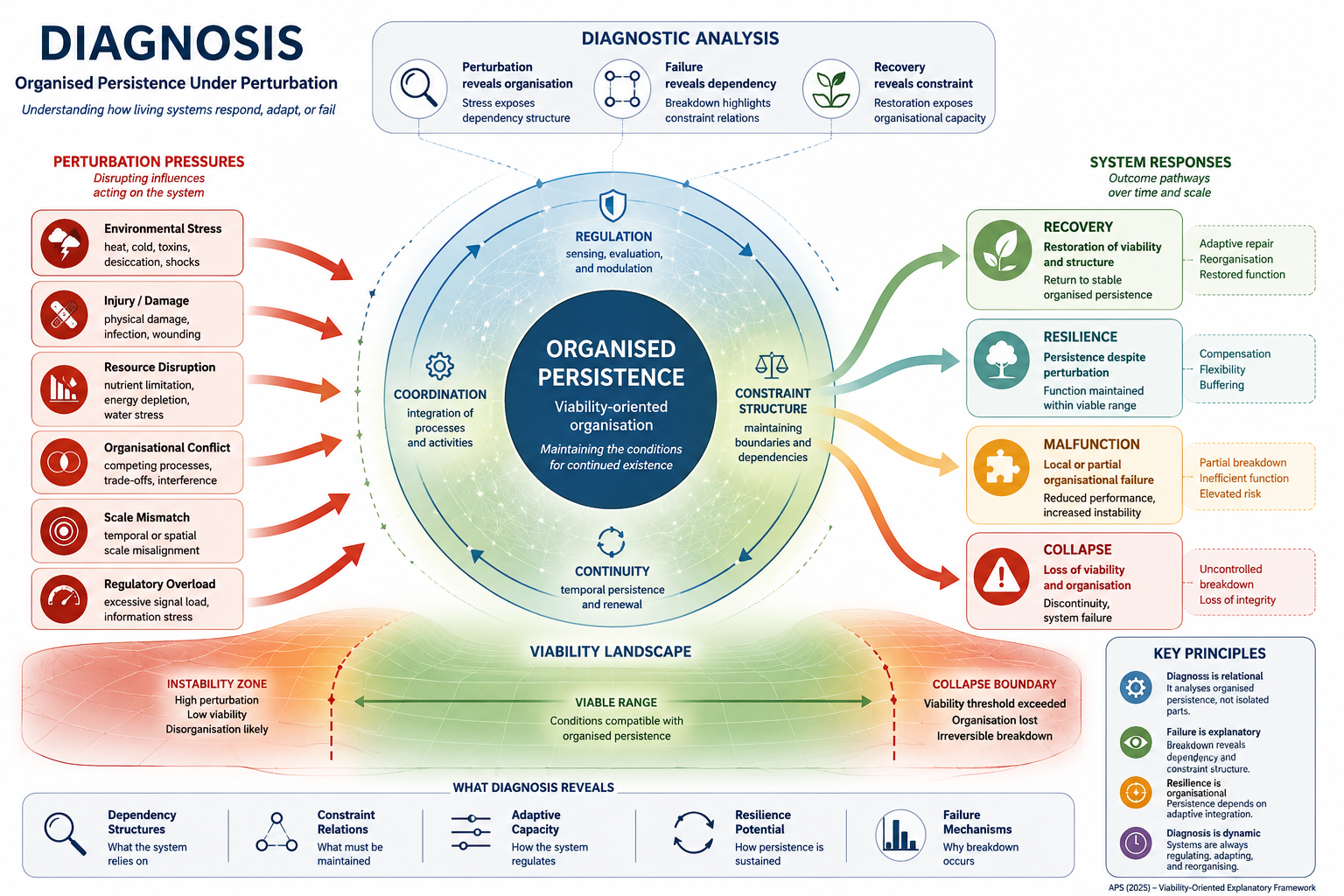
Primary Diagnosis Visual. APS diagnosis evaluates how living systems sustain, reorganise, or lose viable continuity under perturbation. Diagnosis therefore concerns organisational persistence across interacting scales rather than the detection of isolated traits or abnormalities alone.
APS therefore approaches perturbation not as accidental disruption, but as a structured method for revealing organisational continuity and its limits.
Definition, Diagnosis, and Evidence
APS distinguishes carefully between:
- definition;
- diagnosis;
- and evidence.
Definition concerns what life is.
Diagnosis concerns how living organisation is identified.
Evidence concerns observable indicators supporting that diagnosis.
This distinction is essential because biosignatures, traits, molecular markers, or behavioural indicators do not define life by themselves.
They function as evidence that may support inference to underlying organisation.
APS diagnosis therefore does not search for isolated “signs of life.”
It evaluates evidence relative to an explanatory account of organised persistence.
The APS Diagnostic Sequence
APS diagnosis proceeds through a series of organisational evaluations.
These are not rigid algorithmic steps.
They form a structured interpretive framework for analysing biological organisation.
| Diagnostic Dimension | APS Diagnostic Question |
|---|---|
| Organisational coherence | Does the system function as an integrated persistence-maintaining organisation? |
| Constraint closure | Do processes regenerate conditions enabling other processes? |
| Viability orientation | Is activity organised relative to conditions of persistence? |
| Perturbation response | Can the system reorganise under disruption? |
| Scale coupling | Is organisation coordinated across interacting temporal and spatial scales? |
| Evidence | What observable patterns support these inferences? |
Step 1 — Identify the Organised System
Diagnosis begins by identifying the system under investigation.
In APS, biological systems are not defined solely by physical boundaries, but by persistence-maintaining organisational coherence.
The central question becomes:
What processes collectively contribute to the continued existence of this organisation?
Diagnosis therefore requires identifying:
- organisational integration;
- persistence conditions;
- and the extent of the system across time and scale.
Step 2 — Assess Constraint Closure
The next step evaluates whether processes are mutually sustaining.
Biological systems exhibit forms of constraint closure in which:
- processes maintain conditions enabling other processes;
- organisational relations are reciprocally dependent;
- and activity contributes to maintaining system coherence.
Constraint closure is therefore diagnostically important because it identifies whether persistence is internally organised rather than externally imposed.
Step 3 — Apply Perturbation
Diagnosis becomes most informative under perturbation.
Perturbations may include:
- environmental disruption;
- resource limitation;
- structural damage;
- internal dysregulation;
- or altered organisational conditions.
The purpose of perturbation is not destruction.
It is revelation.
Perturbation exposes:
- organisational dependencies;
- capacities for restoration;
- and limits of viability-oriented regulation.
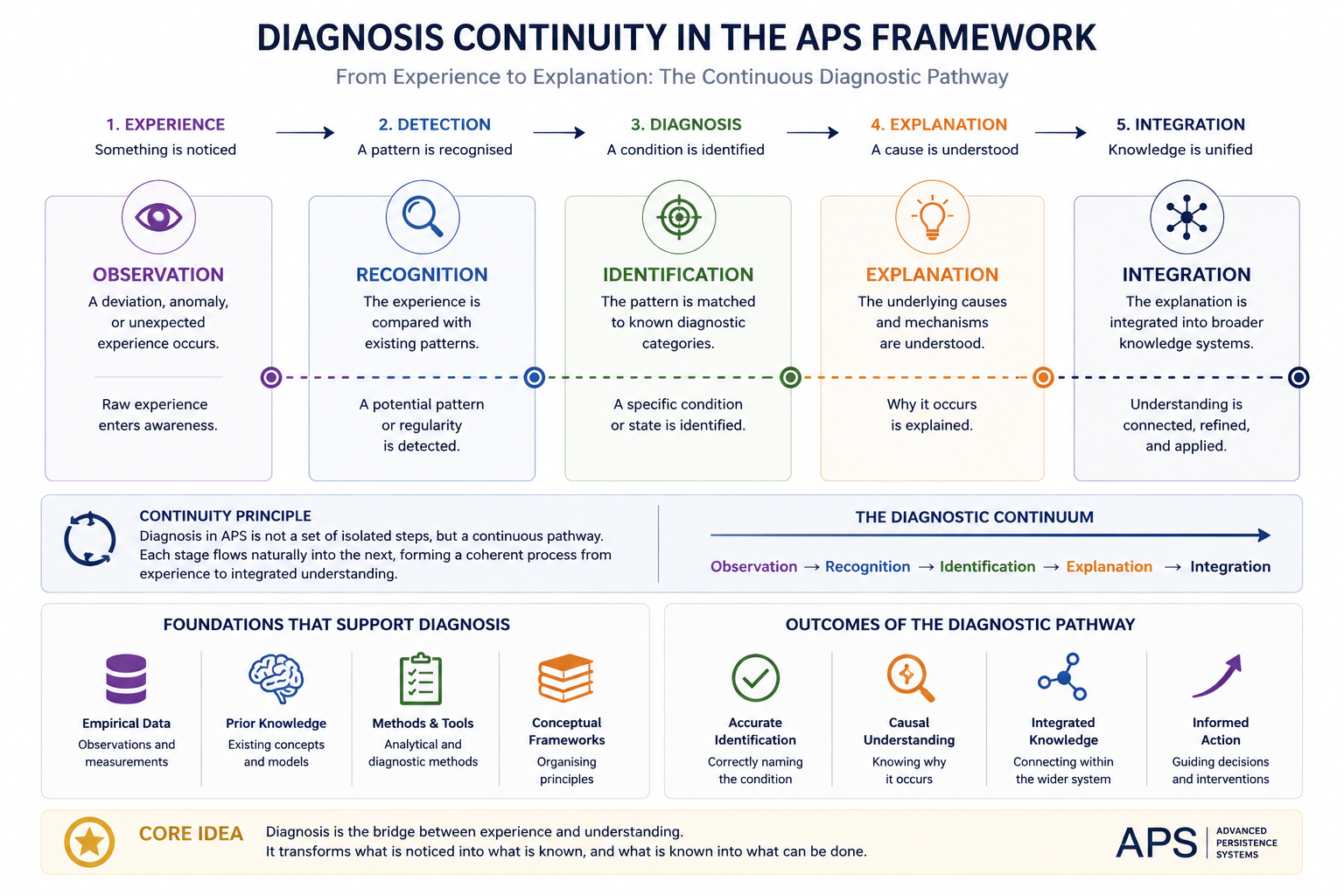
Diagnosis Continuity Visual. Primary visuals clarify the organisational structure of a biological domain. Continuity visuals trace how that organisation develops continuously from viability-oriented activity across scales and time, preserving explanatory continuity across biological organisation.
Diagnosis therefore concerns not merely the detection of abnormalities, but the analysis of how organised persistence succeeds, compensates, destabilises, or fails across time.
Step 4 — Evaluate Organisational Response
Following perturbation, APS distinguishes several broad organisational outcomes.
Degradation
The system fails to restore viable conditions and moves toward breakdown.
External Stabilisation
The system persists only through externally imposed maintenance.
Endogenous Reorganisation
The system reorganises its own activity in ways that restore viability.
Only the third case demonstrates biological agency in the APS sense.
The key issue is whether restoration arises from the organisation of the system itself.
Step 5 — Assess Viability Gradient (VG)
Biological organisation is not strictly binary.
Systems differ in:
- resilience;
- robustness;
- adaptive capacity;
- and persistence-maintaining effectiveness.
The Viability Gradient (VG) captures this variation.
Systems with high VG:
- sustain coherence robustly;
- recover effectively;
- and maintain viability across perturbation.
Systems with low VG:
- degrade easily;
- exhibit fragile organisation;
- or depend heavily upon external scaffolding.
VG therefore functions as a diagnostic dimension rather than a rigid metric.
Step 6 — Assess Normativity Gradient (NG)
Biological systems differentiate between:
- viable and non-viable conditions;
- persistence-supporting and persistence-undermining states;
- and beneficial versus damaging organisational activity.
Differences become diagnostically meaningful because systems organise activity relative to viability conditions.
Diagnosis therefore depends partly upon identifying semiosis: the organisation of differences as mattering within evaluative regulation.
The Normativity Gradient (NG) evaluates the extent to which:
- activity is organised relative to viability;
- deviations are detected;
- and regulation restores persistence-supporting conditions.
NG therefore evaluates the extent to which viability-oriented evaluation and regulation organise system activity.
Step 7 — Assess Cognitive Integration (CI)
Some systems regulate viability without exhibiting cognition.
APS therefore distinguishes:
- biological diagnosis
from:
- cognitive diagnosis.
Cognitive Integration (CI) concerns:
- integrated evaluation;
- temporal depth;
- context sensitivity;
- and cross-scale coordination.
A cognitively integrated system:
- coordinates multiple viability-relevant conditions;
- modulates activity contextually;
- and regulates behaviour beyond simple reactive coupling.
CI therefore evaluates the extent to which evaluative organisation becomes temporally extended, context-sensitive, and integrated across scales.
Step 8 — Evaluate Across Scale
All APS diagnosis is multiscale.
Systems may:
- exhibit short-term stability while degrading long-term;
- maintain local organisation while failing systemically;
- or preserve one process at the expense of broader viability.
Diagnosis must therefore evaluate:
- temporal persistence;
- distributed organisation;
- cross-scale coordination;
- and system-wide coherence.
Biological systems cannot be understood through isolated mechanisms alone.
Diagnosis Is Graded Rather Than Binary
APS diagnosis does not impose an absolute boundary between life and non-life.
Systems may:
- partially sustain viability;
- exhibit incomplete closure;
- possess limited autonomy;
- or depend variably upon external support.
This is why APS employs:
- gradients;
- organisational assessment;
- and explanatory evaluation
rather than binary classification alone.
Borderline systems such as:
- viruses;
- dormant systems;
- protocells;
- synthetic constructs;
- and artificial systems
therefore become diagnostically informative rather than conceptually problematic.
Diagnosis as Organisational Explanation
APS diagnosis ultimately asks:
How does this system sustain itself?
This reframes biological investigation itself.
Diagnosis no longer concerns merely:
- identifying traits;
- cataloguing components;
- or assigning categories.
Instead, it concerns:
- how persistence is maintained;
- how organisation is regenerated;
- how viability is enacted;
- and how biological coherence persists across scale and time.
Diagnosis therefore becomes explanatory rather than merely descriptive.
APS diagnosis therefore operates through the same organisational grammar governing biological explanation more generally:
- agency;
- process;
- scale;
- viability;
- evaluation;
- semiosis;
- cognition;
- and persistence.
From Conceptual Framework to Empirical Method
APS does not replace experimental biology.
The framework instead provides:
- an organisational interpretive framework;
- a viability-relative evaluative structure;
- and a principled method for understanding living systems.
It links:
- conceptual explanation;
- empirical investigation;
- perturbational analysis;
- and biological interpretation
within a unified account of organised persistence.
Closing Perspective
To diagnose a biological system in APS is to evaluate how organisation contributes to persistence.
The defining question is not:
What traits does the system possess?
but:
How does the system sustain itself as a viability-oriented process?
Biological systems are therefore diagnosed not by isolated properties, but by the ways their organisation actively maintains the conditions of its own continued existence.
Related Pathways
- Diagnosis as Continuity Analysis
- Malfunction
- Ecological Resilience
- APS Diagnostics and Empirical Tractability
- Life Detection in APS — Biosignatures, Organisation, and Evidence
- What Is a Biological System?
Key Terms
diagnosis · perturbation · persistence · viability · resilience · malfunction · evaluation · semiosis · cognition · organisation · continuity
See Also
Related Articles
References
- (1865). An Introduction to the Study of Experimental Medicine. Henry Schuman.
- (1932). The Wisdom of the Body. W. W. Norton & Company.
- (2009). Darwinian Populations and Natural Selection. Oxford University Press.
- (1980). Autopoiesis and Cognition: The Realization of the Living. D. Reidel.
- (2015). Biological Autonomy: A Philosophical and Theoretical Enquiry. Springer.
- (2016). Dance to the Tune of Life: Biological Relativity. Cambridge University Press.
- (1991). Life Itself. Columbia University Press.
- (2007). Mind in Life. Harvard University Press.