Evaluation: How Living Systems Modulate Activity Relative to Viability
This article clarifies evaluation within the Agency–Process–Scale (APS) framework. Evaluation is understood as the differential modulation of activity relative to conditions of viability. Living systems do not merely undergo physical processes; they regulate activity in relation to conditions that support or undermine persistence. Evaluation therefore constitutes the real-time enactment of biological normativity and provides the organisational bridge linking viability, semiosis, meaning, cognition, temporality, and biological agency.
Evaluation — How Living Systems Modulate Activity Relative to Viability
Living systems continuously regulate activity relative to conditions affecting persistence.
Cells alter metabolism in response to nutrient availability. Organisms avoid damaging environments. Immune systems discriminate between tolerated and harmful interactions. Plants reorganise growth relative to light, gravity, hydration, and environmental stress.
Biology therefore routinely describes living systems in terms implying evaluation:
- detection;
- regulation;
- adaptation;
- error correction;
- responsiveness;
- significance;
- and selective modulation.
Yet evaluation itself is often left conceptually underdefined.
Sometimes evaluation is treated metaphorically, as though organisms merely appear to evaluate conditions.
In other cases it is reduced to:
- information processing;
- optimisation;
- computational responsiveness;
- or mechanistic feedback considered independently of viability-oriented organisation.
APS rejects both interpretations.
Evaluation is neither metaphorical nor reducible to abstract computation.
Evaluation is a fundamental organisational feature of temporally continuous viability-oriented living systems.
From Viability to Evaluation
Evaluation becomes intelligible only within the broader organisational structure of life.
- Viability defines the conditions required for persistence.
- Normativity establishes what counts as continuity-supporting or continuity-undermining relative to those conditions.
- Evaluation is the differential modulation of activity relative to those conditions.
This sequence does not introduce hidden mental properties or external standards.
It clarifies an organisational structure already present within living systems themselves.
A system capable of sustaining itself must continuously regulate activity relative to conditions affecting persistence across time.
Some conditions support viability.
Others threaten it.
Activity consequently becomes differentially modulated relative to those conditions.
Evaluation is therefore the operational enactment of normativity in real time.
It is through evaluation that living systems maintain continuity between present activity and future persistence.
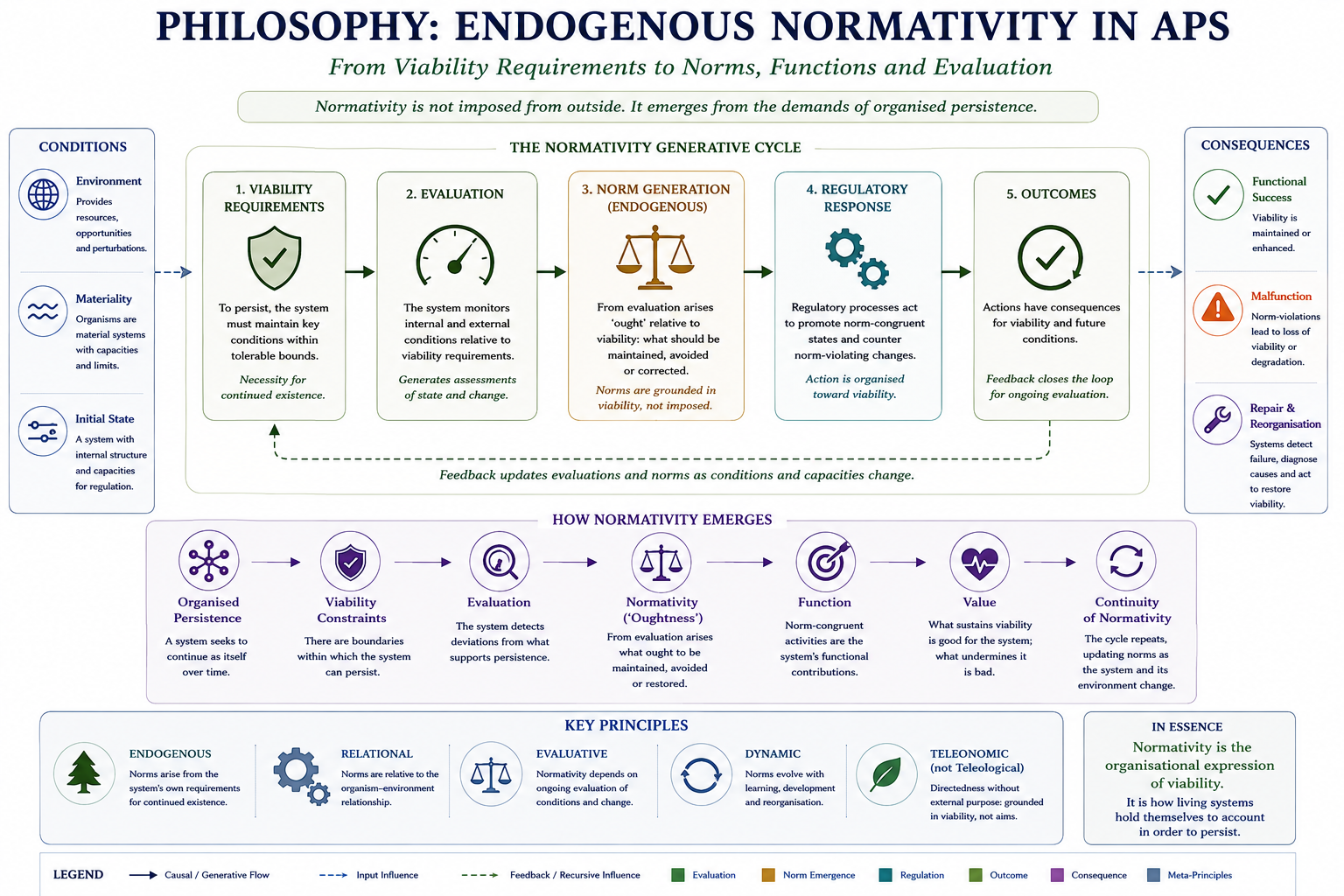
Evaluation and Endogenous Normativity. Evaluation operationalises biological normativity through viability-oriented modulation of activity relative to continuity-preserving conditions.
Evaluation as Organisational Modulation
In APS, evaluation is not a detached judgement imposed upon biological systems from outside.
Evaluation is an organisational process internal to living activity itself.
Evaluation is the differential modulation of activity relative to viability conditions.
Living systems do not merely undergo causal interactions.
They reorganise activity in ways that preserve, restore, or enhance the conditions required for persistence.
This modulation may involve:
- metabolic regulation;
- behavioural adjustment;
- immune discrimination;
- developmental plasticity;
- physiological compensation;
- ecological responsiveness;
- semiosis;
- and continuity-preserving reorganisation.
Evaluation therefore occurs wherever activity is differentially organised relative to viability.
Importantly, this does not imply:
- conscious awareness;
- deliberation;
- symbolic reasoning;
- or explicit representation.
Evaluation is biologically basic before it becomes cognitively elaborate.
APS therefore treats evaluation as organisationally prior to:
- cognition;
- symbolic representation;
- abstract reasoning;
- and consciousness.
Evaluation and Temporal Organisation
Evaluation is inherently temporal.
Living systems do not merely react instantaneously to isolated stimuli.
They maintain organised continuity through changing conditions across time.
Evaluative modulation helps stabilise that continuity.
Activity is therefore organised not merely relative to present conditions, but relative to maintaining persistence across ongoing temporal transformation.
Evaluation consequently depends upon:
- temporal organisation;
- continuity maintenance;
- perturbation-sensitive regulation;
- adaptive reconstruction;
- developmental continuity;
- and persistence-preserving coordination.
Living systems sustain themselves by continuously reorganising activity relative to changing viability conditions.

Evaluation contributes to organised persistence through temporally coordinated modulation of activity relative to changing viability conditions.
Evaluation Without Representation
Many theories implicitly treat evaluation as dependent upon:
- internal models;
- symbolic encoding;
- representation;
- or explicit informational comparison.
APS does not require these assumptions.
A bacterium moving toward nutrients and away from toxins need not internally represent its environment symbolically.
What matters biologically is that environmental differences become integrated into viability-oriented modulation of activity.
APS therefore distinguishes evaluation from representation.
Representation may emerge within some advanced forms of cognition capable of modelling absent, hypothetical, or future conditions.
Evaluation is more fundamental.
Evaluation exists wherever activity becomes differentially organised relative to viability conditions.
Nor does APS identify evaluation with:
- information processing;
- optimisation;
- predictive modelling;
- or computational responsiveness considered independently of organised persistence.
Artificial systems may optimise outputs or classify inputs while remaining externally maintained systems lacking intrinsic viability-oriented persistence.
Biological evaluation differs because:
- the system’s own persistence is at stake;
- modulation contributes to maintaining continuity;
- activity participates in sustaining viability;
- and regulation occurs within continuity-producing organisation.
Evaluation is therefore organisational and embodied rather than merely computational or representational.
Evaluation and Function
Evaluation operationalises biological function.
Functions matter because living systems continuously differentiate:
- continuity-supporting from continuity-undermining conditions;
- adaptive from maladaptive trajectories;
- and stabilising from destabilising organisational states.
Evaluation modulates activity relative to these distinctions.
Without evaluation:
- function would lack operational regulation;
- adaptation would lack directional organisation;
- and persistence would become organisationally unstable.
Evaluation therefore functions as one of the principal operational expressions of biological normativity.
Evaluation and Semiosis
Evaluation provides the organisational basis of semiosis.
Differences become meaningful because they affect viability and therefore alter how activity is regulated.
A chemical gradient, thermal variation, environmental signal, or ecological cue matters biologically only insofar as it participates in viability-oriented evaluation.
Semiosis therefore depends upon evaluation:
- evaluation modulates activity relative to viability;
- semiosis structures differences as mattering within that modulation.
Meaning in APS is thus not fundamentally symbolic or linguistic.
It is the organisation of differences within evaluative biological activity.
APS increasingly understands this relationship developmentally:
persistence
↓
evaluation
↓
semiosis
↓
meaning
↓
information
↓
representation
Persistence establishes the temporal continuity of organised living activity.
Evaluation modulates activity relative to viability.
Semiosis structures differences as biologically meaningful within ongoing regulation.
Meaning emerges as stabilised evaluative significance.
Information emerges where meaningful differences participate in organised coordination.
Representation may arise within some advanced forms of cognition capable of modelling absent, hypothetical, or future conditions.
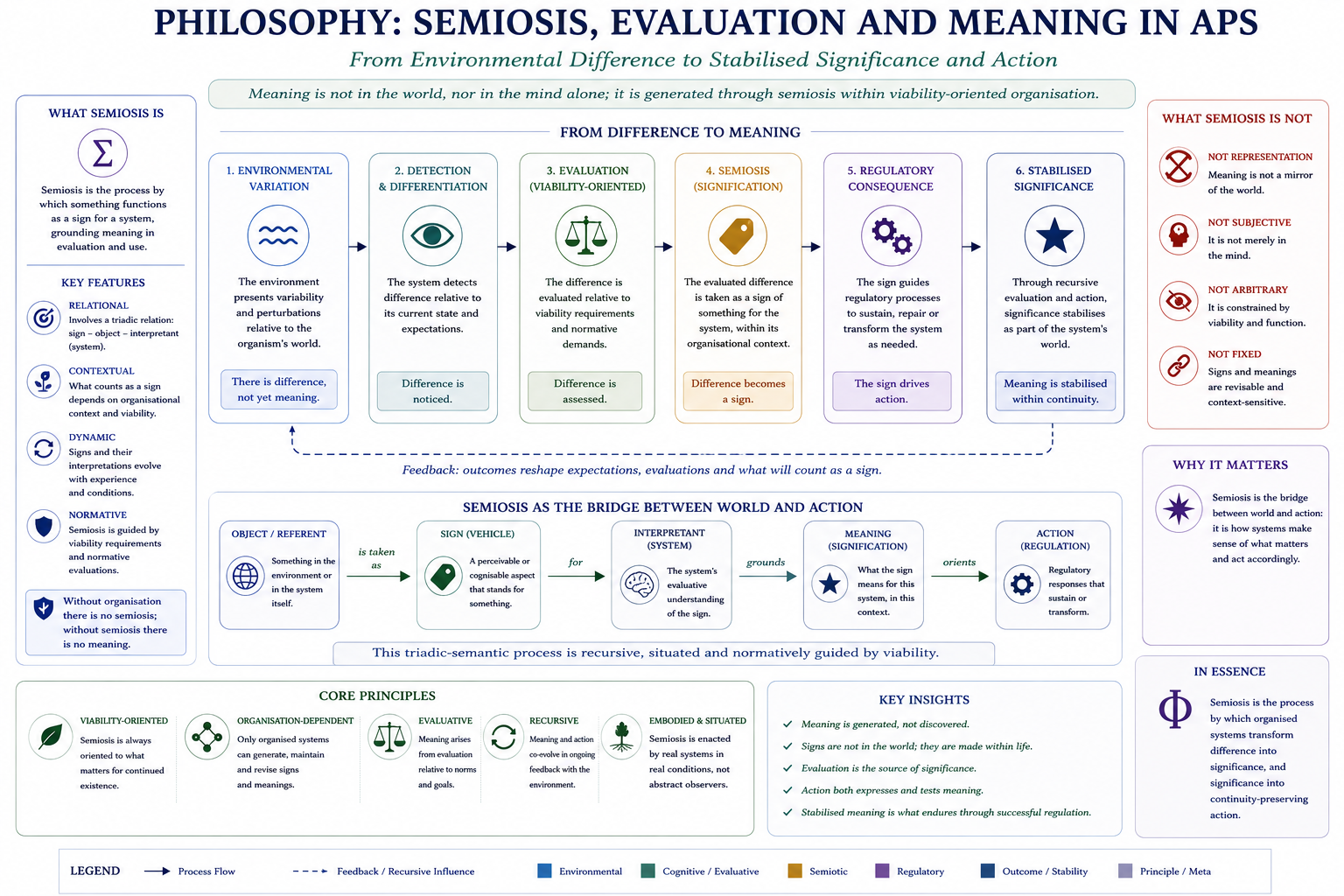
Evaluation, Semiosis, and Meaning. Differences become biologically meaningful because evaluative organisation modulates activity relative to viability-oriented persistence.
Evaluation and Cognition
Evaluation and cognition are closely related but not identical.
Evaluation concerns the real-time modulation of activity relative to viability.
Cognition emerges when evaluative organisation becomes sufficiently integrated and temporally extended such that present regulation becomes organised relative to:
- absent conditions;
- future possibilities;
- memory;
- anticipation;
- or hypothetical states.
All cognition therefore presupposes evaluation.
But not all evaluation constitutes cognition.
This distinction is crucial because it:
- grounds cognition within biology;
- avoids reducing all life to cognition;
- preserves continuity between simple and complex organisms;
- and clarifies how cognition emerges from more fundamental organisational processes.
APS therefore interprets cognition as temporally extended evaluative organisation.
Evaluation and Biological Agency
Evaluation is inseparable from biological agency.
Agency concerns the ongoing activity through which living systems sustain themselves as organised continuities.
Evaluation explains how that activity becomes differentially organised relative to conditions affecting persistence.
Without evaluation, agency would reduce to undifferentiated activity lacking normative organisation.
Without agency, evaluation would lack an organised system within which modulation could occur.
Evaluation therefore functions as one of the central organisational bridges linking:
- viability;
- normativity;
- function;
- semiosis;
- meaning;
- cognition;
- temporality;
- and biological agency.
Evaluation Across Biological Scales
Evaluative organisation operates across multiple biological scales and temporal horizons.
At molecular scales, evaluation may involve:
- metabolic regulation;
- transcriptional modulation;
- signalling coordination;
- and physiological compensation.
At organismal scales, evaluation may involve:
- behavioural adaptation;
- physiological regulation;
- learning;
- and anticipatory organisation.
At ecological scales, evaluation may involve:
- organism–environment coupling;
- collective responsiveness;
- niche construction;
- and distributed ecological regulation.
APS therefore treats evaluation not as a single isolated mechanism, but as an organisational principle operating across interconnected scales of persistence-maintaining activity.
Evaluation and Diagnostics
Evaluation also has diagnostic significance within APS.
Living systems can often be identified not merely by structural organisation, but by how they modulate activity relative to perturbation.
Perturbation-based diagnosis therefore depends partly upon detecting evaluative organisation:
- whether systems distinguish continuity-supporting from continuity-threatening conditions;
- whether activity reorganises relative to those conditions;
- whether regulation contributes to organised persistence;
- and whether continuity becomes stabilised or restored across time.
Evaluation therefore provides an important bridge between APS explanatory ontology and APS diagnostics.
Evaluation and Artificial Systems
Artificial systems may display:
- optimisation;
- adaptation;
- predictive control;
- behavioural responsiveness;
- or sophisticated simulation.
APS does not deny these capacities.
However, optimisation alone does not constitute biological evaluation.
Artificial systems generally operate within externally maintained organisational conditions.
Their activity may be highly sophisticated while remaining detached from intrinsic viability-oriented persistence.
Biological evaluation differs because:
- evaluation contributes directly to maintaining the system’s own conditions of existence;
- modulation occurs within continuity-producing organisation;
- persistence is organisationally at stake;
- and evaluative activity contributes directly to sustaining viability across time.
This distinction is critical for differentiating biological agency from artificial performance.
Why Evaluation Matters
Evaluation occupies a foundational position within APS because it explains how viability-oriented organisation becomes operationally regulated across time.
Without evaluation:
- normativity would remain organisationally inert;
- semiosis would lack grounding;
- meaning would lack biological significance;
- and cognition would lose its continuity with more basic forms of life.
Evaluation therefore functions as one of the principal organisational bridges linking:
- viability;
- function;
- normativity;
- semiosis;
- meaning;
- cognition;
- temporality;
- agency;
- and diagnostics.
Understanding evaluation in this way allows biological significance to be grounded within the organisation of living systems themselves rather than within abstract computation, symbolic representation, or externally imposed interpretation.
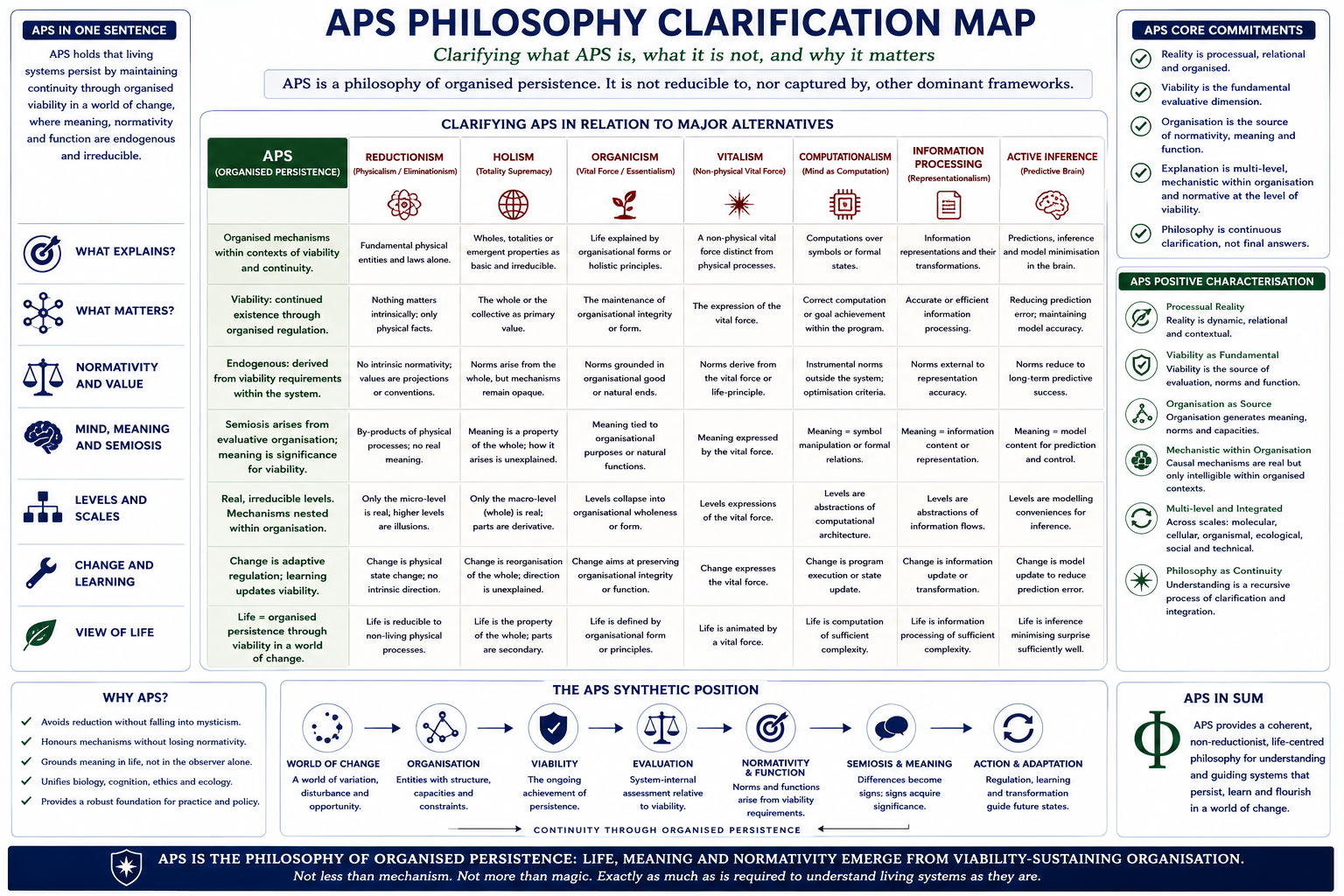
APS Clarification Map. APS grounds evaluation, semiosis, meaning, and cognition within viability-oriented organised persistence rather than abstract information processing or symbolic representation alone.
Conclusion
Living systems do not merely undergo physical processes.
They continuously modulate activity relative to conditions supporting or undermining persistence.
Evaluation is therefore not metaphorical, externally imposed, or reducible to abstract information processing.
It is a fundamental organisational feature of viability-oriented living systems.
APS consequently interprets evaluation as:
- the real-time enactment of biological normativity;
- the operational modulation of activity relative to viability;
- and one of the principal organisational bridges linking persistence, semiosis, meaning, cognition, temporality, and agency.
Key Point
Evaluation is how living systems operationally distinguish and regulate conditions that matter differently relative to viability-oriented organised persistence.
See Also
Related Articles
References
- (2011). Incomplete Nature. W. W. Norton & Company.
- (2018). The Biogenic Approach to Cognition. Adaptive Behavior, 26, 225–240 .
- (2015). Biological Autonomy: A Philosophical and Theoretical Enquiry. Springer.
- (2024). Top-Down Models in Biology: Explanation Beyond Mechanism. Physics of Life Reviews, 48, 1–25 .
- (2026). Agency as the Defining Activity of Life. Biological Theory . https://doi.org/10.1007/s13752-026-00547-6
- (2007). Mind in Life. Harvard University Press.
- (1991). The Embodied Mind. MIT Press.