Semiosis — How Differences Come to Matter in Living Systems
Semiosis concerns sign relations within living organisation. APS does not treat semiosis as the process through which biological significance first arises: Biological Evaluation is the process through which agency generates significance. Semiosis becomes a further explanatory hypothesis where a biologically significant difference functions as a sign in relation to another condition, object, possibility, or state of affairs. Such an attribution requires evidence beyond causal sensitivity, information-bearing correlation, or viability-relative significance alone. APS therefore distinguishes significance, semiosis, meaning, information, representation, and cognition while asking when sign-relational organisation identifies an additional materially implemented dependency that improves explanation of a specified biological explanandum.
Semiosis — How Differences Come to Matter in Living Systems
Introduction
Semiosis is traditionally concerned with signs and the relations through which something functions for a system in relation to something else. In philosophy, linguistics, semiotics, and cognitive science, such relations have often been associated with interpretation, communication, representation, and meaning. Biosemiotics extends the question into biology, asking whether and how sign processes participate in living organisation.
This extension presents an important explanatory problem. If semiosis is restricted to language, symbolic thought, or conscious interpretation, potentially important sign relations in non-human and non-cognitive biological systems may be excluded in advance. If semiosis is broadened until every biological response, signal, or causal correlation counts as semiotic, however, the concept risks losing explanatory discrimination.
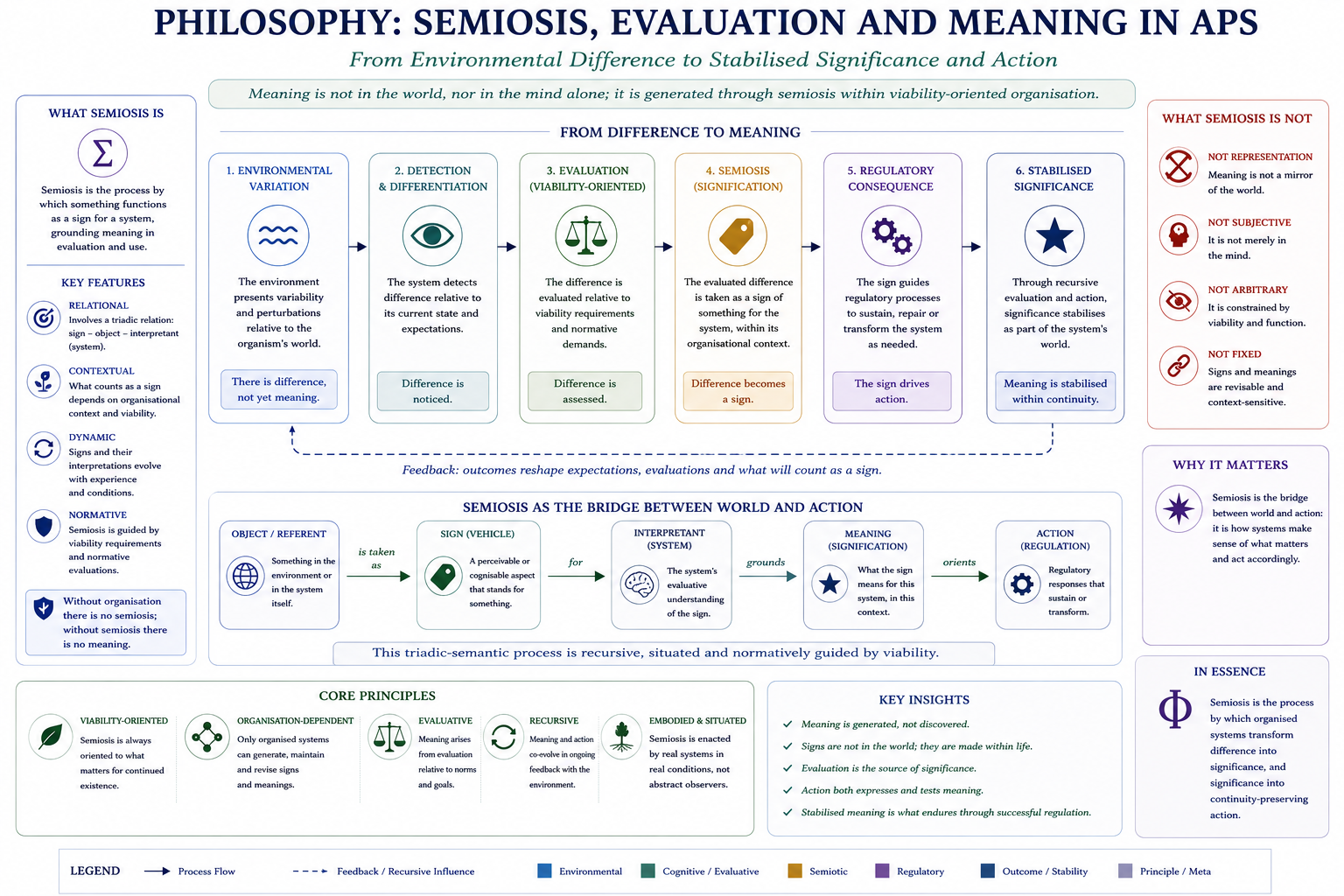
APS approaches this problem by first distinguishing biological significance from semiosis.
Biological agency is viability-oriented organisational activity. Because conditions differ in how they bear upon continued functioning, living systems modulate activity differently in relation to them. Biological Evaluation is the process through which agency generates significance. A difference can therefore matter biologically without the additional claim that it functions as a sign.
Semiosis becomes a further explanatory question. APS uses the concept where a biologically significant difference appears to function within living organisation in relation to another condition, object, possibility, or state of affairs. The semiotic claim is therefore stronger than the claim that a system is causally sensitive to a difference or that the difference carries information.
This distinction also prevents semiosis from becoming an automatic bridge to meaning, representation, or cognition. APS does not posit a compulsory sequence in which evaluation produces semiosis, semiosis produces meaning, meaning produces information, information produces representation, and representation produces cognition. These concepts identify distinguishable explanatory relations whose connections must be established in particular cases.
The central question of this article is consequently:
When does a biologically significant difference function as a sign, and what explanatory work is gained by treating the relation as semiotic?
Where This Article Fits
This Core article occupies a controlled position among the APS treatments of Biological Evaluation, significance, information, cognition, representation, and meaning.
Biological Evaluation owns the prior explanatory question of how differences come to matter biologically. Evaluation generates significance because conditions differ in how they bear upon viability. The existence of such significance does not by itself establish semiosis.
The present article asks the further question of when an already significant difference becomes organised in a specifically sign-relational form. Semiosis is therefore not the source of biological significance but a possible organisation of significant relations.
Information in Biology — An APS Clarification asks a different question again. Informational relations can exist through statistical or causal dependence without automatically becoming either biologically significant or semiotic. Some information-bearing differences may participate in sign relations; others need not.
Cognition — Where Does It Belong in Biology? concerns the organisation of biological significance across time. APS does not currently define cognition through semiosis, although semiotic relations may contribute to cognitive organisation in particular systems.
Representation — When and Whether It Arises in Biological Systems applies a stronger diagnostic test to states or organisations proposed to stand in for, model, or carry content concerning something beyond their immediate occurrence. Semiosis and representation may overlap, but neither concept is reducible to the other.
Finally, Meaning in Biology — An APS Clarification establishes that biological significance is not yet meaning. Meaning concerns the later interpretive organisation of what matters and should not be used as a synonym for semiosis.
The resulting architecture is deliberately non-linear:
Significance ≠ Semiosis ≠ Meaning ≠ Representation.
These distinctions do not imply complete independence. They prevent one concept from doing the explanatory work of another before their relationship has been established.
Biological Significance Before Semiotic Commitment
The first control on an APS account of semiosis is that biological significance does not require semiosis.
Living systems encounter innumerable physical differences. Some make no relevant difference to their activity. Others alter conditions bearing upon viability and consequently modulate what the system does. Through Biological Evaluation, such differences acquire significance relative to the organisation of the living system.
A nutrient concentration may affect microbial activity. Temperature may alter physiological regulation. A developmental condition may modify a cellular trajectory. A chemical difference may influence immune activity. These differences can be biologically significant because of their effects on continued functioning.
Nothing in that description yet requires them to be signs.
This distinction matters because otherwise every viability-relevant causal relation becomes semiotic by definition. The term semiosis would then add little to Biological Evaluation. It would simply rename the fact that differences matter to living systems.
APS therefore separates two questions:
Does the difference matter to the living system?
and:
Does the difference function for that system in relation to something beyond itself?
The first concerns biological significance. The second introduces the semiotic question.
This makes semiosis a substantive explanatory hypothesis rather than an automatic property of life.
Biological Significance Before Semiotic Commitment. Biological Evaluation generates significance because conditions differ in how they bear upon viability. Semiosis becomes a further explanatory hypothesis where a significant difference functions as a sign in relation to something beyond its immediate occurrence.
What Makes a Relation Semiotic?
A sign is not merely a difference that causes another difference.
Physical systems are filled with causal relations. Temperature alters pressure; light triggers chemical reactions; one molecular state changes another. Such relations can carry information in a statistical or causal sense without necessarily being semiotic.
The semiotic question arises when a state or difference functions within an organised system in relation to something other than itself.
Consider a biological signal. Its immediate physical effect may be fully describable through molecular interaction. Yet the same state may also function within the organism because its occurrence indicates another condition, initiates activity appropriate to that condition, or participates in an organised relation whose biological role depends upon what the signal signifies rather than solely upon its local physical properties.
The distinction is subtle but important. A semiotic explanation proposes more than causal efficacy. It proposes a relation among a sign-bearing state, what that state functions in relation to, and the organisation through which that relation affects activity.
APS does not require this relation to be symbolic, linguistic, conscious, or representational in the stronger cognitive sense. A sign relation may be materially implemented in physiological, developmental, behavioural, or other biological organisation.
Neither should the semiotic relation be inferred merely from scientific description. Scientists routinely use one measurable state as an indicator of another. The fact that we treat a molecular concentration as a sign of disease, for example, does not establish that the concentration functions semiotically within the organism itself.
The explanatory task is therefore to identify the sign relation within the organisation of the biological system.
A Diagnostic Test for Semiotic Explanation
APS does not presently propose universal necessary and sufficient conditions for semiosis. Different semiotic theories disagree about the structure and scope of sign relations, and biological cases may realise them in different ways.
APS can nevertheless identify diagnostic considerations that make a semiotic interpretation stronger or weaker.
A semiotic explanation becomes more strongly warranted where:
-
A materially identifiable sign-vehicle or sign-bearing state can be specified.
The proposed sign must be realised within the biological system rather than existing only in the description supplied by an observer. -
The sign functions in relation to something beyond itself.
Its biological role depends upon another condition, object, relation, possibility, or state of affairs rather than being exhausted by its immediate physical effects. -
The system’s activity depends upon that sign relation.
The proposed sign must make a difference to biological organisation because of the relation in which it participates, not merely because it is causally active. -
The relation is not exhausted by simple causal covariance or information-bearing correlation.
Treating the state as a sign should explain something that would otherwise remain unexplained by a weaker causal or informational description. -
Context can alter the significance or use of the sign relation.
A state may function differently according to the organisation, history, developmental condition, or current circumstances of the system, supporting the claim that its role is relational rather than fixed solely by physical form. -
Successful and failed sign-use can in principle be distinguished.
Where a proposed sign relation can be used appropriately or inappropriately, or can fail to guide activity in relation to what it signifies, the semiotic interpretation gains additional explanatory content. -
Semiotic description provides explanatory gain.
The attribution should identify a dependency relevant to the specified explanandum that is not already adequately captured by biological significance, causal regulation, signal transmission, or information alone.
These considerations are diagnostic rather than a scoring system. No single item automatically establishes semiosis, and APS does not presently claim that every genuine sign relation must realise each consideration in precisely the same form.
Their purpose is methodological: to prevent semiotic terminology from replacing explanation.
A semiotic claim should therefore identify what functions as the sign, what it functions in relation to, how that relation is materially implemented, what difference it makes, and why describing the relation as semiotic improves the explanation.
Semiosis and Biological Significance
Semiosis depends upon biological significance in a limited explanatory sense: a proposed biological sign relation must matter to the organisation of the living system if it is to count as biological semiosis.
This does not mean that significance is generated by semiosis.
A difference becomes significant through Biological Evaluation because it bears upon viability-oriented activity. A semiotic relation becomes possible when such a difference acquires a further relational role—for example, when its occurrence functions in relation to another condition and modulates activity accordingly.
This provides a way of understanding why the same physical difference can matter differently in different biological contexts. A chemical state may function as a sign in one organism or developmental condition while having no comparable role in another. Even within the same organism, the significance and use of a signal can change with physiological condition, developmental history, environmental context, or prior activity.
Significance is therefore relationally real without being intrinsic to the physical difference considered in isolation.
Semiosis adds a further relation: the significant difference functions as a sign of, for, or in relation to something else within the organisation of the system.
This is why APS should not say that semiosis transforms meaningless physical differences into biological significance. Biological Evaluation already explains the emergence of significance. Semiosis asks what happens when significant differences acquire sign-relational organisation.
Biological Significance and Semiosis. Biological Evaluation generates significance. Semiosis becomes a further explanatory possibility where a significant difference functions as a sign in relation to another condition, object, possibility, or state of affairs within living organisation.
Semiosis Is Not Meaning
The distinction between semiosis and meaning is especially important because the two concepts are frequently associated within semiotic and biosemiotic traditions.
APS does not deny that sign relations can participate in meaning. It rejects the stronger inference that every biological sign relation is already meaningful in the richer sense developed within the APS cognition–mind architecture.
Biological significance identifies what matters to a living system because conditions differ in how they bear upon viability. Semiosis concerns sign-relational organisation of such differences. Meaning concerns the interpretive organisation of what matters.
These explanatory relations may become increasingly integrated within cognitive systems, minds, language, culture, and reflective agency. Their possible integration does not justify identifying them at their biological origin.
A signal can therefore participate in a semiotic relation without APS having to say that the organism possesses meaning in the same sense in which meaning is attributed to interpretive cognitive organisation. Conversely, meaningful activity may involve many semiotic and representational relations without meaning being reducible to the presence of signs.
The distinction also protects biosemiotic language from anthropomorphic overextension. Terms such as interpretation and meaning-making have legitimate theoretical histories, but when applied to minimal biological systems they can suggest cognitive or experiential capacities that the evidence does not establish.
APS therefore uses them cautiously.
Where biosemiotic theories describe living systems as meaning-making systems, APS can recognise the theoretical importance of that claim while distinguishing it from its own narrower account. Within APS, biological significance is not yet meaning, and semiosis is not by definition meaning-making.
Semiosis and Information
Information and semiosis should likewise remain distinct.
A relation can carry information without functioning as a sign for the biological system. Statistical dependence, causal covariance, sequence structure, and signal transmission can all support legitimate informational descriptions without requiring semiotic interpretation.
Conversely, some information-bearing relations may participate in semiosis. A signal may reliably covary with another condition and, within the organisation of the living system, function in relation to that condition. In such cases informational and semiotic descriptions can concern different aspects of the same materially realised relation.
The important point is that neither concept should be made universally prior to the other.
APS therefore does not claim that information generates semiosis, nor that semiosis universally grounds information. Instead it asks what kind of relation is being described.
If the explanandum concerns statistical dependence, coding structure, transmission, or uncertainty reduction, an informational explanation may be appropriate without semiotic commitment. If the explanandum concerns how one significant state functions for the system in relation to another condition, a semiotic explanation may add something further.
This distinction also prevents the familiar language of signals, codes, and messages from settling the issue prematurely. These terms can be scientifically useful without implying that every information-bearing process constitutes semiosis.
The relation between information and semiosis must therefore be established in the case being investigated rather than derived from a universal conceptual sequence.
Semiosis and Representation
Semiosis and representation can overlap, but they should not be equated.
A semiotic relation requires some state or difference to function in relation to something beyond itself. A representational claim is typically stronger: it proposes that some materially realised state or organisation stands in for, models, or carries content concerning something in a way that contributes distinctively to cognition or behaviour.
Some sign relations may therefore be representational. Others may operate through more immediate biological signalling or relational organisation without satisfying the stronger diagnostics for representation.
The reverse inference should also be avoided. APS does not currently require all possible representation to be derived from a prior semiotic stage.
The dedicated article Representation — When and Whether It Arises in Biological Systems asks when content-bearing or stand-in relations add explanatory work beyond biological significance, information, memory, anticipation, or cognition alone. The present article asks the narrower question of when a significant difference functions sign-relationally.
The distinction can be summarised as follows:
Significance asks what matters.
Semiosis asks whether something significant functions as a sign in relation to something else.
Representation asks whether some state or organisation functions as a content-bearing stand-in or model in a way that adds explanatory work.
These formulations distinguish the questions without predetermining how their answers will relate in every biological system.
Semiosis and Cognition
APS does not define cognition through semiosis.
Cognition is the organisation of biological significance across time. More diagnostically:
Biological agency becomes cognitive when integrated biological significance modulates activity across a temporal field of viability-relevant possibilities in ways not exhausted by immediate or fixed regulation.
Semiotic relations may participate in this organisation. A cognitive system may use signs concerning remembered conditions, anticipated possibilities, social relations, environmental opportunities, or other states that are not reducible to immediate causal stimulation.
It does not follow that cognition must always be semiotic.
A system might organise biological significance across time through learned dispositions, dynamically integrated sensorimotor relations, or other forms of cognitive organisation without the available evidence warranting a distinct sign-relational description.
Nor does semiosis automatically establish cognition. A biological sign relation may contribute to regulation without exhibiting the temporal integration, counterfactual depth, or flexibility required by the APS cognition boundary.
The relationship must therefore be investigated rather than stipulated.
Where semiotic organisation contributes to cognition, the relevant question is what the sign relation adds to the system’s organisation of significance across time. Where cognition can be explained adequately without semiotic commitment, APS should not introduce semiosis merely to complete a conceptual sequence.
Semiosis and Cognition. Cognition concerns the organisation of biological significance across time. Semiotic relations may contribute to that organisation, but APS does not make semiosis either sufficient or universally necessary for cognition.
Semiosis and Biological Agency
Biological agency provides the organisational context within which biological semiosis can be investigated.
APS defines biological agency as viability-oriented organisational activity. Agency does not require semiosis by definition. Living systems can regulate activity relative to viability because Biological Evaluation generates significance without every such relation having to function semiotically.
Where semiosis is present, however, sign relations can contribute to agency by allowing one biologically significant condition to organise activity in relation to another.
The distinction is important. Agency does not explain why living systems “care” in a psychological sense. Viability-oriented organisation establishes asymmetries among conditions according to their consequences for continued functioning. Biological Evaluation makes those asymmetries operational through differential activity.
Semiosis becomes relevant when some significant difference participates in agency not merely through its immediate causal effect but because it functions in relation to something else.
Agency and semiosis are therefore neither independent layers nor interchangeable descriptions. Agency identifies the viability-oriented organisational activity of living systems. Semiosis identifies a particular relational form that may occur within that activity.
Semiosis, Process, and Temporal Organisation
Semiosis, where present, is dynamically realised.
A sign relation need not remain fixed through time. Its role can depend upon physiological condition, developmental history, learning, environmental context, or changing relations between the organism and its surroundings. A state that functions as a sign under one condition may cease to do so under another.
APS uses Process to ask how continuity is maintained despite change. Applied to semiosis, this directs attention to how sign relations are established, maintained, altered, and sometimes lost as living organisation changes through time.
This temporal perspective is particularly useful because it prevents signs from being treated as static pairings between fixed physical states. The same sign-vehicle can participate in different relations according to context, while different sign-vehicles can sometimes support similar functional relations.
Development provides clear cases in which the role of a signal depends upon temporal and organisational context. A molecular state may have different consequences at different developmental stages because the organisation interpreting or responding to it has changed. Learning can likewise alter how a cue functions within behaviour. Physiological state can modify whether an environmental difference has any relevant sign role at all.
These examples do not establish semiosis simply because context sensitivity exists. They show why a semiotic hypothesis, once proposed, must be investigated as a temporally organised dependency rather than as an isolated sign event.
Process therefore does not constitute a separate “dimension” containing semiosis. It provides an analytic projection through which APS asks how any proposed semiotic organisation is maintained and transformed through time.
Where Semiotic Dependencies Are Organised
Semiotic claims can also involve dependencies realised across different spatial and temporal extents.
APS uses Scale to ask where relevant organisation is materially implemented across those extents. It does not assume a hierarchy of semiotic levels or that semiosis is automatically distributed from molecules through cells, organisms, ecosystems, and evolutionary lineages.
A candidate sign relation may be realised within cellular signalling, physiological coordination, developmental organisation, behaviour, communication, or organism–environment interaction. Which spatial extent matters depends upon the explanandum and the evidence supporting the proposed sign relation.
The same control applies to broader ecological relations. An environmental condition can function as a sign for an organism without the ecosystem itself thereby becoming a semiotic agent. Predator cues, resource distributions, signals from conspecifics, or environmental changes may acquire semiotic roles within organismal activity while remaining ordinary causal conditions in other explanatory contexts.
Evolutionary history can help explain why particular sign relations exist or why organisms are sensitive to particular cues. That historical contribution does not make an evolutionary lineage a sign-interpreting agent, nor does it establish an independent evolutionary “scale” of semiosis.
Cross-extent influence must therefore be materially implemented. Wider spatial or temporal relations matter where constraints or interactions alter the local conditions through which the sign relation functions.
Scale-sensitive analysis asks where the relevant semiotic dependency is organised, not how signs ascend or descend through biological levels.
Semiosis and Organised Persistence
Semiosis can contribute to organised persistence without being either constitutive of all persistence or generated automatically by persistence itself.
Living systems persist through viability-oriented, constraint-closed organisation. Some of the dependencies contributing to that continuity may be semiotic. A cue may initiate activity appropriate to an impending condition; a developmental signal may coordinate a transition; a behavioural sign may alter action in relation to another organism; a physiological signal may organise activity in relation to conditions not locally present at the site of response.
Where such relations make a material difference to continued functioning, semiosis can contribute to organised persistence.
This does not establish the converse claim that organised persistence universally depends upon semiosis. Many dependencies relevant to persistence may be adequately explained mechanistically, physiologically, developmentally, or otherwise without sign-relational description.
Nor should persistence itself be used as the criterion of semiosis. A causal relation can contribute to persistence without functioning as a sign.
The explanatory relation is therefore conditional:
Where a materially implemented sign relation contributes to maintaining or re-establishing conditions of continued functioning, semiosis can form part of an explanation of organised persistence.
That is an empirical dependency claim, not an architectural necessity.
Semiotic Failure and Misinterpretation
Failure provides another useful diagnostic for semiotic explanation.
A causal process can fail because a mechanism is damaged or because conditions fall outside its operating range. Semiotic failure raises the further possibility that a sign relation can guide activity inappropriately with respect to what the sign functions in relation to.
For example, a cue that normally indicates one condition may occur when that condition is absent. A biological system may then respond as though the indicated condition were present. If the relation can be specified independently of the immediate physical effect of the cue, such cases strengthen the interpretation that the cue functions as a sign.
This resembles the role of misrepresentation in diagnosing representational organisation, but the concepts should not be identified. A semiotic relation need not satisfy every stronger criterion associated with representation.
The important point is that semiotic explanation becomes more substantive when the system’s use of a sign can succeed or fail as a sign relation, rather than only as a causal mechanism.
Again, this is a diagnostic consideration rather than an absolute criterion. Some biological sign relations may not admit a simple error condition. The possibility of semiotic failure nevertheless helps distinguish sign use from mere covariance.
Semiosis and Artificial Systems
Artificial systems sharpen the distinction between signal processing and biological semiosis.
Machines can detect differences, transmit signals, classify inputs, manipulate symbols, maintain internal states, and in some cases plausibly satisfy representational criteria. None of these capacities by itself establishes biological semiosis.
The relevant APS question is narrower: does the proposed sign relation participate in viability-oriented living organisation?
For existing biological systems, semiosis is investigated within biological agency and Biological Evaluation. For artificial systems, different organisational conditions may apply. APS should therefore not infer artificial semiosis merely from signal processing, nor rule it out solely because a system is artificial.
The possibility of artificial semiosis can remain an open question requiring its own criteria and evidence.
For the purposes of this article, the controlling distinction is simply:
Signal processing, information processing, and representation do not by themselves establish biological semiosis.
The broader question of artificial systems and biological agency belongs to the dedicated APS treatment of artificial intelligence.
Semiosis Within APS Explanatory Methodology
APS does not derive semiosis from a conceptual ladder.
Agency, Process, and Scale are analytic projections of one viability-oriented, constraint-closed living organisation. They can organise questions about a proposed semiotic dependency without establishing that the dependency exists.
Agency asks what viability-oriented activity is occurring and what difference the proposed sign relation makes to that activity. Process asks how the relation is maintained, modified, or reconstructed through time. Scale asks where the relevant dependency is materially organised across spatial and temporal extents.
Biological Evaluation provides the prior account of significance. Semiosis then becomes a further hypothesis about how some significant differences function relationally.
This hypothesis must be specified.
What is the sign-vehicle? What does it function in relation to? What organisation makes that relation possible? How is the relation materially implemented? What happens when the relation is disrupted? Can successful and failed sign-use be distinguished? Does the semiotic description explain something that causal sensitivity, information-bearing correlation, or viability-relative significance alone does not?
These questions make null results possible.
A proposed semiotic relation may turn out to be adequately explained as causal regulation or information transmission. If sign-relational description adds no explanatory gain, APS should not insist upon semiosis merely because the system is alive.
Conversely, where the behaviour of a system depends upon a materially realised relation in which one significant difference functions in relation to another condition, and where that relation cannot be exhausted by a weaker causal description, the semiotic hypothesis gains explanatory support.
Semiosis is therefore neither universalised nor eliminated. It becomes an assessable biological claim.
Semiosis Within APS. APS distinguishes biological significance, semiosis, information, cognition, representation, and meaning. Semiotic explanation is warranted where a materially implemented sign relation adds explanatory work beyond causal sensitivity, information-bearing correlation, or biological significance alone.
Why Semiosis Matters
Semiosis matters because biological systems contain relations for which purely local causal description may sometimes be insufficient.
A signal can matter not only because of what it physically does at the site where it occurs but because of what it indicates within the organisation of the system. A cue can organise behaviour in relation to another condition. A developmental state can initiate activity appropriate to a broader developmental context. Organisms can respond to environmental signs whose significance depends upon relations extending beyond the immediate stimulus.
Semiotic concepts offer a vocabulary for investigating such organisation.
Their explanatory usefulness depends, however, upon maintaining discrimination. If every biologically significant difference is called a sign, semiosis collapses into Biological Evaluation. If every informational correlation becomes semiotic, semiosis collapses into information. If every sign relation is called meaning, semiosis collapses distinctions that APS now needs to preserve. If every sign is assumed to be representational or cognitive, stronger explanatory claims are introduced without evidence.
APS therefore treats semiosis as neither the universal foundation of biological explanation nor a merely optional vocabulary.
It is a substantive explanatory possibility for biological cases in which sign-relational organisation makes a demonstrable difference.
This approach also creates a productive relation with biosemiotics. Biosemiotic traditions have made sign processes central to the investigation of living organisation and have developed rich accounts of biological interpretation, Umwelt, communication, codes, and meaning-making. APS can engage those accounts comparatively without assuming in advance that every APS concept maps directly onto biosemiotic terminology.
The relevant question is not whether APS or biosemiotics possesses the more fundamental vocabulary. It is which dependencies each identifies for a specified explanandum and what evidence supports them.
Conclusion
Living systems inhabit environments containing innumerable differences, but biological significance does not arise because those differences are signs.
Biological Evaluation is the process through which agency generates significance. Conditions matter because they bear differently upon viability and thereby modulate the activity of living organisation.
Semiosis introduces a further explanatory question.
A biologically significant difference becomes a candidate sign when it functions within living organisation in relation to another condition, object, possibility, or state of affairs. Establishing that relation requires more than showing causal sensitivity, signal transmission, statistical information, or viability-relative significance.
APS therefore treats semiotic explanation diagnostically. What is the sign-vehicle? What does it function in relation to? How is the relation materially implemented? What difference does it make to activity? Can successful and failed sign-use be distinguished? Does the semiotic description explain something that a weaker causal, informational, or evaluative account leaves unexplained?
These controls preserve the distinctions now required across the APS cognition–mind architecture:
Significance ≠ Semiosis ≠ Meaning ≠ Representation.
The distinctions are not claims of complete independence and they do not constitute a compulsory sequence. Semiotic relations may contribute to cognition, representation, meaning, communication, development, behaviour, and organised persistence in particular systems. Their presence and explanatory importance must nevertheless be established rather than inferred from APS architecture.
Semiosis therefore occupies a precise but conditional place within APS. It is not the source of biological significance and not an obligatory property attributed to every living process. It is a substantive explanatory hypothesis concerning sign-relational organisation within living systems—one that earns its place where the relevant dependency is materially implemented, empirically supported, and explanatory of the specified biological phenomenon.
Key Point
Biological Evaluation generates significance. Semiosis becomes a further explanatory hypothesis where a biologically significant difference functions as a sign in relation to another condition, object, possibility, or state of affairs. Semiotic explanation is warranted where that sign relation is materially implemented and adds explanatory work beyond causal sensitivity, information-bearing correlation, or biological significance alone.
Explanatory Architecture
Central Question
When does a biologically significant difference function as a sign, and what explanatory work is gained by treating the relation as semiotic?
Architectural Role
This Core article establishes the controlled APS account of semiosis. It distinguishes the generation of biological significance through Biological Evaluation from the further possibility that significant differences become organised in sign-relational form.
The article therefore removes semiosis from any compulsory sequence leading from evaluation through meaning, information, representation, and cognition. Instead it treats semiosis as an assessable dependency hypothesis whose explanatory relevance must be demonstrated for the specified explanandum.
Preceding Explanatory Dependencies
These concepts and articles provide resources required to formulate the semiotic question. They identify explanatory dependencies within APS rather than chronological stages, hierarchical levels, or a compulsory conceptual sequence.
- Viability
- Function
- Normativity
- Biological Evaluation
- Biological Agency
- Biological Significance
- Organised Persistence
Diagnostic Considerations for Semiosis
A semiotic interpretation becomes more strongly warranted where:
- a materially identifiable sign-vehicle or sign-bearing state can be specified;
- the sign functions in relation to something beyond itself;
- the system’s activity depends upon that sign relation;
- the relation is not exhausted by simple causal covariance or information-bearing correlation;
- context can alter the significance or use of the sign;
- successful and failed sign-use can in principle be distinguished;
- and semiotic description explains something not already adequately explained by biological significance, causal regulation, signal transmission, or information alone.
These are diagnostic considerations rather than a frozen set of necessary and sufficient conditions.
Subsequent Explanatory Developments
The distinctions established here are developed, tested, or extended in:
- Meaning in Biology — An APS Clarification
- Information in Biology — An APS Clarification
- Representation — When and Whether It Arises in Biological Systems
- Cognition — Where Does It Belong in Biology?
- What Is Meaning?
- APS and Contemporary Explanatory Approaches
- APS and the Free Energy Principle: Organisation, Formalism, and Explanatory Comparison
Related Explanatory Questions
- How does biological significance arise without presupposing semiosis?
- What distinguishes a sign from a merely causally effective difference?
- When does an information-bearing state function semiotically?
- How does semiosis differ from biological significance?
- How does semiosis differ from meaning?
- How does semiosis differ from representation?
- Does cognition require semiosis?
- Can semiosis occur without cognition?
- What role does context play in establishing sign relations?
- Can successful and failed sign-use be distinguished empirically?
- Where are semiotic dependencies materially organised across spatial and temporal extents?
- How can perturbation distinguish semiotic organisation from ordinary causal regulation?
- Under what conditions does semiotic explanation provide explanatory gain?
Position Within APS
Semiosis is not the process through which biological significance first arises. Biological Evaluation generates significance within viability-oriented organisational activity. Semiosis becomes relevant where some significant difference functions as a sign in relation to something beyond itself.
Agency, Process, and Scale can organise investigation of such relations without establishing them in advance. Agency concerns the viability-oriented activity within which a proposed sign operates. Process concerns how the relation is maintained and transformed despite change. Scale concerns where its material dependencies are organised across spatial and temporal extents.
APS therefore treats semiosis as a possible organisation within living systems rather than as an independent layer, universal stage, or automatically foundational feature of biological explanation.
Position Within the APS Corpus
This Core article is the principal APS treatment of when biological significance warrants specifically semiotic explanation. It follows Biological Evaluation by distinguishing significance from sign-relational organisation and provides a controlled conceptual connection to Information in Biology — An APS Clarification, Cognition — Where Does It Belong in Biology?, Representation — When and Whether It Arises in Biological Systems, and Meaning in Biology — An APS Clarification.
Its central architectural control is:
Significance ≠ Semiosis ≠ Meaning ≠ Representation.
These distinctions do not establish a hierarchy or chronological sequence. They preserve separate explanatory questions so that their relationships can be investigated rather than assumed.
Within the Comparative Explanatory Approaches programme, this article also supplies the APS basis for engagement with biosemiotic, informational, representational, and cognitive approaches. Such comparison must remain target-relative and comparator-relative. Difference in vocabulary or conceptual architecture does not establish competition, complementarity, redundancy, or explanatory priority.
See Also
Related Articles
References
- (2008). Biosemiotics: A New Understanding of Life. Springer.
- (2011). Incomplete Nature. W. W. Norton & Company.
- (2010). Essential Readings in Biosemiotics. Springer.
- (1996). Signs of Meaning in the Universe. Indiana University Press.
- (2008). Biosemiotics. University of Scranton Press.
- (2026). Towards a Biosemiotic Theoretical Biology: Sign Processes and Meaning-Making in Living Systems. MIT Press.
- (2018). The Biogenic Approach to Cognition. Adaptive Behavior, 26, 225–240 .
- (2015). Biological Autonomy: A Philosophical and Theoretical Enquiry. Springer.
- (1931). Collected Papers of Charles Sanders Peirce. Harvard University Press.
- (2026). Agency as the Defining Activity of Life: A Viability-Oriented Framework Integrating Process and Scale. Biological Theory . https://doi.org/10.1007/s13752-026-00547-6
- (2007). Mind in Life. Harvard University Press.
- (2010). A Foray into the Worlds of Animals and Humans. University of Minnesota Press.