Why AI Is Not Biological Agency
Contemporary artificial intelligence systems increasingly display adaptive, responsive, and apparently agent-like behaviour. These developments have encouraged claims that biological and artificial systems differ only in degree rather than kind. APS rejects this conclusion. Behavioural sophistication, optimisation, intelligence-like behaviour, and adaptive responsiveness alone are insufficient for biological agency. Biological agency depends upon viability-oriented, continuity-preserving, self-maintaining organisation sustained across time, whereas contemporary AI systems remain externally maintained optimisation systems lacking endogenous persistence, operational normativity, and viability-oriented organised self-maintenance.
Why AI Is Not Biological Agency
Where this article fits: This article clarifies why APS distinguishes artificial intelligence from biological agency. Contemporary AI systems may display sophisticated optimisation, learning, prediction, representation, and intelligence-like behaviour, but APS argues that such capacities are insufficient for biological agency. Biological agency depends upon viability-oriented organised persistence, endogenous normativity, continuity-preserving regulation, and self-maintaining organisation sustained across time. APS therefore distinguishes externally scaffolded optimisation systems from endogenously self-maintaining biological systems.
Contemporary artificial intelligence systems increasingly display:
- adaptive behaviour;
- flexible coordination;
- context-sensitive responsiveness;
- predictive optimisation;
- representation-like processing;
- and sophisticated problem-solving capacities.
Machine-learning systems optimise across changing environments.
Robotic systems coordinate sensorimotor activity dynamically.
Large language models generate coherent and apparently strategic responses.
These developments have encouraged a growing tendency to treat biological and artificial systems as differing only in degree rather than kind.
APS rejects this conclusion.
This does not mean artificial systems are unimportant, unintelligent, or incapable of remarkable behavioural sophistication.
Nor does APS deny that future synthetic systems might eventually exhibit forms of endogenous organisation substantially different from those currently observed.
Instead APS argues that:
- optimisation;
- behavioural flexibility;
- information processing;
- representation;
- prediction;
- and intelligence-like performance
are insufficient for biological agency.
The central issue is not whether a system behaves intelligently.
The central issue is whether a system exists as a viability-oriented organised persistence whose activity contributes directly to sustaining the conditions of its own continued existence across time.
Contemporary AI systems overwhelmingly do not.
Biological Agency Within the APS Architecture
APS distinguishes:
- life;
- agency;
- evaluation;
- semiosis;
- meaning;
- information;
- representation;
- cognition;
- and intelligence
rather than collapsing them into a single explanatory category.
Within APS, biological agency occupies a foundational organisational position:
viability
↓
evaluation
↓
semiosis
↓
meaning
↓
information
↓
representation
↓
cognition
↓
intelligence
Within this sequence:
- viability establishes continuity conditions;
- evaluation modulates activity relative to persistence;
- semiosis organises meaningful difference;
- meaning stabilises evaluative significance;
- information participates in organised coordination;
- representation may emerge in some systems;
- cognition integrates evaluative organisation across time;
- intelligence emerges as one specialised form of cognitive organisation.
Biological agency therefore precedes intelligence organisationally.
Agency concerns the viability-oriented activity through which living systems sustain organised persistence.
Intelligence may elaborate such organisation.
But intelligence alone does not generate biological agency.
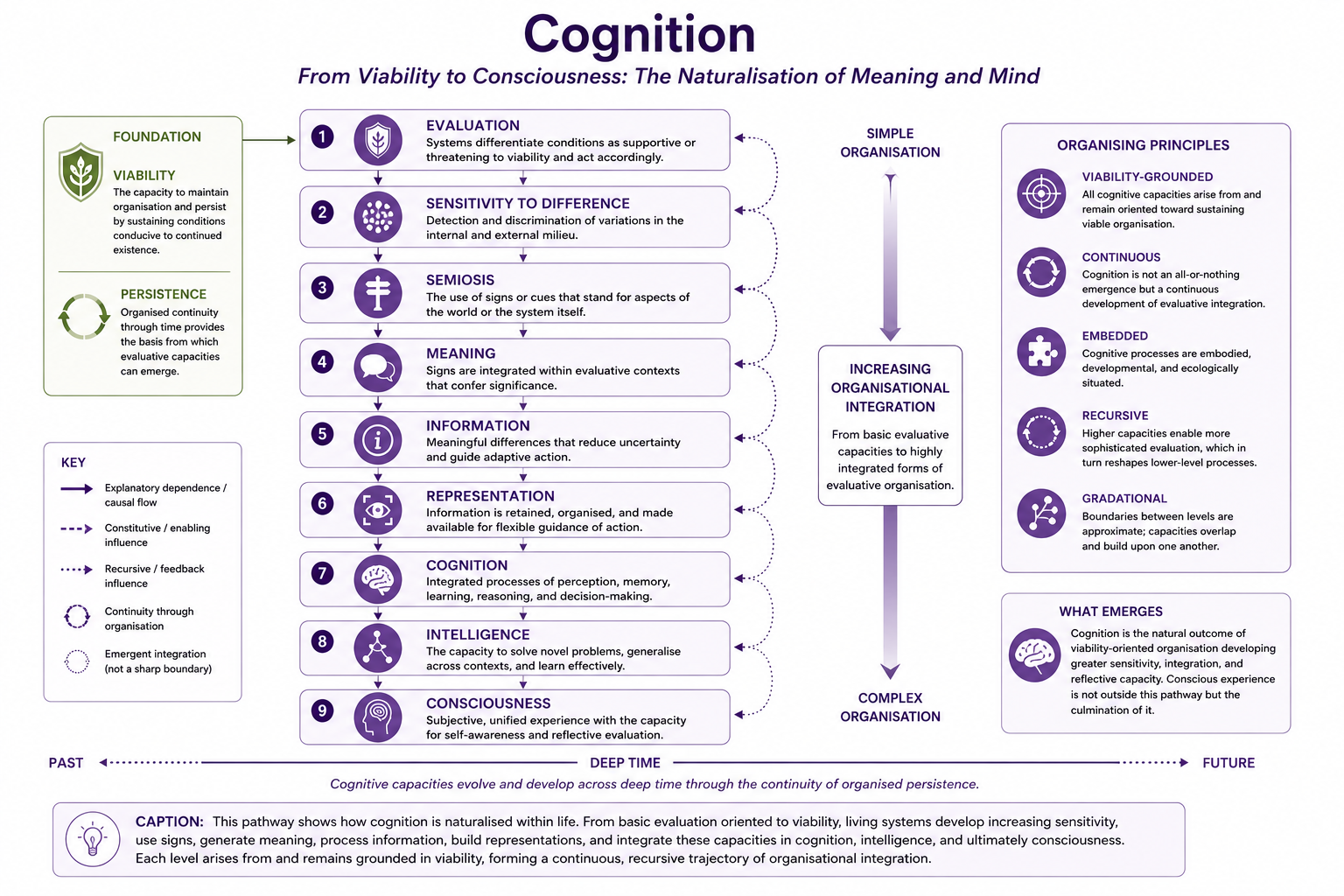
Agency Before Intelligence. Biological agency grounds evaluation, semiosis, cognition, and intelligence within viability-oriented organised persistence rather than emerging from intelligence alone.
Why Intelligence and Agency Became Confused
Many contemporary discussions of AI implicitly assume that sufficiently sophisticated behaviour constitutes agency.
Systems that:
- optimise;
- learn;
- adapt;
- coordinate behaviour;
- predict outcomes;
- and respond dynamically
are increasingly described as autonomous agents.
APS argues that this inference is incomplete.
A system may exhibit highly sophisticated behaviour while remaining entirely dependent upon externally maintained organisational conditions.
In such cases:
- optimisation is externally scaffolded;
- evaluation criteria are externally imposed;
- persistence depends upon external infrastructure;
- and organisational continuity is not maintained endogenously by the system itself.
The appearance of agency therefore does not establish biological agency.
This distinction is fundamental.
Biological agency is not reducible to:
- information processing;
- optimisation;
- behavioural complexity;
- adaptive responsiveness;
- representational sophistication;
- predictive coordination;
- or intelligence considered independently of viability-oriented organisation.
Instead biological agency emerges from:
- endogenous persistence;
- continuity-preserving organisation;
- operational normativity;
- self-maintaining regulation;
- and viability-oriented activity.
APS therefore distinguishes sharply between:
- externally maintained optimisation systems; and:
- endogenously self-maintaining biological systems.
Externally Maintained Optimisation
Contemporary AI systems are typically:
- constructed externally;
- trained externally;
- repaired externally;
- powered externally;
- evaluated externally;
- and maintained externally.
Their optimisation criteria are externally assigned.
Their hardware is externally manufactured and replaced.
Their energy supply is externally regulated.
Their persistence depends upon infrastructures lying outside the systems themselves.
This is not a trivial difference.
An AI system may optimise effectively within a designated problem space while possessing no intrinsic relation to its own continued organisational persistence.
Its optimisation processes do not primarily function to sustain the system’s own viability as an organised system.
Instead they function relative to externally imposed goals.
APS therefore treats current AI systems as:
externally maintained optimisation systems rather than biologically organised agents.
This remains true even where systems:
- learn adaptively;
- coordinate dynamically;
- modify behaviour flexibly;
- distribute computation;
- or simulate goal-directed activity.
Behavioural sophistication alone does not constitute biological agency.
Endogenous Viability-Oriented Persistence
Biological systems differ fundamentally because their activity contributes directly to maintaining the conditions necessary for their own continued existence.
Organisms:
- regulate internal conditions;
- maintain boundaries;
- repair damage;
- acquire energy;
- reorganise under perturbation;
- sustain metabolic continuity;
- reproduce organisational persistence;
- and maintain the constraints enabling continued activity.
These are not externally appended optimisation routines.
They constitute the organisation of the system itself.
APS therefore understands biological agency as inseparable from:
- endogenous persistence;
- continuity-preserving self-maintenance;
- viability-oriented organisation;
- and operational constraint maintenance.
This distinction is central because:
- normativity;
- evaluation;
- semiosis;
- meaning;
- and cognition
all emerge from these persistence conditions.
Environmental differences matter biologically because they participate in viability-oriented regulation.
Biological processes succeed or fail relative to the persistence of the organised system itself.
An organism failing to:
- regulate temperature;
- maintain membranes;
- coordinate metabolism;
- preserve integrity;
- or reorganise after perturbation
ceases to persist as the kind of system it is.
By contrast, most contemporary AI systems possess no comparable endogenous relation to their own continued organisational existence.
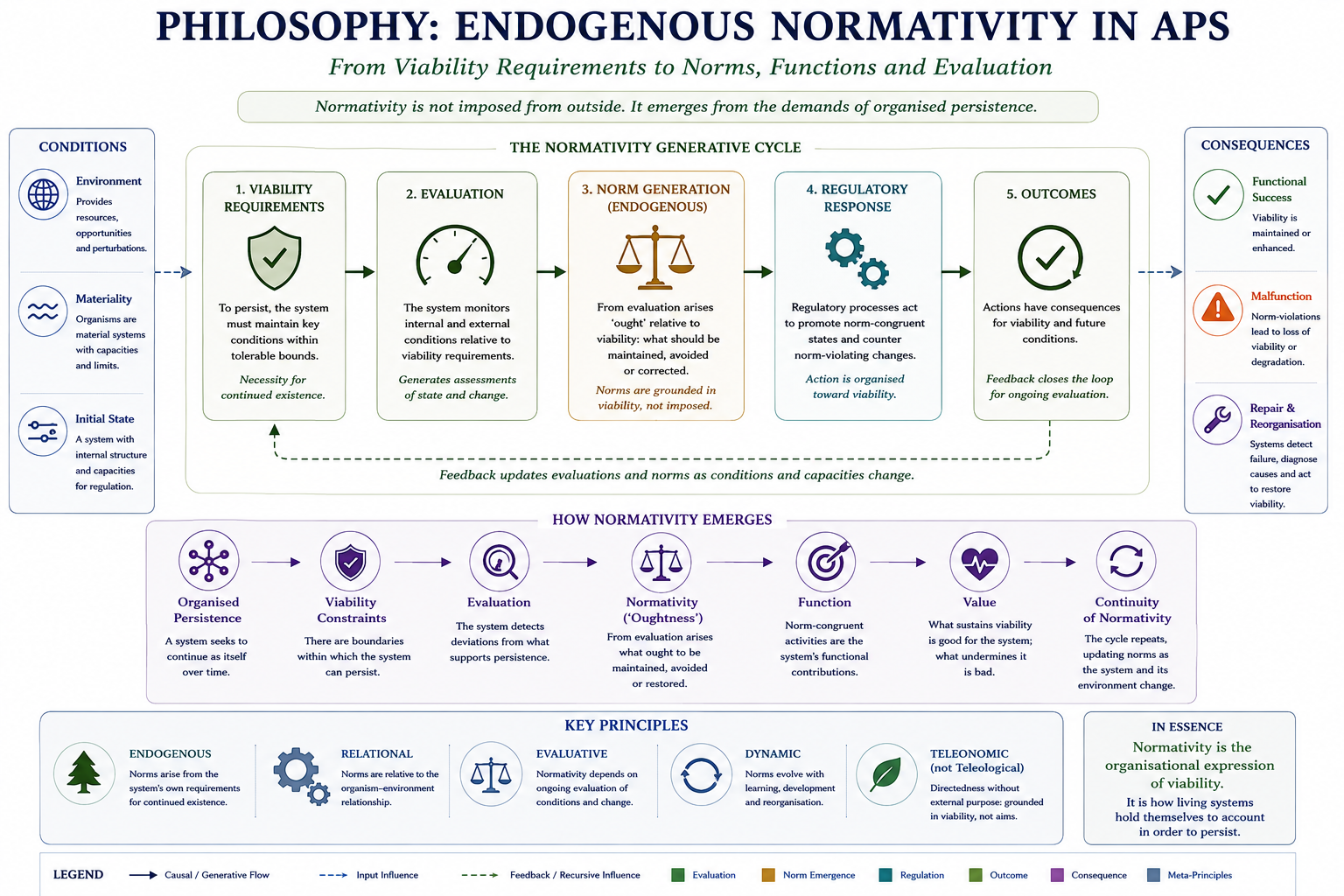
Endogenous Normativity and Biological Agency. Biological agency emerges through viability-oriented self-maintaining organisation whose activity contributes directly to sustaining its own continued persistence.
Why Behavioural Similarity Is Not Organisational Equivalence
Artificial systems increasingly exhibit behaviours resembling features historically associated with living systems:
- adaptation;
- learning;
- environmental sensitivity;
- distributed coordination;
- prediction;
- and behavioural flexibility.
APS does not deny these similarities.
However:
- behavioural similarity is not organisational equivalence;
- simulation of persistence is not organised persistence;
- representation of agency is not biological agency;
- and optimisation is not viability-oriented self-maintenance.
This distinction is especially important in discussions of:
- embodied AI;
- active inference systems;
- swarm intelligence;
- adaptive robotics;
- and biomimetic computation.
Many such systems exhibit architectures inspired by biology.
Yet behavioural resemblance does not establish organisational equivalence.
APS therefore asks a deeper question:
Does the system actively maintain the conditions necessary for its own continued viability as an organised persistence?
This question cannot be answered solely through behavioural observation.
Why Plants Matter Here
Plant biology clarifies this distinction particularly well.
Plants demonstrate that biological agency does not require:
- brains;
- neurons;
- centralized cognition;
- rapid movement;
- or animal-like intelligence.
Plants exhibit:
- distributed coordination;
- electrophysiological signalling;
- adaptive responsiveness;
- environmental sensitivity;
- developmental regulation;
- and continuity-preserving self-maintaining organisation.
APS therefore fully recognises plants as biologically agentive systems.
Plant agency is especially important because it demonstrates that biological agency neither depends upon intelligence nor reduces to neural cognition.
Importantly, plant agency derives not from signalling alone, but from the role of signalling within the larger viability-oriented organisation of the organism.
Electrical signalling matters biologically because it contributes directly to:
- regulation;
- coordination;
- stress response;
- developmental organisation;
- and persistence.
This differs fundamentally from artificial systems merely simulating adaptive responsiveness while lacking endogenous self-maintaining organisation.
The comparison therefore clarifies rather than dissolves the distinction between biological and artificial systems.
AI May Simulate Agency Without Possessing Biological Agency
APS does not deny that artificial systems may:
- simulate agency;
- generate strategic behaviour;
- optimise flexibly;
- represent environments;
- coordinate adaptively;
- or exhibit intelligence-like capacities.
These developments are scientifically important.
However, simulation of agency does not itself constitute biological agency.
A representation of persistence is not organised persistence itself.
A predictive optimisation architecture is not equivalent to viability-oriented self-maintenance.
Current AI systems overwhelmingly remain dependent upon:
- externally maintained energy systems;
- external repair infrastructures;
- externally assigned goals;
- externally maintained architectures;
- and externally scaffolded persistence conditions.
Their organisation therefore remains:
- externally sustained; rather than:
- endogenously viability-oriented.
Biological Agency Is More Fundamental Than Intelligence
APS grounds life in biological agency rather than intelligence.
Agency concerns the viability-oriented activity through which systems sustain organised persistence.
This includes:
- repair;
- regulation;
- compensation;
- adaptive reorganisation;
- and continuity-preserving activity.
Intelligence emerges only downstream from:
- evaluation;
- semiosis;
- meaning;
- cognition;
- and temporally integrated organisation.
This distinction is essential because contemporary AI discussions often conflate:
- intelligence;
- agency;
- optimisation;
- prediction;
- and biological organisation.
APS instead differentiates them organisationally.
Intelligence-like behaviour may occur without biological agency.
Biological agency may occur without intelligence.
Predictive Processing and Artificial Agency
Predictive-processing and Active-Inference approaches often interpret cognition and agency through:
- prediction;
- inference;
- model updating;
- optimisation;
- and error minimisation.
APS accepts that such processes may participate within some advanced forms of cognition and intelligence.
However:
- prediction is not foundational to life;
- optimisation is not foundational to agency;
- and information processing is not foundational to biological organisation itself.
Predictive architectures already presuppose:
- viability-oriented persistence;
- evaluation;
- semiosis;
- meaning;
- cognition;
- and continuity-sensitive organisation.
APS therefore situates predictive processing within a broader continuity-oriented explanatory architecture rather than treating optimisation or inference as the universal explanatory basis of agency.
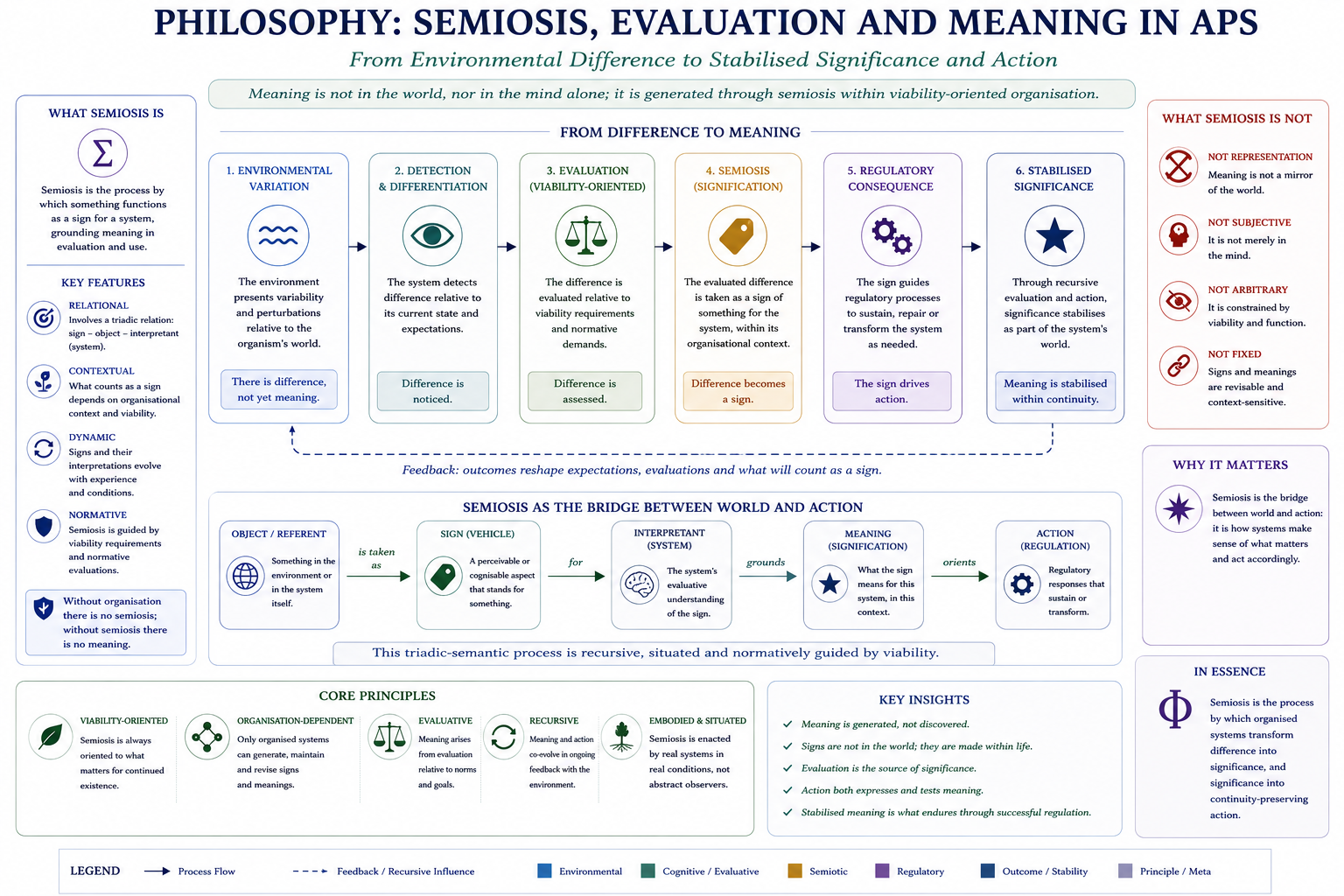
Semiosis and Biological Agency. Biological semiosis emerges through viability-oriented evaluation and continuity-preserving organisation rather than through optimisation or symbolic processing alone.
Future Synthetic Systems
APS does not claim that artificial systems can never become biologically organised.
Nor does APS define biological agency in terms of:
- carbon chemistry;
- neural tissue;
- human cognition;
- or evolutionary origin alone.
APS defines biological agency organisationally.
If future synthetic systems were to exhibit:
- endogenous self-maintenance;
- continuity-preserving organisation;
- operational normativity;
- viability-oriented persistence;
- and self-sustaining organisational continuity,
then APS would evaluate such systems organisationally rather than chauvinistically.
The framework therefore remains open regarding future synthetic possibilities.
Its distinction concerns organisation rather than substrate.
Biological Agency Within the APS Explanatory Grammar
APS situates biological agency within the broader explanatory grammar organised through:
- agency;
- process;
- scale;
- temporality;
- viability;
- evaluation;
- semiosis;
- meaning;
- information;
- representation;
- cognition;
- intelligence;
- and organised persistence.
Artificial systems may increasingly resemble organisms:
- behaviourally;
- computationally;
- functionally;
- or informationally.
APS does not deny these developments.
However, biological agency depends not merely upon what systems do, but upon:
how systems persist as organised continuities in the first place.
Living systems exist through endogenous viability-oriented organisation sustained across time.
Contemporary AI systems overwhelmingly do not.
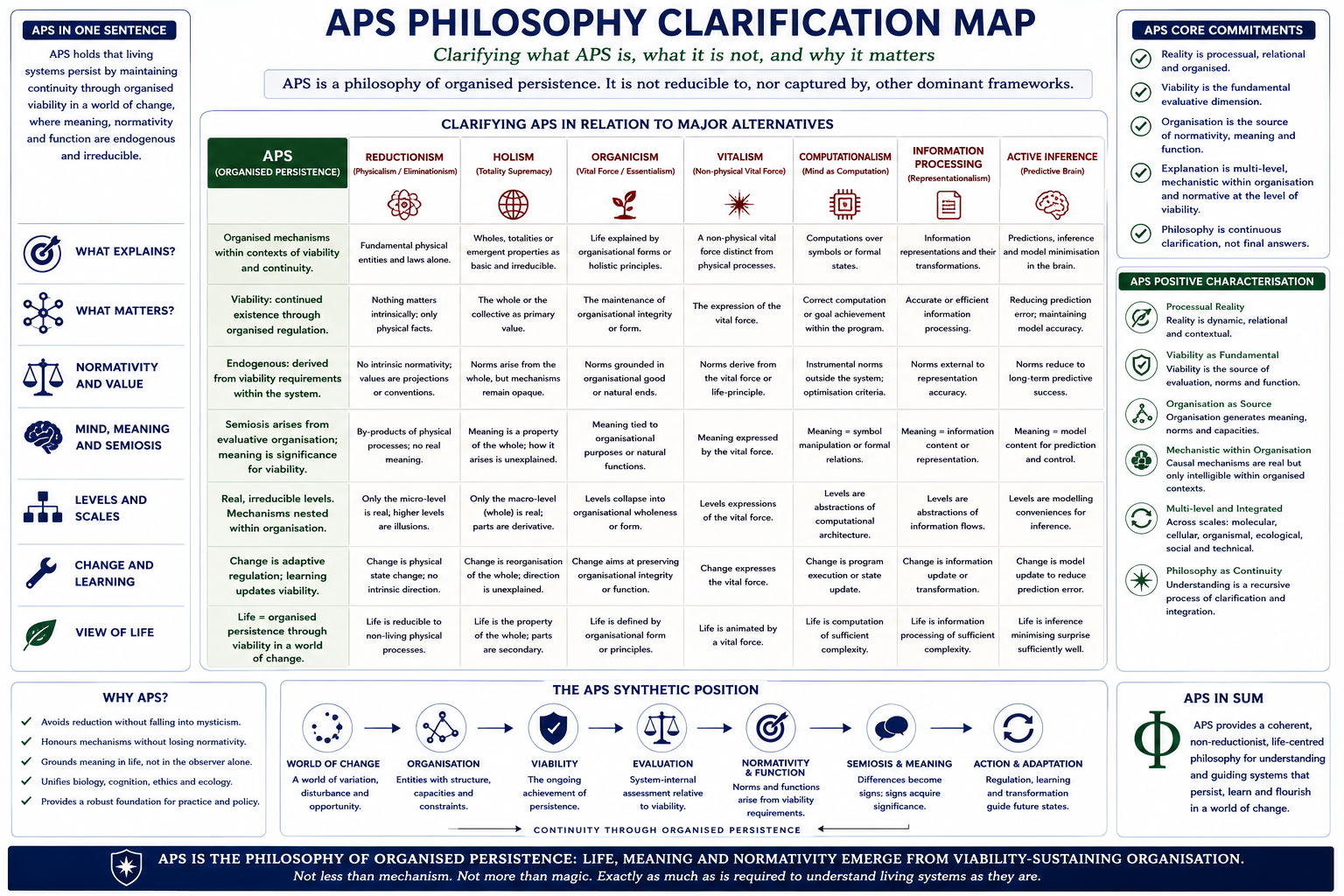
APS Clarification Map. APS distinguishes biological agency from artificial optimisation by grounding agency in viability-oriented organised persistence rather than behavioural sophistication alone.
Why This Clarification Matters
Clarifying the distinction between AI and biological agency helps resolve several persistent conceptual confusions in contemporary biology, cognitive science, and artificial intelligence research.
It:
- distinguishes optimisation from viability;
- distinguishes intelligence from agency;
- grounds semiosis and normativity within organised persistence;
- clarifies why behavioural sophistication alone is insufficient for biological organisation;
- explains why representation and prediction presuppose already existing organised persistence;
- and preserves the distinction between simulation of life and life itself.
APS therefore naturalises biological agency through:
- viability-oriented persistence;
- continuity-preserving organisation;
- endogenous normativity;
- evaluation;
- semiosis;
- and temporally organised self-maintenance.
Conclusion
Artificial systems may increasingly:
- optimise;
- learn;
- predict;
- represent;
- coordinate behaviour;
- and simulate agency.
APS fully recognises these developments.
However, behavioural sophistication alone does not constitute biological agency.
Biological agency depends upon:
- endogenous viability-oriented persistence;
- continuity-preserving organisation;
- operational normativity;
- self-maintaining regulation;
- evaluation;
- semiosis;
- and organised persistence sustained across time.
Current AI systems overwhelmingly remain externally scaffolded optimisation systems rather than endogenously self-maintaining biological organisations.
Life is therefore not reducible to intelligence, prediction, representation, or optimisation alone.
Biological agency emerges only through viability-oriented organised persistence.
Key Point
Artificial systems may simulate intelligence and agency-like behaviour, but biological agency requires endogenous viability-oriented organised persistence sustained through continuity-preserving self-maintaining organisation across time.
See Also
Related Articles
References
- (2022). Competency in Navigating Arbitrary Spaces as an Invariant for Intelligence. Entropy, 24(3), 301 . https://doi.org/10.3390/e24030301
- (2013). Life as We Know It. Journal of The Royal Society Interface, 10, 20130475 . https://doi.org/10.1098/rsif.2013.0475
- (2010). Life after Ashby: Ultrastability and the Autonomy of Living Systems. BioSystems, 91(2), 330–339 . https://doi.org/10.1016/j.biosystems.2008.07.005
- (2022). Technological Approach to Mind Everywhere: An Experimentally-Grounded Framework for Understanding Diverse Bodies and Minds. Frontiers in Systems Neuroscience, 16, 768201 . https://doi.org/10.3389/fnsys.2022.768201
- (2015). Biological Organisation as Closure of Constraints. Springer.
- (2023). Organization in Biology. Springer.
- (2018). Everything Flows: Towards a Processual Philosophy of Biology. Oxford University Press.
- (2026). Agency as the Defining Activity of Life. Biological Theory . https://doi.org/10.1007/s13752-026-00547-6
- (2007). Mind in Life. Harvard University Press.
- (2015). Organisms, Agency, and Evolution. Cambridge University Press.