Why APS Is Not Holism
Holism correctly insists that biological phenomena cannot be understood through isolated components alone. Yet the recognition of organised wholeness does not, by itself, explain how living systems maintain their organisation. Agency–Process–Scale (APS) treats viability-oriented organised persistence as the central explanatory problem, examining the processes, constraints and cross-scale dependencies through which living systems sustain their conditions of existence. This approach neither dismisses mechanisms nor grants wholes an independent explanatory power. It draws on organisational and processual biology while distinguishing explanatory priority from claims of ontological fundamentality. APS is therefore best understood not as a refutation of sophisticated holism, but as a specification of what a satisfactory organisational explanation must make explicit.
Where This Article Fits
*This article clarifies the relationship between Agency–Process–Scale (APS) and philosophical holism. It complements Why APS Is Not Organicism and Reductionism in Biology: An APS Clarification *by examining why neither isolated components nor appeals to organised wholes are sufficient explanatory endpoints. Whereas Organisational Realism in Biology addresses the reality of biological organisation, and Explanatory Priority Is Not Ontological Priority distinguishes explanatory commitments from metaphysical claims, the present article asks what an appeal to wholeness contributes to understanding living systems. Its central argument is that biological organisation must be explained through the materially realised processes, constraints and dependencies that sustain viability and continuity. It does not claim that APS has demonstrated superiority over established organisational or systems approaches.
Introduction - Holism and the Problem of Biological Organisation
Holism has played an important role in the history of biological thought because it draws attention to a difficulty that accounts centred exclusively on isolated components cannot resolve. The properties and activities of organisms depend not only on their constituents but also on the relations among those constituents, the environments in which they operate and the histories through which their organisation develops. From Smuts’s early formulation of holism to later systems approaches, the central insight has been that the behaviour of living systems cannot always be inferred by considering their parts independently (Smuts 1926; Capra 1996). Contemporary processual and organisational philosophies of biology have developed more precise accounts of the relations and activities on which biological individuality depends (Nicholson and Dupré 2018).
APS accepts this insight. Its disagreement is not with the scientific importance of organised wholes, but with the explanatory adequacy of invoking wholeness without specifying how it is achieved. To describe an organism as an integrated whole identifies something that calls for explanation; it does not yet identify the processes and dependencies through which that integration is maintained. A satisfactory account must explain how a living system sustains, repairs or reorganises the conditions necessary for its continued existence, particularly when its constituents and circumstances change.
The question guiding APS is consequently not whether organisms are wholes, but how their organisation remains viable through time. This emphasis makes viability-oriented organised persistence the central explanatory target. It does not imply that existing organisational theories have neglected persistence, nor that APS has demonstrated superiority over them. Rather, APS offers a particular way of coordinating agency, process and scale in the investigation of that problem (Spencer 2026).
Beyond a Simple Opposition Between Parts and Wholes
The familiar opposition between reductionism and holism can obscure the variety of explanations used in biology. Analyses of molecular components and local mechanisms can be indispensable, while accounts of system-level organisation may identify dependencies that component-level descriptions leave implicit. These approaches need not compete for exclusive explanatory authority. Mechanistic research itself often examines organised interactions rather than merely cataloguing parts, as illustrated by philosophical work on mechanisms (Bechtel 2008).
APS therefore does not replace the study of parts with an appeal to the whole. It asks how materially realised processes and constraints, operating at different spatial and temporal scales, jointly sustain the conditions under which biological activity can continue. Molecular reactions, cellular regulation, development, organism–environment interaction and ecological relations may all be relevant, although their explanatory importance must be established for the phenomenon under investigation. Agency, Process and Scale name complementary analytical perspectives on this organisation, not three independent substances or causal forces.

Figure: APS directs attention beyond a simple parts–whole contrast to the processes and dependencies through which living organisation persists.
Continuity, Change and Biological Individuality
Living systems persist through extensive material and organisational change. Proteins are synthesised and degraded, cells divide or die, tissues remodel, and organisms undergo development while interacting with changing environments. Such transformations show why biological identity cannot generally be equated with the retention of an unchanging collection of material parts. At the same time, persistence does not mean that every feature of an organism remains stable. What matters is whether the relevant organisation continues, or is re-established, sufficiently to sustain the system’s viability.
APS interprets biological individuality in these processual terms. An organism’s identity depends on historically continuous, organised activity rather than on an immutable essence. This position is consonant with processual approaches to biological ontology (Nicholson and Dupré 2018; Dupré 2024). Its distinctive emphasis lies in relating that continuity to the viability conditions under which a living organisation can persist. The concept is not a substitute for empirical criteria of individuality: those criteria must be specified for particular biological systems and research questions.
The continuity perspective also helps clarify the relation between stability and transformation. Development and repair may preserve a living system through changes in its organisation; some environmental responses restore viable conditions, while others fail. Evolutionary change, by contrast, concerns processes across generations and cannot simply be identified with an individual organism’s self-maintenance. APS seeks to connect these phenomena through explicit dependencies without collapsing their distinct timescales or explanatory targets.
Constraint-Closure and the Material Basis of Organisation
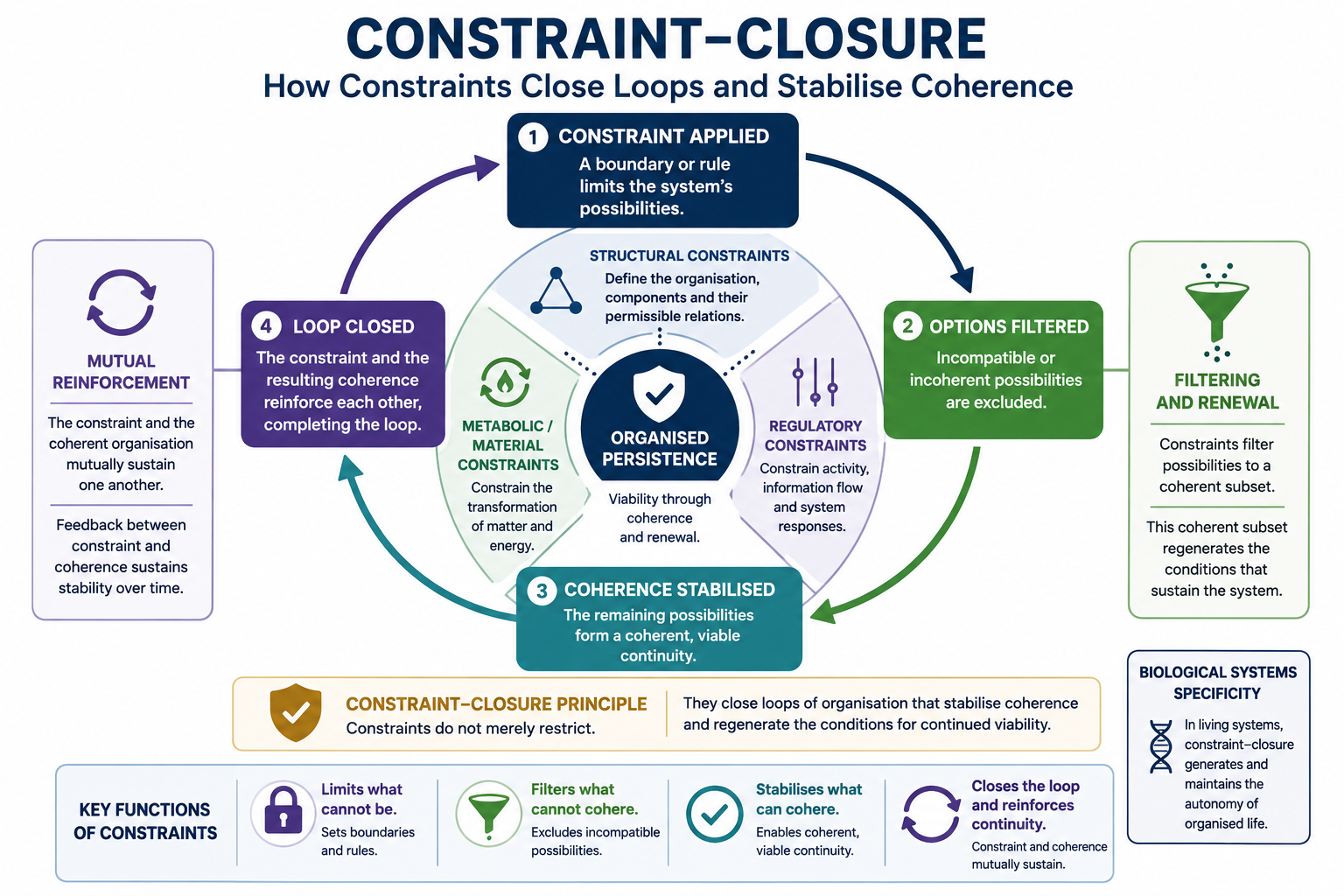
One important resource for explaining biological self-maintenance is the organisational concept of constraint-closure. In organisational approaches, constraints channel processes, and some networks of constraints contribute to the maintenance of the conditions under which those constraints continue to operate. This is a claim about material and causal dependencies, not about an invisible unifying force. Whether such relations exist, and how they operate, are matters for theoretical specification and empirical investigation.
APS uses constraint-closure as one way of identifying how viable organisation may be sustained. It does not treat closure as a magical property possessed by a whole, nor assume that every biological phenomenon is explained by invoking the term. A useful account must identify the relevant constraints, the processes they affect, their mutual dependencies and the conditions under which the organisation would cease to persist. Organisational and functional theories already provide substantial resources for this work; APS’s use of them should therefore be presented as an integration and interpretation, not as their original discovery (Mossio 2023).
Mechanisms, Organisational Realism and Explanatory Limits
An emphasis on organisation need not diminish the importance of mechanisms. Metabolic pathways, signalling networks, physiological regulation and developmental processes provide concrete means through which organisms maintain or alter their conditions of existence. APS asks what these mechanisms contribute to the continued viability of the system and how their contributions depend on other processes and constraints. The viability-relative significance of a mechanism is therefore an additional explanatory question, not an alternative to discovering how that mechanism works.
APS also treats biological organisation as a real feature of living systems, rather than merely a convenient label for a collection of independent events. This organisational realism need not entail that a whole exists independently of its material realisation. It commits the investigator to taking relational and organisational dependencies seriously where they are causally and empirically supported. The important distinction is between identifying a real pattern of organisation and attributing independent explanatory powers to an abstract totality.
These commitments also place limits on APS’s claims. An integrated description is not automatically a better explanation. Where an established mechanistic, organisational or systems account already identifies the same dependencies, an APS formulation may be a useful redescription without providing distinctive explanatory gain. Stronger claims require a common explanatory target, a serious comparator and evidence that the APS account clarifies, predicts, discriminates or otherwise establishes something not adequately supplied by the alternative. As argued in How Does Scientific Explanation Reach Reality?, explanatory integration should remain answerable to evidence and possible failure.
Goal-Directedness Without Metaphysical Purpose
Holistic traditions have sometimes associated living organisation with purpose or teleology. APS retains a naturalised understanding of biological goal-directedness: activities can be assessed in relation to their contributions to maintaining or restoring the conditions of viability. Such assessments do not require cosmic purposes, intrinsic organismic essences or conscious intentions. They depend on identifying the organisation at issue, the conditions under which it persists and the consequences of particular activities for that persistence.
This account must nevertheless distinguish viability-oriented organisation from a claim that every biological outcome is beneficial or successful. Organisms can malfunction, respond maladaptively and die. Their activities are goal-directed in the relevant organisational sense only where the proposed relation between activity and viability is specified and defensible. This keeps teleological language tied to biological investigation rather than using it as an unexplained property of the whole.
Explanatory Priority Without Ontological Supremacy
The fact that organisational relations are important for explaining life does not establish that wholes are metaphysically more fundamental than their constituents. Explanatory priority concerns what an investigation must make intelligible; ontological priority concerns what is most fundamental in reality. APS’s focus on organised persistence is a claim about the former, and it does not settle the latter.
This distinction is especially important when comparing APS with sophisticated holistic and organisational approaches. Many such accounts already reject both atomistic reductionism and mysterious whole-level powers. The difference APS proposes is therefore one of explanatory orientation and conceptual coordination: it foregrounds the maintenance of viability and traces relevant dependencies through processes and scales. Whether that orientation yields additional scientific understanding must be assessed in particular comparisons, not assumed from the terminology of the framework.
Conclusion
APS is not holism in the sense that it does not regard the recognition of organised wholeness as an adequate endpoint of biological explanation. Yet it shares with holism the conviction that relations, contexts and system-level organisation are indispensable to understanding living systems. Its aim is to make the maintenance of viable organisation an explicit object of investigation, connecting concrete mechanisms, mutually dependent constraints, processual individuality and change across scales.
The resulting position avoids treating either isolated parts or abstract wholes as self-sufficient explanations. It asks how a particular living organisation continues under changing conditions, which dependencies make that continuation possible, and what evidence would show that an explanation is adequate. APS offers a coherent framework for posing these questions. Its further scientific value depends on what this framework enables investigators to establish beyond the achievements of existing mechanistic, systems and organisational biology.
Explanatory Architecture
Central Question
Why is recognising a living system as an organised whole insufficient, by itself, to explain how that system maintains its viability and organisational continuity through time?
Architectural Role
This Clarification article distinguishes APS from explanatory forms of holism that treat organised wholeness as a sufficient explanatory endpoint. APS accepts the importance of relations, contexts and system-level organisation but requires explanations to identify the materially realised processes, constraints and dependencies through which living organisation persists.
Agency, Process and Scale provide complementary analytic projections of this organisation rather than independent causes, components or levels. The article clarifies the explanatory priority of organised persistence without attributing ontological supremacy to wholes or claiming demonstrated superiority over established organisational and systems approaches.
Builds On
- What Is APS?
- Agency as the Defining Activity of Life
- Biological Organisation
- Constraint Closure
- Organised Persistence
- Processual Individuality
- Organisational Realism in Biology
Develops Into
- Reductionism in Biology: An APS Clarification
- Why APS Is Not Organicism
- Explanatory Priority Is Not Ontological Priority
- Biological Explanation and Organised Persistence
- The Explanatory Geometry of Biology
- From Life to Explanation — The Explanatory Architecture of APS
See Also
Related Articles
References
- (2008). Mental Mechanisms: Philosophical Perspectives on Cognitive Neuroscience. Routledge.
- (1996). The Web of Life: A New Scientific Understanding of Living Systems. Anchor Books.
- (2024). The Metaphysics of Biology. Cambridge University Press.
- (2023). Biological Functions: A Pragmatic Naturalist Account. Cambridge University Press.
- (2018). Everything Flows: Towards a Processual Philosophy of Biology. Oxford University Press.
- (1926). Holism and Evolution. Macmillan.
- (2026). Agency as the Defining Activity of Life: A Viability-Oriented Framework Integrating Process and Scale. Biological Theory . https://doi.org/10.1007/s13752-026-00547-6