Physiology and Evolution in APS — Two Temporal Perspectives on Organised Persistence
Physiology and evolution are often treated as separate explanatory domains: physiology explaining how organisms function in the present and evolution explaining how they change through time. APS argues that both address the same explanatory target—organised persistence—viewed across different temporal horizons. Physiology explains how organised persistence is enacted, regulated, and maintained within lifetimes, while evolution explains how lineages of organised persistence are reproduced, transformed, and historically diversified across generations. Understanding their relationship clarifies how biological continuity is maintained through continual transformation and reveals a deeper unity underlying biological explanation.
Key Points
- Physiology and evolution address the same explanatory target: organised persistence.
- Physiology explains how organised persistence is enacted and maintained in the present.
- Evolution explains how lineages of organised persistence are transformed through historical time.
- Development links physiological continuity and evolutionary continuity.
- Adaptation connects present regulation with long-term evolutionary transformation.
- Biological explanation requires integration across interacting temporal scales.
Introduction
Where this article fits: This article develops the APS integration of physiology and evolution as temporally differentiated perspectives on organised persistence. Physiology explains how organised persistence is enacted and maintained within lifetimes, while evolution explains how lineages of organised persistence are reproduced, transformed, and diversified across generations. For the broader temporal architecture underlying APS, see Temporal Organisation and Organised Persistence and Persistence — Organised Continuity Through Time.
Introduction
Physiology and evolution have traditionally occupied different regions of biological explanation. Physiology explains how living systems function in the present. Evolution explains how living systems change through time. The distinction appears straightforward and has often encouraged the treatment of physiology and evolution as separate explanatory domains concerned with fundamentally different phenomena.
Physiological explanations focus on metabolism, regulation, repair, coordination, behaviour, and the maintenance of viability within individual organisms. Evolutionary explanations focus on inheritance, variation, adaptation, selection, diversification, and historical transformation across generations. Because these processes operate across different temporal horizons, they are frequently investigated through different methods and conceptual frameworks.
APS argues that this separation obscures a deeper unity. Physiology and evolution do not address different biological realities. Rather, they address different temporal dimensions of the same biological phenomenon. Physiology explains how living systems enact, regulate, and maintain organised persistence within lifetimes, while evolution explains how lineages of organised persistence reproduce continuity, undergo transformation, and accumulate historical change across generations.
Viewed in this way, physiology and evolution become complementary explanatory perspectives. Both seek to explain how living systems maintain continuity despite continual transformation. The difference lies not in what they explain, but in the temporal horizons across which that continuity is investigated.
Organised Persistence as the Common Explanatory Target
APS identifies organised persistence as the central explanatory target of biology. Living systems are distinguished not merely by their material composition or by the possession of particular traits, but by their capacity to sustain viability-oriented organisation through time. Biological explanation therefore seeks to account for how continuity is maintained despite continual material turnover, developmental transformation, ecological interaction, and environmental change.
This perspective provides a common framework for understanding both physiological and evolutionary explanation. Physiological inquiry focuses on the processes through which organised persistence is enacted and maintained in the present, whereas evolutionary inquiry focuses on how forms of organised persistence are reproduced, modified, and transformed through historical time. Although these perspectives emphasise different temporal horizons, both are directed toward explaining the continuity of living organisation.
This relationship becomes clearer when continuity and transformation are considered together. Living systems do not persist by remaining unchanged. They persist through ongoing processes of regulation and reorganisation that preserve viability despite continual change. The same principle applies evolutionarily. Lineages do not persist through static preservation but through the continual reproduction and transformation of organised persistence across generations. In both cases, continuity is achieved through regulated transformation rather than through the absence of change.
APS therefore treats organised persistence as explanatorily prior to both physiology and evolution. Physiology explains how organised persistence is enacted in the present. Evolution explains how organised persistence is transformed historically. Together they illuminate different temporal aspects of the same biological reality.
The Temporal Dimensions of Organised Persistence
The apparent divide between physiology and evolution arises primarily from differences in temporal perspective. At shorter temporal horizons, biological continuity is experienced through the ongoing activities of living systems. Metabolism, regulation, repair, behavioural coordination, and environmental responsiveness become explanatorily prominent because they directly contribute to maintaining viability in the present. Physiological explanations therefore focus on how organised persistence is continuously enacted and sustained from moment to moment.
At longer temporal horizons, a different aspect of organised persistence becomes visible. Inheritance reproduces continuity across generations, variation introduces organisational differences, adaptation reorganises persistence under changing conditions, and natural selection differentially stabilises some forms of continuity relative to others. Evolutionary explanations therefore focus on how organised persistence becomes historically transformed while remaining sufficiently continuous for change to accumulate.
These perspectives are not directed toward different biological phenomena. Both seek to explain organised persistence, but across different temporal horizons. Physiology explains how viability-oriented organisation is maintained within lifetimes, whereas evolution explains how lineages of organised persistence reproduce continuity while undergoing historical transformation across generations. Physiological continuity provides the conditions upon which evolutionary continuity depends, while evolutionary processes shape the inherited organisational architectures through which physiological continuity is realised. Physiology and evolution therefore differ not in what they explain, but in the temporal horizons across which organised persistence is understood.
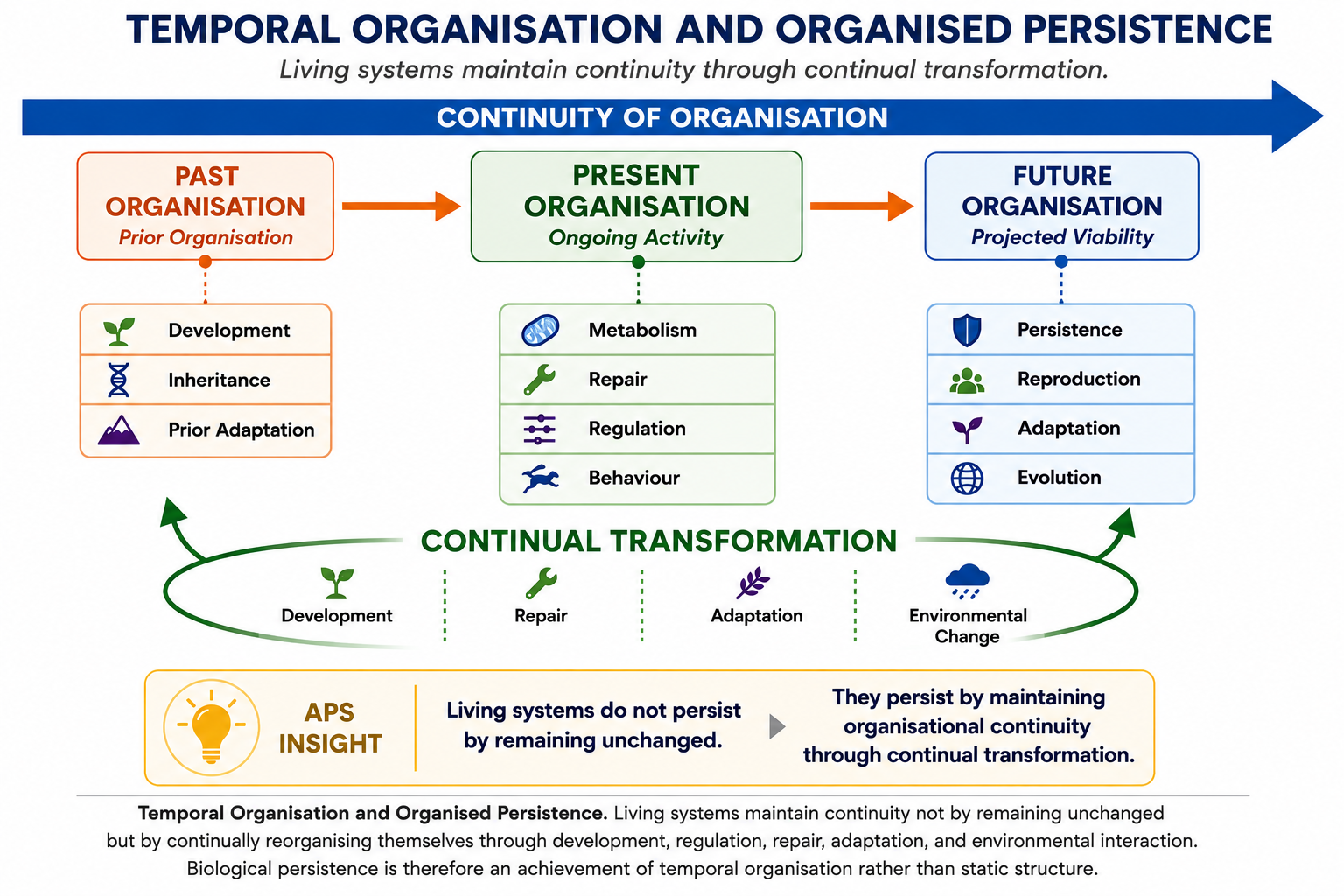
Temporal Organisation and Organised Persistence. Physiology and evolution address the same organised persistence across different temporal horizons. Physiology explains the maintenance of continuity in the present, while evolution explains how continuity is reproduced, transformed, and diversified across generations.
Physiology as the Present Enactment of Organised Persistence
Physiology explains how organised persistence is enacted in the present. Living systems remain viable only because they continuously regulate internal conditions, exchange energy and materials with their environments, repair damage, coordinate behaviour, and respond adaptively to changing circumstances. These activities do not merely accompany persistence; they constitute the processes through which persistence is achieved.
This perspective shifts physiology beyond a purely mechanistic description of biological function. Physiological mechanisms are important because of their contribution to maintaining viability-oriented organisation. Metabolic processes, regulatory networks, repair systems, and behavioural responses all participate in sustaining the continuity of living organisation despite continual perturbation. Physiological explanation therefore concerns more than the operation of mechanisms in isolation. It concerns how those mechanisms collectively contribute to the ongoing enactment of organised persistence.
APS accordingly interprets physiology as a study of continuity-producing organisation operating across relatively short temporal horizons. Physiological systems continuously reorganise themselves in ways that preserve viability despite changing internal and external conditions. The continuity of life within individual organisms is therefore not passively maintained but actively produced through ongoing viability-oriented activity.
From this perspective, physiology provides the present-tense dimension of biological explanation. It explains how organised persistence remains possible here and now. Evolutionary processes depend upon this continuity because only systems capable of sustaining themselves in the present can reproduce continuity across generations and participate in historical transformation.
Evolution as the Historical Transformation of Organised Persistence
If physiology explains how organised persistence is enacted in the present, evolution explains how organised persistence is transformed through historical time. APS defines evolution as the historical transformation of organised persistence across generations. Evolutionary explanation is therefore directed not merely toward changing populations, shifting trait frequencies, or differential reproductive success in isolation, but toward understanding how lineages of organised persistence maintain continuity while undergoing modification, diversification, and adaptation through time.
This perspective shifts the focus of evolutionary explanation. Rather than beginning with traits and asking why they become more or less common, APS begins with historically continuous forms of living organisation and asks how continuity is reproduced while transformation occurs. Evolutionary processes such as inheritance, variation, adaptation, and natural selection all contribute to this broader explanatory task. What evolves is not a disconnected collection of traits but a lineage of organised persistence capable of maintaining continuity across generations while remaining open to historical change.
Inheritance occupies a particularly important position within this architecture because it reproduces the continuity upon which all other evolutionary processes depend. Variation introduces organisational differences within that continuity, adaptation reorganises persistence under changing conditions, and natural selection differentially stabilises some forms of continuity relative to others. Each process contributes to evolutionary transformation, but all presuppose historically continuous lineages capable of sustaining organised persistence through time.
APS therefore interprets evolution as continuity through transformation. Lineages persist not because they remain unchanged, but because they continually reproduce viable organisation while accommodating novelty, environmental change, and adaptive reorganisation. Evolutionary explanation succeeds to the extent that it clarifies how these processes collectively contribute to the historical transformation of organised persistence across generations.
Development as the Bridge Between Physiology and Evolution
The relationship between physiology and evolution becomes clearer when development is considered. Development occupies a unique position within biological organisation because it links present physiological continuity to long-term evolutionary continuity. Every evolutionary lineage depends upon the repeated developmental regeneration of viable organisms, and every instance of physiological organisation emerges through developmental processes operating within individual lifetimes.
Development therefore cannot be treated as merely a mechanism for implementing inherited information. Development actively generates viable organisation, regulates organism–environment interactions, coordinates physiological activity, and maintains continuity despite continual material and environmental change. The persistence of evolutionary lineages depends upon the successful developmental reproduction of these continuity-producing organisations generation after generation.
This perspective reveals why development occupies such a central position within APS. Physiological continuity and evolutionary continuity are not independent phenomena connected only indirectly through reproduction. Rather, development continuously converts one into the other. The physiological organisation of organisms enables them to survive, reproduce, and participate in ecological systems. Developmental processes then regenerate viable forms of that organisation in subsequent generations, allowing evolutionary continuity to persist through time.
Development thus functions as a bridge between physiological and evolutionary perspectives. Physiological continuity unfolds within individual lifetimes, evolutionary continuity unfolds across lineages, and development links these temporal dimensions through the repeated reproduction of viable organisation. Understanding either physiology or evolution therefore requires understanding the developmental processes through which organised persistence is continually regenerated.
Adaptation Across Temporal Scales
Adaptation provides another important connection between physiology and evolution. Traditionally, adaptation is often discussed primarily within evolutionary contexts as the historical outcome of natural selection. APS retains this understanding but argues that adaptation also operates as an ongoing process within the lives of organisms themselves.
Physiological systems continually reorganise activity relative to changing conditions. Organisms regulate internal states, modify behaviour, alter patterns of resource use, and adjust interactions with their environments in ways that contribute to maintaining viability. Adaptation in this sense is a present-tense process through which organised persistence remains viable despite continual perturbation.
Across longer temporal horizons, the consequences of these adaptive activities become distributed through populations and lineages. Evolutionary adaptation concerns the historical stabilisation and transformation of persistence-producing organisation across generations. The adaptive capacities of organisms influence the conditions under which evolutionary continuity unfolds, while evolutionary transformation modifies the adaptive possibilities available to future generations.
Adaptation therefore links physiology and evolution across temporal scales. At shorter timescales it contributes to the regulation of viability within individual organisms. At longer timescales it contributes to the transformation of lineages of organised persistence. The same continuity-producing organisation that enables organisms to remain viable in the present also contributes to the historical trajectories through which living systems diversify and evolve.
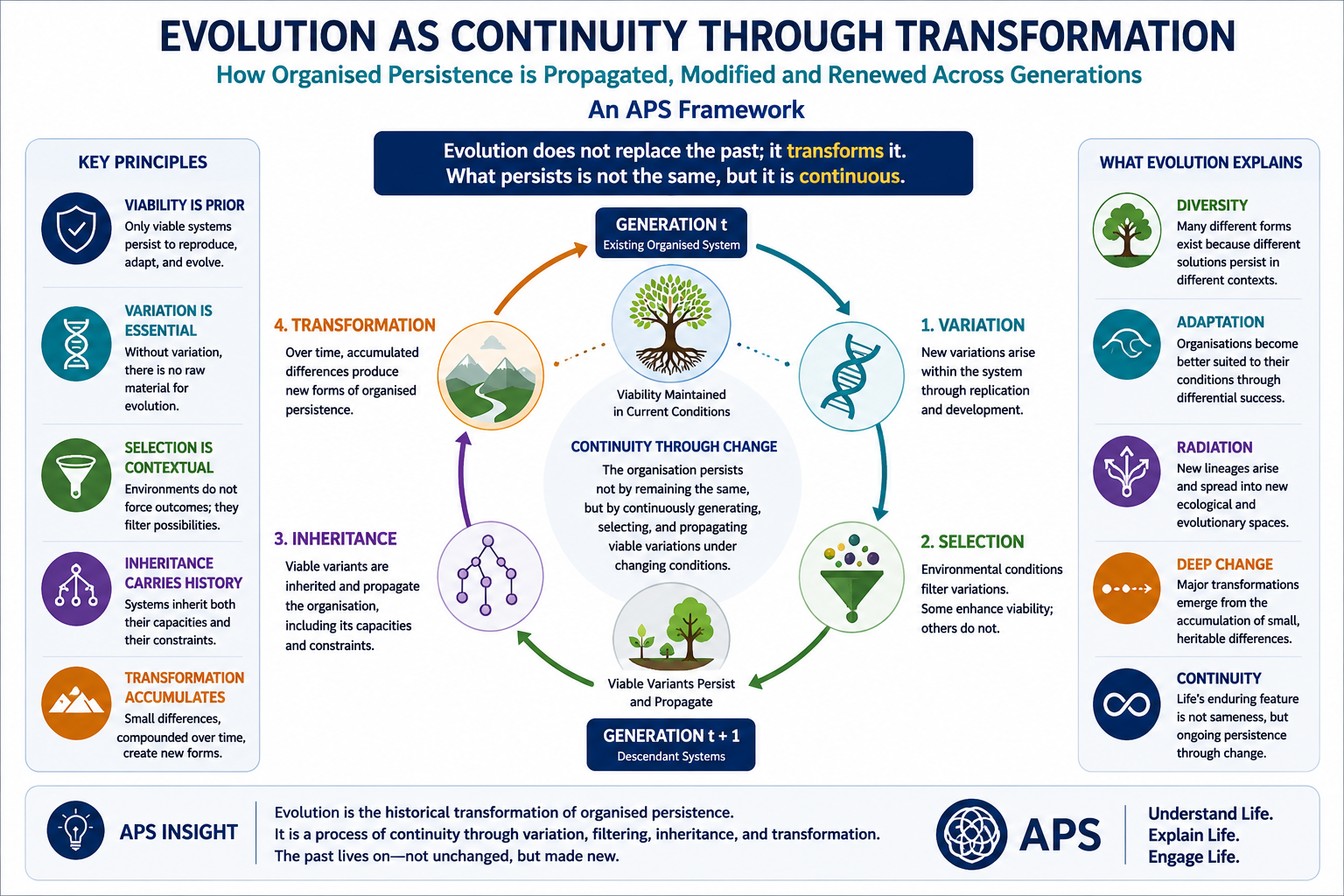
Evolutionary Continuity and Transformation. APS explains evolution as the historical regeneration and transformation of organised persistence across generations. Inheritance reproduces continuity, variation introduces organisational differences, adaptation reorganises persistence under changing conditions, and natural selection differentially stabilises forms of continuity through evolutionary time.
Agency, Ecology, and Temporal Organisation
Physiology and evolution are both embedded within broader systems of agency and ecological interaction. Living systems do not merely undergo biological processes; they actively regulate physiology, behaviour, development, reproduction, and environmental engagement relative to the conditions required for continued viability. APS describes this capacity as biological agency: the viability-oriented organisation through which living systems contribute to maintaining and reproducing the conditions of their own persistence.
Agency is visible physiologically through regulation, repair, responsiveness, behavioural modulation, and environmental interaction. Organisms continuously adjust their activities relative to changing circumstances in ways that preserve viability despite continual perturbation. These activities are not external additions to physiological organisation but central components of how organised persistence is enacted in the present.
The significance of agency extends beyond individual lifetimes. Evolutionary continuity depends upon lineages of organisms repeatedly sustaining viable organisation across generations under changing ecological conditions. The cumulative consequences of viability-oriented activity become distributed through populations, environments, and lineages, contributing to patterns of historical transformation. Evolutionary change therefore depends not only upon differential persistence but also upon the activities through which living systems generate, maintain, and reorganise themselves over time.
Ecology occupies an equally important position within this framework. Physiological organisation depends upon environmental coupling, energetic exchange, microbial interaction, ecological signalling, and resource availability. Evolutionary transformation likewise occurs within ecological contexts that shape adaptive possibilities and continuity conditions. Ecology therefore links physiological viability and evolutionary transformation within the same continuity-producing architecture.
APS consequently treats physiology, ecology, development, and evolution as interconnected dimensions of organised persistence distributed across time and scale. Each contributes to explaining how continuity is maintained despite continual transformation, and none can be understood adequately in isolation from the others.
Rethinking Proximate and Ultimate Explanation
The traditional distinction between proximate and ultimate explanation has played a central role in biological thought. Proximate explanations are typically understood as accounts of how biological phenomena occur, while ultimate explanations address why those phenomena exist in their current forms. Physiology is often associated with proximate explanation and evolution with ultimate explanation.
APS retains the analytical usefulness of this distinction but reinterprets its significance. Proximate and ultimate explanations do not address fundamentally different biological realities. Rather, they represent different temporal perspectives on organised persistence.
Physiological explanations describe how continuity is maintained in the present through regulation, metabolism, repair, development, and environmental interaction. Evolutionary explanations describe how continuity has been reproduced, transformed, and historically stabilised across generations through inheritance, variation, adaptation, and natural selection. Both forms of explanation are directed toward the same underlying phenomenon: the maintenance and transformation of organised persistence through time.
This reinterpretation helps dissolve the apparent separation between physiological and evolutionary inquiry. Physiological organisation cannot be understood independently of the historical processes that produced it, while evolutionary transformation cannot be understood independently of the physiological and developmental systems through which continuity is reproduced. Proximate and ultimate explanations therefore become complementary temporal resolutions within a unified explanatory framework rather than separate explanatory domains.
Implications for Biological Explanation
Understanding physiology and evolution as temporally differentiated perspectives on organised persistence has important implications for biological explanation more generally. It clarifies that biological explanation is not fragmented into independent domains concerned with unrelated phenomena. Instead, apparently distinct explanatory approaches address different dimensions of a common explanatory target.
Mechanistic explanations describe how organised persistence is enacted through coordinated biological processes. Functional explanations describe how those processes contribute to viability and continuity. Evolutionary explanations describe how forms of organised persistence emerge, diversify, stabilise, and transform through historical time. These explanatory perspectives are not competitors. They are complementary dimensions of a broader explanatory architecture directed toward understanding organised persistence.
This perspective also clarifies the relationship between continuity and change. Biological systems do not persist because they remain unchanged. They persist because they continuously reorganise themselves in ways that maintain viability under changing conditions. The same principle applies across physiological, developmental, ecological, and evolutionary timescales. Continuity is achieved through transformation rather than despite it.
APS therefore replaces the image of biology as a collection of disconnected explanatory domains with a more integrated view. Physiology, development, ecology, and evolution become interconnected perspectives on the organisation of living continuity across time. Biological explanation succeeds to the extent that it captures these relationships and clarifies how organised persistence is maintained, reproduced, and transformed across multiple interacting scales and temporal horizons.
Conclusion
Physiology and evolution are often presented as separate domains of biological inquiry, one concerned with present function and the other with historical change. APS argues that this distinction reflects a difference in temporal perspective rather than a difference in explanatory target. Both physiology and evolution seek to explain organised persistence, but they do so across different temporal horizons.
Viewed together, physiology, development, ecology, and evolution reveal a common principle underlying biological organisation: continuity is maintained through transformation. Living systems persist not by remaining unchanged but by continuously reorganising themselves in ways that preserve viability despite ongoing developmental, ecological, and evolutionary change. Physiological organisation sustains continuity within lifetimes, development regenerates continuity across generations, and evolution explains how lineages of organised persistence are historically transformed through time.
This perspective clarifies why physiology and evolution cannot be treated as independent explanatory domains. The continuity enacted by physiological organisation provides the conditions upon which evolutionary continuity depends, while evolutionary processes shape the inherited organisational architectures through which physiological continuity becomes possible. Present organisation and historical transformation are therefore inseparable dimensions of the same biological reality.
APS consequently integrates physiology and evolution within a unified explanatory framework centred on organised persistence as the common explanatory target of biology. Physiology explains how organised persistence is enacted, functional explanations clarify how activities contribute to viability, and evolutionary explanations explain how forms of organised persistence emerge, diversify, and transform through historical time. Understanding life therefore requires understanding continuity through transformation across multiple interacting temporal scales. Physiology and evolution are not separate biological realities but complementary explanatory perspectives on the organised persistence through which living systems maintain, regenerate, and transform themselves across time.
Related Pathways
- Persistence — Organised Continuity Through Time
- Viability — The Organising Principle of Biological Persistence
- Temporal Organisation and Organised Persistence
- Evolution as the Historical Transformation of Organised Persistence
- Ecology as Organised Persistence Across Scales
- Adaptation — How Living Systems Sustain Themselves Through Change
- Scale, Time, and Persistence — Why Life Exists Only Through Organised Continuity
Key Terms
physiology · evolution · organised persistence · continuity · lineage · viability · temporal organisation · adaptation · agency · scale
See Also
Related Articles
References
- (1859). On the Origin of Species. John Murray.
- (1930). The Genetical Theory of Natural Selection. Clarendon Press.
- (2015). Biological Autonomy: A Philosophical and Theoretical Enquiry. Springer.
- (2018). Everything Flows: Towards a Processual Philosophy of Biology. Oxford University Press.