Introduction
APS can initially appear conceptually demanding because many important ideas appear together throughout the framework. Agency, Process, Scale, viability, constraint closure, persistence, adaptation, development, cognition, and organisation recur across different articles and explanatory contexts. Readers may encounter these concepts from different entry points and wonder whether APS is moving between multiple centres of explanation.
The concepts do not, however, represent multiple competing definitions or independent foundations. APS uses them to distinguish different questions concerning living organisation and organised persistence.
This article explains how those concepts fit together, what different work they perform within APS, and why their conceptual integration should not be confused with evidence that every concept is required for every biological explanation.
Where this article fits: The Core Structure of APS provides the canonical account of the framework’s conceptual architecture and the status of its major pathways.
This article serves a complementary role. Rather than reconstructing that architecture in full, it explains how recurring APS concepts such as viability, Agency, constraint closure, Process, Scale, development, cognition, and social organisation relate across different explanatory contexts.
Readers seeking the framework architecture should continue to The Core Structure of APS. Readers seeking a conceptual guide to relationships among APS concepts should begin here.
The Central Question of APS
At its core, APS investigates a question about living organisation:
How is a living system organised such that maintaining and re-establishing the conditions of its own persistence becomes a consequence of its own activity?
Established biological approaches address many aspects of living systems. Mechanistic, evolutionary, dynamical, informational, control-theoretic, organisational, behavioural, developmental, ecological, and other explanations may provide substantive, sufficient, or preferable accounts for particular biological explananda.
APS does not reject or subordinate those explanations. It makes living organisation itself an explicit target of inquiry and asks how viability, activity, constraint, continuity, and organised persistence can be related within that target.
The resulting framework is therefore an APS account of living organisation. Its conceptual integration does not establish that other biological explanations depend upon APS, that APS supplies their foundation, or that APS provides additional explanatory gain for every biological target.
One Organisational Reality, Multiple Explanatory Perspectives
APS makes a canonical commitment about life:
Life is viability-oriented, constraint-closed organisation.
This organisation consists in the ongoing modulation of constraints through which a system actively maintains and re-establishes the conditions of its own persistence.
Different APS concepts formulate different questions about this organisation. They do not all have the same role, and their inclusion within the framework does not make each one necessary for every biological explanation.
For example:
-
Viability identifies conditions relevant to continued functioning and persistence.
-
Biological agency is viability-oriented organisational activity.
-
Constraint closure identifies an APS organisational commitment concerning the reciprocal maintenance of constraints involved in living organisation.
-
Process asks how continuity is maintained despite change.
-
Scale asks where persistence is organised across spatial and temporal extents and materially implemented relations relevant to the explanandum.
Agency, Process, and Scale have a specific architectural role within APS. They are complementary, target-sensitive analytic projections of the same viability-oriented, constraint-closed organisation.
They are not separate entities, components, levels, stages, dimensions, or independent causes. Nor are they universally or equally required for every biological explanation. Their relevance depends upon the explanatory target.
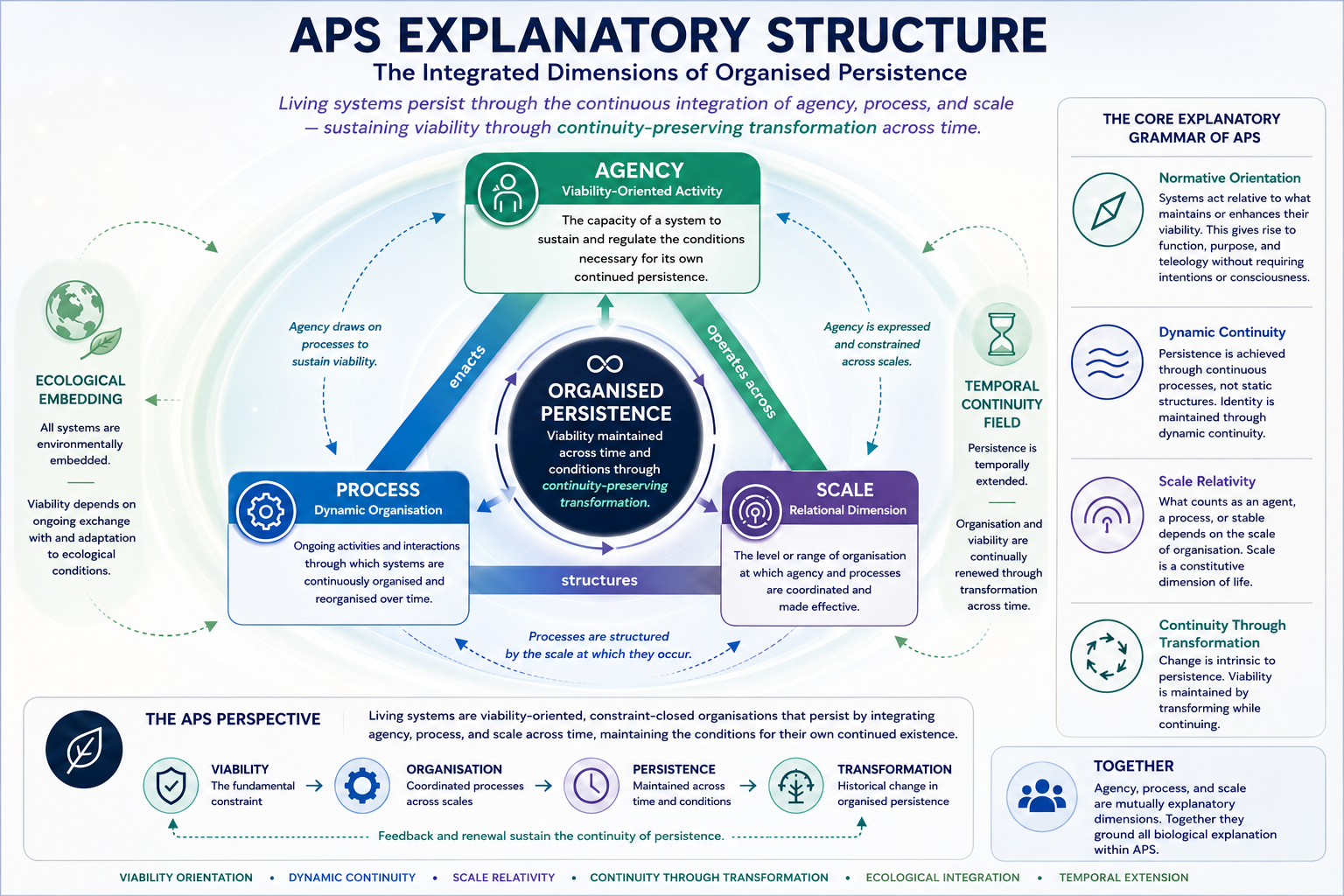
APS Analytic Structure. Agency, Process, and Scale are complementary, target-sensitive analytic projections of the same living organisation. They distinguish different explanatory questions without dividing biological reality into components, levels, stages, or independent causes. Organised persistence is a principal APS explanatory target rather than a fourth projection.
The purpose of these distinctions is not to multiply biological explanations. It is to make explicit which organisational question is being asked and to avoid treating differences of target, perspective, spatial or temporal extent, or explanatory purpose as though they automatically represented competing explanations.
The broader APS research pathways connecting biological agency with Biological Evaluation, significance, cognition, mind, selfhood, reflective agency, meaning, and social organisation contain propositions with different evidential status. Their inclusion within the wider architecture does not establish every proposed dependency or transition.
Four Questions APS Keeps Distinct
APS distinguishes several questions that can otherwise become conflated. These questions are useful for navigating the framework, but they should not be interpreted as universally necessary stages of biological explanation.
1. What Is at Stake? — Viability-Oriented Organisation
Living systems depend upon an organisation of processes and constraints that must remain within conditions compatible with continued functioning and persistence.
APS describes this in terms of viability-oriented organisation.
Viability is not an additional substance or property layered onto an already existing system. Within APS, it identifies the viability-relative conditions under which the organisation of a particular living system can continue functioning and persist.
Viability therefore helps specify what is at stake in questions concerning organised persistence.
2. What Does the Living System Do? — Agency
Living systems do not persist passively.
They regulate, repair, reorganise, compensate, adapt, and otherwise modify their activity under conditions relevant to viability. APS uses biological agency in the compact sense of viability-oriented organisational activity.
Agency does not require consciousness, intelligence, intention, planning, or choice. It is not an additional component added to life; it is an analytic projection concerned with what living systems do.
Agency therefore directs attention to the activity through which living organisation is enacted and sustained.
3. What Organisational Commitment Concerns Constraint Maintenance? — Constraint Closure
Living systems depend upon constraints whose organisation is itself maintained through system activity.
Within APS, constraint closure identifies the reciprocal organisation through which relevant constraints participate in maintaining and re-establishing the organisation that sustains them.
Constraint closure is therefore part of the canonical APS characterisation of life. Its inclusion within APS should not be taken to establish that every biological explanandum requires a constraint-closure explanation or that established biological explanations are incomplete without it.
4. How and Where Is Persistence Organised? — Process and Scale
Living organisation is dynamically maintained through time and materially realised across spatial and temporal extents.
Within APS:
-
Process asks how continuity is maintained despite change.
-
Scale asks where persistence is organised across the spatial and temporal extents and materially implemented relations relevant to the explanandum.
Process and Scale are not co-constitutive biological components or causal levels. They are analytic projections used when the relevant explanatory target requires attention to ongoing transformation, temporal organisation, spatial extent, or materially implemented relations across extents.
No projection has intrinsic explanatory priority, and a specified explanandum may require one, two, or all three APS projections.
Why the Same Concepts Recur
Readers often notice that the same APS concepts appear in multiple contexts.
Agency may appear in discussions of regulation, adaptation, developmental reorganisation, ecological responsiveness, or continuity maintenance. Persistence appears in discussions of viability, resilience, diagnosis, evolution, development, and cognition.
This recurrence does not require the concepts to perform identical explanatory work in every context. The same living organisation can support different explanatory questions depending upon the explanandum.
For example:
| Question | APS Concept or Projection Emphasised |
|---|---|
| What conditions are relevant to continued functioning? | Viability |
| What does the living system do? | Agency |
| How are relevant constraints reciprocally maintained? | Constraint closure |
| How is continuity maintained despite change? | Process |
| Across which extents and materially implemented relations is persistence organised? | Scale |
These concepts therefore need not compete with one another. They distinguish questions that may be relevant to the same biological organisation.
Their recurrence across APS should likewise not be interpreted as evidence that every APS concept is required for every biological explanation.
Why APS Uses Organisational Triads
APS frequently employs conceptual groupings such as:
-
Agency – Process – Scale
-
Persistence – Adaptation – Evolution
-
Evaluation – Semiosis – Cognition
These groupings do not all have the same architectural or evidential status.
Agency–Process–Scale has a specific role as three complementary analytic projections of living organisation. Other triads can function as heuristic or research groupings connecting related questions and propositions.
Their purpose is to preserve distinctions that might otherwise be collapsed. They do not establish additional biological components, theoretical layers, universal explanatory requirements, or demonstrated dependency relations merely by placing concepts together.
For example, Agency and Process distinguish questions about activity and continuity through change. Scale draws attention to the extents and materially implemented relations relevant to the explanandum. Persistence, adaptation, and evolution distinguish related but non-identical questions about continuity, response to changing conditions, and historical transformation.
APS therefore uses such groupings as analytic aids rather than as evidence that biological explanation must conform to a fixed conceptual template.
Diagnosis, Classification, and Organisational Questions
APS has developed a research interest in diagnostic questions concerning living organisation.
Classification asks whether a system belongs to a specified category. Diagnostic inquiry can instead ask what organisational conditions are present, how they are materially realised, and how they contribute to a specified explanandum.
Within APS, questions may include:
-
Is the relevant organisation viability-oriented?
-
How is its activity materially and organisationally grounded?
-
Does the activity contribute to maintaining or re-establishing conditions relevant to persistence?
Such questions can direct attention toward organisation rather than relying only on behavioural, complexity-based, intelligence-based, or historical classifications.
This does not establish a validated APS-specific diagnostic method. Whether an APS diagnostic formulation identifies additional explanatory relations must be assessed for the particular target and against the strongest relevant comparator.
Perturbation, repair, compensation, resilience, and breakdown may provide useful contexts for investigating organisational dependencies, but their usefulness does not itself demonstrate distinctive APS diagnostic capacity.
Present Organisation and Historical Explanation
APS distinguishes questions concerning present organisation from questions concerning historical origin and transformation.
For some explananda, it can be useful first to specify whether and how a system is presently organised in a viability-oriented manner and then separately ask how that organisation arose, developed, or changed historically.
This is an explanatory distinction rather than a universal methodological order.
Evolutionary history can explain the origins and transformations of traits, organisations, capacities, and populations. Present organisational contribution is a different explanatory question. A trait’s evolutionary history does not by itself determine its present viability-relative organisational contribution, just as present function does not eliminate the relevance of historical explanation.
Within APS, evolution is formulated as the historical transformation of organised persistence. This provides an integrative APS perspective on relations among persistence, variation, inheritance, selection, development, ecology, and historical change.
That formulation neither replaces established evolutionary explanations nor establishes additional explanatory gain merely by integrating these questions within APS. The relative contribution of an APS formulation must be assessed against target-matched evolutionary comparators.
Development, Cognition, and Social Organisation
APS also develops research pathways concerning development, cognition, and social organisation.
Development
Development provides an important domain for investigating how living organisation continues through transformation. Growth, differentiation, repair, plasticity, learning, adaptation, and ageing can raise questions about how continuity is maintained or re-established while biological organisation changes.
Within APS, organised persistence provides one way of formulating those questions. It does not follow that every developmental explanandum receives additional explanatory gain from that formulation.
Cognition
APS investigates a proposed pathway from biological agency and Biological Evaluation toward increasingly integrated forms of biological significance and cognition.
These propositions do not constitute a demonstrated developmental sequence. Individual dependencies require independent assessment, and cognition should not be inferred merely from the presence of life, agency, regulation, information, or adaptive behaviour.
Within APS, cognition is investigated in relation to the organisation of biological significance across time and to activity involving viability-relevant possibilities that is not exhausted by immediate or fixed regulation.
The cognition pathway therefore remains a proposition-specific APS research programme rather than an established consequence of the framework’s general architecture.
Social Organisation
APS also investigates how evaluative and organisational processes may become distributed through relations among individuals, groups, institutions, cultures, and materially realised social systems.
This extension does not require attributing biological agency indiscriminately to populations, institutions, cultures, ecosystems, or other collective entities.
Nor does social organisation represent a higher causal level within APS. Questions of Scale remain target-relative and concern physically realised extents and materially implemented relations.
The social pathway therefore investigates possible extensions of APS concepts while retaining the distinctions among biological agency, individual evaluation, collective organisation, social normativity, and moral legitimacy.
From Biological Evaluation to Ethics
One APS research pathway investigates possible dependencies connecting Biological Evaluation, Significance, Meaning, Value, Human Values, Shared Evaluation, Social Norms, Moral Evaluation, Morality, and Ethics.
Within this architecture, Biological Evaluation concerns the process through which agency generates significance. Significance is a relationally real product of biological evaluation.
The later transitions in the pathway introduce additional questions concerning meaning, value, shared evaluation, social norms, moral justification, and reflective ethical inquiry.
These transitions do not have identical evidential status, and the sequence should not be read as a demonstrated causal or developmental progression.
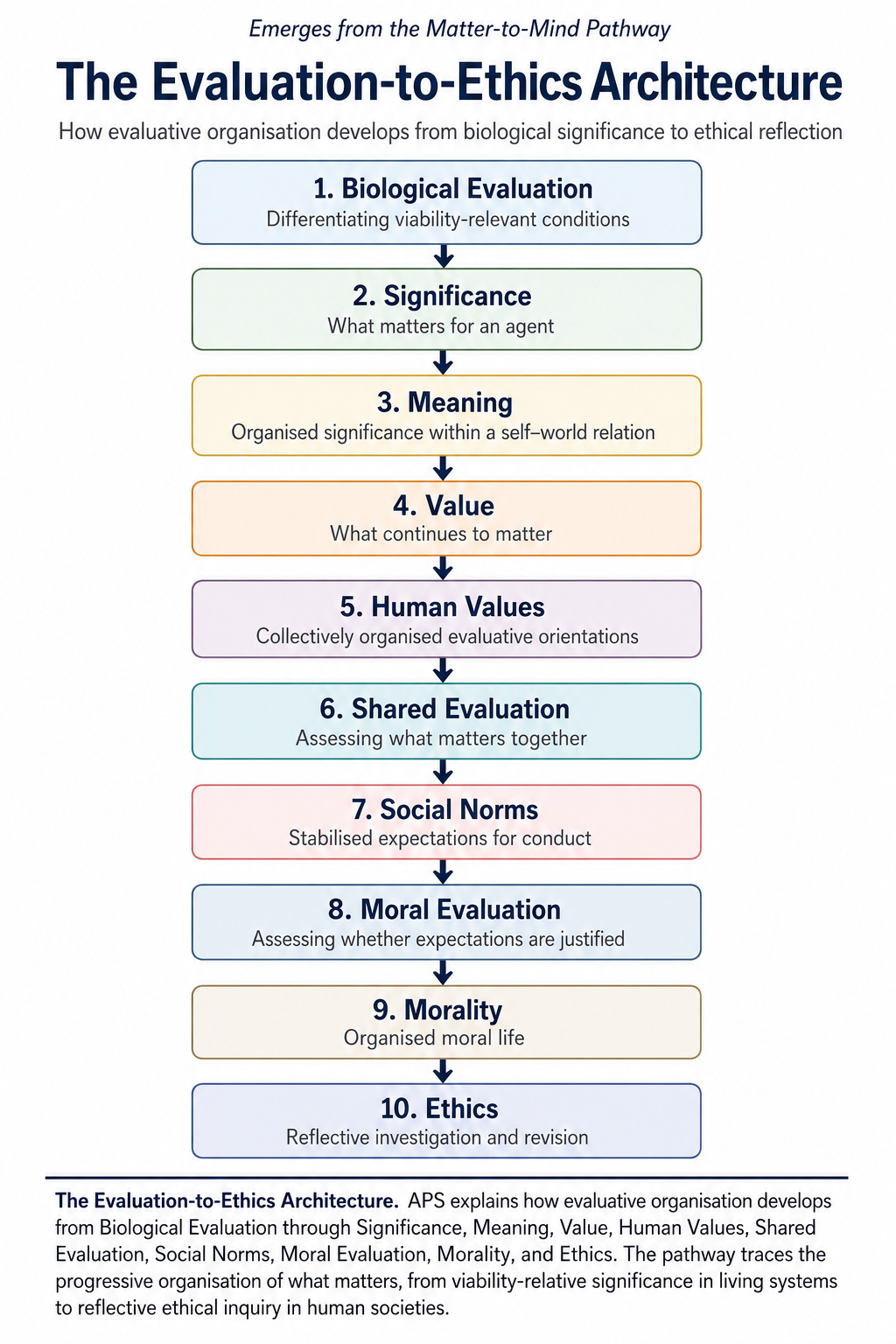
The Evaluation-to-Ethics Architecture. APS proposes this pathway as a research architecture connecting Biological Evaluation, Significance, Meaning, Value, Human Values, Shared Evaluation, Social Norms, Moral Evaluation, Morality, and Ethics. The arrows represent proposed dependencies rather than demonstrated causal or developmental succession. Individual transitions retain their proposition-specific evidential status, and biological viability, social persistence, consensus, or established norms do not by themselves establish moral legitimacy.
The architecture therefore provides a way of organising APS research questions rather than demonstrating that morality or ethics follows automatically from biological evaluation.
In particular, Moral Evaluation introduces a justificatory question that cannot be answered by viability, persistence, consensus, continuity, power, or established social norms alone.
The pathway does not replace the Agency–Process–Scale architecture. Agency, Process, and Scale remain analytic projections used according to the explanandum; the Evaluation-to-Ethics pathway is instead a proposed dependency architecture whose individual claims require separate assessment.
What APS Changes — and What It Does Not
APS changes the explanatory questions that become explicit when living organisation itself is made the target of inquiry.
It proposes that Life is viability-oriented, constraint-closed organisation and examines how that organisation is enacted and maintained through biological activity. The corresponding problem of organised persistence concerns how living organisation maintains and re-establishes continuity through change.
This does not require biological explanation to begin from APS or to reconstruct other explanatory approaches within it.
Mechanistic, evolutionary, dynamical, computational, informational, control-theoretic, organisational, developmental, ecological, and other approaches may provide substantive, sufficient, or preferable explanations for particular biological questions.
APS therefore does not change the scientific status of biology or its material continuity with chemistry and physics. It proposes no special life substance, separate physical laws, non-natural causal forces, or distinct realm of living matter.
Its distinctive commitments concern how living organisation is characterised. Within APS:
-
Biological agency is viability-oriented organisational activity.
-
Biological normativity is viability-relative asymmetry.
-
Biological function is present-tense viability-relative organisational contribution.
-
Purpose concerns viability-oriented organisation without requiring intention.
Agency, Process, and Scale provide complementary analytic projections of one viability-oriented, constraint-closed organisation rather than independent components, causes, dimensions, levels, or a hierarchy.
These commitments provide an analytic framework within which biological questions can be formulated and compared. Their coherence, integration, biological specificity, or breadth does not by itself establish explanatory superiority over alternative approaches.
Where APS and another framework address the same explanatory target, their relative contribution requires target-matched assessment.
A Simple Way to Hold APS Together
The conceptual architecture of APS can be summarised around a small number of related commitments and questions.
APS characterises life as viability-oriented, constraint-closed organisation and investigates organised persistence: how living organisation maintains and re-establishes the conditions of its own continuity through change.
Agency, Process, and Scale provide complementary analytic projections through which relevant aspects of that organisation can be investigated.
Other APS concepts and research pathways address more specific questions concerning viability, constraint organisation, adaptation, development, evolution, cognition, diagnosis, social organisation, normativity, function, purpose, significance, meaning, and ethics.
These concepts are not all equivalent, do not all have the same evidential status, and are not universally necessary for every biological explanation.
Seen in this way, APS can be navigated as an integrative analytic framework whose concepts are connected by their relation to living organisation while remaining distinguishable by target, function, and evidential status.
Why APS Preserves Multiple Concepts
Living systems support many different explanatory questions.
Questions about present activity differ from questions about historical origin. Questions about continuity through change differ from questions about spatial extent. Questions about biological agency differ from questions about cognition. Questions about social normativity differ from questions about moral legitimacy.
APS preserves these distinctions rather than forcing them into a single explanatory category.
This produces conceptual complexity, but the complexity should not be justified simply by asserting that living systems themselves are complex. The relevant test is whether a distinction clarifies an explanandum, identifies an explanatory relation, or contributes something not already supplied by the relevant comparator.
Accordingly, APS concepts should be retained and developed where they improve analytic precision or survive appropriate comparative assessment, not merely because they form part of an integrated conceptual system.
Conclusion
The purpose of this article has been to clarify why APS employs multiple concepts without treating them as multiple independent foundations or universally necessary dimensions of biological explanation.
Viability, biological agency, constraint closure, Process, Scale, development, adaptation, evolution, cognition, diagnosis, and social organisation perform different functions within the framework.
Agency, Process, and Scale have a particularly specific architectural status: they are complementary, target-sensitive analytic projections of the same viability-oriented, constraint-closed organisation. They are analytic projections rather than components of reality.
Organised persistence is a principal APS explanatory target rather than a fourth projection. It concerns how living organisation maintains and re-establishes continuity through change.
Other APS pathways—including those concerning cognition, meaning, social organisation, morality, and ethics—contain propositions and proposed dependencies whose evidential status must be assessed individually.
APS therefore provides an integrative analytic framework for relating questions about living organisation without claiming that conceptual integration establishes biological truth, general explanatory superiority, or the inadequacy of independently established explanations.
The central orienting question can be stated simply:
How is viable continuity organised and maintained through change?
Different APS concepts approach that question from different explanatory perspectives. Their value depends upon the clarity and explanatory contribution they provide for specified targets.
Orientation Pathway
Readers new to APS may find it useful to approach the framework through the following orientation sequence:
What Is APS?
↓
Understanding APS
↓
Naturalising Life
↓
How APS Explains Life
↓
The Core Structure of APS
↓
APS Architecture Map
↓
How APS Concepts Fit Together
This sequence provides a reading route through the orientation material. It should not be interpreted as a hierarchy of explanatory foundations or as evidence that later articles depend scientifically upon all earlier ones.
Where to Go Next
Readers seeking the broader architecture of APS should continue with:
-
The Core Structure of APS — the canonical account of the framework’s major concepts, analytic projections, and research pathways.
-
APS Architecture Map — a visual guide to navigating that architecture.
Readers seeking APS accounts of life and biological explanation should continue with:
-
Naturalising Life
-
How APS Explains Life
Readers interested in the extension of APS research into cognition and mind should continue with:
- How Did Matter Become Aware of Itself?
Readers seeking a broader architectural overview may also explore Understanding APS — The Structure of the Framework and The Core Structure of APS, which examine how the framework is organised and how its major pathways relate.
Readers interested in particular concepts may then explore the persistence, developmental, cognitive, ecological, evolutionary, diagnostic, and social pathways that elaborate these questions in greater depth.
Key Terms
viability · agency · constraint closure · process · scale · persistence · development · adaptation · cognition · diagnosis · social organisation · organised persistence