APS as a Viability-Oriented Framework for Understanding Life
APS is often described as a framework organised around agency, process, and scale.
This description is correct, but it can easily create a misunderstanding.
Agency, process, and scale are not the ultimate starting points of the framework. They are the explanatory dimensions through which APS investigates a deeper biological problem. To understand why APS takes its present form, it is first necessary to understand why viability occupies such a central place within biological explanation.
The question APS asks is not:
What are living systems made of?
Nor is it:
What mechanisms do living systems contain?
Nor even:
What properties distinguish living things from non-living things?
Instead, APS begins with a more fundamental biological observation.
Living systems persist.
They maintain themselves despite continual change. They repair damage, regulate internal conditions, adapt to shifting circumstances, acquire resources, respond to threats, reproduce, and preserve continuity across time. Their existence depends not upon static stability but upon the continual maintenance of conditions compatible with continued life.
This achievement is so familiar that it is easy to overlook its significance.
Every living system faces an ongoing problem.
The conditions required for continued existence are never permanently secured. Resources fluctuate. Environments change. Damage accumulates. Development transforms organisation. Competition creates uncertainty. Ecological relationships shift. Continuity must therefore be continually maintained despite conditions that constantly threaten it.
APS approaches biology through this problem.
The framework begins with the observation that living systems must remain viable.
Everything else follows from there.
Why Viability Matters
The concept of viability is deceptively simple.
At its most general, viability refers to the capacity of a system to maintain the conditions required for its continued persistence. Yet this idea has profound consequences for biological explanation because it identifies what is distinctive about living organisation.
Many systems persist.
Mountains persist.
Rocks persist.
Planets persist.
But they do not ordinarily preserve their existence through ongoing self-maintaining activity.
Living systems do.
Organisms continually generate and regenerate the conditions required for their own continuation. They acquire energy and materials. They repair damage. They regulate internal organisation. They respond to changing circumstances. They modify behaviour. They reorganise developmental trajectories. They maintain ecological relationships essential for survival.
Viability therefore identifies something more than simple existence.
It identifies a particular mode of persistence.
Living systems must continually work to remain possible.
This insight changes the focus of biological explanation.
Rather than asking merely how biological structures operate, APS asks how living systems maintain the conditions required for continued viability despite continual transformation. Explanation becomes centred on persistence rather than on components alone.
This is why viability occupies such a foundational role within APS.
Without viability there is no persistence.
Without persistence there is no biological organisation.
Without biological organisation there is no life to explain.
Viability therefore functions as the organising principle around which the wider framework is constructed.
Life as Viability-Oriented Organisation
APS does not define life through a checklist of properties.
Many traditional definitions attempt to identify a collection of characteristics possessed by living systems. Lists may include metabolism, reproduction, growth, adaptation, homeostasis, evolution, information processing, or responsiveness.
While each captures something important, APS argues that no simple list fully explains why these phenomena matter biologically.
The deeper issue concerns organisation.
Living systems are distinguished not by possessing particular components but by exhibiting a particular form of organised persistence. Their activities contribute to maintaining conditions compatible with continued viability. Biological organisation therefore becomes intelligible through the relationship between activity and persistence.
APS describes this as viability-oriented organisation.
Living systems are organised in ways that contribute to the preservation of their own continuity. Their activities are not simply occurring. They are organised relative to conditions affecting continued existence.
Metabolism contributes to viability.
Repair contributes to viability.
Development contributes to viability.
Adaptation contributes to viability.
Ecological interaction contributes to viability.
Reproduction contributes to viability.
The significance of these activities derives from their relationship to persistence.
This perspective reveals an important feature of biological organisation.
Changes are not neutral.
Some changes support viability.
Others threaten it.
Some reorganisations contribute to continuity.
Others undermine it.
Biological activity therefore acquires significance because living systems exist under conditions where persistence must continually be maintained.
This is why APS repeatedly returns to concepts such as normativity, evaluation, adaptation, resilience, and repair.
These phenomena emerge because viability matters.
For a living system, some states are better than others relative to continued persistence.
Some outcomes contribute to continuity.
Others threaten it.
Life therefore possesses an intrinsic organisational orientation toward viability.
Viability, Continuity, and Organised Persistence
The APS framework has gradually developed a broader language for understanding the significance of viability.
Viability is not an isolated concept.
It exists within a larger continuity architecture.
Living systems persist through time.
Yet they do not persist by remaining unchanged.
They develop.
They adapt.
They learn.
They age.
They repair damage.
They interact with changing environments.
They participate in ecological and social systems.
The continuity of life therefore depends upon the organisation of change rather than the avoidance of change.
APS captures this through the concept of organised persistence.
Organised persistence refers to the maintenance of continuity despite continual transformation. Viability specifies the conditions under which that continuity remains possible.
The relationship between the two concepts is fundamental.
Persistence identifies the explanatory phenomenon.
Viability identifies the conditions persistence must preserve.
Together they provide the foundation for the wider APS framework.
Development becomes important because continuity must survive transformation.
Adaptation becomes important because continuity must remain possible under changing conditions.
Repair becomes important because continuity must recover from disruption.
Resilience becomes important because continuity must withstand perturbation.
Ecology becomes important because continuity depends upon organism–environment relations.
Each continuity architecture explored throughout APS ultimately derives its significance from viability-oriented organised persistence.
Understanding viability therefore means understanding far more than survival.
It means understanding the organisational conditions through which continuity becomes possible at all.
From Components to Organisation
One of the most important consequences of placing viability at the centre of biology is that it changes how explanation is organised.
Traditional biological explanations often begin with components.
Genes.
Proteins.
Cells.
Physiological mechanisms.
Behavioural traits.
These are treated as the primary explanatory units from which larger biological phenomena are constructed.
APS does not reject the importance of such components.
Instead, it asks a prior question:
Why do these components matter biologically?
The APS answer is straightforward.
Components matter because they contribute to the maintenance of viable continuity.
A gene is biologically significant because of its role within continuity-preserving organisation.
A physiological mechanism is significant because it contributes to viability.
A behavioural strategy is significant because it helps sustain persistence under particular conditions.
A developmental process is significant because it preserves continuity through transformation.
The explanatory focus therefore shifts.
Instead of beginning with components and building upward, APS begins with organised persistence and asks how components participate within larger continuity-preserving systems.
This perspective reveals something that component-centred approaches can sometimes obscure.
Living systems are not simply collections of parts.
They are organised continuities.
The significance of any component depends upon the role it plays within the maintenance of viability across time.
APS therefore approaches biological explanation organisationally rather than reductionistically.
Organisation becomes primary.
Components become intelligible through their participation within organisation.
This shift does not diminish the importance of molecular biology, physiology, development, ecology, or evolution.
It provides a framework through which their explanatory contributions can be understood within a common architecture.
Constraint Closure and the Maintenance of Viability
One of the concepts APS inherited from earlier traditions in theoretical biology is constraint closure.
This idea remains important, but its role is best understood within the broader context of viability-oriented organisation.
Living systems are composed of interacting processes.
These processes do not operate independently.
Instead, they are organised in ways that continually generate and maintain the conditions required for their own continuation.
The activities that sustain the system depend upon organisational constraints.
Yet those constraints are themselves maintained through the activity of the system.
This reciprocal relationship is what APS refers to as constraint closure.
Constraint closure therefore helps explain how living systems remain organised despite continual material turnover.
Cells replace molecular components.
Organisms repair tissues.
Development reorganises structures.
Physiological systems adapt to changing conditions.
Yet continuity persists because organisational constraints are continually regenerated through ongoing activity.
Within APS, however, constraint closure is not the explanatory starting point.
Viability is.
Constraint closure matters because it contributes to viability-oriented organised persistence.
It explains one of the organisational mechanisms through which continuity can remain stable despite continual transformation.
The relationship can therefore be understood as:
viability
        ↓
organised persistence
        ↓
constraint closure
rather than the reverse.
This ordering reflects the contemporary architecture of APS.
The central explanatory problem is viability-oriented continuity.
Constraint closure provides one important way in which that continuity can be maintained.
Agency, Process, and Scale
Once viability-oriented organised persistence has been identified as the explanatory target, a second question emerges.
How should such systems be explained?
APS answers this question through three interconnected explanatory dimensions:
- agency;
- process;
- and scale.
These dimensions are sometimes misunderstood as separate explanatory layers.
They are better understood as complementary perspectives on the organisation of continuity.
Agency concerns what living systems do.
Living systems actively contribute to the maintenance of viability. They regulate conditions, acquire resources, repair damage, respond to perturbation, modify behaviour, and reorganise activity relative to changing circumstances.
Agency therefore captures the active character of biological persistence.
Process concerns how continuity unfolds.
Living systems exist through ongoing transformation. Development, metabolism, adaptation, repair, ecological interaction, learning, and reproduction are all processes through which continuity is maintained across time.
Process therefore captures the temporal character of biological persistence.
Scale concerns where continuity operates.
Persistence is distributed across multiple organisational domains and timescales. Molecular activity contributes to cellular continuity. Physiology contributes to organismal continuity. Ecology contributes to environmental continuity. Evolution contributes to historical continuity. Social systems contribute to collective continuity.
Scale therefore captures the distributed character of biological persistence.
Together these dimensions provide the explanatory grammar of APS.
Agency reveals activity.
Process reveals transformation.
Scale reveals distribution.
Each becomes meaningful because living systems must remain viable through time.
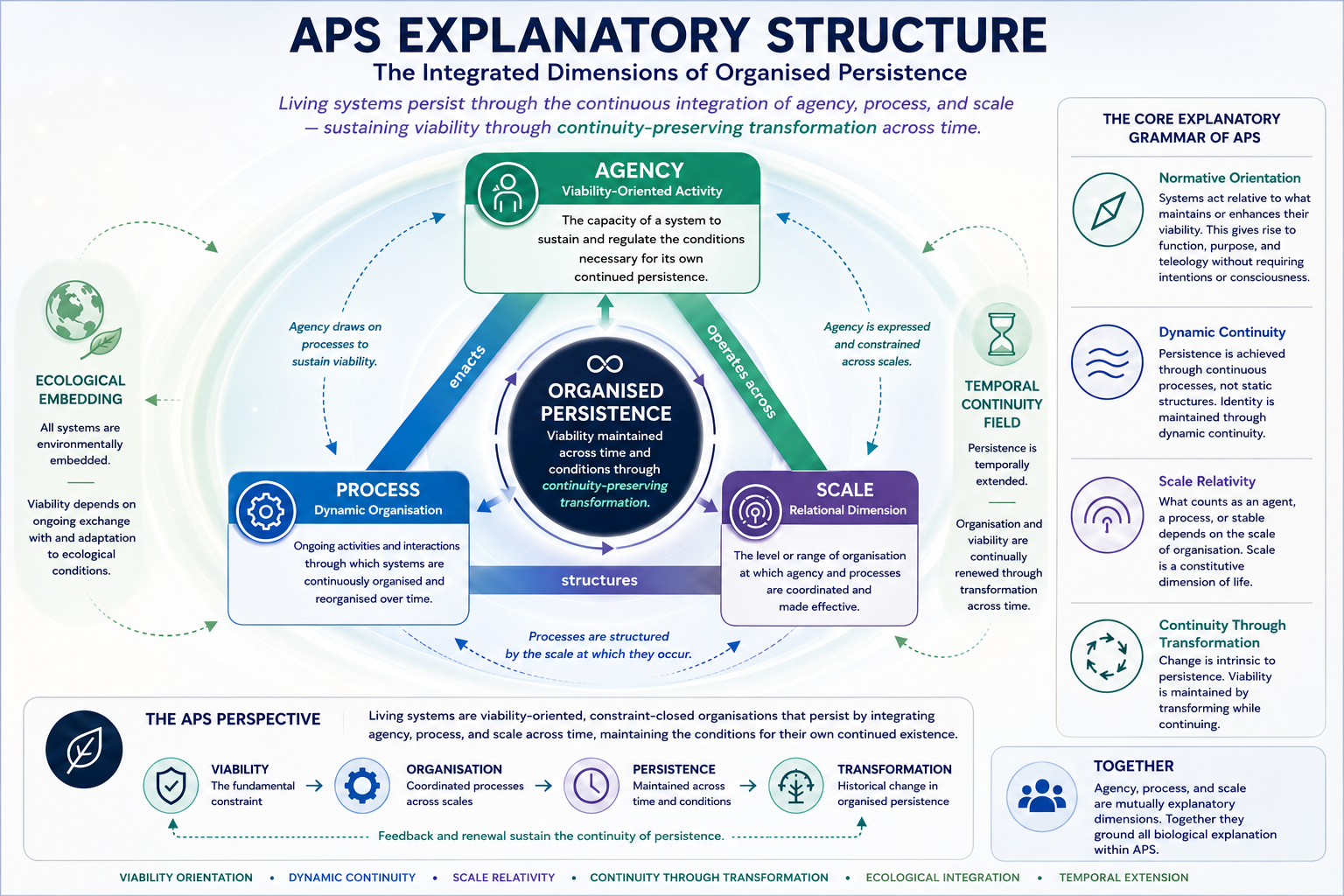
APS Explanatory Structure. Agency, process, and scale provide the explanatory dimensions through which APS investigates viability-oriented organised persistence across biological systems.
Explanation Without Hierarchy
The emphasis on viability also changes how biological organisation itself is understood.
Many traditional frameworks describe biology through hierarchical levels of organisation. Molecules are placed below cells, cells below tissues, tissues below organisms, organisms below populations, and so forth.
APS regards this picture as useful in some contexts but ultimately incomplete.
Living systems are organised through interacting processes distributed across multiple scales rather than through rigid explanatory levels.
Physiological activity influences behaviour.
Behaviour influences ecological relationships.
Ecological conditions influence development.
Development shapes evolutionary possibilities.
Evolution reshapes ecological interactions.
Continuity emerges through reciprocal interactions operating across multiple domains simultaneously.
No single scale possesses explanatory priority in every circumstance.
Instead, biological explanation must remain sensitive to the ways continuity is organised across interacting scales and timescales.
This perspective helps explain why APS repeatedly emphasises integration rather than reduction.
Agency, process, and scale are not independent explanatory categories.
They are mutually dependent dimensions of viability-oriented organisation.
Together they reveal how living systems maintain continuity despite continual transformation, perturbation, and environmental change.
The explanatory task of biology therefore becomes understanding how these dimensions combine to sustain viable persistence across time.
From Persistence to Evolution
One of the recurring themes throughout APS is the distinction between maintaining continuity and transforming continuity.
Both are essential to life.
Yet they operate across different timescales and address different biological problems.
Persistence concerns the ongoing maintenance of viability in the present. Organisms must continually preserve continuity despite changing environmental conditions, developmental transformation, physiological demands, and ecological uncertainty. The organisational processes responsible for this maintenance include regulation, repair, adaptation, resilience, development, and ecological interaction.
Evolution addresses a different challenge.
Instead of explaining how continuity is maintained within lifetimes, evolution explains how biological organisation changes across generations. Populations transform. Lineages diversify. Novel forms emerge. Adaptive capacities shift. The continuity of life extends into historical time.
APS therefore treats persistence and evolution as complementary rather than competing explanatory domains.
Persistence explains how viable organisation is maintained.
Evolution explains how viable organisation changes.
This distinction has important consequences.
Natural selection cannot operate independently of organised persistence. Before evolutionary processes can occur, living systems must already possess the capacity to maintain viable continuity across time. Evolution therefore presupposes the existence of persistence-capable systems.
The relationship can be understood as follows:
organised persistence
        ↓
reproduction
        ↓
inheritance
        ↓
evolutionary transformation
Persistence provides the continuity upon which evolutionary change depends.
Evolution extends continuity into historical time.
This perspective helps explain why APS places organised persistence prior to evolutionary explanation without diminishing the importance of evolution itself.
Evolution remains indispensable.
But it operates within a biological world already organised around viability-oriented continuity.
A Framework for Biology
Understanding APS as a viability-oriented framework also clarifies its broader scientific purpose.
APS is not a replacement for molecular biology.
It is not a replacement for physiology.
It is not a replacement for ecology, evolution, developmental biology, or cognitive science.
Instead, APS provides a framework through which these diverse domains can be understood as contributions to a common explanatory project.
Each domain addresses a different aspect of continuity-preserving organisation.
Development explains continuity through transformation.
Ecology explains continuity through organism–environment relations.
Evolution explains continuity across generations.
Cognition explains continuity through evaluation and adaptive responsiveness.
Social organisation explains continuity distributed across populations, institutions, cultures, and technologies.
Diagnosis explains continuity under conditions of perturbation, disruption, and recovery.
Viewed independently, these subjects can appear highly specialised.
Viewed through APS, they reveal a shared organisational logic.
Each investigates how viability-oriented continuity remains possible under particular conditions and across particular scales.
The framework therefore serves an integrative role.
It does not seek to eliminate disciplinary differences.
Rather, it provides a common explanatory language through which diverse biological domains become intelligible as parts of a larger continuity architecture.
Why APS Is a Viability-Oriented Framework
At this point the reason for the article’s title should be clear.
APS is not called a viability-oriented framework because viability is one concept among many.
It is called a viability-oriented framework because viability provides the organising principle that connects the entire architecture.
Agency matters because living systems actively contribute to viability.
Process matters because viability must be maintained through time.
Scale matters because viability is distributed across interacting domains of organisation.
Development matters because viability must survive transformation.
Adaptation matters because viability must remain possible under changing conditions.
Repair matters because viability must recover following disruption.
Resilience matters because viability must withstand perturbation.
Ecology matters because viability depends upon environmental relations.
Evolution matters because viability extends across generations.
Cognition matters because living systems evaluate conditions affecting viability.
Social organisation matters because continuity can become distributed across populations and historical systems.
The various pathways of APS therefore converge upon a common explanatory centre.
They are different perspectives on the same underlying biological challenge:
How do living systems maintain viable continuity through time?
This question provides the conceptual unity of the framework.
How to Continue Reading
Readers who wish to explore the framework further may continue in several directions.
For a broad introduction to APS:
- What Is APS?
- How APS Explains Life
- Understanding APS
For the deeper conceptual foundations:
- Persistence — Organised Continuity Through Time
- Viability — The Organising Principle of Biological Persistence
- Temporal Organisation and Organised Persistence
- The Explanatory Geometry of Biology
For the major continuity architectures:
- The Developmental Organisation of Life
- The Social Organisation of Life
- Ecology as Organised Persistence Across Scales
- Evolution as the Historical Transformation of Organised Persistence
For conceptual clarification:
- Reductionism in Biology — An APS Clarification
- Why APS Is Not Holism
- Why APS Is Not Organicism
Together these articles reveal how APS develops a unified account of life organised around viability, continuity, and organised persistence.
Conclusion
APS begins from a simple biological observation.
Living systems persist.
Yet they do not persist by remaining unchanged. They continually regenerate the conditions required for their own continued existence despite development, perturbation, environmental change, competition, uncertainty, and transformation.
Viability therefore becomes the central explanatory problem.
APS approaches biology by asking how such viability is maintained through time.
From this starting point, the framework develops an integrated account of agency, process, and scale operating within viability-oriented organised persistence. Development, ecology, evolution, cognition, diagnosis, and social organisation become interconnected continuity architectures through which living systems preserve continuity under changing conditions.
The result is a framework that does not define life through a list of properties, a privileged mechanism, or a single explanatory level.
Instead, APS understands life as a form of viability-oriented organised persistence sustained across time.
Living systems remain possible because continuity becomes organised.
APS exists to explain how that organised continuity is achieved.