Naturalising Life
Many important biological concepts—including purpose, agency, cognition, significance, meaning, and mind—remain conceptually contested despite substantial empirical investigation. This article examines an APS methodological proposal for addressing such difficulties through naturalisation and conceptual closure. Naturalisation seeks biologically tractable formulations of difficult phenomena, while conceptual closure clarifies the terms, relations, boundaries, and explanatory targets needed for those formulations to become scientifically assessable. Neither process establishes that a resulting formulation is biologically correct, explanatorily superior, or empirically validated. Their contribution is methodological: they can help transform conceptual ambiguity into explicit claims capable of independent empirical and comparative assessment. The article illustrates this approach through purpose, agency, cognition, significance, and meaning, and considers its possible role within the wider Matter-to-Mind research programme.
Key Points
- Naturalisation can help formulate difficult biological concepts in scientifically tractable terms.
- Conceptual closure concerns sufficient clarity of terms, relations, boundaries, and explanatory targets for assessment.
- Naturalisation and conceptual closure do not by themselves establish biological truth, explanatory superiority, or empirical validation.
- Biological agency is viability-oriented organisational activity.
- Purpose concerns viability-oriented organisation without requiring intention.
- Cognition, significance, meaning, mind, and related concepts retain proposition-specific evidential burdens.
- APS uses naturalisation and conceptual closure as methodological resources rather than as a universal foundation for biological explanation.
Where this article fits: What Is APS? introduces the framework, while Understanding APS explains how readers can navigate its major domains and pathways.
Naturalising Life serves a different purpose. It examines a methodological proposal within APS: whether naturalisation and conceptual closure can help formulate difficult biological concepts in ways that make their claims clearer and scientifically assessable.
Readers seeking APS’s account of biological explanation should continue to How APS Explains Life. Readers seeking the framework’s conceptual architecture should continue to The Core Structure of APS.
Introduction — Why Naturalisation Matters
Biology employs concepts whose scientific interpretation remains contested. Purpose, agency, cognition, significance, meaning, and mind are prominent examples. They occur in scientific and philosophical discussions of living systems, yet disagreement persists about what they refer to, how broadly they should be applied, and what explanatory work they can legitimately perform.
The sources of these disagreements differ. Purpose can become entangled with intention, design, or final causes. Agency is sometimes restricted to conscious choice. Cognition can be tied to brains, nervous systems, representation, or particular behavioural capacities. Meaning can be treated as exclusively linguistic or psychological. Mind raises further questions concerning cognition, selfhood, awareness, and subjective experience.
Substantial empirical evidence does not automatically resolve such disputes because empirical disagreement is not always the only issue. Sometimes researchers disagree about the target, boundaries, or meaning of the concept through which evidence is being interpreted.
APS treats this as a methodological possibility rather than a general diagnosis of biological controversy. Some disputes may indeed involve conceptual ambiguity or conflation; others may primarily concern evidence, explanatory targets, theoretical commitments, operational criteria, or genuine biological differences.
Naturalising life, as the term is used here, concerns the attempt to formulate difficult biological concepts in terms that locate them within natural, materially realised living organisation and make their claims sufficiently explicit for scientific assessment.
This does not imply that naturalisation is a prerequisite for all scientific explanation, that every contested concept should be preserved, or that a naturalised APS formulation is thereby correct.
A second methodological idea, conceptual closure, concerns the degree to which the terms, relations, boundaries, and explanatory target of a concept have been specified clearly enough for systematic inquiry and comparison.
The central proposal of this article is therefore deliberately bounded:
Naturalisation and conceptual closure can contribute to moving difficult biological concepts from conceptual ambiguity toward scientifically assessable claims.
Whether those claims are empirically supported, explanatorily useful, or preferable to alternatives remains a separate question.
Conceptual Difficulty in Biology
Scientific progress depends upon empirical investigation, but scientific inquiry also requires concepts through which observations, hypotheses, models, and explanations are formulated.
Conceptual difficulty can arise when the same term is used for different phenomena, when boundaries remain unclear, when assumptions imported from another domain are left unstated, or when researchers address different explananda while appearing to disagree about a single claim.
This does not mean that persistent scientific controversies can generally be explained by conceptual instability. Nor does it establish that conceptual clarification will resolve them. It means only that conceptual status can itself become a legitimate object of methodological analysis.
Purpose illustrates the problem. In biological contexts, purposive language may refer to intention, evolved function, goal-directed regulation, organisational contribution, or merely convenient shorthand. Those alternatives should not be treated as equivalent.
Agency raises a related issue. Human agency often implies deliberation or intention, whereas biological agency can be formulated more minimally. APS uses the compact definition:
Biological agency is viability-oriented organisational activity.
This formulation is intended to specify an APS biological target without requiring conscious intention.
Cognition raises a more difficult boundary problem. Neural, behavioural, computational, enactive, basal, biogenic, and other approaches do not necessarily identify the same target or use the same criteria. Evidence of regulation, information processing, adaptive responsiveness, or learning-like behaviour therefore cannot by itself settle what should count as cognition.
Meaning and significance require similar care. Within APS, Biological Evaluation is the process through which agency generates significance, and Significance is a relationally real product of biological evaluation. Meaning belongs to a later and more demanding research pathway and should not be collapsed into significance simply because both concern organism–world relations.
These examples illustrate the methodological problem addressed here. Before competing claims can be compared effectively, it can be necessary to specify what concept is being used, what phenomenon it identifies, and what evidence would count for or against the resulting claim.
That is a problem of assessability rather than a guarantee of resolution.
Naturalisation as a Methodological Proposal
In its broad philosophical use, naturalisation can refer to attempts to understand apparently exceptional or problematic phenomena within the natural world.
Within this article, the term is used more narrowly. APS naturalisation is a methodological effort to formulate difficult biological concepts in relation to materially realised living organisation without either treating them as non-natural exceptions or assuming that they can simply be eliminated in favour of lower-scale descriptions.
This is not an argument against reduction, mechanism, evolutionary explanation, physicalism, functional analysis, or other established approaches. Those approaches may provide sufficient or preferable explanations for particular explananda.
Naturalisation instead asks a different question:
Can the phenomenon be formulated in biologically tractable terms such that the resulting claim becomes explicit enough to investigate?
That formulation may involve identifying the relevant organisation, activity, constraints, relations, spatial and temporal extents, or viability conditions. Which of these matters depends upon the explanandum.
Naturalisation should therefore not be confused with biological validation. A concept may be given a coherent naturalistic formulation and nevertheless prove empirically unsupported, explanatorily redundant, too broad, too narrow, or inferior to an existing account.
Nor does naturalisation require preservation of every inherited concept. Sometimes analysis may show that a term conflates several phenomena or contributes no explanatory gain. In such cases, revision, restriction, decomposition, or abandonment may be appropriate.
The methodological value of naturalisation lies in making the claim clearer—not in protecting the concept from criticism.
From Conceptual Difficulty to Assessable Claim
The methodological sequence proposed here can be represented as follows.
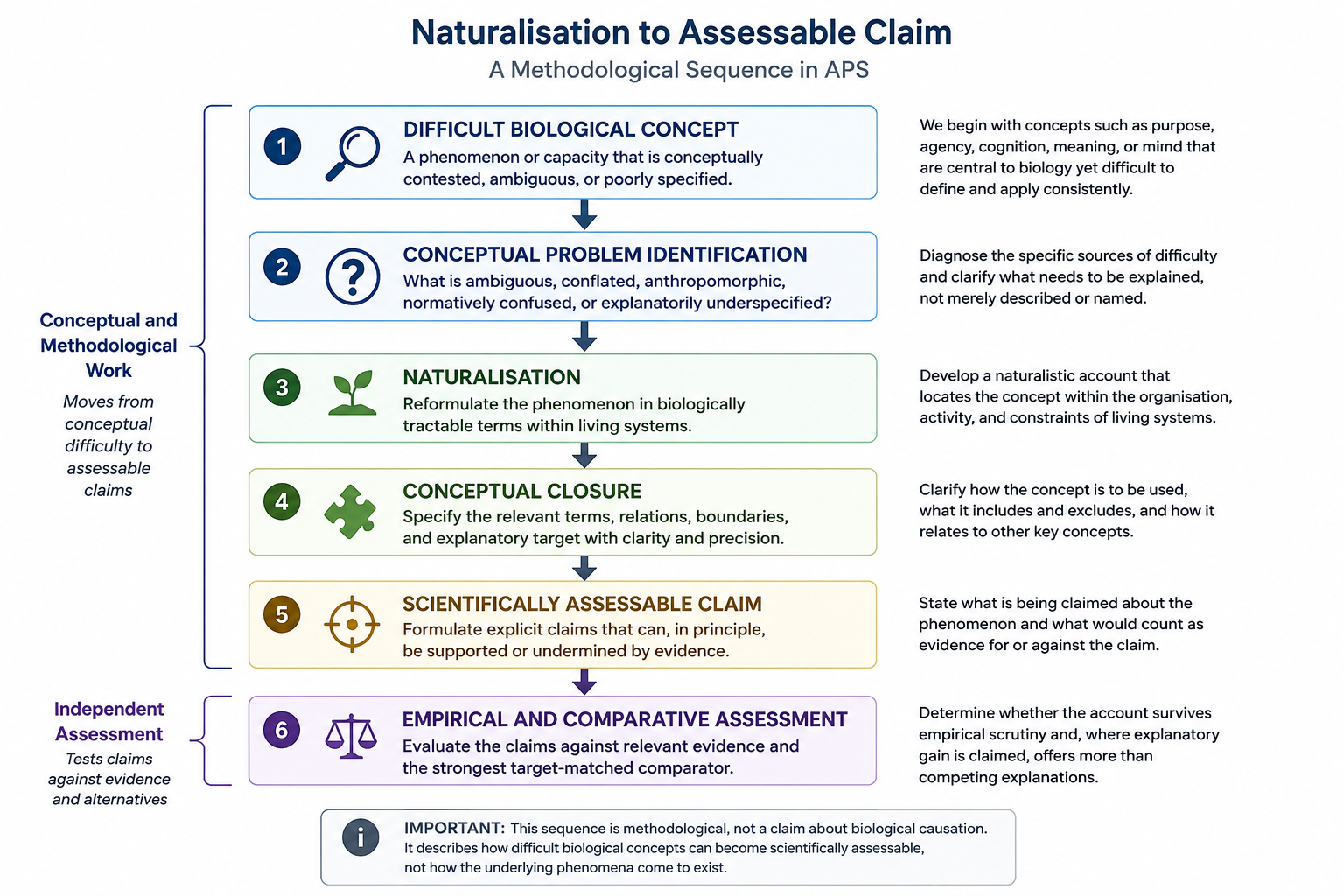
Naturalisation to Assessable Claim. Naturalisation and conceptual closure belong to the conceptual and methodological work required to formulate an explicit claim. They do not validate that claim. Empirical support and, where explanatory gain is claimed, comparison with the strongest target-matched alternative remain independent burdens. The arrows represent a methodological sequence, not biological causation.
The sequence distinguishes six operations.
First, a difficult biological concept is identified. The difficulty may concern ambiguity, anthropomorphic inheritance, normative conflation, uncertain boundaries, explanatory underspecification, or some combination of these.
Second, conceptual problem identification asks exactly what is unclear. This is important because different problems require different remedies. Ambiguity is not the same as empirical inadequacy, and disagreement about boundaries is not the same as disagreement about mechanism.
Third, naturalisation seeks a biologically tractable formulation.
Fourth, conceptual closure specifies the relevant terms, relations, exclusions, boundaries, and explanatory target with sufficient precision for assessment.
Fifth, this work should yield a scientifically assessable claim: a claim explicit enough that evidence could, in principle, support, restrict, revise, or undermine it.
Sixth, substantive claims face independent empirical and comparative assessment. If an APS formulation claims explanatory gain, its contribution must be assessed against the strongest target-matched comparator rather than inferred from conceptual coherence.
This final step is essential. The methodological sequence is successful when it makes a claim more assessable. It is not successful merely because it makes a concept fit neatly within APS.
Conceptual Closure as Clarification for Assessment
Conceptual closure does not mean finality.
Scientific concepts remain revisable, and some productive concepts retain contested boundaries for long periods. Closure should therefore not be treated as a binary state in which a concept becomes permanently fixed.
Within APS, conceptual closure is better understood as sufficient specification for inquiry.
A concept has greater closure when its intended target is clearer, its relevant relations are explicit, its exclusions can be stated, and its role can be distinguished from neighbouring concepts.
This is not the same as definition alone. A formal definition can still be operationally unclear or explanatorily unhelpful.
It is not the same as consensus. Researchers can agree on terminology while disagreeing about the phenomenon.
It is not the same as explanation. A concept can be sufficiently clear for inquiry without the corresponding phenomenon being fully explained.
And it is not the same as evidential closure. A well-specified claim may turn out to be false.
The value of conceptual closure is therefore methodological. It makes disagreement more precise. Researchers can ask whether they are disputing the same target, whether criteria distinguish positive from negative cases, whether alternative accounts are genuinely rivals, and what evidence bears upon the claim.
Conceptual closure, in this bounded sense, contributes to scientific assessability.
Naturalisation, Conceptual Closure, and Scientific Intelligibility
Scientific intelligibility is a broader and more difficult notion than conceptual closure.
A phenomenon can be observable and experimentally tractable while remaining theoretically contested. Conversely, a concept can be clearly defined while contributing little explanatory understanding.
For that reason, this article does not define scientific intelligibility as an automatic product of naturalisation plus conceptual closure.
A more defensible relationship is:
naturalisation
→ can improve biological tractability
conceptual closure
→ can improve conceptual specification
together
→ can contribute to scientifically assessable formulation
independent inquiry
→ determines what evidential and explanatory standing the resulting claim deserves
Scientific intelligibility can therefore increase as concepts, evidence, models, mechanisms, comparative explanations, and empirical results become better coordinated. Naturalisation and conceptual closure may contribute to that process, but they neither exhaust it nor guarantee its outcome.
This distinction preserves the useful insight in the APS naturalisation programme without turning a methodological proposal into a general theory of scientific progress.
APS as a Programme of Integrative Naturalisation
With those limits in place, APS can reasonably be interpreted as containing a recurring programme of integrative naturalisation.
Across several domains, APS attempts to reformulate concepts inherited from philosophical, psychological, or everyday discourse in terms appropriate to living organisation.
The important qualification is that these reconstructions do not all have the same scientific status.
Some are canonical APS commitments. Others are proposed extensions, research pathways, or claims requiring further empirical and comparative assessment.
Life
APS proposes:
Life is viability-oriented, constraint-closed organisation.
This is the canonical APS characterisation of life.
Its explanatory sentence is:
This organisation consists in the ongoing modulation of constraints through which a system actively maintains and re-establishes the conditions of its own persistence.
Within APS, organised persistence is a principal explanatory target: how living organisation maintains and re-establishes continuity through material, structural, developmental, and environmental change.
This formulation does not establish that organised persistence is a uniquely APS problem or that other biological accounts are incomplete unless reconstructed through APS.
Agency
APS naturalises agency without requiring consciousness or intention.
Its compact formulation is:
Biological agency is viability-oriented organisational activity.
Agency is therefore what living systems do within the APS architecture. It is not an additional substance, module, level, or mental property inserted into biological organisation.
This formulation can be compared with alternative accounts of agency. Its coherence within APS does not itself establish its comparative adequacy.
Purpose
APS treats purpose without invoking external design or conscious intention.
Within the framework:
Purpose concerns viability-oriented organisation without requiring intention.
This formulation should not be expressed as purpose “emerging” automatically from life, agency, or a biological imperative.
Instead, APS proposes that purposive biological organisation can be investigated in viability-relative organisational terms. Whether this formulation captures all scientifically legitimate uses of purpose is a separate comparative question.
Cognition
Cognition requires a stronger boundary.
Life does not require cognition; cognition presupposes life.
APS therefore does not identify cognition with regulation, information processing, adaptive responsiveness, evaluation, or agency alone.
Within the current APS research programme, biological agency becomes cognitive when integrated biological significance modulates activity across a temporal field of viability-relevant possibilities in ways not exhausted by immediate or fixed regulation.
This formulation is intended to distinguish cognition from more general biological regulation while retaining continuity with living organisation.
It remains a substantive research proposition requiring operational, empirical, and comparative assessment.
Significance and Meaning
APS distinguishes significance from meaning.
Biological Evaluation is the process through which agency generates significance.
Significance is a relationally real product of biological evaluation.
These formulations concern viability-relative relations through which conditions become significant for organised activity.
Meaning belongs to a later research pathway involving further integration. It should therefore not be defined simply as “significance-for-an-agent,” nor treated as an automatic consequence of biological evaluation.
This distinction is especially important for the Matter-to-Mind programme because it prevents biological significance, cognition, mind, and reflective meaning from collapsing into one another.
Agency, Process, and Scale
Naturalisation does not add a second architecture alongside Agency, Process, and Scale.
Agency, Process, and Scale are analytic projections of one viability-oriented, constraint-closed organisation.
Within APS:
-
Agency asks what living systems do.
-
Process asks how continuity is maintained despite change.
-
Scale asks where persistence is organised across the spatial and temporal extents and materially implemented relations relevant to the explanandum.
They are analytic projections rather than components of reality.
They are not interacting ontological principles, causal levels, developmental stages, or universally necessary dimensions of biological explanation.
No projection has intrinsic causal or explanatory priority. Their use is target-relative.
Naturalisation and conceptual closure have a different function. They concern how a difficult concept or claim can be formulated clearly enough for scientific assessment.
The relationship is therefore methodological rather than architectural equivalence:
-
Agency, Process, and Scale distinguish complementary questions about living organisation.
-
Naturalisation and conceptual closure help specify difficult concepts and claims.
-
Empirical and comparative assessment determine what scientific standing those claims deserve.
This prevents conceptual methodology from being mistaken for ontology and prevents the APS analytic architecture from being re-described as interacting biological causes.
Illustrative Applications
The following examples show how the naturalisation approach can be used within APS. They are illustrations of conceptual reconstruction, not demonstrations that the APS formulations are uniquely correct.
Purpose
Purpose is difficult partly because the term can suggest intention, design, foresight, or final causes.
APS narrows the target by treating purpose as viability-oriented organisation without requiring intention.
The naturalisation step removes the requirement for a conscious or external goal. Conceptual closure then requires clarification of how purpose differs from function, agency, normativity, adaptation, and mere persistence.
The resulting APS claim is more explicit and therefore more assessable. Whether it provides explanatory gain over established accounts remains a comparative question.
Agency
Everyday agency often implies conscious decision-making.
APS instead defines biological agency as viability-oriented organisational activity.
This makes the intended biological target explicit while excluding intention as a necessary condition.
The next question is evidential rather than definitional: whether this formulation discriminates relevant cases, clarifies biological explanation, and contributes beyond established accounts of autonomy, regulation, adaptivity, behaviour, or organisation.
Cognition
Cognition illustrates why naturalisation must not become indiscriminate expansion.
Evidence of adaptive regulation, signal discrimination, memory-like effects, or information processing does not automatically establish cognition.
APS therefore introduces a stronger proposed condition involving integrated biological significance, temporal organisation, and viability-relevant possibilities not exhausted by immediate or fixed regulation.
Naturalisation here does not simply broaden cognition across life. Its role is to make the proposed boundary explicit enough to test.
Significance and Meaning
Meaning presents a particularly important conceptual risk because biological significance can easily be redescribed as meaning without demonstrating the additional organisation required.
APS therefore begins with Biological Evaluation and Significance rather than treating meaning as primitive.
Significance concerns viability-relative relations generated through biological evaluation. Later questions concern how significance becomes integrated into cognition, mind, selfhood, reflective agency, and forms of meaning.
Naturalisation here is therefore a process of differentiation as much as integration. It prevents neighbouring concepts from being collapsed merely because they form part of a connected research programme.
Taken together, these cases show what the methodological proposal can legitimately do. It can clarify targets, remove inappropriate inherited assumptions, specify relations among concepts, and produce claims capable of further assessment.
It cannot determine the outcome of that assessment in advance.
From Life Toward Mind
APS develops a broader research pathway concerning the organisational route from life toward cognition, mind, selfhood, reflective agency, and meaning.
The canonical pathway is:
Life
↓
Agency
↓
Biological Evaluation
↓
Significance
↓
Integration
↓
Cognition
↓
Mind
↓
Selfhood
↓
Reflective Agency
↓
Meaning
This pathway should not be interpreted as a demonstrated causal or developmental sequence.
Its arrows represent proposed dependencies within an APS research architecture. Individual transitions retain their proposition-specific evidential status.
The pathway is useful because it distinguishes questions that are easily conflated. Life and agency do not imply cognition. Significance is not identical to meaning. Cognition is not identical to mind. Selfhood does not require reflective agency, and none of these distinctions by itself solves the problem of subjective awareness.
Naturalisation contributes by asking how each proposed concept can be formulated in biologically tractable terms.
Conceptual closure contributes by asking whether the relevant target, boundaries, dependencies, and exclusions have been specified clearly enough for assessment.
Neither process demonstrates the dependency pathway itself.
The Matter-to-Mind programme therefore remains a research programme rather than an accomplished derivation of mind from life.
Its purpose is to investigate how increasingly demanding forms of organisation might be related while preserving the evidential burden associated with each proposed transition.
APS deliberately stops short of claiming that this programme solves subjective experience. The boundary is explanatory rather than evasive: clarifying the biological-organisational pathway toward awareness is not equivalent to explaining why or how subjective experience exists.
Naturalisation and Existing Biological Explanation
The naturalisation programme should not be interpreted as a demand that established biological explanations be reconstructed within APS.
-
Mechanistic explanations can identify causal organisation.
-
Evolutionary explanations can reconstruct historical transformation.
-
Developmental explanations can account for growth, differentiation, plasticity, and developmental change.
-
Ecological explanations can address organism–environment relations, populations, communities, and environmental dynamics.
-
Dynamical, computational, informational, physiological, control-theoretic, organisational, and other approaches can likewise provide substantive explanations for appropriately specified targets.
APS does not acquire priority over these explanations merely because it formulates questions about living organisation.
Naturalisation and conceptual closure can instead be used to ask whether a contested APS concept has been specified clearly enough to compare with those alternatives.
That is especially important when APS claims additional explanatory contribution.
A claim of explanatory gain requires:
-
a specified explanandum;
-
reconstruction of the strongest relevant comparator;
-
neutral formulation of the competing or complementary claims;
-
evidence that the APS account contributes something not already supplied by the comparator;
-
and willingness to accept rivalry, complementarity, target-difference, redescription, residual gain, or no-additional-gain outcomes.
Conceptual integration cannot substitute for that assessment.
Scientific Intelligibility as an Open Methodological Question
The relationship among naturalisation, conceptual closure, and scientific intelligibility should remain open to investigation.
This article proposes that naturalisation and conceptual closure can contribute to scientific intelligibility by making difficult concepts more tractable and claims more assessable.
It does not establish that these operations constitute a universal epistemology of biology or a general account of scientific progress.
Some concepts become scientifically productive while retaining contested boundaries. Some disputes are resolved primarily by empirical discovery rather than conceptual reconstruction. Some concepts are replaced rather than stabilised. Others divide into several more precise concepts.
The history and philosophy of biology therefore provide no reason to assume a single route to conceptual progress.
APS contributes a narrower methodological proposal: when conceptual ambiguity, inherited anthropomorphism, conflation, or explanatory underspecification obstructs assessment, naturalisation and conceptual closure may help expose exactly what is being claimed.
That proposal is itself assessable.
Its value should be judged by whether it improves conceptual precision, supports discriminating tests, clarifies relations among explanations, or enables more rigorous comparative assessment.
If it does not, its methodological contribution is limited.
What Naturalisation Contributes to APS
Naturalisation is therefore best understood as one methodological strand within APS rather than as its epistemological foundation.
It contributes to the framework by encouraging explicit questions such as:
-
What phenomenon is the concept intended to identify?
-
Which inherited assumptions are being retained or rejected?
-
How is the phenomenon materially realised?
-
What distinguishes the concept from neighbouring concepts?
-
What would count as a positive, negative, or borderline case?
-
What explanatory target does the concept address?
-
What evidence would support or undermine the claim?
-
Does the formulation add anything to the strongest existing explanation of that target?
These questions complement the wider APS concern with organised persistence and the Agency–Process–Scale analytic architecture.
They do not replace established scientific methodology.
Their role is to make APS propositions—and potentially other difficult biological propositions—more explicit, criticisable, and assessable.
That is a stronger methodological standard than simply asking whether the concepts form a coherent system.
Conclusion
Many important biological concepts remain contested despite extensive empirical investigation. Such disputes can involve evidence, theoretical commitments, explanatory targets, operational criteria, conceptual ambiguity, or combinations of these.
APS proposes naturalisation and conceptual closure as two methodological resources for addressing the conceptual part of this problem.
Naturalisation seeks biologically tractable formulations of difficult phenomena.
Conceptual closure seeks sufficient specification of terms, relations, boundaries, exclusions, and explanatory targets for systematic assessment.
Their legitimate outcome is not guaranteed truth or explanatory superiority.
It is scientific assessability.
Once a claim becomes assessable, substantive scientific work remains. Evidence may support it, restrict it, transform it, or undermine it. Comparative analysis may show explanatory gain, complementarity, target difference, redescription, or no additional gain.
This distinction is particularly important within APS because the framework connects concepts across life, agency, Biological Evaluation, significance, cognition, mind, selfhood, reflective agency, meaning, social organisation, morality, and ethics.
Conceptual connection is not equivalent to demonstrated dependency.
Likewise, Agency, Process, and Scale are not interacting ontological principles. They are complementary, target-sensitive analytic projections of the same viability-oriented, constraint-closed living organisation.
Naturalisation therefore does not provide an ontological or epistemological foundation from which the rest of APS follows.
Its more defensible contribution is methodological:
to help move difficult biological concepts from ambiguity toward formulations clear enough to be criticised, compared, and tested.
That contribution also defines the appropriate relationship between Naturalising Life and the wider Matter-to-Mind programme. APS can investigate how concepts such as significance, cognition, mind, selfhood, reflective agency, meaning, and awareness might be biologically formulated without claiming in advance that their proposed dependencies have been demonstrated.
The resulting programme remains open-ended.
Its success depends not on whether increasingly many concepts can be incorporated into APS, but on whether the resulting claims become clearer, more discriminating, empirically tractable, and capable of surviving appropriate comparative assessment.
Related Articles
References
- (2008). Adaptivity: From metabolism to behavior. Adaptive Behavior, 16(5), 325–344 . https://doi.org/10.1177/1059712308093868
- (2023). Organisms and the explanation of biological causation. History and Philosophy of the Life Sciences, 45, 1–23 . https://doi.org/10.1007/s40656-023-00574-2
- (2005). Autopoiesis, Adaptivity, Teleology, Agency. Phenomenology and the Cognitive Sciences, 4(4), 429–452 . https://doi.org/10.1007/s11097-005-9002-y
- (2020). The Metaphysics of Evolution. Oxford University Press.
- (2018). Everything Flows: Towards a Processual Philosophy of Biology. Oxford University Press.
- (2023). Process Thinking in Contemporary Biology. Synthese, 201 . https://doi.org/10.1007/s11229-023-04163-0
- (2018). Organisms, Agency, and the Foundations of Biology. Biological Theory, 13(4), 237–250 . https://doi.org/10.1007/s13752-018-0307-2
- (1982). The Growth of Biological Thought. Harvard University Press.
- (2023). Biological Processes and the Processual Nature of Life. History and Philosophy of the Life Sciences, 45 . https://doi.org/10.1007/s40656-023-00539-5
- (2012). The Music of Life. Oxford University Press.
- (2026). Agency as the Defining Activity of Life: A Viability-Oriented Framework Integrating Process and Scale. Biological Theory . https://doi.org/10.1007/s13752-026-00547-6