How Did Matter Become Aware of Itself?
The matter-to-mind problem combines several distinct explanatory questions. APS approaches one of them biologically by asking how living organisation can support agency, biological evaluation, significance, integration, cognition, mind, selfhood, and reflective agency. These relations form an explanatory architecture rather than an established developmental or evolutionary sequence. APS distinguishes the biological availability of significance from cognition, self-awareness, and phenomenal consciousness, and does not claim to explain why subjective experience exists. Its contribution is to decompose the apparent matter-to-mind gap into more specific organisational explananda that can be investigated independently.
Key Points
- The matter-to-mind problem contains distinct physical, biological-organisational, and phenomenal explananda.
- APS orders Life, Agency, Biological Evaluation, Significance, Integration, Cognition, Mind, Selfhood, and Reflective Agency through conceptual and explanatory dependencies, not an assumed evolutionary sequence.
- Cognition requires integrated biological significance to modulate activity across a temporal field of viability-relevant possibilities beyond immediate or fixed regulation.
- Biological availability of significance, cognitive awareness, self-awareness, and phenomenal consciousness must be distinguished.
- APS decomposes the explanatory gap into tractable organisational questions while leaving phenomenal consciousness unresolved.
Introduction
Among the most remarkable features of the universe is the existence of beings capable of reflecting upon it. Human beings are composed of the same physical materials found throughout nature, yet they can remember the past, imagine possible futures, question their own existence, and seek to understand the world from which they arose.
How can matter become capable of thought? How can physical systems come to sustain perspective, significance, memory, identity, and self-understanding? And how should biology contribute to explaining the existence of organisms capable of asking such questions?
These questions are often gathered into a single matter-to-mind problem. But that formulation can conceal several different explanatory problems. Explaining the physical mechanisms associated with conscious experience is not the same task as explaining the biological organisation required for cognition. Neither is identical to explaining why phenomenal experience exists at all.
APS approaches this terrain primarily through the second problem. It begins with living organisation and asks how agency, biological evaluation, significance, integration, cognition, mind, selfhood, and reflective agency should be related within a biological explanation. The resulting architecture does not describe an independently established evolutionary sequence. It identifies a set of explananda and asks what kinds of organisational dependency would have to be established to explain them.
The distinction is crucial. A conceptual relation within APS does not by itself show that one capacity evolved before another, appears earlier in development, or causes another capacity to occur. Such claims require independent empirical warrant. The APS architecture instead provides an explanatory framework within which those questions can be made explicit and investigated.
This also changes how the title of this article should be understood. How Did Matter Become Aware of Itself? does not assume that there was a single transition at which unconscious matter suddenly became conscious. It asks how organised living systems can acquire increasingly elaborate relations to conditions that matter to them—and how far explaining those relations takes us toward mind, selfhood, reflection, and consciousness.
APS uses awareness in a deliberately broad biological sense when referring to the availability of significance to organised activity. That technical use must be distinguished from phenomenal consciousness: the existence of subjective experience or of something it is like to be a conscious organism. Distinguishing functional availability from phenomenal experience is well established in consciousness research, even though different theories draw the boundary in different ways (Block 1995; Chalmers 1995).
APS therefore does not begin by claiming to explain consciousness. It begins with a more tractable question: what forms of biological organisation must be distinguished if the explanatory distance between living matter and minded life is to be understood rather than merely named?
Where This Article Fits
This article is an advanced synthesis within APS. It draws together concepts developed separately across the framework and uses them to organise the matter-to-mind problem. It does not establish the biological dependencies among those concepts merely by placing them in an explanatory order. Those dependencies remain subject to specification, comparison, and empirical test.
What APS Is Trying to Explain
The contrast between matter and mind can appear stark.
Physical systems can be described in terms of structures, interactions, transformations, and energetic processes. Mind introduces a different vocabulary: perception, memory, significance, anticipation, experience, intention, and reflection. The temptation is therefore to ask what additional property or mechanism crosses the divide.
APS proposes a different first move. Before asking how consciousness arises, it asks what must already be biologically organised for cognition, mind, selfhood, and reflective agency to become possible explananda.
This is a decomposition of the problem, not a solution imposed in advance, and it requires at least three questions to be kept distinct. The first concerns physical implementation: what material processes realise a particular biological or cognitive capacity? The second concerns biological organisation: what relations among self-maintenance, agency, evaluation, significance, integration, and temporally extended regulation make particular forms of cognition and minded organisation possible? The third concerns phenomenal consciousness: why should any such organisation be accompanied by subjective experience at all?
APS is principally concerned with the second question, although it can contribute to the first whenever organisational claims are tied to material mechanisms. It does not presently claim to resolve the third. This restriction marks an explanatory boundary rather than a problem to be concealed.
The matter-to-mind problem becomes more scientifically manageable when the capacities grouped under “mind” are separated rather than treated as one indivisible phenomenon. Explaining biological evaluation is not yet explaining cognition; explaining cognition is not automatically explaining mind; and explaining mind is not automatically explaining selfhood. None of these explanations, taken alone or together, demonstrates why phenomenal consciousness exists. The purpose of the APS architecture is to make these distinctions explicit.
What an APS Dependency Does—and Does Not—Establish
The concepts examined in this article are related, but not every relation among them is the same kind of dependency.
A conceptual dependency concerns how a concept is defined within APS. If cognition is understood in terms of integrated biological significance, then significance and integration are conceptually implicated in the APS account of cognition.
An explanatory dependency is relative to an explanandum. Explaining a particular cognitive capacity may require reference to how significance is integrated, even where other aspects of the system can be explained without that reference.
An organisational dependency is stronger. It claims that a capacity materially depends upon a specified organisation of biological processes or constraints. Such a claim requires biological evidence rather than conceptual coherence alone.
A developmental dependency claims that one capacity arises during ontogeny through or after another. An evolutionary dependency makes a corresponding historical claim about phylogeny. Neither follows simply from the order in which concepts are presented.
Causal dependency must likewise be specified independently: what are the relevant relata, what material relation connects them, and what evidence shows that changing one makes a difference to the other?
This distinction matters throughout the matter-to-mind discussion. The sequence
Life → Agency → Biological Evaluation → Significance → Integration → Cognition → Mind → Selfhood → Reflective Agency
is therefore best read here as an explanatory architecture. Its arrows do not mean “evolved next” or “develops next” unless evidence independently warrants that interpretation.
APS consequently makes itself answerable to biology rather than allowing its conceptual structure to predetermine biological history.
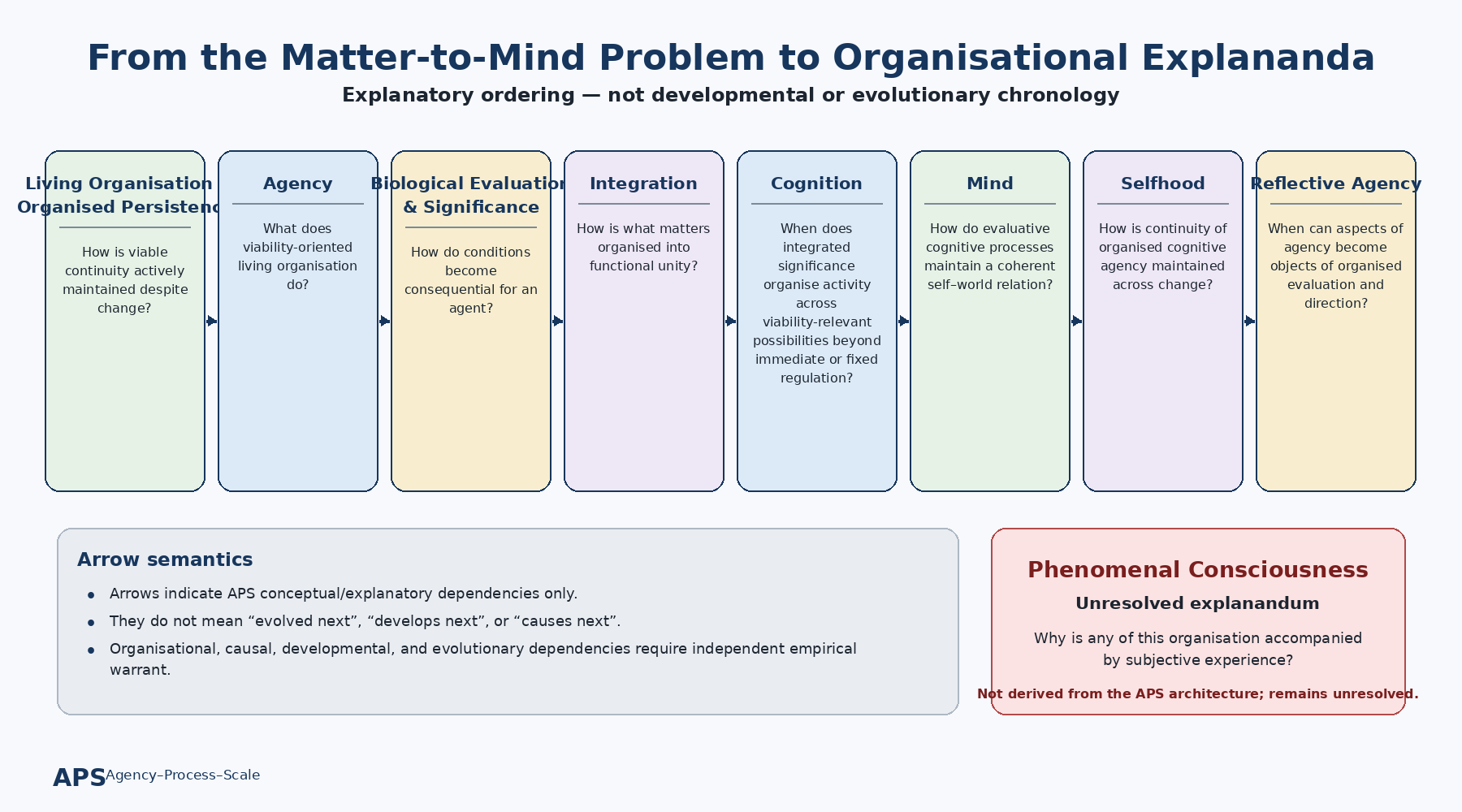
From the Matter-to-Mind Problem to Organisational Explananda. APS orders Life, Agency, Biological Evaluation, Significance, Integration, Cognition, Mind, Selfhood, and Reflective Agency as related explanatory questions. The ordering does not establish developmental or evolutionary chronology. Claims of material, causal, developmental, or evolutionary dependency require independent empirical warrant. Phenomenal consciousness remains a distinct unresolved explanandum.
Living Organisation and Organised Persistence
The biological part of the matter-to-mind problem begins with life.
APS defines life as viability-oriented, constraint-closed organisation. This organisation consists in the ongoing modulation of constraints through which a system actively maintains and re-establishes the conditions of its own persistence.
The relevant phenomenon is therefore not persistence in the generic sense. Non-living structures can persist. What requires biological explanation is organised persistence: the continuing activity through which living systems maintain themselves despite material turnover, disturbance, and changing conditions.
Work on biological autonomy, constraint closure, and endogenous regulation provides an important scientific and philosophical background to this view. Living organisation is not adequately characterised as a static arrangement of components. Its continuity depends upon mutually dependent processes and constraints whose activity contributes to maintaining the organisation within which those processes remain possible (Moreno and Mossio 2015; Montévil and Mossio 2015; Bich et al. 2016).
APS develops this organisational insight in viability-oriented terms (Spencer 2026). Conditions are not equivalent for a living system. Some support the continuation of its organisation; others impair or destroy it. This asymmetry provides the biological basis for normativity without requiring conscious judgement or an externally imposed purpose.
Living organisation is therefore non-indifferent to conditions because different conditions have different consequences for viability.
This does not require a separate force or intrinsic “direction” acting behind biological activity. Nor does it require organisms to represent survival as a goal. Viability orientation is expressed materially through the organisation and activity by which living systems maintain and re-establish the conditions of their own functioning.
That organised persistence establishes the biological setting within which agency and significance can be understood.
Agency: What Living Organisation Does
APS does not treat agency as a second entity added to life after self-maintenance has already been established.
Biological agency is viability-oriented organisational activity.
Agency is therefore what living systems do as the organisation of life is enacted and sustained. Organisms regulate internal processes, acquire resources, repair damage, alter activity under changing conditions, and interact selectively with their environments. Such activity need not involve intention, deliberation, consciousness, or representation.
This conception is compatible with approaches that connect biological agency to autonomy, normativity, adaptivity, and organised interaction while differing over how agency should ultimately be delimited (Di Paolo 2005; Barandiaran, Di Paolo, and Rohde 2009; Moreno and Mossio 2015). APS gives explanatory priority to viability-oriented organisation: agency is the present-tense activity through which that organisation operates.
Agency is context-sensitive because the consequences of conditions depend upon the state and organisation of the agent. A resource can be significant under one condition and irrelevant under another. The same environmental change can support viability in one context and undermine it in another.
The important transition here is therefore explanatory rather than historical. Once living organisation is considered as activity, biology must explain not only how organisation persists but how activity is modulated relative to conditions that make a difference to that persistence.
That is the problem addressed by biological evaluation.
Biological Evaluation and Significance
An agent exists amid innumerable conditions, only some of which make a difference to its viability.
APS calls the process through which those differences become biologically consequential Biological Evaluation.
Biological Evaluation is the process through which agency generates significance.
Evaluation in this sense is not judgement, deliberation, preference, or conscious appraisal. It is the viability-relative differentiation of conditions through organised activity. A condition can support functioning, compromise it, alter future possibilities, or make little difference within the relevant biological context.
The result is captured by the APS concept of Significance:
Significance is a relationally real product of biological evaluation.
It is relational because significance is not an intrinsic property carried by an environmental object independently of an organism. A chemical gradient, temperature change, obstacle, resource, or physiological disturbance becomes significant through its relation to an organised agent and the conditions of that agent’s viability.
This avoids two opposite mistakes: treating significance as merely subjective or mental, when biological significance can be real without being consciously experienced; and treating significance as a property simply present in information, when information can describe a difference without establishing why that difference matters to a particular living organisation.
Biological Evaluation therefore provides the relation through which conditions become significant for agency. This claim is conceptual within APS, while particular claims about how evaluation is materially realised must be established in the biological systems concerned.
Significance also remains distinct from cognition. A condition can matter to an organism without the organism possessing the temporal and counterfactual organisation required by the APS criterion for cognition.
The next explanatory question is therefore how multiple relations of significance become organised together.
Integration: Organising What Matters
Living systems rarely encounter biologically significant conditions one at a time.
Internal state, environmental opportunity, damage, resource availability, developmental condition, prior activity, and competing demands can all bear upon what the system does. Biological organisation must therefore coordinate relations that would otherwise remain functionally fragmented.
APS calls this Integration.
Integration is the organisation of what matters into functional unity.
Integration does not create significance; Biological Evaluation does that. Integration concerns the organisation of significant relations so that they can contribute coherently to ongoing activity.
Research on integrated biological control reinforces the importance of coordination within living organisation: biological regulation often depends not upon a single controller but upon organised relations among mutually constraining processes (Bich et al. 2016). APS extends this organisational question specifically to significance.
Integration can relate internal conditions to environmental circumstances, coordinate competing demands, connect activity across time, and organise multiple viability-relevant relations within a functional whole.
But integration alone is not cognition.
A biological system may exhibit elaborate coordination and regulation without thereby satisfying a useful cognitive criterion. If every sufficiently integrated regulatory process were called cognitive, the distinction between biological regulation and cognition would become difficult to maintain.
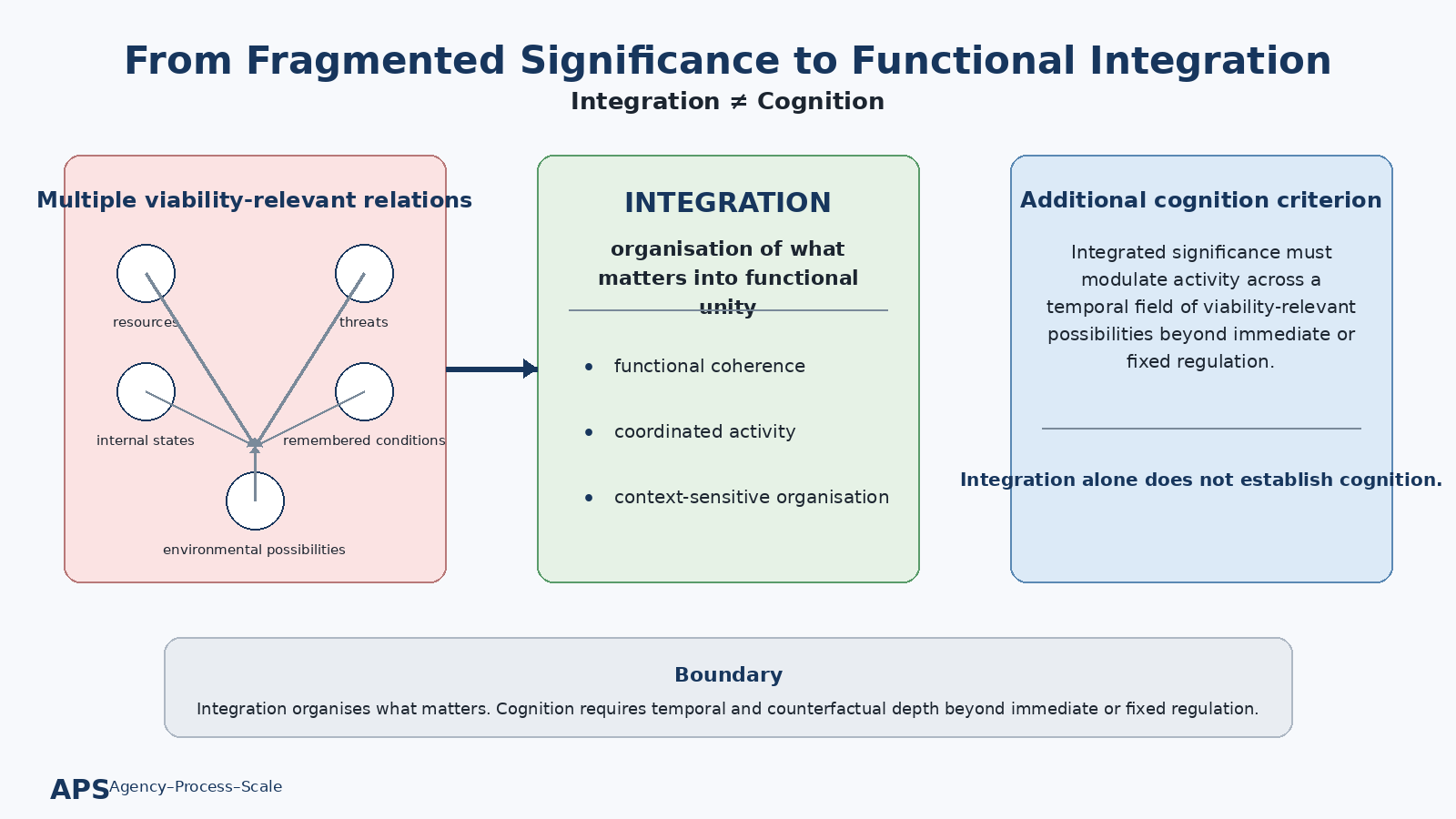
From Fragmented Significance to Functional Integration. Integration organises multiple viability-relevant relations into functional unity and coordinated activity. This organisation does not by itself establish cognition. In APS, cognition additionally requires integrated significance to modulate activity across a temporal field of viability-relevant possibilities beyond immediate or fixed regulation.
The explanatory boundary therefore lies not at integration alone but at what integrated significance can do across a field of possibilities.
Cognition: Organisation Across Viability-Relevant Possibilities
APS requires a stronger criterion for cognition than adaptive response, information processing, complexity, or integrated regulation alone.
The relevant distinction is between activity governed by what is immediately actual or fixed in advance and activity organised across a temporal field of viability-relevant possibilities.
The controlling APS formulation is:
Biological agency becomes cognitive when integrated biological significance modulates activity across a temporal field of viability-relevant possibilities in ways not exhausted by immediate or fixed regulation.
This criterion is intended to preserve continuity between life and cognition without making the two identical.
Research on minimal cognition has increasingly challenged assumptions that cognition must require human-like representation, language, or even a nervous system, while also raising the problem of how cognition can be distinguished from adaptive biological regulation generally (Lyon et al. 2021). APS addresses that boundary through temporal and counterfactual depth.
Past conditions can alter the significance of present conditions. Anticipated possibilities can modulate present activity. Learning can change how later situations are evaluated. Multiple possible trajectories can become relevant to current regulation.
What matters is not simply that a system has dispositions that would produce different outputs under different inputs. Every complex regulatory system can possess such conditional structure. Cognition requires that alternatives acquire operational relevance within the organisation of present activity.
The distinction is therefore between a system that merely could respond differently under another condition and one whose current activity is modulated by biologically significant possibilities extending beyond the immediately actual condition.
Work connecting biological regulation, active inference, and counterfactual cognition illustrates why this boundary is scientifically consequential even where theoretical interpretations differ (Corcoran, Pezzulo, and Hohwy 2020). APS does not adopt every theoretical commitment of those approaches. It uses the comparison to sharpen the explanandum.
Cognition, on this account, remains biologically grounded. It depends upon agency, significance, and integration as those concepts are specified within APS. But that is an explanatory and conceptual dependency. Whether particular cognitive capacities depend upon particular biological structures or evolved through particular historical transitions remains an empirical question.
Mind: Coherent Cognitive Self–World Organisation
Cognition does not exhaust the phenomena ordinarily associated with mind.
An organism may integrate significance across time and possibilities while leaving open a further question: how are multiple evaluative and cognitive processes organised into a coherent relation between the organism and its world?
APS uses Mind for this more specific explanatory target.
Mind consists in integrated evaluative cognitive processes maintaining a coherent self–world relation.
Mind is therefore not synonymous with consciousness. Nor is it merely another name for cognition or a quantitative increase in integration.
The concept identifies an organisation in which perception, evaluation, memory, anticipation, and action participate in a sufficiently coherent pattern that relations between the agent and its world are maintained across changing conditions.
This formulation shares concerns with embodied and enactive approaches that resist treating mind as an isolated internal computational domain and instead emphasise the organised relation between living agents and their worlds (Varela, Thompson, and Rosch 1991; Thompson 2007). APS nevertheless retains its own explanatory architecture and criteria.
The important point is not that cognition “turns into” mind at a universal biological threshold. The claim is that mind names a different explanandum. Where minded organisation is attributed, explanation must address not merely individual cognitive capacities but their integration into a coherent self–world relation.
That relation introduces a further question: what kind of continuity allows such organisation to remain organised as the system itself changes?
Selfhood: Continuity Across Change
Living systems change continuously. Their components turn over, their environments change, and their histories alter the conditions under which they act.
But biological persistence alone should not be identified with selfhood.
If every instance of self-maintenance were sufficient for selfhood, the concept would add little to the account of life already given. APS therefore reserves Selfhood for a more specific form of organised continuity relevant to minded and cognitive organisation.
Selfhood is continuity across change.
In the present context, it concerns the organisation through which a cognitive agent’s relations of significance, activity, and self–world coherence remain connected through transformation. It does not require an immutable inner entity. Nor is it identical to personal identity, reflective self-conception, or phenomenal consciousness.
Processual and embodied approaches provide useful resources for understanding why continuity need not mean material sameness (Varela, Thompson, and Rosch 1991; Thompson 2007). APS places that insight within its viability-oriented architecture.
Selfhood therefore concerns an active achievement of continuity rather than the persistence of an unchanging substance.
This claim should also be bounded carefully. APS does not infer from its definition that every mind must exhibit the same form of selfhood, that selfhood occurs at a universal biological threshold, or that evolutionary history passed through a discrete Mind → Selfhood transition.
The dependency is explanatory: if a biological system is to count as a continuing self in the relevant APS sense, its organisation must explain continuity of cognitive agency across change.
That opens the possibility of a further form of organisation in which aspects of agency themselves become objects of evaluation and modification.
Reflective Agency: Agency Directed Toward Agency
Agency acts. Reflective agency concerns the capacity for organised agency to become directed toward aspects of its own activity.
In APS, Reflective Agency refers to the capacity of a sufficiently organised self to evaluate, direct, and modify aspects of its own agency.
The concept should not be confused with ordinary biological evaluation. Biological Evaluation already occurs within agency and precedes cognition conceptually within APS. Reflective agency therefore does not introduce evaluation for the first time. It introduces a different relation: evaluative organisation can now bear upon the agent’s own patterns of activity, commitments, strategies, or organisation.
Reflective agency is also not synonymous with consciousness, self-awareness, or metacognition, although particular forms of reflection may involve them.
Human beings provide especially elaborate examples. People can examine reasons for action, reconsider commitments, alter habits, revise plans, coordinate long-term projects, and deliberately reshape aspects of their relations with other people and institutions. These capacities show how deeply self-directed agency can become organised.
They should not, however, be described as the “highest” point of a biological hierarchy. Nor does their existence establish that evolution follows a predetermined trajectory toward reflection.
Reflective agency is instead one especially elaborated form of self-directed biological organisation relevant to the matter-to-mind question.
The explanatory task is to determine what organisation makes such self-direction possible and how it is materially implemented—not to infer its history from its position in an APS diagram.
Awareness and the Availability of Significance
The word awareness creates a special difficulty because it is used in many different ways.
In ordinary language, awareness often implies conscious experience. In cognitive science and philosophy of mind, distinctions are commonly made between information or content being available for cognitive use and there being something it is like to experience that content. Block’s distinction between access-consciousness and phenomenal consciousness is one influential expression of this problem (Block 1995). Chalmers likewise distinguishes functional phenomena associated with awareness from the further problem of conscious experience (Chalmers 1995).
APS must therefore make its own usage explicit. At the broadest biological level, APS uses awareness technically for the availability of significance to organised activity, without implying that every organism displaying biological evaluation is phenomenally conscious.
Several distinctions are consequently required. Biological availability of significance occurs when viability-relevant differences are available to modulate organised agency. Cognitive awareness, where that term is appropriate, requires the stronger cognitive organisation described earlier: integrated significance operates across a temporal field of viability-relevant possibilities beyond immediate or fixed regulation. Self-awareness requires still more specification because some aspect of the organised self must itself become available within cognition. Phenomenal awareness or consciousness, by contrast, concerns subjective experience—whether and how there is something it is like for the organism.
These distinctions are analytic controls rather than claims that biology contains four discrete stages of awareness; their purpose is to prevent one explanatory achievement from being mistaken for another.
Most importantly, the broad APS concept of biological awareness must never be used to define the problem of phenomenal consciousness away.
Showing that significance is available to biological regulation does not show that the organism experiences that significance.
Showing that integrated significance supports cognition does not show why cognition is accompanied by experience.
Showing that a system possesses coherent self–world organisation does not show why there should be something it is like to instantiate that organisation.
The matter-to-mind problem becomes clearer when these questions are separated.
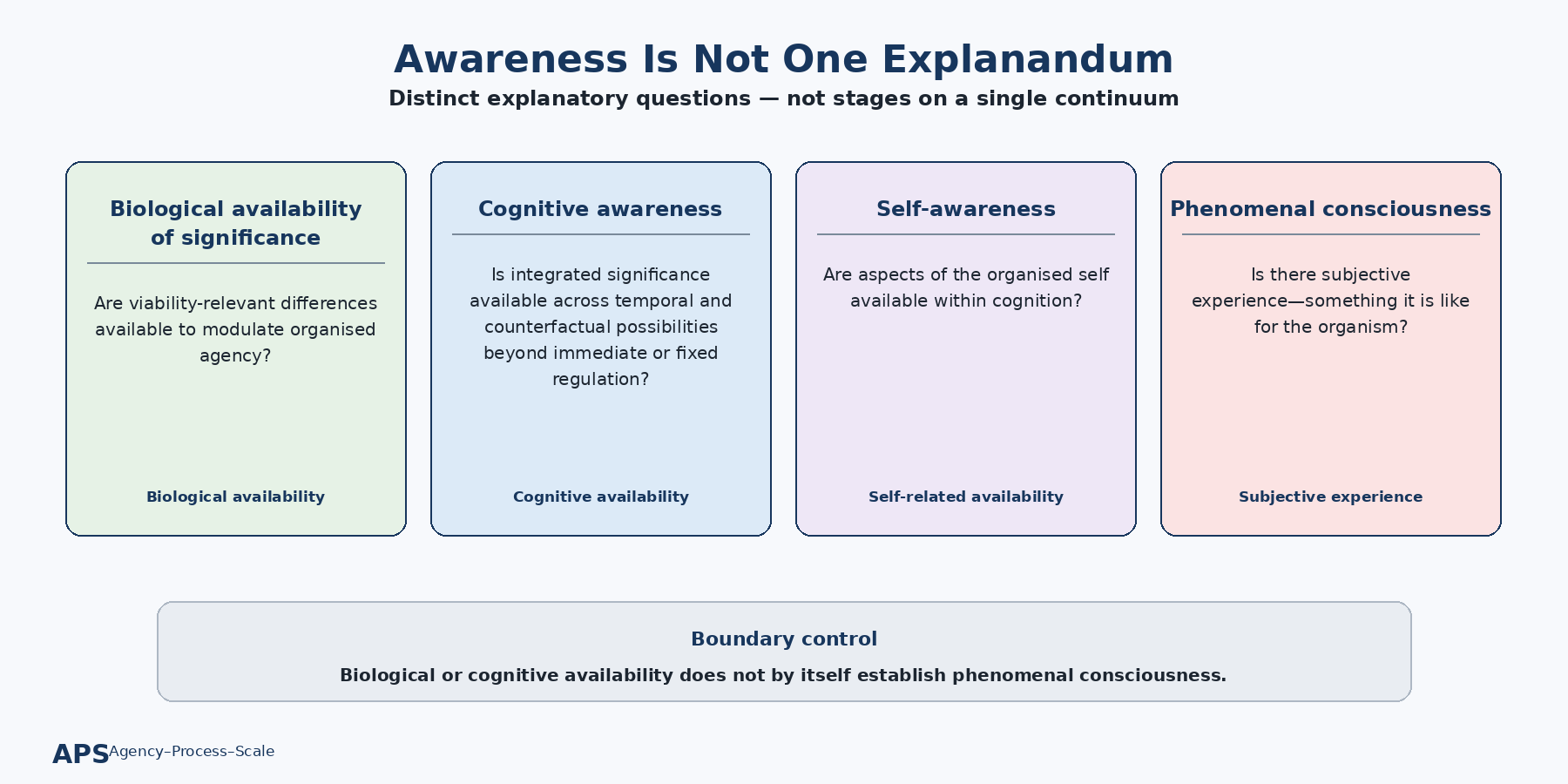
Awareness Is Not One Explanandum. APS distinguishes the biological availability of significance, cognitive awareness, self-awareness, and phenomenal consciousness. These distinctions organise different explanatory questions; they do not represent four established biological stages. Biological or cognitive availability does not by itself establish subjective experience.
Does This Explain Consciousness?
No—not if “explain consciousness” means explain why subjective experience exists.
APS does not presently explain why any biological organisation should be accompanied by phenomenal experience. It does not derive consciousness from constraint closure, agency, significance, integration, cognition, mind, or selfhood. Nor does it claim that identifying organisational prerequisites eliminates the philosophical problem of experience.
This limitation parallels a central distinction in consciousness research. Functional questions concerning discrimination, integration, cognitive availability, report, memory, and control can be investigated without thereby resolving why those functions should be accompanied by experience (Block 1995; Chalmers 1995).
APS therefore makes a more restricted claim: it decomposes the matter-to-mind problem into biologically tractable organisational questions.
-
How does living organisation maintain itself?
-
How does that organisation act relative to viability?
-
How do conditions become significant?
-
How is significance integrated?
-
When does integrated regulation acquire sufficient temporal and counterfactual depth to count as cognition?
-
How can cognitive processes maintain coherent self–world relations?
-
How is such organisation continuous through change?
-
Under what conditions can agency become directed toward aspects of its own organisation?
These questions do not solve phenomenal consciousness. But neither are they trivial preliminaries. They identify substantial explanatory work that can be pursued biologically without pretending that the remaining problem has disappeared.
APS therefore decomposes the explanatory gap rather than claiming to close it.
What the Matter-to-Mind Architecture Establishes
The architecture developed in this article establishes a disciplined relationship among explanatory questions. Life identifies viability-oriented, constraint-closed organisation and the problem of organised persistence, while Agency identifies the activity through which that organisation is enacted. Biological Evaluation identifies the viability-relative process through which agency generates significance, and Significance identifies the relational reality of what matters for an agent. Integration then identifies the organisation of what matters into functional unity.
Cognition identifies a stronger organisation in which integrated significance modulates activity across a temporal field of viability-relevant possibilities beyond immediate or fixed regulation. Mind identifies integrated evaluative cognitive organisation maintaining a coherent self–world relation, while Selfhood identifies continuity of such organised cognitive agency across change. Reflective Agency identifies the possibility that aspects of agency itself become subject to organised evaluation and direction. Awareness, used biologically, concerns the availability of significance within these forms of organisation; phenomenal consciousness remains a separate unresolved explanandum.
What this architecture establishes are conceptual and explanatory relations within APS. It specifies distinctions that biological explanation must respect if these concepts are to do different scientific work, identifies candidate organisational dependencies that can be investigated empirically, and prevents a single word such as mind, awareness, or consciousness from carrying several explanatory burdens at once.
What the architecture does not establish is equally important. It does not show that evolution passed through these concepts as discrete stages, that every lineage develops increasingly elaborate cognition, or that each relation corresponds to a single biological transition. Nor does it show that conceptual dependency is causal dependency or that phenomenal consciousness follows from the architecture. Those remain separate questions, and the strength of the architecture lies not in making them unnecessary but in making them visible.
Conclusion: From Explanatory Gap to Organisational Questions
How did matter become aware of itself?
APS does not answer this by proposing a moment at which matter crossed a boundary and became mind, nor does it replace that leap with a predetermined ladder running from simple life toward reflective humanity. It changes the explanatory problem.
Once living organisation exists, conditions can make different contributions to viability. Through agency, those differences can modulate activity; through Biological Evaluation, they acquire significance; and through Integration, what matters can become functionally organised. Under sufficiently deep temporal and counterfactual organisation, integrated significance can participate in cognition. Cognitive organisation can, in turn, raise further questions about mind, continuity of selfhood, and the capacity of agency to become directed toward itself. These are related explananda, not automatically historical stages, and their relations become biological claims only when the relevant dependencies are specified and empirically warranted. APS architecture cannot substitute for that work.
This methodological restriction also clarifies what remains unexplained. Biological availability of significance is not phenomenal consciousness; cognition is not consciousness; and mind, selfhood, and reflective agency do not by themselves explain subjective experience.
The matter-to-mind problem therefore does not disappear. It becomes differentiated.
Part of the original mystery can be reformulated as questions about organised persistence, agency, evaluation, significance, integration, temporal organisation, self–world coherence, continuity, and self-direction. These questions can increasingly be connected to material biological organisation and subjected to empirical investigation. Another part remains: why any of this organisation should be accompanied by experience. APS leaves that question open.
Its contribution is more disciplined and, for biology, more useful. It asks how far the explanatory distance between matter and mind can be traversed through increasingly precise accounts of living organisation—and marks clearly where those accounts cease to be sufficient. Matter did not need to acquire a mysterious additional substance for biology to confront the matter-to-mind problem; it needed to become organised in ways that made viability, significance, cognition, self–world relations, continuity, and self-direction possible explananda.
Understanding those forms of organisation does not complete the explanation of consciousness. It tells us more precisely what has been explained, what remains to be tested, and what still remains unknown.
See Also
Related Articles
References
- (2009). Defining Agency: Individuality, Normativity, Asymmetry, and Spatio-temporality in Action. Adaptive Behavior, 17(5), 367–386 . https://doi.org/10.1177/1059712309343819
- (2016). Biological Regulation: Controlling the System from Within. Biology & Philosophy, 31(2), 237–265 . https://doi.org/10.1007/s10539-015-9497-8
- (1995). On a Confusion about a Function of Consciousness. Behavioral and Brain Sciences, 18(2), 227–247 . https://doi.org/10.1017/S0140525X00038188
- (1995). Facing Up to the Problem of Consciousness. Journal of Consciousness Studies, 2(3), 200–219 .
- (2020). From Allostatic Agents to Counterfactual Cognisers: Active Inference, Biological Regulation, and the Origins of Cognition. Biology & Philosophy, 35(3) . https://doi.org/10.1007/s10539-020-09746-2
- (2005). Autopoiesis, Adaptivity, Teleology, Agency. Phenomenology and the Cognitive Sciences, 4(4), 429–452 . https://doi.org/10.1007/s11097-005-9002-y
- (2021). Reframing Cognition: Getting Down to Biological Basics. Philosophical Transactions of the Royal Society B, 376(1820) . https://doi.org/10.1098/rstb.2019.0750
- (2015). Biological Organisation as Closure of Constraints. Journal of Theoretical Biology, 372, 179–191 . https://doi.org/10.1016/j.jtbi.2015.02.029
- (2015). Biological Autonomy: A Philosophical and Theoretical Enquiry. Springer. https://doi.org/10.1007/978-94-017-9837-2
- (2026). Agency as the Defining Activity of Life: A Viability-Oriented Framework Integrating Process and Scale. Biological Theory . https://doi.org/10.1007/s13752-026-00547-6
- (2007). Mind in Life: Biology, Phenomenology, and the Sciences of Mind. Harvard University Press.
- (1991). The Embodied Mind: Cognitive Science and Human Experience. MIT Press.