What Is Reflective Agency?
Reflective agency is the capacity of a persistent self to evaluate, direct, and transform its own agency. While agency enables living systems to act, cognition enables evaluation, mind enables coherent self–world organisation, and selfhood enables continuity through time, reflective agency introduces the possibility of self-directed transformation. Through reflective agency, agents become capable of examining and reshaping their goals, commitments, values, and modes of action. APSI therefore treats reflective agency as a distinct organisational achievement emerging from agency, cognition, mind, and selfhood. Reflective agency occupies a pivotal position between selfhood and meaning and provides the foundation for responsibility, deliberate self-change, value formation, and reflective forms of meaning.
Key Points
- Reflective agency is the capacity of a persistent self to evaluate, direct, and transform its own agency.
- Reflective agency emerges from agency, cognition, mind, and selfhood but is not reducible to any of them.
- Selfhood explains persistence; reflective agency explains self-directed persistence.
- Reflective agency is distinct from consciousness, self-awareness, metacognition, and autonomy.
- Reflective agency provides the bridge between selfhood and meaning.
- Through reflective agency, living systems become active participants in shaping their own future organisation.
Introduction
Living systems do more than simply react to their environments. They regulate their activities, coordinate responses, learn from experience, and maintain continuity despite continual change. Through agency, cognition, mind, and selfhood, living systems become increasingly capable of organising their interactions with the world. Yet a further question remains: how does a living system become capable of directing itself?
This question points toward a distinctive form of organisation that extends beyond action, evaluation, coherence, and persistence. Many organisms act in ways that sustain their existence. Some evaluate conditions and modify behaviour accordingly. Others maintain coherent relationships with their environments and preserve continuity across time. But reflective agency introduces an additional possibility. It enables a living system to become an active participant in shaping its own future organisation.
Humans provide the clearest examples. People can examine their own actions, reconsider commitments, revise goals, adopt new values, and deliberately alter patterns of behaviour. They can ask not only what they should do, but what kind of person they wish to become. Such questions involve more than adaptation to circumstances. They involve agency directed toward agency itself.
Within APSI, reflective agency addresses this capacity for self-directed transformation. It explains how a persistent self becomes capable of evaluating, directing, and transforming its own agency. Rather than simply maintaining continuity through change, reflective agents can participate in determining the direction of that change. Reflective agency therefore represents a distinctive achievement within the broader organisation of life, linking persistent selfhood to the emergence of meaning, values, responsibility, and deliberate self-development.
Why Reflective Agency Is Difficult to Define
Reflective agency is often confused with several related concepts. It is commonly associated with consciousness, self-awareness, introspection, metacognition, autonomy, or rational thought. Each of these concepts captures an aspect of reflective life, but none adequately defines reflective agency itself.
One source of confusion is the tendency to equate reflection with awareness. A person who is aware of themselves, their thoughts, or their experiences is often described as reflective. Yet awareness alone is insufficient. A system may possess self-awareness without directing or transforming its behaviour. Knowing oneself is not the same as directing oneself.
A second source of confusion arises from metacognition. Reflective agency clearly involves the ability to examine beliefs, evaluate decisions, and reconsider patterns of thought. However, metacognition concerns cognition about cognition. Reflective agency is broader. Agents may reflect not only upon thoughts but also upon goals, commitments, relationships, values, and forms of action. Reflection therefore extends beyond cognition to agency itself.
Reflective agency is also sometimes treated as synonymous with autonomy. Autonomous systems govern themselves rather than being wholly directed from outside. Yet autonomy alone is not enough. Cells, plants, and many animals exhibit forms of biological autonomy without appearing capable of deliberately evaluating and redirecting their own agency. Reflective agency requires a further capacity for self-directed change.
These distinctions indicate that reflective agency cannot be reduced to awareness, cognition, autonomy, or consciousness. Instead, it occupies a distinctive explanatory domain. It concerns the capacity of agents to become objects of their own evaluation and participants in their own transformation. The challenge is therefore not simply to explain how agents act, but how agents become capable of directing the ways in which they act.
Reflective Agency in APSI
APSI defines reflective agency as the capacity of a persistent self to evaluate, direct, and transform its own agency. Through reflective agency, living systems become capable of acting upon themselves as agents, shaping their future organisation, commitments, values, and patterns of action.
This definition places reflective agency within a broader architecture of biological organisation. Agency enables living systems to act. Significance distinguishes what matters for continued existence. Cognition integrates significance across time, while mind organises cognition and significance into coherent self–world relations. Selfhood provides continuity through change. Reflective agency emerges when this persistent organisation becomes capable of evaluating and directing itself.
Reflective agency therefore occupies a distinctive position within the APSI architecture:
Agency enables action.
Cognition enables evaluation.
Mind enables coherent self–world organisation.
Selfhood enables persistence.
Reflective agency enables self-direction.
The emergence of reflective agency marks a significant organisational transition. Earlier forms of agency allow living systems to regulate their interactions with the world. Reflective agency allows agents to examine, redirect, and transform those interactions. It introduces the possibility that the organisation of agency itself can become the subject of evaluation.
This transition can be understood as the movement from persistence to self-direction. Selfhood explains how a living system remains itself despite continual change. Reflective agency explains how that persistent self becomes capable of influencing what it will become. A reflective agent is therefore not merely an organised system maintaining continuity through time. It is a system capable of participating in the organisation of its own future.
For this reason, reflective agency occupies a pivotal position within APSI. It provides the bridge between persistent selfhood and the emergence of reflective forms of meaning, value, purpose, and responsibility. Through reflective agency, living systems become more than adaptive participants in their environments. They become active participants in shaping themselves.
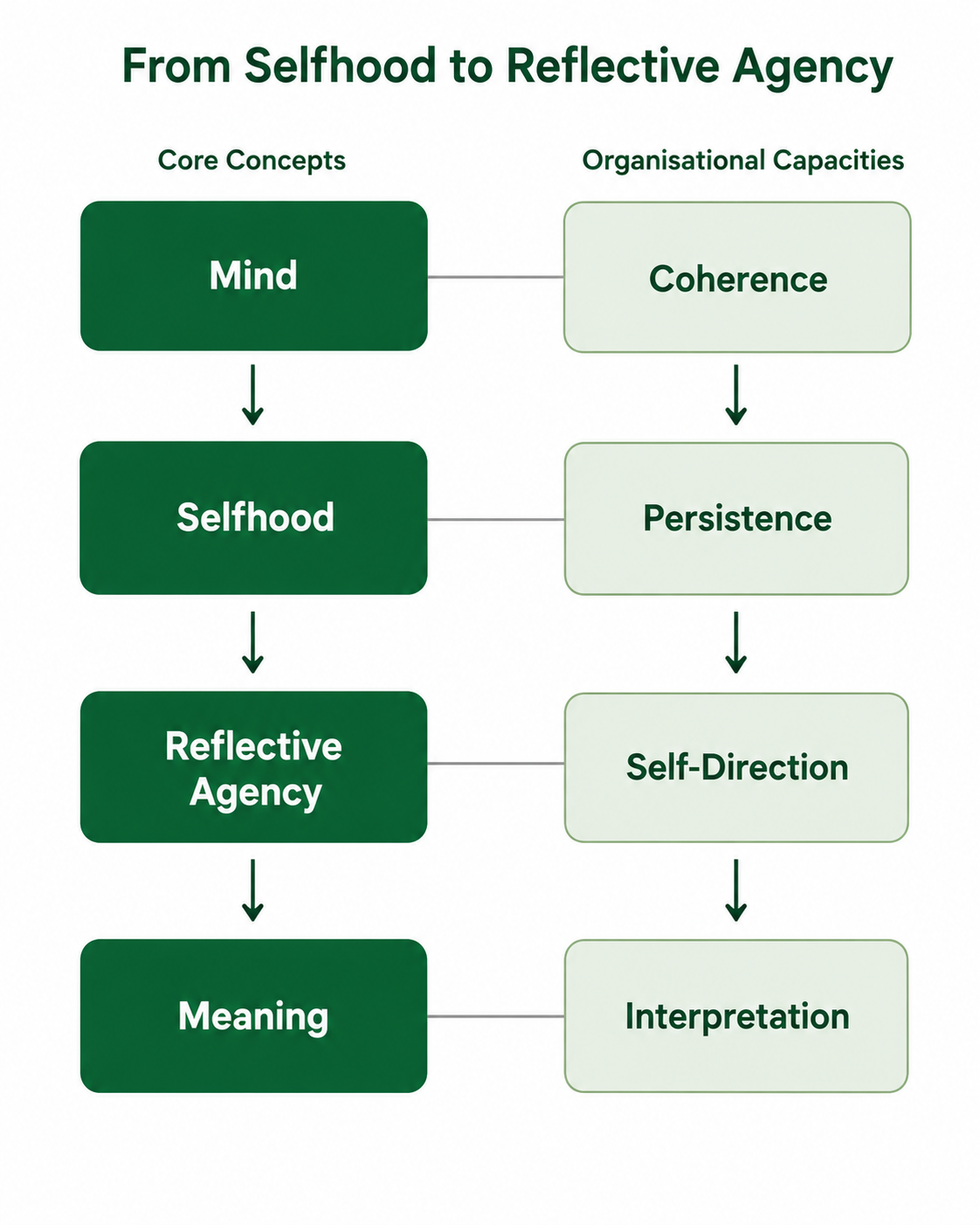
From Selfhood to Reflective Agency. APSI situates reflective agency between selfhood and meaning. Mind establishes coherent self–world organisation, selfhood maintains persistent self–world organisation through time, reflective agency enables self-directed self–world organisation, and meaning emerges through the interpretation of organised significance.
From Persistence to Self-Direction
The transition from selfhood to reflective agency marks one of the most significant developments within the APSI architecture. Selfhood explains how living systems maintain continuity despite continual material, developmental, cognitive, and experiential change. Reflective agency explains how a persistent self becomes capable of participating in the direction of that change. The difference is subtle but profound. Selfhood concerns remaining oneself through change. Reflective agency concerns influencing what that self becomes.
This distinction emerges naturally from the progression established throughout the cognition–mind cluster. Agency enables living systems to act. Cognition enables them to evaluate conditions and organise significance across time. Mind enables coherent self–world organisation. Selfhood enables continuity through change. Reflective agency introduces a new possibility: self-directed persistence. A reflective agent does not merely continue through time. It becomes capable of evaluating and influencing the trajectory of its own development.
Persistence alone cannot explain this capacity. A living system may remain organised despite continual change without becoming capable of directing that organisation. Cells maintain continuity. Plants maintain continuity. Many animals maintain continuity. Selfhood therefore explains how living systems remain themselves, but not how they become capable of deliberately shaping themselves. The persistence of organisation is a necessary condition for reflection, but it is not sufficient.
Reflective agency emerges when a persistent self becomes an object of its own evaluation. The agent can now examine its actions, assess its commitments, reconsider its goals, and modify patterns of behaviour in light of those assessments. Rather than simply responding to changing circumstances, reflective agents become capable of responding to themselves. Agency becomes directed toward agency.
This transition introduces a distinctive form of biological organisation. Through reflective agency, a living system can participate in shaping its own future organisation. The agent is no longer merely maintaining continuity. It is actively influencing the form that continuity will take. Reflective agency therefore represents the movement from persistence to self-direction and from continuity through change to self-directed transformation.
Reflective Agency Is Not Consciousness
Reflective agency is often associated with consciousness because reflective thought is a familiar feature of conscious human experience. People frequently examine their beliefs, question their motivations, reconsider decisions, and imagine alternative futures. These activities are commonly described as reflective. However, reflective agency and consciousness address different explanatory questions.
Consciousness concerns experience. It refers to the subjective character of perception, feeling, awareness, and thought. Questions about consciousness ask what it is like to experience the world or to be a particular kind of organism. Reflective agency addresses a different issue. It concerns the capacity of a persistent self to evaluate, direct, and transform its own agency.
The distinction is important because awareness alone does not explain self-direction. A system may possess experiences without becoming capable of examining or redirecting the organisation of its agency. Conversely, some forms of self-directed organisation may involve capacities that are not easily reduced to subjective experience alone. The explanatory focus of reflective agency is therefore not the existence of experience but the organisation of agency.
APSI consequently treats consciousness and reflective agency as related but distinct concepts. Consciousness concerns what is experienced. Reflective agency concerns what agents do with themselves. Although reflective agency may often be associated with conscious reflection in humans, its defining feature is not experience itself but the capacity for self-directed transformation.
This distinction allows APSI to remain neutral regarding unresolved debates about consciousness while still providing a robust account of reflective organisation. The question of reflective agency is not whether an agent has experiences, but whether it can evaluate and direct its own agency.
Reflective Agency Is Not Self-Awareness
Reflective agency is also frequently confused with self-awareness. The confusion is understandable because reflective agents often possess sophisticated forms of self-knowledge. They can recognise themselves as individuals, monitor their behaviour, and identify aspects of their own psychological and social lives. Yet self-awareness and reflective agency are not the same phenomenon.
Self-awareness concerns knowing oneself. It involves recognising one’s own existence, characteristics, actions, or mental states. Reflective agency concerns directing oneself. It involves evaluating and transforming the organisation of one’s agency rather than merely recognising it.
A person may be highly self-aware while making little effort to alter established patterns of behaviour. Awareness does not automatically generate self-direction. Knowing that one possesses a particular habit, belief, or disposition does not necessarily imply the capacity or willingness to transform it. Reflection requires something more than recognition. It requires evaluation, direction, and change.
At the same time, self-awareness often contributes to reflective agency. The ability to recognise aspects of oneself can provide information that supports self-evaluation and self-direction. Self-awareness may therefore function as an important enabling condition for reflective agency. Nevertheless, it remains only one component of a broader organisational process.
Within APSI, the distinction can be expressed simply. Self-awareness concerns knowledge of oneself. Reflective agency concerns participation in shaping oneself. The former identifies the object of reflection. The latter explains the capacity to act upon it.
Reflective Agency Is Not Metacognition
Reflective agency is sometimes defined as metacognition, or cognition about cognition. Metacognition includes the ability to monitor thinking, evaluate beliefs, assess reasoning, and regulate cognitive processes. These capacities are clearly relevant to reflection, but they do not fully capture what reflective agency explains.
Metacognition focuses primarily on cognitive activity. It concerns how agents think about their own thinking. Reflective agency extends beyond cognition to agency itself. Reflective agents may evaluate not only beliefs and decisions but also goals, commitments, values, relationships, identities, and patterns of action. Reflection therefore operates across the broader organisation of the self rather than being restricted to cognitive processes alone.
The distinction becomes particularly important when considering deliberate self-transformation. A person may reflect upon a belief and revise it. This involves metacognition. However, a person may also reconsider a life goal, alter a long-standing commitment, change a pattern of behaviour, or adopt a new system of values. Such changes involve agency more broadly and cannot be reduced to cognition alone.
Metacognition should therefore be understood as one possible mechanism through which reflective agency operates. It provides tools that support reflection, but it does not define reflection itself. Reflective agency concerns the evaluation and direction of agency as a whole, including but not limited to cognition.
This broader perspective prepares the way for the next stages of the APSI architecture. Once reflective agency is understood as the capacity for self-directed transformation, it becomes possible to examine its relationship to selfhood, its emergence across the living world, and its role in the development of meaning, values, and purpose.
Reflective Agency and Selfhood
Reflective agency emerges from selfhood but cannot be reduced to it. The two concepts occupy neighbouring positions within the APSI architecture and together explain one of the most important transitions in the organisation of living systems. Selfhood explains how agency, significance, cognition, and mind maintain continuity through time. Reflective agency explains how that continuity becomes capable of directing itself.
This relationship can be understood through the distinction between persistence and self-direction. Selfhood provides persistence. It explains how a living system remains itself despite continual material, developmental, cognitive, and experiential change. Reflective agency builds upon this foundation by introducing the possibility that a persistent self can evaluate and influence its own future organisation. A reflective agent is therefore not merely a system that persists. It is a system that participates in determining how it will persist.
This distinction reveals why selfhood is a necessary precursor to reflective agency. Reflection requires an enduring organisational subject. A system cannot evaluate and transform itself unless there is sufficient continuity for that self-relation to exist. Selfhood provides that continuity. Through selfhood, agency, significance, cognition, and mind remain integrated across time. Reflective agency emerges when this persistent organisation becomes capable of acting upon itself.
The relationship can therefore be summarised simply. Mind explains coherent self–world organisation. Selfhood explains persistent self–world organisation. Reflective agency explains self-directed self–world organisation. Together these concepts describe successive forms of biological organisation through which living systems become increasingly capable of participating in their own development.
Reflective Agency Across the Living World
The emergence of reflective agency raises an important question. Is reflective agency present throughout the living world, or does it appear only under particular organisational conditions?
APSI suggests a middle position between these extremes. Reflective agency does not appear suddenly as an entirely new phenomenon, nor is it distributed uniformly across all forms of life. Instead, it emerges gradually from capacities already present within agency, cognition, mind, and selfhood, while requiring a threshold of organisational complexity before becoming fully possible.
Cells provide the earliest foundations. Cellular systems exhibit agency, evaluation, regulation, and persistence. They maintain themselves, respond to changing conditions, and coordinate activity in ways that support continued existence. Yet there is little reason to attribute reflective agency to cells. Cellular organisation appears directed toward maintaining viability rather than evaluating or transforming its own agency.
Plants display more sophisticated forms of agency and cognition. They integrate information from multiple environmental sources, exhibit memory-like processes, and coordinate responses across distributed systems. APSI interprets these capacities as evidence of agency, significance, cognition, and perhaps rudimentary forms of minded organisation. However, current evidence provides little support for the claim that plants evaluate and direct themselves as agents. Their activities remain primarily oriented toward environmental engagement rather than self-directed transformation.
Animals introduce increasingly complex forms of cognition, behavioural flexibility, and minded organisation. Learning, anticipation, social behaviour, and strategic adaptation become progressively more sophisticated across many lineages. In some species, particularly highly social mammals, the distinction between environmental regulation and self-regulation becomes less clear. These capacities may represent important precursors to reflective agency.
Humans currently provide the clearest examples of reflective agency. People can evaluate goals, revise commitments, alter habits, question assumptions, and deliberately reshape aspects of their own lives. They can ask what matters, why it matters, and whether it should continue to matter. Such capacities exemplify the self-directed transformation that defines reflective agency.
This pattern suggests a developmental principle. Reflective agency has gradual origins but threshold emergence. The capacities from which it develops are distributed broadly throughout life, yet reflective agency itself appears only when agency, cognition, mind, and selfhood become sufficiently integrated to support self-directed organisation. APSI therefore treats reflective agency as an emergent achievement rather than a universal property of life.
Reflective Agency and Meaning
Reflective agency occupies a pivotal position between selfhood and meaning. Selfhood explains how organised continuity is maintained through time. Meaning concerns how significance becomes organised within the life of an agent. Reflective agency provides the bridge between them by enabling agents to participate in shaping the significance structures through which they live.
Earlier forms of biological meaning arise through significance. Conditions matter because they affect viability, functioning, and persistence. Through cognition and mind, significance becomes organised into coherent patterns of engagement with the world. Meaning therefore emerges as significance organised within the activities of living systems.
Reflective agency introduces a further possibility. Agents can now evaluate not only environmental conditions but also the significance structures through which they interpret those conditions. They can reconsider goals, revise commitments, alter priorities, and transform systems of value. In doing so, they become participants in the ongoing organisation of meaning.
This transition has far-reaching implications. Values become possible when agents can evaluate what matters. Commitments become possible when agents can direct themselves toward particular forms of action. Purpose becomes possible when agents can organise behaviour around self-endorsed orientations. Morality becomes possible when agents can evaluate not only consequences but also the principles and values guiding action. Worldviews emerge when significance becomes organised into broader systems of interpretation.
Reflective agency therefore enables what might be called self-directed meaning. Meaning is no longer simply inherited from biological organisation or immediate circumstances. It becomes something that can be examined, revised, defended, rejected, and transformed. Through reflective agency, living systems become capable of participating in the organisation of what matters.
For this reason, reflective agency serves as the natural bridge between the biological foundations of significance and the more complex domains of value, purpose, morality, and existential meaning. It links the persistence of selfhood to the interpretation of significance.
Why Reflective Agency Matters
Reflective agency matters because it explains something that no other concept within APSI adequately explains. Agency explains action. Cognition explains evaluation. Mind explains coherence. Selfhood explains persistence. Yet none of these concepts explains how a persistent self becomes capable of directing and transforming its own agency.
Without reflective agency, APSI can explain how living systems act, evaluate conditions, maintain coherent engagement with the world, and preserve continuity through change. What remains unexplained is how agents become active participants in shaping the future organisation of those processes. The transition from persistence to self-direction would remain conceptually unaccounted for.
This gap becomes particularly visible in human life. People do not merely respond to circumstances. They reconsider goals, revise beliefs, alter habits, adopt new values, and intentionally reshape patterns of behaviour. Such activities cannot be adequately described as agency alone, because the object of action is often the organisation of agency itself. Nor can they be reduced to cognition, mind, or selfhood. Each contributes to reflection, but none explains self-directed transformation.
Reflective agency therefore occupies a distinct explanatory domain. It explains how living systems become capable of evaluating, directing, and transforming their own modes of action. It accounts for the emergence of deliberate self-development, responsibility, commitment, and many forms of reflective meaning.
Within APSI, reflective agency completes a developmental sequence that begins with action and culminates in self-direction. Agency acts. Cognition evaluates. Mind coheres. Selfhood persists. Reflective agency self-directs. Together these concepts describe increasingly sophisticated forms of biological organisation through which living systems become participants in their own development.
Conclusion — Reflective Agency as Self-Directed Transformation
Reflective agency represents a distinctive achievement within the organisation of life. It emerges from agency, cognition, mind, and selfhood, yet cannot be reduced to any of them. Its defining contribution is the introduction of self-direction into the architecture of biological organisation.
Agency enables living systems to act. Cognition enables them to evaluate. Mind enables coherent self–world organisation. Selfhood enables continuity through change. Reflective agency enables a persistent self to become an active participant in shaping its own future organisation. Through reflection, agency becomes capable of acting upon itself.
Reflective agency should therefore not be understood as merely consciousness, self-awareness, or metacognition. Each may contribute to reflection, but none captures its defining role. Reflective agency concerns the capacity of a persistent self to evaluate, direct, and transform its own agency. It is the organisational basis of self-directed change.
Through reflective agency, living systems become more than adaptive participants in their environments. They become active participants in their own becoming. They can evaluate what matters, reconsider commitments, redirect patterns of action, and influence the trajectories through which their lives unfold. Reflection transforms persistence into self-directed persistence and continuity into self-directed transformation.
Reflective agency also prepares the way for a deeper understanding of meaning. Once agents become capable of directing themselves, they become capable of directing the significance structures through which they interpret themselves and the world. The question is no longer simply how living systems act or persist, but how they understand, organise, and transform what matters.
For APS, this transition marks an important stage in a larger explanatory journey. From agency and significance through cognition, mind, selfhood, and reflective agency, the organisation of life becomes increasingly capable of participating in its own development. Reflective agency therefore stands at the threshold of meaning and points toward one of the deepest questions in the APS research programme: how organised matter became capable not only of sustaining itself, but of understanding and shaping itself.
See Also
Related Articles
References
- (2009). Defining Agency: Individuality, Normativity, Asymmetry, and Spatio-temporality in Action. Adaptive Behavior, 17(5), 367–386 . https://doi.org/10.1177/1059712309343819
- (2011). Specifying the Self for Cognitive Neuroscience. Trends in Cognitive Sciences, 15(3), 104–112 . https://doi.org/10.1016/j.tics.2011.01.001
- (2005). Autopoiesis, Adaptivity, Teleology, Agency. Phenomenology and the Cognitive Sciences, 4(4), 429–452 . https://doi.org/10.1007/s11097-005-9002-y
- (2018). A Manifesto for a Processual Philosophy of Biology. Oxford University Press.
- (2015). Biological Autonomy. Springer.
- (2026). Agency as the Defining Activity of Life. Biological Theory . https://doi.org/10.1007/s13752-026-00547-6
- (2007). Mind in Life. Harvard University Press.
- (1991). The Embodied Mind. MIT Press.