Where Do Human Values Come From?
Human values emerge from the evaluative capacities of living systems but are transformed by language, culture, symbolic cognition, social learning, and institutions. Within APS, human values are continuous with biological values because both arise from meaning and evaluation, yet they are not identical to biological values because human values become shared, reflective, historically transmitted, and normatively organised. This article explains how biological valuation becomes human valuation and prepares the transition from biological values to morality.
Key Points
- Human values emerge from biological valuation but are not reducible to it.
- Language, culture, symbolic cognition, social learning, and institutions transform biological values into shared human values.
- Human values provide the immediate foundation for morality while preserving continuity with the wider organisation of life.
Introduction
Human values shape nearly every aspect of human life. They influence how people make decisions, organise societies, raise children, create institutions, and judge what is right or wrong. Values such as fairness, honesty, responsibility, freedom, compassion, and justice often appear very different from the biological concerns associated with survival, reproduction, or adaptation. Because of this difference, human values are sometimes treated as entirely separate from biology, arising solely from culture, religion, philosophy, or personal choice.
Yet human beings are living organisms. Like all organisms, humans perceive significance in their environments, evaluate conditions according to their consequences, and act in ways that support their continued functioning and adaptive persistence. The values that guide human societies therefore did not emerge from nowhere. They developed from capacities already present in biological systems, even though they have been transformed in uniquely human ways.
Within the Agency–Process–Scale (APS) framework, human values are understood as an evolutionary and cultural extension of biological valuation. They arise from the same fundamental processes of agency, meaning, and evaluation that characterise life more generally, but they become reshaped through symbolic cognition, language, culture, social learning, and institutional organisation. Human values are therefore continuous with biological values without being reducible to them.
Human Values Are Not Biological Values
Human values differ from biological values in important respects. Biological values emerge from the requirements of organised persistence. Conditions become valuable because they contribute to viability, functioning, and adaptive persistence. Water, nutrients, shelter, cooperation, and offspring care are valuable because they support the continuation of living systems.
Human values often concern matters that extend beyond immediate biological requirements. People may value justice, truth, artistic expression, religious commitment, environmental protection, or political freedom. Such values frequently involve symbolic meanings, shared traditions, abstract principles, and long-term social goals. Individuals may even sacrifice immediate biological interests in order to uphold values they regard as important.
These differences are real, but they should not be mistaken for a complete separation between biological and human values. Human values are not detached from the biological world. Rather, they emerge from organisms already capable of perceiving significance, evaluating conditions, and assigning importance to aspects of their environments. The challenge is therefore not to choose between biological and cultural explanations but to understand how biological valuation becomes transformed into human valuation.
Human Values Grow from Biological Valuation
The foundations of human values lie in processes already visible throughout life. Living systems continuously distinguish among conditions according to their significance for continued functioning and adaptive persistence. Through agency, meaning, and evaluation, organisms identify opportunities, threats, resources, and relationships that matter. Repeated evaluations stabilise into biological values that help guide behaviour and regulation.
Human beings inherit these biological capacities. Like other organisms, humans are agents capable of perceiving significance, evaluating circumstances, learning from experience, and modifying behaviour accordingly. Human valuation therefore begins with the same underlying processes that support biological agency more generally. The pathway from biological values to human values does not begin with culture or morality but with the evaluative capacities already present in living systems.
What distinguishes humans is not the existence of valuation itself but the expansion of valuation through increasingly sophisticated forms of cognition. Humans can reflect upon values rather than merely express them through behaviour. They can compare competing values, imagine alternative possibilities, justify decisions, and discuss what ought to be valued. Human values therefore emerge from biological valuation while simultaneously extending beyond it.
The relationship between biological and human values can be understood as continuity without identity. Human values remain grounded in the capacities for agency, meaning, evaluation, and valuation that characterise life, but they acquire new properties through symbolic cognition, language, culture, and social organisation.
Language Changes Valuation
A major step in this transformation is the emergence of symbolic cognition. Humans are able to represent objects, events, relationships, and possibilities through symbols that can be manipulated independently of immediate experience. This capacity allows individuals to imagine alternatives, compare possibilities, reflect upon choices, and communicate complex ideas.
Language is the most important expression of this broader symbolic capacity. Through language, experiences can be described, remembered, compared, and communicated. What was once an individual evaluation can become a shared understanding.
Language allows people to name values, discuss their importance, and argue about their meaning. Concepts such as justice, honesty, dignity, and responsibility become possible because symbolic communication enables humans to represent and exchange increasingly abstract ideas. Values are no longer limited to immediate situations. They can be discussed across generations, applied to hypothetical circumstances, and incorporated into broader systems of thought.
Language also allows values to become increasingly abstract. A biological preference for cooperation can become articulated as fairness. A tendency to protect kin and social partners can become expressed through concepts of loyalty, obligation, or responsibility. Language does not create values from nothing. Rather, it transforms biological valuation into forms that can be shared, examined, criticised, and refined.
Culture Stabilises Values
Culture provides a second major transformation. Through cultural transmission, values become preserved and communicated across generations. Knowledge, customs, beliefs, norms, and traditions can persist long after the individuals who first expressed them have disappeared.
This process creates a second inheritance system alongside biological inheritance. Genes transmit biological information, while culture transmits behavioural, symbolic, and normative information. Cultural inheritance allows values to accumulate, diversify, and change much more rapidly than genetic evolution alone.
Cultural traditions are not static. They are continually modified as communities respond to changing conditions, encounter new ideas, and develop new forms of organisation. Some values become reinforced and stabilised, while others decline, fragment, or are replaced. Human values therefore possess a historical dimension. They are inherited, revised, and transformed through ongoing processes of cultural evolution.
Because values are transmitted culturally, they often vary among societies and historical periods. Different communities may place differing emphasis on individual freedom, social equality, religious devotion, environmental stewardship, or economic achievement. Such variation does not imply that values are arbitrary. Rather, it reflects the fact that human valuation develops within particular cultural, historical, and ecological contexts.
Culture therefore stabilises human values while also allowing them to evolve. Values become collective achievements rather than merely individual preferences.
Social Learning and Institutions
Human values are further reinforced through social learning and institutions. Children acquire many of their values through observation, imitation, teaching, and participation in social life. Families, communities, schools, religious organisations, governments, and legal systems all contribute to the transmission and maintenance of values.
As values become shared, they generate expectations concerning how individuals should behave toward one another. Repeated expectations become social standards, and social standards may eventually become formal or informal norms. In this way, valuation begins to shape patterns of behaviour that extend beyond individual preference.
Institutions play a particularly important role because they stabilise and reinforce these emerging norms. Laws express values concerning justice and responsibility. Educational systems promote values associated with knowledge and citizenship. Religious traditions often reinforce values concerning meaning, obligation, and community. Political systems embody values concerning authority, participation, and rights.
Through these institutions, values become more than personal preferences. They become shared expectations that influence behaviour across entire societies. Institutions therefore transform individual valuation into collective normative systems.
At the same time, institutions remain subject to evaluation and revision. Human values are not fixed. They are continually interpreted, challenged, and renegotiated as societies encounter new conditions and new forms of knowledge. This flexibility reflects the same adaptive capacities that characterise living systems more generally.
Human Values as Shared Systems of Meaning
Human values can be understood as shared systems of meaning that help organise social life. They identify what a community regards as important, desirable, admirable, or worthy of protection. Values therefore guide not only individual behaviour but also collective expectations and social coordination.
Importantly, human values are not simply many individuals holding similar preferences. They are jointly maintained systems of significance sustained through communication, cooperation, shared commitments, and social practice. Communities continually reproduce and modify values through the ways they educate, reward, criticise, celebrate, and remember.
Because values are embedded within systems of meaning, they help shape identity and belonging. They influence how people understand themselves, their relationships, and their place within society. Shared values promote cooperation by providing common standards through which actions can be interpreted and evaluated.
From an APS perspective, this development represents an extension of biological valuation rather than a complete departure from it. Biological values emerge from the significance of conditions for organised persistence. Human values extend this process into symbolic and cultural domains, allowing significance to become collectively represented, communicated, negotiated, and institutionalised.
Human values therefore occupy an intermediate position between biological valuation and morality. They remain connected to the evaluative processes that characterise life while also serving as the foundation for more formal systems of ethical judgement.
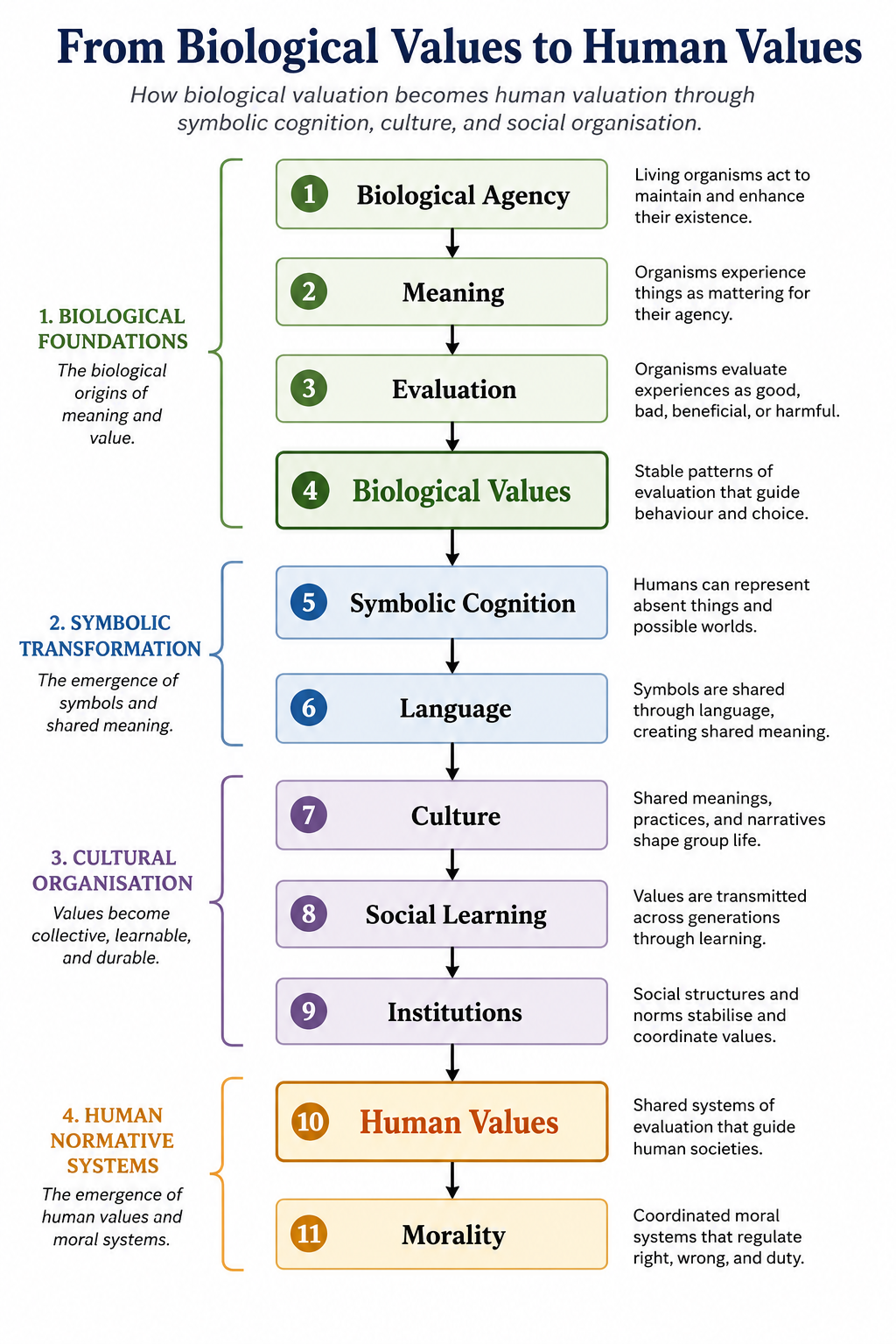
From Biological Values to Human Values. Human values emerge from biological values through cognitive, symbolic, cultural, and institutional transformations. This pathway preserves continuity with biological valuation while explaining the distinctive features of human social and moral life.
Human Values and the Origins of Morality
Human values provide the immediate foundation from which morality emerges. Moral systems develop when values become linked to ideas of obligation, responsibility, approval, criticism, and justification. While values identify what is important, morality concerns how people ought to act in relation to themselves and others.
This distinction is important. Human values and morality are closely related, but they are not identical. A society may value many things without converting all of those values into moral obligations. Morality emerges when certain values become associated with expectations concerning right and wrong conduct.
Human values also do not always align with one another. Values such as freedom and security, fairness and loyalty, or individual autonomy and collective welfare may sometimes point in different directions. One reason moral systems become necessary is that societies require ways of negotiating competing values and resolving conflicts among legitimate concerns.
The emergence of morality therefore depends upon capacities already present in human valuation. Reflection, communication, social learning, and collective organisation make it possible to formulate norms, establish responsibilities, and evaluate behaviour according to shared standards. Moral systems emerge when values become organised into frameworks that help communities navigate cooperation, conflict, obligation, and judgement.
APS therefore rejects the view that morality appears independently of biology. At the same time, it rejects the idea that morality can be reduced to biological interests alone. Moral systems emerge from organisms that already evaluate and value the world, but they are transformed by symbolic cognition, language, culture, and social organisation.
Conclusion
Human values emerge from the same fundamental processes of agency, meaning, evaluation, and valuation that characterise living systems more generally. They are therefore continuous with biological values. However, they are not identical to biological values because they are transformed by symbolic cognition, language, culture, social learning, and institutions.
Within the APS framework, the pathway from biological values to human values can be understood as a progressive extension of biological agency. Through meaning and evaluation, living systems identify conditions that matter. Repeated evaluations stabilise into biological values. In humans, symbolic cognition, language, culture, and social organisation transform these biological values into shared systems of meaning that guide individual and collective behaviour.
Through these transformations, valuation becomes increasingly explicit, reflective, collective, and historically transmitted. Human values become systems through which societies coordinate action, negotiate differences, and organise social life. In doing so, they provide the immediate foundation for morality.
The emergence of human values therefore illustrates how increasingly complex forms of organisation can develop without requiring a break between biology and culture. Human values are neither detached from life nor reducible to biological interests. They are an evolutionary and cultural extension of biological valuation, linking the evaluative capacities of living systems to the moral worlds created by human societies.
See Also
Related Articles
References
- (2001). Social Cognitive Theory: An Agentic Perspective. Annual Review of Psychology, 52, 1–26 . https://doi.org/10.1146/annurev.psych.52.1.1
- (2012). Incomplete Nature. W. W. Norton.
- (2005). Autopoiesis, Adaptivity, Teleology, Agency. Phenomenology and the Cognitive Sciences, 4(4), 429–452 . https://doi.org/10.1007/s11097-005-9002-y
- (1966). The Phenomenon of Life. Harper & Row.
- (2015). Cultural Evolution. University of Chicago Press.
- (2015). Biological Autonomy. Springer. https://doi.org/10.1007/978-94-017-9837-2
- (2023). Determining the Ways of Living. Palgrave Macmillan. https://doi.org/10.1007/978-3-031-50417-3
- (2026). Agency as the Defining Activity of Life. Biological Theory . https://doi.org/10.1007/s13752-026-00547-6