What Are Biological Values?
Biological values arise from the evaluative activities of living systems. Through organised persistence, organisms distinguish conditions according to their significance for viability, functioning, and adaptive persistence. Repeated evaluations stabilise into patterns of biological importance that guide regulation, behaviour, and goal-directed activity. Within the Agency–Process–Scale (APS) framework, biological values provide a bridge between meaning, evaluation, human values, and morality while avoiding both moral reductionism and the assumption that values originate only in human culture.
Introduction
Living systems constantly encounter conditions that affect their continued existence. Water, nutrients, oxygen, shelter, social partners, offspring, and environmental stability all matter because they influence the ability of organisms to survive, function, and adapt. Yet why do these things matter, and what makes one condition important while another remains irrelevant? Questions of value are often associated with human beliefs, preferences, ethics, or culture, but from an Agency–Process–Scale (APS) perspective, valuation begins much earlier. Long before humans developed moral systems or philosophical theories, living systems were already distinguishing conditions according to their significance for continued existence and functioning.
APS proposes that biological values emerge from the evaluative activities of living systems. Organisms do not merely encounter the world; they continually regulate their interactions with it in ways that support viability and adaptive persistence. Through these interactions, some conditions repeatedly contribute to continued functioning, while others repeatedly threaten it. As these patterns recur, they become stabilised as enduring forms of biological importance. Understanding biological values therefore helps explain why organisms pursue goals, why behaviour is directed rather than random, and how the foundations of human values and morality emerge from the organisation of life itself.
What Is a Biological Value?
A biological value is a condition, resource, relationship, or state that consistently contributes to the maintenance, regulation, or adaptive persistence of a living system.
Biological values are not moral principles, conscious preferences, or abstract ideals. Rather, they are patterns of significance that emerge from the organisation and activities of living systems. A condition becomes valuable because it contributes to viability, functioning, or long-term persistence. Water, for example, is valuable to most organisms because it supports metabolism and physiological regulation. Oxygen is valuable to aerobic organisms because it enables energy production. Food is valuable because it provides the resources required for growth, maintenance, and reproduction. These conditions are not valuable in themselves; they are valuable because of the role they play in sustaining living organisation.
This means that biological values are relational rather than intrinsic. The same condition may be valuable for one organism, neutral for another, and harmful for a third because value depends upon the relationship between the organism and the condition being encountered. Sunlight, for example, supports photosynthesis in plants and is therefore highly valuable to many species, yet excessive exposure may damage other organisms or create physiological stress. Biological values therefore do not exist independently of living systems. They emerge from the ongoing interaction between organisms and the conditions that affect their persistence.
From an APS perspective, biological values are neither arbitrary nor externally imposed. They arise through the continual processes by which living systems maintain organised persistence in changing environments. Value is therefore not an additional feature attached to life but a consequence of the way living systems must continually regulate themselves in order to remain viable.
Why Do Living Systems Have Values?
Living systems have values because they must continually maintain themselves under conditions that are never perfectly stable. Life is characterised by organised persistence: the capacity of living systems to maintain functional organisation through time despite continual material turnover and environmental change. This persistence requires ongoing regulation. Organisms must acquire resources, respond to threats, repair damage, coordinate internal processes, and adjust to changing circumstances if they are to continue functioning.
To regulate effectively, organisms must distinguish among conditions. Some conditions support viability, while others threaten it. Some opportunities promote growth and adaptation, while others impose costs or risks. Regulation therefore depends upon making functional distinctions between circumstances that matter and those that do not. These distinctions create the foundation for valuation because they establish differential significance within the organism’s interactions with its environment.
From an APS perspective, valuation is not an optional feature added to life but a natural consequence of organised persistence. Any system that must continually maintain itself under changing conditions must distinguish between circumstances that support persistence and those that undermine it. These distinctions generate significance because some conditions affect the system’s ability to continue functioning while others do not. Significance makes evaluation possible, and repeated evaluation gives rise to value. Biological values therefore emerge naturally from the organisational requirements of living systems rather than from conscious reflection, subjective preference, or externally imposed standards.
A bacterium moving toward nutrients and away from toxins does not possess human beliefs about what is good or bad. Nevertheless, its behaviour reflects a distinction between conditions that support persistence and conditions that undermine it. Likewise, plants alter growth patterns in response to light, water availability, competition, and environmental stress because these conditions influence their continued functioning. Animals allocate attention, energy, and behaviour toward circumstances that affect survival, reproduction, and adaptive success. Although the mechanisms differ, each case reflects the same underlying principle: the organisation of the living system establishes a framework within which some conditions matter more than others.
Biological values therefore arise because living systems are active agents. They continually regulate interactions with their environments in ways that sustain viability and adaptive persistence, and this ongoing process of regulation inevitably generates patterns of significance. Values emerge from these patterns of significance rather than from external rules or conscious deliberation, making valuation a natural consequence of life itself.
Values Emerge from Meaning and Evaluation
Biological values are closely connected to biological meaning and biological evaluation. Meaning concerns significance: a condition has meaning when it indicates something relevant to the organism. Evaluation concerns assessment: organisms distinguish whether a condition is beneficial, harmful, or neutral relative to continued functioning and persistence. Values emerge when these evaluations become stable patterns of importance that help organise future behaviour and regulation.
Consider the smell of smoke. The smell itself is not the threat. Instead, it signifies the possible presence of fire and therefore has meaning because it indicates a potentially important environmental condition. If fire threatens viability, the condition is evaluated as dangerous. Because avoiding severe harm is consistently important for survival, information about fire acquires high value. In this sequence, meaning identifies significance, evaluation assesses significance, and value reflects the importance of that significance for organised persistence.
The same process occurs throughout biology. Nutrients acquire value because repeated evaluation reveals their importance for metabolism and growth. Predators acquire negative value because they threaten viability. Potential mates acquire value because they contribute to reproduction and lineage continuity. Social partners acquire value because cooperation can enhance defence, learning, offspring care, and long-term persistence. In each case, value emerges through the repeated interaction of significance and evaluation rather than existing independently of the organism’s activities.
Biological values therefore emerge through ongoing interactions between organisms and their environments. Conditions that consistently influence organised persistence become stabilised as patterns of biological importance because they repeatedly affect the organism’s capacity to maintain itself through time. APS accordingly views values as dynamic rather than fixed. Water becomes increasingly valuable during drought, shelter becomes more valuable during extreme weather, and information about predators becomes more valuable when danger is present. Value therefore reflects the changing relationship between living systems and the conditions that affect their persistence.
APS views biological values as the stabilised products of meaning and evaluation. Organisms continually encounter significant conditions, assess their consequences, and modify behaviour accordingly. Through repeated interactions across time, some patterns of significance become consistently important because they repeatedly influence viability, functioning, and adaptive persistence. These recurring patterns become biological values, helping to organise future behaviour, regulation, and decision-making.
Biological Values and Goals
Biological values and biological goals are closely related but not identical. Values concern what matters, whereas goals concern what organisms do about what matters. A condition becomes valuable because it contributes to viability, functioning, or adaptive persistence, while goals emerge when organisms direct behaviour toward obtaining, maintaining, or avoiding particular conditions. Values therefore provide the significance that guides action, whereas goals provide the direction through which that significance is expressed.
Hydration, for example, is valuable because water is necessary for physiological function. Seeking water is a goal. Food is valuable because it supports metabolism, growth, and maintenance. Foraging is a goal. Offspring may be valuable because they contribute to lineage continuity. Protecting, provisioning, or caring for offspring becomes a goal. In each case, value establishes why a condition matters, while goals organise behaviour in response to that importance.
This distinction helps clarify why behaviour appears directed throughout biology. Organisms are not necessarily pursuing abstract ideals or consciously represented objectives. Rather, they are responding to conditions that have become biologically significant through their relationship to organised persistence. Values influence behaviour indirectly by shaping the goals through which organisms regulate their interactions with the world.
From an APS perspective, values therefore provide a motivational structure from which goals and behaviour emerge. Understanding this relationship helps explain how directed activity can arise throughout living systems without requiring conscious intention or explicit planning.
Biological Values Across Scales
Biological values occur across the full spectrum of life’s organisation because organised persistence must be maintained across multiple spatial and temporal scales. The particular mechanisms involved may differ, but the underlying challenge remains the same: living systems must distinguish conditions according to their consequences for continued organisation and adaptive persistence.
At the cellular scale, values are expressed through processes that maintain metabolic stability, membrane integrity, energy balance, and functional coordination. Cells continually regulate internal conditions and respond to disturbances that threaten viability. At the organismal scale, values become visible through behaviour, physiology, and development as organisms acquire resources, avoid threats, regulate internal states, and respond adaptively to environmental conditions.
Although the mechanisms involved may differ dramatically, many living systems perform functionally equivalent evaluative roles. Bacteria regulate movement in response to chemical gradients, plants adjust growth according to light, water, and nutrient availability, animals modify behaviour in response to opportunities and threats, and social groups coordinate activities that support collective persistence. In each case, the system distinguishes conditions according to their consequences for continued organisation. APS therefore treats biological valuation as a scale-independent feature of living systems rather than a property tied to any particular biological structure or mechanism.
At the social scale, biological values may include cooperation, communication, coordination, and parental care. Social groups often generate forms of collective regulation that enhance the persistence of individuals and populations. At the ecological scale, persistence-promoting interactions can shape relationships among species and environments. Mutualistic interactions, ecosystem engineering, and niche construction all influence conditions that support continued organisation across larger systems. At the evolutionary scale, biological values become associated with lineage continuity, adaptive flexibility, and the long-term persistence of populations through changing environments.
APS does not treat these scales as isolated levels arranged in a rigid hierarchy. Instead, values emerge through interactions occurring across multiple scales simultaneously. Cellular regulation influences organismal behaviour, organismal activities modify ecological conditions, ecological interactions shape evolutionary trajectories, and evolutionary processes alter the conditions under which future organisms develop and act. Biological values therefore represent multiscale expressions of the same underlying imperative: the maintenance and continuation of organised living systems.
Biological Values Are Not Moral Values
Because biological values distinguish conditions according to their consequences for viability and functioning, they introduce a basic form of normativity into living systems. Some conditions are better than others relative to organised persistence, while others are detrimental. This biological normativity does not determine moral right and wrong, but it does establish a framework within which living systems can be described as functioning well or poorly relative to their own continued existence.
Although biological values provide an important foundation for understanding human behaviour, they should not be confused with moral values. Biological values concern viability, regulation, adaptation, and persistence because they emerge from the requirements of living organisation. Moral values concern questions such as justice, fairness, rights, responsibility, dignity, and ethical obligation. These concepts require forms of symbolic thought, cultural learning, social institutions, and reflective reasoning that extend far beyond basic biological regulation.
The distinction is important because biological values do not automatically determine what is morally right. A behaviour that enhances survival or reproduction is not necessarily morally justified, just as moral principles often involve considerations that cannot be reduced to immediate biological interests. The fact that a condition promotes persistence does not by itself establish an ethical obligation to pursue it.
APS therefore rejects both extremes. Human morality is neither disconnected from biology nor reducible to it. Biological values provide the foundation upon which more complex forms of normativity can develop, but moral systems also incorporate cultural traditions, social institutions, symbolic meanings, and ethical reflection. Understanding biological values helps explain where morality comes from without reducing morality to biology.
Agency gives rise to meaning, meaning enables evaluation, evaluation stabilises into biological values, and biological values provide the foundation from which human values and morality emerge.
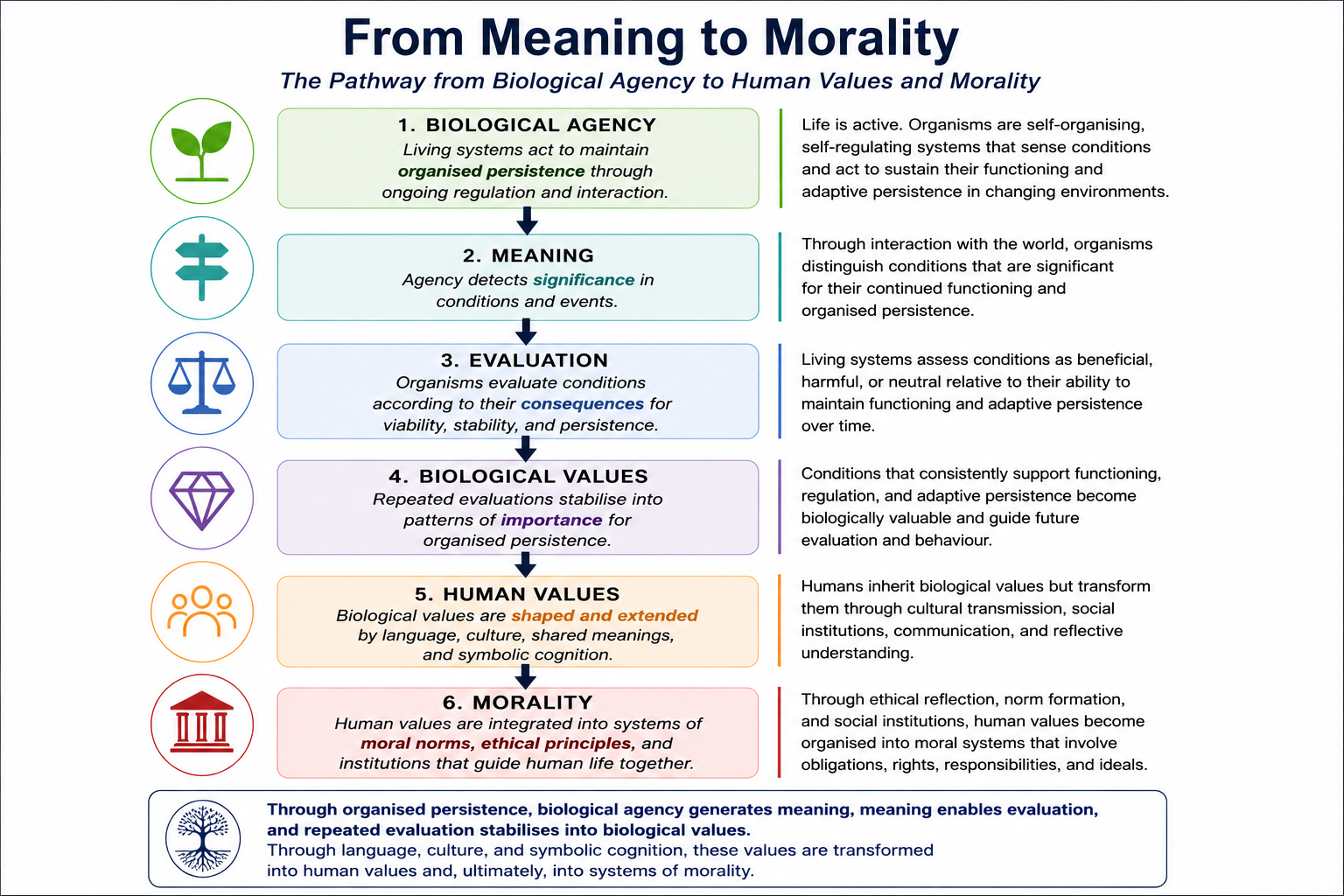
From Meaning to Morality. Biological agency generates meaning, meaning enables evaluation, and repeated evaluation stabilises into biological values. Through language, culture, and symbolic cognition, biological values become transformed into human values and morality.
From Biological Values to Human Values
Human beings inherit the biological foundations of valuation shared with other living systems. Like all organisms, humans distinguish conditions according to their significance for health, safety, cooperation, reproduction, and continued functioning. Human life therefore remains grounded in the same fundamental processes of meaning, evaluation, and valuation that characterise living systems more generally.
However, humans also possess capacities that transform biological values into something new. Language allows values to be communicated, debated, and revised. Culture enables values to be transmitted across generations and embedded within social traditions. Symbolic cognition allows humans to imagine alternative futures, evaluate competing possibilities, and construct abstract principles that extend beyond immediate biological concerns. Social institutions stabilise shared norms and expectations, creating forms of collective organisation that shape behaviour and belief.
Through these processes, biological values become human values. Concepts such as fairness, loyalty, responsibility, freedom, and justice do not emerge independently of biology. They arise from organisms that already evaluate conditions and assign significance to the world around them. Yet they also involve cultural, historical, symbolic, and reflective dimensions that exceed purely biological regulation.
Human values are continuous with biological values because they emerge from the same underlying processes of meaning, evaluation, and valuation. However, they are not identical to biological values. Language, culture, symbolic cognition, historical traditions, and ethical reflection transform biological valuation into forms of obligation, principle, and shared meaning that cannot be fully explained by biological regulation alone. Human values therefore exhibit continuity without identity: they remain connected to their biological foundations while acquiring properties and forms of significance unique to human social life.
Human values can thus be understood as an evolutionary and cultural extension of more fundamental biological processes. They represent a transformation rather than a replacement of biological valuation, preserving continuity with the organisation of life while creating the conditions for morality, ethics, and reflective self-understanding.
Conclusion
Biological values are patterns of significance that emerge from the evaluative activities of living systems. They arise because organisms must continually distinguish conditions that support or undermine viability, functioning, and adaptive persistence. Through the ongoing demands of organised persistence, living systems generate meaning, evaluate significance, and stabilise recurring patterns of importance that guide future regulation and behaviour.
By explaining why some conditions matter more than others, biological values help connect agency, cognition, meaning, evaluation, goals, and behaviour within a unified framework. They are not moral principles, conscious preferences, or externally imposed standards. Rather, they are emergent features of living systems engaged in the ongoing task of maintaining themselves through changing conditions.
Viewed in this way, biological values are not isolated properties of organisms but emergent features of agency operating across multiple scales of life. They arise wherever living systems distinguish, evaluate, and respond to conditions that affect organised persistence. Because these processes occur throughout biology, biological valuation provides an important point of continuity linking cellular regulation, organismal behaviour, social organisation, ecological interactions, and evolutionary change.
Understanding biological values also reveals an important continuity between biology and humanity. Human values and moral systems do not appear from nowhere. They develop from evaluative capacities already present throughout life while being transformed by language, culture, symbolic thought, social institutions, and ethical reflection. Biological values therefore provide the bridge between the organisation of living systems and the emergence of human moral worlds.
By linking meaning, evaluation, behaviour, and adaptive persistence within a single explanatory framework, biological values occupy a pivotal position within APS. They illuminate how significance becomes stabilised within living systems and help explain the continuity that extends from biological organisation to human values and, ultimately, to morality itself.
See Also
Related Articles
References
- (2001). Social Cognitive Theory: An Agentic Perspective. Annual Review of Psychology, 52, 1–26 . https://doi.org/10.1146/annurev.psych.52.1.1
- (2016). Biological Regulation: Controlling the System from Within. Biology & Philosophy, 31(2), 237–265 . https://doi.org/10.1007/s10539-015-9497-8
- (2012). Incomplete Nature. W. W. Norton.
- (2005). Autopoiesis, Adaptivity, Teleology, Agency. Phenomenology and the Cognitive Sciences, 4(4), 429–452 . https://doi.org/10.1007/s11097-005-9002-y
- (2016). Other Minds. Farrar, Straus and Giroux.
- (1966). The Phenomenon of Life. Harper & Row.
- (2015). The Cognitive Cell. Frontiers in Psychology, 6, 264 . https://doi.org/10.3389/fpsyg.2015.00264
- (2015). Cultural Evolution. University of Chicago Press.
- (2015). Biological Autonomy. Springer. https://doi.org/10.1007/978-94-017-9837-2
- (2023). Determining the Ways of Living. Palgrave Macmillan. https://doi.org/10.1007/978-3-031-50417-3
- (2026). Agency as the Defining Activity of Life: A Viability-Oriented Framework Integrating Process and Scale. Biological Theory . https://doi.org/10.1007/s13752-026-00547-6