What Is Biological Evaluation?
Biological evaluation is the process through which living systems distinguish conditions according to their significance for viability, functional integrity, and adaptive persistence. In APS, evaluation emerges directly from biological agency and provides the foundation for adaptive regulation, meaning, cognition, mind, selfhood, values, and morality. By explaining how significance arises within living systems, biological evaluation serves as a central bridge between biological organization and human experience.
Key Points
- Biological evaluation is the process through which living systems distinguish conditions according to their significance for viability and adaptive persistence.
- Evaluation emerges directly from biological agency and provides the basis for adaptive regulation.
- Evaluation establishes biological significance, explaining why some conditions matter while others do not.
- Meaning emerges from evaluated significance.
- Cognition develops through the organization of biologically significant information.
- Mind and selfhood emerge through increasingly integrated forms of evaluative cognition.
- Human values and morality arise through reflective forms of evaluation.
- Biological evaluation is the process through which agency generates significance.
Introduction
Living systems do not merely exist within their environments. They continuously encounter conditions that differ in their consequences for continued functioning and persistence. A bacterium moves toward nutrients and away from toxins. A plant alters its growth in response to light, water, and competition. Animals assess opportunities, dangers, and social relationships. Humans evaluate not only physical conditions but also beliefs, values, and goals.
What unites these diverse examples is that living systems do not treat all conditions as equivalent. Some conditions matter more than others. Some contribute to continued functioning, while others threaten it. Across all forms of life, organisms must continually distinguish among these possibilities.
APS refers to this process as biological evaluation.
Biological evaluation is the process through which living systems distinguish internal and external conditions according to their significance for viability, functional integrity, and adaptive persistence. Through evaluation, organisms identify what supports or undermines their continued existence and regulate their activity accordingly.
Although often overlooked, biological evaluation occupies a central position within living systems. It helps explain how the world becomes significant for organisms, how agency acquires direction, and how increasingly complex forms of significance contribute to the emergence of meaning, cognition, mind, selfhood, values, and morality. In this sense, biological evaluation forms one of the principal bridges between biological organization and human experience.
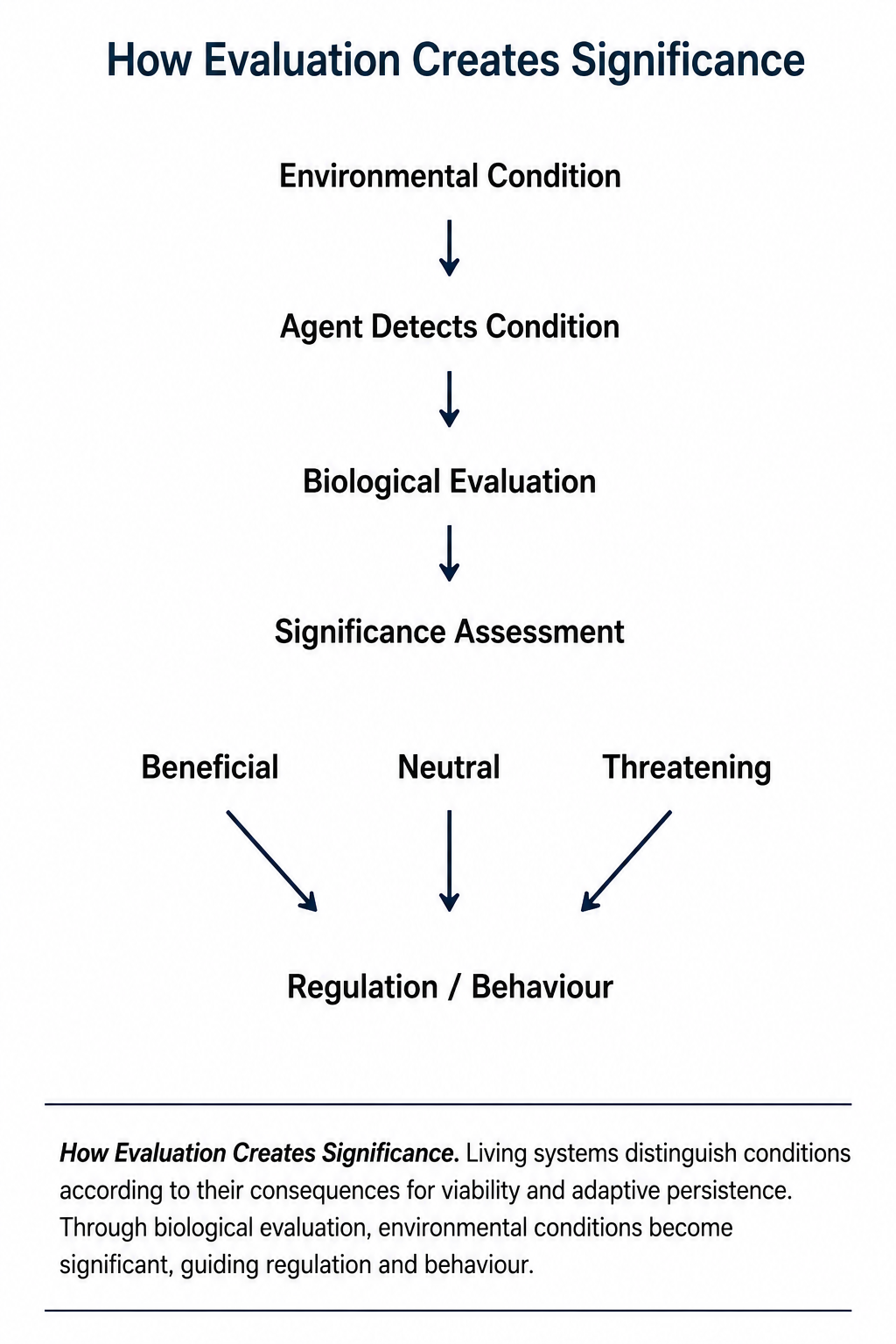
How Evaluation Creates Significance. Living systems distinguish conditions according to their consequences for viability and adaptive persistence. Through biological evaluation, environmental conditions become significant, guiding regulation and behaviour.
Why Living Systems Must Distinguish What Matters
Living systems face a fundamental challenge.
The environments in which organisms exist contain countless physical, chemical, and biological conditions. Most are irrelevant at any given moment. Some support continued functioning. Others threaten it. To persist, organisms must distinguish among these possibilities and respond appropriately.
This requirement arises directly from the nature of life itself. Living systems do not persist automatically. They maintain themselves through ongoing regulation, continuously compensating for internal change and environmental disturbance. Such regulation is only possible if organisms distinguish conditions according to their significance.
A living system that treated all conditions as equally important could not regulate itself effectively. It could not preferentially acquire resources, avoid damaging circumstances, repair disruptions, coordinate development, or adapt to changing environments. Persistence therefore depends not only on detecting conditions but also on distinguishing which conditions matter.
Biological evaluation provides this capacity. Through evaluation, organisms transform a world of innumerable possibilities into a world structured by significance. In doing so, they establish the basis for adaptive regulation, behaviour, cognition, and ultimately the more complex forms of meaning and value that emerge later in evolution.
Biological evaluation is therefore not an optional feature of life. It is a fundamental consequence of living as an organized, self-maintaining system.
Evaluation and Agency
In APS, biological agency refers to the capacity of living systems to initiate, regulate, and coordinate interactions that sustain functional integrity and adaptive persistence.
Agency necessarily involves evaluation.
An organism capable of acting but incapable of distinguishing favourable from unfavourable conditions would have no basis for adaptive regulation. It could not preferentially acquire resources, avoid threats, repair damage, coordinate growth, or modify behaviour in response to changing circumstances. Without some means of distinguishing what matters, agency would be directionless.
For this reason, biological evaluation emerges directly from agency. The capacity to regulate oneself presupposes the capacity to distinguish conditions according to their significance for continued functioning. Agency explains why organisms act. Evaluation explains how organisms distinguish what those actions should be directed toward.
This relationship is one of the central insights of APS. Agency introduces active regulation into biology, while evaluation introduces significance. Together they explain how living systems become oriented toward conditions that support persistence and away from conditions that undermine it.
Biological evaluation may therefore be understood as the process through which agency generates significance.
What Is Biological Evaluation?
Biological evaluation is the process through which living systems distinguish conditions according to their significance for viability, functional integrity, and adaptive persistence.
Evaluation is not conscious judgement, moral reasoning, or human preference. Rather, it is the more fundamental biological process through which living systems differentiate among conditions in ways that influence their continued organization.
A cell detecting membrane damage, a root responding to moisture gradients, an immune system discriminating between threat and non-threat, and a human reflecting on a difficult decision all involve evaluation, despite their enormous differences in complexity. In each case, conditions are distinguished according to what they mean for the continued functioning of the system.
The defining feature of evaluation is therefore not consciousness but significance. Evaluation establishes which conditions matter and which do not. It determines what is relevant to the organism, what requires a response, and what can be ignored.
Seen in this way, biological evaluation provides the foundation for many phenomena often discussed separately within biology. Adaptive regulation, behaviour, cognition, meaning, and value all depend upon prior distinctions concerning significance. Before organisms can learn, remember, anticipate, choose, or reflect, conditions must first matter.
Evaluation establishes this biological significance.
Evaluation Across Life
Biological evaluation appears throughout the living world.
Single cells regulate nutrient uptake, stress responses, repair mechanisms, and metabolic activity according to changing internal and external conditions. Even at this scale, organisms distinguish conditions that support continued functioning from those that threaten it.
Bacteria alter movement in response to chemical gradients, adjusting behaviour according to opportunities and constraints within their environments. These responses are not random. They reflect distinctions concerning biological significance.
Plants continuously evaluate light availability, water conditions, soil chemistry, herbivory, competition, and seasonal cues. Through changes in growth, physiology, signalling, and resource allocation, they regulate their activity in relation to conditions that matter for persistence and reproduction.
Animals extend these capacities through increasingly sophisticated sensory systems, learning processes, memory, anticipation, and behavioural flexibility. Their evaluations become more integrated, allowing organisms to respond to complex and rapidly changing environments.
Humans expand evaluation still further through language, symbolic thought, culture, and reflection. In addition to evaluating immediate biological conditions, humans evaluate beliefs, goals, social norms, values, and moral commitments.
Despite these differences in complexity, a common principle remains visible across all forms of life. Organisms continuously distinguish conditions according to their significance for continued functioning and adaptive persistence. The specific mechanisms differ, but the underlying process remains remarkably consistent.
Biological evaluation therefore appears to be a general feature of biological agency rather than a specialized capacity confined to particular groups of organisms. It is one of the most fundamental ways in which living systems engage with the world.
Evaluation and Meaning
Biological evaluation provides the foundation for meaning.
Meaning is often associated with language, symbols, concepts, or conscious reflection. Yet living systems encounter meaningful conditions long before such capacities appear. To understand how meaning emerges, it is necessary to begin with significance.
Through biological evaluation, organisms distinguish conditions according to their consequences for continued functioning and persistence. Some conditions support viability, others threaten it, and many remain irrelevant. In making these distinctions, organisms establish significance. Conditions come to matter because they influence the organism’s ability to maintain itself and respond effectively to its circumstances.
Meaning emerges from this significance.
A nutrient source matters because it contributes to continued functioning. A toxin matters because it threatens that functioning. A social signal matters because it alters future interactions. In each case, the condition acquires meaning because it has been evaluated as significant for the organism.
Meaning therefore does not originate with language, culture, or conscious awareness. At its most fundamental level, meaning arises whenever conditions matter to a living system. Biological evaluation creates the distinctions through which significance emerges, and meaning is the expression of that significance relative to an agent.
From an APS perspective, meaning is not imposed upon life from the outside. It emerges from the ongoing evaluative activity of living systems themselves. Evaluation generates significance; meaning is significance as it exists for an agent.
This relationship provides a naturalized account of meaning grounded in biological agency while preserving continuity between biological and human forms of significance.
Evaluation and Cognition
Once significance exists, organisms face a further challenge.
Conditions that matter must be detected, integrated, remembered, compared, anticipated, and coordinated with action. As organisms interact with increasingly complex and changing environments, the management of significance itself becomes a biological problem.
This challenge gives rise to cognition.
Evaluation and cognition are therefore closely related but distinct. Evaluation establishes significance. Cognition organizes significance.
In APS, cognition refers to the processes through which living systems detect, integrate, retain, anticipate, and act upon biologically significant information. Cognition builds upon evaluation rather than replacing it. Without evaluation there would be no basis for distinguishing which information matters and which does not. Information could be processed, but it would possess no biological relevance.
Evaluation supplies this relevance.
Cognition extends it through memory, learning, anticipation, flexible behaviour, and context-sensitive regulation. These capacities allow organisms to manage increasingly complex worlds of significance and to coordinate responses across longer timescales and broader environmental contexts.
For this reason, APS treats cognition as the informational elaboration of biological evaluation. Evaluation identifies what matters. Cognition develops the capacity to organize, retain, and act upon what matters.
Seen in this way, cognition is not an isolated faculty added to living systems. It emerges from the increasingly sophisticated organization of significance generated through biological evaluation.
Evaluation, Mind, and Selfhood
As evaluative and cognitive processes become increasingly integrated, organisms develop more coherent and flexible relationships with themselves and their environments. Significance is no longer processed in isolated ways but becomes coordinated across multiple timescales, contexts, and forms of interaction. The organism increasingly functions as a unified centre through which significance is interpreted, organized, and acted upon.
This growing integration provides the foundation for mind.
APS defines mind as the integrated organization of evaluative cognitive processes through which an agent maintains a coherent relationship with itself and its world. Mind therefore represents neither a departure from biological processes nor a mysterious addition to them. Rather, it emerges through the increasing integration of evaluative and cognitive activity.
The emergence of mind also supports the emergence of selfhood.
As evaluative and cognitive processes become increasingly organized around the continuity of a particular agent, a stable centre of significance develops. Experiences, actions, memories, anticipations, and interactions become coordinated around the ongoing persistence of a living system. The organism no longer merely responds to significant conditions; it becomes the continuing locus for whom those conditions are significant.
APS defines a self as an organized centre of agency, evaluation, cognition, and interaction that maintains continuity across changing conditions.
Selfhood therefore does not appear suddenly with human reflection or language. Instead, it emerges gradually from increasingly integrated forms of biological organization. The complexity of selfhood varies enormously across living systems, but its roots lie in the same evaluative processes that support agency, meaning, and cognition.
From this perspective, mind and selfhood are not separate from biological evaluation. They are increasingly sophisticated expressions of the organization of significance. Evaluation establishes significance, cognition organizes significance, mind integrates significance, and selfhood becomes a continuing centre of significance.
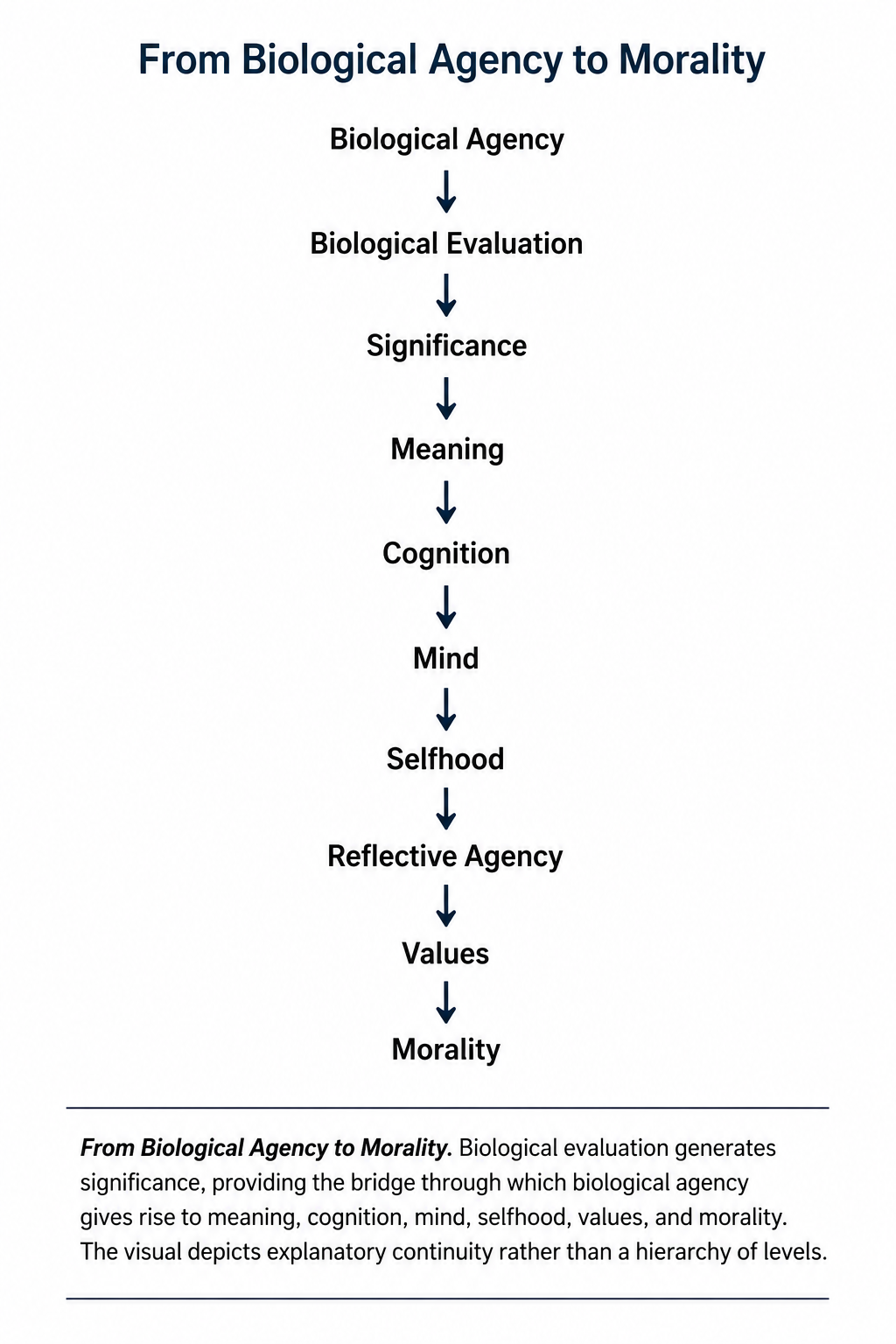
From Biological Agency to Morality. Biological evaluation generates significance, providing the bridge through which biological agency gives rise to meaning, cognition, mind, selfhood, values, and morality. The visual depicts explanatory continuity rather than a hierarchy of levels.
Evaluation, Values, and Morality
Biological evaluation should not be confused with human values or morality.
A plant evaluating water availability is not making a moral judgement. A bacterium moving toward nutrients is not pursuing an ethical ideal. The evaluative processes found throughout life are concerned with biological significance rather than moral justification.
Nevertheless, these processes provide the foundation upon which more complex forms of significance can emerge.
As cognition, mind, and selfhood become increasingly sophisticated, organisms acquire the capacity to evaluate not only environmental conditions but also their own actions, goals, and patterns of behaviour. In humans, language, symbolic thought, culture, and social learning greatly expand this capacity. Evaluation is no longer confined to immediate biological concerns but extends to social relationships, shared norms, long-term aspirations, and abstract ideals.
This transition gives rise to values.
Values emerge when reflective agents organize significance into relatively stable patterns of preference, commitment, and concern. What matters is no longer determined solely by immediate biological circumstances but also by personal histories, cultural traditions, social institutions, and collective forms of understanding.
Morality emerges through a further elaboration of evaluation.
Reflective agents do not merely evaluate conditions and actions. They also evaluate the standards by which evaluations themselves should be judged. Questions of fairness, responsibility, obligation, harm, and justice arise when individuals and communities reflect upon how significance ought to be interpreted and acted upon within shared social worlds.
From an APS perspective, morality therefore represents a highly sophisticated form of reflective evaluation. It is continuous with the evaluative processes found throughout life while remaining irreducible to them. Human morality cannot be reduced to biological regulation, but neither does it emerge from nowhere. It develops through increasingly complex forms of significance grounded in biological agency.
A broad APS pathway may therefore be summarized as:
Agency ↓ Biological Evaluation ↓ Meaning ↓ Cognition ↓ Mind ↓ Selfhood ↓ Reflective Agency ↓ Values ↓ Morality
This pathway does not describe a hierarchy of levels. Rather, it describes an explanatory continuity through which increasingly sophisticated forms of significance emerge from living organization.
Why Information Alone Is Not Enough
Many contemporary theories emphasize information as a defining feature of living systems. Information is undoubtedly important. Organisms detect signals, transmit information, store memories, and coordinate behaviour through complex informational processes.
Yet information alone cannot explain significance.
Information may exist without mattering to the system that processes it. A thermometer detects temperature changes, but the information carries no significance for the thermometer itself. The device registers differences without distinguishing whether those differences support or undermine its continued existence.
Living systems differ in a crucial respect.
Organisms do not merely process information. They evaluate information according to its significance for viability, functioning, and adaptive persistence. The same signal may be beneficial, harmful, or irrelevant depending upon the organism, its current condition, and the broader context in which it exists.
Evaluation therefore explains something that information alone cannot explain: why certain conditions matter.
Information processing describes how signals are detected, transmitted, stored, and transformed. Biological evaluation explains why those signals acquire significance in the first place.
This distinction is essential for understanding life. Living systems are not simply information-processing machines. They are systems that process information in relation to their own continued existence. Evaluation transforms information into significance, providing the foundation upon which meaning, cognition, and behaviour become possible.
Why Biological Evaluation Matters
Biological evaluation helps explain a remarkable range of phenomena that are often treated separately within biology, cognitive science, philosophy, and the human sciences.
It contributes to:
adaptive regulation, biological function, behaviour, development, cognition, meaning, learning, value formation, moral reflection.
More fundamentally, biological evaluation helps explain how the world becomes significant for living systems.
Without evaluation, biology could describe structures, mechanisms, physiological processes, developmental pathways, and evolutionary change. What would remain unclear is why any of these conditions matter to organisms themselves. Biological systems would appear as complex mechanisms rather than as agents engaged in the ongoing task of sustaining themselves within changing environments.
Evaluation addresses this gap.
It explains how organisms distinguish among possibilities, how significance emerges from biological organization, and how increasingly complex forms of significance contribute to cognition, mind, selfhood, and morality.
For this reason, biological evaluation occupies a unique position within APS. It is not simply another biological process among many others. It functions as a bridge connecting biological organization and human experience, linking the dynamics of living systems with the emergence of meaning, values, and moral reflection.
Conclusion
Living systems are not passive collections of parts responding mechanically to external forces. They continuously distinguish conditions according to their significance for continued functioning and persistence. Through this process, organisms transform a world of innumerable possibilities into a world structured by what matters.
This process is biological evaluation.
Biological evaluation emerges directly from agency and provides the foundation from which increasingly sophisticated forms of significance develop. Meaning emerges from significance. Cognition organizes significance. Mind integrates significance. Selfhood becomes a continuing centre of significance. Reflective agents transform significance into values and morality.
APS therefore treats biological evaluation as one of the central processes of living systems. It does not replace agency, cognition, meaning, or morality. Instead, it explains how these domains are connected through a continuous process of increasingly complex evaluative organization.
To understand how living systems act, learn, adapt, create meaning, and develop moral worlds, we must first understand how they distinguish what matters.
Biological Evaluation is the process through which agency generates significance.
See Also
Related Articles
References
- (2015). Organizational Closure and the Concept of Function. Synthese, 192(11), 3547–3572 . https://doi.org/10.1007/s11229-014-0516-2
- (2005). Autopoiesis, Adaptivity, Teleology, Agency. Phenomenology and the Cognitive Sciences, 4(4), 429–452 . https://doi.org/10.1007/s11097-005-9002-y
- (2022). Sensorimotor Life: An Enactive Proposal. Oxford University Press.
- (1979). The Ecological Approach to Visual Perception. Houghton Mifflin.
- (2008). Biosemiotics: An Examination into the Signs of Life and the Life of Signs. University of Scranton Press.
- (1980). Autopoiesis and Cognition. D. Reidel Publishing Company.
- (2015). Biological Autonomy: A Philosophical and Theoretical Enquiry. Springer.
- (2009). An Organizational Account of Biological Functions. British Journal for the Philosophy of Science, 60(4), 813–841 . https://doi.org/10.1093/bjps/axp036
- (2026). Agency as the Defining Activity of Life: A Viability-Oriented Framework Integrating Process and Scale. Biological Theory . https://doi.org/10.1007/s13752-026-00547-6
- (2007). Mind in Life: Biology, Phenomenology, and the Sciences of Mind. Harvard University Press.