What Is the Meaning of Life?
The question of life's meaning has traditionally been addressed through religious, philosophical, and existential perspectives. In the Agency–Process–Scale (APS) framework, meaning is understood as a natural feature of living systems rather than an exclusively human concern. Meaning arises wherever conditions, relationships, events, or actions make a difference to the viability, persistence, flourishing, or continuity of living systems. This perspective distinguishes meaning from purpose, function, and goals while explaining how each emerges from biological organisation. Rather than locating meaning outside life, APS interprets meaning as an expression of the organised, agency-driven processes through which living systems maintain continuity across changing conditions. Human meaning represents a particularly reflective and symbolic manifestation of a more general biological phenomenon.
Key Points
- Meaning concerns significance rather than purpose alone.
- Meaning emerges wherever something matters to the persistence or flourishing of a living system.
- Biological meaning is not restricted to humans.
- Meaning, purpose, function, and goals are related but distinct concepts.
- APS naturalises meaning through biological agency and organised persistence.
- Human meaning represents a highly elaborated form of a broader biological phenomenon.
Introduction
Few questions have been asked more often than:
What is the meaning of life?
The question appears in philosophy, religion, literature, psychology, and everyday conversation. It has inspired ancient debates, spiritual traditions, modern self-help books, scientific speculation, and countless late-night discussions. For many people, it is the ultimate question—the one that seems to lie behind all the others.
The answers have been remarkably diverse. Some have argued that the meaning of life lies in happiness, virtue, love, knowledge, service, or spiritual fulfilment. Others have suggested that life has no inherent meaning and that meaning must be created rather than discovered. Religious traditions often locate meaning in a relationship with the divine, while secular philosophies frequently emphasise personal values, human flourishing, or contribution to others.
Popular culture has also contributed to the discussion. In The Hitchhiker’s Guide to the Galaxy, a supercomputer calculates the answer to the ultimate question of life, the universe, and everything. After millions of years of computation, the answer turns out to be simply: 42.
The joke works because it exposes a deeper difficulty. Before answering a question, we must understand what the question is asking. Knowing the answer is of little use if the question itself remains unclear.
The same problem arises with the meaning of life. Different people often mean very different things when they ask the question. Some are asking about purpose. Others are asking about significance, value, fulfilment, morality, happiness, or identity. Still others are asking whether life has any meaning at all.
For this reason, the phrase meaning of life often combines several distinct questions into a single expression. Unless these questions are carefully separated, discussions of meaning can become confused, with different answers addressing different concerns.
APS approaches the question from a different direction. Rather than beginning with human beliefs, personal fulfilment, or cosmic purpose, it begins with life itself. It asks a prior question:
How does meaning arise in living systems?
This shift does not dismiss traditional philosophical or existential concerns. Instead, it seeks to understand the biological conditions that make questions of meaning possible in the first place.
Before asking what the meaning of life is, however, we must first clarify what we mean by meaning.
Meanings of Meaning
The word meaning appears straightforward, yet it is used in several different ways. When people ask about the meaning of life, they are often combining multiple questions into a single phrase. Some of these questions overlap, while others concern quite different aspects of human experience.
Clarifying these different senses of meaning is therefore an important first step. Without such clarification, discussions of life’s meaning can easily become debates in which different people are answering different questions without realising it.
One familiar form is linguistic meaning. This is the sense in which words, symbols, and messages convey information. When we ask what a sentence means, we are asking about interpretation, representation, and communication.
Another is existential meaning. This is the sense most people have in mind when they ask whether life is meaningful. Questions about purpose, significance, fulfilment, identity, and belonging belong to this domain. Existential meaning concerns how individuals understand their place in the world and what makes life worth living.
A third form is moral meaning. Here the focus shifts from significance to value. Questions about right and wrong, responsibility, justice, and human flourishing belong to the moral domain. Although moral and existential meaning often overlap, they are not identical. A person may find meaning in activities that are not necessarily moral, and moral obligations may at times conflict with personal sources of meaning.
There is also human meaning. Human beings create complex systems of significance through language, culture, memory, imagination, science, religion, philosophy, art, law, and social life. These forms of meaning extend far beyond immediate biological concerns and are uniquely elaborated within human societies.
Yet beneath these familiar forms lies a more fundamental question.
This is biological meaning.
Biological meaning concerns the way living systems distinguish between conditions that matter and conditions that do not. A shortage of water matters to a plant. A chemical gradient matters to a bacterium. A predator matters to a deer. In each case, certain features of the world become significant because they affect the organism’s continued activity, viability, and persistence.
At first glance, these forms of meaning may appear unrelated. In reality, they form a continuum. Linguistic meaning depends upon minds capable of interpretation. Moral meaning depends upon organisms capable of evaluation. Human meaning depends upon cognitive, social, and cultural capacities. All of these ultimately arise within living systems.
The relationship is therefore not one of identity but of continuity. Biological meaning is not the same as moral meaning, existential meaning, or human meaning. Nor are these higher forms simply reducible to biology. Nevertheless, they emerge from capacities that first appear within the living world.
Understanding this relationship allows the question of life’s meaning to be approached from a new direction. Rather than beginning with human purpose or cosmic significance, APS begins by asking how significance becomes possible at all.
Meaning, purpose, function, and goal are closely related but distinct concepts. Meaning concerns significance—what matters within a particular context. Purpose concerns what something is for. Function concerns the role a process or component plays within a larger system. Goal concerns an outcome toward which activity is directed. These concepts often overlap in living systems because organisms act in ways that sustain viability and organised persistence, but they should not be treated as interchangeable.
The remainder of this article focuses primarily on biological meaning. APS argues that understanding how meaning emerges in living systems provides a foundation for understanding many of the higher forms of meaning that humans experience and create. To explore this idea, however, we must first distinguish meaning from another concept with which it is frequently confused: purpose.
Why Biology Changes the Question
For most of human history, questions about meaning have been approached through philosophy, religion, ethics, and personal reflection. These traditions have explored what makes life valuable, what purposes human beings should pursue, and how individuals can live meaningful lives. Such questions remain important, but they typically begin with human experience already taken for granted.
Biology introduces a different perspective.
Rather than starting with human beliefs or values, biology begins with life itself. It asks what distinguishes living systems from nonliving ones and whether that distinction has implications for understanding meaning.
Consider a rock resting on a hillside. Rain may erode it, sunlight may warm it, and gravity may eventually carry it downslope. These events affect the rock, but they do not matter to the rock. The rock has no stake in what happens. It does not regulate its condition, respond to preserve itself, or distinguish between favourable and unfavourable circumstances.
The same is true of rivers, clouds, planets, and stars. They undergo change and participate in complex physical processes, but there is no sense in which certain outcomes are better or worse for them. They simply follow the dynamics of the systems of which they are a part.
Living systems are different.
A bacterium moves toward nutrients and away from harmful chemicals. A plant alters its growth in response to light, water, and competition. An animal seeks food, avoids danger, repairs injury, and reproduces. In each case, some conditions support continued viability while others threaten it. The organism’s activities are organised around maintaining itself within a changing environment.
Importantly, this observation does not require consciousness, intention, or reflection. A plant does not need to contemplate its future for drought to matter biologically, nor does a bacterium require beliefs or desires for nutrients to be significant. The distinction lies not in awareness but in organisation. Living systems are organised in ways that make some outcomes consequential for their continued existence.
Once a system actively maintains itself, the world ceases to be merely a collection of external events. Certain conditions become relevant, some differences become important, and some interactions contribute to continued functioning while others undermine it. The emergence of such distinctions marks a fundamental difference between living and nonliving systems.
From a biological perspective, then, the question is no longer simply:
What is the meaning of life?
A prior question emerges:
Why do some things matter to living systems at all?
This question does not replace the traditional search for meaning. Rather, it asks how meaning becomes possible in the first place. Before there can be human values, personal purposes, moral commitments, or cultural ideals, there must first be living systems for which conditions can be favourable or unfavourable, beneficial or harmful, relevant or irrelevant.
APS approaches meaning from this biological starting point. Instead of treating meaning as something added to life from outside, it asks how significance emerges from the organisation and activity of living systems themselves.
To understand this idea, we must examine more closely what biological meaning is and how it arises.
Biological Meaning: When Things Matter
If meaning is not limited to language, culture, or human reflection, what form does it take in the living world?
APS approaches this question through the concept of biological meaning.
Biological meaning arises when differences become consequential for the continued activity of a living system. A condition becomes meaningful when it affects whether an organism can maintain itself, function effectively, and persist through time. In this sense, meaning is not primarily about interpretation, symbolism, or conscious understanding. It is about significance within the context of life itself.
At first glance, this may seem like an unusual use of the word meaning. We often associate meaning with language, ideas, or subjective experience. Yet living systems continually encounter conditions that matter long before language, symbolic thought, or conscious reflection enter the picture.
Consider a bacterium moving through its environment. Chemical gradients may indicate nutrients or harmful substances. The bacterium’s responses are not random. Certain environmental differences influence whether it can acquire resources, maintain its internal organisation, and continue its activities. Those differences therefore possess biological significance.
The bacterium does not need to understand what nutrients are. It does not require beliefs, intentions, or awareness. The significance arises because some environmental conditions contribute to the continuation of the organism while others undermine it.
The same principle applies throughout the living world. A plant responds to variations in light, water availability, temperature, and herbivore damage because these conditions influence its capacity to maintain itself. Animals respond to food, predators, mates, social partners, and environmental hazards because these factors affect survival and reproduction. Although the mechanisms differ, the underlying pattern is the same: some conditions matter because they influence the organism’s continued viability.
More cognitively complex organisms can learn, remember, anticipate, and adapt their behaviour in sophisticated ways. These capacities greatly expand the range of meaningful relationships an organism can have with its environment. They do not create biological meaning from nothing, however. Rather, they build upon a more fundamental condition already present throughout life: some differences matter because they affect the continuation of living activity.
This observation points toward a deeper feature of living systems.
Unlike nonliving objects, organisms are organised around their own continued existence. They acquire resources, regulate internal conditions, repair damage, respond to environmental change, and maintain functional integrity despite continual disturbance. Life is therefore not a static state but an ongoing process of active self-maintenance.
APS describes this continuity through the concept of organised persistence.
Organised persistence is the capacity of living systems to maintain and renew themselves through time despite continual material turnover and environmental change. Molecules are replaced, cells may come and go, and behaviours may vary, yet the living system continues because its organisation remains dynamically sustained.
This helps explain why biological meaning emerges at all.
If a system were entirely indifferent to its own continuation, nothing would be biologically significant. Environmental changes would simply occur without any distinction between favourable and unfavourable outcomes. Living systems are different because some conditions support continued organisation while others threaten it. The distinction matters because the organism is actively engaged in maintaining a viable relationship with its environment.
This introduces another central APS concept: viability.
Viability refers to the capacity of a living system to remain functionally organised under changing conditions. Threats to viability are therefore biologically meaningful because they affect the organism’s ability to persist. A drought matters to a plant because water availability affects viability. A nutrient gradient matters to a bacterium because it influences metabolic activity. A predator matters to a deer because it affects the animal’s capacity to continue living.
In each case, significance emerges from the relationship between the organism and its circumstances.
Biological meaning is therefore relational rather than intrinsic to either organism or environment alone. The same environmental condition may be highly significant for one organism and largely irrelevant for another. Water matters differently to a desert plant than to a fish. A chemical signal that guides one bacterial species may be meaningless to another. Significance depends upon the organisation, activities, and requirements of the living system involved.
This relational character helps explain the diversity of life. Different organisms inhabit different worlds of significance because they engage with their environments in different ways. Beneath this diversity, however, lies a common pattern: living systems continually distinguish between conditions that support persistence and conditions that threaten it.
APS therefore proposes that biological meaning is not an accidental by-product of life. It is a natural consequence of the way living systems are organised. Wherever there is ongoing self-maintenance, regulation, adaptation, and viability-oriented activity, there are conditions that matter. Wherever conditions matter, biological meaning emerges.
This does not mean that all forms of meaning are biological. Human meanings associated with art, morality, religion, science, and personal purpose involve additional layers of cognition, language, culture, and reflection. Nevertheless, these more complex forms of meaning do not arise independently of life. They develop from a deeper biological foundation in which living systems already inhabit a world structured by significance.
The next question is therefore not whether meaning exists in living systems, but how such meaningful relationships are generated and sustained. What enables organisms to distinguish between beneficial and harmful conditions, respond adaptively to change, and maintain viability through time?
APS addresses this question through the concept of biological agency.
To understand why some things matter to living systems, we must therefore examine the agency through which living systems actively create and maintain meaningful relationships with the world around them.
Agency and the Origin of Meaning
Agency and the Origin of Meaning
Biological meaning does not arise simply because living systems exist. It arises because living systems actively participate in their own continued existence.
This is where the APS concept of biological agency becomes central.
We have seen that some conditions matter to living systems while others do not. Water matters to a plant, nutrients matter to a bacterium, and a predator matters to a deer because these conditions influence whether the organism can maintain itself and persist through time. Yet significance does not reside in the environment alone. A chemical gradient, a ray of sunlight, or a change in temperature is not inherently meaningful. Such conditions become meaningful only in relation to living systems whose continued activity depends upon them.
To understand why some things matter, we must therefore understand the nature of the organisms to which they matter.
APS approaches this through the concept of agency.
In its broadest sense, agency refers to the capacity of a living system to initiate, regulate, and coordinate interactions that contribute to continued viability. Agency is not limited to conscious decision-making, planning, or reflective thought. Human agency includes these capacities, but biological agency is more fundamental. It refers to the active, self-maintaining character of life itself.
A useful way to appreciate this distinction is to compare living systems with familiar nonliving systems. Rivers flow downhill, crystals grow, and hurricanes can maintain recognizable structures for extended periods. These systems may exhibit striking forms of organization, but they do not regulate themselves in ways directed toward their own continued viability. They do not actively maintain boundaries, acquire resources, repair damage, or modify their behaviour to sustain themselves under changing conditions.
Living systems do.
A bacterium alters its movements in response to chemical gradients. A plant adjusts growth in response to light and water availability. An animal modifies behaviour as environmental conditions change. Across the living world, organisms continually regulate their relationships with their surroundings in ways that support continued functioning.
Agency therefore transforms the relationship between organism and environment.
For a passive object, environmental events simply occur. For an agent, those same events acquire relevance because they affect the organism’s ongoing activity. A fall in temperature, for example, is merely a physical change in the environment. For an organism, however, it may influence metabolism, development, resource availability, reproduction, or survival. The significance of the event emerges from its consequences for a living system engaged in maintaining itself.
Through agency, organisms continually distinguish between conditions that support viability and conditions that threaten it. They acquire resources, avoid hazards, regulate internal states, repair disruptions, and modify activity in response to changing circumstances. These processes do not require conscious awareness. They require only that the organism be organized in ways that enable active self-maintenance.
From an APS perspective, this is the origin of biological meaning.
Meaning emerges because living systems are not passive objects undergoing change. They are active systems engaged in sustaining themselves. Their activities establish distinctions between what contributes to continued functioning and what undermines it, thereby generating a world of biological significance.
A simple example illustrates the point. Imagine two identical patches of sunlight striking two different surfaces. One falls on a rock, the other on a plant.
For the rock, the sunlight produces physical effects. The rock may warm slightly, but nothing in its organization depends upon responding to the light.
For the plant, the situation is different. Light contributes to photosynthesis, influences growth, affects energy acquisition, and helps regulate development. The same environmental condition has become biologically meaningful because of the way the plant is organized and because of the activities through which it maintains itself.
The significance arises neither from the sunlight alone nor from the organism alone. It emerges through the active relationship between the two.
This principle extends throughout the living world. Different organisms generate different worlds of significance because they possess different forms of organization, different capacities, and different requirements for viability. A cactus and a fish, a bee and an oak tree, a wolf and a coral reef all engage with their environments in distinctive ways. Yet each participates in the same fundamental process: actively distinguishing between conditions that support persistence and conditions that threaten it.
Agency therefore provides the link between life and meaning.
Biological meaning is not imposed upon living systems from outside, nor does it await the appearance of consciousness. It emerges because living systems actively regulate themselves and their relationships with the world. Through agency, environmental differences become biologically relevant. Through agency, significance enters the living world.
This perspective also helps explain why meaning can exist long before language, culture, or reflective thought. The foundations of meaning are already present wherever living systems actively maintain themselves and respond to conditions that affect viability. Human forms of meaning build upon these foundations rather than creating them anew.
Understanding agency therefore reveals why living systems inhabit worlds structured by significance. The next question is how organisms detect, interpret, and respond to these meaningful differences. To answer that question, we must turn to cognition.
Cognition: Interpreting What Matters
If biological meaning explains why some conditions matter to living systems, cognition helps explain how organisms detect, interpret, and respond to those conditions.
The two concepts are closely related but distinct. Biological meaning concerns significance: some conditions contribute to viability while others threaten it. Cognition concerns the processes through which organisms make use of those meaningful differences. Put simply, biological meaning concerns what matters, while cognition concerns how organisms engage with what matters.
This distinction is important because cognition is often associated exclusively with brains, consciousness, or intelligent behaviour. In everyday language, cognition is frequently equated with thinking, reasoning, or problem-solving in ways that resemble human mental activity.
APS adopts a broader perspective.
From an APS perspective, cognition is a specialised expression of biological agency rather than a synonym for adaptive regulation. It arises when biologically significant conditions are integrated in ways that modulate activity across a temporal field of viability-relevant possibilities. Detecting environmental differences and responding adaptively are not, by themselves, sufficient to establish cognition. This distinction allows APS to recognise continuity between biological regulation and cognition without treating every regulatory response as cognitive.
This does not imply that all organisms think in the same way. A bacterium, an oak tree, a honeybee, and a human being possess profoundly different structures and capabilities. The claim is not that they share identical mechanisms, but that they face a common challenge: they must continually engage with biologically meaningful differences in ways that support continued viability.
A bacterium moving through a chemical gradient illustrates the distinction between adaptive regulation and cognition. Chemical conditions may affect nutrient acquisition and viability, and the bacterium can modify its movement accordingly. Such responsiveness demonstrates biological agency, but it does not, by itself, establish cognition. A cognitive interpretation would require further evidence that biologically significant information is integrated in ways that modulate activity across a temporal field of viability-relevant possibilities.
Plants illustrate how biological regulation can become integrated across processes and time. They adjust growth in response to light, alter root development in response to water and nutrient availability, coordinate defensive responses to damage, and modify physiology as conditions change. These activities demonstrate biological agency and may involve substantial integration across the organism. Whether particular responses qualify as cognitive depends upon evidence that integrated biological significance modulates activity across a temporal field of viability-relevant possibilities. Cognition therefore cannot be inferred from adaptive responsiveness or cross-system coordination alone.
In animals, cognition becomes increasingly elaborate. Learning, memory, navigation, social recognition, anticipation, and behavioural flexibility expand the organism’s ability to engage with biologically meaningful information. Instead of responding only to immediate conditions, animals can increasingly draw upon past experience and expected future outcomes.
Human cognition extends these capacities still further. Through language, abstraction, imagination, and symbolic thought, humans can consider possibilities far removed from immediate experience. We can construct scientific theories, create legal systems, imagine alternative futures, and reflect upon the meaning of life itself.
Despite these differences, APS emphasizes continuity rather than separation.
AAcross the living world, organisms face the common challenge of maintaining viability under changing conditions. They detect relevant differences, coordinate responses, and regulate their activities through diverse mechanisms. These shared requirements establish continuity in biological agency, but they do not establish that every form of adaptive regulation is cognitive.
Where cognition is present, its mechanisms may differ profoundly between organisms. APS therefore distinguishes functional similarities in biological regulation from evidence of cognition itself. Cognitive status depends upon the integration of biological significance across a temporal field of viability-relevant possibilities, not simply upon the capacity to detect information or produce adaptive responses.
Seen in this light, cognition is deeply connected to organised persistence.
Living systems persist because they continually regulate themselves in relation to changing circumstances. Such regulation may involve detecting relevant conditions, evaluating their significance, and modifying activity accordingly. Where these processes meet the additional requirements of cognition, cognitive activity can contribute to viability by extending the organism’s capacity to engage with significant conditions across time.
The relationship is also fundamentally temporal.
Biological meaning establishes significance in the present, but cognition allows organisms to extend that significance across time. Memory preserves information about past interactions. Learning enables previous experience to influence future behaviour. Anticipatory responses prepare organisms for likely future conditions. Through these processes, cognition expands the temporal horizon of biological meaning.
Importantly, cognition does not create biological meaning from nothing. A nutrient remains biologically significant before it is detected. Water affects plant viability whether or not the plant responds successfully. A predator remains dangerous even if prey fail to recognise it. Cognition operates within a world already structured by biological meaning.
At the same time, cognition enriches that world. The more effectively an organism can detect, integrate, remember, and respond to meaningful differences, the more sophisticated its engagement with the environment becomes. Cognition therefore deepens and expands biological meaning without replacing it.
As organisms become capable of responding not only to immediate conditions but also to signals, cues, and representations, the living world acquires new forms of significance. A scent can indicate food, a warning call can indicate danger, and a visual display can indicate reproductive status. Meaning is no longer limited to direct interactions with the environment. It increasingly flows through signs.
Understanding this transition requires us to examine semiosis: the processes through which signs, signals, and representations acquire significance within the living world.
Semiosis: From Signal to Significance
A flower opening in the morning light, a bird responding to a warning call, a plant adjusting its growth in response to changing day length, and a bacterium following a chemical gradient all involve more than direct physical interactions with the environment.
They involve information.
More specifically, they involve situations in which one thing comes to indicate, represent, or stand for something else. A scent may indicate food. A shadow may indicate danger. A change in day length may indicate the approach of a new season. A chemical gradient may indicate the location of resources.
This capacity lies at the heart of semiosis.
Semiosis refers to the processes through which signs, signals, and representations acquire significance within living systems. It concerns how organisms use information about the world to guide their activities and maintain viable relationships with their environments.
At first glance, semiosis may appear to belong primarily to the human world. Language, writing, mathematics, and symbolic communication are obvious examples of sign use. Yet semiosis extends far beyond human culture. Wherever organisms respond to something because it indicates something else, sign processes are present in some form.
The crucial point is that signals do not become meaningful by themselves.
A chemical molecule drifting through water, a scent molecule travelling through air, or a pattern of reflected light are all physical events. They become signs only when they participate in the activities of living systems.
This is why semiosis is closely connected to biological meaning.
Biological meaning establishes significance by making some conditions consequential for organised persistence. Semiosis extends that significance by allowing organisms to respond not only to conditions themselves but also to indicators of those conditions.
A grazing animal responding to an alarm call illustrates the principle. The sound itself is not the danger. It matters because it indicates the possible presence of a predator. The animal responds not to the predator directly but to a sign that stands for a biologically significant condition.
Similarly, many plants use environmental cues to regulate development. Changes in day length can trigger flowering, and chemical signals released by neighbouring plants can influence defensive responses. The cue itself is not the ultimate condition to which the organism responds. Rather, it provides information about circumstances that may affect future viability.
Even bacterial chemotaxis exhibits a rudimentary form of this principle. Chemical gradients do not merely influence movement mechanically. They provide information about resource distributions in the surrounding environment, allowing behaviour to become organised in relation to what the signal indicates.
In each case, semiosis allows organisms to engage with the world more effectively than direct reaction alone would permit.
This has an important consequence: semiosis expands the temporal and spatial reach of biological meaning.
Without sign processes, organisms would respond primarily to conditions that are immediately present. Through semiosis, they can respond to events that are distant, anticipated, hidden, or only indirectly encountered. A warning call may indicate a predator not yet seen. Seasonal cues may signal environmental changes that have not yet occurred. A scent trail may reveal resources located beyond immediate perception.
Semiosis therefore allows adaptive regulation to extend beyond the here and now.
As cognition becomes more sophisticated, sign processes support increasingly complex forms of learning, memory, anticipation, communication, and coordination. Organisms engage not only with the physical world itself but also with information about that world.
From an APS perspective, semiosis is not an independent phenomenon layered onto life from above. It emerges naturally from the interaction between biological meaning and cognition.
Biological meaning establishes what matters.
Cognition enables organisms to detect and use meaningful differences.
Semiosis allows those meaningful differences to be represented, communicated, and acted upon through signs.
These processes are inseparable. Remove biological meaning and signs lose significance. Remove cognition and signs cannot be interpreted. Remove semiosis and the ability to engage with indirect information becomes greatly diminished.
Seen in this way, semiosis forms a bridge between biological and human forms of meaning.
In nonhuman organisms, sign processes support adaptive regulation, communication, coordination, and anticipation. In humans, these same processes become elaborated through language, writing, mathematics, art, science, law, religion, and culture. Human symbolic systems are extraordinarily sophisticated, but they build upon capacities already present in more fundamental forms throughout the living world.
This continuity helps explain how human meaning emerges without appearing suddenly or mysteriously. Language does not create meaning from nothing, nor do culture and symbolic thought create significance from nothing. Rather, they extend and transform processes through which living systems already engage with biologically meaningful aspects of their environments.
As semiosis becomes increasingly sophisticated, signs come to represent not only food, danger, and opportunities for survival, but also memories, identities, values, beliefs, aspirations, and entire systems of knowledge. Meaning becomes distributed across communities, traditions, institutions, and cultures.
The result is a new domain of significance: the uniquely human world of symbolic meaning.
To understand the meaning of life in its fullest sense, we must therefore move beyond biological meaning, agency, cognition, and semiosis alone and examine how human beings transform these biological foundations into the rich worlds of purpose, morality, identity, culture, science, religion, and personal significance that characterise human life.
<
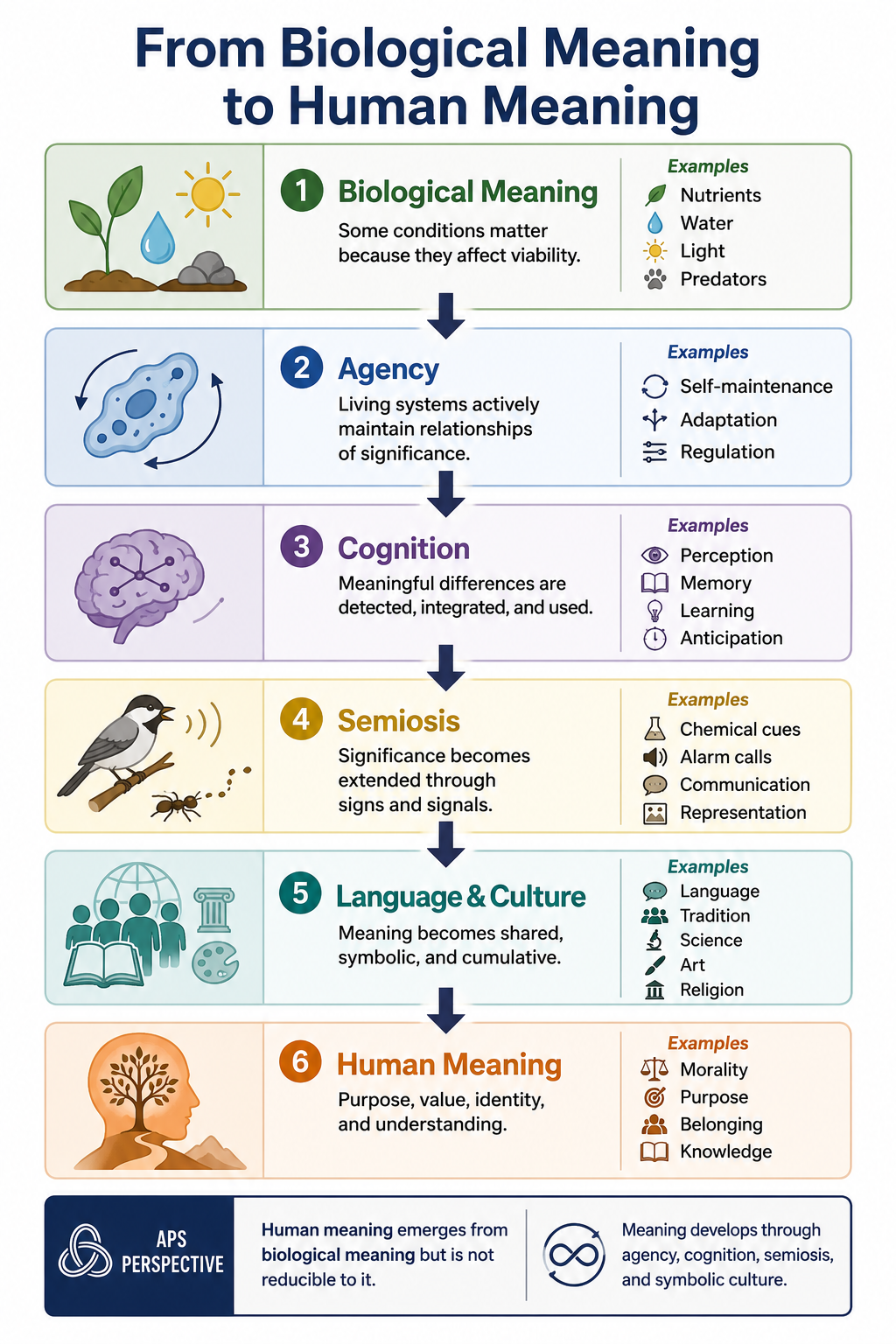
From Biological Meaning to Human Meaning. APS proposes that meaning originates when environmental differences become consequential for living systems engaged in organised persistence. Through agency, cognition, and semiosis, these relationships of significance become increasingly elaborate, eventually supporting language, culture, and the uniquely human forms of meaning associated with purpose, value, identity, morality, science, and understanding.
Human Meaning: Continuity Without Reduction
By this point, a pattern has emerged.
Biological meaning arises when some conditions become consequential for the viability and organised persistence of living systems. Agency establishes and maintains these relationships of significance. Cognition enables organisms to detect, integrate, remember, and respond to meaningful differences. Semiosis extends significance through signs, signals, and representations.
Human meaning develops from these foundations.
At the same time, it cannot be fully reduced to them.
This balance between continuity and difference is central to the APS perspective. Human beings remain living organisms and therefore participate in the same fundamental biological processes found throughout the living world. Yet humans also possess distinctive capacities that allow meaning to expand into forms unknown elsewhere in nature.
Understanding human meaning therefore requires avoiding two opposite mistakes.
The first is to treat humans as completely separate from the rest of life, as though meaning suddenly appeared with language, consciousness, or culture. This view creates an unnecessary divide between human experience and the biological world from which it emerged.
The second is to reduce all human meaning to survival, reproduction, or other biological processes. This overlooks the extraordinary complexity of symbolic life and fails to explain why people devote themselves to activities whose significance often extends far beyond immediate biological concerns.
APS rejects both extremes.
Human meaning emerges from biological meaning, but it is not reducible to it.
The foundation remains biological. Like all organisms, humans inhabit a world in which some conditions matter more than others. We depend upon food, water, shelter, social relationships, and countless forms of environmental support. Our bodies remain living systems engaged in organised persistence. Biological meaning therefore continues to shape human life at every moment.
What distinguishes humans is the extent to which cognition and semiosis expand the scope of significance.
Through language, symbolic thought, and cultural transmission, meaning is no longer confined to direct interactions with the environment. Humans can communicate about absent objects, imagined futures, remembered pasts, abstract ideas, and hypothetical possibilities. Experiences can be shared, preserved, criticised, revised, and transmitted across generations. Meaning becomes distributed across conversations, stories, traditions, institutions, and collective forms of memory.
Culture plays a central role in this expansion. Languages, customs, laws, scientific traditions, religious practices, artistic conventions, and social norms provide shared frameworks through which people interpret experience and understand their place in the world. Human meaning therefore exists not only within individuals but also within enduring cultural systems that connect people across space and time.
These symbolic systems greatly expand the range of things that can matter. Scientific theories, works of art, moral principles, political institutions, religious beliefs, and personal commitments derive their significance from roles they play within larger networks of understanding, value, and practice. Such forms of meaning cannot be adequately described solely in terms of immediate biological needs, even though they ultimately depend upon capacities that emerged within the biological world.
What unites these diverse forms of human meaning is the capacity for reflection.
Humans do not merely participate in meaningful relationships; they can think about them. We can ask why something matters, compare competing values, revise our goals, reject inherited traditions, imagine alternative futures, and create new systems of significance. Through symbolic thought, meaning becomes increasingly open-ended, negotiated, and transformative.
Personal identity emerges within this symbolic landscape. Individuals develop life stories, commitments, aspirations, relationships, and projects that contribute to a sense of self. Questions of purpose, fulfilment, vocation, and legacy all arise within this uniquely human domain of meaning.
Yet despite its complexity, human meaning remains continuous with its biological foundations.
Without living organisms there would be no cognition. Without cognition there would be no semiosis. Without semiosis there would be no language, culture, science, morality, religion, art, or personal narratives. Human meaning therefore represents neither a departure from life nor an exception to it. It is an emergent expansion of processes already present within the living world.
Human beings are not detached observers asking questions from outside nature. We are living systems whose biological foundations have given rise to language, culture, imagination, and reflection. Through these capacities, the significance that first emerges in biological relationships becomes transformed into the rich symbolic worlds that characterise human experience.
The question is therefore no longer simply how humans create meaning.
A deeper question comes into focus:
If biological meaning is intrinsic to living systems, and human meaning emerges from those foundations, does life itself possess meaning?
Does Life Have Meaning?
Having explored biological meaning, agency, cognition, semiosis, and human meaning, we can now return to the question that has guided this discussion from the beginning:
Does life have meaning?
APS approaches this question differently from many traditional perspectives. Rather than asking whether life possesses a predetermined purpose or ultimate destination, it asks whether meaning is already present within the living world itself.
From this perspective, the answer is yes.
Life has meaning because living systems generate relationships of significance.
Throughout this article, we have seen that organisms are not passive objects drifting through a neutral environment. They actively maintain themselves, respond to changing conditions, and engage with circumstances that affect their continued viability. In doing so, they create distinctions between what matters and what does not.
This distinction is the foundation of biological meaning.
A drought matters to a plant. A nutrient gradient matters to a bacterium. A predator matters to a deer. These forms of significance are not imposed upon life from outside. They emerge because living systems are organised in ways that make some conditions consequential for their continued activity.
This does not mean that life possesses a single universal purpose.
One of the central themes of APS is that meaning and purpose should not be confused. To say that life has meaning is not to claim that every organism exists for the same reason, pursues the same goal, or contributes to a predetermined cosmic plan. Meaning concerns significance—what matters and why—whereas purpose concerns what something is for.
APS therefore does not propose a single ultimate goal toward which all life is directed. Living systems exhibit directionality because they are organised around viability and organised persistence, not because they are following a script written in advance.
This distinction helps avoid a false choice that often appears in discussions of meaning. Meaning is frequently treated as either something imposed upon nature from outside or something invented entirely by human minds. APS suggests a third possibility.
Meaning can emerge as a natural feature of living systems.
Living organisms actively maintain themselves in relation to their environments. Because they do so, some conditions support continued activity while others undermine it. Significance emerges through these relationships. Meaning is therefore neither an external gift nor a subjective illusion. It is a consequence of the way living systems engage with the world.
This does not make meaning purely objective or purely subjective.
A nutrient matters to a bacterium because of the kind of organism it is. Water matters to a plant because of the way the plant is organised. Significance always arises through a relationship between a living system and its circumstances. Meaning is therefore fundamentally relational.
This relational perspective helps explain both the diversity and the unity of meaning in the living world. Different organisms inhabit different worlds of significance because they possess different forms of organisation and different requirements for viability. Yet all participate in the same general process through which environmental differences become meaningful in relation to ongoing biological activity.
Human meaning represents the most elaborate expression of this process, but not an exception to it. The values, purposes, identities, beliefs, and aspirations that shape human lives emerge within a broader world in which significance is already present. Through language, culture, and symbolic thought, humans expand and transform that inheritance into increasingly rich forms of meaning.
APS therefore answers the question Does life have meaning? in a distinctive way.
Life has meaning because living systems continuously generate and sustain relationships of significance through their interactions with the world.
Meaning is neither an illusion nor an external gift.
It is a natural consequence of life itself.
What Is the Meaning of Life?
We can now return to the question that began this article:
What is the meaning of life?
For centuries, people have searched for a single answer. Philosophers have proposed competing theories, religions have offered different visions of purpose and significance, and countless individuals have sought meaning through relationships, achievement, creativity, service, or spiritual practice. Yet no universally accepted answer has emerged.
APS suggests that part of the difficulty lies in the question itself.
The phrase meaning of life often combines several distinct concerns: purpose, value, significance, fulfilment, identity, morality, and belonging. Different answers frequently address different aspects of the question.
APS therefore reframes the problem.
Rather than asking what purpose life serves, it asks how meaning becomes possible in the first place.
The answer begins with a simple observation: living systems inhabit worlds in which some things matter.
Because organisms are engaged in maintaining themselves through time, distinctions emerge between conditions that support continued activity and conditions that threaten it. From these distinctions arises biological meaning. Through agency, living systems actively establish and maintain relationships of significance. Through cognition, they detect and respond to meaningful differences. Through semiosis, significance becomes extended through signs, signals, and representations. In humans, these processes are elaborated through language, culture, imagination, memory, morality, science, religion, and art.
Human meaning therefore emerges from biological meaning while extending it into uniquely symbolic forms.
From an APS perspective, the meaning of life is not a fixed purpose imposed from outside nature, nor is it merely a subjective invention existing only in individual minds.
Meaning is a natural consequence of life’s organisation.
Living systems continually create, sustain, and transform relationships of significance. Human beings inherit this condition and develop it through reflection, culture, and symbolic thought into the rich worlds of value and purpose that characterise human existence.
This perspective also helps reconcile two intuitions that often appear to conflict. Meaning is deeply personal because each individual inhabits a unique history, set of relationships, and cultural context. Yet meaning is not arbitrary because it emerges from real relationships between living systems and the conditions that shape their continued activity and flourishing.
The search for meaning therefore does not begin outside life.
It begins within life.
Every organism inhabits a world in which some things matter more than others. Human beings transform this biological condition into stories, identities, institutions, moral systems, scientific theories, artistic traditions, and personal aspirations. These are not departures from meaning but increasingly elaborate expressions of it.
The question What is the meaning of life? therefore has no single answer that applies equally to every person, culture, or circumstance.
Yet APS identifies a common foundation beneath this diversity.
Life is meaningful because living systems generate and sustain relationships of significance. Human meanings emerge from these foundations and expand them into ever more complex forms of understanding, value, and purpose.
The meaning of life is not a destination to be reached or a message waiting to be decoded.
It is the ongoing process through which living systems make the world matter.
Life does not merely possess meaning.
Life is the source from which meaning emerges.
See Also
Related Articles
References
- (2012). Incomplete Nature. W. W. Norton.
- (2020). The Metaphysics of Evolution. Cambridge University Press.
- (2018). Everything Flows: Towards a Processual Philosophy of Biology. Oxford University Press.
- (2006). Man's Search for Meaning. Beacon Press.
- (1982). The Growth of Biological Thought. Harvard University Press.
- (2026). Agency as the defining activity of life: A viability-oriented framework integrating process and scale. Biological Theory . https://doi.org/10.1007/s13752-026-00547-6