Is There Design in Nature?
Living systems exhibit extraordinary organisation that is often described as design. Yet modern biology rejects the idea that organisms were intentionally designed. How can both claims be true? APS argues that biological design is real, but does not require a designer. Design emerges from viability-oriented, constraint-closed organisation and the continual activity through which living systems sustain themselves across time.
The Puzzle of Design
A bird wing. An orchid flower. The vertebrate eye. The mammalian immune system. Even more remarkable is the capacity of living organisms to develop from a single cell, repair damage, adapt to changing circumstances, and maintain themselves across decades of continual change.
Such phenomena confront us with a striking fact: living systems exhibit forms of organisation that are extraordinarily intricate. Their structures are coordinated across scales, their activities are integrated through time, and their behaviour is organised in ways that reliably contribute to continued existence. Indeed, many biological systems display degrees of functional integration that exceed anything human beings have yet engineered.
Yet modern biology insists that these systems were not designed.
This tension gives rise to one of the oldest and most persistent puzzles in the life sciences. How can organisms exhibit such extraordinary design if nobody designed them?
Historically, the apparent design of living systems was taken as evidence of an external designer. The complexity and coordination of biological structures seemed difficult to explain in any other way. Wings appear suited to flight, eyes to vision, roots to nutrient acquisition, and immune systems to defence. The apparent fit between biological structures and the activities they perform naturally encouraged the conclusion that living systems had been intentionally arranged for particular purposes.
The development of evolutionary theory transformed this picture. Darwin’s account of variation, inheritance, and natural selection provided a powerful naturalistic explanation for how complex biological organisation could arise without foresight or external intention. Modern biology therefore rejects the inference from design to designer. Organisms are not understood as products of planning, purpose, or external direction.
Yet the puzzle does not disappear.
Even after the rejection of external designers, living systems continue to exhibit extraordinary organisation. They develop, regulate, repair, adapt, and sustain themselves through changing conditions. Biological structures still appear remarkably well suited to the activities they perform. The language of function, adaptation, organisation, and purpose remains deeply embedded within biological explanation because the phenomena that originally motivated such language remain present and continue to demand explanation.
For this reason, debates about design repeatedly return to biology. Some conclude that design must imply a designer. Others argue that design is merely an illusion produced by evolutionary processes. Both positions capture part of the truth, yet neither fully explains why living systems appear so strikingly organised.
APS approaches the puzzle differently.
The central question is not whether biological design points to a designer, nor whether design is merely apparent. The deeper question is what the intuition of design is actually tracking in living systems themselves.
APS argues that the appearance of design reflects something real. Living systems are organised in distinctive ways that support their continued existence. The challenge is therefore not to explain away design, but to understand how organised biological structure can emerge naturally without requiring external imposition or intention.
This article develops an APS answer to that challenge. Biological design is real, but it is not imposed. It emerges from the viability-oriented organisation through which living systems generate, maintain, and reproduce the conditions of their own persistence.
Why Design Creates a Philosophical Problem
The puzzle of design arises because design appears to imply something more than organisation alone.
When people encounter a complex machine, a building, or a piece of sophisticated engineering, they naturally infer a designer. Human designs are associated with planning, foresight, intention, and the deliberate arrangement of parts toward particular ends. In ordinary experience, design seems inseparable from a designing mind.
This intuition appears equally compelling when applied to living systems. Organisms are not merely complex. They exhibit forms of organisation that seem directed toward specific outcomes. Eyes contribute to vision, leaves contribute to photosynthesis, roots contribute to nutrient acquisition, and immune systems coordinate vast networks of interacting processes in ways that support survival. Across biology, structures appear remarkably well suited to the activities they perform.
The apparent fit between organisation and outcome has therefore encouraged a powerful inference:
Traditional design arguments begin with the observation that living systems appear highly organised and purposefully structured. From this observation they infer that such organisation must ultimately originate from an external designer.
For much of intellectual history this inference appeared almost unavoidable. If a watch implies a watchmaker, then surely organisms—which are vastly more complex than watches—must imply an even greater designer. Classical teleological arguments rested upon precisely this intuition.
The difficulty is that the intuition captures something genuine. The apparent design of living systems is not a superficial observation. Biological organisation exhibits real coordination, integration, and functional coherence. Organisms are not random collections of parts. Their structures and activities are organised in ways that systematically contribute to continued existence. The challenge is therefore not simply to dismiss the intuition of design, but to understand why it arises so naturally in the first place.
At the same time, modern biology has become deeply suspicious of design language. Scientific explanations seek natural causes rather than appeals to external intention. Explanations grounded in planning, foresight, or purpose appear incompatible with the methodological commitments of contemporary science. Biology therefore finds itself in an unusual position: it studies systems that often appear designed while simultaneously rejecting traditional explanations based upon designers.
This creates a persistent philosophical tension.
If design necessarily implies intention, then modern biology appears unable to account for one of the most striking features of living systems. Yet if design language is simply abandoned, something important seems to be lost. The extraordinary organisation of living systems remains visible even if the vocabulary used to describe it changes.
The central problem therefore becomes clearer. The question is not merely whether organisms were designed. The deeper question is whether the organised character of living systems can be understood without importing assumptions about intention, planning, or external purpose. In other words, can there be genuine biological design without a designer?
Answering this question requires understanding why biology rejected traditional design explanations in the first place and what remains once those explanations have been removed.
Why Biology Rejects Designers
The modern biological rejection of designers did not arise from hostility to purpose or organisation. It emerged because naturalistic explanations proved capable of accounting for features of living systems that had previously been attributed to external intention.
Prior to Darwin, the apparent design of organisms posed a profound explanatory challenge. Biological structures frequently appeared so well suited to their activities that intentional arrangement seemed the most plausible explanation. Wings appeared designed for flight, eyes for vision, and flowers for reproduction. The apparent fit between structure and activity naturally encouraged appeals to purpose and design.
Darwin’s theory of evolution by natural selection fundamentally altered this landscape.
Natural selection demonstrated how organised biological structures could emerge through cumulative historical processes rather than deliberate planning. Variations that enhanced survival and reproduction tended to persist, while less successful variations tended to disappear. Across immense spans of time, this process could produce organisms exhibiting remarkable adaptation to their environments without any need for foresight or intention.
The result was a profound transformation of biological explanation. What had previously seemed to require a designer could now be understood as the outcome of evolutionary history. The apparent purposiveness of organisms no longer pointed toward external design but reflected the differential persistence of biological forms across generations. Adaptation became explicable through variation, inheritance, and selection rather than through appeals to intention or final causes.
As evolutionary theory developed, the explanatory role of external designers steadily diminished. Modern biology came to understand living systems as products of natural processes operating across deep time. The extraordinary organisation of organisms no longer required intervention from outside nature. Biological complexity could arise through evolutionary transformation itself.
This shift represents one of the greatest achievements in the history of science.
Yet the success of evolutionary explanation also created a new difficulty.
Evolution explains how organised biological structures arise historically. It explains why wings, eyes, immune systems, and nervous systems exist. What it does not eliminate is the organisation of living systems themselves. Organisms continue to maintain themselves, regulate themselves, repair damage, coordinate activities across scales, and respond adaptively to changing conditions. The question of how such organisation should be understood therefore remains.
In many discussions, the rejection of designers is treated as equivalent to the rejection of design. Once external intention has been removed, design is often described as merely apparent or metaphorical. Organisms may look designed, but the design itself is said to disappear under scientific scrutiny.
Yet this conclusion does not obviously follow.
The success of evolutionary theory demonstrates that biological organisation does not require an external designer. It does not demonstrate that the organisation itself is unreal. The structures and processes that originally motivated design language remain present. Living systems continue to exhibit coordinated patterns of activity that contribute to their persistence, and they continue to display organisation that appears highly functional and remarkably integrated.
Consequently, the rejection of designers solves only part of the puzzle.
Biology has shown that design does not require external intention. What remains unresolved is why living systems continue to appear so strikingly organised and whether the intuition of design is tracking something real about biological organisation itself.
To answer that question, we must confront a remarkable fact. Even after external designers have been rejected, the language and intuition of design repeatedly return. Something about living systems continues to invite the comparison.
Why Design Refuses to Disappear
If the problem of biological design had been solved simply by rejecting designers, the language of design would likely have disappeared from biology long ago.
It has not.
Biologists continue to speak of function, adaptation, regulation, organisation, signalling, information, error correction, developmental programmes, and biological goals. Scientific papers routinely describe systems as performing tasks, solving problems, responding to challenges, or contributing to survival. Although the vocabulary varies across disciplines, the underlying intuition remains remarkably persistent: living systems appear organised in ways that are systematically related to their continued existence.
This persistence is philosophically significant. The continued appearance of design language cannot be explained merely as a historical residue from pre-Darwinian thinking. Modern biology has repeatedly refined its conceptual vocabulary while retaining many of the organisational insights that originally motivated teleological descriptions. The language survives because biologists continue to encounter phenomena that seem to require it.
Consider a developing embryo. From a single fertilised cell emerges a highly organised multicellular organism composed of specialised tissues, organs, and regulatory systems. Development proceeds through coordinated interactions distributed across scales, producing reliable outcomes despite variation, perturbation, and environmental uncertainty. The resulting organisation is not assembled from outside but generated from within the developing system itself.
The same pattern can be seen in tissue repair. When damage occurs, living systems frequently reorganise activity in ways that restore functional integrity. Cells proliferate, differentiate, migrate, and coordinate their behaviour. The resulting process often appears directed toward the recovery of viability. Although no external engineer supervises the process, the outcome can seem remarkably similar to purposeful repair.
Examples of this kind occur throughout biology. Immune systems identify and respond to threats. Plants alter growth patterns in changing environments. Animals regulate temperature, energy balance, and behaviour. Entire ecosystems exhibit forms of dynamic organisation that contribute to persistence across time.
In each case, biological activity appears organised in relation to conditions that matter for continued existence. Beneath these diverse phenomena lies a common theme. Living systems do not simply exist; they continually maintain themselves through changing conditions. Development, repair, regulation, adaptation, and environmental responsiveness all contribute to a broader organisational achievement: persistence. As biological explanation moves beyond individual structures and toward the processes through which living systems sustain themselves across time, the organisation responsible for this achievement becomes increasingly visible.
This observation helps explain why the intuition of design repeatedly returns. The intuition is not primarily generated by complexity. Many non-living systems are complex. Nor is it generated solely by adaptation, since adaptation itself requires explanation. Rather, the intuition arises because living systems exhibit organised activity that appears systematically oriented toward maintaining and reproducing the conditions of their own persistence.
Human engineering provides a useful contrast. Engineered systems typically derive their organisation from external design. The arrangement of components reflects decisions made by designers who stand outside the system itself. Biological systems exhibit comparable forms of integration and coordination, yet they achieve these outcomes without external planning. The similarity is sufficient to evoke comparisons with design even though the underlying processes are fundamentally different.
This is why neither of the traditional responses proves entirely satisfactory. To insist that design must imply a designer overlooks the possibility that organised biological structure can emerge through natural processes. Yet to dismiss design as mere illusion ignores the remarkable organisational achievements of living systems themselves. Both responses fail because they treat design as something that must either be imposed from outside or explained away altogether.
APS approaches the issue differently. The persistence of design language is not a mistake. It reflects the fact that living systems possess a distinctive form of organisation that genuinely requires explanation. The recurring intuition of design is therefore not tracking an external designer but a real feature of biological organisation itself.
The challenge is to identify what that feature is.
To do so, we must examine the conceptual frameworks biology has traditionally used to understand purposive organisation and the limitations that have prevented them from fully resolving the puzzle.
Teleology, Teleonomy, and Their Limits
The persistence of design language in biology has long encouraged attempts to understand living systems through concepts such as teleology and teleonomy.
Both concepts seek to explain why organisms appear organised in relation to particular outcomes. Both recognise that living systems exhibit forms of activity that seem directed toward goals, functions, or ends. Yet they differ profoundly in how they interpret the source of this apparent purposiveness.
Traditionally, teleology referred to explanation in terms of ends or purposes. A teleological explanation accounts for a phenomenon by reference to what it is for or what it is intended to achieve. In classical philosophy, teleological explanations often implied that natural systems possessed intrinsic purposes or were directed toward predetermined ends. This framework provided a natural way of understanding the apparent design of living organisms, but it also became associated with appeals to intention, final causes, and external design.
As biology developed into a modern science, many researchers became uncomfortable with these implications. Explanations based upon intention or purpose appeared difficult to reconcile with naturalistic accounts of biological organisation. Consequently, teleology increasingly came to be viewed with suspicion.
The concept of teleonomy emerged as an attempt to preserve the useful insights of teleological language while avoiding these problematic commitments.
Teleonomy acknowledges that organisms often behave in ways that appear goal-directed. However, it explains this appearance through evolutionary history rather than through intrinsic purposes or external intentions. Biological structures and behaviours seem directed toward particular outcomes because natural selection has favoured variants that contribute to survival and reproduction. Apparent purpose becomes an outcome of historical evolutionary processes rather than evidence of foresight or design.
This was an important conceptual advance. Teleonomy allowed biology to retain the language of function, adaptation, and goal-directedness without invoking designers or final causes. It provided a naturalistic account of why organisms frequently appear organised around particular activities and outcomes.
Yet teleonomy does not completely resolve the puzzle of design.
Evolutionary history explains how biological structures originate and why particular traits persist across generations. It explains why eyes exist, why wings contribute to flight, and why immune systems enhance survival. Historical explanations, however, do not fully capture the organisational reality of living systems as they exist here and now.
An organism is not simply a record of its evolutionary past. It is an active system continually maintaining itself in the present. Cells regulate internal conditions. Organisms repair damage. Physiological processes coordinate activities across scales. Behaviour responds to changing circumstances. Development generates and stabilises organised structure. These activities contribute directly to the continued persistence of the living system itself.
Consequently, the central phenomenon that originally motivated teleological language has not disappeared. Living systems continue to exhibit organisation that appears directed toward maintaining viability. They continue to display coordinated activities whose significance cannot be understood solely by describing their physical components or their evolutionary history. The question remains how this organisation should be interpreted.
This reveals a limitation shared by both traditional teleology and many teleonomic accounts. Teleology often places too much emphasis on purpose, intention, or ends. Teleonomy often places too much emphasis on historical origins. Neither fully captures the ongoing organisational activity through which living systems sustain themselves across time.
APS therefore approaches the issue from a different direction.
Rather than beginning with purposes, intentions, or historical outcomes, APS begins with the organisation of living systems themselves. The central question is not whether organisms possess purposes, nor whether apparent design can be reduced to evolutionary history. The question is how living systems generate, maintain, and regulate the organised conditions required for their continued persistence.
The challenge is therefore not merely to explain why organisms appear purposeful, but to explain the organisational reality that gives rise to that appearance.
From this perspective, the appearance of design is neither mysterious nor illusory. It reflects a real organisational phenomenon emerging from the activities through which living systems remain viable. The task is therefore not to choose between teleology and teleonomy, but to identify the underlying organisational reality that gives rise to both concepts in the first place.
APS: Design Without a Designer
APS begins from a simple observation: living systems are not passive objects. They are active systems engaged in the continual maintenance of their own existence. Organisms regulate internal conditions, acquire resources, repair damage, respond to environmental change, coordinate activities across scales, and reproduce the conditions necessary for continued persistence. These activities are not occasional features of life; they constitute what living systems fundamentally do.
From an APS perspective, this activity is biological agency.
Biological agency does not imply consciousness, deliberation, or intention. Rather, it refers to the viability-oriented activity through which living systems sustain, modulate, and recreate the conditions of their own persistence. Organisms act because remaining viable requires action. Life is therefore not simply a collection of structures but an ongoing process of organised self-maintenance.
This shift in perspective changes how design is understood.
Traditional design arguments begin with organisation and infer a designer. APS begins with organised activity itself. The remarkable organisation of living systems is not treated as evidence of external planning but as the outcome of the continual processes through which organisms remain viable.
What appears as design is therefore not imposed from outside. It emerges from within.
Consider a living organism confronted with changing conditions. Survival requires the coordinated regulation of metabolism, development, behaviour, and environmental interaction. Activities that contribute to viability tend to be stabilised and integrated within the organism, while activities that undermine viability tend to be modified, constrained, or eliminated. Across time, this continual process generates increasingly organised patterns of activity and structure.
The result is a system whose organisation appears highly functional. Importantly, this functionality does not originate from foresight. The organism does not possess a blueprint describing its future state, nor does it pursue externally specified objectives. Instead, organisation emerges because viability creates a persistent asymmetry between conditions that support continued existence and conditions that threaten it.
This asymmetry is fundamental. For a living system, some outcomes matter and others do not. Nutrient acquisition matters. Temperature regulation matters. Developmental coordination matters. Repair matters. These activities matter because they contribute to the persistence of the organism itself. Biological organisation therefore becomes structured around viability-related constraints long before any appeal to intention becomes necessary.
APS interprets design as an expression of this organisational reality.
This position differs from two familiar responses to biological design. One concludes that the apparent design of living systems necessarily implies a designer. The other concludes that once designers have been rejected, the appearance of design must be treated as an illusion. APS rejects both conclusions.
The apparent fit between biological structures and their activities does not arise because someone planned the system in advance. Nor is it a misleading appearance that disappears under scientific scrutiny. Rather, it arises because living systems continuously generate, maintain, repair, and refine forms of organisation that contribute to their persistence.
The organisation of living systems appears purposeful because viability imposes real constraints on what can succeed and what can fail. Conditions that support persistence tend to be stabilised and integrated into biological organisation, while conditions that undermine persistence tend to be modified, compensated for, or eliminated. Across developmental, physiological, ecological, and evolutionary timescales, these processes generate increasingly coherent forms of organisation.
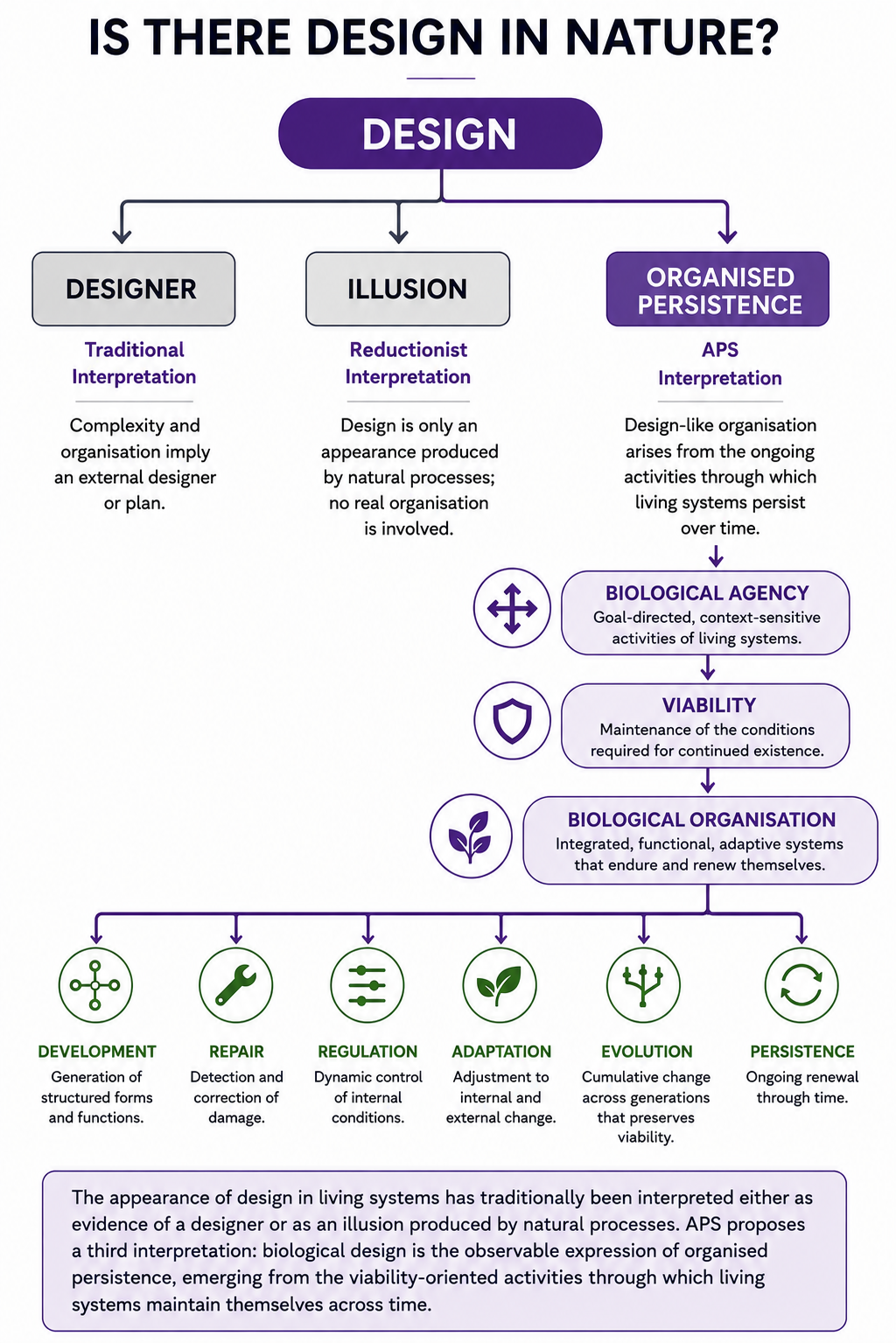
The APS position is therefore neither that biological design provides evidence of an external designer nor that it should be dismissed as a misleading appearance. Instead, biological design should be understood as an expression of organised persistence. Living systems continuously generate, maintain, repair, and reorganise the conditions required for their own continued existence. The apparent design of biological structures emerges from these ongoing organisational processes rather than from prior intention or external imposition.
The central APS claim is straightforward.
Design is real.
What is rejected is not design itself but the inference that design requires a designer.
Living systems exhibit remarkable organisation because they are viability-oriented systems engaged in the continual production and maintenance of the conditions necessary for their own persistence. Biological design is therefore best understood as an expression of organised persistence rather than as evidence of prior intention or external planning.
The challenge now becomes understanding why this organisational activity so often resembles engineering. Why do living systems appear not merely organised but engineered? Why do biological structures so readily invite comparison with human design?
Answering these questions requires examining the distinctive relationship between biological organisation and the engineering analogy itself.
Why Living Systems Look Engineered
One reason the puzzle of design remains so compelling is that living systems often appear strikingly similar to engineered systems.
Biologists routinely encounter structures and processes that seem purpose-built. Eyes focus light, wings generate lift, kidneys regulate internal chemistry, and immune systems identify and respond to threats. Developmental systems coordinate the construction of highly organised bodies. Across biology, structures appear integrated into larger systems in ways that resemble the organisation of sophisticated human technologies.
The comparison is not entirely misplaced.
Both engineered systems and living systems exhibit organised relationships among components. In both cases, multiple processes interact to produce coherent outcomes. Structures contribute to larger patterns of activity, and failures in one component can influence the functioning of the whole. These similarities help explain why engineering language appears so naturally in biological description.
Yet the similarities should not obscure an equally important difference.
Engineering begins with a designer. A bridge exists because engineers planned it. A computer exists because designers specified its architecture. A machine is organised according to objectives established outside the system itself. The organisation originates in external intention before it appears in material form.
Living systems operate differently.
An organism does not wait for an external designer to organise its activities. Its organisation emerges through its own ongoing processes. Development constructs biological structure from within. Physiology continually maintains functional organisation. Repair mechanisms respond to disruption. Behaviour adjusts to changing conditions. Evolution transforms biological organisation across generations. At every stage, organisation is generated and sustained by processes internal to living systems themselves.
This distinction is fundamental.
Engineering imposes organisation; life produces organisation.
Indeed, many contemporary engineering disciplines increasingly look to living systems for inspiration. Adaptive control, distributed regulation, resilience, robustness, and self-repair are often treated as advanced engineering achievements, yet living systems have exhibited such capacities throughout evolutionary history. In this respect, engineering frequently attempts to reproduce organisational capabilities that biology already possesses rather than providing the original model for understanding them.
This observation helps explain why organisms often appear to exceed human engineering. Living systems do not simply perform functions; they continually generate and maintain the conditions that make those functions possible. The comparison with engineering therefore reveals both a similarity and a limitation. Biological organisation often achieves forms of adaptive integration that engineering still struggles to emulate.
The difference becomes especially apparent when systems are damaged.
Most engineered systems possess limited capacities for self-repair. When a bridge collapses, the bridge does not rebuild itself. When a computer fails, it does not reorganise its own architecture to restore function. Repair requires intervention from outside the system.
Living systems are different. Cells repair damaged molecules, tissues regenerate, organisms compensate for injury, developmental systems reorganise activity in response to perturbation, and physiological systems continually restore conditions necessary for viability. The organisation responsible for persistence is therefore not fixed once and for all. It is continually recreated through biological activity.
This capacity helps explain why living systems often surpass the achievements of human engineering. Human technologies can be extraordinarily sophisticated, but they typically remain dependent upon external construction, maintenance, and repair. Living systems integrate these capacities within the organisation of the system itself. Organisms do not merely function; they participate in the continual production and maintenance of the conditions that make functioning possible.
For this reason, the engineering analogy is simultaneously illuminating and misleading.
It is illuminating because biological systems genuinely exhibit remarkable forms of organisation. The intuition that organisms appear designed is not mistaken. Living systems often display levels of coordination, integration, and functional coherence that invite comparison with our most sophisticated technologies.
The analogy becomes misleading when it encourages the assumption that biological organisation must originate in the same way as human design. APS rejects this assumption. The organised character of living systems does not derive from external planning. It emerges from the viability-oriented activities through which organisms sustain themselves across time. Engineering provides a useful metaphor because living systems genuinely achieve extraordinary organisational outcomes, but the mechanisms through which those outcomes arise are fundamentally biological rather than technological.
Seen in this light, the resemblance between organisms and engineered systems becomes easier to understand. Both exhibit organised structures that contribute to coherent outcomes. Both display relationships between parts and wholes. Both appear functionally integrated. Yet only living systems continuously generate, maintain, repair, and reproduce the organisation upon which their own existence depends.
This is why organisms look engineered even when they are not engineered.
The appearance of design arises because living systems achieve forms of organisation that engineering seeks to emulate. What appears to be external design is, in reality, the expression of an ongoing organisational process through which living systems preserve their own viability.
The remaining task is to identify the broader organisational principle underlying this achievement. If biological design is real, and if it emerges without external imposition, then design must ultimately be understood in relation to the deeper phenomenon that unifies biological organisation itself: organised persistence.
Design as Organised Persistence
The preceding sections have developed a common theme. Living systems exhibit extraordinary organisation, that organisation often appears designed, and yet modern biology rejects the existence of external designers. The persistence of this tension suggests that the intuition of design is tracking something real, even if traditional interpretations of design have proven inadequate.
APS argues that the mistake lies not in recognising design, but in misunderstanding its source.
From an APS perspective, the unifying feature of living systems is organised persistence. Living systems do not merely exist; they actively sustain themselves through time. Cells maintain internal conditions despite continual material turnover. Organisms regulate physiology in changing environments. Development generates and stabilises biological structure. Behaviour modifies organism–environment relationships. Evolution transforms lineages while preserving continuity across generations. Across all of these processes, living systems remain engaged in the continual production and maintenance of the conditions required for continued existence.
This activity is neither incidental nor secondary. It is the defining organisational characteristic of life.
The organisation observed throughout biology therefore reflects a common requirement: persistence under changing conditions. Structures, processes, and behaviours contribute to living systems because they participate in maintaining viability. The resulting organisation appears purposeful because viability creates real differences between success and failure, persistence and collapse, continuation and termination. Biological organisation becomes structured around these asymmetries.
Seen from this perspective, design acquires a different meaning. It is no longer understood as the product of prior intention, nor is it reduced to a convenient metaphor. Instead, design refers to the organised relationships through which living systems sustain themselves across time. Biological design is the observable expression of organised persistence.
This interpretation helps unify many features of biology that are often discussed separately. Development generates organised structure, physiology maintains it, behaviour modifies it in response to changing conditions, and evolution transforms it across generations. Although these phenomena are frequently treated as distinct domains of inquiry, they can all be understood as different expressions of the same underlying organisational reality: the generation, maintenance, adaptation, and continuation of viable organisation.
What appears as design is therefore not a separate biological mystery. It is one manifestation of the broader processes through which living systems persist.
This perspective also clarifies why biological design differs fundamentally from engineering design. Engineering typically begins with a plan and produces an organised system. Living systems begin with organised activity and continually generate organisation through that activity. The resulting structures may resemble engineered artefacts, but they arise through fundamentally different processes. Biological design is not imposed upon living systems; it emerges from the ongoing dynamics of living systems themselves.
The concept of organised persistence therefore resolves the central tension running throughout this article. The traditional design argument correctly recognised that living systems exhibit extraordinary organisation. Modern biology correctly rejected the inference that such organisation requires an external designer. APS integrates these insights by identifying the organisational reality underlying both observations.
The appearance of design is real because organised persistence is real.
Living systems genuinely exhibit forms of organisation that contribute to their continued existence. These forms of organisation can be studied, explained, compared, and evaluated without appealing to external intentions or purposes. Design remains a meaningful biological concept because it refers to an observable organisational achievement rather than to the existence of a designer.
The puzzle that opened this article can now be answered.
There is design in nature.
But the design found in living systems is not imposed from outside. It emerges from the viability-oriented organisation through which living systems generate, maintain, and reproduce the conditions of their own persistence.
Design is therefore neither evidence of a designer nor a mere illusion.
It is the visible expression of organised persistence.
Conclusion: There Is Design in Nature
We can now return to the question that opened this article.
Is there design in nature?
From an APS perspective, the answer is yes.
Living systems exhibit extraordinary forms of organisation. They develop, regulate, repair, adapt, and reproduce themselves. They coordinate activities across scales and maintain viability under changing conditions. These organisational achievements are neither accidental nor illusory. They are observable features of biological reality.
What APS rejects is not design itself but a particular interpretation of design.
Historically, the apparent design of organisms encouraged the conclusion that a designer must exist. Modern biology correctly challenged this inference by showing how complex biological organisation can emerge through natural processes. Yet the rejection of designers did not eliminate the remarkable organisation of living systems themselves. The phenomena that originally motivated design language remain present and continue to demand explanation.
APS resolves this tension by distinguishing design from designer. Design need not imply prior intention, external planning, or foresight. Instead, biological design emerges from the viability-oriented organisation through which living systems sustain themselves across time. Organisms continuously generate, maintain, repair, and reorganise the conditions required for their own persistence. The resulting organisation appears purposeful because it is structured around real biological requirements for continued existence.
The appearance of design therefore reflects something genuine: the organisational achievement of living systems themselves.
This conclusion has implications beyond the question of design. It helps explain why biological concepts such as function, purpose, adaptation, regulation, and agency remain indispensable to biological explanation. These concepts persist because they refer to aspects of the organised activity through which living systems remain viable. Their explanatory power derives not from hidden intentions but from the realities of biological organisation.
Seen from this perspective, design is neither a relic of natural theology nor a metaphor that science must eventually abandon. It is a legitimate biological phenomenon. What requires explanation is not why organisms appear designed, but how living systems generate and sustain biological organisation without external imposition.
APS answers this question through the concepts of agency, viability, and organised persistence. Life is not defined by static structure but by the continual activity through which living systems maintain themselves. Biological agency generates and regulates the conditions required for persistence. Organised persistence provides the broader framework within which development, physiology, behaviour, ecology, and evolution become intelligible. Design emerges as one expression of this deeper organisational reality.
The puzzle that has accompanied biology for centuries therefore admits a naturalistic solution.
There is design in nature.
But the design found in living systems is not imposed from outside.
It emerges from the ongoing organisation of life itself.
See Also
Related Articles
References
- (1996). Darwin's Black Box. Free Press.
- (1859). On the Origin of Species. John Murray.
- (1986). The Blind Watchmaker. W. W. Norton.
- (1998). The Design Inference. Cambridge University Press.
- (1995). Darwin's Dangerous Idea. Simon and Schuster.
- (1980). Autopoiesis and Cognition. D. Reidel.
- (1988). Toward a New Philosophy of Biology. Harvard University Press.
- (1971). Chance and Necessity. Alfred A. Knopf.
- (2015). Biological Autonomy. Springer.
- (2018). What Is Life?. Cambridge University Press.
- (1802). Natural Theology; or, Evidences of the Existence and Attributes of the Deity. R. Faulder.
- (1979). Principles of Biological Autonomy. North Holland.