What Is the Fundamental Unit of Life?
The search for a fundamental unit of life has shaped biological theory for more than a century. Cells, genes, organisms, species, and ecosystems have each been proposed as biology's primary unit because each explains important aspects of living systems. Yet no single candidate has achieved universal acceptance. In the Agency–Process–Scale (APS) framework, this persistent disagreement reflects a deeper feature of life itself. Living systems are organised through agency, process, and scale rather than around a single privileged entity. Different biological units become important because they illuminate different dimensions of biological organisation. Organisms nevertheless occupy a distinctive explanatory position as regulatory hubs in which genetic, cellular, developmental, ecological, and evolutionary processes become integrated into coherent living activity. The debate over life's fundamental unit therefore reveals less about a missing biological building block than about the inherently multiscale nature of living systems.
Key Points
- Biology has repeatedly proposed different fundamental units because different biological phenomena require different explanatory perspectives.
- Cells, genes, organisms, species, and ecosystems each illuminate genuine aspects of biological organisation.
- The debate over fundamental units is closely connected to questions of biological individuality and organismality.
- Holobionts, microbiomes, colonial organisms, and symbiotic systems challenge simple definitions of biological individuals.
- In APS, life is organised through agency, process, and scale rather than around a single privileged unit.
- Organisms occupy a distinctive explanatory role as regulatory hubs where biological agency is integrated across scales.
Introduction: The Search for Life’s Fundamental Unit
Many sciences seek a fundamental unit from which more complex phenomena can be understood. Chemistry is built upon atoms. Physics investigates matter and energy through increasingly elementary particles and fields. These successes naturally encourage a similar question in biology:
What is the fundamental unit of life?
At first glance, the answer may seem obvious. Living organisms are composed of cells, genes are inherited across generations, and evolution occurs within populations and species. Yet each of these observations points toward a different candidate. Throughout the history of biology, researchers have proposed that the fundamental unit of life is the cell, the gene, the organism, the species, or even larger ecological systems. Each proposal has gained influence because it captures an important aspect of biological reality.
The persistence of this debate reveals something distinctive about life itself. Unlike many physical systems, living systems are organised across multiple spatial and temporal scales. Genes influence cells, cells contribute to organisms, organisms interact within populations, and populations participate in ecosystems. Biological explanations therefore often depend upon relationships among entities rather than upon a single privileged component.
More importantly, the history of the debate raises a deeper question. Why has biology repeatedly generated different answers to what appears to be the same problem? If there truly were a single fundamental unit of life, one might expect biological theory gradually to converge upon it. Instead, different periods of biological research have elevated different entities to positions of explanatory prominence. Cells, genes, organisms, species, and ecosystems have each been regarded as biology’s primary unit, yet none has succeeded in displacing all alternatives.
This recurring pattern suggests that the difficulty may not lie with any particular candidate. Rather, it may reflect something about the nature of living systems themselves. Life may not be organised around a single privileged entity in the way that matter can be analysed into atoms or molecules. Different biological units may appear fundamental because they illuminate different aspects of living organisation.
This article examines the major candidates that have been proposed as the fundamental unit of life and explores why each has proven both powerful and incomplete. It argues that the long-standing search for a single biological unit reveals a deeper feature of life itself: living systems are organised through interacting processes that span multiple scales. From the APS perspective, the debate over life’s fundamental unit ultimately points beyond any particular biological entity toward a deeper question: how biological agency is coordinated across the living world.
Why Biology Searches for Fundamental Units
The search for a fundamental unit is not unique to biology. Across the sciences, identifying basic units has often led to major advances in understanding. Atoms helped explain chemical reactions, molecules clarified the structure of matter, and elementary particles revealed previously hidden aspects of physical reality. These successes created an expectation that biological complexity might similarly be understood by identifying the most fundamental unit of life.
Biology, however, presents a special challenge. Living systems are not merely collections of components. They grow, develop, regulate themselves, reproduce, adapt, and evolve. As a result, biological explanation often involves understanding how diverse processes become organised into coherent living systems rather than simply identifying the material parts from which those systems are constructed.
This distinction is important because what counts as fundamental depends upon the kind of explanation being sought. In one sense, a fundamental unit is a basic building block from which larger structures are assembled. In another, it is the primary explanatory focus through which a phenomenon becomes intelligible. These meanings frequently coincide in the physical sciences, but they need not coincide in biology.
Cells, for example, are essential components of organisms, yet many biological questions concern phenomena that emerge only at the level of whole organisms or populations. Similarly, genes are indispensable for heredity, but understanding genes themselves requires reference to cells, organisms, and evolutionary history. A biological entity may therefore be indispensable without serving as the sole explanatory centre of biological theory.
This distinction helps explain why biology has repeatedly generated competing candidates. Different biological disciplines investigate different kinds of questions. A geneticist studying inheritance naturally focuses on genes. A physiologist investigating homeostasis often focuses on organisms. An ecologist examining nutrient cycles may focus on ecosystems. Each candidate appears fundamental because it occupies a central explanatory role within a particular domain of inquiry.
The result is unusual. Rather than converging on a single universally accepted unit, biology repeatedly identifies entities that seem fundamental for different reasons. Genes explain heredity. Cells explain metabolic organisation. Organisms explain integrated activity and behaviour. Species explain evolutionary continuity. Ecosystems explain ecological interdependence. The search for a single foundational unit therefore becomes increasingly difficult because biological organisation itself extends across multiple scales and forms of continuity.
This observation suggests that the history of the debate may be as informative as its outcome. The repeated emergence of competing units suggests that biology may not be missing a single answer. Instead, it may be confronting a deeper feature of living systems themselves. Living systems may resist reduction to a single explanatory centre because their organisation is inherently multiscale and relational. Before considering that possibility directly, it is useful to examine the first and most influential candidate in the history of the debate—the cell.
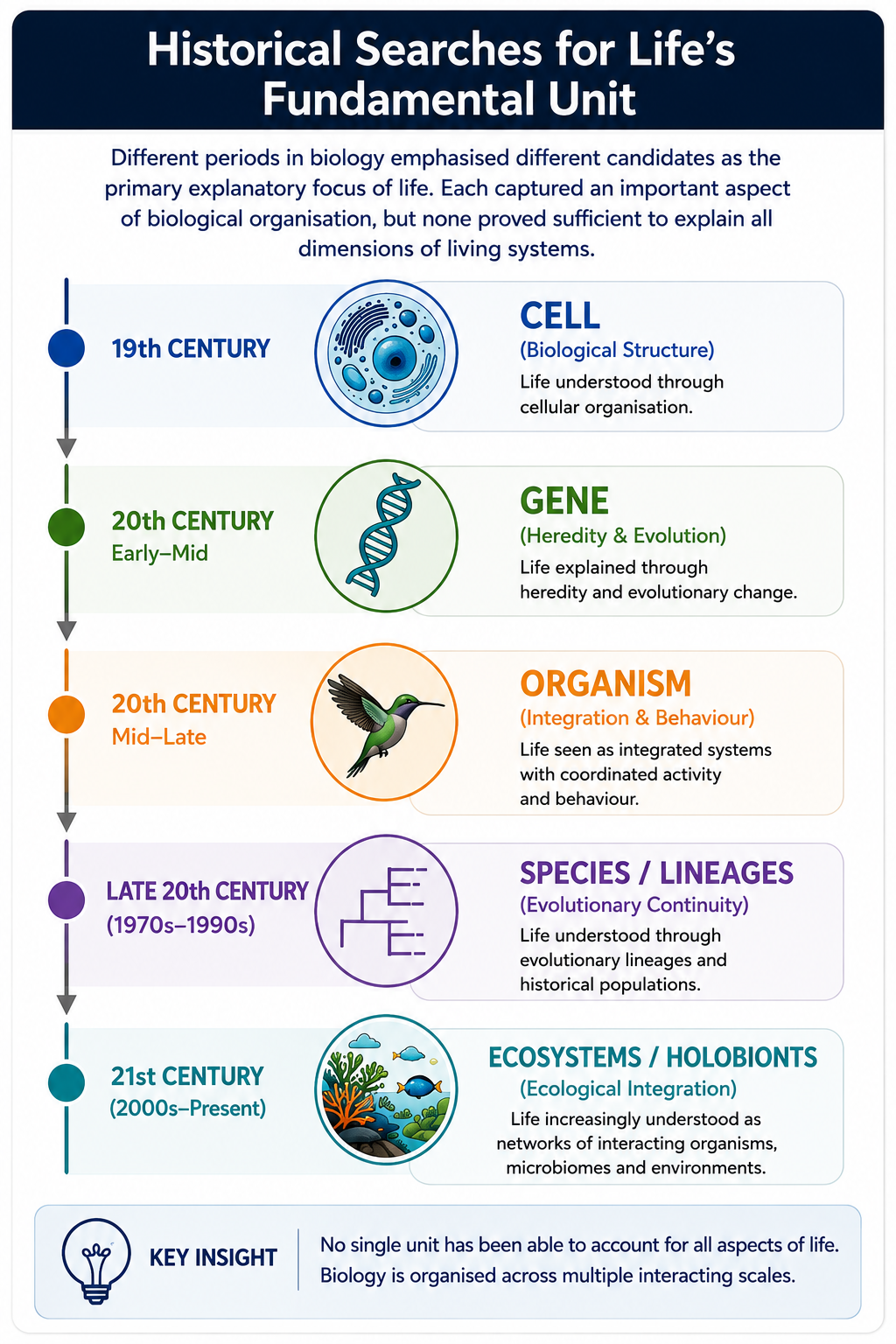
Historical Searches for Life's Fundamental Unit. Different periods in biology emphasised different candidates as the primary explanatory focus of life. Each captured an important aspect of biological organisation, but none proved sufficient to explain all dimensions of living systems.
The Cell as the Fundamental Unit
For much of modern biology, the cell has been regarded as the fundamental unit of life. This view emerged from the development of cell theory during the nineteenth century through the work of Matthias Schleiden, Theodor Schwann, and Rudolf Virchow. Their work established three principles that transformed biological thought: all living organisms are composed of cells, the cell is the basic unit of biological organisation, and new cells arise from pre-existing cells.
Cell theory offered an elegant solution to the search for biological unity. Whether examining plants, animals, fungi, or microorganisms, researchers repeatedly encountered the same fundamental organisational structure. Cells appeared to provide a common foundation underlying the extraordinary diversity of living forms. For the first time, biology possessed a candidate capable of explaining what all living systems shared.
The appeal of the cell extended beyond its universality. Cells perform many of the activities traditionally associated with life itself. They acquire energy, regulate internal conditions, respond to environmental change, grow, and reproduce. Even the simplest organisms consist of cells, while more complex organisms are composed of vast numbers of interacting cells. It therefore seemed reasonable to regard the cell as the basic unit from which biological organisation arises.
The explanatory power of cell theory remains immense. Cellular biology provides the foundation for modern physiology, developmental biology, microbiology, and medicine. Many biological processes can only be understood by examining how cells maintain themselves and interact with their surroundings. In this sense, the cell remains one of the most successful candidates ever proposed as the fundamental unit of life.
Yet the very success of cell theory gradually revealed its limitations. Multicellular organisms exhibit forms of organisation that cannot always be explained by examining individual cells in isolation. The coordinated activity of tissues, organs, and whole organisms often depends upon patterns of regulation that extend beyond any single cellular boundary. Individual cells within complex organisms may lose the ability to survive independently while contributing to larger systems that possess distinctive forms of organisation and behaviour.
These observations reveal an important tension. The cell may be the basic unit of biological structure, yet many biological phenomena depend upon forms of integration that transcend individual cells. Development, behaviour, physiological regulation, and environmental responsiveness frequently emerge through interactions among vast numbers of cells organised into coherent wholes. Understanding such phenomena often requires shifting attention from cells themselves to the larger systems they collectively constitute.
In retrospect, the rise of cell theory illustrates a recurring pattern within biology. The cell achieved prominence because it successfully explained a crucial dimension of living organisation. Its explanatory power, however, proved greater for some questions than for others. The search for a single foundational unit therefore continued, not because cell theory failed, but because life itself seemed to require additional forms of explanation.
Yet even as cell theory transformed biological understanding, another question remained unresolved. If cells explained the organisation of living matter, what accounted for the continuity of heredity across generations? Increasingly, the answer appeared to lie in genes.
The Gene as the Fundamental Unit
The twentieth century witnessed a profound shift in biological thinking. While nineteenth-century biology had focused largely on cells and organisms, the discovery of the mechanisms of heredity increasingly directed attention toward genes. The emergence of genetics, followed by molecular biology, encouraged many researchers to regard genes as the fundamental units of life because they appeared to provide a common explanation for inheritance, development, and evolution.
Genes possess a distinctive form of continuity. Individual cells die, organisms age and perish, and species may eventually disappear, yet genetic information can persist across generations through reproduction. This continuity made genes especially attractive as explanatory centres. The rediscovery of Mendelian inheritance in the early twentieth century, combined with later discoveries concerning DNA structure and function, established genes as central to modern biological explanation. By the latter half of the century, many biologists regarded life itself as fundamentally an informational phenomenon organised around the storage, transmission, and expression of genetic information.
Gene-centred perspectives gained additional influence through evolutionary theory. Because inherited genetic variation contributes to evolutionary change, genes appeared to provide a natural bridge between individual organisms and long-term evolutionary processes. Some interpretations went further, proposing that organisms could be understood primarily as vehicles through which genes persist and reproduce. From this perspective, genes seemed to possess a degree of explanatory primacy that cells and organisms lacked.
The success of genetics and molecular biology is undeniable. Genes play indispensable roles in heredity, development, cellular regulation, and evolutionary continuity. Many biological phenomena cannot be understood without reference to genetic mechanisms. Modern medicine, agriculture, biotechnology, and evolutionary biology all depend heavily upon genetic explanations.
Yet the explanatory success of genes does not necessarily establish them as the fundamental unit of life. Genes do not function independently of cellular and organismal contexts. A sequence of DNA becomes biologically meaningful only within a living system capable of interpreting, regulating, and responding to that information. Gene expression depends upon cellular machinery, developmental processes, environmental conditions, and regulatory networks that extend far beyond any individual gene.
Increasingly, biological research has shown that heredity and development cannot be understood as simple one-way processes in which genes determine biological outcomes independently of context. Development emerges through interactions among genes, cells, organisms, and environments. The same genetic sequence can produce different outcomes under different conditions, while similar biological functions may arise through different genetic pathways. Information therefore does not flow in a simple linear direction from genes to organisms. Rather, biological organisation emerges through networks of reciprocal interaction operating across multiple scales.
Genes therefore explain a crucial dimension of biological organisation, but they do not explain biological organisation as a whole. Their significance depends upon the living systems in which they are embedded, just as those systems depend upon the hereditary continuity that genes help provide.
The history of gene-centred thinking illustrates a broader pattern already visible in cell theory. Genes achieved prominence because they successfully explained a particular biological problem—in this case heredity and evolutionary continuity. However, when elevated from a powerful explanatory focus to the universally fundamental unit of life, they encounter the same difficulty as cells. They illuminate certain dimensions of living organisation exceptionally well while leaving others only partially explained.
This observation begins to clarify why the search for a single fundamental unit repeatedly encounters difficulties. Different candidates appear fundamental because they explain different aspects of living systems. The question then becomes whether there exists an entity capable of integrating these diverse dimensions of biological organisation. Historically, many biologists have answered that question by turning to the organism.
The Organism as the Integrative Individual
Among all proposed candidates for life’s fundamental unit, the organism occupies a distinctive position. Unlike genes or cells, organisms are the entities most readily recognised as living things. Animals, plants, fungi, and microorganisms exist as organised individuals that grow, develop, interact with their environments, and reproduce. For many biologists, this makes the organism the most natural starting point for understanding life.
The appeal of the organism extends beyond intuition. Organisms bring together numerous biological processes within coherent functional wholes. They coordinate metabolism, development, physiological regulation, environmental responsiveness, and reproduction. The activities of genes and cells become biologically significant largely because they contribute to the persistence and functioning of organisms. In this sense, organisms occupy a central position within biological explanation, linking molecular and cellular processes with broader ecological and evolutionary dynamics.
Development further strengthens the case for organism-centred thinking. An organism is not simply a collection of cells assembled together. Throughout development, cells differentiate, communicate, and organise themselves into increasingly integrated structures and functions. The resulting individual exhibits forms of coordination that cannot be fully understood by examining isolated components alone. The persistence of organismal identity despite continual material turnover illustrates a broader biological principle: living systems endure not because their constituent parts remain unchanged, but because patterns of organisation and activity are maintained through time.
Behaviour provides another reason organisms have often been regarded as fundamental. Organisms perceive aspects of their environments, regulate internal conditions, and respond to changing circumstances in ways that contribute to their continued existence. Even relatively simple organisms display forms of adaptive responsiveness that cannot be readily attributed to genes or cells considered in isolation. Their capacity to coordinate activity across multiple biological processes gives organisms a distinctive explanatory role within living systems.
These observations connect directly with biological agency. Organisms actively maintain themselves, regulate interactions with their environments, and participate in processes that contribute to their persistence through time. Whether through movement, growth, physiological adjustment, developmental plasticity, or ecological modification, organisms are among the clearest expressions of life’s capacity for organised persistence.
For these reasons, many theoretical biologists have regarded organisms as biology’s primary explanatory focus. Organisms are where heredity becomes development, where development becomes behaviour, and where behaviour influences ecology and evolution. They occupy a uniquely integrative position within the living world, bringing together processes that are often studied separately within different biological disciplines.
Yet the apparent simplicity of the organism conceals a deeper problem. The more closely biologists examine living systems, the more difficult it becomes to determine precisely what counts as an organism in the first place. The search for a fundamental unit therefore leads naturally to a second and equally important question:
What constitutes a biological individual?
The Problem of Biological Individuality
The search for a fundamental unit of life is inseparable from the problem of biological individuality. Before identifying life’s primary unit, we must first determine what qualifies as a biological individual. Surprisingly, this question often proves far more difficult than it initially appears.
Many organisms seem straightforward. A tree, a bird, or a bacterium appears to possess clear boundaries and a coherent identity. Such cases encourage the intuition that biological individuals are discrete entities that can be readily distinguished from their surroundings. Yet a growing number of examples challenge this assumption.
Lichens provide a classic illustration. Traditionally regarded as individual organisms, lichens are now understood to consist of intimate associations among fungi, photosynthetic partners, and often additional microbial communities. Their ecological success depends upon the integrated functioning of multiple species. This raises a fundamental question: is a lichen one organism, several organisms, or something in between?
Similar challenges arise in discussions of holobionts and microbiomes. Many multicellular organisms exist in close association with vast communities of microorganisms that influence nutrition, development, immunity, and behaviour. Humans, plants, and countless other organisms depend upon microbial partners for normal functioning. If these microbial communities contribute directly to organismal performance, where should the boundaries of the individual be drawn?
Endosymbiosis provides an even more striking example. Mitochondria and chloroplasts originated as free-living organisms before becoming integrated into larger cellular systems. What began as interactions among distinct organisms eventually produced new forms of biological individuality. Such cases suggest that individuality is not always a fixed starting point but may itself emerge through processes of integration and organisational transformation.
Other examples challenge individuality from a different direction. Colonial organisms such as corals, bryozoans, and siphonophores consist of multiple interconnected units that function together as larger wholes. Slime moulds alternate between solitary and collective forms during their life cycles, shifting between individuality and cooperation depending upon environmental conditions. Eusocial insect colonies exhibit forms of coordinated behaviour so sophisticated that some researchers have described them as superorganisms.
Taken together, these examples reveal that biological individuality is often graded, context-dependent, and historically contingent. Living systems do not always conform to simple categories of individual and collective. Instead, individuality frequently emerges through patterns of integration, coordination, and organised persistence that may vary across biological scales and through evolutionary time.
Importantly, these observations do not undermine the reality of organisms. Rather, they challenge overly simple assumptions about what organisms are. Biological individuals are not necessarily defined by rigid physical boundaries or complete independence. They may be better understood in terms of the degree to which diverse processes become integrated into coherent and enduring patterns of organisation.
The individuality problem therefore helps explain why biology repeatedly struggles to identify a single fundamental unit. Different candidates appear plausible because biological organisation itself is distributed across multiple forms of individuality and multiple scales of integration. The search for a fundamental unit increasingly becomes a search for the organisational principles that connect these diverse manifestations of life.
Beyond Organisms: Species, Lineages, and Ecosystems
Although cells, genes, and organisms have received most attention in discussions of biological individuality, some researchers have argued that life can only be fully understood by examining larger-scale entities. Evolutionary biology, ecology, and systems theory have each highlighted forms of organisation that extend beyond individual organisms and persist across broader spatial and temporal scales.
One such candidate is the species. Species possess a form of continuity that transcends individual lifetimes. Organisms are born and die, yet species may persist for thousands or even millions of years. Because evolution operates through populations and lineages rather than isolated individuals, some biologists have suggested that species represent a more fundamental explanatory focus than individual organisms. Species organise patterns of reproduction, inheritance, diversification, and evolutionary change in ways that cannot be reduced entirely to the activities of individual organisms.
Closely related are lineages, which emphasise continuity through time. Lineages connect past, present, and future generations through processes of descent and inheritance. From this perspective, life is fundamentally historical. The persistence of living systems depends not only on the maintenance of individual organisms but also on the continuation of evolving lineages. Adaptation, diversification, and evolutionary innovation become intelligible only when viewed through the lens of lineage continuity.
Ecological approaches extend the scope further still. Organisms do not exist independently of their environments. They depend upon complex networks of interaction involving other organisms, resources, and ecological processes. Ecosystems integrate these relationships into dynamic systems that regulate energy flow, nutrient cycling, population dynamics, and environmental conditions. Because life is inseparable from these interactions, some researchers have argued that ecosystems provide a more appropriate framework for understanding biological organisation than individual organisms alone.
These larger-scale perspectives illuminate dimensions of life that genes, cells, and organisms cannot fully explain by themselves. Species clarify evolutionary continuity. Lineages reveal the historical character of life. Ecosystems expose ecological interdependence. Each contributes important insights into the organisation of living systems and expands our understanding of biological continuity beyond the lifetime of any single organism.
At the same time, none provides a universally satisfactory solution to the search for a fundamental unit. Species do not metabolise, develop, or directly regulate themselves in the manner organisms do. Lineages depend upon the continued existence of living individuals across generations. Ecosystems possess diffuse boundaries and often lack the integrated forms of organisation associated with biological agency. While these entities are unquestionably important, they do not simply replace genes, cells, or organisms as life’s primary explanatory focus.
The recurring pattern should now be apparent. Each candidate achieves explanatory success because it captures a genuine aspect of biological organisation. Yet each becomes problematic when treated as the sole explanatory centre of biology. The persistence of the debate therefore suggests that life may not be organised around a single privileged unit at all. Instead, biological organisation appears to involve multiple forms of continuity, multiple forms of individuality, and multiple scales of integration operating simultaneously.
This observation leads naturally to a further question. If no single candidate can adequately capture the diversity of living organisation, what should we make of the many cases that appear to fall between established categories? It is these borderline cases that most clearly expose the limits of simple unit-based accounts of life.
Borderline Cases and the Limits of Simple Units
The debate over life’s fundamental unit becomes especially revealing when applied to cases that resist straightforward classification. Throughout the history of biology, researchers have repeatedly encountered living systems that do not fit neatly into conventional categories. These cases are often treated as exceptions or anomalies, yet they may reveal something important about the nature of biological organisation itself.
Holobionts provide one of the clearest examples. Many organisms exist in intimate association with diverse microbial communities that contribute to nutrition, development, immunity, and environmental responsiveness. Plants depend upon complex root-associated microbial networks, while animals harbour extensive microbial communities that influence physiology and behaviour. Such relationships raise difficult questions about biological boundaries. If essential functions depend upon integrated associations among multiple organisms, should the individual be identified with the host alone, the microbial community, or the larger functional system they collectively form?
Microbiomes extend this challenge further. The composition of microbial communities may change substantially over time while maintaining important functional relationships. These systems often resemble ongoing processes more than stable collections of discrete parts. Their continuity depends less upon the persistence of particular components than upon the persistence of organisation and function. This observation echoes a broader theme that has emerged throughout the article: living systems often maintain identity through organised continuity rather than material permanence.
Endosymbiosis demonstrates that such integrations can become evolutionarily transformative. Mitochondria and chloroplasts originated as independent organisms before becoming incorporated into larger cellular systems. What began as interactions among distinct individuals eventually produced new forms of biological organisation. The history of life therefore contains repeated examples in which formerly separate entities became integrated into more complex wholes.
Other cases challenge individuality in different ways. Colonial organisms blur the distinction between individual and collective organisation. Siphonophores, for example, consist of highly specialised zooids that function together as integrated wholes. Some colonies display degrees of coordination comparable to those found within more familiar organisms. Similarly, eusocial insect colonies exhibit remarkable forms of collective organisation, leading some researchers to describe them as superorganisms.
Slime moulds reveal yet another possibility. During part of their life cycle, individual cells live independently. Under different conditions, those same cells aggregate into coordinated multicellular structures capable of collective behaviour. Individuality therefore shifts dynamically as environmental conditions change. Rather than existing as a fixed property, individuality appears as an organisational achievement that emerges through changing patterns of interaction.
These examples are often presented as problems for traditional biological categories. From an APS perspective, however, they can be understood differently. They do not represent failures of biological organisation. Instead, they reveal that living systems achieve continuity, coordination, and persistence through multiple forms of integration. The difficulty lies not in the organisms themselves but in the expectation that life should conform to a single, universally applicable unit.
The recurring appearance of such cases helps explain why the search for a single fundamental unit repeatedly encounters difficulties. The living world contains a remarkable diversity of organisational forms, many of which resist simple classification. Rather than forcing these systems into predetermined categories, a more productive approach is to ask what organisational principles unite them despite their differences. That question leads directly to the broader challenge of understanding why no single biological unit can fully explain life.
Why No Single Unit Fully Explains Life
The search for a fundamental unit of life has produced a succession of compelling candidates. Cells explain the organisation of living matter. Genes explain heredity and evolutionary continuity. Organisms integrate development, physiology, behaviour, and environmental responsiveness. Species and lineages illuminate the historical continuity of evolution, while ecosystems reveal the ecological relationships upon which all life depends. Each candidate captures an important aspect of biological reality, and each has therefore appeared, at different times, to provide the long-sought foundation of biological explanation.
Yet the history of the debate reveals a persistent pattern. Every proposed unit succeeds in explaining some dimensions of life while proving less satisfactory for others. Cells cannot fully explain organismal behaviour. Genes cannot account for the organisation of living systems independently of cellular and developmental contexts. Organisms alone do not explain the evolutionary continuity of lineages or the ecological processes that sustain life. Species and ecosystems, meanwhile, illuminate broader forms of organisation but lack many of the integrative properties associated with individual living systems.
This recurring difficulty suggests that the problem lies deeper than the limitations of any particular candidate. The search for a universally fundamental unit assumes that biological organisation can ultimately be understood through a single privileged entity. Such an assumption has often proven fruitful in the physical sciences, where explanatory success is frequently associated with identifying increasingly basic components. Living systems, however, exhibit a different kind of organisation. Their persistence depends upon interactions among entities operating across multiple spatial and temporal scales.
Genes require cells. Cells participate in organisms. Organisms exist within populations, communities, and ecosystems. These relationships are not merely additive. Each scale both constrains and enables processes occurring at other scales. Biological organisation therefore emerges through networks of reciprocal interaction rather than through the activity of any isolated unit.
The problem becomes even clearer when viewed through the lens of biological individuality. Holobionts, microbiomes, colonial organisms, superorganisms, and other borderline cases demonstrate that life does not always divide neatly into discrete, self-contained entities. Instead, individuality itself often emerges from dynamic patterns of integration, coordination, and persistence. The boundaries of biological organisation can be fluid, context-dependent, and historically contingent.
Taken together, these observations suggest that the repeated failure to identify a single fundamental unit is not simply an unresolved problem within biology. Rather, it may reveal something important about life itself. Living systems appear to be organised through multiple, interacting forms of continuity that cannot be reduced to a single explanatory centre. The challenge, therefore, is not to identify one unit that supersedes all others, but to understand how these different forms of organisation become coordinated within the living world.
The question then shifts. Instead of asking which biological entity is fundamental, we can ask what organisational principles allow such diverse entities to participate in the persistence and evolution of life. It is this broader perspective that motivates the APS approach.
The APS Perspective: Life as Agency Across Scale
The Agency–Process–Scale (APS) framework approaches the question of life’s fundamental unit from a different direction. Rather than beginning with a particular biological entity, APS begins with the observation that living systems are dynamic, organised processes that persist through continual interaction with their environments. From this perspective, the central challenge is not identifying a privileged unit but understanding how biological organisation is maintained across changing conditions and across multiple scales.
APS rests on three complementary principles. First, life is fundamentally processual. Living systems persist through ongoing activity rather than through the permanence of their material components. Cells replace molecules, organisms undergo continual physiological change, and ecological systems fluctuate through time, yet patterns of organisation remain sufficiently stable to sustain continuity.
Second, biological organisation is inherently multiscale. Processes occurring at one scale influence and depend upon processes occurring at others. Molecular interactions affect cellular behaviour, cellular processes contribute to organismal functioning, organisms modify ecological conditions, and ecological conditions shape evolutionary trajectories. No single scale can be fully understood in isolation from the others.
Third, living systems exhibit biological agency. Agency, in the APS sense, refers to the capacity of living systems to initiate, regulate, and coordinate goal-directed interactions that contribute to their continued viability. This capacity is expressed in different ways across the living world, but it consistently involves the active maintenance of organised persistence under changing conditions.
Viewed through this framework, the search for a fundamental biological unit takes on a different meaning. Genes, cells, organisms, species, and ecosystems are not competing foundations of life. Rather, they are different manifestations of biological organisation operating within a larger process of coordinated persistence. Each becomes explanatorily important because it illuminates a particular aspect of how living systems maintain continuity through time.
This perspective helps explain why the historical debate has proven so resistant to resolution. Biology repeatedly generates different candidates because living systems genuinely possess multiple forms of organisation, each of which becomes salient for particular explanatory purposes. The persistence of competing units is therefore not evidence of theoretical failure. It reflects the multiscale character of life itself.
The APS framework does not deny the importance of biological units. On the contrary, genes, cells, organisms, species, and ecosystems all remain indispensable to biological explanation. What APS rejects is the expectation that any one of these entities must serve as the exclusive foundation of biology. Living systems are better understood as interconnected networks of organised activity in which different units contribute to continuity, adaptation, and evolution in different ways.
This conclusion naturally raises a further question. If no single unit occupies a universally privileged position, do some forms of organisation nevertheless play a particularly important integrative role within the living world? APS suggests that the answer is yes, and that this role is most clearly expressed by organisms.
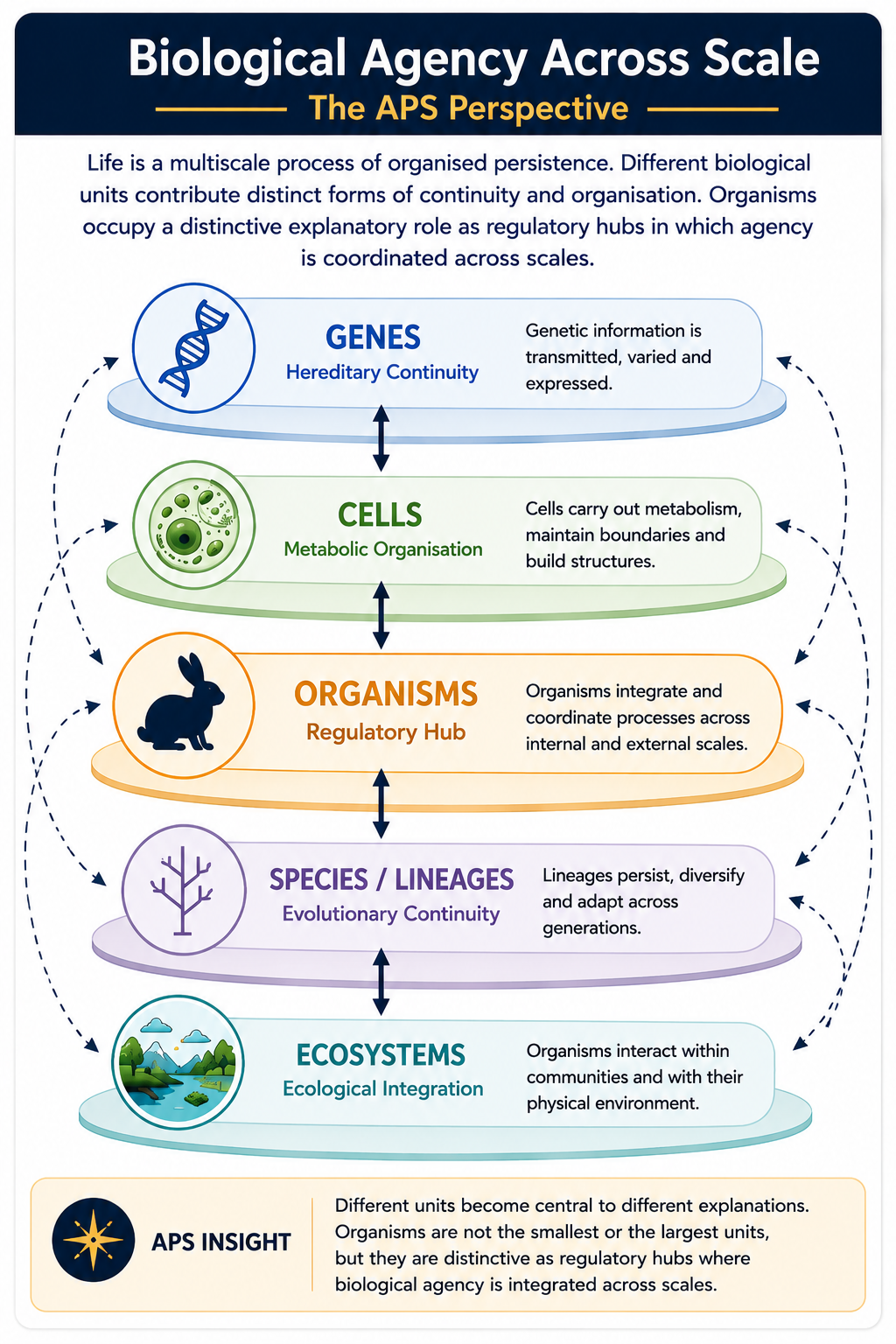
Biological Agency Across Scale. APS interprets life as a multiscale process of organised persistence. Genes, cells, organisms, species, and ecosystems each contribute to biological organisation. Organisms occupy a distinctive explanatory role because they function as regulatory hubs through which agency is coordinated across scales.
Organisms as Regulatory Hubs
Although APS rejects the search for a single privileged unit of life, it does not imply that all biological entities play identical explanatory roles. Different forms of organisation contribute to living systems in different ways. Among these, organisms occupy a distinctive position because they function as regulatory hubs through which processes operating across multiple scales become integrated.
Organisms are the sites at which genetic, cellular, developmental, physiological, behavioural, ecological, and evolutionary processes converge. They coordinate the activities of cells, regulate exchanges with the environment, and mediate interactions that influence both ecological dynamics and evolutionary change. In this sense, organisms provide a unique point of integration within the broader network of biological organisation.
This integrative role helps explain why organism-centred perspectives have remained influential throughout the history of biology. Organisms are not merely collections of parts, nor are they passive outcomes of genetic programs. They actively maintain their own organisation, respond to environmental challenges, and modify the conditions under which they live. Through development, behaviour, niche construction, and reproduction, organisms participate directly in shaping the biological processes that sustain them.
Importantly, describing organisms as regulatory hubs does not imply that they occupy the highest level of a biological hierarchy. APS rejects such hierarchical interpretations. Organisms are not privileged because they sit above other scales. Rather, they are distinctive because they serve as sites of integration where processes occurring across different scales become coordinated into coherent living activity.
This perspective also clarifies the relationship between organisms and the many borderline cases discussed earlier. Holobionts, symbiotic associations, colonial organisms, and superorganisms do not undermine the importance of organisms. Instead, they demonstrate that organismality itself can be expressed in diverse ways. What matters is not strict adherence to a particular structural form but the extent to which biological processes become integrated into coherent patterns of organisation, regulation, and persistence.
The concept of organismality is therefore especially important. Organismality shifts attention away from rigid categorical definitions and toward degrees of functional integration. Different living systems may express organism-like properties to different extents, yet all participate in broader processes of biological organisation. This perspective accommodates the diversity of life without abandoning the explanatory importance of organisms.
From an APS perspective, organisms are thus neither the sole fundamental unit of life nor merely one candidate among many. They occupy a distinctive explanatory role because they provide one of the principal loci through which biological agency becomes organised across scales. Understanding this role helps explain why organisms remain central to biological explanation even within a thoroughly multiscale view of life.
Conclusion: The Fundamental Unit Question Reconsidered
The search for life’s fundamental unit has shaped biological thought for more than a century. Cells, genes, organisms, species, lineages, and ecosystems have each been proposed as the primary unit of life because each captures important dimensions of biological organisation. The history of the debate demonstrates the remarkable explanatory power of these concepts and the central roles they continue to play within biological science.
At the same time, the persistence of competing answers reveals that no single candidate fully encompasses the complexity of living systems. Cells explain biological structure and metabolism. Genes explain heredity and evolutionary continuity. Organisms integrate development, physiology, and behaviour. Species, lineages, and ecosystems illuminate broader forms of historical and ecological organisation. Each contributes something indispensable, yet none can entirely replace the others.
Borderline cases such as holobionts, microbiomes, endosymbiotic systems, colonial organisms, superorganisms, and slime moulds make this point especially clear. These examples repeatedly challenge attempts to draw fixed boundaries around biological individuality and reveal that living organisation often extends across multiple forms of integration. Rather than representing exceptions to biological principles, they expose features of life that are present throughout the living world.
From the APS perspective, the repeated failure to identify a single fundamental unit is not a sign of theoretical inadequacy. Instead, it reflects the nature of life itself. Living systems are organised through agency, process, and scale rather than around a single privileged entity. Different biological units become important because they illuminate different aspects of organised persistence and different forms of continuity operating across the living world.
The question of life’s fundamental unit therefore leads to a deeper insight. Biology repeatedly generates different explanatory centres because life itself is inherently multiscale. Genes, cells, organisms, species, and ecosystems are not rival foundations competing for explanatory supremacy. They are interconnected expressions of biological organisation that contribute, in different ways, to the persistence and evolution of living systems.
The search for a single privileged unit ultimately gives way to a richer understanding of life. The living world is not organised around one fundamental entity but around the ongoing coordination of biological agency across multiple scales. Within this broader picture, organisms remain especially important as regulatory hubs through which many of these processes become integrated. Yet their significance derives not from occupying a privileged position in a hierarchy of life, but from the distinctive role they play in sustaining the organised persistence that characterises living systems.
See Also
Related Articles
References
- (2015). Host Biology in Light of the Microbiome: Ten Principles of Holobionts and Hologenomes. PLOS Biology, 13(8), e1002226 . https://doi.org/10.1371/journal.pbio.1002226
- (2010). The Problem of Biological Individuality. Biological Theory, 5(4), 312–325 .
- (2013). The Multiple Realizability of Biological Individuals. The Journal of Philosophy, 110(8), 413–435 .
- (2020). The Metaphysics of Evolution. Cambridge University Press.
- (2018). Everything Flows: Towards a Processual Philosophy of Biology. Oxford University Press.
- (2013). No Levels, No Problems: Downward Causation in Neuroscience. Philosophy of Science, 80(5), 1042–1052 . https://doi.org/10.1086/673898
- (1974). A Radical Solution to the Species Problem. Systematic Biology, 23(4), 536–544 . https://doi.org/10.1093/sysbio/23.4.536
- (2009). Darwinian Populations and Natural Selection. Oxford University Press.
- (1978). A Matter of Individuality. Philosophy of Science, 45(3), 335–360 .
- (1970). Origin of Eukaryotic Cells. Yale University Press.
- (1982). The Growth of Biological Thought. Harvard University Press.
- (2006). Evolution and the Levels of Selection. Oxford University Press.
- (2026). Agency as the defining activity of life: A viability-oriented framework integrating process and scale. Biological Theory . https://doi.org/10.1007/s13752-026-00547-6
- (2008). Role of Microorganisms in the Evolution of Animals and Plants: The Hologenome Theory of Evolution. FEMS Microbiology Reviews, 32(5), 723–735 .