What Is Biological Regulation?
Biological regulation is one of the most pervasive concepts in biology, yet its meaning often varies across disciplines. In the Agency–Process–Scale (APS) framework, regulation is understood as the coordination of viability-oriented organisation under changing conditions. Living systems remain viable only by maintaining continuity despite continual internal and external change, and regulation is one of the principal organisational processes through which organised persistence is achieved. Rather than serving as biology's ultimate explanatory target, regulation helps explain how living systems preserve viable organisation across multiple scales and timescales.
Key Points
- Biological regulation coordinates living organisation under changing conditions.
- Regulation arises because living systems must preserve viable continuity despite continual change.
- Regulation is broader than homeostasis and extends across multiple biological scales.
- Regulation is not equivalent to external control or biological agency.
- In APS, regulation contributes to the maintenance of organised persistence.
- Understanding regulation clarifies how familiar biological concepts fit within a unified explanatory framework.
Introduction
Every living system regulates itself.
Cells regulate metabolism. Plants regulate water balance and growth. Animals regulate physiology, behaviour, development, and reproduction. From the molecular to the ecological, regulation appears throughout biology so consistently that it is often regarded as one of the defining characteristics of living systems.
Yet this familiarity conceals a deeper biological question.
Why do living systems regulate themselves at all?
Most biological explanations answer this question by describing regulatory mechanisms. They explain signalling pathways, feedback loops, genetic networks, endocrine systems, neural circuits, and countless other processes through which organisms modify their activity under changing conditions. These accounts have transformed modern biology, but they largely address how regulation occurs rather than why regulation is necessary for living organisation itself.
The APS framework approaches regulation from a different direction. Rather than treating regulation as an isolated biological process or a specialised form of control, APS asks what role regulation plays within the broader organisation of living systems. This shift in perspective reveals regulation not as an end in itself, but as one of the principal organisational processes through which living systems maintain their viability over time.
Living systems exist under continual conditions of internal and external change. Their continued viability therefore cannot be assumed. If organisms are to persist despite developmental transformation, environmental fluctuation, and ongoing material turnover, they must preserve sufficient organisational continuity for life to continue. Regulation emerges from this requirement. It is one of the processes through which living systems continually coordinate their activities so that viable organisation is maintained despite continual change.
Understanding regulation therefore requires understanding the biological problem it solves.
Why Do Living Systems Regulate Themselves?
Living systems exist in conditions of continual change.
Internal organisation is constantly being remodelled as cells divide, tissues develop, metabolic demands fluctuate, and damaged structures are repaired or replaced. At the same time, organisms encounter changing temperatures, varying nutrient supplies, pathogens, competitors, and continually shifting ecological conditions. Stability is therefore not the natural condition of life but something that must be continually achieved.
These conditions create a persistent biological challenge. Living systems must remain viable despite ongoing change. The organisation that supports life cannot simply be preserved unchanged, because life itself depends upon continual transformation. Growth, repair, development, adaptation, reproduction, and ecological interaction all require organisms to modify their own organisation while remaining capable of continued existence.
Without regulation, these continual changes would rapidly undermine biological organisation. Processes that support viability under one set of conditions may become damaging under another. Activities that are appropriate during development may be incompatible with reproduction. Physiological states that sustain an organism during abundance may become unsustainable during scarcity. Living systems must therefore do more than simply continue operating. They must continually coordinate their own activity so that changing conditions do not lead to organisational breakdown.
Regulation exists because viability cannot be maintained automatically. Living systems must continually preserve organisational continuity despite ongoing internal and external change, and this requires the coordination of biological processes operating across multiple timescales. Regulation is one of the principal means through which such coordination is achieved.
This observation immediately distinguishes biological regulation from many familiar engineering concepts. The objective is not to prevent change, but to ensure that change remains compatible with continued living organisation. Growth, development, adaptation, repair, learning, and reproduction all depend upon the capacity of organisms to modify themselves while preserving the organisation that makes those activities possible.
Regulation is therefore not an occasional biological process added to an otherwise stable system. It is an intrinsic consequence of living organisation itself.
Regulation Is Not Simply Control
Regulation is frequently described using the language of control. Biology speaks of genetic control, hormonal control, neural control, metabolic control, and feedback control, and these concepts have proved indispensable in understanding how living systems operate.
However, the language of control can also obscure an important biological distinction.
Outside biology, control often implies an external controller directing a system towards predetermined objectives. A thermostat controls room temperature, and an autopilot controls an aircraft because each imposes corrective actions upon an otherwise passive system. Living systems are fundamentally different. Their regulatory processes arise from within the organisation of the organism itself and contribute directly to the continued existence of that organisation.
The systems that regulate metabolism, development, immunity, physiology, and behaviour are themselves products of the living organisation they help sustain. Regulation is therefore not imposed upon life from outside; it is generated by life as part of its own ongoing activity.
This point is especially important because living systems are not passive recipients of regulatory control. They actively generate, maintain, and modify the processes through which viability is preserved. Regulatory activity emerges from the organisation of the organism itself and remains inseparable from the broader viability-oriented activity of living systems. Regulation therefore reflects an intrinsic property of living organisation rather than an externally imposed mechanism of control.
APS therefore distinguishes regulation from externally imposed control. Regulation is an intrinsic organisational process through which living systems continually coordinate their own activities in ways that preserve viability under changing conditions.
What Regulation Achieves
At first sight, regulation appears to consist primarily in maintaining stability. Physiological variables such as temperature, osmotic balance, pH, blood glucose, and ion concentrations are all maintained within ranges compatible with continued life, and these examples have strongly influenced how regulation is commonly understood.
Yet living systems regulate far more than physiological variables.
Development requires continual regulation of differentiation and growth. Immune systems regulate responses to infection while avoiding destructive self-activity. Behaviour is regulated in response to changing environmental opportunities and threats. Plants regulate patterns of growth in response to light, water availability, and competition. Across every level of biological organisation, regulation continually coordinates diverse processes whose immediate objectives differ but whose collective consequence is the continued viability of the organism.
A broader pattern therefore emerges. Regulation does not simply preserve individual variables or isolated processes. It continually coordinates biological organisation so that living systems remain viable despite continual internal and external change. Through this activity, regulation contributes to maintaining the continuity of living organisation across time despite ongoing transformation.
Regulation therefore serves a larger organisational role than is often recognised. By preserving viable continuity, regulatory processes contribute to the maintenance of the organised persistence of living systems. Their significance lies not merely in stabilising particular variables but in helping organisms remain viable entities capable of continuing development, adaptation, reproduction, and interaction with changing environments.
This broader perspective naturally raises a further question.
If regulation consistently contributes to the maintenance of viable continuity and organised persistence, what larger biological phenomenon is regulation helping living systems to sustain?
Regulation and Organised Persistence
The preceding discussion leads naturally to a broader biological question.
If regulation continually coordinates living organisation under changing conditions, what larger biological phenomenon is that coordination serving?
APS answers this question by identifying organised persistence as one of biology’s central explanatory concerns.
Living systems must remain viable despite continual internal and external change. Viability therefore requires continuity. Yet continuity cannot be maintained automatically. Organisms continually replace components, reorganise internal processes, respond to environmental fluctuations, and undergo developmental transformation. The persistence of living systems consequently depends upon preserving sufficient organisational continuity for life to continue despite continual change.
This requirement gives rise to organised persistence. Living systems do not persist because they remain unchanged. They persist because they continually maintain and renew the organisation upon which viability depends. Organised persistence therefore refers to the ongoing achievement of preserving viable continuity despite continual material turnover and environmental uncertainty.
Regulation contributes directly to this achievement. Living systems do not regulate themselves simply to maintain individual variables, nor merely to preserve particular structures or execute isolated functions. Regulation contributes to the continued persistence of the organism as an organised, viability-oriented system. Its biological significance therefore lies not in regulation itself, but in the way regulation enables living systems to maintain coherent organisation while continually changing.
Seen in this light, regulation is not the phenomenon biology ultimately seeks to explain. It is one of the principal organisational processes through which organised persistence is achieved. Organised persistence creates the need for continual coordination, and regulation provides one of the primary means through which that coordination occurs. The explanatory emphasis therefore shifts from the mechanisms of regulation alone to the biological role those mechanisms play within the continuing organisation of life.
This shift does not diminish the importance of regulatory mechanisms. On the contrary, it places them within a broader explanatory framework that clarifies why such diverse forms of regulation appear throughout biology. Whether molecular, physiological, developmental, behavioural, or ecological, they all contribute to the same underlying biological requirement: the maintenance of viable organisation across time.
APS does not replace existing concepts of regulation. Instead, it explains why regulation occupies such a central place in biology by situating it within the broader framework of organised persistence. Regulation becomes intelligible because living systems must continually coordinate their own activity in order to remain viable.
Regulation Is Not Homeostasis
Regulation is frequently equated with homeostasis, but the two concepts are not identical.
Homeostasis refers to the maintenance of particular physiological variables within ranges compatible with continued viability. Temperature, blood glucose, osmotic balance, blood pressure, and acid–base chemistry are familiar examples. These forms of regulation are indispensable because living systems depend upon the stability of numerous internal conditions.
Yet homeostasis represents only one expression of biological regulation.
Organisms also regulate developmental transitions, immune responses, reproductive cycles, patterns of behaviour, ecological interactions, and the continual reorganisation of tissues throughout life. None of these processes can be adequately understood simply as the maintenance of constant internal variables. Instead, they involve the continual coordination of changing biological activities whose outcomes remain compatible with viability.
This distinction becomes clearer when regulation is viewed through the lens of organised persistence. Homeostasis contributes to viability by maintaining conditions compatible with continued functioning, but regulation encompasses a much broader range of organisational processes through which living systems preserve viable continuity despite continual change. Homeostasis is therefore one way regulation supports organised persistence, not its defining characteristic.
APS therefore regards homeostasis as a specialised form of regulation rather than its defining characteristic.
This distinction is important because it broadens the explanatory scope of regulation beyond physiological equilibrium. Regulation encompasses every organised process through which living systems coordinate their own activity in ways that preserve viable organisation despite continual change.
Regulation, Homeorhesis, and Development
TThe distinction becomes even clearer when development is considered.
Developing organisms cannot remain physiologically or structurally constant. Cells divide, tissues differentiate, organs mature, and patterns of organisation continually change. If biological regulation consisted only in preserving fixed states, development would be impossible.
This is one context in which the concept of homeorhesis becomes important.
Homeostasis, allostasis, and homeorhesis draw attention to different but partly overlapping features of biological regulation. Homeostasis principally concerns the maintenance of biologically relevant conditions within viable ranges. Allostasis principally concerns adjustment of regulation as present or anticipated demands change. Homeorhesis principally concerns cases in which an unfolding biological trajectory is itself maintained, coordinated, or recovered through regulation.
Development provides an important domain for homeorhetic regulation because developmental organisation unfolds through temporally extended change. Development as such, however, is not necessarily homeorhetic. Growth, differentiation, maturation, repair, plasticity, and other biological changes warrant homeorhetic description only where there is evidence that their unfolding trajectory is itself regulated.
The relationship between these concepts becomes clearer when viewed in terms of organised persistence. Homeostatic regulation can contribute by maintaining conditions compatible with continued viability. Allostatic regulation can contribute by altering regulatory activity as circumstances change. Homeorhetic regulation can contribute where organised persistence depends upon maintaining, coordinating, or recovering an unfolding biological trajectory.
APS therefore treats homeostasis, allostasis, and homeorhesis as related regulatory emphases rather than competing mechanisms, successive stages of organisation, or an exhaustive taxonomy. Their explanatory relevance must be established for the biological case concerned.
Regulation and Agency
Regulation is closely related to biological agency, but the two concepts should not be confused.
Agency concerns the viability-oriented activity of living systems. It refers to the capacity of organisms to evaluate conditions, reorganise their own activity, and sustain themselves through ongoing engagement with their environments.
Regulation contributes to this activity by coordinating the biological processes through which agency is expressed.
An organism does not first regulate itself and then become an agent. Rather, regulatory processes operate within the broader activity of a living system already engaged in maintaining its own viability. Regulation therefore provides one of the principal organisational means through which biological agency is enacted.
The relationship can be understood without assigning these concepts to an organisational hierarchy. Agency identifies viability-oriented activity, regulation identifies processes through which that activity is coordinated, and organised persistence identifies the continuity of living organisation through change. These are related explanatory descriptions of the same viability-oriented organisation rather than successive levels or stages.
This distinction is important because some theoretical accounts identify regulation itself as the defining characteristic of biological autonomy. APS adopts a broader perspective. Agency provides the organisational context within which regulation acquires its biological significance, while regulation provides one of the principal processes through which agency maintains organised persistence.
Regulation is therefore neither identical with agency nor independent of it. The two concepts describe complementary dimensions of the same viability-oriented organisation. Agency explains why living systems engage in viability-oriented activity. Regulation helps explain how that activity remains coordinated. Organised persistence is the continuing organisational achievement that their interaction makes possible.
Regulation Across Biological Scales
The pervasive nature of regulation becomes particularly clear when viewed across biological scales.
Within cells, regulatory processes coordinate metabolism, gene expression, membrane transport, and intracellular signalling. These activities continually preserve the conditions required for cellular viability despite ongoing molecular turnover and environmental fluctuation.
Within multicellular organisms, regulation extends this same organisational requirement across broader scales. Physiological systems coordinate resource allocation, immune responses, hormonal signalling, development, reproduction, and behaviour. Although the mechanisms differ from those operating within cells, the underlying organisational challenge remains the same: maintaining viable continuity despite continual change.
Developmental regulation expands this requirement further. Organisms must preserve continuity not only across changing physiological conditions but also across changing organisational states. Growth, differentiation, maturation, repair, and adaptation all require the coordination of transformation without loss of viability. Development therefore illustrates how regulation contributes to maintaining organised persistence across changing biological trajectories.
Behavioural regulation extends organised persistence into the organism’s active engagement with its environment. Organisms continually adjust movement, foraging, communication, defence, and other activities in response to changing conditions. Regulation therefore coordinates not only internal organisation but also the organism’s ongoing interaction with its surroundings.
At broader ecological scales, organisms regulate patterns of interaction with changing environments through movement, resource use, niche construction, and adaptive responses. Persistence increasingly depends upon maintaining viable relationships between organisms and the ecological systems within which they exist.
Although these examples differ greatly in mechanism and timescale, they exhibit a common organisational pattern. In every case, regulation coordinates biological activity so that viable organisation is preserved despite continual internal and external change.
APS interprets this recurrence as a consequence of organised persistence itself.
Because living organisation exists simultaneously across multiple organisational and temporal scales, regulation likewise appears across multiple scales. Molecular regulation, physiological regulation, developmental regulation, behavioural regulation, and ecological regulation are therefore not separate explanatory categories. They are progressively broader organisational expressions of the same biological requirement: the continual coordination of living systems so that organised persistence can be maintained.
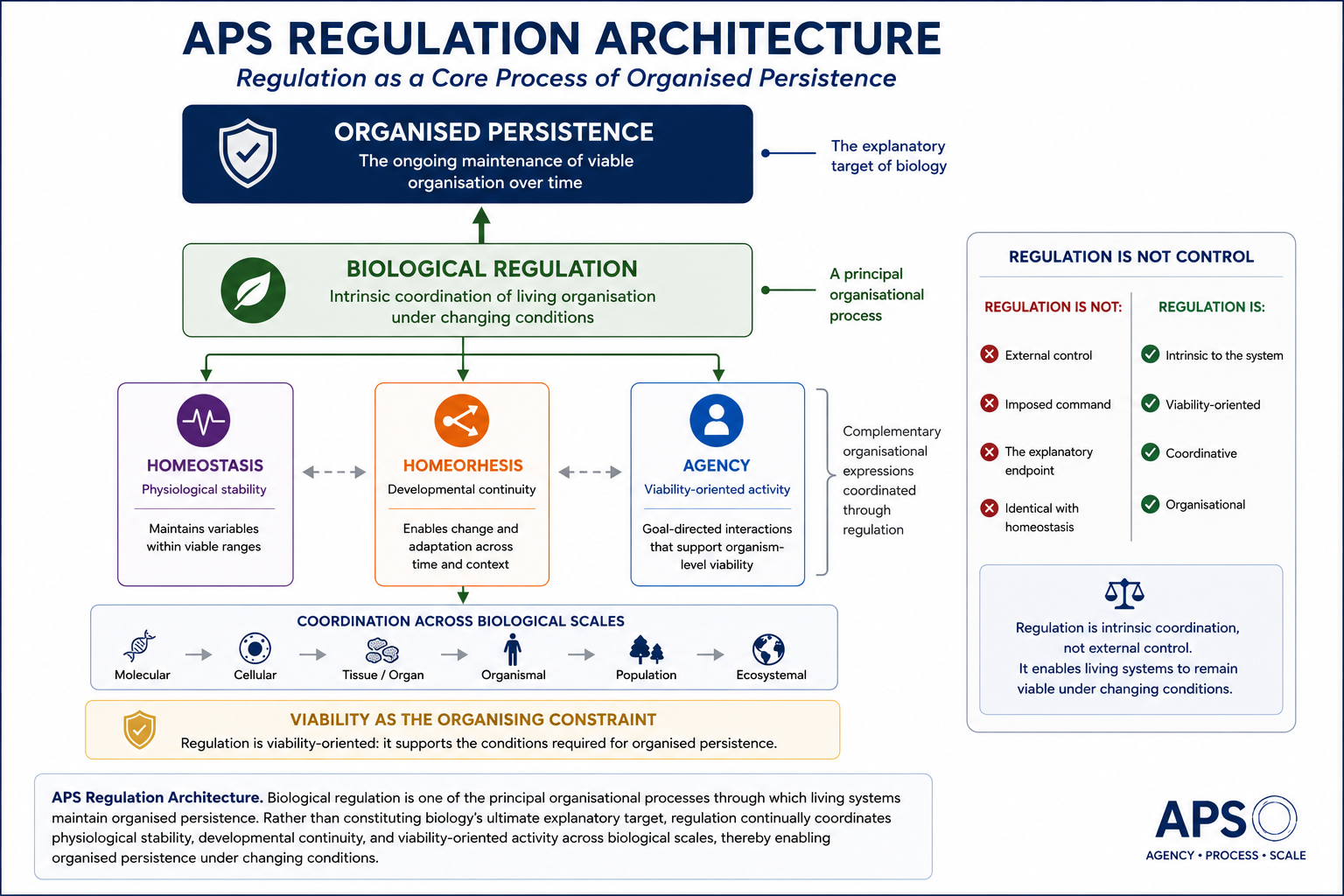
APS Regulation Architecture. Biological regulation is one of the principal organisational processes through which living systems maintain organised persistence. Rather than constituting biology's ultimate explanatory target, regulation continually coordinates physiological stability, developmental continuity, and viability-oriented activity across biological scales, thereby enabling organised persistence under changing conditions.
Why Regulation Matters
Regulation is one of the most familiar concepts in biology precisely because it is one of the most pervasive. Every living system depends upon the continual coordination of countless biological processes whose immediate purposes differ but whose collective consequence is the preservation of viable organisation. Whether regulating metabolism, coordinating embryonic development, responding to environmental change, repairing damaged tissues, or adjusting behaviour, regulation enables living systems to remain coherent while continually changing.
APS places these diverse examples within a common explanatory framework.
Rather than treating regulation as an isolated phenomenon or as the defining characteristic of life, APS understands regulation as one of the principal organisational processes through which living systems maintain organised persistence. This perspective preserves the enormous explanatory value of regulatory biology while clarifying its broader biological significance. The central question therefore becomes not simply how regulation operates, but what regulation enables living systems to achieve.
This shift has important consequences for biological explanation. Mechanistic accounts explain how regulatory processes operate. Functional explanations clarify why those processes contribute to viability and organised persistence. Developmental explanations show how regulation coordinates trajectories of growth, differentiation, and transformation. Evolutionary explanations explain how regulatory systems originate, diversify, and change through time. APS does not replace these explanatory traditions. Instead, it reveals that they become mutually intelligible when understood as complementary perspectives on the maintenance and transformation of organised persistence.
Seen in this way, regulation occupies an important place within biology’s explanatory grammar. Mechanisms explain how coordination occurs. Functions explain why coordination contributes to persistence. Evolution explains how regulatory organisation changes historically. Together they address different dimensions of the same biological phenomenon: the continual maintenance of viable continuity through time.
Regulation therefore illustrates one of the central themes of the APS framework. Familiar biological concepts become more coherent when viewed not as competing explanatory traditions but as different perspectives on a common biological phenomenon.
Conclusion
Living systems do not regulate themselves simply to maintain stability.
They regulate themselves because life depends upon the continual coordination of biological organisation under changing conditions. Stability is one consequence of regulation, but so too are growth, development, adaptation, repair, reproduction, behaviour, and ecological interaction. Regulation therefore supports change as much as it supports continuity.
APS places regulation within this wider biological context.
The argument developed throughout this article can be summarised as a progression from viability to regulation. Living systems must remain viable despite continual change. Viability therefore requires continuity. Continuity requires organised persistence. Organised persistence requires continual coordination across changing conditions, organisational states, and biological scales. Regulation emerges as one of the principal organisational processes through which that coordination is achieved.
Rather than identifying regulation as the primary explanatory target, APS understands it as one of the principal organisational processes through which living systems achieve organised persistence. Regulation contributes to the maintenance of viability by continually coordinating the activities through which organisms preserve themselves despite continual internal and external change.
Seen in this way, regulation is neither an isolated mechanism nor a universal explanation. It is one component of a broader explanatory architecture in which agency enacts viability-oriented activity, regulation coordinates that activity, homeostasis stabilises the conditions that support it, homeorhesis preserves its developmental trajectories, and organised persistence emerges as the continuing achievement that these processes collectively sustain.
Understanding regulation in this broader context reveals why it appears throughout biology. It is not simply because living systems require control, but because living systems can remain alive only by continually organising themselves in ways that preserve their own viability. Regulation therefore becomes intelligible as one of the fundamental organisational processes through which continuity is maintained and organised persistence becomes possible.
See Also
Related Articles
References
- (1956). An Introduction to Cybernetics. Chapman & Hall.
- (2019). Robustness and Autonomy in Biological Systems: How Regulatory Mechanisms Enable Functional Integration, Complexity and Minimal Cognition Through the Action of Second-Order Control Constraints. Springer. https://doi.org/10.1007/978-3-030-01198-7_6
- (1932). The Wisdom of the Body. W. W. Norton & Company.
- (2019). Biological Autonomy. Springer. https://doi.org/10.1007/978-94-017-9837-2
- (2021). Organization and Determination in the Living. Springer. https://doi.org/10.1007/978-94-024-2253-6
- (2026). Agency as the defining activity of life: A viability-oriented framework integrating process and scale. Biological Theory . https://doi.org/10.1007/s13752-026-00547-6
- (1957). The Strategy of the Genes. George Allen & Unwin.