Biology — What the Science of Life Explains
Biology explains living systems through diverse but complementary forms of inquiry. APS focuses on a distinctive organisational problem: how viability-oriented, constraint-closed organisation is enacted and maintained through change, and how forms of living organisation are transformed through evolutionary history. Agency, Process, and Scale provide complementary analytic projections through which this organisation can be investigated.
Key Points
- Life is viability-oriented, constraint-closed organisation.
- Organised persistence describes the continuity of living organisation through change; it is not another definition of Life.
- Biological agency is viability-oriented organisational activity through which living organisation is enacted and sustained.
- Evolution concerns the historical transformation of living organisation across generations.
- Agency, Process, and Scale are complementary analytic projections of one living organisation, not independent components, levels, or causes.
The Puzzle of Life
Every living thing faces the same challenge: maintaining the conditions under which its organisation can continue.
Cells must continually rebuild themselves. Organisms must acquire resources, repair damage, regulate internal conditions, and respond to changing environments. Their material constituents turn over, their surroundings change, and disturbances continually alter the conditions under which they function. Yet living systems can maintain remarkable continuity through these changes.
This capacity presents biology with a fundamental explanatory problem. It is not enough to identify what living things are made of or the processes occurring within them. We must also explain how living systems sustain themselves as organised and viable forms of activity despite continual material and environmental change, and how the organisation making this possible is transformed through evolutionary history.
APS describes this continuity through change as organised persistence.
Organised persistence is not itself a definition of Life. APS defines Life more specifically as viability-oriented, constraint-closed organisation. Organised persistence identifies what such organisation achieves through time: continuity of living organisation despite the changes through which that continuity must be maintained.
Living systems therefore do not merely persist in the sense that an enduring object remains present. They continually maintain and re-establish conditions required for their own functioning. Cells sustain metabolic and regulatory organisation through ongoing biochemical activity; organisms regulate physiological and behavioural activity under changing conditions; and organism–environment relations materially affect the conditions under which such organisation remains viable. Ecological communities may themselves exhibit persistence and change, but this does not by itself establish that communities possess the same viability-oriented organisation or biological agency as the living systems that participate in them.
The Agency–Process–Scale (APS) framework approaches living organisation through three complementary analytic projections. Agency concerns what living systems do in relation to viability. Process concerns how organisational continuity is maintained through change. Scale concerns the spatial and temporal extents across which persistence is organised. These are not three components, levels, or independent dimensions of Life. They are analytically distinguishable ways of investigating the same living organisation.
This perspective also clarifies an important distinction between Life and evolution. The organisation of living systems must be maintained in the present, while the forms of organisation through which living systems persist can themselves be transformed across generations. The first problem concerns the organisation and activity characteristic of Life; the second concerns its historical transformation through evolution.
APS therefore begins from a particular integrative question: what organisation enables living systems to maintain continuity through change, and how is that organisation transformed through evolutionary history? It does not propose this as a replacement for the distinct explanatory targets of molecular, mechanistic, developmental, physiological, ecological, evolutionary, or other biological approaches. Rather, it asks what becomes explanatorily available when their findings are considered in relation to living organisation and its persistence through change.
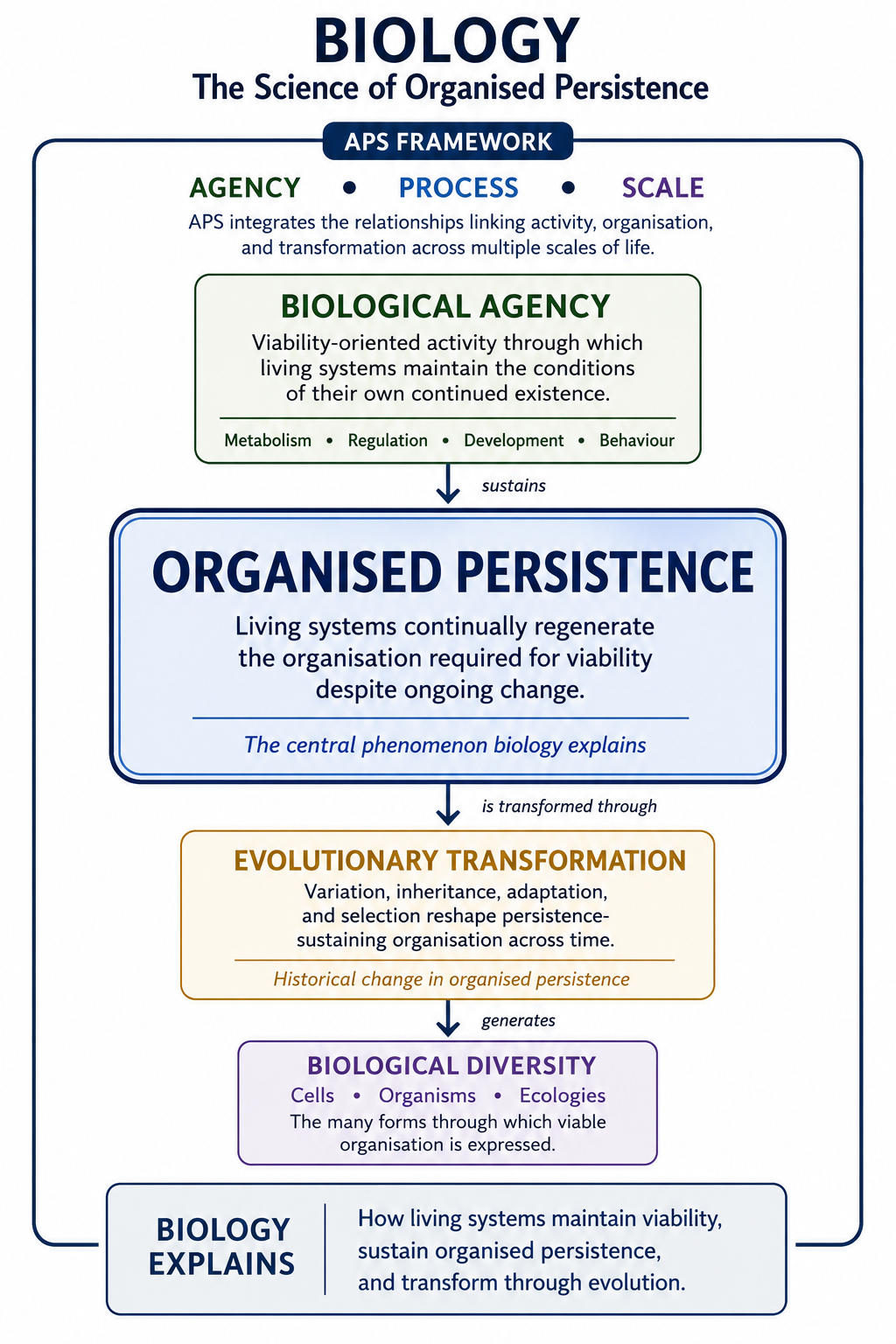
Life, Organised Persistence, and Evolution. Life is viability-oriented, constraint-closed organisation. Organised persistence describes the continuity of living organisation through change, while evolution concerns its historical transformation across generations. Agency, Process, and Scale are complementary analytic projections on this organisation rather than independent components or dimensions of Life.
The Hidden Phenomenon Biology Studies
Biology is often presented as the study of organisms, genes, cells, populations, or ecosystems. These are central objects of biological research, but they do not exhaust the explanatory questions biology asks. APS draws attention to a further problem: how living systems maintain their organisation through continual material, functional, and environmental change.
What distinguishes a living system from a non-living assemblage is not simply the materials from which it is constructed. Living systems are composed of physical matter found elsewhere in nature. The relevant distinction lies in how that matter is organised. APS characterises Life as viability-oriented, constraint-closed organisation: organisation in which activity occurs relative to conditions that support or undermine continued functioning, and in which the constraints governing that activity participate in maintaining and re-establishing the conditions of the organisation itself.
The two parts of this definition perform different explanatory roles. Viability identifies an asymmetry among possible conditions: some support the continued functioning of the organisation, while others impair or terminate it. Viability therefore does not simply mean “being alive” or “remaining alive.” Constraint closure concerns how the organisation is maintained: relevant constraints are themselves generated, sustained, or re-established through processes that they help regulate. Neither concept merely restates Life; together they specify the organisation APS proposes as characteristic of living systems.
Living organisation cannot therefore be understood as a static arrangement. Its material constituents are replaced, environmental conditions fluctuate, and internal states continually change. Living systems nevertheless maintain and re-establish the organisation required for their continued functioning. Metabolism, regulation, repair, development, and behaviour can all contribute, in different systems and circumstances, to maintaining that organisation through change.
This distinction also clarifies the relationship between Life and biological agency. Life identifies the organisation characteristic of living systems; biological agency identifies its present-tense viability-oriented activity. A living system does not passively possess Life and then separately act. Its organisation is continually enacted and sustained through its activities.
This makes continuity itself an important explanatory problem. A living cell maintains organisation through materially implemented biochemical and regulatory processes; a multicellular organism does so through interacting physiological, developmental, behavioural, and other processes. Organism–environment relations can materially alter the conditions under which such organisation remains viable.
APS uses organised persistence to identify this continuity through change. Life identifies viability-oriented, constraint-closed organisation; organised persistence identifies the continuity of that organisation as it is maintained and re-established through changing conditions. The explanatory task is then to understand how such continuity is achieved, under what conditions it is maintained or lost, and how the organisation supporting it is transformed through evolutionary history.
Biological Agency: What Living Systems Do
Living organisation is continually enacted through activity. Living systems acquire resources, repair damage, regulate internal conditions, respond to perturbations, coordinate processes, and modify their interactions with surrounding environments. These activities differ enormously among living systems, but they can contribute to maintaining or re-establishing the conditions under which biological organisation continues to function.
APS uses the term biological agency for this viability-oriented organisational activity. Agency in this sense does not imply conscious intention, deliberation, representation, or reflective decision-making. It identifies what living systems do in relation to conditions that matter to their continued functioning. A regulatory response that restores a viable physiological condition, for example, can instantiate biological agency without requiring the system consciously to anticipate that outcome or represent it as a goal.
Agency therefore has a specific relationship to Life without being identical to it. Life identifies viability-oriented, constraint-closed organisation; Agency identifies the viability-oriented activity through which that organisation is enacted and sustained. The distinction is analytic rather than a division between two independent biological things. A living system does not first possess Life and subsequently acquire Agency as an additional property. Agency is the present-tense activity of living organisation.
This perspective can bring otherwise different biological activities into a common explanatory relation without making them instances of a single mechanism or process. Metabolism, physiological regulation, repair, development, behaviour, and organism–environment interaction involve different material processes and answer different biological questions. Where such activities contribute to maintaining or re-establishing conditions of viability, however, they can be examined under the analytic projection of Agency.
Agency does not “produce” organised persistence as though the two were independent stages in a causal sequence, nor is Agency defined simply as whatever causes a system to persist. Rather, viability-oriented activity contributes to maintaining and re-establishing living organisation under changing conditions. Agency concerns what living systems do relative to viability; organised persistence concerns the continuity of living organisation through change.
Biological agency can consequently give living activity a directed character without implying conscious purpose. Conditions are not equivalent for a living system: some support continued functioning, while others impair it. Activity that regulates, repairs, compensates, or reorganises the system in relation to those conditions can therefore be viability-oriented without being intentionally chosen. Goal-directed biological activity need not be explained by attributing reflective intentions to living systems; it can arise from the organisation of activity relative to viability.
Agency is therefore the APS analytic projection that asks:
What does the living system do in relation to viability?
It foregrounds the activity through which living organisation is enacted and sustained while leaving the material mechanisms, processes, and relations implementing that activity available to their appropriate biological explanations.
Evolution Transforms Living Organisation
Living systems maintain and re-establish their organisation in the present, but the forms of organisation through which they do so are also historically transformed. Biology must therefore explain not only how living organisation continues through change within the lifetime of a system, but how forms of living organisation change across generations.
The structures and processes through which living systems maintain viability have evolutionary histories. Metabolic pathways, developmental systems, physiological regulation, behavioural capacities, and organism–environment relations have been modified across generations. The organisation through which Life is presently enacted is therefore also historically conditioned.
Evolution is conventionally explained through variation, inheritance, selection, drift, and other established evolutionary mechanisms. APS does not replace these explanations. It asks an additional organisational question: how are forms of viability-oriented living organisation transformed through evolutionary history? Evolution concerns the historical transformation of living organisation and, consequently, of the ways in which organised persistence is achieved.
Evolutionary processes operate where living systems already exist, reproduce, vary, and participate in processes of evolutionary change. Evolution therefore does not explain the present-tense organisation characteristic of Life merely by appealing to history. Present living organisation and its evolutionary transformation are related without being explanatorily interchangeable.
Across evolutionary history, heritable variation introduces or preserves differences, and evolutionary processes alter their distribution across populations and generations. Where such changes affect the organisation through which living systems maintain viability, the ways in which organised persistence is realised can also change. APS leaves the mechanisms and dynamics of those changes to the appropriate evolutionary explanations.
Major evolutionary transitions illustrate the extent of such transformation. Photosynthetic innovations altered the energetic possibilities available to living systems and profoundly changed their environments. Multicellularity produced forms of organisation in which differentiated cells participate in the maintenance and reproduction of multicellular organisms. Nervous systems enabled new forms of sensory integration, regulation, and behaviour. Social organisation can alter the conditions under which organisms coordinate activity, acquire resources, reproduce, and respond to their environments. These developments differ greatly in mechanism and history; what they share here is their capacity to transform the organisation and conditions through which living systems maintain viability.
Evolution is therefore not a second defining feature added to Life. Life identifies viability-oriented, constraint-closed organisation; evolution concerns the historical transformation of living organisation across generations.
These transformations occur across different spatial and temporal extents. Genes, cells, developmental systems, organisms, populations, and organism–environment relations can all be relevant to evolutionary explanation, depending on the explanandum. APS does not treat these as a fixed hierarchy of explanatory levels. Rather, Scale asks across what spatial and temporal extents the organisation and relations relevant to a particular explanatory problem must be considered.
Agency and evolution consequently answer different questions. Agency concerns the viability-oriented activity through which living organisation is enacted and sustained in the present; evolution concerns the historical transformation of living organisation across generations. Forms of organisation sustaining living systems in the present can therefore themselves have histories of modification, diversification, and persistence.
The Organisational Question in Biological Explanation
The organisation of living systems raises a further question: what does an organisational perspective contribute to biological explanation?
Biology explains an extraordinary range of phenomena. Mechanistic explanations identify organised components and activities through which particular phenomena are produced; evolutionary explanations reconstruct historical processes of change; developmental, physiological, ecological, molecular, mathematical, and other approaches address further explanatory targets using their own evidence and methods. APS does not propose that these explanations become genuinely biological only when redescribed in organisational terms.
Living systems nevertheless present questions for which organisation may matter. Their components participate in systems that maintain and re-establish conditions required for continued functioning despite material turnover, perturbation, and environmental change. Identifying a component or causal interaction may therefore leave open a further question: what contribution does that component, activity, or relation make within the organisation of the living system concerned?
APS treats biological organisation as an explanatory target in its own right. This does not mean that organisation exists independently of the material processes through which it is realised, nor does it require a higher-order cause acting upon those processes. Organisational relations are materially implemented through biological components, activities, constraints, and interactions.
Whether an organisational analysis adds anything depends on the explanandum and on what the established explanation already captures. A molecular explanation may establish how a particular interaction occurs; a mechanistic explanation may identify the organised activities responsible for a phenomenon; a developmental explanation may account for the generation of form; an evolutionary explanation may account for historical transformation. APS asks whether considering such findings in relation to living organisation makes something further explanatorily available. It cannot assume in advance that it will.
The same restraint applies to reduction. APS does not require the claim that molecular, genetic, or mechanistic explanations are intrinsically incomplete. A gene-centred explanation may be entirely adequate for a specified question. In another context, understanding the explanatory significance of gene activity may require relations involving cellular regulation, development, physiology, behaviour, or environmental conditions. The issue is not whether an explanation occupies a supposedly lower or higher level, but whether the relations required by the specified biological problem have been adequately represented.
APS therefore treats organisational explanation as complementary rather than automatically superior to established biological approaches. Its contribution must be demonstrated rather than assumed. Describing a phenomenon in terms of viability, organisation, Agency, Process, Scale, or organised persistence is not by itself explanatory advance. The relevant comparison is with the strongest established explanation: what does it already account for, what does an APS analysis make explicit, and does the difference provide genuine explanatory integration rather than redescription?
APS: A Framework for Understanding Life
Life, biological agency, organised persistence, and evolution are closely related without being interchangeable. Life identifies viability-oriented, constraint-closed organisation; Agency its present-tense viability-oriented activity; organised persistence its continuity through change; and evolution the historical transformation of living organisation. APS brings these relationships into a common analytic framework without reducing them to a single causal sequence or explanatory problem.
The Agency–Process–Scale framework investigates living organisation without reducing it to any single mechanism, process, spatial extent, or temporal interval. Biology encompasses phenomena ranging from molecular and cellular activity to organismal regulation, ecological relations, and evolutionary transformation. APS does not collapse these different explanatory problems into a single description. It asks how living organisation can be examined while preserving their distinctions and making relevant relations explicit.
APS begins from the proposal that Life is viability-oriented, constraint-closed organisation. Such organisation is materially realised through biological processes and relations, continually enacted through activity, maintained through change, and extended across spatial and temporal extents. No single description captures all of these explanatory aspects. APS therefore distinguishes Agency, Process, and Scale as complementary analytic projections of one living organisation.
The term analytic projection is important. Agency, Process, and Scale are not three components from which living organisation is assembled, three levels at which it exists, or three independent causes whose interaction produces organised persistence. A projection selects a particular explanatory aspect of the same materially realised organisation. The distinction is made by the explanatory inquiry, not by dividing the living system into three corresponding kinds of thing.
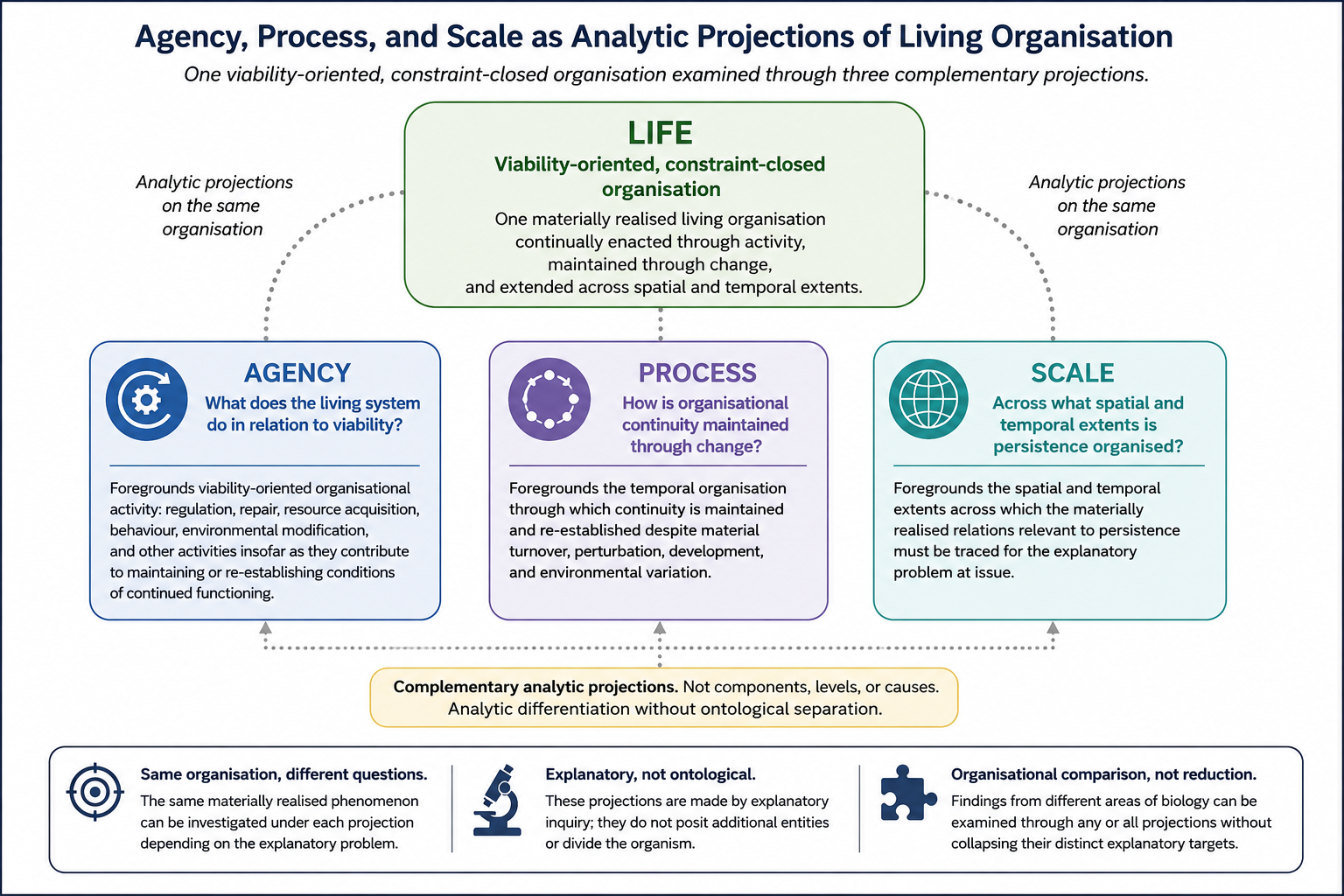
Agency, Process, and Scale as Analytic Projections of Living Organisation. APS treats Agency, Process, and Scale as complementary analytic projections of one viability-oriented, constraint-closed organisation. Agency asks what living systems do in relation to viability; Process asks how organisational continuity is maintained through change; and Scale asks across what spatial and temporal extents persistence is organised. These distinctions differentiate explanatory questions without dividing living organisation into independent components, levels, or causes.
Agency asks what living systems do in relation to viability. It foregrounds viability-oriented organisational activity such as regulation, repair, resource acquisition, behaviour, and environmental modification insofar as these contribute to maintaining or re-establishing conditions of continued functioning.
Process asks how organisational continuity is maintained through change. Living organisation persists despite material turnover, changing internal states, perturbation, development, and environmental variation. Process foregrounds the temporal organisation through which continuity is maintained and re-established through these changes.
Scale asks across what spatial and temporal extents persistence is organised. It does not designate a hierarchy of biological levels or imply that wider scales exercise a distinctive form of causation over smaller ones. Depending on the explanatory problem, relevant relations may extend across molecular, cellular, organismal, environmental, developmental, intergenerational, or other spatial and temporal extents. Scale identifies where those relations must be traced for the explanandum at issue.
These projections answer different questions without dividing the organism into separate Agency, Process, and Scale systems. Consider physiological regulation. The same materially realised phenomenon may be investigated in terms of what regulatory activity does relative to viability (Agency), how regulatory organisation maintains continuity through changing conditions (Process), and across what spatial and temporal extents the relevant relations must be traced (Scale). What changes is the explanatory question being asked of the same organisation.
This is why analytic projection is more than terminology. Without these distinctions, Agency, Process, and Scale risk collapsing into a general assertion that living systems are organised. If they are instead treated as independent dimensions or causal domains, an analytic distinction becomes an ontological division. Analytic projection permits explanatory differentiation without ontological separation.
APS can therefore bring findings from different areas of biology into organisational comparison without claiming that all biological disciplines investigate the same explanandum. Its contribution remains conditional: it must make some explanatorily relevant organisation, relation, or dependency available that the strongest established explanation does not already adequately provide.
Agency, Process, and Scale thus distinguish what living systems do, how organisational continuity is maintained through change, and across what spatial and temporal extents persistence is organised. They are analytic projections of one viability-oriented, constraint-closed organisation, not different ingredients from which Life is constructed.
The Central Insight
Viewed from this perspective, living systems present biology with a distinctive explanatory problem. They are materially realised systems whose organisation is continually maintained and re-established under changing conditions, while the forms of organisation through which they persist are themselves transformed across evolutionary history.
APS approaches this problem from the proposal that Life is viability-oriented, constraint-closed organisation. Living systems are not merely collections of components or static arrangements of matter. Their organisation is continually enacted through viability-oriented activity and maintained despite material turnover and perturbation. The continuity thereby achieved is what APS describes as organised persistence.
This does not reduce the diversity of biological explanation to a single task. Different biological fields investigate different phenomena through different methods and explanatory resources. APS asks what becomes explanatorily available when living organisation is examined through Agency, Process, and Scale: what living systems do in relation to viability, how organisational continuity is maintained through change, and across what spatial and temporal extents persistence is organised.
The distinction between Life and evolution remains fundamental. Life concerns the organisation characteristic of living systems and its present enactment and maintenance. Evolution concerns the historical transformation of living organisation across generations. Biological agency identifies the viability-oriented organisational activity through which living organisation is enacted and sustained; it does not by itself constitute a complete explanation of persistence.
The resulting picture is both integrative and constrained. Organised persistence is an important target for understanding the continuity of living organisation through change, but it is not another definition of Life and need not be the explanatory target of every biological inquiry. Nor does describing a phenomenon through APS terminology establish explanatory gain. Any such contribution must be demonstrated relative to the biological question and to what established explanation already provides.
The central APS insight is therefore not that all biology can be reduced to organised persistence. It is that living systems exhibit a distinctive form of organisation whose continuity and historical transformation can be investigated without separating organisation from its material realisation or collapsing the plurality of biological explanation. To understand Life, on this account, is to understand viability-oriented, constraint-closed organisation, the activities through which it is enacted and sustained, the continuity it maintains through change, and the histories through which its forms are transformed.
Explanatory Architecture
This article develops the following explanatory architecture:
Life
→ viability-oriented, constraint-closed organisation
Living organisation through time
→ organised persistence: the continuity of living organisation through change
APS investigates this organisation through three complementary analytic projections:
- Agency — what living systems do in relation to viability
- Process — how organisational continuity is maintained through change
- Scale — across what materially realised spatial and temporal extents, and through what relations among them, persistence is organised
Evolution
→ the historical transformation of living organisation across generations
Biological explanation
→ multiple explanatory approaches directed toward different biological questions, with organisational analysis contributing only where it makes explanatorily relevant organisation or relations available beyond what the strongest established explanation already provides
Agency, Process, and Scale are analytic projections rather than components, levels, causes, or independent dimensions of biological reality. The architecture therefore represents explanatory relationships, not a causal sequence or hierarchy.
In summary:
Life persists, evolution transforms that persistence, and biological explanation clarifies the organisation that makes both possible.
See Also
References
- (2026). Agency as the defining activity of life: A viability-oriented framework integrating process and scale. Biological Theory . https://doi.org/https://doi.org/10.1007/s13752-026-00547-6