What Is Evolution in APS?
Evolution is commonly understood as change in heritable populations through time, often formalised as change in gene frequencies across generations. APS accepts the importance of these processes but asks a prior question: what must exist for evolutionary change to occur at all? This article presents the APS account of evolution as the historical transformation of organised persistence. By integrating persistence, adaptation, inheritance, lineage continuity, and natural selection within a unified explanatory framework, APS clarifies what evolutionary explanations explain and how evolutionary change remains rooted in the continuity of living organisation.
Key Points
- Evolution is the historical transformation of lineages of organised persistence.
- Organised persistence is the condition that makes evolutionary processes possible.
- Inheritance reproduces continuity across generations while variation introduces organisational differences.
- Adaptation links present viability regulation to long-term evolutionary transformation.
- Natural selection operates on differences in the persistence of viable organisation rather than creating organisation itself.
- Evolutionary explanations explain how continuity and transformation remain connected through the history of life.
Why Reconsider the Meaning of Evolution?
Evolutionary biology is one of the most successful explanatory frameworks in modern science. It explains adaptation, diversification, inheritance, extinction, ecological change, and the deep history of life. Population genetics, evolutionary ecology, developmental biology, comparative phylogenetics, and molecular evolution have all provided powerful ways of understanding biological change through time.
APS does not reject these achievements. It accepts the importance of inheritance, variation, adaptation, natural selection, population change, and gene-frequency dynamics. Its question is not whether these processes matter. They plainly do. The APS question is more basic: what must exist for evolutionary change to occur at all?
Gene frequencies change. Traits change. Populations change. But evolutionary explanations also presuppose historically continuous living systems capable of maintaining themselves, reproducing organisation, generating variation, and remaining viable across generations. Before evolution can transform anything, there must be organised continuity available to be transformed.
APS begins from this point. Instead of defining evolution primarily as change in genes, traits, or populations, APS asks how living organisation persists and transforms through time. The central object of evolutionary explanation is therefore not an isolated component but the continuity and transformation of lineages of organised persistence.
Evolution as the Transformation of Viability-Oriented Organisation
APS defines evolution as the historical transformation of lineages of viability-oriented organisation. This definition does not replace familiar evolutionary processes such as inheritance, variation, adaptation, and natural selection. Rather, it clarifies what those processes collectively transform through time: organised persistence.
Living systems are not static objects that occasionally change. They are ongoing processes of self-maintenance, regulation, development, repair, reproduction, and ecological interaction. Evolution describes how these persistence-sustaining processes are modified, stabilised, diversified, and reorganised across generations.
From this perspective, evolution is not a separate domain of biology detached from the organisation of living systems in the present. It is the historical dimension of biological organisation itself. The same viability-oriented activity that sustains organisms within lifetimes also provides the continuity through which lineages persist and transform across evolutionary time.
Evolution therefore concerns continuity through transformation. Lineages remain historically continuous not because they remain unchanged, but because organised persistence is reproduced while undergoing variation, adaptation, and differential stabilisation under changing ecological conditions.
The Condition of Evolution: Organised Persistence
Evolution presupposes organised persistence. Without systems capable of maintaining organisation over time, reproducing continuity, and remaining viable across generations, there would be nothing for evolutionary processes to modify, stabilise, or transform.
Persistence in APS does not mean mere survival or passive continuation. It means the active maintenance of viability-oriented organisation. Living systems persist because they regulate internal conditions, repair damage, respond to environmental change, reproduce developmental continuity, and sustain the conditions required for their own continued existence.
This establishes a fundamental dependency. Evolution does not generate organised persistence from nothing. Rather, organised persistence is the condition that makes evolution possible. Variation, inheritance, adaptation, and natural selection can operate only where there are living systems capable of maintaining enough continuity for historical transformation to accumulate.
Population-level descriptions, including gene-frequency change, implicitly assume this continuity. Genes, traits, and populations can change through time only because living systems reproduce organised continuity across generations. APS makes this dependency explicit by grounding evolutionary explanation in the persistence-sustaining organisation of life.
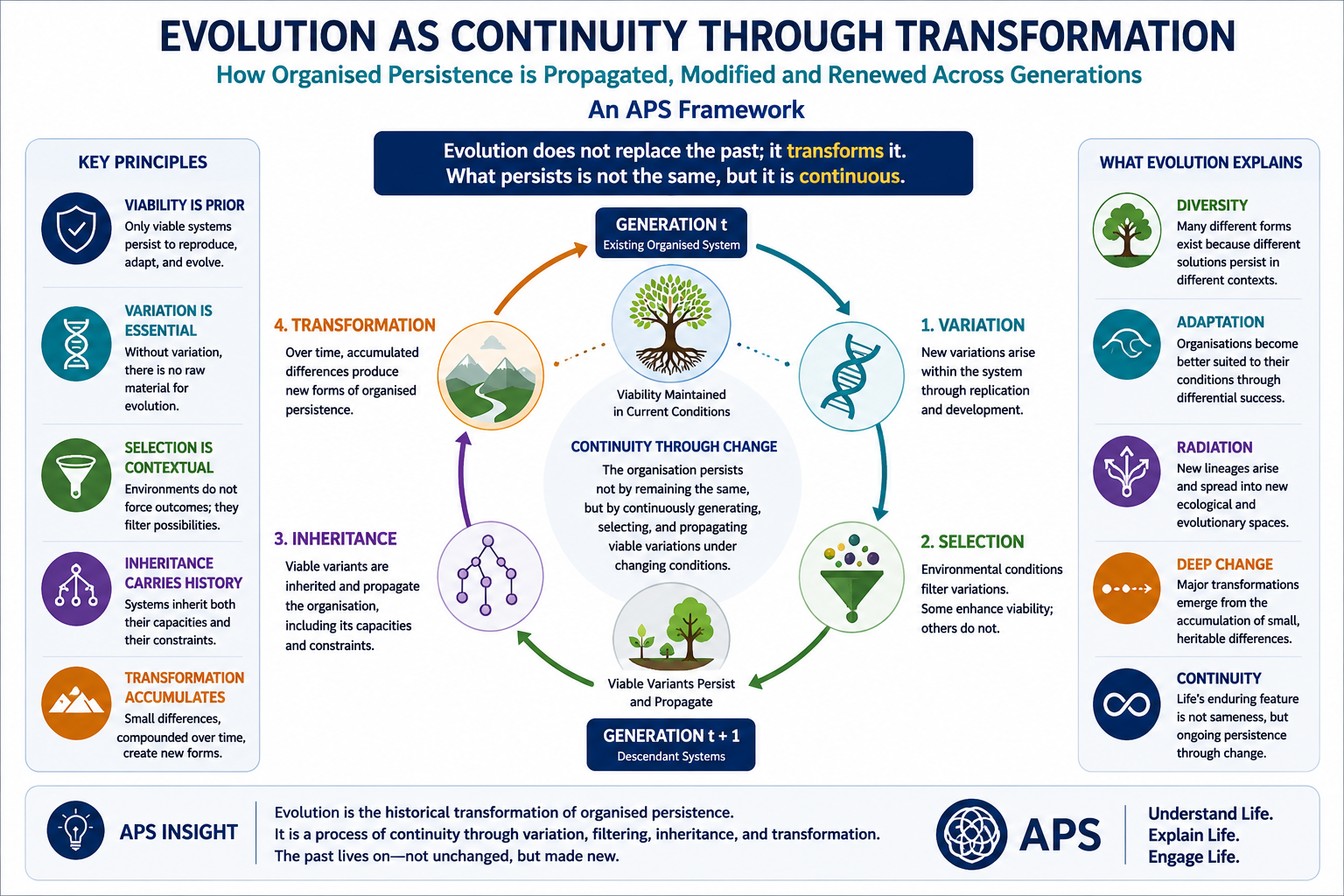
Evolutionary Continuity and Transformation. APS interprets evolution as the historical transformation of organised persistence. Inheritance reproduces continuity, variation introduces organisational differences, adaptation reorganises persistence under changing conditions, and natural selection differentially stabilises forms of continuity through time.
Adaptation as Present-Tense Reorganisation
Adaptation is often described as the outcome of evolutionary history. Traits are considered adaptations because they were historically favoured by natural selection and subsequently retained within populations. APS accepts this historical perspective but argues that it captures only part of the picture.
Living systems must continually adapt in the present. Organisms regulate physiology, alter behaviour, modify patterns of resource use, adjust developmental trajectories, and reorganise interactions with their environments in ways that sustain viability under changing conditions. Adaptation is therefore not merely a historical result but an ongoing biological activity.
APS defines adaptation as the reorganisation of viability-oriented organisation in response to changing conditions. This reorganisation occurs within constraint-closed systems that actively contribute to maintaining the conditions required for their own persistence. Adaptation is thus an expression of biological agency rather than a passive response imposed from outside.
This present-tense dimension of adaptation is essential for understanding evolution. Evolutionary transformation does not occur independently of the adaptive activities of living systems. The capacities through which organisms maintain viability, interact with environments, exploit resources, and respond to ecological challenges influence the trajectories through which lineages persist and change. Adaptation therefore connects immediate viability with long-term evolutionary transformation.
Viewed in this way, adaptation functions as a bridge between physiology and evolution. Physiological adaptation sustains continuity within lifetimes, while evolutionary adaptation contributes to the transformation of lineages across generations. Both involve the reorganisation of persistence under changing conditions.
Inheritance as Continuity of Organisation
Inheritance is traditionally understood as the transmission of genetic information from one generation to the next. APS recognises the central importance of genetic systems while arguing that inheritance must be understood more broadly if evolutionary continuity is to be adequately explained.
What persists across generations is not simply a collection of genes but the capacity to regenerate viable organisation. Every generation must reconstruct a living system capable of development, physiology, ecological interaction, reproduction, and adaptation. Inheritance therefore concerns the reproduction of organised continuity rather than the transmission of a privileged component.
Genes contribute indispensably to this process. They stabilise developmental trajectories, support reliable reproduction, and participate in the maintenance of continuity across generations. Yet genes do not operate independently of developmental systems, physiological organisation, ecological contexts, and the broader organisational structures within which they function. The continuity reproduced through inheritance is consequently organisational rather than merely genetic.
APS therefore defines inheritance as the continuity of viability-oriented organisation across generations. This continuity includes genetic processes but also encompasses developmental organisation, organism–environment relations, ecological interactions, and the constraint structures through which viable organisation is reproduced.
This broader conception of inheritance helps clarify what evolves. Evolutionary continuity is maintained because lineages repeatedly regenerate viable forms of organised persistence. Inheritance provides the continuity upon which variation, adaptation, and natural selection operate. Without inheritance there could be no enduring lineages and therefore no evolutionary transformation.
Natural Selection as a Dependent Process
Natural selection remains one of the most important concepts in evolutionary biology. APS retains its significance while clarifying its explanatory role.
Selection does not create organisation, generate viability, or explain the existence of living systems. It operates only within populations of systems that are already capable of sustaining organised persistence. Selection therefore presupposes the existence of viable organisms, reproducing lineages, and continuity-producing forms of biological organisation.
This point is often obscured because evolutionary discussions frequently begin with variation and selection. APS instead begins with organised persistence. Only after continuity has been established can differences among forms of organisation be compared, stabilised, or differentially reproduced through time.
Selection consequently acts upon differences in the persistence of viable organisation. Organisms vary in their capacities to maintain viability, reproduce continuity, interact successfully with ecological conditions, and sustain persistence under changing circumstances. Natural selection differentially stabilises some of these forms of organisation relative to others.
APS therefore interprets natural selection as a dependent evolutionary process. It contributes to the historical transformation of organised persistence, but it does not generate the continuity upon which that transformation depends. Selection shapes evolutionary trajectories because viable organisation already exists; it is not the source of viability itself.
This reinterpretation does not diminish the importance of natural selection. Rather, it situates selection within a broader explanatory framework in which persistence, inheritance, variation, adaptation, and selection become interconnected components of evolutionary organisation.
What Evolutionary Explanations Explain
The question “What is evolution?” ultimately leads to a deeper question: what do evolutionary explanations explain?
Evolutionary explanations are often described as explanations of change through time. While correct, this formulation remains incomplete. Change alone is not uniquely biological. Rivers change, climates change, and geological systems change. Evolutionary biology is concerned with a more specific phenomenon: the continuity and transformation of living organisation through historical time.
APS therefore interprets evolutionary explanation as the explanation of how forms of organised persistence emerge, reproduce continuity, diversify, stabilise, and transform across generations. Evolutionary explanations do not merely document historical change; they explain how continuity remains possible despite continual transformation.
Inheritance explains how continuity is reproduced. Variation explains how organisational differences arise. Adaptation explains how persistence is reorganised under changing conditions. Natural selection explains how some forms of continuity become differentially stabilised relative to others. Together these processes account for the historical transformation of lineages of organised persistence.
Evolutionary explanation therefore occupies a distinctive place within the broader explanatory architecture of biology. Mechanistic explanations describe how persistence-sustaining organisation is enacted. Functional explanations clarify how activities contribute to viability. Evolutionary explanations explain how forms of organised persistence emerge, diversify, and transform through historical time.
Evolution as the Historical Extension of Biological Agency
APS unifies physiology and evolution by recognising that both concern the organisation of living continuity across time. Physiology explains how organisms maintain viability in the present through regulation, repair, metabolism, development, behaviour, and environmental interaction. Evolution explains how these forms of viability-oriented organisation are reproduced, modified, and transformed across generations.
This relationship becomes clearer when viewed through the concept of biological agency. Agency in APS refers not to consciousness or intention but to the capacity of living systems to contribute to maintaining the conditions required for their own persistence. Organisms actively regulate their interactions with the world, reorganise themselves under changing conditions, and sustain viability despite continual perturbation.
Evolution extends this persistence-sustaining activity across historical time. The adaptive activities of organisms shape ecological interactions, developmental trajectories, reproductive success, and lineage continuity. Evolutionary transformation therefore does not occur independently of biological agency. It emerges through the accumulated consequences of viability-oriented activity distributed across generations.
In this sense, evolution can be understood as the historical extension of biological agency. The processes through which organisms maintain themselves in the present become, over longer temporal horizons, the processes through which lineages persist, diversify, and transform. Evolution is therefore not detached from the organisation of living systems but arises from the historical unfolding of that organisation through time.
From Components to Organisation
Evolutionary theory has often been framed around the causal significance of particular components. Genes, traits, individuals, groups, populations, and species have each been proposed as privileged units of evolutionary explanation. These debates have generated important insights but can also encourage the impression that evolution is ultimately driven by a single kind of biological entity.
APS adopts a different explanatory strategy. Rather than asking which component is fundamentally responsible for evolution, it asks how organised persistence is maintained and transformed across multiple scales of biological organisation.
From this perspective, components derive their biological significance from the roles they play within persistence-sustaining organisation. Genes matter because they contribute to developmental continuity and inheritance. Traits matter because they contribute to viability. Populations matter because they provide the context within which evolutionary processes unfold. Species matter because they identify historically continuous lineages of organised persistence.
No single component explains evolution in isolation. Evolution emerges from the interaction of developmental, physiological, ecological, reproductive, and evolutionary processes operating across multiple scales simultaneously. Causation is therefore distributed throughout organised systems rather than concentrated within privileged parts.
APS consequently replaces component-centred explanation with an organisation-centred explanatory grammar. Evolution is understood not as the consequence of a single causal factor but as the historical transformation of organised persistence unfolding across interacting biological scales.
APS and Mainstream Evolutionary Theory
APS does not reject mainstream evolutionary theory. It accepts the importance of inheritance, variation, adaptation, natural selection, population processes, ecological interaction, developmental influences, and evolutionary diversification. These remain indispensable components of evolutionary explanation.
The distinctive contribution of APS lies elsewhere. Rather than proposing new evolutionary mechanisms, APS seeks to clarify how existing mechanisms relate to a common explanatory target. Evolutionary biology has generated powerful accounts of how living systems change through time. APS asks what it is that these processes collectively transform.
Its answer is organised persistence.
This shift helps illuminate relationships that often remain implicit within evolutionary theory. Inheritance reproduces continuity. Variation introduces organisational differences. Adaptation reorganises persistence under changing conditions. Natural selection differentially stabilises forms of continuity through time. Each process contributes to evolutionary transformation because each operates upon historically continuous forms of living organisation.
APS therefore provides an explanatory framework rather than an alternative evolutionary mechanism. It does not replace evolutionary theory. It clarifies how the diverse explanatory resources of evolutionary biology fit together within a broader account of continuity and transformation across the history of life.
Continue Exploring
- Variation in APS — Where Does Novelty Come From?
- Inheritance and Continuity in APS
- Selection Revisited — What Does Selection Actually Act On?
- Adaptation — How Living Systems Sustain Themselves Through Change
- What Counts as Evolutionary Explanation?
- Physiology and Evolution in APS — Two Temporal Perspectives on Organised Persistence
Conclusion
Evolution is commonly described as biological change through time. APS accepts this description but argues that it leaves an important question unanswered: what is it that changes while remaining sufficiently continuous for evolution to occur?
APS answers that question by identifying organised persistence as the central object of evolutionary explanation. Evolution concerns the continuity and transformation of lineages of organised persistence across generations. Inheritance reproduces continuity, variation introduces organisational differences, adaptation reorganises persistence under changing conditions, and natural selection differentially stabilises forms of continuity through time.
Viewed in this way, evolution is not merely the explanation of change. It is the explanation of how continuity and transformation remain inseparably connected throughout the history of life. Living systems persist not by remaining unchanged but by continuously reproducing and reorganising the conditions required for viability under changing ecological and historical circumstances.
APS therefore interprets evolution as the historical transformation of organised persistence. This perspective preserves the insights of mainstream evolutionary biology while providing a broader explanatory framework within which inheritance, variation, adaptation, natural selection, development, physiology, and ecology can be understood as complementary dimensions of a single evolutionary process.
Key Point
Evolution in APS is the historical transformation of lineages of organised persistence. Evolutionary explanations explain how continuity is reproduced, modified, stabilised, and transformed through time, revealing how living systems maintain continuity through continual change across the history of life.
See Also
Related Articles
References
- (1859). On the Origin of Species. John Murray.
- (2009). Darwinian Populations and Natural Selection. Oxford University Press.
- (1970). The Units of Selection. Annual Review of Ecology and Systematics, 1, 1–18 . https://doi.org/10.1146/annurev.es.01.110170.000245
- (1995). The Major Transitions in Evolution. Oxford University Press.
- (1982). The Growth of Biological Thought: Diversity, Evolution, and Inheritance. Harvard University Press.
- (2015). Biological Autonomy: A Philosophical and Theoretical Enquiry. Springer.
- (2003). Niche Construction: The Neglected Process in Evolution. Princeton University Press.
- (2006). Evolution and the Levels of Selection. Oxford University Press.