What Counts as an Evolutionary Explanation?
This article clarifies what qualifies as an evolutionary explanation within the Agency–Process–Scale (APS) framework. APS argues that evolutionary explanation is directed not merely at statistical change or differential reproductive success, but at the transformation of viability-oriented, persistence-sustaining organisation across generations. Evolutionary explanation therefore requires attention to persistence, adaptation, inheritance, development, variation, ecological interaction, and multiscale organisation. Natural selection remains a major evolutionary process, but it operates within broader organisational conditions that evolutionary explanation must also capture.
Introduction
Evolutionary biology is one of the most successful explanatory frameworks in science. Through concepts such as variation, inheritance, adaptation, and natural selection, it explains how living systems transform across generations and how biological diversity emerges historically.
Evolutionary explanation is often characterised primarily in terms of statistical change, gene-frequency dynamics, differential reproductive success, or shifts in trait distributions within populations. These approaches have yielded powerful explanatory insights, but they can leave insufficiently specified the organisational conditions that make evolutionary change biologically possible in the first place.
APS argues that evolutionary explanation must ultimately be directed toward the transformation of viability-oriented, persistence-sustaining organisation across generations. Evolutionary explanation is therefore not concerned merely with populations, traits, genes, or statistical outcomes considered in isolation. Rather, it seeks to explain how living systems maintain continuity through time while simultaneously undergoing historical transformation.
From this perspective, evolution concerns neither the accumulation of traits nor the changing composition of populations alone. It concerns the ongoing modification of organised persistence. The central question is not simply why certain variants become more common than others, but how lineages of living organisation maintain continuity, generate variation, reorganise adaptively, and transform historically across changing ecological conditions.
This reframing does not reject evolutionary theory or diminish the importance of natural selection. Instead, it situates evolutionary processes within a broader organisational account of living systems and clarifies the explanatory target toward which evolutionary theory is directed.
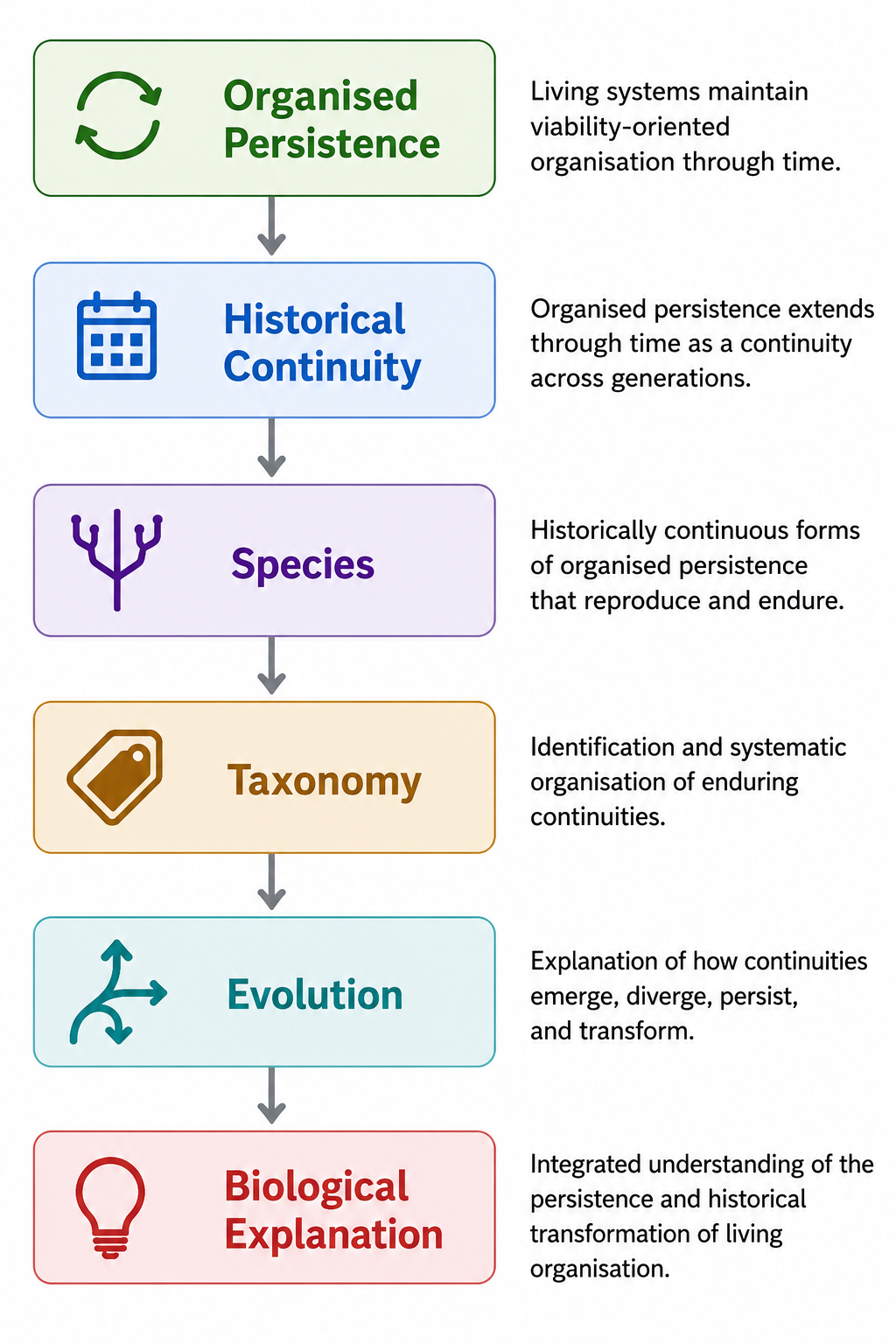
Evolutionary Explanation in APS. APS situates evolutionary explanation within a broader explanatory architecture linking organised persistence, historical continuity, species, taxonomy, and evolutionary explanation. Evolutionary explanation concerns how lineages of organised persistence emerge, persist, diversify, and transform through time.
APS situates evolutionary explanation within a broader explanatory architecture. Mechanistic explanations describe how persistence-sustaining organisation is enacted, functional explanations describe how those activities contribute to viability, and evolutionary explanations explain how forms of organised persistence emerge, diversify, and transform through historical time. Evolutionary explanation therefore addresses one dimension of a larger explanatory framework directed toward organised persistence as the common explanatory target of biology.
Evolutionary Explanation Requires Viable Organisation
All evolutionary explanations presuppose the existence of systems capable of remaining alive long enough to participate in evolutionary processes. Before there can be inheritance, variation, adaptation, or selection, there must already be living organisations capable of maintaining themselves, reproducing developmental continuity, and responding adaptively to changing conditions.
This point is often overlooked because evolutionary theory typically begins with populations of organisms that are already assumed to exist. Yet evolutionary processes cannot operate in the absence of systems capable of sustaining viability. Without such systems there can be no inheritance, no differential persistence, no continuity across generations, and therefore no evolution.
Evolutionary explanation must therefore begin not simply with selection or variation, but with the organisational conditions through which living systems exist as living systems. APS characterises these systems as viability-oriented, constraint-closed organisations whose activities contribute to maintaining the conditions required for their own continued existence. Evolutionary processes operate within this organisational reality rather than generating it from nothing.
The significance of this point extends beyond questions about the origin of life. Even within established evolutionary lineages, inheritance, adaptation, and selection remain dependent upon systems that are already capable of maintaining organised persistence. Evolutionary theory therefore presupposes a biological reality that it does not itself create. The explanatory task is not merely to account for changes in populations through time, but to understand how historically continuous forms of living organisation remain capable of participating in evolutionary processes at all.
Evolutionary Explanation and Persistence
APS defines evolution as the historical transformation of organised persistence across generations. Persistence is therefore not a secondary consequence of evolution but one of its central explanatory concerns.
Living systems are not static entities that occasionally undergo change. They are ongoing organisational processes that continuously regenerate the conditions required for their own continued existence. Evolutionary transformation is possible only because this continuity is maintained. What evolves is not a collection of disconnected traits but an enduring lineage of organised persistence capable of remaining historically continuous while undergoing modification through time.
This perspective shifts the explanatory focus of evolutionary biology. Rather than beginning with traits and asking how they change, APS begins with organised persistence and asks how continuity is maintained while transformation occurs. Evolutionary explanation therefore seeks to account for the mechanisms and processes through which living organisation stabilises, diversifies, reorganises, and accumulates historical change across generations.
The importance of persistence becomes particularly clear when considering inheritance, adaptation, and selection together. Inheritance reproduces continuity, adaptation reorganises that continuity under changing conditions, and selection differentially stabilises some forms of continuity relative to others. Each process contributes to evolutionary transformation, but all presuppose the existence of an ongoing lineage of organised persistence that remains continuous enough for historical change to accumulate.
Adaptation and Evolutionary Explanation
Adaptation and natural selection are often treated as closely related or even interchangeable concepts. APS argues that they refer to different aspects of evolutionary organisation and therefore perform distinct explanatory functions.
Adaptation concerns the active reorganisation of viability-oriented systems under changing conditions. Living systems continually regulate their internal organisation and their interactions with their environments in ways that contribute to maintaining viability. Adaptation therefore belongs to the ongoing activity of living systems themselves and reflects the capacity of organised persistence to remain viable despite continual perturbation.
Natural selection, by contrast, concerns the historical differential stabilisation of some adaptive reorganisations relative to others. Selection does not generate viability, create adaptive organisation, or produce persistence directly. Rather, it explains why certain forms of already viable organisation become historically more persistent than competing alternatives.
This distinction is important because evolutionary explanation must account for more than the differential persistence of variants. It must also explain how viable variants arise, how living systems reorganise themselves adaptively, and how organised persistence is maintained despite continual environmental and developmental change. Adaptation concerns the production and maintenance of viable organisation, whereas selection concerns the long-term historical consequences of that organisation across populations and generations.
Seen in this way, adaptation and selection are complementary rather than competing explanatory concepts. Adaptation explains how living systems remain viable in the present, while selection explains how the consequences of those adaptive activities become distributed through evolutionary time. Selection therefore remains indispensable to evolutionary theory, but it does not exhaust evolutionary explanation. The broader explanatory task is to understand how organised persistence generates, maintains, and transforms the adaptive capacities upon which evolutionary processes ultimately depend.
Evolutionary Explanation and Inheritance
Evolutionary continuity depends upon inheritance, but inheritance cannot be understood solely as the transmission of genes or encoded information. What persists across generations is not a genetic blueprint detached from the living system that carries it, but a developmental organisation capable of regenerating viable forms of life. Evolutionary continuity therefore depends upon the reliable re-establishment of organised persistence from one generation to the next.
This broader perspective reveals why inheritance occupies such a central position within evolutionary explanation. Inheritance reproduces the continuity upon which all other evolutionary processes depend. Variation can modify only what is already continuous, adaptation can reorganise only what already exists, and selection can differentially stabilise only forms of organisation capable of persisting across generations. Evolutionary transformation therefore presupposes inherited continuity rather than replacing it.
Genes participate indispensably in this process, but they do not exhaust it. The inheritance of living organisation involves developmental systems, physiological coordination, ecological relations, behavioural activities, and the wider organisational context within which viable persistence is regenerated. Evolutionary explanation must therefore account for the reproduction of organised continuity itself rather than reducing inheritance to the transmission of informational units alone.
Seen from an APS perspective, inheritance is best understood as the ongoing regeneration of historically continuous forms of living organisation. It is through this continuity that evolutionary change accumulates, lineages persist, and organised persistence becomes capable of historical transformation.
Evolutionary Explanation and Variation
Variation is often treated as the raw material upon which evolutionary processes operate. APS accepts the importance of variation but argues that variation cannot be understood simply as random difference appearing independently of the organisational systems in which it occurs.
Variation emerges within viability-oriented organisation itself. Developmental dynamics, physiological regulation, behavioural activity, ecological interaction, and environmental coupling all contribute to the generation of organisational differences. Although stochastic processes play an important role in evolution, viable variation remains constrained by the conditions required for organised persistence. Not every possible variation can be sustained, and not every organisational change can remain evolutionarily continuous.
This point is crucial because evolutionary explanation seeks to understand not only why some variants persist but also how biologically meaningful variants arise in the first place. Variation is therefore not merely a source of diversity. It is a structured consequence of living systems actively maintaining and reorganising themselves under changing conditions. The possibilities available to evolution emerge from the organisational capacities of living systems themselves.
Variation, inheritance, and adaptation consequently form an integrated explanatory complex. Inheritance reproduces continuity, variation introduces organisational differences within that continuity, and adaptation regulates how those differences contribute to viability. Evolutionary transformation emerges through the interaction of all three rather than through any one of them in isolation.
Development as a Constitutive Evolutionary Process
Development is often presented as a process that implements inherited information, while evolution is treated as a separate process occurring at the population level. APS rejects this separation. Development is not supplementary to evolution but constitutive of evolutionary organisation itself.
Living systems reproduce continuity through developmental processes that generate viable organisation, regulate organism–environment interactions, stabilise physiological coordination, and reorganise activity throughout the life cycle. Every instance of evolutionary continuity therefore depends upon successful developmental organisation. Without development there can be no inheritance, no viable variation, no adaptive reorganisation, and ultimately no persistence of organised life across generations.
This relationship has important implications for evolutionary explanation. Evolutionary change does not occur independently of development and then become expressed through developmental processes. Rather, developmental organisation actively shapes the forms of variation that arise, the ways organisms interact with their environments, and the conditions under which continuity is reproduced. Development therefore participates directly in the production of evolutionary outcomes.
APS consequently treats development as a constitutive dimension of evolutionary organisation rather than as a secondary process operating downstream of genetic transmission. Evolutionary explanation must account not only for historical change across generations but also for the developmental processes through which living continuity is repeatedly regenerated and transformed.
Evolutionary Explanation Across Scale
APS also rejects the idea that evolutionary explanation can be reduced to a single privileged scale of organisation. Evolutionary processes emerge through interactions distributed across multiple scales of persistence, each contributing to the maintenance and transformation of living organisation.
Evolutionary explanations routinely involve genes, cells, tissues, organisms, behaviour, ecological interactions, populations, and environmental modification. These should not be understood as isolated domains arranged within a simple hierarchy. Rather, they represent interconnected dimensions of organised persistence whose activities reciprocally influence one another across time. References to higher and lower levels, or to top-down and bottom-up causation, may provide useful descriptive shorthand, but they should not be interpreted as implying a literal hierarchy of biological causation.
This perspective helps explain why no single scale can exhaust evolutionary explanation. Genes are indispensable participants in evolutionary organisation, yet genes alone do not explain viability, development, adaptation, agency, or persistence. Equally, organismal, ecological, and population-level explanations remain dependent upon processes occurring across other scales of organisation. Evolutionary understanding therefore requires explanatory integration rather than explanatory reduction.
APS accordingly interprets evolution as a multiscale process of historical transformation occurring within interconnected systems of organised persistence. Evolutionary explanation succeeds to the extent that it captures these reciprocal organisational relations rather than privileging any single scale as uniquely explanatory.
Natural Selection Within Evolutionary Explanation
APS fully accepts natural selection as a major evolutionary process. Selection explains how some forms of organised persistence become historically stabilised relative to others and remains indispensable for understanding adaptive evolutionary change.
At the same time, APS rejects the idea that selection alone explains the existence or organisation of life itself. Natural selection presupposes systems already capable of persistence, inheritance, variation, adaptation, development, and biological agency. Without these organisational conditions there would be nothing available for selection to act upon and no continuity through which evolutionary consequences could accumulate.
This observation does not diminish the importance of selection. Rather, it clarifies its explanatory role. Selection explains the differential persistence of viable organisational forms across evolutionary time, but it does not explain the origin of viability itself. The processes that generate, maintain, and reproduce organised persistence remain essential components of evolutionary explanation.
Selection therefore operates within a broader organisational framework. Evolutionary biology cannot be reduced to differential reproductive success, optimisation, or statistical population change alone because these processes presuppose historically continuous forms of living organisation. Understanding evolution requires explaining both the persistence that selection acts upon and the historical consequences that selection helps produce.
Evolutionary Explanation and Biological Agency
APS treats biological agency as a constitutive feature of evolutionary organisation rather than as an optional addition to evolutionary theory. Living systems actively regulate physiology, behaviour, development, reproduction, and environmental interaction relative to the conditions required for continued viability. These activities contribute directly to how organised persistence is maintained and transformed through time.
Agency does not replace natural selection, nor does APS advocate Lamarckian inheritance. The significance of agency lies elsewhere. Evolutionary processes depend upon systems that actively generate, maintain, and reorganise themselves in response to changing circumstances. The historical consequences of these viability-oriented activities become distributed across populations and generations, contributing to patterns of evolutionary change.
Recognising the role of agency helps clarify why evolutionary explanation cannot be restricted to population-level outcomes alone. Differential persistence is only one part of the explanatory story. Evolution also depends upon the activities through which living systems generate variation, maintain continuity, adapt to changing environments, and reproduce viable forms of organisation.
Evolutionary explanation must therefore include the organisation of biological activity itself. Agency is not an alternative to evolutionary theory but part of the organisational reality that makes evolutionary processes possible. Understanding evolution requires understanding how living systems actively participate in the maintenance and transformation of their own persistence.
The APS Explanatory Grammar of Evolution
APS situates evolutionary explanation within the broader explanatory grammar of agency, process, and scale. These are not independent explanatory domains but mutually reinforcing perspectives on the organisation of living systems. Agency concerns the viability-oriented activities through which living systems regulate and maintain themselves. Process concerns the temporally extended dynamics through which continuity is reproduced and transformed. Scale concerns the distribution of these activities and processes across interconnected dimensions of biological organisation.
Evolutionary explanation emerges through the integration of these perspectives. Persistence, adaptation, inheritance, variation, development, ecological interaction, and historical transformation are not separate explanatory topics that can be assembled after the fact. They are interdependent aspects of the same organisational reality. Each contributes to explaining how lineages of living organisation maintain continuity while undergoing historical change.
This integrated perspective helps clarify why no single mechanism can exhaust evolutionary explanation. Natural selection remains indispensable, but selection alone cannot explain the developmental, physiological, ecological, and organisational conditions that make evolutionary change possible. Equally, development, inheritance, or adaptation cannot be understood independently of the historical processes through which their consequences accumulate across generations.
Evolutionary biology therefore explains more than changing populations or shifting trait frequencies. It explains how organised persistence is maintained, diversified, and transformed through the reciprocal interaction of agency, process, and scale. APS does not replace existing evolutionary theory. Rather, it clarifies the broader explanatory architecture within which evolutionary mechanisms acquire their meaning.
Implications for Evolutionary Biology
Reframing evolutionary explanation around organised persistence has several important implications for evolutionary theory. First, it restores continuity as a central explanatory concern. Evolutionary change can occur only because viable forms of organisation persist long enough for historical transformation to accumulate. Continuity is therefore not merely the background against which evolution unfolds but one of the primary phenomena that evolutionary explanation must address.
Second, this perspective clarifies the relationship between viability and selection. Natural selection explains the differential persistence of viable organisational forms, but viability itself is not created by selection. Living systems must already possess the capacity to maintain and reproduce organised persistence before selection can exert evolutionary effects. Evolutionary explanation must therefore account for the organisational conditions that make selection possible rather than attributing all evolutionary organisation to selection alone.
Third, the APS framework integrates development, physiology, ecology, and agency directly into evolutionary explanation. These are not supplementary influences added to an otherwise complete evolutionary theory. They are constitutive dimensions of the organisational processes through which continuity is reproduced, variation is generated, and historical transformation occurs. Evolutionary understanding consequently requires explanatory integration across biological domains rather than explanatory reduction to any single mechanism or scale.
Finally, APS shifts attention away from viewing evolution primarily as a process of trait change and toward understanding evolution as the historical transformation of organised persistence. Traits remain important, but they are understood as manifestations of evolving organisational systems rather than as the primary explanatory target. Evolutionary biology becomes the study of how living organisation maintains continuity while generating the diversity and complexity observed throughout the history of life.
APS therefore does not replace evolutionary biology. It reorganises its explanatory structure around the persistence and transformation of living organisation itself, providing a more explicit account of what evolutionary explanations ultimately explain.
Conclusion
Evolutionary explanation is often presented as the explanation of statistical change, differential reproductive success, or changing trait distributions within populations. APS argues that these phenomena are important because they contribute to a deeper explanatory objective: understanding the historical transformation of viability-oriented, persistence-sustaining organisation across generations.
From this perspective, evolution concerns the continuity and transformation of organised persistence. Inheritance reproduces continuity, variation introduces organisational differences within that continuity, adaptation reorganises living systems in response to changing conditions, development regenerates viable forms of organisation across generations, and natural selection differentially stabilises some forms of organised persistence relative to others. Each process contributes to evolutionary transformation, but none is sufficient in isolation.
Evolutionary explanation therefore requires a broader organisational perspective. It must account not only for the outcomes of evolutionary change but also for the conditions that make such change possible. Living systems are active, viability-oriented organisations whose persistence, development, and adaptive capacities provide the foundation upon which evolutionary processes operate. Selection remains indispensable, yet it acts within a larger organisational reality that evolutionary theory must also explain.
APS situates these relationships within a unified explanatory framework organised through agency, process, and scale. Evolutionary biology consequently becomes more than the study of changing populations or evolving traits. It becomes the study of how lineages of organised persistence maintain continuity, generate diversity, and transform historically across the intertwined developmental, ecological, and evolutionary processes that constitute living systems. In this way, evolutionary explanation is understood not as the explanation of change alone, but as the explanation of continuity through transformation.
See Also
Related Articles
References
- (1859). On the Origin of Species. John Murray.
- (2009). Darwinian Populations and Natural Selection. Oxford University Press.
- (1980). Individuality and Selection. Annual Review of Ecology and Systematics, 11, 311–332 .
- (1970). The Units of Selection. Annual Review of Ecology and Systematics, 1, 1–18 . https://doi.org/10.1146/annurev.es.01.110170.000245
- (1982). The Growth of Biological Thought: Diversity, evolution, and Inheritance. Harvard University Press.
- (2015). Biological Autonomy: A Philosophical and Theoretical Enquiry. Springer.
- (2019). Everything Flows: Towards a Processual Philosophy of Biology. Oxford University Press.
- (2000). The Ontogeny of Information. Duke University Press.
- (2003). Developmental Plasticity and evolution. Oxford University Press.