Inheritance and Continuity in APS
In the Agency–Process–Scale (APS) framework, inheritance is not the transmission of privileged components such as genes, but the continuity of viability-oriented organisation across generations. APS reframes inheritance as the reliable reconstitution of constraint-closed living systems, integrating development, environment, and organisation into a unified account of biological continuity. Inheritance explains how viable organisation is reliably reconstituted across generations, providing the continuity that links organised persistence to fitness, natural selection, and evolutionary transformation.
Key Points
- Inheritance in APS is the continuity of viability-oriented organisation across generations.
- What persists is not a component but a reproducible pattern of persistence-sustaining organisation.
- Genes participate in inheritance but do not constitute it.
- Development is the process through which inherited organisation is reconstituted.
- Organism–environment coupling is part of what is inherited, not external to it.
- Evolution depends on the reliable re-establishment of viable organisation, not merely information transfer.
Inheritance as Organisational Continuity
Within the Evolution domain, inheritance explains the continuity that makes evolutionary transformation possible. If natural selection accounts for the differential persistence of living systems, inheritance explains how viable organisation persists across generations in the first place. In APS, inheritance is therefore understood as the continuity of viability-oriented organisation through time rather than the transmission of privileged biological components.
Inheritance is not the transfer of a substance, code, or informational entity from one generation to the next. It is the reliable reconstitution of a living system capable of sustaining itself as a viability-oriented organisation. Evolution depends upon this continuity because transformation can accumulate only when living organisation is repeatedly re-established across generations. What persists through evolutionary history is therefore not a gene, structure, or molecule considered in isolation, but a pattern of organisation capable of maintaining viability within changing circumstances.
Inheritance stabilises continuity across generations and thereby provides the foundation upon which variation, adaptation, and selection can operate. Without inheritance there could be no cumulative evolutionary transformation because there would be no enduring organisational continuity to transform. Inheritance therefore occupies a central position within the APS continuity architecture. Biological agency sustains viability-oriented activity. Viability enables organised persistence. Inheritance reproduces that persistence across generations, providing the continuity upon which fitness, natural selection, and evolutionary transformation depend. Evolutionary change therefore presupposes inherited continuity before it can become historically differentiated.
Beyond Component Transmission
Traditional accounts of inheritance often focus on the transmission of genetic material. Genes undoubtedly participate in biological continuity, but APS rejects the view that inheritance can be reduced to the transfer of genes or any other privileged component. The central question is not which component is passed on, but how viable organisation is reliably re-established across generations.
Genes do not produce biological continuity independently. Their effects depend upon the organisational contexts in which they are expressed, the developmental processes through which they become biologically effective, and the environmental conditions that support the persistence of living systems. A gene contributes to inheritance only insofar as it participates in a broader network of organisational relations that collectively sustain viability. Biological continuity therefore emerges from the organisation within which genes participate rather than from genes considered in isolation.
This perspective shifts attention away from components and toward organisation itself. Biological continuity does not arise because particular elements are transmitted unchanged through time. Rather, continuity emerges because living systems repeatedly reconstruct patterns of organisation capable of maintaining themselves. Genes are therefore contributors to inheritance rather than its explanatory foundation. Their significance derives from the role they play within an ongoing process of organisational continuity.
APS thus reframes inheritance from a problem of component transmission to a problem of organisational persistence. The fundamental question becomes how living systems reliably regenerate viability-oriented organisation despite continual material turnover, developmental transformation, and environmental change.
Development as Reconstitution
Inheritance becomes biologically effective through development. Development is the process by which inherited organisation is reconstituted as an operational living system. In APS, development is therefore not secondary to inheritance but one of the primary mechanisms through which inheritance is realised.
This understanding differs significantly from accounts that treat development as the execution of a genetic programme. Living systems do not simply unfold pre-specified instructions. Instead, development reconstructs a dynamic, constraint-closed organisation through the coordinated interaction of molecular, cellular, physiological, behavioural, and environmental processes. What emerges is not the implementation of a blueprint but the re-establishment of a viable system.
Development is the point at which continuity becomes active. Through developmental processes, inherited organisational relations are rebuilt and integrated into a functioning whole capable of maintaining itself. Continuity is therefore enacted rather than merely stored. The persistence of a lineage depends not only on what is inherited but also on the successful developmental reconstruction of inherited organisation.
Inheritance and development consequently form a single continuity architecture. Inheritance provides the conditions through which viable organisation can be re-established, while development performs that re-establishment through the coordinated reconstruction of living organisation. Neither process is intelligible in isolation because each depends upon the other for its biological significance. Together they explain how living systems preserve continuity despite continual material and organisational change.
This continuity architecture extends beyond inheritance and development alone. The successful developmental reconstitution of viable organisation contributes directly to the continuity of persistence-sustaining organisation across generations. In this sense, development helps establish the continuity upon which fitness and natural selection subsequently operate.
The Role of Environment in Continuity
APS also rejects the view that inheritance occurs solely within organisms. Living systems inherit within ecological and developmental contexts that contribute directly to the maintenance of continuity across generations. Organism–environment coupling is therefore not external to inheritance but part of the continuity architecture through which viability is sustained.
Every generation develops within environmental conditions that both constrain and support developmental reconstruction. These conditions may include ecological niches, parental modifications of the environment, symbiotic relationships, behavioural traditions, and other stabilising structures that contribute to the reliable re-establishment of viable organisation. Such relations are not passive backgrounds against which inheritance occurs. They actively participate in making continuity possible.
From this perspective, inheritance extends beyond internal biological components to encompass the organised relations through which developmental and ecological continuity are maintained. The persistence of a lineage depends not only on what occurs within organisms but also on the stability of the broader relational systems that support developmental reconstitution.
This broader conception of inheritance aligns naturally with APS’s emphasis on organism–environment coupling. Living systems persist through ongoing interactions with their environments, and these interactions frequently contribute to the continuity of viable organisation across generations. Inheritance therefore concerns the continuation of organisational relations rather than the transmission of isolated biological entities.
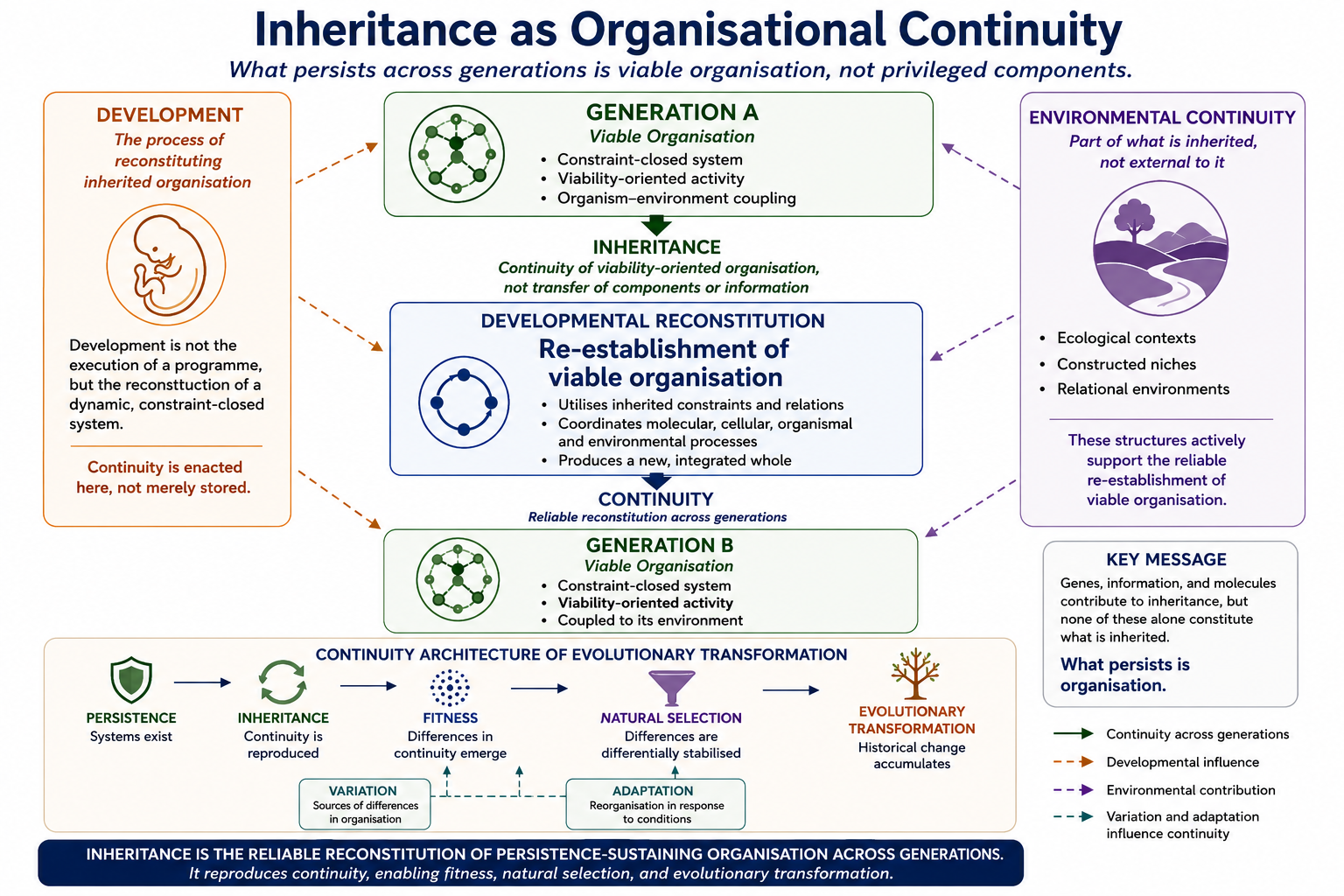
Inheritance as Organisational Continuity. In APS, inheritance is not the transmission of privileged components but the reliable reconstitution of viability-oriented organisation across generations. Development, environmental continuity, and organisational persistence together provide the continuity that makes evolutionary transformation possible.
Reliability Without Replication
Inheritance does not require perfect replication of biological components. Living systems are characterised by continual material turnover, developmental variation, and environmental fluctuation. What must persist is not the exact duplication of parts but the reliable reconstitution of viable organisation.
This reliability emerges through the stability of organisational relations rather than the preservation of identical material structures. Constraint relations, developmental processes, and organism–environment interactions collectively provide sufficient continuity for viability to be maintained despite ongoing change. Living systems can therefore remain recognisably continuous even while the components through which continuity is realised are repeatedly replaced.
Variation enters this process at multiple points because developmental pathways diverge, environmental conditions shift, and novel organisational arrangements emerge over time. Yet continuity persists so long as viable organisation remains capable of re-establishing itself within acceptable bounds. Inheritance therefore preserves continuity without requiring exact repetition, allowing living systems to remain both stable and transformable.Inheritance is therefore compatible with transformation because it operates at the level of organisation rather than exact replication.
This explains a central feature of biological systems. Evolutionary change does not occur despite continuity but through it. The capacity of living systems to preserve organisational coherence while remaining open to variation is precisely what allows evolutionary transformation to unfold over extended periods of time.
Inheritance and Evolutionary Transformation
Inheritance provides the continuity that makes evolution possible. Without the repeated reconstitution of viable organisation, there would be no stable basis upon which variation, adaptation, and selection could operate. Evolution therefore depends upon inheritance not merely as a mechanism of transmission but as the process through which continuity itself is maintained.
Within APS, biological agency sustains viability-oriented activity, viability enables organised persistence, inheritance reproduces that persistence across generations, fitness reflects differences in continuity among inherited forms of organisation, and natural selection differentially stabilises those differences through evolutionary time. Evolutionary transformation emerges from the interaction of these processes rather than from any single process considered in isolation.
Inheritance occupies a particularly important position within the APS continuity architecture because it reproduces the continuity upon which all subsequent evolutionary processes depend. Variation can generate differences, fitness can reflect differences in continuity, and natural selection can differentially stabilise those differences only because viable organisation is repeatedly re-established across generations. Without inheritance there could be no enduring continuity through which evolutionary change might accumulate and therefore no basis upon which differential continuity could emerge. What evolves is consequently not an arbitrary collection of traits or components but an ongoing lineage of organised persistence whose continuity is continually regenerated even as it is modified, differentiated, and transformed through time. persistence extending through time.
APS consequently rejects the view that inheritance merely preserves the past. Inheritance simultaneously conserves continuity and enables transformation. It stabilises the organisational conditions through which novelty can accumulate without destroying viability. The historical transformation of organised persistence therefore depends upon inheritance at every stage. Evolutionary transformation is possible only because continuity is repeatedly regenerated before it is varied, differentially continuous, and selectively stabilised.
From Information to Organisation
Many evolutionary theories describe inheritance primarily in terms of information transfer. APS does not deny the usefulness of informational language, but it rejects the view that information constitutes an independent causal substance capable of explaining continuity on its own.
Information acquires biological significance only within organised systems capable of interpreting, enacting, and sustaining it. Genes, signals, developmental cues, and environmental regularities contribute to continuity because they participate in living organisation. Their significance derives from the role they play within systems that maintain viability rather than from informational properties considered in isolation.
APS therefore reframes informational descriptions as secondary to organisational explanations. Information can be a useful way of describing how continuity is stabilised and reproduced, but it does not replace the organisational processes through which continuity is achieved. Biological inheritance remains fundamentally a problem of organisational persistence rather than informational transmission.
This shift mirrors the broader APS explanatory strategy. Just as agency is understood through viability-oriented organisation rather than mentalistic assumptions, and evolution is understood through organised persistence rather than isolated mechanisms, inheritance is understood through the continuity of living organisation rather than through the transfer of privileged informational entities.
Inheritance therefore links developmental continuity, ecological continuity, and evolutionary continuity within a single organisational process. What persists across generations is not an isolated component but a viable pattern of organisation capable of repeatedly reconstructing itself under changing conditions. The problem of inheritance is therefore ultimately the problem of continuity itself.
Inheritance Within Evolutionary Organisation
Inheritance occupies a central position within the evolutionary continuity architecture developed throughout APS. It explains how viable organisation persists across generations, providing the continuity that allows variation, adaptation, and selection to contribute to long-term evolutionary transformation.
Inheritance therefore occupies a pivotal position within the continuity architecture developed throughout APS. Organised persistence can become historically continuous only if continuity is repeatedly regenerated across generations. Fitness reflects differences in that continuity, while natural selection differentially stabilises those differences. Inheritance provides the continuity that makes both processes possible.
The significance of inheritance therefore lies not in the transmission of particular components but in the reliable reconstitution of living organisation. Genes, developmental processes, ecological relations, and organism–environment interactions all contribute to this continuity, but none alone constitutes what is inherited. What persists is a lineage of viability-oriented organisation capable of repeatedly reconstructing itself despite continual change.
The relationship between inheritance, fitness, and natural selection is particularly important. Inheritance reproduces continuity. Fitness reflects differences in continuity among forms of persistence-sustaining organisation. Natural selection differentially stabilises those differences across evolutionary time. These processes are therefore complementary components of a single evolutionary continuity architecture rather than competing explanations.
Inheritance thus reveals an important principle of evolutionary organisation. Living systems persist historically not because they replicate themselves perfectly, but because they continually regenerate the organisational conditions required for viability. Evolutionary continuity emerges from this ongoing process of reconstitution, linking persistence in the present with transformation across generations and providing the continuity upon which variation, fitness, and natural selection ultimately depend.
Continue Exploring
- The Evolutionary Organisation of Life
- Natural Selection and Organised Persistence
- Adaptation — How Living Systems Sustain Themselves Through Change
- Variation — Where Evolutionary Novelty Comes From
Key Point
Inheritance in APS is the reliable reconstitution of viability-oriented, persistence-sustaining organisation across generations. It reproduces the continuity upon which fitness, natural selection, and evolutionary transformation depend, linking organised persistence in the present to evolutionary continuity through time.
See Also
Related Articles
References
- (1994). Developmental Systems and Evolutionary Explanation. Journal of Philosophy, 91(6), 277–304 .
- (2005). Evolution in Four Dimensions. MIT Press.
- (2023). Determination, Explanation, and Organization. Springer.
- (2018). Everything Flows. Oxford University Press.
- (2001). Cycles of Contingency. MIT Press.
- (2026). Agency as the Defining Activity of Life: A Viability-Oriented Framework Integrating Process and Scale. Biological Theory . https://doi.org/10.1007/s13752-026-00547-6
- (2003). Developmental Plasticity and Evolution. Oxford University Press.